• About

Seeking and Serving

~ seek and serve Christ in all persons

Seeking and Serving

Monthly Archives: November 2021

On Shielding and Sharing Joy…

17 Wednesday Nov 2021

Posted by jandrewsweckerly in reflection

≈ Leave a comment

Tags

complain, compline, God, goodness, grateful, gratitude, imperfection, joy, joyous, perfection, prayer, shield, Thanksgiving

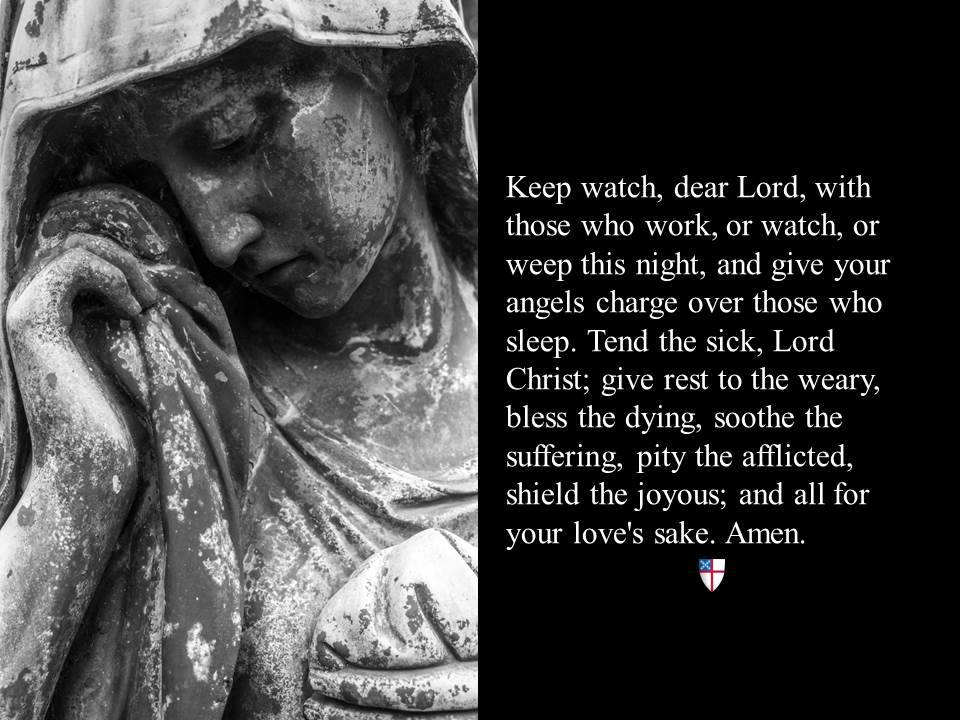
Photo credit: https://www.facebook.com/episcopalian/photos/keep-watch-dear-lord-with-those-who-work-or-watch-or-weep-this-night-and-give-yo/10155444636122925/

This month at Youth Group, before we began our closing prayer, the leader asked us each to name one good thing that had happened in the last week.  Immediately, the brows of each person in the room (adults included) furrowed as we tried to think back about something good in a sea of busyness.  Some of us struggled to remember anything good.  Others immediately burst forth with a fun thing they had gotten to do.  Some shyly shared an accomplishment for which they were proud.  And some were more abstract, like the beauty of the fall foliage.

I was struck by how each one of us in the room had to think quite hard about something good happening in our lives. I do not think we struggled because there is nothing good.  I think we struggled because our brains, or maybe our culture, has wired us to do the opposite – to complain about all the things going wrong, to see only the imperfections in life or in ourselves, to be discouraged by all that could be better in our circles.  A heart of gratitude or joy takes work.  Some of us come by gratitude and joy naturally, but most of us have been enculturated to see where there is want.  That’s why one of our favorite prayers from Compline has a line in its petitions to God for God to “shield the joyous.”[i] 

As we approach Thanksgiving Day next week, I wonder if this year you are still struggling to find the joy.  Maybe you still cannot gather safely with family, maybe you are worried about the safety of the children or the vulnerable in your family, or maybe you are just weary from this time of pandemic.  I suspect many of us are feeling critical of the imperfect and are having a hard time holding on to the perfect(ly good enough). 

My prayer for you this week is that God shields your joy.  But I invite you to consider partnering with God in this endeavor.  Each day until Thanksgiving Day, before you drift off to sleep, think back to one thing for which you grateful, that gave you joy, or was just a good moment.  The goodness does not have to be big or creative.  Start with something basic.  While you engage in this prayerful practice, I will be praying that God shields your joy, and I hope you will share your joy with someone else – so they can be shielded by God too. 


[i] Book of Common Prayer, 134.

Sermon – John 11.32-44, Isaiah 25.6-9, AS, YB, November 7, 2021

17 Wednesday Nov 2021

Posted by jandrewsweckerly in Sermons

≈ Leave a comment

Tags

All Saints Sunday, All Souls Day, death, God, hope, humanity, Jesus, Lazarus, loss, necrology, new life, promise, saint, Sermon, soul, strength, tears, weep

Most Sundays we talk about Jesus’ life and witness and how we can emulate the Son of God.  Many years ago, there was even a campaign with the letters WWJD:  What Would Jesus Do.  But what we rarely talk about is how incredibly hard that ideal is – how hard as everyday humans emulating the Savior, who was both fully human and fully divine, really is.  So, in theory, a day like today should be a relief.  All Saints Sunday is a day we shift gears and talk about emulating people who were fully human.  Of course, that notion is tricky too.  By “saints” the church means those “persons of heroic sanctity, whose deeds were recalled with gratitude by

later generations.”[i]  These are people like St. Francis who shed his every earthly possession and obtained the stigmata, Mother Teresa who nursed this sickest of the sick and poorest of the poor, or even St. Margaret, who slayed her way out of a dragon after being tortured for her faith. 

I think that is why we often conflate All Saints and All Souls Day – the latter being a day when we remember all of those who have died in the hope of the resurrection.  These are the saints or souls who may not have been marked by heroic sanctity, but certainly had an impact on our lives.  These are the moms and dads, the spouses and friends, the children and lovers who may not have always been holy, but certainly taught us about the Christian faith and who we entrusted to the hope of the resurrection as we sat by their deathbeds or mourned their sudden deaths from afar.

We conflate the notion of All Souls Day into All Saints Day because there is something more human about All Souls Day – not only because we can relate to ordinary human life and death, but because the celebration today makes us feel like our humanity can be enough too.  That’s why I love the gospel lesson we get today.  In all the texts about Jesus’ healings, outwitting the challengers, and his ultimate sacrifice for us on the cross, today we get a text about Jesus being very human.  Before the amazing miracle of raising Lazarus from the dead, we are told, very simply, Jesus wept.  Caught up in the grief of his friends Martha and Mary and lost in his own overwhelming sense of loss, Jesus cries; not just a single, artistic tear, but a full-on bout of weeping.  In that solitary moment of grief, Jesus feels deeply, tangibly human.

I do not know about you, but that is what I need from Jesus today.  Later in our service we will list the names of the beautiful souls from Hickory Neck who died in the last year – those who made us laugh, sometimes made us angry, who put a smile on our face, and sometimes made us weep.  In the Prayers of the People, we will pray for the over 750,000 people who have died of COVID in the United States, mourning not just their loss, but the loss of our old “normal” and all that this pandemic has taken from us.  We mourn the ways in which many of the funerals we celebrated in the last year cheated us from each other’s presence – a reality that has still not be fully remedied.  In the midst of what has been a time of significant trauma, we need a Savior who weeps with us – and not just for the dear friend who has died, but also for the fact that his raising Lazarus will soon mean his own death.[ii]

That very gift of Jesus’ humanity today is what empowers us to boldly proclaim hope[iii] in the midst of sorrow, in the midst of trauma, in midst of this strange in-between time.  The words of Isaiah remind us of the promise, the promise that, “the Lord of hosts will make for all peoples a feast of rich food, a feast of well-aged wines, of rich food filled with marrow, of well-aged wines strained clear.  And he will destroy on this mountain the shroud that is cast over all peoples, the sheet that is spread over all nations; he will swallow up death forever.  Then the Lord God will wipe away the tears from all faces, and the disgrace of his people he will take away from all the earth, for the Lord has spoken.  It will be said on that day, Lo, this is our God; we have waited for him, so that he might save us.  This is the Lord for whom we have waited; let us be glad and rejoice in his salvation.”  On this All Saints Sunday, that is our hope for the week – the promise that the Lord God will wipe away tears – because God’s Son has known our tears – and that we will enjoy that rich feast with our loved ones again.  This in-between time is just that – a time in-between where the promise of new life is a rich promise indeed; one that gives us strength for the not-yet time.  Thanks be to God!


[i] Holy Women, Holy Men:  Celebrating the Saints, (New York:  The Church Pension Fund, 2010),664.

[ii] Debie Thomas, “When Jesus Weeps,” October 28, 2018, as found at https://www.journeywithjesus.net/essays/1999-when-jesus-weeps on November 5, 2021.

[iii] Kathryn M. Schifferdecker, “Mourn Loss, Proclaim Faith,” November 1, 2021, as found at https://www.workingpreacher.org/dear-working-preacher/mourn-loss-proclaim-faith on November 5, 2021.

Sermon – Mark 12.28-34, Deuteronomy 6.1-9, P26, YB, October 31, 2021

17 Wednesday Nov 2021

Posted by jandrewsweckerly in Sermons

≈ Leave a comment

Tags

commandments, discomfort, gift, God, grace, Jesus, love, neighbor, perfect, radical, responsive, self, Sermon, shema, silence

In preparation for a mission trip to Honduras, we did a lot of study on the history, politics, and economic development of the country.  Part of that preparation included reading Don’t Be Afraid, Gringo, the story of Honduran woman Eliva Alvarado.  Her story is the story of all campesinos – the poor and oppressed in her country.  Her story is the kind of story that stirs up righteous indignation and makes you want to hop on a plane to go fight for justice.  But in the conclusion of her story, she says to the reader that her ultimate desire is for us to stay where we are.  She does not want her story to inspire us to come there and “fix” things.  Instead, she implores us to fix ourselves – explore our own country’s policies and practices that abet the oppression by the privileged in her country. 

I remember when we got to her conclusion, the team sat in silence for a long time.  You could see the wheels churning in each of our minds – surely, we know what is best, surely we can fix things if we can just get there, surely there is a way around the way this woman has made us feel impotent.  And yet, there was profound truth in her words, and an understanding that to not listen to her final request would be worse than to have not read her words at all.  And so, we sat in pained silence, letting her charge sit uncomfortably with us.

Jesus creates a similar silence at the end of our gospel lesson today.  Jesus has been poked and prodded by one group after another at this point in Mark’s gospel.  In chapter 11, the chief priests, scribes, and elders question Jesus’ authority.  Early in chapter 12, the Pharisees and some Herodians try to trap Jesus with a question.  Finally, some Sadducees question Jesus about a theological issue.  Then today, a scribe asks a “palpably disarming” question – not one to test Jesus, but as one scholar says, an “invitation to the table of theological discourse.”[i]  The conversation today is about the greatest of the commandments. 

Jesus’ response is not new.  In fact, Jesus quotes the shema, the classic text we heard just this morning from Deuteronomy, “Hear, O Israel: The Lord is our God, the Lord alone. You shall love the Lord your God with all your heart, and with all your soul, and with all your might.”  This is a text the Israelites have emblazoned in the minds of their children, and repeated for generations, “Shema Yisrael, Adonai eloheinu, Adonai echad.”  “Hear, O Israel, The Lord is our God, the Lord alone (or the Lord is one).”  Jesus tweaks the answer only slightly from the original shema, adding that we should love the Lord our God with all our mind in addition to all our heart, soul, and strength.  And he adds that we should love our neighbor as ourselves.  But that notion is true to the original commandments as well.  When the scribe agrees with Jesus, saying loving God and neighbor as self is more important than any other ritual of the faith, the crowd falls silent, and we are told “no one dared to ask him any question.”  In other words, “Jesus’ critics were silenced and the effect was momentarily deafening.”[ii] 

So why is the crowd suddenly and dramatically silenced?  What’s the big deal about loving God and neighbor as self?  We talk about these commands all the time.  I mean, Bishop Curry has preached these words more times than I can count.  So why do Jesus’ words shock the room into silence?  One scholar suggests that the silence is so deafening because those gathered understood something about the reality of love that we modern Americans sometimes neglect.  As one scholar explains, “…sometimes — especially in western Christianity — we focus so hard on the emotive and affective aspects of love that we forget its rigor, its robustness, its discomfort.  We assume that loving God and our neighbors means expressing friendly sentiments to God in Sunday worship, and exchanging warm pleasantries with the people who live near us during the week.  We forget that in the scriptures, the call to love is a call to vulnerability, sacrifice, and suffering.  It’s a call to bear a cross and lay down our lives.  Biblical love is not an emotion we feel, it’s a path we travel.  As the children of God, we are called to walk in love. Think aerobic activity, not Hallmark sentiment.”[iii]  An invitation into that kind of radical love – the love of neighbors we would rather not love, the love that is as powerful as the natural, preserving love of self[iv], the love that is a response to the overwhelming love of God for us – that kind of invitation is sobering. 

I remember having read Elvia’s disinvitation to come to Honduras and “fix” things felt like a disempowering, painful rebuffing of love.  But I think I felt that way because we do not get to dictate what love of neighbor looks like.  True love of neighbor is not self-designed but is responsive – responsive to our love of God, and respectfully responsive to the self-articulation of needs by others.  Elvia’s self-articulation was deafeningly silencing the way Jesus’ invitation is too.  As scholar Debie Thomas explains, “Silence is the appropriate first response to the radical love we’re called to.  We dare not speak of [love] glibly.  We dare not cheapen [love] with shallow sentiment or piety.  Rather, [we] ask for the grace to receive [love] as the wise scribe received [love].  In awed and grateful silence.”[v]  Only when we have sat in the uncomfortable silence that recognizes the true love of God and neighbor as self are we ready to take up every perfect gift God has given us and travel the path of love.  Amen.


[i] Cynthia A. Jarvis, “Pastoral Perspective,” Feasting on the Word, Year B, Vol. 4 (Louisville: Westminster John Knox Press, 2009), 262.

[ii] Jarvis, 364.

[iii] Debie Thomas, “Walk in Love,” October 24, 2021, as found at https://www.journeywithjesus.net/lectionary-essays/current-essay?id=2944 on October 29, 2021.

[iv] Victor McCracken, “Theological Perspective,” Feasting on the Word, Year B, Vol. 4 (Louisville: Westminster John Knox Press, 2009), 262.

[v] Thomas.

Recent Posts

  • On the Myth and Magic of Advent…
  • On Risking Failure and Facing Fear…
  • Sermon – Luke 23.33-43, P29, YC, November 23, 2025
  • On Inhabiting Gratitude…
  • Sermon – Luke 20.27-38, P27, YC, November 9, 2025

Archives

  • December 2025
  • November 2025
  • October 2025
  • September 2025
  • August 2025
  • July 2025
  • June 2025
  • March 2025
  • February 2025
  • December 2024
  • November 2024
  • October 2024
  • September 2024
  • August 2024
  • July 2024
  • June 2024
  • May 2024
  • March 2024
  • February 2024
  • January 2024
  • December 2023
  • November 2023
  • October 2023
  • September 2023
  • August 2023
  • July 2023
  • June 2023
  • May 2023
  • March 2023
  • February 2023
  • January 2023
  • December 2022
  • November 2022
  • October 2022
  • June 2022
  • May 2022
  • January 2022
  • December 2021
  • November 2021
  • October 2021
  • September 2021
  • August 2021
  • June 2021
  • May 2021
  • April 2021
  • March 2021
  • February 2021
  • January 2021
  • December 2020
  • November 2020
  • October 2020
  • September 2020
  • August 2020
  • July 2020
  • June 2020
  • May 2020
  • April 2020
  • March 2020
  • February 2020
  • January 2020
  • December 2019
  • November 2019
  • October 2019
  • September 2019
  • August 2019
  • July 2019
  • June 2019
  • May 2019
  • April 2019
  • March 2019
  • February 2019
  • January 2019
  • December 2018
  • November 2018
  • October 2018
  • September 2018
  • August 2018
  • July 2018
  • June 2018
  • May 2018
  • April 2018
  • March 2018
  • February 2018
  • January 2018
  • December 2017
  • November 2017
  • October 2017
  • September 2017
  • August 2017
  • July 2017
  • June 2017
  • May 2017
  • April 2017
  • March 2017
  • February 2017
  • January 2017
  • December 2016
  • November 2016
  • October 2016
  • September 2016
  • August 2016
  • July 2016
  • June 2016
  • May 2016
  • April 2016
  • March 2016
  • February 2016
  • January 2016
  • December 2015
  • November 2015
  • October 2015
  • September 2015
  • August 2015
  • July 2015
  • June 2015
  • May 2015
  • April 2015
  • March 2015
  • February 2015
  • January 2015
  • December 2014
  • November 2014
  • October 2014
  • September 2014
  • August 2014
  • July 2014
  • June 2014
  • April 2014
  • March 2014
  • February 2014
  • January 2014
  • December 2013
  • November 2013
  • October 2013
  • September 2013
  • August 2013
  • July 2013
  • June 2013
  • May 2013
  • April 2013
  • March 2013
  • February 2013
  • January 2013
  • December 2012
  • November 2012
  • October 2012
  • September 2012

Categories

  • reflection
  • Sermons
  • Uncategorized

Meta

  • Create account
  • Log in
  • Entries feed
  • Comments feed
  • WordPress.com

Blog at WordPress.com.

  • Subscribe Subscribed
    • Seeking and Serving
    • Join 394 other subscribers
    • Already have a WordPress.com account? Log in now.
    • Seeking and Serving
    • Subscribe Subscribed
    • Sign up
    • Log in
    • Report this content
    • View site in Reader
    • Manage subscriptions
    • Collapse this bar
 

Loading Comments...