On Peace, Love, and Conduits…

Tags

, , , , , , , , , ,

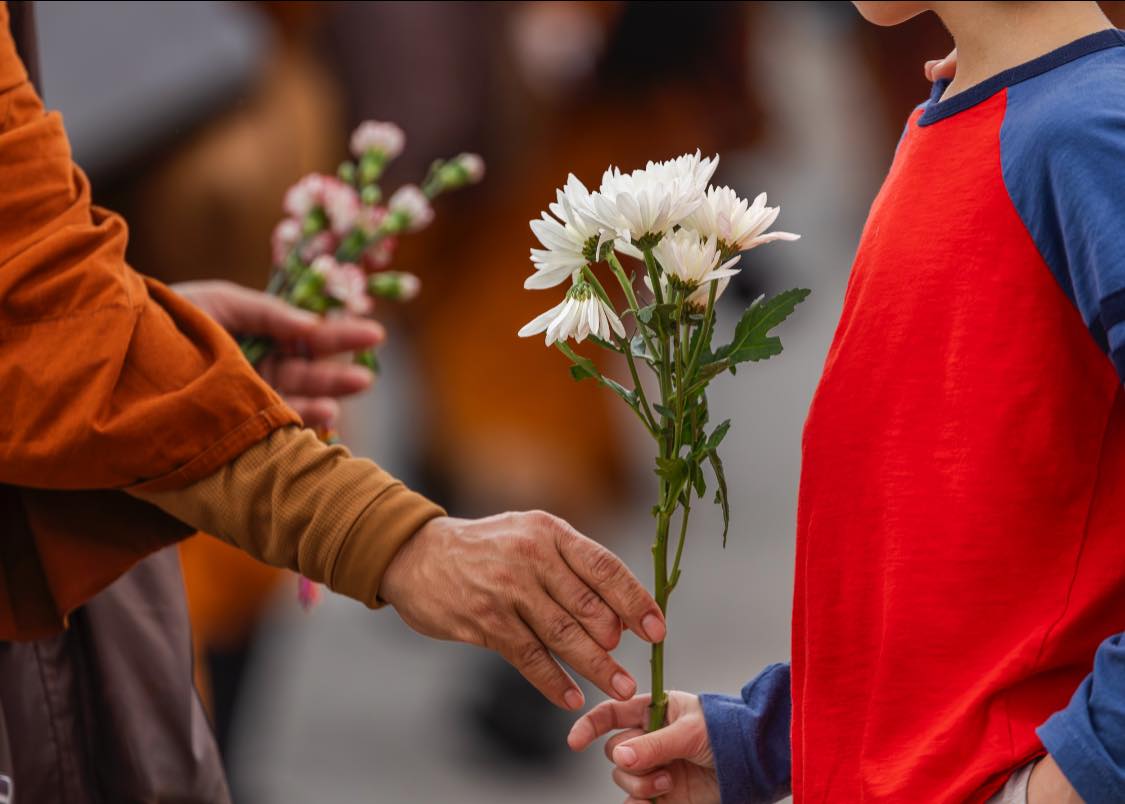
Photo credit: Ken Hicks, as found at https://www.facebook.com/groups/sagingnotaging/posts/25680765434890871/

This past Sunday a parishioner told me about how she had been following the Walk for Peace[i] movement – a 120-day 2,300-mile journey by Buddhist monks walking from Fort Worth, Texas to Washington, DC to raise awareness of peace, loving kindness, and compassion across America and the world.  The parishioner is hoping to see them as they pass a town near us.  I had not heard about the group, and have been fascinated to learn about their journey.  They are not asking for money, do not offer selfies, and ask that no political statements accompany their journey.

Meanwhile, in response to the death of Minneapolis resident Renee Good, the Episcopal Church in Minnesota held an online prayer vigil last night open to the entire country to lament violent immigration enforcement in the Twin Cities area.  Over 3,400 people joined the prayers online, as those gathered offered their fatigue, anger, and heartbrokenness to God.  The bishop in that diocese invited those gathered to “turn the world upside down by mobilizing for love.”[ii]

As I have been thinking about the tumult of theses days and the tensions in our country, I have often felt helpless – as though the division is so deeply embedded and hardening between us that there is little to effect substantive change.  But as I thought about these two groups – simply walking without taking sides, or responding to division with prayer and love – I found myself wondering if I might more intentionally lean into my own faith tradition’s gifts too.

As I was reading about the monks, I saw that the only gift they “allow” in their walk is the gift of flowers.  Later I learned that they receive these flowers as gifts, but then they gift those flowers to people along their walk.  Conceivably, those flowers could be changing hands with people who do not agree on political issues, but who can pass along flowers to one another in gestures of peace. 

This coming Sunday, our church will be honoring Martin Luther King, Jr.’s feast day.  This year, our clergy will be reading excerpts from one of his sermons.  As clergy, we have been amazed at how, decades later, King’s words still resonate powerfully with what feels like problems unique to our generation.  I wonder if his words can be a conduit like those flowers that might pass peace and understanding and grace and love to our community and beyond.  I invite you to consider what conduits might be in your path today, or what conduits you might offer to begin slow, steady change.


[i] https://www.facebook.com/walkforpeaceusa/

[ii] Shireen Korkzan, “Thousands join Episcopal Church vigil to lament violent immigration enforcement actions, unite in pursuing justice,” January 14, 2026, as found at https://episcopalnewsservice.org/2026/01/14/thousands-join-episcopal-church-vigil-to-lament-violent-immigration-enforcement-unite-in-pursuing-justice/

On Pageants, Dread, and Joy…

Tags

, , , , , , , , , , , , , , ,

Photo credit: https://nationaltoday.com/epiphany/

This Sunday was our church’s annual Epiphany Pageant.  Each year, following all the Christmas festivities, when the time comes for the feast of the Epiphany – the arrival of the magi – we insert the pageant into the middle of our Sunday worship service.  I love the pageant each year because it allows us to breathe in the fullness of those twelve days of Christmas.  I love the pageant each year because it allows our families to recover from the whirlwind that can be Christmas with young children before pausing at the manger without the chaos.  I love the pageant each year because we cede the reins of our patterns of worship and ask our children to lead us in a substantive way.  And I love the pageant each year because it is sheer joy – the best gift of the entire Christmas season.

The day after that pageant, my family’s life shifted back into “normal” mode:  the children went off to school after two weeks of rest, the adults went back to work, the household duties of laundry, dishes, and picking up resumed.  This shift is often met with dread.  Two weeks is enough time to have fully relaxed and stepped out of production mode.  For the kids, it is met with resuming responsibilities of classwork and extracurricular requirements.  For the adults, there are all the things we put on hold that now feel overwhelmingly urgent.  The same is true for the household – staring us in the face are all the items we know need tending:  cleaning, the bills, the scheduling, the negotiating. 

This week though, I have been praying through the dread and holding it in tension with the sheer joy that I witnessed on Sunday.  While the weight of all the “stuff” of life is certainly there and mounting, what the joy reminded me of is that I love all the “stuff” of life that makes our life so rich.  I love being in a church community that values and empowers our children and their faith lives.  I love being in a community that reminds me of the significance of ultimate things and the presence of God in the midst of the seeming chaos of life.  I love having a family to journey through life with and watching each member of the family evolve into beautiful versions of their selves.

This week, I wonder how you might tap into the sacred pause of Epiphany.  I wonder what gifts the magi are bringing you this week to remind you of the presence of Jesus in your life.  I wonder how you might acknowledge the joy found in the seeming tidal wave of responsibility that comes after time apart.  I look forward to hearing about your epiphanies this week!

Sermon – Matthew 2.1-12, Isaiah 60.1-6, EPD, YA, January 4, 2026

Tags

, , , , , , , , , , , , , , , , ,

At our 10:00 am service today, we honor the feast of Epiphany with our annual Epiphany Pageant.  Every year I love watching the children and youth bring the Christmas story alive one more time.  Part of what makes the service special is hearing the story with fresh ears – not from a clergy person reading from the aisle like every other Sunday, but with a variety of voices narrating and enlivening the words, making the incarnation story more incarnate.  I love how the pageant keeps us in the Christmas moment one more week, and I love how the story brings all our Christmas characters under one roof, reminding us of the continual unfolding of the mystery of the incarnation.  Though there is something certainly endearing about the whole experience of a pageant, there is also something quite profound in a pageant too.

But what pageants can sometimes do is focus our attention so intently on the manger – on Jesus and his family – that we forget what happens outside the manger is just as important as what happens at the manger.  Even our beloved carol “We Three Kings,” draws us to the experience of the magi’s adoration in Bethlehem, without insight into what happens in Jerusalem.  This year, after hearing of registrations, of humble births, of angel choruses, of everyday shepherds spreading the Gospel, and of cosmic explanations of the incarnation, we turn our attention to Jerusalem.  Isaiah gives us some clue about where our attention is drawn.  “Arise, shine; for your light has come, and the glory of the LORD has risen upon you…Lift up your eyes and look around…”[i] instruction in Isaiah is not for Bethlehem, but the city of Jerusalem[ii] – the city where Jesus’ journey will end, the city for whom Jesus weeps, the city of eventual redemption and salvation.  There, Isaiah foretells of the incarnation, how the people of God are to reflect the light of Christ, and to pay attention to what is happening around them, to God incarnate.

Those words, “lift up your eyes and look around,” have been lingering with me.  Instead of looking deep into the scene at the manger or with the holy family, I am drawn by what is happening in Jerusalem.  Three things happen there.  One, we learn more about the magi.  The testimony of the magi is what most of us associate with Epiphany.  Foreigners set out on a quest, more attuned to the cosmic nature of the incarnation than the people of faith.  Their astrological findings do not simply fascinate them, but inspire action – a long, uncomfortable journey to see the incarnation for themselves.  As profound as their witness is, they cannot complete the journey alone.  They stop in Jerusalem for guidance.  They know they are on the right path; they just cannot quite get to the proper place.  And so, the magi stop and ask for help along the way.  They know something significant has happened, but they need guidance from people of faith to fully realize their journey.[iii]

The magi’s insightful question, “Where is the child who has been born king of the Jews?” is a question that brings in the second action.  The chief priests and scribes, the ultimate insiders of the faithful, those who hold the revelation of scripture and interpret scripture for the people of God, are given news that should be earth shattering.  When asked about the birth of the Messiah, the religious leaders recall what they know of the Messiah:  the Messiah is to be born of Bethlehem and is to shepherd and rule the people of God.  The religious leaders offer the key – the prophecy of scripture about the coming Messiah.  And yet, even though they have this scriptural foundation, they do not react to the news of the magi.  Even though these wise people profess this awaited Messiah has been born, the religious leaders do not drop everything.  They do not even ask to go with the Magi, just to check and see if this story might have something.  They may be versed in scripture, but their inaction shows that even insiders sometimes need outsiders to be faithful.[iv]

Finally, the third thing that happens are the actions of Herod.  Herod is probably the most fascinating to me.  He is wise too, even if he uses his wisdom for his own nefarious purposes.  Herod knows the announcement, even if from an outsider of a new king being born means his own kingship is threatened, and shows how fragile his rule is.[v]  But instead of acting impulsively, he manipulates those around him.  First, he calls in the religious leaders.  You see, Herod is not a Jew – in fact, he is a Roman, serving at the leisure of the kingdom.  But his subjects are Jewish, and so he is wise enough to seek their counsel on what a king, what a Messiah, might look like.  But instead of sending his religious leaders to check things out in Bethlehem, knowing they might discover a true king among them, he secretly sends the foreigners, hoping to manipulate them into doing the work of finding the king, knowing he will get news from them so he can kill this new king.  Herod is only worried about himself and his power, and he will do whatever is needed to maintain that power.

The foreign magi are so unfamiliar with the people of God, they do not initially understand the weight of their question about the new king.  The scribes and religious leaders are so buried in their scripture, and so keen to keep balance with secular power, they do not realize the messianic fulfillment right in front of them.  And Herod is so bent on keeping his power, he does not fully understand the power of God working all around him.  All three of these agents in our story need the words of Isaiah today – all three need to lift up their eyes and look around.

We are not unlike the characters in our story today.  How often are we so mired in our own power – as people of privilege and comfort, as Americans with power more globally, as members and advocates in this community – how often does a word about the movement of God, the promise of change, and the possibility of giving up some of our power to allow that fulfillment, make us just as nefarious as Herod – just as willing to manipulate the world around us?  Or how often have we steeped ourselves in scripture, scouring God’s Holy Word, longing for some sort of guidance or truth, not realizing truth is being spoken through another right to our faces?  Or how often have we been so intent on a mission, so focused on what we sense God calling us to do, we ignore the consequences of our actions, forget the power of our words?

Today’s scripture reading is certainly about the gift of the magi to us – the revelation of the incarnation, the insight of foreigners, and the abundance and homage the incarnation inspires.  But today’s scripture reading is also an invitation to consider our own response to that incarnation in the modern era, considering the ways in which we have not lifted our eyes and looked around.  Taking up Isaiah’s invitation to self-critique is important because there is also a promise in Isaiah.  You see, when we lift our eyes and look around, we acknowledge the narrowness in our lives, or we acknowledge the ways in which we are blind to our own power, or we discover the ways in which we even hide behind our faith, we are then able to see the promise in Isaiah.  Isaiah tells us to look around because glory of the LORD has risen upon us.  Isaiah says in verse five, “Nations shall come to your light, and kings to the brightness of your dawn.”  When we talk about shining our light on this holy hill here at Hickory Neck, this is what we mean.  The gift of the magi to us is not news that is frightening.  When we are not hoarding power or hiding behind our intellect or comfort zones, the news of the magi is news for rejoicing.  And that rejoicing is light that draws nations, and kings, and neighbors, and strangers, and family members, and friends.  The gift of the magi is the invitation to let go of the things that feel under our control, and embrace the thing in no way we control, but in every way brings us grace, love, and abundance.  That is the kind of living that shines light from this hill and brings others to Christ’s light.  That is the light offered to us today in the magi.  That is the kind of good news worthy of pageants and proclamation today.  Amen.


[i] Isaiah 60.1, 4a

[ii] Rolf Jacobson, “Sermon Brainwave #701 – Day of Epiphany,” December 29, 2019, as found at http://www.workingpreacher.org/brainwave.aspx?podcast_id=1216 on December 24, 2025.

[iii] R. Alan Culpepper, “Exegetical Perspective,” Feasting on the Word, Yr. A, Vol. 1 (Louisville:  Westminster John Knox Press, 2010), 217.

[iv] Culpepper, 217.

[v] Stanley Hauerwas, Matthew (Grand Rapids:  Brazos Press, 2006), 38-39.

Sermon – Luke 2.1-20, CE, YA, December 24, 2025

Tags

, , , , , , , , , , , , , , ,

Ten Christmases ago – my very first Christmas at Hickory Neck – we gathered near midnight in the Historic Chapel, mesmerized by the flickering of candlelight and eager to experience our first Christmas together.  It started out as an idyllic night.  And then, right as I began my sermon, a car alarm went off.  Now I am a consummate professional, so I kept going.  But I noticed how, after the alarm kept beeping and beeping, one parishioner at a time snuck out of the church to ensure the beeping was not coming from their car.  I swear that beeping went on for 5 minutes before we found the right clicker to shut the noise down.  Recovering, we moved forward with the service, overcoming other minor hiccups as I figured out how to best celebrate in the beautiful space by candlelight.  And then, right as we proclaimed the dismissal, we heard the blaring roar of fire trucks right outside the church.  We all looked confused as there was not fire in the space where we were worshiping.  We later learned that one of the candles got a little too smokey and the fire station down the hill had been silently alerted.  We were able to send them back to the station, but the night was anything but a Silent Night at Hickory Neck.

I have always found the fact that we sing Silent Night on Christmas Eve to be a humorous contradiction.  Nothing about the night of Jesus’ birth was silent.  His parents entered Bethlehem amidst the chaos of the census, where they finally found space in an inn among the animals.  I do not know how much you have been around animals, but they are not particularly silent – even while sleeping.  Then there is the act of giving birth.  I know Mary is the Blessed Mother, but I do not know of any woman who is silent in childbirth – let alone a newborn who is silent after the trauma of entering the world.  And although the shepherds keeping watch over their flocks by night might have been enjoying some relative quiet, those angels sure are not quiet.  I am pretty sure a multitude of the heavenly host praising God is really loud. 

So, what inspired the author of hymn Silent Night?  Well, we’ve cobbled together a bit about the formation of the hymn.  “Joseph Mohr worked as a country priest serving a small village in present-day Austria.  His father had abandoned the family prior to his birth, and Joseph relied on the encouragement and support of the local church for his education.  He was active in the choir, learned violin and guitar, and went on to seminary and full-time ministry.  While a parish priest, Joseph penned Silent Night and asked his friend, a local schoolmaster, to compose the melody for a Christmas Eve service.”[i]  Varying sources say he wrote the words while walking in the quiet snow-covered town, and that the night of Christmas Eve that year in 1818, the organ had broken, so the organist, Franz Gruber, figured out how to play the tune on the guitar.[ii]  There was something magical about the carol, though, because Joseph Mohr’s hymn spread around the world over time, being translated into over 300 languages.

But perhaps the most famous thing about the song happened almost 100 years later amid brutal trench war in World War I.  On December 24, 1914, “…as Christmas Eve night drew in, British soldiers watched in surprise as German troops began to place makeshift Christmas trees on the ridge of the German trenches.  Soon after enemy soldiers waved to each other and shouted Christmas greetings.  Then a few German soldiers came gingerly over the top of the trenches to retrieve their dead and wounded comrades from the battlefield.  British soldiers followed their example, until ‘No Man’s Land’ was cleared of the dead and dying.  Although the pause in fighting had brought a welcome sense of calm, both sides were still divided.  Then through the cold, starry night a German soldier began to sing ‘Stille Nacht,’ [or Silent Night].  What followed was both sides singing more well- known carols, some sung at the same time in both German and English.  Then soldiers ventured over the top of the trenches again, this time to exchange smiles, show photographs of loved ones, and even play football together.”[iii] 

As I have been thinking about the well-loved, seemingly universally healing and appealing carol of Silent Night, despite the obvious contrast in that actual, quite noisy night and the night described in the carol, I have begun to wonder what we mean by the word “silent.”  I wonder if instead of the absence of noise, we might mean a sense of hyperfocus.  When Mohr composed about that silent night, I wonder if he meant the silence that only comes with profound clarity where the world truly seems to stop as truth is revealed to you.  One can image how time seems to freeze, the distractions of crying children, or noisy uncles, or cranky pets suddenly mute, as profound truth makes sense for us.  On that snowy night in the World War I trenches, the profound truth was in the humanity of the formerly faceless enemy.  On that night in Bethlehem, the profound truth was that a Savior was born – not a generic savior but a savior born “to you,” the text tells the lowly shepherds.  On that night for that parish priest, with a broken organ on the biggest night of the Church year, the profound truth was “…not just a baby in a manger, but love’s pure light, …[where] we too can encounter God’s redeeming grace.”[iv]            

That is the church’s gift to you tonight too.  I cannot take away the noise of children (or adults who act like children), or the noise of anxiety and stress, or even the noise of seemingly unending political strife.  But the church can offer you the silence that comes from the truth of love’s pure light, radiant beams, and God’s redeeming grace.  Even if the noise only momentarily fades into nothing, in that silence the incarnate God whispers to you the only gift you need tonight – love’s pure light, radiant beams, and redeeming grace.  God gifts you with the grounding truth of this night, so that on all the other nights, all the other hours, all the other minutes, you have the silent night to help you brave the noise.  Amen.


[i] David Chavez, “Advent Devotional,” as found at https://www.cslewisinstitute.org/christmas-carol-silent-night/ on December 23, 2025.

[ii] “A Weary World Rejoices.  Silent Night: God’s Inadvertent Ways” St. Luke’s UMC, December 24, 2020, as found at chrome-extension://efaidnbmnnnibpcajpcglclefindmkaj/https://www.stlukesumc.com/GetFile.ashx?guid=f669184e-bb9b-4641-a7a9-e75da96a5d4a on December 23, 2025.

[iii] “Silent Night:  A Reflection,” as found at chrome-extension://efaidnbmnnnibpcajpcglclefindmkaj/https://missio.org.uk/wp-content/uploads/2018/11/Silent-Night-a-reflection-notes.pdf on December 23, 2025.

[iv] Chavez.

Sermon – Matthew 1.18-25, A4, YA, December 21, 2025

Tags

, , , , , , , , , , ,

By the time we get to the fourth Sunday in Advent, most of us are on the Christmas train.  We have bought presents for loved ones, greened our homes and church (although we did hold back on any red to get us through Advent!), we have been singing along with Nat King Cole and Mariah Carey for weeks, and based on the crowd at the grocery store last night, we’ve bought tons of food for the big day.  So, on this fourth Sunday in Advent, when we hear of Jesus’ origin story – although not the fun version from Luke that we’ll hear in few days – most of our eyes glaze over and our ears tune out, thinking “Yeah, yeah, yeah, Joseph was a pretty cool dude to stay with Mary and claim Jesus as his own.”

This year, though, I am especially grateful for some time with Joseph and Matthew’s gospel.  Like many people of faith, I normally resonate more with Mary – I have multiple icons of Mary and Jesus in my office, I love to pray the Hail Mary, and given my gender, I simply relate to the physical experience of Mary more than Joseph.  But on a very practical, everyday level, Mary can seem a little otherworldly – a saint so saintly that she can be hard to emulate.  Instead, I like the earthy, realness of Joseph today.

Joseph had done everything by the books.  He is a righteous man, which means he follows the law to the letter.  Everything is heading in the proper direction, going as planned, according to schedule.  And then he gets the worst possible news.  Mary is pregnant.  Since Mary and Joseph are betrothed, but not yet in the stage of marriage where they have consummated the union, there is no way Joseph is the biological father of the child.  He can only assume Mary has been unfaithful.  Joseph has two options: he can have Mary stoned or he can divorce her.[i]  He is well within his rights to utilize either path, and would not receive criticism by other faithful Jews.  But Joseph is one of those rare treasures who not only knows the letter of the law, but also understands the spirit of the law.  Instead of a brutal, public punishment for Mary, he decides he will divorce her quietly, hoping to help her avoid the full force of cultural judgment.

Joseph makes a well-informed, respectable, and compassionate decision.  He makes his decision and then rests his weary mind and body.  That is when life changes yet again.  God appears to Joseph in a dream, and explains that Joseph’s decision cannot stand.  This child in Mary’s womb is special, and not only is Joseph not to divorce her, he is to legally claim the child as his own by naming the child.  So, what does Joseph do?  He bends even further than he already has, and takes Mary as his wife.

On the one hand, I like that this is a story of an ordinary man listening to and responding to God.  In that way, we hear the gospel lesson sharing a similar message to us today.  You don’t have to be some superstar like Mary, or have some band of angels come with messages, or even journey for months following a star.  You don’t have to be some holier-than-thou Christian, some uber-activist bringing on world peace, or even a sinless follower of God.  You just need to be like this everyday Joe – a Joseph who is willing to pay attention and to say a quiet yes – even if saying yes feels scary or scandalous.

Yes, on the one hand, I like that this is story of an ordinary man listing to and responding to God.  On the other hand, I like that Matthew’s gospel tells us that Joseph is not actually some ordinary man – some everyday Joe.  You see, Joseph is a direct descendent of not only Abraham, but also King David.  If we had read the 17 verses before the passage we read today, we would have gotten the genealogy of names that lead to Jesus – those hard names that every lector dreads reading.  But those names tell us so much.  Matthew, “…mentions Abraham – the patriarch who abandoned his son, Ishmael, and twice endangered his wife’s safety in order to save his own skin.  He mentions Jacob, the trickster usurper who humiliated his older brother.  He mentions David, who slept with another man’s wife and then ordered that man’s murder to protect his own reputation.  He mentions Tamar, who pretended to be a sex worker, and Rahab, who was one.  These are just a few representative samples.”  Scholar Debie Thomas asks, “Notice anything?  Anything like messiness?  Complication?  Scandal?  Sin?  How interesting that God, who could have chosen any genealogy for his Son, chose a long line of brokenness, imperfection, dishonor, and scandal.  The perfect backdrop, I suppose, for his beautiful works of restoration, healing, hope, and second chances.”[ii]

I like that Joseph is not just an ordinary man saying yes.  I like that Joeseph is a specific, special man, even if that specialness does not come from something he did.  In that way, Joseph is like every person in this room.  Like Joseph, your life is probably messy too.  You probably have misbehaving people in your family tree, that ancestor that people only talk about in embarrassed whispers, or that relative you do not want to introduce to anyone else for fear of guilt by association.  If God can use Joseph in all his messiness, specificity, and ordinariness, then you better believe God is likely inviting you, in your ordinary, messy, specificity into some scary, world-changing stuff too.  No wonder that the angel Gabriel’s first words to Joseph were, “Do not be afraid!”

I know you were hoping to hop onto the Christmas train and skip over this fourth Sunday in Advent.  But maybe this year isn’t supposed to be about some idyllic, picturesque Christmas.  As Debie Thomas says, “If we want to enter into God’s messy story, then perhaps [“Be not afraid” are] words we need to hear, too.  Do not be afraid.  Do not be afraid when God’s work in your life looks alarmingly different than you thought [God’s work] would.  Do not be afraid when God upends your cherished assumptions about righteousness.  Do not be afraid when God asks you to stand alongside the scandalous, the defiled, the suspected, and the shamed.  Do not be afraid when God asks you to love something or someone more than your own spotless reputation.  Do not be afraid of the precarious, the fragile, the vulnerable, the impossible.  Do not be afraid [to notice and embrace the] mess [of Christmas this year].  The mess is the place where God is born.”[iii]  Amen.           


[i] David Lose, “Matthew’s Version of the Incarnation,” December 17, 2013, as found at https://www.workingpreacher.org/dear-working-preacher/matthews-version-of-the-incarnation on December 20, 2025.

[ii] Debie Thomas, “Into the Mess,” December 15, 2019, as found at https://journeywithjesus.net/essays/2484-into-the-mess on December 20, 2025.

[iii] Thomas.

Sermon – Matthew 11.2-11, A3, YA, December 14, 2025

Tags

, , , , , , , , , , , ,

“Are you the one who is to come, or are we to wait for another?”  John the Baptizer’s words have been haunting me all week.  This year, John’s question hits a little too close to home.  As the safety of people of color has been threatened – whether they are legally or illegally here; as the hard-earned rights of women and those in the LGBTQ+ community are being second-guessed; as the decency of and respect for every human being feels lost as a shared core value, I too find myself asking, “Are you the one who is to come, Jesus, or are we to wait for another?”  Where is God in the unraveling of our nation and her communities.[i]

On this third Sunday in Advent – on this Gaudete Sunday, or Rose Sunday, or Joy Sunday – we find no joy in John the Baptizer’s experience.  “…Imprisoned for speaking the hard truth to Herod, John is in chains and in crisis, wondering if he has staked his life on the wrong promise and the wrong person.  The Messiah, as far as John can tell, has changed nothing.  He was supposed to make the world new.  He was supposed to bring justice, fairness, and order to human institutions, such that a tyrant like Herod would no longer sit on the throne, and a righteous man like John would no longer languish in a rat-infested prison.  Jesus was supposed to finish the costly work John started so boldly in the wilderness — to wield the axe, bring the fire, renew the world.”[ii]  And yet, nothing – nothing at all – has worked out as John had imagined from this supposed Messiah. 

So how does Jesus answer John’s question?  Well, before we go to Jesus’ words in Matthew, we first heard from Isaiah today.  You see, John is not the first person of faith to find himself floundering in despair and uncertainty.  The prophet Isaiah’s words were consumed by and encouraging to a people in exile – a people who had lost everything and knew not whether they would ever return to their gifted home.  To those despondent people, God instructs the prophet Isaiah, saying, “Say to those who are of a fearful heart, ‘Be strong, do not fear!  Here is your God.’”[iii]  Be strong.  Do not fear.  Here is your God.

Now you might be thinking, “No offense, Jennifer, but I have been trying for most of this year to be strong and not to fear.  And quite frankly, I’m not seeing much of God these days.”  You might be feeling like the last year is not so very different from that cold, dank prison cell where John sat – after, let’s be honest, living an exemplary life for God.  If a guy who leaps in the womb at the pregnancy of Mary with Jesus, who preaches in the wilderness with minimal resources and rustic living, who baptizes the Messiah himself – if that guy is sitting bewildered about God’s presence in Jesus in the world, how are we supposed to be strong – to not fear – to know that our God is here?

Well, fortunately, Jesus does answer John the Baptizer.  Jesus tells the disciples of John to, “Go and tell John what you hear and see: the blind receive their sight, the lame walk, the lepers are cleansed, the deaf hear, the dead are raised, and the poor have good news brought to them.  And blessed is anyone who takes no offense at me.”[iv]  In other words, scholar Debbie Thomas explains, “Jesus says: go back to John and tell him your stories.  Tell him my stories.  Tell him what your eyes have seen and your ears have heard.  Tell him what only the stories — quiet as they are, scattered as they are, questionable as they are — will reveal.  Why?  Because who I am is not a pronouncement.  Not a sermon, a slogan, or a billboard.  Who I am is far more elusive, mysterious, and Other than you have yet imagined.  Who I am will emerge in the lives of ordinary people all around you — but only if you’ll consent to see and hear.”[v] 

Thomas goes on to say, “But this story is not ‘okay,’ and many of our own stories aren’t okay either.  The prison bars that hold us don’t always give way.  Our doubts don’t always resolve themselves.  Justice doesn’t always arrive in time.  Questions don’t always receive the answers we hunger for.  Jesus calls us to see and hear all the stories of the kingdom — and that includes John’s story, too.  ‘Blessed is anyone who takes no offense at me,’ Jesus says.  Offense runs away.  Offense quits.  Offense erects a wall and hides behind [the wall] because reality is harsher and more complicated than we expected [reality] would be.  Yes, some stories are terrible, period.  They break hearts and end badly.  People flail and people die, and this, too, is what the life of faith looks like.  Don’t take offense.  Don’t flee.”

Now, I don’t know if you know this, and you may be wondering why we get this part of John’s story today, but John the Baptizer is actually the patron saint of joy.  He was in Elizabeth’s womb and leapt for joy at the incarnation of Jesus inside Mary’s womb.  According to John’s gospel, when John the Baptizer knew his work was complete and that Jesus the Messiah’s work was beginning, he said, “My joy is now complete.”  So how do can we be strong, not fear, and trust that God is here?  How can we see and hear Jesus’ stories and embrace joy?

Debie Thomas argues about this, “Maybe John understood something hard and flinty about joy.  Joy in a prison cell isn’t about sentimentality.  Or happiness.  Or the pious suppression of our own most painful crises and questions.  Maybe he understood that joy is what happens when we dare to believe that our Messiah disillusions us for nothing less than our salvation, stripping away every lofty expectation we cling to, so that we can know God for who [God] truly is.  Maybe [John] realized that God’s work is bigger than the difficult circumstances of his own life, calling John to a selfless joy for the liberation of others.  Maybe John’s joy was otherworldly in the most literal sense, because he understood that our stories extend beyond death, and find completion only in the presence of God himself.  ‘Are you the one who is coming?’ John asked in despair.  ‘You decide,’ Jesus [answers] in love.”[vi]

Nothing we say or do today will whitewash the messiness of these days.  No amount of pink or talking or singing about joy is going to transform your heart into joy.  What Isaiah and Jesus are saying is that joy can be found though.  There are stories and examples of goodness all around you for you to see and hear.  Our invitation this week is look and listen – to each other, to our neighbors, to strangers and friend alike.  God is around us in the darkness, breaking through with joy.  Be strong.  Do not fear.  God is here.  God is here in you, and me, in the stranger, in the other.  Our work is to look and listen.  Amen.


[i] Karri Alldredge, “Commentary on Matthew 11:2-11,” December 14, 2025, as found at https://www.workingpreacher.org/commentaries/revised-common-lectionary/third-sunday-of-advent/commentary-on-matthew-112-11-7 on December 12, 2025.

[ii] Debie Thomas, “Are You the One?” December 4, 2016 as found at https://journeywithjesus.net/essays/1201-are-you-the-one on December 12, 2025.

[iii] Isaiah 35.4a.

[iv] Matthew 11.4-6.

[v] Thomas.

[vi] Thomas.

On the Myth and Magic of Advent…

Tags

, , , , , , , , , , , , ,

Photo credit: https://christchurchofaustin.org/announcement2/

As a pastor, I am constantly preaching about savoring the quiet anticipation of Advent.  We even offer Advent Lessons and Carols, which has a more contemplative note than its celebratory sibling, Christmas Lessons and Carols.  But in everyday life, I am just as vulnerable as anyone else to the secular chaos in which Advent lives.  I find myself running kids around to obligations and performances, juggling calendar conflicts with all the special holiday offerings, and even add commitments myself because I want to maintain annual traditions.  Nothing about life outside of church feels quiet and centered.

I think is why I was so grateful for the gift of a minimally scheduled Saturday this past weekend.  Both professionally and personally the calendar was mostly clear – I even reserved the TV for watching a basketball game which I rarely can do.  As my daughter and I settled in, she proposed doing a puzzle together – an activity we always say we’ll do but somehow never get around to doing.  And so evolved an afternoon of sports watching, puzzle assembling, and the kind of conversation that can only happen when you make unstructured space for it.  When I got to close of the day, I realized that while a part of me felt guilty for not being particularly “productive” (no catching up on work, no doing household chores, no addressing Christmas cards), I marveled at how spiritually and emotionally productive the day felt with my daughter.

I know finding even moments of quiet anticipation in Advent can feel impossible these days.  There are so many things vying for our attention – many of them quite good and important.  But I wonder if you might be able to carve out some unscheduled time in these weeks left of Advent.  They may have to be in the car on your way to something, or while walking on the treadmill, or saying goodnight to the children.  Maybe it means making your way to church even if you have other invitations. Whenever you can find that sacred space, I promise the life and love of Christ is waiting for you in the stillness.  God is already there.  You are invited to say hello.

On Risking Failure and Facing Fear…

Tags

, , , , , , , , , , , , , ,

Photo credit: https://stock.adobe.com/search?k=parachute+jump+plane

I was listening to a podcast this week that was talking about how, as they mature, adults have a harder time trying new things because they have a deeper understanding, and perhaps fear of, failure.  Children don’t have this same hesitancy.  They try new things, figure out what works and what doesn’t, and keep at it.  There is a freedom in their development that allows them not to hold back or be afraid, but to keep trying out new experiences and challenges.

As one of my daughters ages, she is heading into that in-between time where she doesn’t have the same innocent willingness to try and fail, and is starting to understand that failures or inadequacies are sometimes noticed by others negatively.  She is trying out a new extracurricular this fall, and hated the first session.  As we headed into the second session, she pulled out all the stops about why she shouldn’t have to go back:  she wasn’t good enough, people weren’t nice, she would bring down the group through her inexperience.  In a moment of weakness, I almost caved.  I know how big those feelings are.  I palpably remember the anxiety that kind of experience brings, and I wanted to protect her from that hurt. 

When she came out of the second practice, she was a different person.  She was smiling, had a lightness to her step, and a warmth about her.  “That was fun!” she said.  As I listened to her describe the session, I was overwhelmed with two realizations.  First, I realized how close I came to cutting off a growth experience – how she would have never had learned the feeling of what it means to push through fear and find joy.  And second, I realized I needed to take a long look at where I am cutting off growth experiences in my own life.  Masked with the label, “wisdom,” how often do I fail to risk?

I wonder what growth opportunities are being presented to you today.  It doesn’t have to be something big or dramatically different.  Part of creating an openness to growth means being open to the little invitations – talking to a stranger when that’s not something you would normally do, reaching out for support when you don’t like feeling dependent upon someone, saying yes to an invitation to something that is not at all in your comfort zone but you admittedly have never tried to know for sure.  Those yeses prepare us for the yeses the Holy Spirit desires in each of our lives.  Those invitations are often God’s quiet invitations into God’s joy.  Those experiences are often pathways to the incarnate Jesus in your life.  I can’t wait to hear what you say yes to this week!

Sermon – Luke 23.33-43, P29, YC, November 23, 2025

Tags

, , , , , , , , , , , ,

Today I have a confession.  I am tired.  After watching the debacle of the longest ever government shutdown, only to jump into the next political scandal, struggling to understand how vastly different the kingdom of God is from the kingdom of man, I find myself not emboldened, but just tired.  Now, as person of faith, I am always looking for hope.  In fact, even this week, your Vestry and I spent time taking a step back and looking at all the goodness happening in this place – the signs of vitality and vibrancy, the things that are bringing us joy, moments and ministries that are giving us life.  But I confess, even with all that energy and goodness to celebrate, one look back out into the world, and my spirit is dampened and I am just…tired.

As I turned to our gospel lesson for today, I was hoping for some bit of encouragement – some promise that everything would be okay.  Knowing today is Christ the King Sunday, the last Sunday in the liturgical year whose text should bring into focus the point of a year of journeying with Christ, I had hoped that there would be some sort of rallying text that would invigorate me and shake me out of my exhaustion.  But instead, on this day when we honor Christ our King, what is the image we are given?  A beaten, humiliated, ridiculed, discredited, shameful shell of a man, hanging on a cross, defeated in approaching death.  We do not get Christ risen from the grave today – the ultimate Easter message.  No, today we get Good Friday – our hoped-for Messiah, seemingly defeated on the cross.  Of course, he dies with great dignity, forgiving sinners until the very end, welcoming the repentant even on their last breath, resisting every urge strike back or at least refute the charges against him.  He dies with dignity, but he dies nonetheless.

I have often thought it is strange how the cross, and not the empty tomb is our primary Christian symbol.  That we use an instrument of death as our sign for victory is rather odd.  But today we do not just honor Christ’s death on the cross; we honor how he died on the cross.  Even in death Christ our King managed to love his neighbor – even the really bad neighbors.  Even in death, Christ managed to love God – inviting God to forgive even the most hateful behavior.  Even on the cross, Jesus never loses his focus.  Jesus never gets tired.

Just like the kingdom of God is different, so is the king of God.  The people of God never really had a king until they reached the Promised Land.  They saw the neighboring countries with their armies and their admirable kings, and they wanted one for themselves.  That was their first mistake.  God granted them a king to rule over them, but inevitably, the kings, like any humans, were flawed – some more than others.  Hence, there are four books in the Hebrew Scriptures about the kings who ruled and the judges who tried to correct their behavior.  Most of the kings were corrupted by power, money, and greed.  Many abused the people.  Even the most revered king, King David, was a bit of a mess.  But Jesus is not like foreign kings or the kings of Israel.  Jesus’ kingship is different.  He loves the poor and cares for the sick, he sees through the pretenses of the temple and calls for authenticity, he loves deeply and forgives infinitely.[i]  And he never tires of being this kind of king.

For most of us, looking to Jesus as an example of how to rally out of our fatigue and weariness may feel overwhelming to our tired selves.  Instead, I found looking at the repentant thief to be helpful.  You see, the thief was probably tired too.  Anyone who is a thief has been hustling long before he gets caught.  He may have even been caught several times before for more minor offenses.  His arrest this time is different.  There will be no escape.  He will hang on that cross until he dies.  With the cruelty of the cross, and the pain of his body, also shining forth is an overwhelming sense of fatigue.  He too is tired.  Tired of running, tired of hustling, tired of the life that leads one to become a thief.  But even in his deep fatigue, he does something extraordinary.  When the other thief taunts Jesus, the repentant thief lets the other thief have it.  Hanging in agony, he looks outside himself, and refuses to stand for the hypocrisy of the other thief.  He decries the injustice of Jesus’ sentence, he wisely points out his own, as well as the other’s, culpability in sin, and then, without shame looks right at Jesus and asks Jesus to remember him.

Even at our most weary, tired states, when we feel like there is no hope, or when death feels ever present, Jesus invites us to keep shining our light for all to see.[ii]  Our gospel this week has people doing just that:  taking their world of hurt, pain, sadness, sorrow, defeat, seeming hopelessness, and turning toward the light.[iii]  The thief, hanging in humiliation and death, finds his light.  Jesus, defeated in the eyes of all but the thief today, keeps shining his light until the bitter end.  And Hickory Neck has them too.  Our children last Sunday and our psalm this Sunday that tell us to “Be still and know that I am God.”[iv]  Our parishioners delivering food before thanksgiving and shopping for the forgotten for Christmas.  Our members making stretch gifts to support the work of the kingdom here. 

Christ our King invites us to do likewise.  Of all people, Jesus understood being tired.  His cry out to God in prayer in the Garden of Gethsemane is a prayer of a tired man.  But Jesus stood up that night, all the way to the cross on Calvary and refused to let fatigue be an excuse for a world without love, hope, and forgiveness.  Our king may not look like other kings.  His story may be strange and full of contradictions.  But our king has the power to pull you out of darkness and drag you into the light.  But along the way, he is going to need you to shine your light too.  Amen.


[i] David Lose, “Christ the King C:  What Kind of King Do You Want?” November 14, 2016, as found at http://www.davidlose.net/2016/11/christ-the-king-c-what-kind-of-king-do-you-want/ on November 21, 2025.

[ii] Karoline Lewis, “Who and What is Your King?” November 13, 2016, as found at http://www.workingpreacher.org/craft.aspx?post=4754 on November 21, 2025.

[iii] Patrick J. Willson, “Homiletical Perspective,” Feasting on the Word, Yr. C, Vol. 4 (Louisville: Westminster John Knox Press, 2010), 337.

[iv] Psalm 46.10a.

On Inhabiting Gratitude…

Tags

, , , , , , , ,

Photo credit: https://www.southernliving.com/culture/what-to-write-in-thank-you-card

November is regularly a month when I talk about gratitude with my parish.  Most of that push comes from the confluence of things that happen in November.  We are almost always closing up our stewardship season in November – a season when we encourage parishioners to let their giving reflect their gratitude toward God.  We are also preparing for the Thanksgiving holiday – which although a secular holiday comes pretty close to being a sacred time of thanksgiving and praise.  And just yesterday we took the day to thank Veterans, honoring the sacrifices their vocations require and the blessings we enjoy because of their work.

This year, to help cultivate my own sense of gratitude, I picked up a calendar one of my favorite non-profits produced call “30 Days of Gratitude.”  Though some of the “activities” are to think about something I am grateful for, like a good memory in my home, most of the “activities” are more hands-on – like expressing gratitude to every member of the household or greeting a neighbor.  What I have loved about the calendar is the shift the calendar has created. 

Often when we talk about gratitude, we feel burdened – like we’re supposed to force ourselves into an emotion.  But what the calendar has done is make gratitude tangible – to act on my gratitude.  What’s beautiful about that shift is that the action is something I can do that has the unintended consequence of feeling gratitude instead of trying to manufacture gratitude out of thin air.  The calendar has made gratitude incarnate – allowed me to inhabit gratitude instead of simply emoting gratitude.  It’s a subtle change, but one that feels much more freeing.

I wonder how you are navigating gratitude during this season.  What are the barriers to you inhabiting gratitude?  What burdens are clouding your gratitude practices, making you more cranky than grateful?  Gratitude is not easy.  If it were, folks wouldn’t be producing gratitude calendars and journals.  I invite you to find the tool, the person, or the community who can help make your gratitude incarnate.