• About

Seeking and Serving

~ seek and serve Christ in all persons

Seeking and Serving

Tag Archives: faith

Sermon – Acts 2.42-47, E4, YA, April 26, 2026

29 Wednesday Apr 2026

Posted by jandrewsweckerly in Sermons

≈ Leave a comment

Tags

abundance, care, Christian, church, cohousing, community, disconnected, faith, God, Holy Spirit, Jesus, possessions, Sermon, social, stewardship, transform, worth

“The meltdown started with a small thing — a bag of [lollipops].  Rachel Damgen’s four-year-old son wanted one.  She said no.  It was a few years ago, in the middle of the pandemic, when it was not unusual for her to be home alone for an 11-hour stretch with her two young kids. She was struggling with the isolation.  Small obstacles felt outsized…”  That meltdown, where she too ended up crying on the floor, “…was a turning point.  With their extended families far away in other states, she and her husband, Chris Damgen, began asking themselves if there was any way to reconfigure their lives in order to optimize for more support and community.  The answer they found was cohousing.”[i]

According to research, “The cohousing movement started in Denmark in the late 1960’s.  Today [cohousing is] an international movement.”  In the United States there are almost 200 cohousing communities across 36 states.  “Cohousing participants commit themselves to live intentionally in community.  Families live in private housing, but share public spaces, responsibilities, meals, resources, activities, and events.  Shared care for children and the elderly is often part of the mix.  Neighbors collaborate to plan and manage their communities.  Decisions often require consensus.  Cohousing is one response to the lack of social equity that the political scientist Robert Putnam of Harvard documented in his book Bowling Alone: The Collapse and Revival of American Community (2000).  Putnam showed how many people today feel disconnected and isolated.  We’ve accumulated what he called a growing ‘social-capital deficit’ that leaves people in our culture longing for a ‘more collectively caring community.’”[ii]

That same collectively caring community is what Luke describes in the lesson from the Acts of the Apostles today.  The scene takes place after the event of Pentecost, when the early church is forming and growing under the leadership of the apostles.  The reading first tells us some very basic tenants of life as a Christian – a new follower of Jesus.  We are told that after they are baptized, they do four things:  they devote themselves to the apostles’ teaching (so, what we might call Bible Study); to fellowship (think about small groups, Men’s Breakfast, or what some Episcopalians call the eighth sacrament, Coffee Hour); the breaking of the bread (for us this is weekly communion, but they also mean the actual sharing of meals after the ritual of communion); and the prayers (this is both the formal and informal prayers that were breathed in and out of daily life).  I imagine all those things sound very familiar and are things you too like about life in Church.

But then comes the twist from Luke that probably made each of you squirm if you were listening.  Luke tells us, “All who believed were together and had all things in common; they would sell their possessions and goods and distribute the proceeds to all, as any had need.  Day by day, as they spent much time together in the temple, they broke bread at home and ate their food with glad and generous hearts, praising God and having the goodwill of all the people.”[iii]  They sold their possessions and goods and distributed the proceeds to all.  Now, I know what you are thinking, “Here we go – here comes the financial ask to the Stewardship Campaign.”  Well, take a deep breath.  That’s not where we’re going.  Well, not totally.

Professor Willie James Jennings helps break open this radical way of living.  “It is not a new thing,” he says, “that people would offer up their possessions to a noble or religious cause…A different order of sacrifice is being performed here, one that reaches back to the very beginnings of Israel…  A new kind of giving is exposed at this moment, one that binds bodies together as the first reciprocal donation where the followers will give themselves to one another.  The possessions will follow.  What was at stake here was not the giving up of all possessions but the giving up of each one, one by one as the Spirit gave direction, and as the ministry of Jesus made demand.  Thus anything they had that might be used to bring people into sight and sound of the incarnate life, anything they had that might be used to draw people to life together and life itself and away from death and the end of the reign of poverty, hunger, and despair – such things were subject to being given up to God.  The giving is the sole purpose of announcing the reign of the Father’s love through the Son in the hands of communion together with the Spirit.”[iv]  In other words, coming into the life of Jesus and the walk of faith transforms the whole life – how one spends one’s time and how one regards and shares their treasure.  Those newly baptized into the newly forming Christian community were not just declaring faith in Jesus, or joining a Church:  their entire lives and way of being was transformed. 

The Damgen family moved into a cohousing complex in Oregon.  Moving into the community was a game changer – both for their mental health and for the health of their family.  They decided to have a third child because they knew the community would support them.  Rachel described a day where one sick kid had finally fallen asleep when another kid needed to be picked up.  Within five minutes, she found a neighbor who could sit in the home while the sick kid slept so she could run to the school.  Kids and elders play and visit together in the common spaces, pets are enjoyed across family lines, and, as one older widow in the community attests, the community helps conquer loneliness and isolation experienced by many in America.[v]

Now, I’m not saying we all need to move to Oregon or we all need to time travel to those early days with Peter and the apostles.  But what I am saying is being a part of Hickory Neck and being a faithful Christian means not just engaging the practices of learning, fellowship, communion, and prayer.  If we take the life and witness of Jesus seriously, our entire lives are transformed here.  How we regard others, how we regard our possessions, and how we regard our worth is changed.  As Matt Skinner says, “Deep care and concern are unavoidable fruit of Easter faith.”[vi]  When Jesus says in our gospel from John today, “I came that they may have life, and have it abundantly,”[vii] Jesus gives that abundant life that through the vehicle of the Church and the Holy Spirit.  The shared gifts, the shared community, the shared sense of care and love is abundant in this place because we inherit the fruit of Easter faith.  Our invitation is not to go and do more work to inherit abundance.  Our invitation is to see the abundance all around us, to celebrate and share that abundance, and to invite others into that overflowing abundance with us.  Amen.


[i] Katia Riddle, “How to be not lonely? ‘Cohousing’ is an answer for some people,” December 1, 2024, as found at https://www.npr.org/sections/shots-health-news/2024/11/29/nx-s1-5210688/lonelieness-epidemic-social-isolation-parenting-cohousing on April 25, 2026.

[ii] Dan Clendenin, “Life Together,” April 30, 2017, as found at https://journeywithjesus.net/essays/1362-life-together on April 24, 2026.

[iii] Acts 2.46-47a.

[iv] Willie James Jennings, Acts (Louisville:  Westminster John Knox Press, 2017), 39-40.

[v] Riddle.

[vi] Matthew L. Skinner, Acts:  An Interpretation Bible Commentary (Louisville:  Westminster John Knox Press, 2025),50.

[vii] John 10.10b.

Sermon – Matthew 6.1-6, 16-21, AW, YA, February 18, 2026

15 Wednesday Apr 2026

Posted by jandrewsweckerly in Sermons

≈ Leave a comment

Tags

Ash Wednesday, community, discipline, faith, fasting, holy, Jesus, Lent, self, Sermon, together

I have always regarded Ash Wednesday and our Lenten experience as the ultimate self-directed season.  The ashes on our foreheads remind us of how we came into this world alone and we will go out alone.  The disciplines we assume this day for the next six weeks are catered to our own journeys, focusing on what we have discerned we personally need to right our own relationship with God.  When I confess, I am struck by memories of grievances I have committed – images and feelings flashing before me as a particular set of words hits close to home.

But as I read Matthew’s convicting gospel this year, I remembered the wise words of New Testament scholar Karoline Lewis.  All those warnings Jesus makes, “Beware of practicing your piety before others…whenever you give alms, do not sound a trumpet…when you pray, do not be like the hypocrites…whenever you fast, do not look dismal…”, all of those warnings are not in the singular.  In the original Greek, they are actually in the plural.[i]  So the words are more like, beware of practicing you all’s piety.  Or maybe in Southern speak, “when ya’ll pray…” Jesus is not criticizing or singling out you or you or me.  Jesus is singling out the community of the faithful.

That may sound like semantics, but there is something quite dramatic about Jesus speaking in the plural versus the singular.  Every week in Sunday services, we confess our sins.  But we confess them communally.  Communal confession is an extraordinary event.  While we may feel lost or despondent about our inability to live in the light of Christ as individuals, when we communally confess, a room of voices is saying with you, “Me too!”

One of the things I grieved the most during the pandemic was our inability to gather in person.  I loved that we had and continue to have an online community – especially when people write things in the comments, greet one another, or meet Hickory Neck for the first time.  But our necessary isolation during the pandemic naturally led to a pattern of looking inward – sometimes so much so that we forgot we are not alone – that there is a whole community of faith who is walking this journey with us and struggling just as we are.  There is something quite powerful about listening to the voices of a 7-year-old next to the 77-year-old – the person who looks so put together next to the person who is clearly struggling – the dad with children next to the widow – all confessing together.  Week in and week out, those myriad voices remind us we are not alone.

Of course, part of that reason we get so focused on the self in Lent is because self-interest and self-focus is culturally entrenched in being a modern American.  There is both a blessing and a curse to the American dream – that any individual can achieve their dreams, if they just pull themselves up by their bootstraps – an argument that assumes everyone has bootstraps.  But indigenous New Testament scholar Danny Zacharias argues that we have a lot to learn from indigenous communities in Lent.  Zacharias says, “Traditional Indigenous cultures practice communal living and redistribution of resources, often rejecting the accumulation of wealth as a sign of individual success.  Indigenous communities also have high social expectations upon wealthier individuals to be the providers, especially for communal events.  Generosity and balance are seen as fundamental to a good life.  Indigenous leaders have historically been known for their generosity, with material lack by a leader being a strong sign of virtue and abundant generosity.[ii]  Jesus’ teaching affirms this principle, calling his disciples to a life where wealth is measured not in possessions but in righteousness and relationship with God.”[iii]

So if Jesus is talking to all y’all this Lent, and if we can learn something from indigenous communities this Lent, what does communal Lent look like?   One model might come from Pope Leo this year.  The pope said, “I would like to invite you to a very practical and frequently unappreciated form of abstinence:  that of refraining from words that offend and hurt our neighbor.  Let us begin by disarming our language, avoiding harsh words and rash judgement, refraining from slander and speaking ill of those who are not present and cannot defend themselves.  Instead, let us strive to measure our words and cultivate kindness and respect in our families, among our friends, at work, on social media, in political debates, in the media and in Christian communities.  In this way, words of hatred will give way to words of hope and peace.”[iv]

Our invitation today as we enter Lent is to remember that the act of reconciliation and redemption does not happen alone.  We all are invited into a holy Lent.  We all are invited into prayer, fasting, and alms giving – even if that fasting looks like fasting from hurtful words.  We all are invited to remember we are dust.  In person, online, and hybrid together, we are not invited into solo, parallel journeys.  Our journeys are strengthened and made possible through the companionship of community.  You are not alone.  We are in this together.  And Jesus lights the way for us all.  Amen.


[i] Karoline Lewis, as described on the podcast, “Sermon Brainwave:  #889: Ash Wednesday – February 22, 2023,” February 17, 2023, as found at https://www.workingpreacher.org/podcasts/889-ash-wednesday-february-22-2023 on February 17, 2026.

[ii] Randy S. Woodley, Shalom and the Community of Creation: An Indigenous Vision, Prophetic Christianity (Grand Rapids: Eerdmans, 2012), 155.

[iii] Danny Zacharias, “Commentary on Matthew 6:1-6, 16-21,” February 18, 2026, as found at https://www.workingpreacher.org/commentaries/revised-common-lectionary/ash-wednesday/commentary-on-matthew-61-6-16-21-18 on February 17, 2026.

[iv] Pope Leo XIV, as quoted at https://www.facebook.com/FrJamesMartin/posts/pfbid02uQANdoLUZ94niQnhZDvRN1vSQmSG6BckAQ3HwGm2PpLpGUmZtBCqqpKbijunr9Bwl on February 13, 2026.

On Politics, Football, and Love…

11 Wednesday Feb 2026

Posted by jandrewsweckerly in reflection

≈ 1 Comment

Tags

Bad Bunny, Benito, church, faith, football, God, hard, hate, Jesus, love, neighbor, politics, Super Bowl

Photo credit: https://www.harpersbazaar.com/celebrity/latest/g70287539/bad-bunny-hidden-messages-super-bowl-halftime-performance/

I confess that I did not know much about Bad Bunny when he was announced as this year’s Super Bowl Halftime Show artist.  I had seen clips of him guest starring on sketch shows and talk shows, but knew very little beyond that.  I eventually learned that he sings almost exclusively in Spanish, and that lots of folks were upset by the fact that they, as non-Spanish speakers, would not be able to understand the lyrics.  I did not really share that upsettedness.  Even with minimal Spanish myself, I was more curious about how 1) someone who sings exclusively in Spanish could be such a global success, and 2) what he would do with the global stage the Super Bowl provides.

The minute the show started, I was transported.  I have never traveled to Puerto Rico, but I have been to the Dominican Republic several times with church mission trips, and the sugar cane fields, the guys playing dominoes, and the rhythms of dance were immediately familiar.  As the show unfolded, I found not an artist defending his right to be performing at the Super Bowl, but instead, an artist joyfully welcoming everyone into his culture – and as he would likely say, into our culture.  Toward the end of the show, a billboard in the stadium displayed the words, “The only thing more powerful than hate is love.”  And suddenly, I realized Bad Bunny, Benito as he is called by those who know him, took us all to Church. 

You see, in my “purple” congregation, I always tell folks I don’t preach politics – I preach Jesus.  On Super Bowl night, Benito didn’t preach politics – he preached love.  And for those who were frustrated about language, or, more likely, frustrated that a Spanish-speaking singer reminded them of the political strife that the enforcement of immigration regulations has unleashed in our country, I found myself remembering that love, especially Jesus’ command to love, is always political when embraced wholeheartedly.  You cannot commit to love of neighbor without encountering neighbors you would rather not love.  And so, when a worldwide superstar holds up a football with the words, “Together we are America,” he is also holding up a mirror with the question to at least followers of Jesus, “Are you loving your neighbor?”

Most of us do not have a worldwide stage to be agents of Christ’s love.  Very few of us have pulpits from which to preach God’s love.  But all of us, every single day, have the ability and the commission from Jesus to love.  Love God, love self, love neighbor.  Love is hard work – hatred is so much easier.  But being faithful has never been about the easy way.  Being faithful has always meant being a beloved child of God who is then required to gift that love to others.  Sometimes it takes a Spanish-speaking superstar, sometimes it takes a wise grandmother, sometimes it takes an innocent child – but the message is always the same.  We are called to love, and love is so much bigger than we will ever feel comfortable with; and, we do it anyway.  Thank you, Benito, for reminding us whose we are.

On Justice, Kindness, Humility, and the Messy Middle…

28 Wednesday Jan 2026

Posted by jandrewsweckerly in reflection

≈ Leave a comment

Tags

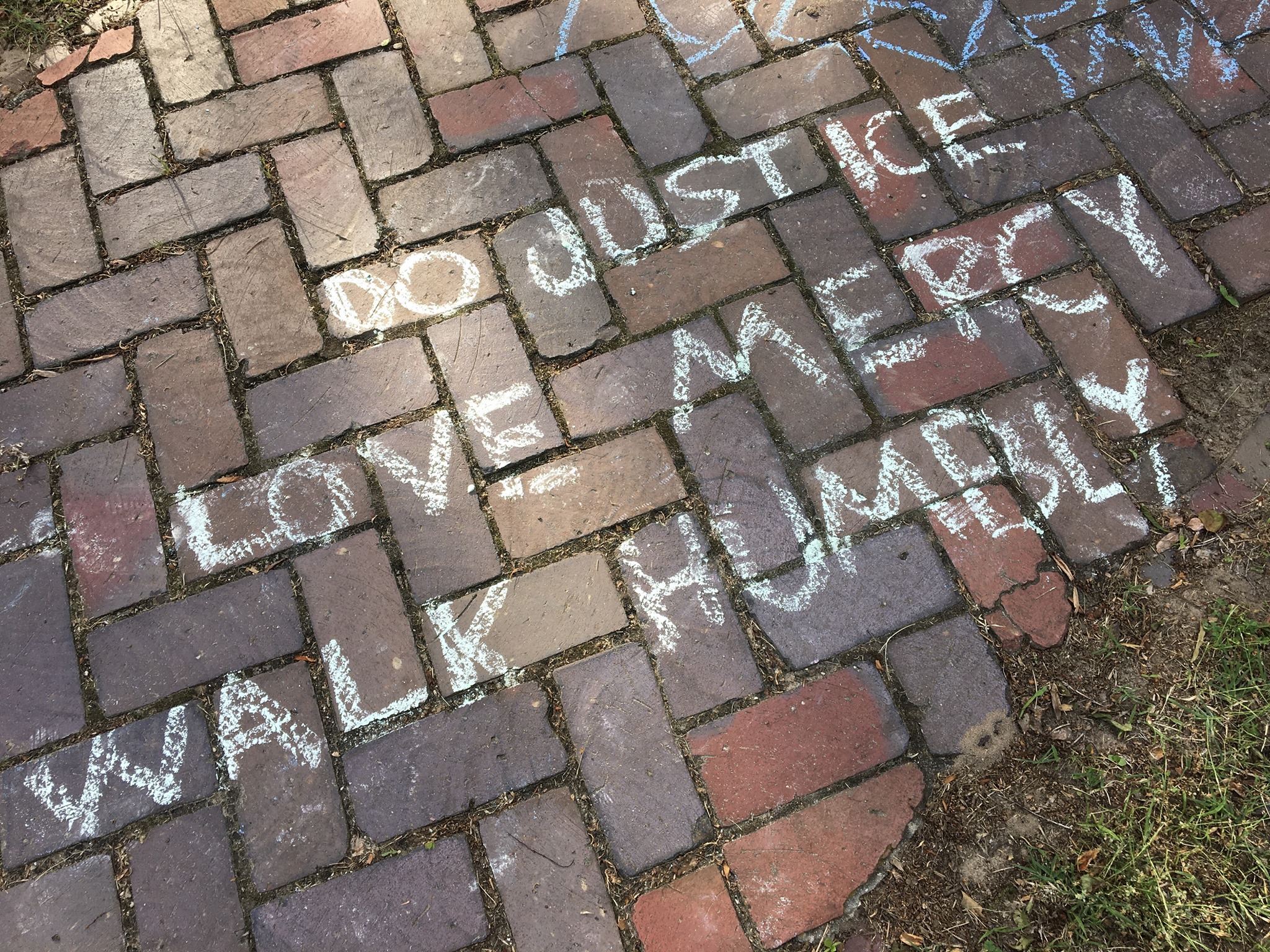
difference, divisive, faith, God, humble, Jesus, justice, kindness, mercy, messy, middle, politics, purple, strain

Photo credit: Jennifer Andrews-Weckerly; reuse with permission

I serve a parish located in a “purple” county whose political leanings are also quite “purple.”  The political views of our parishioners are widely ranging – conservative, liberal, and moderate; Republican, Democrat, and Independent – we all gather every week around the thing that binds us together:  the Eucharistic Table.  Being determined to stay together across difference is not easy.  But we feel an authenticity about that purple identity – that following Jesus and sharing the weekly feast with people we do not always agree with is a counter-witness to the deep divides we experience out in the world.  It keeps us honest, it forces us to humanize one another, and it definitely deepens our prayer life.

That conviction about identity and practice is under constant strain in these tense politically divisive days.  This past weekend as I learned of Alex Pretti’s death, I knew we were entering even more deeply into that tension.  I even had a fellow clergyperson ask me, “So how is your church handling Minneapolis?”  I confess, I wanted to be able to say that we were encouraging a single, clear response.  I wanted to lean into my personal convictions and comfort zone, and lean away from the messy middle that is being a part of a purple church.

Fortunately, our readings for this coming Sunday have teed us up perfectly for staying in the messy middle.  The prophet Micah in chapter 6, verse 8 says, “He has told you, O mortal, what is good, and what does the Lord require of you but to do justice and to love kindness and to walk humbly with your God?”  I always argue that God is not affiliated with American political parties.  And I always argue that that does not mean following God is apolitical.  Now, telling my people to do justice, love kindness, and walk humbly with your God, does not mean that justice, kindness, and humble walking will look the same for every person.  But doing justice, loving kindness, and walking humbly with your God does mean that we are required to stop defending political parties and start defending the dignity of every human being.  Doing justice, loving kindness, and walking humbly means that we cannot hide behind political policies and instead must look our fellow human beings in the eyes, seeing one another through God’s eyes.

Now I know many clergy who avoid “purple” churches because being in churches that align with their personal politics feels more authentic (and, if we’re being honest, easier).  But I love being a part of a purple church because it forces me not to assume political rhetoric blindly when faced with the turmoil of the day, but to pick up justice, kindness, and humility.  I want my parishioners to take action out of their sense of faithful commission.  And that action will look different for each person.  But I will remind them whose they are and what that Lord requires:  do justice, love kindness, and walk humbly with your God. 

On Peace, Love, and Conduits…

14 Wednesday Jan 2026

Posted by jandrewsweckerly in reflection

≈ Leave a comment

Tags

chang, change, conduit, conflict, division, faith, grace, Jesus, love, tension, understanding

Photo credit: Ken Hicks, as found at https://www.facebook.com/groups/sagingnotaging/posts/25680765434890871/

This past Sunday a parishioner told me about how she had been following the Walk for Peace[i] movement – a 120-day 2,300-mile journey by Buddhist monks walking from Fort Worth, Texas to Washington, DC to raise awareness of peace, loving kindness, and compassion across America and the world.  The parishioner is hoping to see them as they pass a town near us.  I had not heard about the group, and have been fascinated to learn about their journey.  They are not asking for money, do not offer selfies, and ask that no political statements accompany their journey.

Meanwhile, in response to the death of Minneapolis resident Renee Good, the Episcopal Church in Minnesota held an online prayer vigil last night open to the entire country to lament violent immigration enforcement in the Twin Cities area.  Over 3,400 people joined the prayers online, as those gathered offered their fatigue, anger, and heartbrokenness to God.  The bishop in that diocese invited those gathered to “turn the world upside down by mobilizing for love.”[ii]

As I have been thinking about the tumult of theses days and the tensions in our country, I have often felt helpless – as though the division is so deeply embedded and hardening between us that there is little to effect substantive change.  But as I thought about these two groups – simply walking without taking sides, or responding to division with prayer and love – I found myself wondering if I might more intentionally lean into my own faith tradition’s gifts too.

As I was reading about the monks, I saw that the only gift they “allow” in their walk is the gift of flowers.  Later I learned that they receive these flowers as gifts, but then they gift those flowers to people along their walk.  Conceivably, those flowers could be changing hands with people who do not agree on political issues, but who can pass along flowers to one another in gestures of peace. 

This coming Sunday, our church will be honoring Martin Luther King, Jr.’s feast day.  This year, our clergy will be reading excerpts from one of his sermons.  As clergy, we have been amazed at how, decades later, King’s words still resonate powerfully with what feels like problems unique to our generation.  I wonder if his words can be a conduit like those flowers that might pass peace and understanding and grace and love to our community and beyond.  I invite you to consider what conduits might be in your path today, or what conduits you might offer to begin slow, steady change.


[i] https://www.facebook.com/walkforpeaceusa/

[ii] Shireen Korkzan, “Thousands join Episcopal Church vigil to lament violent immigration enforcement actions, unite in pursuing justice,” January 14, 2026, as found at https://episcopalnewsservice.org/2026/01/14/thousands-join-episcopal-church-vigil-to-lament-violent-immigration-enforcement-unite-in-pursuing-justice/

On Pageants, Dread, and Joy…

07 Wednesday Jan 2026

Posted by jandrewsweckerly in reflection

≈ Leave a comment

Tags

beautiful, children, Christmas, dread, Epiphany, faith, God, Jesus, joy, magi, overwhelming, pageant, pause, responsibility, sacred, value

Photo credit: https://nationaltoday.com/epiphany/

This Sunday was our church’s annual Epiphany Pageant.  Each year, following all the Christmas festivities, when the time comes for the feast of the Epiphany – the arrival of the magi – we insert the pageant into the middle of our Sunday worship service.  I love the pageant each year because it allows us to breathe in the fullness of those twelve days of Christmas.  I love the pageant each year because it allows our families to recover from the whirlwind that can be Christmas with young children before pausing at the manger without the chaos.  I love the pageant each year because we cede the reins of our patterns of worship and ask our children to lead us in a substantive way.  And I love the pageant each year because it is sheer joy – the best gift of the entire Christmas season.

The day after that pageant, my family’s life shifted back into “normal” mode:  the children went off to school after two weeks of rest, the adults went back to work, the household duties of laundry, dishes, and picking up resumed.  This shift is often met with dread.  Two weeks is enough time to have fully relaxed and stepped out of production mode.  For the kids, it is met with resuming responsibilities of classwork and extracurricular requirements.  For the adults, there are all the things we put on hold that now feel overwhelmingly urgent.  The same is true for the household – staring us in the face are all the items we know need tending:  cleaning, the bills, the scheduling, the negotiating. 

This week though, I have been praying through the dread and holding it in tension with the sheer joy that I witnessed on Sunday.  While the weight of all the “stuff” of life is certainly there and mounting, what the joy reminded me of is that I love all the “stuff” of life that makes our life so rich.  I love being in a church community that values and empowers our children and their faith lives.  I love being in a community that reminds me of the significance of ultimate things and the presence of God in the midst of the seeming chaos of life.  I love having a family to journey through life with and watching each member of the family evolve into beautiful versions of their selves.

This week, I wonder how you might tap into the sacred pause of Epiphany.  I wonder what gifts the magi are bringing you this week to remind you of the presence of Jesus in your life.  I wonder how you might acknowledge the joy found in the seeming tidal wave of responsibility that comes after time apart.  I look forward to hearing about your epiphanies this week!

Sermon – Matthew 2.1-12, Isaiah 60.1-6, EPD, YA, January 4, 2026

07 Wednesday Jan 2026

Posted by jandrewsweckerly in Sermons

≈ Leave a comment

Tags

Christmas, Epiphany, faith, God, grace, Herod, incarnation, Jesus, kings, light, look, magi, Messiah, pageant, power, proclamation, scribes, Sermon

At our 10:00 am service today, we honor the feast of Epiphany with our annual Epiphany Pageant.  Every year I love watching the children and youth bring the Christmas story alive one more time.  Part of what makes the service special is hearing the story with fresh ears – not from a clergy person reading from the aisle like every other Sunday, but with a variety of voices narrating and enlivening the words, making the incarnation story more incarnate.  I love how the pageant keeps us in the Christmas moment one more week, and I love how the story brings all our Christmas characters under one roof, reminding us of the continual unfolding of the mystery of the incarnation.  Though there is something certainly endearing about the whole experience of a pageant, there is also something quite profound in a pageant too.

But what pageants can sometimes do is focus our attention so intently on the manger – on Jesus and his family – that we forget what happens outside the manger is just as important as what happens at the manger.  Even our beloved carol “We Three Kings,” draws us to the experience of the magi’s adoration in Bethlehem, without insight into what happens in Jerusalem.  This year, after hearing of registrations, of humble births, of angel choruses, of everyday shepherds spreading the Gospel, and of cosmic explanations of the incarnation, we turn our attention to Jerusalem.  Isaiah gives us some clue about where our attention is drawn.  “Arise, shine; for your light has come, and the glory of the LORD has risen upon you…Lift up your eyes and look around…”[i] instruction in Isaiah is not for Bethlehem, but the city of Jerusalem[ii] – the city where Jesus’ journey will end, the city for whom Jesus weeps, the city of eventual redemption and salvation.  There, Isaiah foretells of the incarnation, how the people of God are to reflect the light of Christ, and to pay attention to what is happening around them, to God incarnate.

Those words, “lift up your eyes and look around,” have been lingering with me.  Instead of looking deep into the scene at the manger or with the holy family, I am drawn by what is happening in Jerusalem.  Three things happen there.  One, we learn more about the magi.  The testimony of the magi is what most of us associate with Epiphany.  Foreigners set out on a quest, more attuned to the cosmic nature of the incarnation than the people of faith.  Their astrological findings do not simply fascinate them, but inspire action – a long, uncomfortable journey to see the incarnation for themselves.  As profound as their witness is, they cannot complete the journey alone.  They stop in Jerusalem for guidance.  They know they are on the right path; they just cannot quite get to the proper place.  And so, the magi stop and ask for help along the way.  They know something significant has happened, but they need guidance from people of faith to fully realize their journey.[iii]

The magi’s insightful question, “Where is the child who has been born king of the Jews?” is a question that brings in the second action.  The chief priests and scribes, the ultimate insiders of the faithful, those who hold the revelation of scripture and interpret scripture for the people of God, are given news that should be earth shattering.  When asked about the birth of the Messiah, the religious leaders recall what they know of the Messiah:  the Messiah is to be born of Bethlehem and is to shepherd and rule the people of God.  The religious leaders offer the key – the prophecy of scripture about the coming Messiah.  And yet, even though they have this scriptural foundation, they do not react to the news of the magi.  Even though these wise people profess this awaited Messiah has been born, the religious leaders do not drop everything.  They do not even ask to go with the Magi, just to check and see if this story might have something.  They may be versed in scripture, but their inaction shows that even insiders sometimes need outsiders to be faithful.[iv]

Finally, the third thing that happens are the actions of Herod.  Herod is probably the most fascinating to me.  He is wise too, even if he uses his wisdom for his own nefarious purposes.  Herod knows the announcement, even if from an outsider of a new king being born means his own kingship is threatened, and shows how fragile his rule is.[v]  But instead of acting impulsively, he manipulates those around him.  First, he calls in the religious leaders.  You see, Herod is not a Jew – in fact, he is a Roman, serving at the leisure of the kingdom.  But his subjects are Jewish, and so he is wise enough to seek their counsel on what a king, what a Messiah, might look like.  But instead of sending his religious leaders to check things out in Bethlehem, knowing they might discover a true king among them, he secretly sends the foreigners, hoping to manipulate them into doing the work of finding the king, knowing he will get news from them so he can kill this new king.  Herod is only worried about himself and his power, and he will do whatever is needed to maintain that power.

The foreign magi are so unfamiliar with the people of God, they do not initially understand the weight of their question about the new king.  The scribes and religious leaders are so buried in their scripture, and so keen to keep balance with secular power, they do not realize the messianic fulfillment right in front of them.  And Herod is so bent on keeping his power, he does not fully understand the power of God working all around him.  All three of these agents in our story need the words of Isaiah today – all three need to lift up their eyes and look around.

We are not unlike the characters in our story today.  How often are we so mired in our own power – as people of privilege and comfort, as Americans with power more globally, as members and advocates in this community – how often does a word about the movement of God, the promise of change, and the possibility of giving up some of our power to allow that fulfillment, make us just as nefarious as Herod – just as willing to manipulate the world around us?  Or how often have we steeped ourselves in scripture, scouring God’s Holy Word, longing for some sort of guidance or truth, not realizing truth is being spoken through another right to our faces?  Or how often have we been so intent on a mission, so focused on what we sense God calling us to do, we ignore the consequences of our actions, forget the power of our words?

Today’s scripture reading is certainly about the gift of the magi to us – the revelation of the incarnation, the insight of foreigners, and the abundance and homage the incarnation inspires.  But today’s scripture reading is also an invitation to consider our own response to that incarnation in the modern era, considering the ways in which we have not lifted our eyes and looked around.  Taking up Isaiah’s invitation to self-critique is important because there is also a promise in Isaiah.  You see, when we lift our eyes and look around, we acknowledge the narrowness in our lives, or we acknowledge the ways in which we are blind to our own power, or we discover the ways in which we even hide behind our faith, we are then able to see the promise in Isaiah.  Isaiah tells us to look around because glory of the LORD has risen upon us.  Isaiah says in verse five, “Nations shall come to your light, and kings to the brightness of your dawn.”  When we talk about shining our light on this holy hill here at Hickory Neck, this is what we mean.  The gift of the magi to us is not news that is frightening.  When we are not hoarding power or hiding behind our intellect or comfort zones, the news of the magi is news for rejoicing.  And that rejoicing is light that draws nations, and kings, and neighbors, and strangers, and family members, and friends.  The gift of the magi is the invitation to let go of the things that feel under our control, and embrace the thing in no way we control, but in every way brings us grace, love, and abundance.  That is the kind of living that shines light from this hill and brings others to Christ’s light.  That is the light offered to us today in the magi.  That is the kind of good news worthy of pageants and proclamation today.  Amen.


[i] Isaiah 60.1, 4a

[ii] Rolf Jacobson, “Sermon Brainwave #701 – Day of Epiphany,” December 29, 2019, as found at http://www.workingpreacher.org/brainwave.aspx?podcast_id=1216 on December 24, 2025.

[iii] R. Alan Culpepper, “Exegetical Perspective,” Feasting on the Word, Yr. A, Vol. 1 (Louisville:  Westminster John Knox Press, 2010), 217.

[iv] Culpepper, 217.

[v] Stanley Hauerwas, Matthew (Grand Rapids:  Brazos Press, 2006), 38-39.

Sermon – Matthew 11.2-11, A3, YA, December 14, 2025

07 Wednesday Jan 2026

Posted by jandrewsweckerly in Sermons

≈ Leave a comment

Tags

despair, doubt, faith, fear, God, Jesus, John the Baptist, joy, listen, look, Messiah, Sermon, strong

“Are you the one who is to come, or are we to wait for another?”  John the Baptizer’s words have been haunting me all week.  This year, John’s question hits a little too close to home.  As the safety of people of color has been threatened – whether they are legally or illegally here; as the hard-earned rights of women and those in the LGBTQ+ community are being second-guessed; as the decency of and respect for every human being feels lost as a shared core value, I too find myself asking, “Are you the one who is to come, Jesus, or are we to wait for another?”  Where is God in the unraveling of our nation and her communities.[i]

On this third Sunday in Advent – on this Gaudete Sunday, or Rose Sunday, or Joy Sunday – we find no joy in John the Baptizer’s experience.  “…Imprisoned for speaking the hard truth to Herod, John is in chains and in crisis, wondering if he has staked his life on the wrong promise and the wrong person.  The Messiah, as far as John can tell, has changed nothing.  He was supposed to make the world new.  He was supposed to bring justice, fairness, and order to human institutions, such that a tyrant like Herod would no longer sit on the throne, and a righteous man like John would no longer languish in a rat-infested prison.  Jesus was supposed to finish the costly work John started so boldly in the wilderness — to wield the axe, bring the fire, renew the world.”[ii]  And yet, nothing – nothing at all – has worked out as John had imagined from this supposed Messiah. 

So how does Jesus answer John’s question?  Well, before we go to Jesus’ words in Matthew, we first heard from Isaiah today.  You see, John is not the first person of faith to find himself floundering in despair and uncertainty.  The prophet Isaiah’s words were consumed by and encouraging to a people in exile – a people who had lost everything and knew not whether they would ever return to their gifted home.  To those despondent people, God instructs the prophet Isaiah, saying, “Say to those who are of a fearful heart, ‘Be strong, do not fear!  Here is your God.’”[iii]  Be strong.  Do not fear.  Here is your God.

Now you might be thinking, “No offense, Jennifer, but I have been trying for most of this year to be strong and not to fear.  And quite frankly, I’m not seeing much of God these days.”  You might be feeling like the last year is not so very different from that cold, dank prison cell where John sat – after, let’s be honest, living an exemplary life for God.  If a guy who leaps in the womb at the pregnancy of Mary with Jesus, who preaches in the wilderness with minimal resources and rustic living, who baptizes the Messiah himself – if that guy is sitting bewildered about God’s presence in Jesus in the world, how are we supposed to be strong – to not fear – to know that our God is here?

Well, fortunately, Jesus does answer John the Baptizer.  Jesus tells the disciples of John to, “Go and tell John what you hear and see: the blind receive their sight, the lame walk, the lepers are cleansed, the deaf hear, the dead are raised, and the poor have good news brought to them.  And blessed is anyone who takes no offense at me.”[iv]  In other words, scholar Debbie Thomas explains, “Jesus says: go back to John and tell him your stories.  Tell him my stories.  Tell him what your eyes have seen and your ears have heard.  Tell him what only the stories — quiet as they are, scattered as they are, questionable as they are — will reveal.  Why?  Because who I am is not a pronouncement.  Not a sermon, a slogan, or a billboard.  Who I am is far more elusive, mysterious, and Other than you have yet imagined.  Who I am will emerge in the lives of ordinary people all around you — but only if you’ll consent to see and hear.”[v] 

Thomas goes on to say, “But this story is not ‘okay,’ and many of our own stories aren’t okay either.  The prison bars that hold us don’t always give way.  Our doubts don’t always resolve themselves.  Justice doesn’t always arrive in time.  Questions don’t always receive the answers we hunger for.  Jesus calls us to see and hear all the stories of the kingdom — and that includes John’s story, too.  ‘Blessed is anyone who takes no offense at me,’ Jesus says.  Offense runs away.  Offense quits.  Offense erects a wall and hides behind [the wall] because reality is harsher and more complicated than we expected [reality] would be.  Yes, some stories are terrible, period.  They break hearts and end badly.  People flail and people die, and this, too, is what the life of faith looks like.  Don’t take offense.  Don’t flee.”

Now, I don’t know if you know this, and you may be wondering why we get this part of John’s story today, but John the Baptizer is actually the patron saint of joy.  He was in Elizabeth’s womb and leapt for joy at the incarnation of Jesus inside Mary’s womb.  According to John’s gospel, when John the Baptizer knew his work was complete and that Jesus the Messiah’s work was beginning, he said, “My joy is now complete.”  So how do can we be strong, not fear, and trust that God is here?  How can we see and hear Jesus’ stories and embrace joy?

Debie Thomas argues about this, “Maybe John understood something hard and flinty about joy.  Joy in a prison cell isn’t about sentimentality.  Or happiness.  Or the pious suppression of our own most painful crises and questions.  Maybe he understood that joy is what happens when we dare to believe that our Messiah disillusions us for nothing less than our salvation, stripping away every lofty expectation we cling to, so that we can know God for who [God] truly is.  Maybe [John] realized that God’s work is bigger than the difficult circumstances of his own life, calling John to a selfless joy for the liberation of others.  Maybe John’s joy was otherworldly in the most literal sense, because he understood that our stories extend beyond death, and find completion only in the presence of God himself.  ‘Are you the one who is coming?’ John asked in despair.  ‘You decide,’ Jesus [answers] in love.”[vi]

Nothing we say or do today will whitewash the messiness of these days.  No amount of pink or talking or singing about joy is going to transform your heart into joy.  What Isaiah and Jesus are saying is that joy can be found though.  There are stories and examples of goodness all around you for you to see and hear.  Our invitation this week is look and listen – to each other, to our neighbors, to strangers and friend alike.  God is around us in the darkness, breaking through with joy.  Be strong.  Do not fear.  God is here.  God is here in you, and me, in the stranger, in the other.  Our work is to look and listen.  Amen.


[i] Karri Alldredge, “Commentary on Matthew 11:2-11,” December 14, 2025, as found at https://www.workingpreacher.org/commentaries/revised-common-lectionary/third-sunday-of-advent/commentary-on-matthew-112-11-7 on December 12, 2025.

[ii] Debie Thomas, “Are You the One?” December 4, 2016 as found at https://journeywithjesus.net/essays/1201-are-you-the-one on December 12, 2025.

[iii] Isaiah 35.4a.

[iv] Matthew 11.4-6.

[v] Thomas.

[vi] Thomas.

Sermon – I Timothy 6.6-19, Luke 16.19-31, P21, YC, September 28, 2025

01 Wednesday Oct 2025

Posted by jandrewsweckerly in Sermons

≈ Leave a comment

Tags

community, faith, God, grasp, lesson, life, money, parenting, Sermon, share, sympathize, value, vocation

Parenting is probably the most difficult of the vocations God has given me – not simply because parenting can be physically, emotionally, and spiritually exhausting, or because of the heftiness of the responsibility of shaping decent human beings who will have an impact on the world, or because parenting forces you to justify every belief and value you hold.  Those alone would be daunting enough.  But parenting is also a difficult vocation because of the way parenting evolves:  from those early days of helping this creature learn the basics for survival, to those young days of helping children wonder and ask the big questions of life, to those middle days of clarifying family, faith, and individual values that will guide their behavior and choices, to those later days of gently reflecting on those ultimate things of life – of what really makes for a life of meaning and purpose.

In many ways, our scripture lessons lately have felt like listening to a parent trying to help us figure out what this whole life thing is all about.  On the surface, our lessons today are straight of central casting for a stewardship talk – we’ve really teed up the parishioner who will share his testimony today with everything he needs.  From Amos who foreshadows what will happen to those who spend their lives luxuriating in lavishness, as if luxuriating is an end in and of itself; to Paul’s letter to Timothy who warns how dangerous a love of money can be, distracting us from things of ultimate significance; to our gospel lesson which starkly depicts the eternal significance of how wealth can make us so blind to the needs of others that we condemn ourselves in the life beyond this life.  The lessons this week seem to serve up the ultimate stewardship sermon:  the place of money in our lives is so fraught with spiritual consequences, you should just give that money to the church so that you do not have to worry about a fate like those in our lessons today!

And while our budget for next year might appreciate such a lesson, much like parenting has varied phases, so does the church’s teaching of us.  The one line of all the weighty lessons on wealth from today that has been hovering in my mind comes from Paul’s first letter to Timothy.  In the last line of the portion of his letter we heard today, Paul says we “are to do good, to be rich in good works, generous, and ready to share, thus storing up for [ourselves] the treasure of a good foundation for the future, so that [we] may take hold of the life that really is life.”  So that we may take hold of the life that really is life.  The verb in the Greek translated as “take hold” is a not a gentle verb – taking hold is better translated as to grasp desperately.[i]  So we are to grasp desperately to the life that really is life. 

This is the phase of parenting where I find myself:  how do I teach my children what the “life that really is life” is?  In a world that very much feels like the passage from Amos, telling us that “life that really is life” is a life so comfortable you can set your goal as luxuriating in peace, or in a world that so values individualism that we are trained not to let our gaze linger on people like Lazarus or to even know their name for that matter, or in a world that seems to jump from one political controversy to the next, destabilizing our moral compass, how are we supposed to even know what the life that really is life is?

Award winning journalist Amy Frykholm, inspired by that simple phrase “the life that really is life,” traveled to a tiny city in southern Mexico, Fortín de las Flores, after reading Sonia Nazario’s book Enrique’s Journey.  The book details the story of a Honduran man trying to make his way into the United States by traveling on top of a freight train.  His story is not all that unique – the 20,000 residents of Fortín see people like him all the time.  What is unusual about Fortín is how they respond to these migrants.  Instead of responding with fear, or with self-protection, or even with a blind eye, the people of Fortín act as a place of mercy.  Actively making their way to the trains to deliver food, water, and supplies every day – food left over from their food trucks which are just barely making enough for their own families to survive, water poured into zipped baggies they can toss them to the tops of trains, and even sweatshirts or winter hats because they know that after the stop in Fortín, the migrants will face the brutal cold of a trip through mountains.  When journalist Frykholm asked them why they cared for these strangers, most of the residents just looked at her like she was asking a silly question.  A resident of Fortín who had lived in the United States understood her confusion.  He said, “‘The central value of this society is compartir,’ [the Spanish word for “sympathize”] …as he carried a bag of oranges toward a train that had briefly stopped not far from the hotel.  ‘Even a business is primarily a place from which to share.’”[ii] 

The wealth the rich man has in our gospel lesson is not bad in and of itself.  The wealthy man is not even an evil man – he does not actively do anything bad to people like Lazarus.  The danger in the wealthy man’s life is how he does not see,[iii] how he presumes his wealth is simply a blessing for him to enjoy from God.  Debie Thomas writes, “It has taken me a long time to recognize how insidious this notion of ‘blessing’ really is.  How contrary [the notion of blessing] is to Jesus’s teachings.  When I was growing up, no one ever told me that by locking human suffering out, I was locking myself in.  Locking myself into a life of superficiality, thin piety, and meaninglessness.  As our reading from [Paul’s letter to Timothy] puts it this week, the refusal to confront my own privilege, the refusal to bear the burdens of those who have less than me, is a refusal ‘to take hold of the life that really is life.’”[iv]

That is our invitation today – to desperately grasp on to the life that really is life.  Fortunately, scripture does not give us this hefty command like a parent sending out their grown child with one last bit of advice.  Paul wrote this letter not just to Timothy but to the community of faith.  Paul wrote this letter to the community of faith because Paul knew they could not grasp desperately to the life that really is life without some companions on the journey – without a village of people whose central value is compartir.  We gather with people every week because we need a community who can hold us accountable to our values and who can challenge us when loose track of what a life that really is life is.  Sometimes the community will do that by looking at us like we are asking a silly question; sometimes the community will do that by inviting us to be generous givers; and sometimes the community will do that by sitting us down to open up wisdom for us.  But mostly, the community will partner with us because each one of us is desperately trying to grasp onto that life that really is life too.  Together, we create our own little Fortín right here in Toano, witnessing with simplicity the life that really is life – together.  Amen.


[i] Stephanie Mar Smith, “Theological Perspective,” Feasting on the Word, Yr. C, Vol. 4 (Louisville:  Westminster John Knox Pres, 2010), 110.

[ii] Amy Frykholm, “Life That Really Is Life,” September 21, 2025, as found at https://journeywithjesus.net/essays/3969-life-that-really-is-life on September 26, 2025

[iii] Charles B. Cousar, “Exegetical Perspective,” Feasting on the Word, Yr. C, Vol. 4 (Louisville:  Westminster John Knox Pres, 2010), 119.

[iv] Debie Thomas, “The Great Chasm,” September 22, 2019, as found at https://journeywithjesus.net/essays/2374-the-great-chasm on September 26, 2025.

On Leaks and Parishes…

31 Thursday Jul 2025

Posted by jandrewsweckerly in reflection

≈ Leave a comment

Tags

church, Episcopal, faith, God, member, parish, spiritual, world

Photo credit: Jennifer Andrews-Weckerly. Reuse with permission only.

Last week at our church we discovered a leak in our parish house that necessitated saws, hammers, and very loud industrial fans.  By Friday, the constant noise broke my patience and I decided I needed to find an alternate place to work remotely – maybe not a place of silence, but certainly a change of scenery.  I landed in two different eateries/coffeehouses and decided to publicize my “remote office.”

What I found was people visiting from out-of-town I did not know were here, parishioners running errands, happy for an open ear, and lots of gratitude for being invited into the shared experience – both from church members and non-members alike.  The experience reminded me why Episcopal Churches are often referred to as “parishes.” Once upon a time, Episcopal churches served a geographic region, or a parish, and the priest was sort of the neighborhood priest.  Doing my work and meeting people where they are – whether they are from my actual church or not, reminded me of the original intention or churches:  that their priests were for the good of the entire community, not just the members.

Archbishop William Temple is attributed with having once said, “The Church is the only institution that exists primarily for the benefit of those who are not its members.”  At our church, we often talk about our mission being simultaneously about those inside our walls and those outside our walls.  That’s why we are doing some big things of late:  developing a third worship service designed specifically for people who are not a part of our community; forming a team who will look at alternative uses of our property that are missional and community-facing; and establishing small groups for spiritual formation that meet off campus – in homes and places of everyday “parish” life.  If we truly believe Archbishop Temple, then our clergy sitting in coffeehouses and eateries should more often be the norm than the crisis-driven exception.

Being out in the “parish” is not just the role of the priest.  I wonder how you are taking your faith, your worship community, your church out into the world.  When was the last time you asked a friend about their spiritual health (in the same way you would ask them about their physical or emotional health)?  When was the last time you were listening deeply to another person’s story and were willing to offer where you saw God in their story?  When was the last time you invited someone to church – not necessarily to the building on Sunday at a certain time, but into the experience of “church” that has been so transformative for you?  I cannot wait to hear about how you can envision taking your church out into the parish!

← Older posts

Recent Posts

  • On Redefining Community…
  • On Parenting, Milestones, and Community…
  • Sermon – Acts 2.42-47, E4, YA, April 26, 2026
  • On Seasons of Discernment…
  • Sermon – Luke 24.13-35, E3, YA, April 19, 2026

Archives

  • May 2026
  • April 2026
  • February 2026
  • January 2026
  • December 2025
  • November 2025
  • October 2025
  • September 2025
  • August 2025
  • July 2025
  • June 2025
  • March 2025
  • February 2025
  • December 2024
  • November 2024
  • October 2024
  • September 2024
  • August 2024
  • July 2024
  • June 2024
  • May 2024
  • March 2024
  • February 2024
  • January 2024
  • December 2023
  • November 2023
  • October 2023
  • September 2023
  • August 2023
  • July 2023
  • June 2023
  • May 2023
  • March 2023
  • February 2023
  • January 2023
  • December 2022
  • November 2022
  • October 2022
  • June 2022
  • May 2022
  • January 2022
  • December 2021
  • November 2021
  • October 2021
  • September 2021
  • August 2021
  • June 2021
  • May 2021
  • April 2021
  • March 2021
  • February 2021
  • January 2021
  • December 2020
  • November 2020
  • October 2020
  • September 2020
  • August 2020
  • July 2020
  • June 2020
  • May 2020
  • April 2020
  • March 2020
  • February 2020
  • January 2020
  • December 2019
  • November 2019
  • October 2019
  • September 2019
  • August 2019
  • July 2019
  • June 2019
  • May 2019
  • April 2019
  • March 2019
  • February 2019
  • January 2019
  • December 2018
  • November 2018
  • October 2018
  • September 2018
  • August 2018
  • July 2018
  • June 2018
  • May 2018
  • April 2018
  • March 2018
  • February 2018
  • January 2018
  • December 2017
  • November 2017
  • October 2017
  • September 2017
  • August 2017
  • July 2017
  • June 2017
  • May 2017
  • April 2017
  • March 2017
  • February 2017
  • January 2017
  • December 2016
  • November 2016
  • October 2016
  • September 2016
  • August 2016
  • July 2016
  • June 2016
  • May 2016
  • April 2016
  • March 2016
  • February 2016
  • January 2016
  • December 2015
  • November 2015
  • October 2015
  • September 2015
  • August 2015
  • July 2015
  • June 2015
  • May 2015
  • April 2015
  • March 2015
  • February 2015
  • January 2015
  • December 2014
  • November 2014
  • October 2014
  • September 2014
  • August 2014
  • July 2014
  • June 2014
  • April 2014
  • March 2014
  • February 2014
  • January 2014
  • December 2013
  • November 2013
  • October 2013
  • September 2013
  • August 2013
  • July 2013
  • June 2013
  • May 2013
  • April 2013
  • March 2013
  • February 2013
  • January 2013
  • December 2012
  • November 2012
  • October 2012
  • September 2012

Categories

  • reflection
  • Sermons
  • Uncategorized

Meta

  • Create account
  • Log in
  • Entries feed
  • Comments feed
  • WordPress.com

Blog at WordPress.com.

  • Subscribe Subscribed
    • Seeking and Serving
    • Join 391 other subscribers
    • Already have a WordPress.com account? Log in now.
    • Seeking and Serving
    • Subscribe Subscribed
    • Sign up
    • Log in
    • Report this content
    • View site in Reader
    • Manage subscriptions
    • Collapse this bar

Loading Comments...