
• About

Seeking and Serving

~ seek and serve Christ in all persons

Seeking and Serving

Tag Archives: disciples

Sermon – Luke 11.1-13, P12, YC, July 28, 2013

31 Wednesday Jul 2013

Posted by jandrewsweckerly in Uncategorized

≈ Leave a comment

Tags

disciples, God, Jesus, Lord's Prayer, prayer, relationship, Sermon

During seminary, one of the requirements for becoming a priest is to serve for eight weeks in a hospital setting as a chaplain.  Now one might think that there is a hospital chaplaincy course or that the hospital gives chaplains training on how to be a chaplain.  But the truth is, we received two day of “training,” half of which was about just being in hospital, not about how to be a chaplain.  Needless to say, on day three, when the supervisor told us to go to our floors and to get to work, I was almost stunned into inaction.  What would I say?  What was I supposed to do? 

Of course, only hours into the job, I realized how much I had underestimated the challenges.  Not only did I have no idea how to enter a room and strike up a conversation that was not like the ones they were having with every doctor and nurse, I also had no idea how to pray appropriately for the Roman Catholic, the Pentecostal, the Jew, the United Methodist, the Episcopalian, and the uncertain person who was not sure about God but was still willing to let me pray.  I remember sharing my anxiety with a fellow Episcopalian and he simply said, “Oh, I always just pray prayers using the same format as the collects in the Book of Common Prayer.”  Despite my love for the collects in our Prayerbook, an entire childhood of praying like a Methodist meant that his advice offered little encouragement. 

The truth is I am not sure most of us are ever really taught how to pray.  We know a good prayer when we hear one, and we may even write down a prayer we like, but very few of us volunteer to lead prayer at the opening of a meeting or over a meal.  Part of the problem is that most of us think there is a right way to pray.  We imagine there is some magical formula like my friend from seminary suggested, or we worry that our extemporaneous prayer will not be smooth enough or use holy enough words.  We worry that the way that we pray somehow suggests the quality of Christian we are.  Prayer, like biblical literacy, is one of those areas that we get completely anxious about when pressed in public.

The good news is that we are in good company.  We hear in our gospel lesson today one of the disciples say to Jesus, “Lord, teach us to pray.”  The disciples at this point have seen Jesus pray many times.  They see how good he is and they see how important prayer is in his life.  In fact, in Luke’s gospel, Jesus is regularly found in prayer.[i]  They watch Jesus enter into prayer with God for months, and they long to be able to do that too.  And so they come to Jesus, and they vulnerably submit their request:  teach us to pray. 

Their question is full of implications.  First is the admission that they do not have the first idea about what they are doing.  Maybe they learned some prayers in temple, or maybe their parents prayed with them.  But they realize in watching Jesus that they do not actually know how to pray themselves.  Not really.  Second, they see a real connection between Jesus and God that somehow is revealed in Jesus’ prayer life.  Perhaps they see how prayer strengthens him in his weakness and how he is more vulnerable with God than even with them.  They long for that kind of connection with God too, but still, they are not sure how the whole thing works.  Finally, a deeper implication is at hand in the disciples’ question.  Perhaps they are not only asking Jesus how to pray, but also wanting to know what is actually happening in prayer.  Perhaps they have tried praying on their own – for an illness, for a new job, for a broken relationship – but the prayer did not work.  They want Jesus to teach them the right way to pray so that the results they desire are fulfilled.

In some ways, Jesus does that.  First, Jesus gives them a simple prayer.  When you pray, pray this.  The prayer is one that countless Christians have etched into their minds for over two thousand years.  Many of us have distinctive memories of learning the Lord’s Prayer, while others of us just simply know the prayer without remembering how the prayer became ingrained into our conscience.  The Lord’s Prayer is perhaps the only part of a funeral that everyone – even those who never go to church – seem to know and can recite.  This is the same prayer that we say every Sunday, that we teach our children, that we say near death, that we pray when we cannot muster up any other words.  In this way, Jesus teaches the disciples and all of us to pray. 

But then, Jesus goes on to really teach the disciples about prayer.  He tells this funny parable about a man who awakens his friend in the dead of the night because another friend has come to his house and he has no food to feed him.  The man in bed refuses at first, but after much persistence, he caves and gives his friend what he needs.  At the end of the parable, Jesus says, “Ask, and it will be given you; search, and you will find; knock, and the door will be opened for you.”  Yes, Jesus gives the disciples the words they can use to pray.  But Jesus is also trying to teach them about what prayer really is.  Jesus presents this parable of two friends in a relationship that involves give and take.  Jesus is trying to teach the disciples that prayer is about relationship.  The prayer relationship with God is one in which the disciples will be coming in the middle of the night asking for very inconvenient things.  The prayer relationship is active, deeply personal, and will involve asking for what they really need.[ii]  In fact, Jesus says of the man in the parable, “because of his persistence he will get up and give him whatever he needs.”  Another translation of the word “persistence,” is “shamelessness.”[iii]  In other words, Jesus teaches the disciples that this prayerful relationship holds nothing back, cannot be embarrassed, and certainly does not worry about pretenses.

Unfortunately, we may hear those words about asking, searching, and knocking and remember every time that our prayers have not been answered, when we have not found, and the door has not been opened.  But Jesus is inviting us today to reframe prayer not as something we do with the expectation of an exchange:  I ask for healing, or a job, or a romantic partner, and God gives that to me.  We are still to come to God with those pains:  the longing for healing, the desire for vocational fulfillment, and the hope for partner who makes us happy and whole.  But instead of bringing those things to God because we want them solved, Jesus suggests that we bring those things to God so that all of ourselves is nakedly before God.  Only then can we have the intimacy with God that we desire and the realness of relationship we long to have. 

Now where this gets messy is when we start trying to understand why things happen – when we are not healed and people tell us, “It was God’s will,” or “Everything happens for a reason.”  But those answers hold little weight when a child dies or when someone loses their home.  I cannot believe in a God who wills those things to happen.  In fact, when a teen asks me why their parents are still getting divorced even though they prayed for the divorce not to happen, or when a mom loses a pregnancy and wants to know why God would let that happen, my answer has most often been, “I don’t know.”  I do not know why our physical ailments are not healed and why horrible or disappointing things happen to us.  All I do know is that God longs for us to bring all of that to God in prayer. 

So when I am angry, God wants me to let God have it.  When I am sad, God wants me to pour out my heart.  When I am lost, God wants me to share my wandering self.  And when I am not even sure God is with me or loves me, God wants me to just come and sit, even if I do not have words or if I do not feel like I can really trust God anymore.  When the disciples ask Jesus to teach them to pray, Jesus gives them a simple, straightforward prayer, teaching them and us that we do not need holy words or even our own words – especially when we cannot find our own words.  But Jesus teaches us all so much more.  Jesus teaches us to be shamelessly honest about what we need whenever we are in need.  And Jesus teaches us that prayer is based on trust – not a trust that everything works out for the best or that we will get exactly what we want – but a trust that God is listening and God loves us and all the world.[iv]  Jesus’ teaching is not tidy – but Jesus’ teaching invites us in, encourages us, and holds us in this wonderful journey with God – the one who we come to know through prayer.  Amen.


[i] James A. Wallace, “Homiletical Perspective,” Feasting on the Word, Yr. C, Vol. 3 (Louisville: Westminster John Knox Press, 2010), 289.

[ii] Elisabeth Johnson, “Commentary on Luke 11.1-13,” as found at http://www.workingpreacher.org/preaching.aspx? commentary_id=1724 on July 25, 2013. 

[iii] Wallace, 291.

[iv] David Lose, “Teach Us to Pray,” as found at http://www.workingpreacher.org/craft.aspx?m=4377&post=2654 on July 25, 2013.
Sermon – Acts 16.9-15, E6, YC, May 5, 2013

10 Friday May 2013

Posted by jandrewsweckerly in Uncategorized

≈ Leave a comment

Tags

disciples, Easter, evangelism, Good News, Holy Spirit, Jesus, Lydia, Paul, Sermon, spiritual practice

This Eastertide, I have been thinking a lot about evangelism.  The bishop asked us to have a conversation about our mission and evangelism efforts here in Plainview during Eastertide.  The Vestry just started reading a book about evangelism as a spiritual discipline.  And our Vestry retreat in April was about the tangible practices of evangelism we could employ.  For a topic that makes most Episcopalians very uncomfortable, evangelism seems to be everywhere I turn.  But as I was thinking about the theme of evangelism this Eastertide, I realized that the theme’s prominence makes quite a bit of sense.  Eastertide is sort of the “so what?” of the resurrection.  Throughout Eastertide, we are hearing the stories of the disciples’ reaction to the resurrection, and what life was like after this pivotal moment.  What better time to think about evangelism than while the disciples are doing just that – taking the Good News of Jesus’ resurrection and sharing that Good News with others.

What I appreciate then about our lesson from Acts today is that the practice of evangelism in biblical times was not exactly precise.  You would think that the book of Acts would tell the story of how after Jesus’ death the disciples knew exactly how to spread the Good News.  You would think after all those years with Jesus, the disciples had clear instructions for moving forward, and were able to draw up a structured evangelism plan.  But our stories from Acts this year have included nothing of the sort.  So far we have heard stories of a brutal persecutor of Christians being dramatically converted, of Peter realizing that Gentiles should also be included in the Christian community, and today we hear of this foreign woman of power coming to Christ.  I am pretty sure if the disciples sat down and planned their target audience for the Good News, Paul, Cornelius, and Lydia would not have been on their list.  And yet, this is the story of evangelism we hear during Eastertide: a story of unlikely and unexpected people hearing and responding to the word of God.

On the surface, this sounds like good news to us.  These stories of conversion give a sense of confidence that no matter with whom we share the story of Jesus, they will be converted.  But looking at the end of the story glosses over the actual experiences of those on the evangelism journey.  If you remember, when Paul is converted, and his eyes are scaled over, the Christian who goes to talk with him is scared to death.  God tells him to go to Paul, but that is little assurance when that instruction means walking into the lair of a nasty murderer of Christians.  And for Peter, his interaction with Cornelius means that he must surrender all that has been familiar to him – the necessity of circumcision and all that he has known as being central markers of faithfulness – and let go of that familiarity.  Even with this interaction between Paul and Lydia today, Paul must take on a long journey based on a few words in a dream, only to find not a Macedonian man who is asking for help, but a foreign woman.[i]

These stories during Eastertide only highlight our own anxieties about evangelism.  As modern Christians, we have a hard enough time sharing the Good News with our friends and family.  Religion is one of those primary topics to avoid at dinner parties.  At the slightest hint of discomfort from someone else, we immediately drop the topic, not wanting to drive away a friend or colleague.  We do not want to become known as some Jesus freak who everyone avoids at parties.  Quite frankly, there are even times when we feel uncomfortable even talking about our faith within Church.  How in the world could we ever then expect ourselves to be able to talk to those who are hostile, unchurched, or strangers to us?

Before I went to seminary, I participated in a group at my parish called EFM – Education for Ministry.  The program was a four-year program where a small group of people gathered and each year covered a different topic – Old Testament, New Testament, Church History, and Theology.  During one of the scripture years, I was traveling by plane alone and I was sorely behind in my scripture reading.  I carried a large study bible with me, and that trip I found that I had more interesting conversation than you could ever imagine.  I had a slightly uncomfortable conversation with a young evangelical male who started telling me about his conservative views on scripture.  I had a businessman ask me if I was a minister or theology student.  When I told him no, he seemed bewildered as to why I would be reading the Bible, and kept eyeing me suspiciously the rest of that flight.  I had a middle-aged woman start telling me about her church and Bible Studies she had enjoyed.  And of course, there were tons of people who just stared at me warily trying to figure out what my angle was.  You would think the lesson from my trip would be, “Take a Bible with you, and see what evangelism opportunities it creates.”  But to be honest, I found myself wanting to never carry a Bible with me again in an airport.

I think why we get so uncomfortable about evangelism is we imagine evangelism as knocking on the doors of strangers, presenting some uncomfortable script, and then having doors slammed in our faces.  But our lesson from Acts today shows us a different model.  Our lesson from Acts tells us is that yes, evangelism will entail going places that may be uncomfortable or interacting with people you would not expect.  Paul goes on a long journey expecting to meet a man and gets something quite different.  Lydia goes seeking a place to pray with her familiar girlfriends and hears something entirely new.  But evangelism is not just about the evangelizer and the evangelizee.  The other major actor is the Holy Spirit.  The text tells us that the Lord opened Lydia’s heart to listen eagerly to Paul.  Evangelism is the intersection between human faithfulness and divine guidance.  “Paul would not have been guided to this place at this moment, were he not first of all at God’s disposal, open to being guided, sensitively attuned to being steered in one direction and away from all others.  Lydia would not have arrived at this place or time, had she not first of all been a worshiper of God, a seeker already on her way.  Peter does his part and Lydia hers, but it is God who guides all things and works in and through all things, not just for good but for what would otherwise be impossible.”[ii]

What is so liberating about this understanding of evangelism is that even if we thought we had to or could do evangelism on our own, we realize today that our work of evangelism only happens with God.  The book our Vestry is reading says that “Evangelism is a spiritual practice of expressing gratitude for God’s goodness and grace.”[iii]  That does not sound so bad, does it?  A spiritual practice of expressing gratitude for God’s goodness and grace.  He does not define evangelism as saving souls or self-righteously driving away your friends.  He says that evangelism is about expressing gratitude for God’s goodness and grace.  Knowing that definition of evangelism and knowing from scripture that evangelism happens as a partnership between our faithfulness and God’s guidance makes the whole enterprise seem a lot less scary.

I want you to take a moment to think about the best vacation you ever had.  Think about all the reasons why the vacation was wonderful and why you enjoyed yourself.  Think about the happiness and peace that the vacation brought you and the warm smile that just recalling the trip brings to your face.  Imagine the enthusiasm in your voice as you share that story with someone else and the great conversation your sharing might evoke.  Now, take a moment to imagine the same experience with a conversation about your faith journey.  Think about the great joy you have had in your relationship with God.  Think about the happiness and peace you have at times found in God.  And now think about the enthusiasm in your voice as you share that story with someone else and the incredible conversation your sharing might evoke.  That is all that happens between Paul and Lydia.  That is all that God invites you to do today.  Because the Holy Spirit will take care of rest.  Amen.


[i] Eric Barreto, as found at http://www.workingpreacher.org/preaching.aspx?commentary_id=584.

[ii] Ronald Cole-Turner, “Theological Perspective,” Feasting on the Word, Yr. C, Vol. 2 (Louisville: Westminster John Knox Press, 2009), 476

[iii] David Gortner, Transforming Evangelism (New York: Church Publishing, 2008), 29.

Sermon – John 21.1-19, E3, YC, April 14, 2013

17 Wednesday Apr 2013

Posted by jandrewsweckerly in Uncategorized

≈ Leave a comment

Tags

action, disciples, follow, Jesus, quiet, Sermon, surrender

There are two layers to our gospel lesson today.  In one layer, there is a lot of movement and action.  We have disciples fishing, a man shouting about where to put nets, Peter leaping out of a boat to swim ashore, breakfast sizzling in a pan over a crackling fire, and Peter and Jesus having this strangely repetitive conversation.  This layer of the text is really distracting.  There is so much happening that by the time we get to Jesus telling Peter to feed his lambs, we forget the part of the story about Peter getting dressed to jump into water.  The frenetic nature of the text leaves us with more questions than answers.  Why is Peter fishing at a time like this?  Why is he naked?  Why do the disciples not recognize Jesus at first?  Why is Jesus cooking breakfast?  Why does Jesus repeat his question to Peter three times?

In truth, I think there is so much activity in our gospel lesson because the disciples are a little frenetic themselves.  They had all settled into certain identities in their lives – many of them were fishermen, many of them had families that they worked with, and all of them had homes where they resided.  Their lives were simple and predictable.  Then this guy came into their lives and their identity and purpose got totally out of balance.  They had no consistent daily routine, they left behind everything they knew, this man they were following was compelling but also completely confusing, and they were being asked to totally change their lives.  And just when they had found the rhythm of managing their unpredictable lives with Jesus, then everything turns over on its head again, and they lose everything – their leader, their purpose, and their identity.  So in an effort to find something to hang on to, the disciples become punchy with action.

We all do this.  I know that I am particularly stressed out when I find myself intently scrubbing something in the house.  I may not be able to solve some problem at work, or I might not be able to fix some relationship that needs mending, but I can have a clean floor.  I might not have responded to the forty-eight emails and the twenty-nine items on my to-do list, but my desk will be cleared of all clutter and looking freshly dusted.  My neurotic behavior is cleaning, but we all have some neurotic behavior.  Some of us need to find a mall to clear our minds of all the stuff going on inside of us.  Somehow finding the perfect dress or pair of shoes takes away our other anxieties.  Others of us get out in the garden and dig our way to peace of mind.  Something about a freshly weeded garden makes us feel like something was accomplished, even if the rest of us is in shambles.  Still others hit the gym.  There is nothing like sweating away anxieties or feeling the burn to take away the other feelings going on inside of us.[i]

What is interesting about all the activity and noise found in our gospel lesson is that there is another layer of this text that is completely quiet.  We start with the disciples silently staring at that Sea of Tiberias.  There is nothing left to say among them, because they have talked this whole resurrection thing to exhaustion.  Then we find the disciples on the boat fishing in the middle of the night.  I do not know the last time you went fishing, but fishing is one of the more quiet, uneventful activities you can do.  Despite the splashing of Peter to swim to Jesus, once they all gather on the beach, no one says a word.  The air is only filled with the quiet lapping of water and the sizzling of a pan over a fire.  The disciples have questions, but no one says anything.  Even the conversation between Jesus and Peter has a quiet tone to the conversation.

In some ways, I think this is where the text is really pointing.  The disciples, who have irritated Jesus to no end, finally fall silent.  No more asking about who shall be first, and nor more asking what Jesus means or who he is.  No more crazy proposals like building booths for Moses, Elijah, and Jesus, and no more insisting that Jesus wash all of their bodies, not just their feet.  No more insisting that they would never betray Jesus.  There is nothing left to say.  And so they stare quietly, they fish in silence, and they answer in hushed voices.

This layer is the most important because this layer marks a shift.  The disciples stop trying to muscle their way to discipleship, and they finally learn to let Jesus take the lead.  They have become so physically, mentally, and spiritually exhausted that they stop trying to control everything, and they simply wait for Jesus to tell them what to do.  This is a critical moment in the disciples’ journey with Christ.

I think many of you know this about me, but I love to dance.  I grew up doing all sorts of dancing, but the most difficult form of dancing I stumbled into was formal partnered dancing – the fox trot, waltz, etc.  In the other forms of dancing I learned, I was responsible for myself, learning the steps, and making sure I knew the rhythm so that the dance looked beautiful.  But in partnered dance, especially as the woman, you have to learn how to follow.  As someone with pretty good rhythm and memory for steps, you have no idea how incredibly frustrating it is to follow a man who does not know what he is doing.  The tendency is to want to use your arms or legs to start guiding the man, or even to whisper the directions.  But the role of the woman is to follow where the man leads – perhaps the only time in a woman’s life that she is forced to do this!  But what I also found in this kind of dancing is that when you have a really good partner, he can make you feel like the most graceful, beautiful woman on the dance floor.  In fact, you stop worrying about the steps and the count, and you start moving with fluidity and ease.  The price for such a feeling is total surrender and trust.  But the payoff is that you find a joy so strong that you will hunt down that partner and beg them to save you a dance.

This is the kind of submission the disciples finally master on that beach.  No more trying to muscle Jesus into the way they want him to behave.  No more trying to talk their way through their relationship with him.  They surrender all they have to him, longing for the clarity that only he can give them.  And when they finally do that, in the quiet of that morning, they finally hear the words of purpose for their lives.  “Follow me,” Jesus says.  They are the same words Jesus said to them at the beginning of their relationship with him.  But now they finally hear.  And now they can finally respond with their whole being.  Jesus’ words are as clear as they can be.  Jesus’ words give their life meaning.  And their spirit is finally in the place where they can hear and respond.  They are truly and thoroughly ready to follow him.

This is what Jesus invites us to do as well.  This morning, as we sit in the sacred place, Jesus invites us to shove those piles off the desks of our minds, to rip out the weeds blocking our hearts, and to drop our armfuls of distractions and to listen to his simple words for us.  The words are there waiting.  The direction is clear.  The peace and comfort of clarity and purpose are ours for the taking.  So when you come to this table for the Eucharistic feast, quietly listening for Jesus’ words for you, you will be able to hear those words, “Follow me,” and do just that when you walk out those church doors.  Amen.


[i] Gary D. Jones, “Pastoral Perspective,” Feasting on the Word, Yr. C, Vol. 2 (Louisville: Westminster John Knox Press, 2009), 420.

Sermon – John 13.1-17, 31b-35, MT, YC, March 28, 2013

29 Friday Mar 2013

Posted by jandrewsweckerly in Uncategorized

≈ Leave a comment

Tags

disciples, foot washing, Jesus, love, Maundy Thursday, Sermon

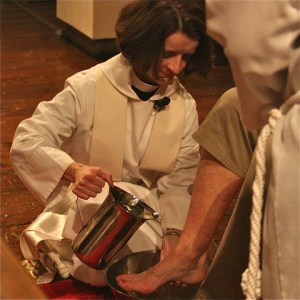
IMG_2898_2Tonight our actions mirror the actions of our gospel lesson.  Like the disciples, we gather around the table.  I imagine our potluck meal was not unlike the meal the disciples had with Jesus that night – an intimate meal with friends who feel like family, sharing stories, laughter, and woes.  We too are a ragtag team of followers, gathered at a meal, who seek to know our Savior better, and who lean on a community of faith to join us in the journey.  As the disciples did that night, we will also have our feet washed.  I imagine our discomfort in having our feet washed, and even our wondering what the foot washing means, are not that different from Peter’s struggles.  Finally, we too will come to the Eucharistic table.  This night was the night that Jesus instituted the sacrament of Eucharist.  Like Jesus shared his last meal with the disciples that night, we too receive the sacred body and blood of Christ for the last time until the Easter Vigil.

In observing the patterns of our gathering this night, we could feel pretty good about ourselves.  We could look at the synchronicity between us and the disciples that night and feel like we have joined them in a great memorial of our brothers in Christ.  But tonight is not just about imitating manual acts.  The entire point of that night – the table fellowship, the washing of feet, the sharing in Christ’s body and blood – is not about the actions themselves.  The point of that night was establishing a way of being.  Jesus establishes the way that the community will be together:  “I give you a new commandment, that you love one another.  Just as I have loved you, you also should love one another.  By this everyone will know that you are my disciples, if you have love for one another.”

This command to love one another is perhaps one of the most difficult commands of Jesus.  All we have to do is look at two people in the room that night to see what Jesus means.  Both Judas and Peter are in the room when Jesus says that they are to love one another.  That means when Judas hands Jesus over to die, and when Peter embarrasses them by three times denying the Savior he claimed to be willing to die for, that the other disciples will have to find a way to love both Judas and Peter later.

For us, that means when our family members, friends, fellow parishioners, and even strangers betray us, we too will have to love each of those individuals.  Love is not an easy act.  Love means that we have to accept the role of servant, the one who kneels down on the floor and washes the dirty feet of another, even a betrayer.  But we also have to be the person who allows him or herself to be cared for in a similar way.  Margaret Guenther once said, “If we love one another as Jesus loves us, we must be ready to put aside our grudges, hurts, and righteous anger.”  Guenther admits, “I tend to love with my fingers crossed.  I’m ready to love almost everyone, but surely I can’t be expected to love the person who has harmed me.  Or who does not wish me well.  Or who seems hopelessly wrong-headed.  Surely I am allowed one holdout, one person whom I may judge unworthy of love.  But the commandment has no loopholes; it demands that we let go of our pet hates, the ones we clutch like teddy bears.”[i]

NPR does a series called StoryCorps.  I will never forget one story I heard about a woman who befriend the boy who killed her son.  At first she was filled with anger at her son’s murderer, but then twelve years later, she went to visit the young man in prison and everything changed.  “He became human to me,” explained the woman.  They departed that day with a hug.  Twenty years after the murder of her son, the woman and the murderer now are neighbors, caring for one another like a mother and son.  She demands the same attention from him a mother would, and he always strives to care for her and earn her approval.  She plans to see him graduate from college – something her own son never got to do.  And maybe someday go to his wedding.[ii]  This is the kind of love that Jesus is talking about on this sacred night.

Luckily, the Church gives us our liturgy tonight to encourage us on the way.  If we want to love as Jesus commands, we can come forward, and be willing to be loved through the washing of our feet.  If we want to love as Jesus commands, we can earnestly confess our sins before others, recommitting ourselves to love.  If we want to love as Jesus commands, we can come to the table one more time, perhaps kneeling by someone with whom we have a grudge, and being renewed into the way of love.  And if we want to love as Jesus commands, we will take all the strength that we gain from this night, and we will walk out those doors a people transformed – transformed into beings who love with abandon, not caring on whom we waste the love or how or whether the love is returned to us.  When we love in this way, we love like Jesus – and everyone will know that we are Jesus’ disciples by our love.  Amen.


[i] Margaret Guenther, “No Exceptions Permitted,” Christian Century, vol. 112, no. 15, May 3, 1995, 479.

[ii] Story found at http://www.npr.org/2011/05/20/136463363/forgiving-her-sons-killer-not-an-easy-thing as of March 25, 2013.

Newer posts →

Recent Posts

  • On the Myth and Magic of Advent…
  • On Risking Failure and Facing Fear…
  • Sermon – Luke 23.33-43, P29, YC, November 23, 2025
  • On Inhabiting Gratitude…
  • Sermon – Luke 20.27-38, P27, YC, November 9, 2025

Archives

  • December 2025
  • November 2025
  • October 2025
  • September 2025
  • August 2025
  • July 2025
  • June 2025
  • March 2025
  • February 2025
  • December 2024
  • November 2024
  • October 2024
  • September 2024
  • August 2024
  • July 2024
  • June 2024
  • May 2024
  • March 2024
  • February 2024
  • January 2024
  • December 2023
  • November 2023
  • October 2023
  • September 2023
  • August 2023
  • July 2023
  • June 2023
  • May 2023
  • March 2023
  • February 2023
  • January 2023
  • December 2022
  • November 2022
  • October 2022
  • June 2022
  • May 2022
  • January 2022
  • December 2021
  • November 2021
  • October 2021
  • September 2021
  • August 2021
  • June 2021
  • May 2021
  • April 2021
  • March 2021
  • February 2021
  • January 2021
  • December 2020
  • November 2020
  • October 2020
  • September 2020
  • August 2020
  • July 2020
  • June 2020
  • May 2020
  • April 2020
  • March 2020
  • February 2020
  • January 2020
  • December 2019
  • November 2019
  • October 2019
  • September 2019
  • August 2019
  • July 2019
  • June 2019
  • May 2019
  • April 2019
  • March 2019
  • February 2019
  • January 2019
  • December 2018
  • November 2018
  • October 2018
  • September 2018
  • August 2018
  • July 2018
  • June 2018
  • May 2018
  • April 2018
  • March 2018
  • February 2018
  • January 2018
  • December 2017
  • November 2017
  • October 2017
  • September 2017
  • August 2017
  • July 2017
  • June 2017
  • May 2017
  • April 2017
  • March 2017
  • February 2017
  • January 2017
  • December 2016
  • November 2016
  • October 2016
  • September 2016
  • August 2016
  • July 2016
  • June 2016
  • May 2016
  • April 2016
  • March 2016
  • February 2016
  • January 2016
  • December 2015
  • November 2015
  • October 2015
  • September 2015
  • August 2015
  • July 2015
  • June 2015
  • May 2015
  • April 2015
  • March 2015
  • February 2015
  • January 2015
  • December 2014
  • November 2014
  • October 2014
  • September 2014
  • August 2014
  • July 2014
  • June 2014
  • April 2014
  • March 2014
  • February 2014
  • January 2014
  • December 2013
  • November 2013
  • October 2013
  • September 2013
  • August 2013
  • July 2013
  • June 2013
  • May 2013
  • April 2013
  • March 2013
  • February 2013
  • January 2013
  • December 2012
  • November 2012
  • October 2012
  • September 2012

Categories

  • reflection
  • Sermons
  • Uncategorized

Meta

  • Create account
  • Log in
  • Entries feed
  • Comments feed
  • WordPress.com

Blog at WordPress.com.

  • Subscribe Subscribed
    • Seeking and Serving
    • Join 394 other subscribers
    • Already have a WordPress.com account? Log in now.
    • Seeking and Serving
    • Subscribe Subscribed
    • Sign up
    • Log in
    • Report this content
    • View site in Reader
    • Manage subscriptions
    • Collapse this bar
 

Loading Comments...