
• About

Seeking and Serving

~ seek and serve Christ in all persons

Seeking and Serving

Tag Archives: foot washing

Homily – John 13.1-17, 31b-35, MT, YA, April 13, 2017

27 Thursday Apr 2017

Posted by jandrewsweckerly in Sermons, Uncategorized

≈ Leave a comment

Tags

betrayal, commonality, disciples, enemy, example, foe, foot washing, friend, God, homily, Jesus, Judas, love, Maundy Thursday, power, reconcile, vulnerable

In 1984, the gay community in London was seeing a lot of violence and oppression by not only the police, but also the community.  In the midst of their own activism, one gay activist caught wind of the Coal Miners who were striking in Wales.  Upon watching the violence of the police against the strikers, the activist realized their suffering was not unlike his own, and that of the gay community.  And so, in an act of solidarity and love, he organized his gay community to raise funds to support the families of the striking miners.

But not everyone was on board.  You see, the miners worked in small towns in which many members of the gay community had once lived.  In those small communities, they had been bullied, taunted, and beaten.  And now someone was asking them to come to their aid.  Many in the gay community could not turn the other cheek.  Why should they return hatred with love?  And as the gay activists soon learned, their help would not be readily received.  Why should the gay community risk further rejection, shame, and violence to support an oppressed people who could not see their commonality?

Jesus shares a meal with his disciples as he has done on so many occasions.  Only on this night, he is among friend and foe.  He knows Judas is about to betray him.  He knows that Judas is about to put into motion a series of actions that cannot be stopped, that will lead to pain and suffering, and ultimately death.  Looking into Judas’ eyes, Jesus must have felt a betrayal so deep that he had to resist hatred as a human response.  “How could you?” would be an easy question for Jesus to ask in this intimate moment.

But Jesus does not do that. He does not challenge Judas or reprimand or even expose Judas in front of the others directly.  No, he takes off his outer robe, takes a bowl and a pitcher of water, and he washes the feet of everyone in that room – not just the feet of those whom he loves – which would have been a poignantly intimate moment anyway.  But as he makes his way down the table, he shifts his bowl under the dusty feet of Judas; feet as dirty as the rest of them.  He takes the feet of this betrayer of his trust and confidence, and he manages to love Judas as deeply as everyone else.  Tenderly, lovingly, he washes the feet of the enemy of the worst kind – an enemy who was once a friend.  Love in the face of betrayal.

This year, Jesus’ tenderness with Judas has been haunting me.  I do not know about you, but the last thing I want to do is tenderly, lovingly care for my enemy.  Society teaches me to have a strong defense, to protect myself, to avoid conflict.  The norm is not to kneel down before a betrayer of trust, to make oneself subservient, and lovingly treat someone who acts so hatefully.  Only a fool makes himself vulnerable before the enemy.  And yet, that is what Jesus does.  That is how he shows the depths of his love.  He does not use his power to thwart the enemy.  He restrains his power to bring the enemy in – always with the offering of love that can transform any heart.

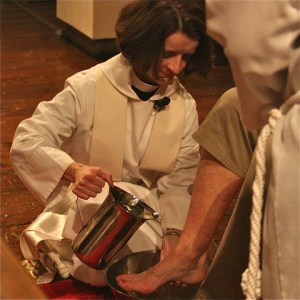
Tonight, we will engage in the tradition of washing others’ feet.  Many of us get caught up the squeamishness of feet and the vulnerability such intimacy involves.  But something much bigger happens in foot washing than letting go of self-consciousness.  In foot washing we enter into the love of Christ:  washing the feet of those we know well and love; washing the feet of those we know only superficially; washing the feet of those who seem to have their lives totally together and those who we know are suffering; washing the feet of someone who has indeed offended you, and washing the feet of someone with whom you wish to reconcile.

But what we do literally here, we take out figuratively into the world.  Washing the feet of someone you know, or even someone you do not know well in church is one thing.  Washing the feet of the people who are not here is another thing entirely.  Though Jesus’ washed his disciples’ feet, the inclusion of Judas suggests that loving one another cannot be limited to the community of believers.[i]  All we have to do is imagine an actual enemy, someone who has betrayed our trust or offended our values, someone who oppresses the oppressed, and then we know how hard what Jesus does is tonight.  Tonight, some powerful feelings are set loose:  sorrow, loss, regret, even fear; but also some powerful feelings are set loose by Jesus:  commitment, conviction, and determination.  God lays aside everything tonight.[ii]  Enter into Christ’s love tonight through the example he sets for us.  Know that God will use the power of this act to change your heart.

A year after that bold move by the gay community in London in the 1980s, much had happened.  Horrible things were said, mean things were done, violence erupted, commitments were betrayed, and help was rejected.  But a year later, even after ultimately losing their cause, the mineworkers did something out of character.  Chapter after chapter of mineworkers loaded onto buses, came to London, and marched for gay rights with their new brothers and sisters.  God’s love has tremendous power.  Even if that love cannot transform the heart of a Judas, the witness of that love slowly breaks through and transforms communities.  Join us tonight as we start locally.  Know that God will use your small action here to do bigger work out in the world!  Amen.

[i] Susan E. Hylen, “Exegetical Perspective,” Feasting on the Word, Yr. A, Vol. 2 (Louisville:  Westminster John Knox Press, 2010), 275.

[ii] William F. Brosend, “Pastoral Perspective,” Feasting on the Word, Yr. A, Vol. 2 (Louisville:  Westminster John Knox Press, 2010), 276.
Sermon – John 13.1-17, 31b-35, 1 Corinthians 11.23-26, MT, YC, March 23, 2016

29 Tuesday Mar 2016

Posted by jandrewsweckerly in Sermons, Uncategorized

≈ Leave a comment

Tags

change, communion, disciples, foot washing, intimate, Jesus, love, Maundy Thursday, meal, Sermon, tangible

As I was writing the sermon for tonight, I realized that maybe we have structured our evening all wrong.  We actually started off on the right foot.  We gathered over a common meal, assembled by dishes from each of our homes (or from the deli you swung by on the way here).  Our meal was a feast made by many hands, and completely organic – shared out of the varying gifts we bring.  In fact, we even did things in a way that was more in line with what Paul wanted for the Corinthians.  The passage that we read tonight from First Corinthians is mostly just the familiar text that includes Jesus’ institution of Holy Eucharist.  But in the verses before what we read tonight, Paul admonishes the Corinthians.  Instead of a true Eucharistic meal, where bread and wine are shared equally and intentionally, the Corinthians have gotten into the habit of having communal meals, but everyone fends for themselves.  In other words, their meal would be like if Kathleen had made a homemade casserole, Kim had grabbed Chinese takeout for her and the kids, Lois had brought the finest filet mignon with a glass of wine from a local fine dining establishment, and I showed up empty-handed.  Except in Corinth, you eat what you bring.  If you show up empty-handed, you leave hungry.  Unlike the Corinthians, at least we got that part right tonight.

But if I had been thinking, instead of coming up here to our beautiful worship space, we would have stayed downstairs.  Mid-meal, I would have taken off my jacket, rummaged around for a towel and bowl from our kitchen, and started washing your feet.  As I moved from table to table, we would have talked about what I was doing, and why Jesus did the same for his disciples.  You see, tonight, we hear the story that is only found in John’s gospel about how Jesus teaches the disciples to love and serve one another and their neighbors.  In order to love, which is going to be their primary mission, they will need to be able to get down on the floor among the crumbs and the remains of the festivities, and tenderly care for one another.

And further, had we been feeling really countercultural, I would have grabbed a loaf of bread that someone got at Stop-N-Shop, and some wine sitting on the beverage table, and we would have talked about how on the night before Jesus is betrayed, he breaks bread with his friends, telling them that the bread is his body, and the wine is his blood – given for them.  We would have passed the loaf around, tearing the bread into bite-sized pieces, dropping blessed crumbs everywhere, and looking into each other’s eyes as we pass the bread, reminding each other that this is the body and blood of our Lord.

If I had been thinking, that is what we could have done tonight – because that is what happens on this last night for Jesus:  a downhome, shared, messy meal, with uncomfortable, intimate moments, and a meal that does not necessarily feed our bellies but feeds our souls.  But Jesus’ words and experiences that night are not just for the disciples.  His words are words for the future.  He knows his death is coming.  In the face of death, he longs to remind the disciples what they will need to do after his death.  This last night is all about Jesus’ final instructions to the disciples.

That is why we call this day Maundy Thursday.  Maundy comes from the Latin word for mandate.  On this night we remember Jesus’ mandate to love one another as he has loved us.[i]  We remember Jesus’ mandate to serve.  And we remember Jesus’ mandate to eat together, feasting on the holy meal.  Where we remember that mandate does not actually matter – whether we remember among the old stones of a Cathedral, in the cozy, board and batten sanctuary of St. Margaret’s, or in the bustling, laughter-filled, sometimes messy Undercroft.  The location matters much less than the intentionality with which we listen to Jesus’ words.

Tonight I invite you walk through the last night of Jesus experiencing the tangibility of this night:  a meal with fellow believers, the washing of feet, Holy Communion, and the stripping of the altar as we head into the night watch.  But I also invite you to remember Jesus’ final mandate:  to love as he has loved us, to serve others, and to sustain our work through the holy meal.  The actions of this night are important, but even more important is the way that this night changes us tomorrow.  Amen.

[i] Mike Graves, “Homiletical Perspective,” Feasting on the Word, Year C, Vol. 2 (Louisville:  Westminster John Knox Press, 2009), 271.

Sermon – John 13.1-17, 31b-35, MT, YC, March 28, 2013

29 Friday Mar 2013

Posted by jandrewsweckerly in Uncategorized

≈ Leave a comment

Tags

disciples, foot washing, Jesus, love, Maundy Thursday, Sermon

IMG_2898_2Tonight our actions mirror the actions of our gospel lesson.  Like the disciples, we gather around the table.  I imagine our potluck meal was not unlike the meal the disciples had with Jesus that night – an intimate meal with friends who feel like family, sharing stories, laughter, and woes.  We too are a ragtag team of followers, gathered at a meal, who seek to know our Savior better, and who lean on a community of faith to join us in the journey.  As the disciples did that night, we will also have our feet washed.  I imagine our discomfort in having our feet washed, and even our wondering what the foot washing means, are not that different from Peter’s struggles.  Finally, we too will come to the Eucharistic table.  This night was the night that Jesus instituted the sacrament of Eucharist.  Like Jesus shared his last meal with the disciples that night, we too receive the sacred body and blood of Christ for the last time until the Easter Vigil.

In observing the patterns of our gathering this night, we could feel pretty good about ourselves.  We could look at the synchronicity between us and the disciples that night and feel like we have joined them in a great memorial of our brothers in Christ.  But tonight is not just about imitating manual acts.  The entire point of that night – the table fellowship, the washing of feet, the sharing in Christ’s body and blood – is not about the actions themselves.  The point of that night was establishing a way of being.  Jesus establishes the way that the community will be together:  “I give you a new commandment, that you love one another.  Just as I have loved you, you also should love one another.  By this everyone will know that you are my disciples, if you have love for one another.”

This command to love one another is perhaps one of the most difficult commands of Jesus.  All we have to do is look at two people in the room that night to see what Jesus means.  Both Judas and Peter are in the room when Jesus says that they are to love one another.  That means when Judas hands Jesus over to die, and when Peter embarrasses them by three times denying the Savior he claimed to be willing to die for, that the other disciples will have to find a way to love both Judas and Peter later.

For us, that means when our family members, friends, fellow parishioners, and even strangers betray us, we too will have to love each of those individuals.  Love is not an easy act.  Love means that we have to accept the role of servant, the one who kneels down on the floor and washes the dirty feet of another, even a betrayer.  But we also have to be the person who allows him or herself to be cared for in a similar way.  Margaret Guenther once said, “If we love one another as Jesus loves us, we must be ready to put aside our grudges, hurts, and righteous anger.”  Guenther admits, “I tend to love with my fingers crossed.  I’m ready to love almost everyone, but surely I can’t be expected to love the person who has harmed me.  Or who does not wish me well.  Or who seems hopelessly wrong-headed.  Surely I am allowed one holdout, one person whom I may judge unworthy of love.  But the commandment has no loopholes; it demands that we let go of our pet hates, the ones we clutch like teddy bears.”[i]

NPR does a series called StoryCorps.  I will never forget one story I heard about a woman who befriend the boy who killed her son.  At first she was filled with anger at her son’s murderer, but then twelve years later, she went to visit the young man in prison and everything changed.  “He became human to me,” explained the woman.  They departed that day with a hug.  Twenty years after the murder of her son, the woman and the murderer now are neighbors, caring for one another like a mother and son.  She demands the same attention from him a mother would, and he always strives to care for her and earn her approval.  She plans to see him graduate from college – something her own son never got to do.  And maybe someday go to his wedding.[ii]  This is the kind of love that Jesus is talking about on this sacred night.

Luckily, the Church gives us our liturgy tonight to encourage us on the way.  If we want to love as Jesus commands, we can come forward, and be willing to be loved through the washing of our feet.  If we want to love as Jesus commands, we can earnestly confess our sins before others, recommitting ourselves to love.  If we want to love as Jesus commands, we can come to the table one more time, perhaps kneeling by someone with whom we have a grudge, and being renewed into the way of love.  And if we want to love as Jesus commands, we will take all the strength that we gain from this night, and we will walk out those doors a people transformed – transformed into beings who love with abandon, not caring on whom we waste the love or how or whether the love is returned to us.  When we love in this way, we love like Jesus – and everyone will know that we are Jesus’ disciples by our love.  Amen.


[i] Margaret Guenther, “No Exceptions Permitted,” Christian Century, vol. 112, no. 15, May 3, 1995, 479.

[ii] Story found at http://www.npr.org/2011/05/20/136463363/forgiving-her-sons-killer-not-an-easy-thing as of March 25, 2013.

Recent Posts

  • On the Myth and Magic of Advent…
  • On Risking Failure and Facing Fear…
  • Sermon – Luke 23.33-43, P29, YC, November 23, 2025
  • On Inhabiting Gratitude…
  • Sermon – Luke 20.27-38, P27, YC, November 9, 2025

Archives

  • December 2025
  • November 2025
  • October 2025
  • September 2025
  • August 2025
  • July 2025
  • June 2025
  • March 2025
  • February 2025
  • December 2024
  • November 2024
  • October 2024
  • September 2024
  • August 2024
  • July 2024
  • June 2024
  • May 2024
  • March 2024
  • February 2024
  • January 2024
  • December 2023
  • November 2023
  • October 2023
  • September 2023
  • August 2023
  • July 2023
  • June 2023
  • May 2023
  • March 2023
  • February 2023
  • January 2023
  • December 2022
  • November 2022
  • October 2022
  • June 2022
  • May 2022
  • January 2022
  • December 2021
  • November 2021
  • October 2021
  • September 2021
  • August 2021
  • June 2021
  • May 2021
  • April 2021
  • March 2021
  • February 2021
  • January 2021
  • December 2020
  • November 2020
  • October 2020
  • September 2020
  • August 2020
  • July 2020
  • June 2020
  • May 2020
  • April 2020
  • March 2020
  • February 2020
  • January 2020
  • December 2019
  • November 2019
  • October 2019
  • September 2019
  • August 2019
  • July 2019
  • June 2019
  • May 2019
  • April 2019
  • March 2019
  • February 2019
  • January 2019
  • December 2018
  • November 2018
  • October 2018
  • September 2018
  • August 2018
  • July 2018
  • June 2018
  • May 2018
  • April 2018
  • March 2018
  • February 2018
  • January 2018
  • December 2017
  • November 2017
  • October 2017
  • September 2017
  • August 2017
  • July 2017
  • June 2017
  • May 2017
  • April 2017
  • March 2017
  • February 2017
  • January 2017
  • December 2016
  • November 2016
  • October 2016
  • September 2016
  • August 2016
  • July 2016
  • June 2016
  • May 2016
  • April 2016
  • March 2016
  • February 2016
  • January 2016
  • December 2015
  • November 2015
  • October 2015
  • September 2015
  • August 2015
  • July 2015
  • June 2015
  • May 2015
  • April 2015
  • March 2015
  • February 2015
  • January 2015
  • December 2014
  • November 2014
  • October 2014
  • September 2014
  • August 2014
  • July 2014
  • June 2014
  • April 2014
  • March 2014
  • February 2014
  • January 2014
  • December 2013
  • November 2013
  • October 2013
  • September 2013
  • August 2013
  • July 2013
  • June 2013
  • May 2013
  • April 2013
  • March 2013
  • February 2013
  • January 2013
  • December 2012
  • November 2012
  • October 2012
  • September 2012

Categories

  • reflection
  • Sermons
  • Uncategorized

Meta

  • Create account
  • Log in
  • Entries feed
  • Comments feed
  • WordPress.com

Blog at WordPress.com.

  • Subscribe Subscribed
    • Seeking and Serving
    • Join 394 other subscribers
    • Already have a WordPress.com account? Log in now.
    • Seeking and Serving
    • Subscribe Subscribed
    • Sign up
    • Log in
    • Report this content
    • View site in Reader
    • Manage subscriptions
    • Collapse this bar
 

Loading Comments...