
• About

Seeking and Serving

~ seek and serve Christ in all persons

Seeking and Serving

Tag Archives: light

Sermon – Luke 1.26-38, A4, YB, December 21, 2014

15 Thursday Jan 2015

Posted by jandrewsweckerly in Uncategorized

≈ Leave a comment

Tags

action, Advent, Angel Gabriel, Black Lives Matter, burden, favored, God, Jesus, light, Magnificat, Mary, submission

This week, the song The Angel Gabriel has been running through my mind over and over.  Our choir sang the song at Advent Lessons and Carols a few weeks ago.  The lyrics go, “The angel Gabriel from heaven came, With wings as drifted snow, with eyes as flame:  ‘All hail to thee, O lowly maiden Mary, Most highly favored lady.’  Gloria!”  When sung the song has a soft, gentle feel to it.  You can almost sense the intimacy of the encounter between the Angel Gabriel and Mary.  The lyrics go on to say, “Then gentle Mary meekly bowed her head; ‘To me be as it pleaseth God,’ she said.  ‘My soul shall laud and magnify God’s holy name.’  Most highly favored lady.  Gloria!”  The description of Mary as a “most highly favored lady,” and her humble, bowed acceptance of God’s call all depict a meek and mild version of Mary, someone who obediently follows God’s will at the sacrifice of her own will.

Of course, that path is one that her son will take later in his life.  We remember the scene of Jesus praying in the Garden of Gethsemane.  As Jesus wrestles with God in prayer, he prays, “My Father, if it is possible, let this cup pass from me; yet not what I want but what you want.”  Like his mother who faced the impossibility of a virgin birth at a young age, Jesus faced a violent death.  And both responded with humble submission.  They gave over their lives to God, not knowing what was ahead, but trusting fully in the Lord.

My problem with our scripture this week is that the scripture just does not jive with what is happening in our world.  These last couple of weeks I have been overwhelmed with the sheer volume of stories about violence and degradation:  from the excessive use of force toward persons of color by the police force, to stories of sexual assault on college campuses, to the execution of children by terrorists in Pakistan.  As wave after wave of bad news comes, I keep hearing echoes of Eric Garner’s last words, “I can’t breathe.”  That is how these stories have made me feel – like I cannot breathe.  I ponder how our country has gotten to the point where black people feel like their lives do not matter.  I wrestle with how some of our young men have come to believe that they can exercise power over and violate women.  I am perplexed at how a group of faithful people can use that faith to justify killing others.  With these visceral stories bombarding me from every direction, the last kind of lesson I want to hear about is a lesson about how one should mildly and meekly submit to God.  I do not want to submit to God – I want to act!

What I really wanted to hear from scripture today was not the Angel Gabriel calling Mary a lowly maiden, but instead the Magnificat, Mary’s song that we sang today, which is found just a few verses after the gospel lesson today in Luke.  Right after Gabriel leaves, Mary reunites with Elizabeth.  When they connect over their miracle pregnancies, Mary sings a song of praise called the Magnificat.  In that song she proclaims, “…the Mighty One has done great things for me, and holy is his name.  His mercy is for those who fear him from generation to generation.  He has shown strength with his arm; he has scattered the proud in the thoughts of their hearts.  He has brought down the powerful from their thrones, and lifted up the lowly; he has filled the hungry with good things, and sent the rich away empty.”[i]  This is the kind of song I wanted to hear this week when current events are so dire.  I want the promise of a God who favors the oppressed, the hungry, and the violated.  I want a God who lifts up the poor and scatters the proud.  The Magnificat has all sorts of musical settings because Mary’s song is sung at the service of Evensong throughout the year.  Some of the settings are meek and mild, like our gospel reading today.  But some are actually quite powerful, connoting the strong victory you hear in Mary’s song.  I realized that is what I want to hear from scripture today – not a story of mild submission, but of victorious uprising and justice.

But the more I struggled this week with Luke’s words, the more I realized a deeper truth.  I have been looking to God for answers – some sort of response about how God could let these things happen, and why I feel like our world is falling apart.  But what I realized the more I heard these two competing songs in my mind is that victory for God does not always feel like victory for God’s agent.  So, yes, Jesus is ultimately victorious when he rises from the dead.  But at that moment of Gethsemane, he humbly submits to God, not knowing what evil awaits.  Likewise with Mary:  she will become the venerated mother, the one whom people will pray through for centuries.  God is victorious through her.  And yet, she is still a mother whose son is murdered by the officials.  In fact, being highly favored, as Gabriel claims Mary is, may not feel like being highly favored.  Months later, when Jesus is presented as a baby at the Temple, Simeon confirms this hard truth.  Simeon says to Mary, “This child is destined for the falling and the rising of many in Israel, and to be a sign that will be opposed so that the inner thoughts of many will be revealed – and a sword will pierce your own soul too.”[ii]

Of course, that is the way that being called to serve God usually is.  Though Moses was called by God in a dazzling display of a burning bush, he was also almost murdered by pharaoh and the very people he had saved.  Though David was the blessed and anointed king of Israel, David also had to flee for his life when Saul became jealous of God’s favor for David.  Though Thomas Cranmer was the Archbishop who basically founded and shaped the liturgy of the Church of England, and by association the Episcopal Church, he was also martyred for his commitment to the reformation of the Church.  Though eventually Nelson Mandela became the leader of South Africa and the facilitator for ending apartheid, he was first imprisoned for twenty-seven years.  That is the sad truth of Mary this week.  Favor in God’s eyes does not mean a smooth, satisfied, simple life.  When we accept God’s call, when we humbly submit to God’s invitation to serve in our own lives, we can only expect to journey through trials on the way to glory.  That is the sobering truth Mary offers us today.

But that is not the end of the story.  I think that the reason the songs about Mary have been battling in my head this week is because there will never be one victor.  Being highly favored in God’s sight is neither an invitation to a life of mild obedience and suffering, nor a life of victorious dominance.  Being favored in God’s sight is a bit of both.  So though Mandela suffered, he also came to know and love his prison guards.  He found hope and grace in the midst of darkness and oppression.  I think the same is happening in our current events today.  Despite the destruction caused by riots in Ferguson and the arrests from protests in Staten Island, people across racial lines are encountering one another.  A white police chief in Richmond, CA was photographed standing with other protestors holding a sign that read, “#Black Lives Matter.”  And when two officers were murdered in retaliation for Eric Garner yesterday, the black community immediately spoke out against such violent retaliation.  Despite the flurry of stories about sexual assault on college campuses, college campuses are now taking seriously their handling of the violence.  Despite the horror of students being murdered in Pakistan, advocates for change are beginning to see how desperate the need for change and collaboration is.  In the darkness of our world, God is using God’s favored ones to be light.

That is our invitation today.  Through Mary, we are reminded that answering God’s call on our lives will not be easy or even pleasant at times.  There will be times when serving the Lord will feel like more of a burden than a joy.  But when we submit to our God, God can use us in powerful ways.  God can make us agents of light, in a world that is striving to find a way out of the darkness.  Mary responds to that invitation with the words, “Here am I, the servant of the Lord; let it be with me according to your word.”  You can say those words today too, accepting God’s desire to use you as an agent of light.[iii]  The promise of being highly favored holds many blessings waiting to unfold.  Amen.

[i] Luke 1.49-53

[ii] Luke 2.34-35

[iii] David Lose, “Favored Ones,” December 11, 2011 found at https://www.workingpreacher.org/craft.aspx?post=1611 on December 16, 2014.
Sermon – Matthew 11.25-30, St. Francis’ Feast Day, YA, October 5, 2014

08 Wednesday Oct 2014

Posted by jandrewsweckerly in Uncategorized

≈ Leave a comment

Tags

animals, blessing, burden, disciple, Jesus, light, reconciliation, rest, Sermon, St. Francis, wolf

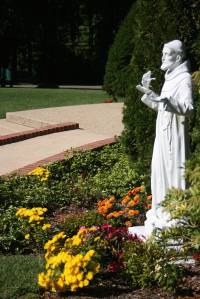
Today we honor the life of St. Francis of Assisi.  Francis is one of the most popular and admired saints of all time.  Most of us know the highlights of his story: born the son of a wealthy man in 1182; had a conversion experience and devoted his life to Lady Poverty; shaped monastic and lay devotion; was a friend to all God’s creatures – being know to have preached to the birds.

But the story I like most is the story about St. Francis and the Wolf.  According to legend, there was a wolf that was terrorizing the town of Gubbio, killing and eating animals and people.  The villagers tried to fight back, but they too died at the jaws of the wolf.  Francis had pity on the townspeople and went out to meet the wolf.  When Francis found the wolf, he made the sign of the cross, and said, “Come to me, Brother Wolf.  In the name of Christ, I order you not to hurt anyone.”  In response, the wolf calmly laid down at Francis’ feet.  Francis then went on to explain to the wolf how he was terrorizing the people and other animals – all who were made in the image of God.  The wolf and Francis then made a pact that he would no longer harm the townspeople and the townspeople would no longer try to hurt the wolf.  The two traveled into town to explain the pact they had formed.  The people were amazed as Francis and the wolf walked side-by-side into town.  Francis made the people pledge to feed the wolf and the wolf pledge not to harm anyone else.  From that day on, the wolf went door to door for food.  The wolf hurt no one and no one hurt the wolf; even the dogs did not bark at the wolf.[i]
What I love about this story of St. Francis is that the story is about reconciliation and relationship.  At the beginning of the story the town and the wolf are at an impasse – the wolf is hungry and getting attacked; the people are afraid and are lashing out.  What Francis does for both parties is shock them out of the comfortable.  For the wolf, no one has addressed the wolf kindly – they have either shut the wolf out or actively tried to kill him.  For the people, the wolf has not asked for help – he has simply and violently taken what he needed and wanted.  Francis manages to shock the wolf first – not through violence or force, but with the power of love and blessing.  By giving a blessing in the name of God, Francis is then able to implore the wolf to reciprocate with love.  Francis also manages to shock the village – not with a violent victory, but with a humble display of forgiveness and trust.  By walking into town with a tamed wolf at his side, Francis is able to encourage the town embrace, forgive, and care for the wolf.  Francis’ actions remind both parties that unless their relationships are reconciled, unrest and division will be the norm.

The funny thing about this story is that the story is pretty ridiculous.  I mean, how many of us go around talking to wild animals, blessing them with the sign of the cross, expecting anything other than being attacked?  We will never really know whether the story is true.  But like any good Biblical story, whether the story is true is hardly the point: the point is that the stories point toward “Truth” with a capital “T.”  What this story teaches is that peace and reconciliation only happen through meeting others where they are.  We cannot expect great change unless we are willing to get down in the trenches – to go out and meet that destructive wolf face-to-face.  The other thing this story teaches is relationships are at the heart of peace work.  Only when the wolf and the town began to get to know each other and began to form a relationship with one another could they move forward.

This is the way life is under Jesus Christ.  In our gospel lesson today, Jesus says, “Come to me, all you that are weary and are carrying heavy burdens, and I will give you rest.  Take my yoke upon you, and learn from me; for I am gentle and humble in heart, and you will find rest for your souls.  For my yoke is easy, and my burden is light.”  Jesus’ words have layered meaning.  The first meaning we all catch is that Jesus offers us rest and refreshment.  Jesus encourages us to come to him, to cast our burdens and cares upon him, and to take rest, to take Sabbath in Christ.  Our souls will find peace in Christ Jesus.  The second meaning is that peace in Christ Jesus is not without work.  Jesus does not say come unto me and relax forever in happy retirement.  Jesus says we will still have to take on a yoke – the burden of disciple living.  But luckily, that burden of being Christ’s disciple will not be burdensome – it will be light.  Finally, not only will Jesus make the workload “light,” as in not heavy.  Jesus will also make us “light” – as in lights that shine into the darkness and refuse to allow the shadow to overwhelm.[ii]  We become the light when we work for reconciliation in our relationships with others.

That is why we do so many special things today.  Today, we ask for healing prayers – that God might help us reconcile the relationships in our life that need healing.  Today, we ask for blessing on our animals – that God might help our relationship with our pet be one of blessing and light.  Today, we come to Jesus for Sabbath rest – that God might renew us on this Sabbath day, use the rest to fill us with light, and renew our commitment to be agents of reconciliation, gladly putting on Christ’s yoke.  Amen.

[i] John Feister, “Stories about St. Francis and the Animals,” as found at http://www.americancatholic.org/features/francis/stories.asp on September 30, 2014.

[ii] Mel Williams, “Let it go…and rest” Faith and Leadership, July 6, 2014 as found at http://www.faithandleadership.com/sermons/mel-williams-let-it-go%E2%80%A6and-rest  on September 30, 2014.

Homily – Isaiah 42.10–12, Harry Thacker Burleigh, September 11, 2014

19 Friday Sep 2014

Posted by jandrewsweckerly in Uncategorized

≈ Leave a comment

Tags

9/11, darkness, God, Harry Thacker Burleigh, homily, light, new song, September 11th, shadow

Today is a unique day.  Since 2001, we are unable to hear the words “September 11th” without associating the date with the events of that fateful day 13 years ago.  We remember where we were, what we saw, and how we felt.  We remember those who died – family members, friends, co-workers, and acquaintances.  September 11th is a day associated with pain – on both personal and national levels.  For many of us, we had never experienced a sense of such vulnerability to terror and devastation in our home country.  And though we do not live in an active war zone, the events of that day changed life here forever.  In fact, there is a whole generation now that has grown up in a post-9/11 world.

Harry Thacker Burleigh knew a little about what growing up in the shadow of darkness meant.  Born in 1866 in Erie, Pennsylvania, right after the Civil War, Harry’s grandfather, a former slave who had been blinded by a savage beating, passed along old spirituals to Harry.  That music was a gateway for Harry.  With some difficulty, Harry won admission to the National Conservatory of Music.  Meanwhile, he became a soloist at St. George’s Episcopal Church in New York City.  He faced resistance at St. George’s as a black man in the choir, but over time he became a beloved part of the congregation.  In time, Harry became a respected composer, arranger, and music editor.  He also played a key part in making old spirituals widely accessible.

Despite living in the shadow of slavery, Harry seemed to have embraced the words from Isaiah: “Sing to the LORD a new song.”  Harry could have easily kept his head down and simply survived in a post-slavery world.  Instead, he pushed for a new life – for the freedom to express himself.  He literally and figuratively sang a new song to the LORD, making music that reinterpreted the old spirituals, but also making a new life through music.  His making a new song made light shine into the darkness all around him – and he transformed the world around him.

God invites us to sing a new song in a post-9/11 world.  The invitation for us is to figure out what our new song will be.  We cannot erase what happened to us and to our country on that fateful day.  But we can change how we shine light into the shadows left over from that day.  So sing to the LORD a new song – in only the ways that you can.  Amen.

Sermon – Matthew 5.13-20, E5, YA, February 9, 2014

12 Wednesday Feb 2014

Posted by jandrewsweckerly in Uncategorized

≈ 1 Comment

Tags

generous, God, Jesus, light, public, shine

Today we are going to try something a little different.  The text that we just heard from Matthew was in the New Revised Standard Version.  The text says, “You are the light of the world.  A city built on a hill cannot be hid.  No one after lighting a lamp puts it under the bushel basket, but on the lampstand, and it gives light to all in the house.  In the same way, let your light shine before others, so that they may see your good works and give glory to your Father in heaven.”  The New Revised Standard Version is lovely, giving us the beautiful metaphor about us being light; and that by shining our light, we allow others to give glory to God.  But sometimes, we hear scripture so often that the language becomes stale.  I can almost imagine the inner monologue of many of us in the room, “Yeah, yeah, yeah, Jesus.  I know the song, ‘This little light of mine.’”  Or maybe you have some mental image of the super chipper, always happy person, whose face seems to radiate light, and whose life seems so perfect that just remaining friends with them is a challenge.

So in order to get you out of your “This little light of mine,” rut, I want you to hear the same text from a paraphrase version of the Bible called The Message.  “Here’s another way to put it: You’re here to be light, bringing out the God-colors in the world.  God is not a secret to be kept.  We’re going public with this, as public as a city on a hill.  If I make you light-bearers, you don’t think I’m going to hide you under a bucket, do you?  I’m putting you on a light stand.  Now that I’ve put you there on a hilltop, on a light stand—shine! Keep open house; be generous with your lives.  By opening up to others, you’ll prompt people to open up with God, this generous Father in heaven.”  Something about this version of Jesus’ words makes me much more excited about the idea of being light.  This version of Jesus is a little like the cool teacher from school, who wants to break it down for you so you can understand and act.

Let’s take the passage line by line.  First Jesus says, “You’re here to be light, bringing out the God-colors in the world.”  We learn two things from this first line.  First, we have a purpose in life – to be light.  If ever you are floundering with who you are or what you are meant to do with your life, Jesus reminds us that we are here to be light.  Second, being light means we will bring out the God-colors in the world.  Just this past week, I have found light in all sorts of fun places:  the sunset catching a wall of tall trees whose limbs were all frozen, making the light sparkle in the sunset; the afternoon sun that shines through our stained glass windows, making a beautiful mosaic of color in the Narthex; the morning sun that peaks through the trees, warming not only my cold body, but also reminding me that there is still hope in the bleak midwinter.  But God-colors are not just experiences with light; they are also the full range of the goodness of God – the red of God’s love, the yellow of God’s mercy, the green of God’s refreshment, the blue of God’s forgiveness, and the purple of God’s grace

So if our purpose is to be light that brings out the God-colors of the world, are we allowed to hold that knowledge and comfort in ourselves?  Not according to Jesus.  Next he says, “God is not a secret to be kept.  We’re going public with this, as public as a city on a hill.”  Now I know we have been talking a lot about evangelism this past year.  We have been talking about sharing our stories with our neighbors, and listening for and naming God in the world.  And for many of us, including me at times, this has made us wary or anxious.  But Jesus words in this paraphrase sound like a hype-man who makes us want to get out there.  We’re going public!  We’re going to get out there, and show some love and light!  I don’t know about you, but this gets me much more excited about Jesus’ metaphor.

So as Jesus gets us hyped up, telling us he wouldn’t dare hide us under a bucket, Jesus gives us a simple task: Shine!  You are already light, a light that points to the beautiful God-colors in the world.  Our only remaining job?  To shine!  Be the light that God created you to be.

Now, you might be wondering, okay, shining sounds simple enough, but what does that really mean?  Jesus gives us more: “Keep open house; be generous with your lives.”  Now certainly generosity means sharing our earthly possessions.  But the kind of generosity Jesus is talking about is also hospitality.  When I was in college, I befriended a campus minister who had a family of five.  They had a guest room downstairs connected to a bathroom.  For as long as I knew her, someone was always in that guest room.  Whether the room was used by a seminarian, a recent college graduate looking for work, or someone doing volunteer service for a year, that room was always in use.  This is what Jesus means when he says to be generous with your lives.  Share that guest room.  Take time out of your day to visit a shut-in or someone who is sick and stay longer than you really want to.  Stop for that person asking for a handout and hear a bit of their story.  Be generous with your life.

And why do we need to do all of this?  Jesus says, “By opening up to others, you’ll prompt people to open up with God, this generous Father in heaven.”  Here’s the funny twist at the end.  Jesus basically says both “it is all about you,” and “it is not at all about you.”  The “all about you” is the need to open up to other.  Maybe for you that means being more vulnerable than feels comfortable.  Maybe for you that means being present with someone you would rather not be present with.  Maybe for you that means trying something that takes you out of your comfort zone.  And why do we have to focus on opening up to others?  That’s the “it’s not all about you” part.  Your opening up to others encourages others to open up to God.  At the end of the day, that is what all of this hype and vulnerability and shining is all about – about helping others to see and know and open up to the God whom we find so incredible.  By putting ourselves out there, we become a doorway for others to God.  What a fine privilege!  So be a light that shines.  Get out in the world.  Keep open house.  Be generous.  Open up to others.  Your work allows the rest of the world “in” on the secret:  because we’re going public!  Amen.

Sermon – John 1.1-14, CD, YA, December 25, 2013

08 Wednesday Jan 2014

Posted by jandrewsweckerly in Uncategorized

≈ Leave a comment

Tags

Christmas, darkness, death, God, incarnation, Jesus, John, light, prologue, resurrection

I must admit that I have always been a little wary of John’s prologue at Christmas time.  I tend to prefer the earthy stories of Jesus in a manger, of dramatic angelic appearances, of messy shepherds, and of a baffled holy family.  I like that I can picture the events in my mind and ponder their meaning.  I like that I could imagine myself there and even wonder what the events mean to me two thousand years later.  My love of these stories is only accentuated by the songs we sing on Christmas Eve, and the nostalgia the music brings to me.

But today, on Christmas Day, we get none of that.  We sing no songs, we hear no romantic, familiar stories, and we do not get lost in the ancient narrative.  Instead, on this busy, often loud day, we come into a totally different space – a place of quiet reverence – and we hear a totally different text.  John does not go back to the beginning of Jesus’ story – he goes back to the beginning of all our stories.  “In the beginning was the Word, and the Word was with God, and the Word was God.”  Our minds drift not back to a stable, but to the beginning of creation, when the earth was a formless void – tohu wavohu.  Whereas our synoptic gospels try to tell us about who Jesus is by giving a story about his birth narrative, John’s gospel takes an even wider lens to try to explain who Jesus is.

In some ways the contrast between Christmas Eve’s stories about the stable and Christmas Day’s quiet reflection on the beginning of time is quite appropriate.  On Christmas Eve we are full of giddiness and excitement.  We break the long anticipation of Advent with a festive celebration of Jesus’ birth.  We share in jubilation, as if we are a crowd of people gathered at the maternity ward, sharing cigars and bear hugs.  But today, like a crew that has come in to clean up after a late-night party, we gather in these pews with a bit more sobriety, deeply pondering what all this incarnation stuff means.  For that kind of work, John’s gospel is the perfect gift.  John almost seems to say, “Yes, all those stories you know and love about Jesus are true and are to be celebrated.  But do not get swept away in the excitement and forget what this really means.”

For John, he begins his gospel starting not with details of the event of the incarnation, but with details about the significance of the incarnation.  For John, he is not interested in the sentimentality of a cute baby.  John is interested in the astounding fact that God became incarnate – took on flesh, lived among us, took on our dirty, gritty lives, and faced rejection and suffering – all so that we might live.  The God of creation – that same creative God we know from Genesis – is the same God who comes among us.  The Word has always been, and yet the Word also enters into human history to give life and light to the people.  When we talk about this kind of momentous significance, it is no wonder that we gather here in quiet awe of our God, soberly realizing the tremendous, salvific gift of the Word made flesh coming to dwell among us.

In some ways, the contrast between Christmas Eve and Christmas Day are hitting home a little more vividly this year.  On the one hand, I have a four-year old, who really gets Christmas this year, who is excited beyond belief about baby Jesus, St. Nicholas, presents, and visiting family.  Her enthusiasm is infectious, and I want to cultivate that joy.  I am reminded of that collect from compline that asks God to “shield the joyous.”  But on the other hand, death has been heavy around me these last few days.  A dear friend from Delaware died this weekend, St. Margaret’s Cemetery helped a young couple from a neighboring church bury an 8-month stillborn child on Monday, and just two days ago, a St. Margaret’s parishioner lost his mother.  In light of the grief of those around me, I am grateful for a sober reminder of the awesomeness of our God, the salvation and promise of resurrection that is only made possible through the incarnation – that Word made flesh who lived among us, and who is full of grace and truth.  In the end, there is hope on both sides – hope for the happily joyous this season and hope for the soberly mournful this season.  I thank God for a Church who tends to both sets of needs, but mostly I thank God for taking on our earthly flesh, for giving us the Word who knew both joy and sorrow, and for promising us that the light shines in the darkness, and the darkness does not overcome it.  Amen.

Homily – John 10.11-16, Cemetery Memorial Service, December 21, 2013

08 Wednesday Jan 2014

Posted by jandrewsweckerly in Uncategorized

≈ 2 Comments

Tags

Blue Christmas, Christmas, funeral, God, Good Shepherd, grief, Jesus, light, memorial, shadow, winter solstice

Last week I attended the funeral of a parishioner’s mother.  As I sat in a cold pew, on a messy, snowy day, I remember thinking how hard Christmas would be for the family this year.  When death is so fresh at your door, hearing songs that proclaim this to be the “most wonderful time of the year,” do not exactly ring true.  When the loss is so new, finding the energy to send cards or get presents sometimes feels half-hearted, if not impossible.  When the absence is so overwhelming, even preparing a favorite recipe of the lost loved one can feel like ripping open one’s heart as you measure, stir, bake, and taste the memories.

I would love to tell families that coping with the loss gets easier over time, but my experience is that no matter how long ago your loved one passed away, the loss still creates an ache in your heart that never really goes away – especially during Christmas time.  Society, and even the Church, tells us that the Christmas season is supposed to be filled with joy, light, and hope.  But for those with grief, Christmastime just reminds us of all the Christmases that we enjoyed with our loved ones – the memories we have, the traditions we enjoyed together; even the bickering and disagreements would seem preferable to not having our loved one at all.  As time goes on and the family grows, you mourn all the new life that they will never see.

Part of the reason we gather today is to honor the shadow side of Christmas.  We acknowledge the pain, suffering, and grief that Christmas can bring.  We acknowledge the incompleteness, however slight, of the joy of this season.  We acknowledge that we might relate more to the Jesus who is in the tomb this season than the happiness of the Jesus born in a manger.  Today, on this winter solstice – the one day of the year with the least amount of light – we honor the fact that there are times of darkness in our faith.  And the Church stands with us, giving us permission to claim the darkness because, ultimately, we know that the light and the darkness cannot be separated.

That is why I find the gospel lesson today so affirming.  In John’s gospel, Jesus tells the disciples, “I am the good shepherd.  I know my own and my own know me.”  This is the reason why the Church encourages us to acknowledge grief today:  because Jesus already knows the hurt is there.  That is what makes him such a good shepherd.  There is no need to hide the fullness of who we are.  There is no need to try to fake good cheer.  There is no need to pretend to be constantly festive if we are not.  All we have to do is look around this room to realize that not only is Jesus with us in our memories or grief, our brothers and sisters gathered here today are also struggling with the conflicting nature of this season.

Acknowledging that hurt, we come together today to shine a little bit of light into that shadow side of Christmas.  Though we name the shadow side of Christmas, we also reclaim the light we find in Christmas.  Both in our gospel lesson and in the 23rd Psalm we proclaim the Lord to be our Good Shepherd.  We remember that the Lord is with us, that God’s rod and God’s staff comfort us.  We remind one another that we are not alone.  And we light a candle as we leave this place.  In the midst of darkness, we cling to that light – even if only a small flicker from our one candle.  We take that candle to our loved one’s grave remembering all the light that they brought to us.  But that flame goes with us too.  Perhaps we will find that just naming our pain today allows that flame to shine slowly, but steadily, in us.  Perhaps as we see the candles flicker at Christmas services in a few days or in our homes over this next week, we will remember the light of Christ reaching out to us, inviting us to remember that the darkness will not overwhelm us.  Or perhaps that flame will remind us of a deeper joy – not the joy of presents, eggnog, and parties – but the joy of a Good Shepherd who knows us, who loves us, and who will continue to shine a light onto our path.

On this winter solstice, I invite you to remember that after today, our days start claiming more light.  No longer will our days keep getting shorter.  Our days will slowly start to lengthen.  The light will refuse to let the darkness take over.  That is the good news that we proclaim today as we remember our loved ones.  Though there may always be a part of us that hides in the shadows of Christmas, Christ still shines a bit of light in our lives too – sometimes only as little light as is found on the winter solstice – but sometimes as much light as we find in the summer solstice.  So hold fast to the Good Shepherd.  Hold fast to the light.  Hold fast to the promise of resurrection life that is for our loved ones and for us.  Those promises can make even the shadow side of Christmas a little brighter.  Amen.

Homily – Colossians 4.2–6, John of the Cross, December 12, 2013

19 Thursday Dec 2013

Posted by jandrewsweckerly in Uncategorized

≈ Leave a comment

Tags

Advent, darkness, God, homily, John of the Cross, light, prayer

Today we honor Juan de la Cruz, or John of the Cross.  Though he died in 1591, John was widely unknown until more recently.  Born in 1542 in Spain, his father died when he was three.  His mother and siblings were thrown into poverty.  He received early education in an orphanage, but by 17 he had learned carpentry, tailoring, sculpting, and painting through apprenticeships.  He was able to do his university studies with the Jesuits; after school he joined the Carmelite order.  In 1567, he was ordained to the priesthood and recruited by Teresa of Avila to reform the Carmelite order.  He studied extensively, was a spiritual director, and devoted himself to the search for God.  Because of his attempts to dramatically reform the Carmelites, he was eventually imprisoned.  There he wrote poetry as a comfort.  His “Dark Night of the Soul” became his most famous piece.  As John of the Cross has been rediscovered, he has become known as “the church’s safest mystical theologian” and “the poet’s poet.”

I was thinking John must have known a lot about the dark night of the soul.  He had a rough childhood, fought to get an education, and then found incredible resistance when he tried to make the devotion of the Carmelites better; his prison cell must have felt like a dark night.  I am reading an Advent devotional right now, and it has felt pretty dark at times.  I can tell the author has experienced some rough times, though she never specifies what they are in her poetry.  But the darkness of her soul pervades her writing.  I have wondered as I read why she is putting such darkness in our Advent devotional – a season of light.  But then I thought about the realities of this season – the pain the season can bring of lost loved ones, of unfulfilled dreams, of unmet expectations, of pressure and anxiety.  Perhaps the author, like John of the Cross, is willing to expose the dark night that can live in the soul.

So where is the light for us to grasp in Advent?  I appreciate those words of instruction in Colossians: “Devote yourselves to prayer.”  Prayer is one of the places that we can dump darkness and discover light.  Prayer is the conversation in which we can struggle vulnerably and honestly with God, and eventually end up on the other side renewed and refreshed.  This is one of our Advent invitations:  devote yourselves to prayer.  Whether you already feel bathed in light or you are longing for the light, prayer is the place where we meet God and we find strength for the journey.  Amen.

Homily – Isaiah 60.1-5, John Raleigh Mott, October 3, 2013

05 Saturday Oct 2013

Posted by jandrewsweckerly in Uncategorized

≈ Leave a comment

Tags

gospel, homily, Jesus, John Raleigh Mott, joy, light

Today we celebrate John Raleigh Mott.  John was born in 1865 and was known as an evangelist and ecumenical pioneer.  As a young man he worked with various organizations including the World Student Christian Federation and the YMCA.  He helped organize the International Missionary Conference in 1910 – one of the broadest gatherings of Christians up to that point.  Of Christian mission he said, “It is a startling and solemnizing fact that even as late as the 20th century, the Great Command of Jesus Christ to carry the Gospel to all mankind is still so largely unfulfilled … the Church is confronted today, as in no preceding generation, with a literally worldwide opportunity to make Christ known.”  His work developing the ecumenical movement continued, and in 1946 he received the Nobel Peace Prize for his work establishing and strengthening international organizations that worked for peace. 

What is interesting about John’s comments from the early 1900s is that they seem to ring true 100 years later.  We, too, are not fulfilling Jesus Christ’s command to carry the Gospel to all mankind.  Forget around the world – we don’t even want to talk to our next-door neighbors about Jesus.  We get so caught up in not wanting to offend that we can’t even share the story in our lives that brings us such joy.  So where do we find inspiration despite our fears?

I think our lesson from Isaiah helps with this.  “Arise, shine; for your light has come, and the glory of the LORD has risen upon you … Nations shall come to your light, and kings to the brightness of your dawn.”  We forget that our joy, our story of faith when told honestly and vulnerably, shines before others.  I have seen that light in each of you here as you share your faith stories.  Joy inspires joy, and makes us radiant.  We even hear the same in the Gospel lesson.  The joy from seeing Jesus interact with the widow causes people to spread the word throughout the surrounding area – their joy became a light to the nations.

Joy is why we celebrate John Raleigh Mott, too.  His joy drew people in and propelled him out into the world to share that joy.  John invites us today to remember that same joy in ourselves.  We will find, like him, that as we go out, people also come to us.  Nations shall come to your light – our invitation is to share that light!  Amen.

Sermon – Luke 24.1-12, EV, YC, March 30, 2013

10 Wednesday Apr 2013

Posted by jandrewsweckerly in Uncategorized

≈ Leave a comment

Tags

Easter Vigil, God, light, liturgy, Messiah, movie, salvation, Sermon, tomb

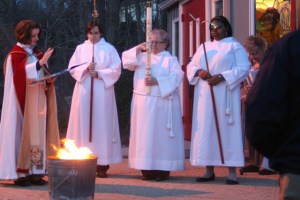
IMG_3202Our liturgy tonight operates a bit like a movie whose mode of telling stories is in flashbacks.  We start the movie with the scene we just heard.  Several women are gathered around the empty tomb, their mouths agape, and their minds racing.  And then, the flashbacks begin.

Mary the mother of James recalls that ancient story of creation.  That empty tomb reminds her of those words – tohu wabohu – the formless void.  She vaguely remembers what God said about creating humankind in God’s image.  And she hears those words repeated over and over again, “It was good; ki-tov”

Meanwhile, another woman flashes back to when humankind’s sinfulness so angered God that God flooded the earth.  For forty days, Noah knew the nothingness of that empty tomb in front her.  But she also remembers that covenant God made with Noah – that never again will there be a flood to destroy the earth.  Perhaps there is a rainbow in this tomb, and not only the watery floods that she sees.

Joanna looks into that empty tomb and remembers another time her people faced desperation.  She flashes back to the rushing Egyptians who have pinned her people to the Red Sea.  She remembers the panicked screams of her people toward Moses.  She remembers how God saved them then – how God created a way out of no way.  She wonders whether the empty tomb is not unlike that empty seabed – the one that the Israelites used to get to freedom.

Another woman stares into that vacant tomb and she remembers a different tomb.  She remembers the death and hopelessness of those bones in that valley – the thousands of devastated lives.  But then she remembers what God told Ezekiel.  She remembers the rattling of those bones coming together, and the way the breath of God, the ruah of God breathed life into those bones.  She wonders if she hears the faint ruah of God now coming out of that empty tomb.

But Mary Magdalene remembers a different story from Zephaniah.  She hears the words of that song in a fresh way today.  “Sing aloud, O daughter of Zion.”  Is this the day that God will save us?  Can her beloved Jesus be not missing, but raised?  Might Jesus be the one who will restore her fortunes?  She longs for God to be saying to her, “Rejoice and exult with all your heart, O daughter Jerusalem.”  “Please let this empty tomb be an occasion for rejoicing and not for more pain and suffering for my Lord,” Mary Magdalene prayers in her heart.

And then the movie brings us abruptly back to the empty tomb, the sound of silence like so many times before in their history.  The appearance of emptiness threatens their fragile, exhausted psyches.  Their unspoken memories fail to comfort them because they are unable to utter a word of remembrance and assurance to one another.

As outsiders watching this movie, as we watch those looking into the tomb, we begin to connect the various flashbacks.  The answers are there before the angels need to say a word.  God loves us and creates us in God’s image.  And we are not only good – but we are very good – wehineh-tov.  God promises to never destroy us again as God once did.  God promises liberation from oppression.  God promises restoration to our bodies and spirits.  God promises to bring us home.  God promises and God saves us time and again.  And now, with this Messiah who has finally arrived, God saves us once and for all.  What has felt like a defeat is now the reason to rejoice.  The smiles that spread across our faces are exact mirrors of the smiles that spread across the faces of those women at the tomb.  The smiles are smiles that happen as we connect the varied flashbacks, remembering our salvation history, and this final act of salvation through the death and resurrection of our Lord and Savior Jesus Christ.  That tomb is not a formless void, but the holy site where all our salvation narrative culminates.  That empty tomb is in fact not empty at all.  That tomb is full of life.  Tonight is a night for alleluias, for songs of joy, and for dancing.  The light shatters the darkness this night, and we celebrate the greatest victory of all time.  Alleluia! Christ is risen.  The Lord is risen indeed!!

Sermon – John 18.1-19.42, GF, YC, March 29, 2013

29 Friday Mar 2013

Posted by jandrewsweckerly in Uncategorized

≈ Leave a comment

Tags

cross, dark, Good Friday, hope, Jesus, light, Sermon, sin, stark, ugliness

Good Friday is one of the most difficult liturgies in the Church year.  The tone of the liturgy alone is stark.  Without our usual adornments and vestments, without music, and without our sacred sacramental feast, we are already feeling bereft.  But added on top of all this starkness is our passion reading from John.  This is one of those stories that gets worse and worse as we read.  Our tendency in the face of such overwhelming grief and failure is to start disassociating ourselves from others, somehow hoping to deny that there is ugliness in each of us that could lead to the exact same results had we been there.

We would like to believe that we would never betray Jesus in the way that Judas does.  Surely nothing could ever lure us into such a treacherous act.  Unless, of course, we think Jesus needs a little motivation.  Many have argued that Judas’ betrayal is caused by his desire to push Jesus into the role of a political Messiah – to assume the military power that rightly belongs to Jesus.[i]  If we believe as Judas does that Jesus is the political Messiah that we had been waiting for, perhaps we too might find some way to give Jesus a push to fight back.  Surely we have all experienced impatience and pushed others along the way.  Judas’ ugliness seeps into even us at times.

If we have to admit that some of Judas is in us, then at least we can imagine that we would not betray Jesus as Peter does.  We all know that Jesus has said following him will lead to death – we would say “Yes,” to that servant girl’s question because, come what may, we would stand with Jesus.  But how many of us have failed ourselves and our friends under similar pressure.  That survival instinct – that desire to protect ourselves takes over all the time – even if only in the form of white lies that cover our interests.  We have to remind ourselves that Peter wants to be a better disciple – he does attempt to protect Jesus with the sword, and he at least follows Jesus into the cold courtyard.  Who knows if we could have done that?  So parts of Peter must be in us too.

If we concede some of Judas and Peter in us, surely we can at least claim that we are not like Caiaphas.  Surely we would never look at Jesus and claim, “It is better for one person to die for the people.”  Surely we always stand on the side of goodness – except, of course, when we are choosing the lesser of two evils, as Caiaphas claims he is doing.  I remember a classic ethics case in seminary.  A group of Jews were hiding from the Nazis.  A baby in the group starts crying.  The ethical question is this:  Do you suffocate the child in order to protect the lives of the whole group, or do you save the child, knowing that the entire group will be discovered because of the crying baby and most likely murdered.  Just because one option is less evil does not make the option good.  Unfortunately, Caiaphas can be found in us also.

Perhaps, then, we can still deny the Pilate in ourselves.  We see in Pilate a man who knows the right thing to do, but who keeps waffling, trying to weasel out of a decision.  But we too have had times of indecision, even when we know what to do; because the right thing is rarely the easy or popular thing.  How do any of us fare when faced with a group who is staunchly opposed to what we know is right?  Yes, Pilate is in us too.

Having experienced many passion narratives where we have been required to say the “crowd” part, “Crucify him,” we would like to believe that we would never be like the chief priests who shout this line.  Surely we would not succumb to that same behavior.  But in the last several years, we have heard enough stories about mob mentality to know the power of the mob to deteriorate morals.  People say and do things they would never do otherwise when egged on by a crowd.  I think about that school bus monitor who was taunted by four boys on a school bus.  When the parents saw the video, they could not believe their children had done such a thing – had fallen in with the group.  We look at those boys and wonder how that could have happened, forgetting the times we have been swept up in anger or pushed to the point of breaking.  Yes, we have some of the chief priests in us.

So if we cannot deny all these individuals, perhaps we can at least deny the behavior of the soldiers.  We would never flog Jesus and mock him in the ways that they do.  We would not nail him to that cross or gamble for his clothes or pierce his side.  But all we have to do is remember those scandalous photos of the military prison in Abu Ghraib less than ten years ago to realize how corrupted judgment can become, especially for those who have to desensitize themselves to violence as soldiers often need to.  We all take on the behaviors of those biblical soldiers from time to time.

This is what makes Good Friday so difficult.  Certainly we are devastated about what happens to Jesus.  But more importantly, we are devastated because we know deep down, in the most sinful parts of ourselves, we too have betrayed Jesus, denied him, judged him, condemned him, rejected him, mocked him, cursed him, flogged him, and killed him.[ii]  What is so painful about this day is not so much Jesus’ painful death, but our own participation in that death.  That is why we leave here in silence, and why we keep watch in the face of our sinfulness.

But even in this most despairing of days, there is one sliver of hope for me.  Just as we can be Judas, Peter, Caiaphas, Pilate, chief priests, and soldiers, perhaps we can also be like Mary and the beloved disciple.  Perhaps we could also find the goodness in ourselves that would take the risk of standing at the foot of that cross.  Perhaps we can find in us the one who keeps watch until Jesus draws his last breath.  Surely we have all done this throughout our lives.  We too have set at the bedside of a loved one in their final hours.  We have fought sleep, given in to grief, rubbed a withered hand, and waited through the ambiguity of those last hours.

This is the image that gives me hope today.  I think of the countless bedsides I have joined, as we loved someone through to death.  We have spoken in hushed voices, patted each other on the back, and shared hugs.  We have shed tears, reminisced with stories, and prayed the prayers and psalms.  We have stumbled through goodbyes, hoping our words and presence show forth our love.  We have simultaneously felt helpless, and felt like we were doing the right thing.

This is our invitation today.  We claim all of the Judas, Peter, Caiaphas, Pilate, chief priests, and soldiers in us, but we also claim those who stand at the foot of the cross in us too.  The beauty is that we can do both – in fact we can stand at the foot of the cross more honestly if we recognize all the parts in us.  And we can stand at the foot of the cross more vigilantly when we look around and see the community of faith who stands there with us.  We can lean on one another, giving one another strength to live into the light over the darkness.  Even as we see him hanging on the cross, we stand as a community unwilling to let the darkness overcome the light.  Recognizing the dark and light in each of us, even on this darkest of days, we can choose to stand at the foot of the cross together, and claim the light.  Amen.


[i] George Arthur Buttrick, Ed., The Interpreter’s Dictionary of the Bible, vol. 2 (New York: Abingdon Press, 1962), 1007.

[ii] Jim Green Somerville, “Pastoral Perspective,” Feasting on the Word, Yr. C, Vol. 2 (Louisville: Westminster John Knox Press, 2009), 302-304.

← Older posts
Newer posts →

Recent Posts

  • On Politics, Football, and Love…
  • On Sharing the Love…
  • Sermon – Micah 6.1-8, Matthew 5.1-12, EP4, YA, January 30, 2026
  • On Justice, Kindness, Humility, and the Messy Middle…
  • Feast of the Rev. Dr. Martin Luther King, Jr., January 18, 2026

Archives

  • February 2026
  • January 2026
  • December 2025
  • November 2025
  • October 2025
  • September 2025
  • August 2025
  • July 2025
  • June 2025
  • March 2025
  • February 2025
  • December 2024
  • November 2024
  • October 2024
  • September 2024
  • August 2024
  • July 2024
  • June 2024
  • May 2024
  • March 2024
  • February 2024
  • January 2024
  • December 2023
  • November 2023
  • October 2023
  • September 2023
  • August 2023
  • July 2023
  • June 2023
  • May 2023
  • March 2023
  • February 2023
  • January 2023
  • December 2022
  • November 2022
  • October 2022
  • June 2022
  • May 2022
  • January 2022
  • December 2021
  • November 2021
  • October 2021
  • September 2021
  • August 2021
  • June 2021
  • May 2021
  • April 2021
  • March 2021
  • February 2021
  • January 2021
  • December 2020
  • November 2020
  • October 2020
  • September 2020
  • August 2020
  • July 2020
  • June 2020
  • May 2020
  • April 2020
  • March 2020
  • February 2020
  • January 2020
  • December 2019
  • November 2019
  • October 2019
  • September 2019
  • August 2019
  • July 2019
  • June 2019
  • May 2019
  • April 2019
  • March 2019
  • February 2019
  • January 2019
  • December 2018
  • November 2018
  • October 2018
  • September 2018
  • August 2018
  • July 2018
  • June 2018
  • May 2018
  • April 2018
  • March 2018
  • February 2018
  • January 2018
  • December 2017
  • November 2017
  • October 2017
  • September 2017
  • August 2017
  • July 2017
  • June 2017
  • May 2017
  • April 2017
  • March 2017
  • February 2017
  • January 2017
  • December 2016
  • November 2016
  • October 2016
  • September 2016
  • August 2016
  • July 2016
  • June 2016
  • May 2016
  • April 2016
  • March 2016
  • February 2016
  • January 2016
  • December 2015
  • November 2015
  • October 2015
  • September 2015
  • August 2015
  • July 2015
  • June 2015
  • May 2015
  • April 2015
  • March 2015
  • February 2015
  • January 2015
  • December 2014
  • November 2014
  • October 2014
  • September 2014
  • August 2014
  • July 2014
  • June 2014
  • April 2014
  • March 2014
  • February 2014
  • January 2014
  • December 2013
  • November 2013
  • October 2013
  • September 2013
  • August 2013
  • July 2013
  • June 2013
  • May 2013
  • April 2013
  • March 2013
  • February 2013
  • January 2013
  • December 2012
  • November 2012
  • October 2012
  • September 2012

Categories

  • reflection
  • Sermons
  • Uncategorized

Meta

  • Create account
  • Log in
  • Entries feed
  • Comments feed
  • WordPress.com

Blog at WordPress.com.

  • Subscribe Subscribed
    • Seeking and Serving
    • Join 395 other subscribers
    • Already have a WordPress.com account? Log in now.
    • Seeking and Serving
    • Subscribe Subscribed
    • Sign up
    • Log in
    • Report this content
    • View site in Reader
    • Manage subscriptions
    • Collapse this bar
 

Loading Comments...