
• About

Seeking and Serving

~ seek and serve Christ in all persons

Seeking and Serving

Tag Archives: Newtown

Sermon – John 14.1-6, Cemetery Christmas Memorial Service, December 22, 2012

23 Sunday Dec 2012

Posted by jandrewsweckerly in Uncategorized

≈ Leave a comment

Tags

blue, Christmas, death, grief, Jesus, Newtown, Sermon, St. Thomas, suffering

Less than two weeks ago, I would have told you that St. Margaret’s was progressing nicely toward Christmas, ready to celebrate the birth of the Christ Child.  We have had a blessed Advent, and have been looking forward to some wonderful liturgies, including this service.  But then tragedy struck Newtown, Connecticut, and since that time, many of our parishioners have been struggling not only to find their “Christmas Spirit” again, but have even been struggling with God in all this.  I have heard all sorts of questions from our parishioners.  “What kind of God allows this to happen?”  “Where was God when those poor children were being slaughtered?”  “How are we to trust God now?”

I imagine the emotional state of those who are active here at St. Margaret’s is a bit close to what many of you have already been struggling with for months or even years.  Christmas is one of the hardest holidays in the face of grief.  Parishes around the country celebrate “Blue Christmas” services because despite what all the media hype tells us, Christmas can be very hard for many of us.  All of the forced happiness and gift giving masks the pain, loneliness, and heartache that Christmas can bring.  When we are blessed to have our family around, we are reminded of the deep dysfunction and hurt that families sometimes create.  When we are away from family, we long for some idealized version of Christmas we have imagined in our heads.  And when we have lost someone to life beyond this life, we are reminded of all the Christmases we had with them, wishing we could have just a few more.  When faced with the kind of death we saw in Newtown, Christmas can be a time when we would rather rage at God than meekly sit at the Christ Child’s feet.

And so, today we gather.  We gather to lift up our “blue” feelings, our pain and our suffering, our anger and our sense of loss back to God.  We come today to lift that back to God, because we really do not know what else to do with all of that “stuff” inside of us.  Of course, we all experience death differently.  For some of us, the death of our loved one is recent, and the pain is as fresh as the day we lost them.  For others, our loved one has been gone for a while, but the hurt still lingers and catches us off guard at times.  And for others, our loved one has been gone for a long time, but the hollow in our heart will never fully close.

We come to God with all of our “stuff” because somewhere in the depths of our beings we know that God – and only God – can handle our “stuff.”  God can handle our anger, our pain, and our grief.  God can take our frustration, our fickleness, and our fears.  God can handle our lost hope, our distant hearts, and our distrust.  We know all of this because we see how Jesus treats Thomas in the gospel lesson we hear today.  Thomas is the one among the disciples who is always brutally honest, saying what no one else is willing to say, even if what he has to say does not portray himself in the best light.  This Thomas is the Thomas who refuses to believe in the risen Christ until he touches his wounds.  And today, in our gospel lesson, this Thomas is the panicked disciple who worries about how to find the way to this spacious dwelling place that Jesus has just described.  Jesus does not rebuke Thomas for his questions or even for his implicit doubts.  Instead, Jesus stays in relationship with Thomas, teaching him patiently what he needs to learn.

Jesus is patient with Thomas because the words that Jesus offers that day are critically important for Thomas to understand.  Jesus is explaining to Thomas and the other disciples gathered what they can now expect about the experience of death.  Through Jesus, they are promised resurrection life.  They are promised a dwelling place with abundant rooms – a place where Jesus will take them himself.  “Do not let your hearts be troubled.”  Jesus words are like the words of a soothing mother, teaching the disciples that the experience of death is changed through the life and death of our savior Jesus Christ.

In times of grief, whether grief over violence against children, or the grief over our own loved ones, Jesus words are what we cling to this holiday season.  If we can hear those words, “Do not let your hearts be troubled,” we may use this as our mantra to get us through this challenging time.  Do not let your hearts be troubled.  But if we cannot hear those words today, then remember Jesus’ presence with Thomas, even in the midst of Thomas’ confusion and pain.  Jesus stays with Thomas, helping him through this news.  So even if we need to be angry with God or are not ready to let our hearts stop being troubled, Jesus will stay with us.  Jesus is infinitely patient, preparing the way for us.  May you find some peace this Christmas season from Christ’s presence with you.  Amen.
Advent transition…

19 Wednesday Dec 2012

Posted by jandrewsweckerly in Uncategorized

≈ Leave a comment

Tags

Advent, Christmas, grief, incarnation, liturgy, Newtown

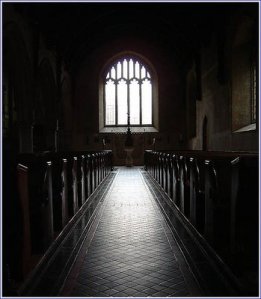
dark churchThis Advent has been a bit of an emotional rollercoaster.  Here in Plainview, at the beginning of Advent we were just getting back into a “normal” rhythm post-Hurricane Sandy.  One of my parishioners even noted that he realized I was “back in the game” when he got a flurry of church emails from me.  On Second Advent, we had our Annual Meeting, and we were all pleasantly surprised that an Annual Meeting could actually be quite fun and reinvigorating.  We were all heading toward the Christmas apex when the shooting in Newtown last Friday threw us for a loop.  Advent Three was one of the most mournful Sundays we have had in a while.  Many parishioners shared with me that they wanted to be in Church because they needed it.  We shared sadness, fears, and tears.  We lingered a little longer at Coffee Hour, needing the community of faith to help us process the event.  We all seem to be struggling to hold on to the “Christmas spirit.”

In the midst of this emotional rollercoaster, St. Margaret’s heads into a four-day series of liturgies that leads us to the manger.  I would be a little more anxious about how I was going to revive my own “Christmas spirit,” if the liturgies were not laid out as they are.  I am relieved to start our four days with our Cemetery Memorial services.  Every year we invite parishioners and family members who have loved ones buried in our cemetery to come for one of two memorial services.  We pray the burial office, listen to a necrology, and sing Christmas hymns.  The service is not simply for those whose names will be read.  This service really is becoming a “Blue Christmas” service – a service to recognize that Christmas is not always the happy version of perfection that commercials would have us believe.  Christmas is rife with baggage from our past, strife within families, feelings of loneliness or grief, and a general desire to pull inward during a season that tries to shove us outward.  In the wake of the shooting in Newtown, I am especially grateful for these liturgies.

After we get through these services, we move into Advent Lessons and Carols the next day.  On this last Sunday in Advent, we get the chance to really ease our way out of Advent and into Christmas by lingering in Advent through scripture and songs.  I am grateful for the gentle transition and pray that it will allow me the space to turn my thoughts and emotions to the blessing of Christ’s incarnation.

Perhaps after these liturgies I will be ready for our family service on Christmas Eve.  I am looking forward to the revamped service, in which our children and families will play an active leadership role in worship.  In a time when we have been mourning the loss of God’s beloved children, I cannot think of a better way to embrace Jesus’ command to, “Let the little children come to me.”  Perhaps by then I will be relieved to join the choir in singing those long-awaited Christmas hymns and to enter into the Holy Night of Christmas Midnight Mass.

Of course, if all of that does not do the trick, certainly the spoken service on Christmas Day might.  The quiet of that service is a nice place to recenter in the midst of a crazy time.  Sure, opening presents will be fun, especially with my more aware three-year old, but the quiet of church may be the safe haven we all need to ground the day in Christ Jesus.  It is at times like this that I am grateful for the ways in which the Episcopal Church is a church rooted in rich liturgies.  Come join us!

Sermon – Luke 3.7-18, A3, YC, December 16, 2012

17 Monday Dec 2012

Posted by jandrewsweckerly in Uncategorized

≈ Leave a comment

Tags

Advent, God, Newtown, repentance, seeking, Sermon, serving, sharing, sin

I have been reeling since hearing the news of the shooting tragedy in Newtown, Connecticut on Friday.  The emotions alone are still raw.  The image of twenty-seven families losing a child or parent is heart-wrenching.  At a time when many of them were probably gearing up for the holidays, now they are planning funeral liturgies.  The image of hundreds of families gratefully greeting their children is tainted by what will be weeks if not years of therapy for innocence lost.  I know my own child is still recovering from fears from Hurricane Sandy – I can only imagine the fears these families will have to process.  The image of police officers and first responders flooding the scene, faithfully doing their jobs is marred by the probability that they too will need months and years to process the scene:  not with the eyes of professionals, but with the eyes of human beings.  As one FBI officer explained, although they are trained to do their jobs professionally, they are not unfeeling robots.

We too are left with a swirl of emotions.  I have felt deep sadness, confusion, shock, anger, and frustration.  With few answers to questions, we do not know who to blame or how to respond.  As you watch the news and follow social media, you can already hear the call to demonize guns, the mental health field, government, and the shooter.  In some ways, blaming someone or something would make the whole experience easier.  Otherwise, we are left bereft, feeling God’s absence or at least questioning God’s presence in suffering.

I wondered today, then if John the Baptist’s message this Advent was even relevant.  Perhaps we could turn somewhere else altogether today for solace.  But the more I thought about the gospel lesson, the more I realized John’s message of repentance is exactly what we need today.  On this “Stir Up Sunday,” John’s message of repentance stirs up in us our own culpability in the presence of sin in this world.  While I desire to point a finger at someone else for the sinfulness of the world, John the Baptist tells me, to look at my own sinfulness today.  John says, “Do not begin to say to yourselves, ‘We have Abraham as our ancestor’; for I tell you, God is able from these stones to raise up children of Abraham.”  In other words, do not let your redeemed status, your chosen status, let you get complacent about your sinfulness.  In today’s terms, do not let your identity as not being the shooter let you believe yourself to be free of sin.

As our confirmands prepare for confirmation this spring, they are working through a curriculum that keeps pointing them back to the Catechism.  In our Catechism are a series of questions I find helpful today.  Turn, if you will, with me to page 848 of your Prayer Books.  Here are the questions on sin:

What is sin?  Sin is the seeking of our own will instead of the will of God, thus distorting our relationship with God, with other people, and with all creation.  How does sin have power over us?  Sin has power over us because we lose our liberty when our relationship with God is distorted.  What is redemption?  Redemption is the act of God which sets us free from the power of evil, sin, and death.  How did God prepare us for redemption?  God sent the prophets (like John the Baptist!) to call us back to himself, to show us our need for redemption, and to announce the coming of the Messiah.  What is meant by the Messiah?  The Messiah is one sent by God to free us from the power of sin, so that with the help of God we may live in harmony with God, within ourselves, with our neighbors, and with all creation.

This Advent, and in light of this tragedy, we are all invited to reflect on how our sinfulness pulls us away from God, one another, and all creation.

As dark and disheartening as John’s message may feel today, our gospel lesson does not leave us without guidance.  Three times, in response to John’s call to repentance, different groups of people ask the same question, “What then should we do?”  That question has been echoing with me all week, especially after Friday.  What then should we do?  To each group in the text, John has different advice – advice that is specific to their lot in life.  To the crowds he says, “Whoever has two coats must share with anyone who has none; and whoever has food must do likewise.”  To the crowds, John gives them the work of justice.  They are to share their abundance with others.  This is their work of repentance.  To the tax collectors, John says, “Collect no more than the amount prescribed for you.”  Tax collectors were able to survive by charging more than the base tax – their comfort came from these overages.  John challenges this widely accepted practice with another call to justice.  The tax collectors are not to abuse their positions of power.  This is their work of repentance.  To the soldiers, John says, “Do not extort money from anyone by threats or false accusations, and be satisfied with your wages.”  The soldiers used violence and manipulation for their own personal gain.  John challenges them to rule with justice.  The soldiers are to care for the people, not abuse them.  This is their work of repentance.  For each person, John saw a unique way of living a repentant life based on the vocations and values of that specific individual.[i]

Asking the question, “What then should we do?” is where John tries to get us today.  At this time of year, when we receive the most requests for contributions to churches, nonprofits, and universities, opportunities abound for goodness.  In the wake of Hurricane Sandy, as we learn of our neighbors here in Plainview – students and teachers at the school just down Washington Avenue – who need our help, opportunities abound for goodness.  In the wake of national violence, as we make sense of suffering and pain and as we enter into authentic conversation with our neighbors, opportunities abound for goodness.

The opportunities for goodness, the answer to the question “What then shall we do?” are found in our baptismal covenant.  As we discussed last week at our Annual Meeting, I have been discerning with our Vestry about who St. Margaret’s is and what our work is to be about.  We have wondered together this past year about what is the message that we want to convey to others about our identity.  Out of that discernment has emerged three verbs:  seeking, serving, and sharing.  We are a community that is seeking a deeper relationship with Christ, where seekers can simply be seekers on the journey with us.  We are a community that is serving our neighbors, loving and caring for them.  And we are a community that is sharing the good news of St. Margaret’s and the Good News of Christ Jesus with our community.  In these three words, seeking, serving, and sharing, we are, as our baptismal covenant suggests, proclaiming by word and example the Good News of God in Christ and seeking and serving Christ in all persons, loving our neighbor as our selves.  So when we look at that question of “What then shall we do?” our answer is to be a people seeking, serving, and sharing.

Luckily, our lectionary does not give us with a strong challenge without some encouragement.  We hear the comforting words from another of God’s prophets, Zephaniah.  “Do not fear, O Zion; do not let your hands grow weak.  The LORD, your God, is in your midst…he will rejoice over you with gladness, he will renew you in his love; he will exult over you with loud singing.”  In the face of tragedy, God does not leave us without work to do.  As we repent of our sins, what we shall do is to seek, serve, and share.  But in case that work feels like work, God encourages us in the journey.  Do not fear.  Do not let your hands grow weak.  God will renew you in God’s love.  Our work is laid out before us – we can get out there, seeking, serving, and sharing, because God will renew us in love.  Amen.


[i] Kathy Beach-Verhey, “Homiletical Perspective,” Feasting on the Word, Yr. C, Vol. 1 (Louisville: Westminster John Knox Press, 2009),71.

Recent Posts

  • On the Myth and Magic of Advent…
  • On Risking Failure and Facing Fear…
  • Sermon – Luke 23.33-43, P29, YC, November 23, 2025
  • On Inhabiting Gratitude…
  • Sermon – Luke 20.27-38, P27, YC, November 9, 2025

Archives

  • December 2025
  • November 2025
  • October 2025
  • September 2025
  • August 2025
  • July 2025
  • June 2025
  • March 2025
  • February 2025
  • December 2024
  • November 2024
  • October 2024
  • September 2024
  • August 2024
  • July 2024
  • June 2024
  • May 2024
  • March 2024
  • February 2024
  • January 2024
  • December 2023
  • November 2023
  • October 2023
  • September 2023
  • August 2023
  • July 2023
  • June 2023
  • May 2023
  • March 2023
  • February 2023
  • January 2023
  • December 2022
  • November 2022
  • October 2022
  • June 2022
  • May 2022
  • January 2022
  • December 2021
  • November 2021
  • October 2021
  • September 2021
  • August 2021
  • June 2021
  • May 2021
  • April 2021
  • March 2021
  • February 2021
  • January 2021
  • December 2020
  • November 2020
  • October 2020
  • September 2020
  • August 2020
  • July 2020
  • June 2020
  • May 2020
  • April 2020
  • March 2020
  • February 2020
  • January 2020
  • December 2019
  • November 2019
  • October 2019
  • September 2019
  • August 2019
  • July 2019
  • June 2019
  • May 2019
  • April 2019
  • March 2019
  • February 2019
  • January 2019
  • December 2018
  • November 2018
  • October 2018
  • September 2018
  • August 2018
  • July 2018
  • June 2018
  • May 2018
  • April 2018
  • March 2018
  • February 2018
  • January 2018
  • December 2017
  • November 2017
  • October 2017
  • September 2017
  • August 2017
  • July 2017
  • June 2017
  • May 2017
  • April 2017
  • March 2017
  • February 2017
  • January 2017
  • December 2016
  • November 2016
  • October 2016
  • September 2016
  • August 2016
  • July 2016
  • June 2016
  • May 2016
  • April 2016
  • March 2016
  • February 2016
  • January 2016
  • December 2015
  • November 2015
  • October 2015
  • September 2015
  • August 2015
  • July 2015
  • June 2015
  • May 2015
  • April 2015
  • March 2015
  • February 2015
  • January 2015
  • December 2014
  • November 2014
  • October 2014
  • September 2014
  • August 2014
  • July 2014
  • June 2014
  • April 2014
  • March 2014
  • February 2014
  • January 2014
  • December 2013
  • November 2013
  • October 2013
  • September 2013
  • August 2013
  • July 2013
  • June 2013
  • May 2013
  • April 2013
  • March 2013
  • February 2013
  • January 2013
  • December 2012
  • November 2012
  • October 2012
  • September 2012

Categories

  • reflection
  • Sermons
  • Uncategorized

Meta

  • Create account
  • Log in
  • Entries feed
  • Comments feed
  • WordPress.com

Blog at WordPress.com.

  • Subscribe Subscribed
    • Seeking and Serving
    • Join 394 other subscribers
    • Already have a WordPress.com account? Log in now.
    • Seeking and Serving
    • Subscribe Subscribed
    • Sign up
    • Log in
    • Report this content
    • View site in Reader
    • Manage subscriptions
    • Collapse this bar
 

Loading Comments...