• About

Seeking and Serving

~ seek and serve Christ in all persons

Seeking and Serving

Tag Archives: relationship

God and cell phones…

03 Wednesday Dec 2014

Posted by jandrewsweckerly in Uncategorized

≈ Leave a comment

Tags

Advent, connection, disconnected, God, prayer, relationship, technology

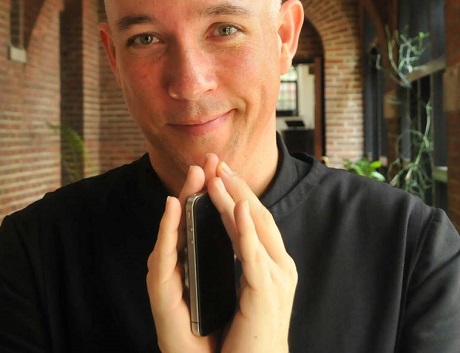
To see me now, you might not guess the initial reluctance I experienced with using a cell phone.  My progress was slow from owning one at all, to learning to text, to using a smart phone, to now using my agile phone.  Part of my reluctance was what such usage would mean – being able to be reached at all times; work emails invading “down time,” making me feel like I am never truly off; decreased patience with others who are not as technologically savvy; and constant usage for everyday needs.  I still try to resist looking at my phone constantly – I put it down during dinner time, I try not to respond to emails on my day off, I sometimes wait to look up something until I am at my computer.  But I still have those moments when my daughter impatiently waits while I finish one quick text or email to someone.  Though I ask her to hold on while I finish, I worry that I am becoming what I feared.

But there are also days when I am really grateful for my phone.  I currently have a parishioner who in the last stages of life.  The family and I know that the parishioner could go at any time, and so we are keep watch, spending time together, and holding each other in prayer.  I am keeping my phone especially close, checking for texted updates or for the dreaded call.  I even keep my phone on my nightstand in case I need to run to the hospital overnight.  That may sound unpleasant to some, but what I have come to see these last few weeks is that my phone is becoming not just a tool for pastoral care (a way for parishioners to reach me for emergencies), but it is also becoming a tool for my prayer life.  When I check my phone and there are no messages about this parishioner, I use the moment as a reminder to pray – pray for the parishioner, the parishioner’s family, and talk with God about the hard stuff of life.  Who would have thought that this little phone – a thing which I had once associated with menace, annoyance, and disconnectedness – could also be a tool for deep connection, prayer, and blessing?

Courtesy of http://episcopaldigitalnetwork.com/ens/2014/11/12/anglicans-invited-to-celebrate-advent-using-your-camera-phones/

Courtesy of http://episcopaldigitalnetwork.com/ens/2014/11/12/anglicans-invited-to-celebrate-advent-using-your-camera-phones/ Check out their website for a concrete way of using technology this Advent!

What I love about this tiny revelation is that it points to a larger truth.  God is constantly working through us in the current age.  It may sound silly, but I think God can work through our technology – through my little cell phone – for good, inviting me back into relationship with God, and working through it to connect us to one another.  The trick is keeping a watchful eye for God when it could otherwise be easy to miss God.  Of course, that is not a new problem.  God has been inviting God’s people into relationship from the beginning of time – and we have regularly been resistant.  The trick for staying connected is finding those things that help us return to the LORD:  whether it is a cell phone, a strategically placed Prayer Book that reminds us to pray, a set of prayer beads that you keep in your pocket, or a regular commitment to church attendance.  I wonder what things in your life might be repurposed to help you reconnect with the holy this week.


Sermon – Genesis 21.8-21, P7, YA, June 22, 2014

25 Wednesday Jun 2014

Posted by jandrewsweckerly in Uncategorized

≈ Leave a comment

Tags

blessing, God, Hagar, hear, Ishmael, promise, relationship, see, Sermon, suffering, understand, wilderness

Alice sat on her bathroom floor crying.  The bathroom was the only place she felt like she could get a moment of privacy.  Her tears were the release she found for what felt like an impossible juncture.  Last summer things had been okay for Alice.  She was coping with her divorce, and managing to feed and care for her son on her own, despite the fact that her income from cleaning houses was so small.  She had managed to work out some government assistance that gave her enough cushion to keep food on the table and a roof over their heads.  Life was not easy, but life could be a lot worse.

But during the last year, her world began to fall apart.  After a work injury, Alice could not clean houses for months.  Being self-employed meant she had no one to fill in at her houses.  After several months, her customers all got new help.  Because she was not working, her government assistance began to lower.  The assistance programs required that clients work to receive assistance.  Alice could not clean houses because of her injury, and she did not have enough education to qualify for any other type of work.  As the money became more and more scarce, Alice began to fear for her son.  Her son was looking thinner and more sickly each day.  He did not understand what was happening, and his deserved frustration and led her to the bathroom to cry.  Things had gone from bad to worse as Alice feared they would have no food, no home, or that she could lose her son.  All that was left to do was to cry:  to cry tears of sorrow, to cry out to God for mercy.

Hagar knows Alice’s tears.  We remember that Hagar is the handmaid for Sarah, Abraham’s wife, whom Sarah had given to Abraham to take as a wife because Sarah was infertile.  Hagar resented this action, and has already suffered a great deal, grappling with her powerlessness and lack over control over her most private, personal space.  Today the text brings us forward a few years in Hagar’s family.  Hagar’s son Ishmael is growing into a young boy, and Sarah has finally conceived her own son.  The birth of Isaac is a joyous occasion that all of the family celebrates.  But just as Hagar has begun to reclaim her personhood, Hagar suffers again.  Sarah sees Ishmael – the son that reminds her of her infertility, who will not represent the blessed line of Abraham – playing with Isaac – her own son, whom she proudly bore and who will mark the blessedness of Abraham’s line.  Sarah turns to Abraham and tells him to send Hagar and Ishmael away.  Although Abraham is crushed by the idea, God supports Sarah’s decision.  For Hagar, the world is against her.  We hear no words from Hagar as Abraham loads water and bread on her shoulders, gives her Ishmael, and sends her out into the wilderness.

Hagar wanders in the desolate wilderness until she runs out of water.  Looking at her son, whose death she imagines is immanent, Hagar puts him under the shade of a bush and walks away.  She walks away and cries out to God.  She cannot watch the death of her son.  Not after all she has been through.  She cries out to God as her last resort.

The tough part of this story is figuring out why this is happening.  Why would Sarah condemn Hagar and Ishmael to death by having them driven out into the wilderness?  Why would God agree with Sarah, especially when Ishmael’s birth was Abraham and Sarah’s choice in the first place?  Why does Abraham give up his first son so easily, without a word to Hagar?  The grief in this passage feels overwhelming, and we are left pointing angry fingers in multiple directions.

Hagar’s wilderness moment is familiar to us today.  We have those times when we feel like everyone is against us, including God.  The wildernesses of our lives are those desolate, lonely, dark places of wandering.  The wilderness is a scary, stark place of solitude that takes us to the depths of our finitude and forces us into encounters with God.  In the wilderness, we experience God in a way that we cannot not experience God elsewhere.  In the dry desert of suffering, which is scorching by day and frigid by night, with little water, we experience a sense of nakedness and vulnerability that we try to mask in our everyday lives.

Despite the darkness in the Genesis text today, there is also incredible hope for the suffering.  The last third of the text we hear today is filled with God’s action for the afflicted.  First, God hears Ishmael.  The text says “And God heard the voice of the boy.”  This word “to hear” is important on many levels.  In the original Hebrew, Ishmael’s name means “God will hear.”[i]  Already, Ishmael’s name – God will hear – comes to fruition.  God hears Ishmael.  Further, the word “to hear” in Hebrew, shamah, connotes more than physical hearing.  As we have talked about before, “to hear” in Hebrew also means “to understand.”  God understands how Ishmael and Hagar cry out.  God hears and understands their pain.

The second action we encounter at the end of this passage is God making a promise.  The angel of God speaks to Hagar about Ishmael saying, “I will make a great nation of him.”  We know from scripture that God does not make promises lightly with God’s people.  God fulfills God’s promises.  If God says that God will make a great nation of Ishmael, Hagar knows to believe God.  No matter how dire things seem, God makes a promise, and God does not disappoint.

The third action we encounter is that God opens Hagar’s eyes.  The text says that “God opened her eyes and she saw a well of water.”  In the opening of Hagar’s eyes, God allows Hagar to perceive God’s presence and action in her suffering.  God lifts the blindness that suffering and desperation create.  God shows Hagar the gift of life that God provides in the well of water.  God’s gift is abundant, and God reveals the gift when Hagar cannot see.

The fourth and final action is that God is with Ishmael.  The text says, “God was with the boy.”  The verb “to be” is one of the most simple and basic of words.  When applied to God, “to be with” has great meaning.  The text says that in all Ishmael does, in all the experiences Ishmael has, in all that Ishmael’s journey entails, God is with him.  God does not abandon Ishmael.  God does not forget.  God is with him.

I am reminded of one of my favorite Gospel hymns.  The hymn is called “He’s an On Time God.”  The song talks about the ways that God always comes to our need just when we need God.  The refrain goes, “He may not come when you want Him, but He’ll be there right on time.  He’s an on-time God, oh yes He is.”  The song describes the Israelites who crossed the Red Sea just before the Sea collapsed on the Egyptians, the relief of Job’s suffering, and the feeding of the 5,000 by Jesus.  What I love about the song is the booming chorus of singers and the repeated affirmation that God is on time.  Of course, the theology of the song is a little trickier.  I think the song misses something by suggesting that God is not always with us.  But the song is on to something.  I might rephrase the refrain to be something like – suffering may not end when you want it, but you will realize God is with you in the suffering right on time.  In this way, God is an on-time God.

We may not understand God’s actions, or why we suffer, but God is with us.  Hagar is a great gift this week for reminding us about what our relationship with God is like.  Hagar reminds us that we have an active relationship with God.  Hagar shows us that we can cry out to God in our suffering.  Hagar demonstrates to us that God is not a far away god who is removed from our daily lives.  By crying out to God, we reveal our earthy, dynamic relationship with God.

Meanwhile, God’s actions toward Hagar show us that God has a reciprocal relationship with us.  God is active in our lives.  God hears us, understands us, and will act in our lives.  God is with us, all of the time, especially in our suffering.  When we enter into that relationship with God, crying out to God, we let go of notions of distance from God or personal control of our lives.  We allow God to open our eyes so that we can see God’s action in our lives.  By opening our eyes, God shows us the blessings God has for us.  God did not tell Hagar and does not tell us what our blessings will look like.  But there will be blessings.  God will open our eyes to reveal the bounty of blessing for us.  As we enter into that holy, vulnerable relationship with God, allowing our eyes to be opened, we see God’s blessings – right on time.  Amen.

[i] Gordon J. Wenham, Word Biblical Commentary, vol. 2 (Dallas: Word Books, 1994), 88.

A little help…

18 Wednesday Jun 2014

Posted by jandrewsweckerly in Uncategorized

≈ Leave a comment

Tags

control, God, help, humility, neighbor, parent, relationship, vulnerable

As a parent of two young children, I have had to readjust how I do about pretty much everything.  Grocery shopping is one of the trickiest.  My current method is to put my oldest in the shopping cart seat (luckily she is still small enough for that) and to put my youngest on my chest in a baby carrier.  This mostly allows my hands to be free for pushing the cart, getting items off the shelf and onto the belt, keeping up with my shopping list, and generally entertaining two kids while trying to accomplish the task at hand.  It works, but it also feels like trying to manage a tornado.  I am happy if I remember most everything on my list and get the groceries and family home safely.  But I can only imagine what this chaos looks like to outsiders; and truthfully, I have never taken a moment to observe how others see me.

Courtesy of http://healthland.time.com/tag/humility/

Courtesy of http://healthland.time.com/tag/humility/

So imagine my surprise this week as I was trying to keep my oldest in the cart and my youngest from crying on my chest while unloading our groceries into the car, when, out of the blue, a young woman appeared and asked me if I would like some help loading our car.  I really have no idea what direction she came from, how long she had watched me scrambling, or what made her approach me.  And I must admit, my first thought was to worry about a stranger seeing the other chaos that is my car trunk.  Dumbfounded by the offer, embarrassed by the knowledge that I must have really looked like I needed help, and humbled by the fact that I really could use some help, I hesitantly allowed her to help me.  Before I knew it, the car was loaded and she was gone.  As I got in the car, my brain was filled with questions.  Had I thanked her sufficiently?  Why didn’t I ask her name?  What was her story?  Why did she offer to help me?

But the question that lingered the most was, “Why was I so hesitant to receive her help?”  I have worked for several nonprofit agencies that help those in need.  I have often given lip service to how my children are not just raised by me, but raised by a village.  I often preach about the value of vulnerability within community.  And yet, my immediate reaction to a stranger offering to help me was to insist that I could do it on my own.

Of course, this is often my struggle with God too.  How often have I gone to God in prayer, and then immediately tried to take control again when I felt like I was sufficiently at peace?  How often have I complained to God about an issue and then refused help from someone who was likely sent by God in the first place?  How often have I been willing to wash others’ feet, but not allowed Jesus to wash mine?  My parking lot experience this week reminded me of how much my pride gets in the way of authentic, vulnerable, beautiful relationship with God and my neighbor.  It takes a tremendous amount of trust to allow that kind of intimacy.  But when I do, I continue to be amazed at the ways that both God and my neighbor really do rise to the occasion.

Sermon – Matthew 5.21-37, E6, YA, February 16, 2014

21 Friday Feb 2014

Posted by jandrewsweckerly in Uncategorized

≈ Leave a comment

Tags

actions, God, intention, Jesus, law, relationship, Sermon, uncomfortable, words

Today is one of those Sundays when you hear the gospel and your response is, “Whoa there, Jesus!”  If there is not something in the gospel lesson that makes you uncomfortable, I would be shocked.  All the hard stuff is here today: conflict between family members and neighbors, lustful thoughts, divorce, and even oaths.  That last one may not sound all that upsetting, but wait until we talk about oaths, and you will start to get uncomfortable about that one too.  As modern-day Christians, there are parts of the Bible that we would just prefer to skim over – those tough lessons that we either do not abide by or totally disagree with – but that we try to ignore so that we can still claim to believe in Holy Scripture.  In fact, just last week in Adult Forum we were talking about how preachers in the Episcopal Church never get to choose the scripture for a given Sunday.  That is both the beauty and the challenge of being an Episcopalian.  By following the assigned lectionary, we hear the beautiful breadth of scripture, and are also forced to deal with the tough stuff of scripture.

Let’s review the tough stuff first.  First Jesus says that before the people of God offer gifts at the altar, they should make sure they are reconciled with their sister or brother.  Now if each of us had to make sure that all of our relationships were reconciled before we came to the Eucharistic table, I would imagine most of us would rarely receive Eucharist.  Think about that family member, that fellow parishioner, or that friend from school or work with whom you just had an argument.  Did you reconcile with them before coming to church today?

Next Jesus tells the people that avoiding adultery is not enough – they must even avoid lustful thoughts because that is as sinful as committing adultery.  You would have to be pretty immune to our entire culture not to face lust today – in advertising, in entertainment, and throughout media.  That does not even account for the lust we experience in spontaneous encounters with strangers, let alone with acquaintances and friends.

Then Jesus adds that anyone who divorces or who marries a divorcee is committing adultery.  With over half of marriages ending in divorce today, each one of us here is impacted by a divorce: if not our own, then the divorce of a family member or a friend.   I have a distinct memory of studying a Bible passage like this in Sunday School was I was in high school.  My teacher at the time had been divorced, but was thriving in a second marriage.  I asked her if we really believe Jesus’ words nowadays, and she insisted that we do.  I demanded to know how that could be since she and her husband were so happy and faithful.  She stated matter-of-factly that she and her husband would be judged for their lives.  To be honest, knowing how faithful she was, and how judged she felt by scripture, I began to question my faith altogether.

Finally Jesus instructs the people of God not to take oaths.  This one may sound a little strange, but basically Jesus is saying that you should never have to swear an oath because people should always be able to trust your word.  Your “yes” should mean yes, and your “no” should mean no.  So when your teacher asks you if you did all the reading or your boss asks you if you have completed a particular task, your “yes” better mean yes.  When you insist that you have not done something, you had better be sure that that “no” can be trusted.  In essence, there should be no need for you to swear at any point in life because your word can always be trusted.  You should not have to promise to not tell anyone else a secret because you have never told another person’s secret.  I do not know about you, but that makes me think a lot harder about what words come out of my mouth, sometimes even out of habit.

So are you uncomfortable yet?  Is your mind spinning from all the ways in which your behavior is contrary to what Jesus instructs today?  The good news is that there is actually good news.  Jesus does not offer these four rules as a way of making faithful living harder than faithful living already is.  As Jesus says in the verses preceding what we hear today, Jesus does not come to abolish the law, but to fulfill the law.  In other words, Jesus is still preaching the law of God, but Jesus is trying to get the people to see the intention behind the law.  So Jesus says, “Yes, do not murder, but really beware of anger altogether.”  Anger erodes not just our relationships with others but anger erodes our relationship with God.  Instead, by being a person who seeks reconciliation, we can be people bringing about the reign of God in our midst.[i]  Jesus longs for us to have the peace that comes in living a life that strives for reconciliation as opposed to the life that is willing to tolerate brokenness.  Of course, God knows relationships are complicated, and that some relationships are downright harmful.  But what Jesus is trying to get at is that longing for peace and reconciliation is the first step in healing not only specific relationships, but in healing the community of faith.

Jesus also affirms the original law about not committing adultery and not coveting; but he adds lust as being equally offensive.  Now I know this one is tricky because we are sexual beings and our sexuality is a gift from God.  But what Jesus wants us to acknowledge is that lingering on lust takes our attention away from healthy, loving relationships.  Furthermore, Jesus also affirms the dignity of every human being by affirming that no one should be treated as a sexual object.  Jesus is not saying deny your sexuality; Jesus is simply reminding us to celebrate healthy expressions of that sexuality.  I am reminded of a couple of music videos put out by pop-star Beyonce recently.  My first response to the videos was that they were pretty sexually explicit.  But when you listen to the words and see that her husband is the male counterpart in the video, you can see that Beyonce is simply celebrating the gift of healthy sexual experiences within the covenant of marriage.  Though the idea might be a stretch, perhaps what Beyonce is trying to communicate is not that she should be an object of sexual desire, but that we all should celebrate the gift of sexuality experienced within covenanted relationships.

Next, what Jesus says about divorce is not much different than what was already understood about divorce.  But what Jesus adds is a sense of accountability, particularly for men, to tend to the well-being of their wives, who are made the most vulnerable in divorce in Jesus’ time.  We all know the devastating effects of divorce; and fortunately, many of us have come through the other side to see the health and wholeness that come from ending unhealthy relationships and even in finding new thriving ones.  But what Jesus is really talking about here is being more attentive to the way that our actions impact the most vulnerable in society.  Our life decisions and actions are not made in a vacuum.  Jesus is encouraging us to be thoughtful and intentional about how we make those decisions and then how we handle their implications.  In the end, that sees to the welfare of a much broader range than simply ourselves.

Finally, what Jesus says about oaths is not as legalistic as it sounds, even though there are faith traditions that refuse to swear oaths.  Ultimately, what Jesus is trying to get us to see is that our words and our integrity matter.  If we are truthful people, then we have no need for oaths.  Jesus’ invitation is for us to be thoughtful about our words, not only being a people who actively tell the truth, but also being people who do not flippantly use words or make promises without considering their implications.

So ultimately, Jesus tells us today that our actions, our words, our relationships matter.  As followers of Christ, we do not get to be independent agents who care only for ourselves – a concept that is pretty counter-cultural in the United States.  Jesus’ words and their implications do put a burden on us and sometimes make us feel uncomfortable.  But in the end, Jesus words and their implications also make for healthier relationships, a healthier community, healthier relationships with God, and ultimately, a healthier version of yourself.  So embrace the uncomfortable, and know that Jesus has your back!  Amen.


[i] Marcia Y. Riggs, “Theological Perspective,” Feasting on the Word, Yr. A., Vol. 1 (Louisville: Westminster John Knox Press, 2010), 358.

Homily – John 20.24-29, Habakkuk 2.1-4, St. Thomas the Apostle, December 19, 2013

12 Wednesday Feb 2014

Posted by jandrewsweckerly in Uncategorized

≈ Leave a comment

Tags

doubt, homily, Jesus, relationship, Thomas

We hear from Thomas several times in the gospels.  When Jesus insists on going to Judea to visit friends in Bethany, Thomas declares, “Let us also go, that we may die with him.” (John 11:16)  At the Last Supper, as Jesus tries to prepare the disciples for his departure, Thomas interjects, “Lord, we do not know where you are going; how can we know the way?” (John 14.5)  And as we hear today, after Jesus’ resurrection, Thomas will not accept the disciples’ account without seeing Jesus’ wounds.  When he finally does see Jesus, he declares, “My Lord and my God.” Thomas was thoughtful, passionate, and loyal.  But Thomas was also skeptical, had doubts, and asked questions.

Though we often refer to Thomas as “Doubting Thomas,” I actually really love Thomas.  His passion is overwhelming and inspiring.  But even more compelling to me are his questions and his doubts.  Thomas feels very real to me: he openly exposes his doubts and questions – something we all have done at some point in our lives, even if we are not as bold as Thomas to admit it.  Thomas shows me how hard believing was even in the presence of Jesus Christ – how much more reassuring to know that our doubts are that much more to be expected.

But perhaps what I love most about the Thomas stories is Jesus’ reaction to him.  Though Jesus may sound like he is scolding Thomas today, Jesus still comes, knowing that Thomas needs reassurance.  When Thomas asked his panicked questions, Jesus also responds pastorally.  Jesus’ relationship with Thomas is even more inspiring to me than Thomas himself.  We find in their relationship a Godhead who is patient, open to question, giving, and kind.  Of course, Jesus pushes Thomas, too – but any good relationship with God involves both challenge and grace.

In some ways, that relationship is revealed in our Old Testament lesson today.  The author says, “I will stand at my watch post … I will keep watch to see what he will say to me, and what he will answer concerning my complaint.”  God responds, “Write the vision; make it plain …”  Through relationship with God, we know that we have a God who responds – maybe sometimes with grace and sometimes with challenge.  But the promise of a responsive God is ours.  Thanks be to God!  Amen.

Sermon – Matthew 4.12-23, E3, YA, January 26, 2014

29 Wednesday Jan 2014

Posted by jandrewsweckerly in Uncategorized

≈ Leave a comment

Tags

call, extraordinary, fishers of people, God, immediately, Jesus, ministry, ordinary, relationship, transformative

The first time I sensed a call to ordained ministry was in my last year of college.  The sense of call was strong and I felt like I could hear God’s word to me as clear as a bell.  And so what did I do?  I ran the other way…for a long time.  I remember thinking, “Oh, no.  I can’t do that.  How about I choose how I will serve God?”  And so off I went to my first my position after college.  When that was done, I knew the position was not quite the right fit, so I tried something a little closer to what felt like my call.  And of course, within a year or two, that did not quite feel right either.  And so I began to try to figure out how else God might be calling me.  Around and around I went with this game until finally someone just said straight out, “I think you ought to become an Episcopal priest.”  Even with that direct, irrefutable statement from a live person, I still could not say yes.  I took another whole year in discernment before I was finally ready to say yes to God. 

Needless to say, my response to God’s call was nothing like the response of the disciples in today’s Gospel.  Matthew says that Peter and Andrew immediately left their nets and followed Jesus.  Immediately they left.  The Message translation of this verse says, “They didn’t ask questions, but simply dropped their nets and followed.”  I do not know about you, but the idea of following Jesus immediately, and especially following Jesus without asking any questions seems ludicrous to me.  That act of leaving immediately is equally shocking in Jesus’ day too.  The disciples follow Jesus without qualification or questions.  They leave behind their entire profession, which is quite likely a lucrative business at the time.  All of this without any assurances that they will be provided for or have the ability to improve their financial standing by following Jesus.  Finally, following Jesus immediately means leaving behind families.[i]  This last shocker is perhaps the most unsettling because this is all happening in a time when family connections are “a primary source both of identity and honor,” and at a time when caring for one’s parents is “rooted both in cultural custom and in biblical law.”[ii]  This call narrative is as shocking then as the narrative is shocking now.

In our Adult Forum series last week, we talked about discerning God’s call in our lives.  We opened by reading this text from Isaiah 42, “Here is my servant, whom I uphold, my chosen, in whom my soul delights; I have put my spirit upon him; he will bring forth justice to the nations.  He will not cry or lift up his voice, or make it heard in the street; a bruised reed he will not break, and a dimly burning wick he will not quench; he will faithfully bring forth justice.”[iii]  Our class then reread the Isaiah passage, inserting our names in the passage.  So we heard statements like, “Kurt will bring forth justice to the nations,” or “I have put my spirit upon Barbara.”  We realized two things once we put our own names into the passage.  One, when we hear the words, “called to ministry,” we often think of clergy, missionaries, or people from scripture – not everyday people from Long Island.  Second, many of us do not think of ourselves as being called to a ministry.  We may volunteer at church or help out others, but we rarely use “call” language to describe what we do with our time, especially if our secular work does not feel particularly tied to our sacred beliefs.  But then we read the Catechism in the back of the Prayer Book.  The first persons listed as being ministers of the Church are lay persons, and according to the Catechism, the ministry of the laity, “…is to represent Christ and his Church; to bear witness to him wherever they may be; and, according to the gifts given them, to carry on Christ’s work of reconciliation in the world.”[iv]  So not only were we grappling with the idea of being ministers, we were grappling with the idea that those call stories are not just for someone else – we have a call story too.

Once we come around to the idea that we are all called by God, the big question then becomes, can we imagine responding to God’s call immediately like the disciples do with Jesus today?  Do we hear God’s invitation into ministry or a new vocation and immediately drop our nets, without question or delay?  Perhaps a better place to begin is to look back at Matthew’s text and see exactly what Jesus calls those first disciples to do.  Jesus says to follow him and he will make them fishers of people.  I have always read that invitation and basically translated the invitation as Jesus is going to teach them to be evangelists, converting others to Christ.  But as I read this week, I stumbled across a new interpretation of that phrase.  One scholar suggests that inviting the disciples to be fishers of people is an invitation to be in relationship – with Jesus, with each other, and with all the various people they will meet over the next few years, or perhaps even over the rest of their lives. 

If being fishers of people means being in relationship, what does that actually look like?  Exploring Jesus’ relationship with his disciples gives us some clues.  Being fishers of people means “bearing each other’s burdens, caring for each other and especially the vulnerable, holding onto each other through thick and thin, always with the hope and promise of God’s abundant grace.”[v]  Why would Jesus call people into relationship in this way?  Because by calling ordinary people in the midst of their ordinary lives into relationship with the ordinary people all around them, extraordinary things happen. 

So what does that look like here at St. Margaret’s?  In some ways many of us are already fishers of people.  We care for one another in this community, visit one another especially in crisis or illness.  But we also are in relationship with our neighbors – the staff at the local high school who connects us with those in need; our interfaith brothers and sisters as we make sandwiches together for the hungry; the people we meet, both at local ministries, but even our AHRC neighbors as we grow vegetables together.  And the invitation to be fishers of people keeps finding new manifestations here.  Our Outreach Committee is exploring a relationship with a community in Haiti – one facilitated by our relationship with another local parish here in Nassau County.  Though I know many of us are hesitant about international service, imagine what our dropping our nets without question and following Jesus might look like in that relationship.  Meanwhile, as we consider the possibility of a pilgrimage, we consider the ways that we will forge new relationships – with God, with one another, and certainly with people we have never met before.  Even something as simple as our new sponsorship of a Plainview Little League team this year has the potential for being a place to be fishers of people – where we can meet local parents while taking in a game and rooting for our team. 

These very real invitations into new relationships are scary or perhaps seem frivolous to us now.  But the power of Jesus’ invitation to be fishers of people is transformative.  First, accepting the invitation to be fishers of people transforms us.  When we enter into relationships with others, those interactions change us forever.  They help us see God in new ways, they help us reshape our worldview, and they help us to better understand our calling – that ministry that we all have.  Being fishers of people transforms not just us, but also transforms those with whom we are in relationship.  For many years, the staff at AHRC saw St. Margaret’s as distant, if not even inhospitable neighbors.  But now, the staff knows our names, sees new hope in our relationship, and perhaps even sees the love of Jesus through us.  Finally, being fishers of people transforms not just us and those with whom we are in relationship; being fishers of people transforms the kingdom of God here and now.  Our relationships have an impact way beyond the relationships themselves.  Others see the quality of our relationships and they see something intriguing, something inviting, and something inclusive.  Through those relationships, we invite others in, and the kingdom of earth begins to look a lot more like the kingdom of God.  You may not be able to drop your nets immediately today to follow Jesus.  But if you cannot drop them today, know that Jesus’ invitation to follow him is waiting for you and that God will empower you to say yes when you are ready.  Amen.


[i] Troy A. Miller, “Exegetical Perspective,” Feasting on the Word, Yr. A., Vol. 1 (Louisville: Westminster John Knox Press, 2010), 289.

[ii] Judith Jones, “Commentary on Matthew 4.12-23,” as found at http://www.workingpreacher.org/preaching.aspx? commentary_id=1972 on January 23, 2014.

[iii] Isaiah 42.1-3 

[iv] BCP, 855.

[v] David Lose, “Fishers of People,” as found at http://www.workingpreacher.org/craft.aspx?post=3018 on January 23, 2014.

Sermon – Luke 16.1-13, P20, YC, September 22, 2013

26 Thursday Sep 2013

Posted by jandrewsweckerly in Uncategorized

≈ 1 Comment

Tags

dishonest, friends, Jesus, manager, master, money, relationship, Sermon, wealth

If you were following today’s gospel lesson closely, you are most likely wondering whether you heard Jesus correctly, as his words make little sense.  Jesus tells another one his parables about money.  When a scheming, dishonest, self-serving manager is about to get fired, he goes and does the unthinkable.  He forgives debts which are not his debts to forgive, hoping in the end to make enough friends who might support him once he is out of a job.  And so when the master returns and finds out what has happened, we expect judgment to reign down on him even greater than before.  But in a shocking turn, the master commends the manager for acting shrewdly.  In response to this turn in the story, Jesus says to the disciples, “I tell you, make friends for yourselves by means of dishonest wealth so that when it is gone, they may welcome you into the eternal home.”  We hear Jesus basically telling the disciples to use dishonest wealth in the same way as this manager, and our response is confusion, disbelief, and maybe even disappointment.

After years of economic downward spiral, after watching banks and individuals cheat their way to the top while pushing down the poor and middle-class, many of us find Jesus’ words confusing if not altogether offensive.  We want nothing to do with a life that encourages scheming and plotting behavior and the embracing of dishonesty.  Some part of us feels a bit betrayed by Jesus’ strange advice and we are not entirely sure how to proceed.

So for those of us stuck in a bit of a confused haze about dishonesty, money, and relationships, we are going to take a step back and look at what is actually happening in the parable so that we can understand Jesus’ comments a bit better.  First, we have a poorly-behaving manager.  The manager has squandered away the master’s money.  When he is caught, the manager takes a good look at himself and admits some honest truths – he is not capable of doing manual labor and he is too embarrassed to beg for money.  Having been honest about who he is, he connives his way into a solution:  he will engender goodwill among his neighbors by doing financial favors for each of them – forgiving portions of their debts in the hopes that they will sometime very soon return the favor.  Both the master and Jesus recognize the shrewdness or wisdom in the manager’s behavior because the manager uses his wits to get out of a devastating position.

After understanding exactly what Jesus is complimenting, next we need to understand what Jesus is saying about money.  When Jesus says to “make friends for yourselves by means of dishonest wealth,” Jesus is not saying to start behaving unethically.  Jesus is claiming that money itself is inherently a means, not an end.  This point is a little tricky for us.  We all have varying philosophies about money.  Some of us manage to care very little about money, with money holding very little power over us.  Some of us struggle with money, sometimes remembering how money can be used for good, but most times feeling like money creates stress and anxiety in our lives that we cannot seem to shake.  And others of us become narrowly focused on money – either in how we can acquire more or what ways we can spend and enjoy money more.  What Jesus knows that we often forget is that money is inherently “dishonest.”  Money creates systems of injustice and hierarchies of power; money can destroy marriages and friendships; and money can be the ruin of many a person.  So when Jesus says to make friends through dishonest wealth, he does not mean to become a dishonest people; he means that money is inherently luring us into dishonesty, and we can either throw our hands up in the air in resignation and a refusal to be associated with that dishonesty, or we can use that dishonest wealth as a means to something much more important – relationship with others.

So if we understand what the manager is actually doing, and we can see money as a means to an end, how do we get to the step of being comfortable with using something bad for good?  Jesus is not telling us to manipulate people with money in order to be in relationship with others.  Most of us believe the old adage that you cannot buy friends – or at least not good ones anyway.  But Jesus is not suggesting we try to buy friends.  Jesus is suggesting that instead of categorizing everything into good and evil, honest and dishonest, we become a bit shrewder in our thinking.  Jesus encourages his disciples to learn from the dishonest manager because the dishonest manager takes a pretty awful situation and manipulates the situation into something good.  The kind of shrewdness Jesus is encouraging is the kind of activity that we might call, “thinking outside of the box.”  If the disciples are to live in this world and thrive, they are going to have to think outside of the box and get creative not only with money, but all sorts of things.

As I have been struggling with this text this week, I did one of the things that I often do in Bible Study.  I started looking at other translations to see if I could make more sense of Jesus’ words.  This week, I found the most help from a translation called, The Message.  Now as ample warning, The Message is a very contemporary paraphrase of the Bible, which takes a lot of theological liberties that I am often uncomfortable with; but I do often find that the language from that paraphrase opens up the biblical text enough for me to start seeing the text with fresh eyes.  The Message translates Jesus words in this way:  “Now here’s a surprise:  The master praised the crooked manager!  And why?  Because he knew how to look after himself.  Streetwise people are smarter in this regard than law-abiding citizens.  They are on constant alert, looking for angles, surviving by their wits.  I want you to be smart in the same way—but for what is right—using every adversity to stimulate you to creative survival, to concentrate your attention on the bare essentials, so you’ll live, really live, and not complacently just get by on good behavior.”

What Jesus is trying to say to us today is layered.  First, money has a corrupting force in our lives.  Jesus talks about money incessantly in scripture, from telling people to give away all their money, to scolding people about storing up their money in larger barns, to reminding people not to stress about money, to this odd text about money.  As Luke concludes today, Jesus tells us that we cannot serve God and money, because of the all-consuming way that money can corrode our relationship with God.

Second, we cannot escape money.  Money is a part of our everyday lives, and as we all know is necessary for functioning – for food, for shelter, for clothing, for comfort.  Even those monks and nuns who take on a vow of poverty still rely on the money of others for support.  Money, with all its potential for corruption, is inescapable in our lives.

Finally, once we understand the power and place of money in our lives, Jesus reminds us that when we are wise, keeping God at the center, we can use money as a means to goodness in our relationship with God and with one another.  The manager “transforms a bad situation into one that benefits him and others.  By reducing other people’s debts, he creates a new set of relationships based not on the vertical relationship between lenders and debtors (rooted in monetary exchange) but on something more like the reciprocal and egalitarian relationship of friends.”[i]  This kind of work is not about charity per se, but about making friends.[ii]

A commercial has been circulating around the internet lately.[iii]  In the video, a boy is caught red-handed trying to steal a bottle of medicine and a soda.  A woman is berating him in front of a marketplace, wanting to know why he would take these things.  He confesses that the items are for his mother.  A local merchant steps forward, and hands the woman a handful of money to cover the cost of the stolen items.  The man then quietly asks the boy if his mother is sick.  When the boy nods yes, the merchant has his daughter also bring a container of vegetable broth and other items, and sends the boy on his way.  The next clip of the commercial shows the merchant thirty years later, still working in his shop.  He collapses and is taken to the hospital.  The daughter becomes completely overwhelmed as the medical bills add up, even selling the shop they had once run together.  As she is found crying near her father’s bedside, she finds a revised copy of her bill.  The amount due is zero.  We find out through the video that the doctor who forgives the bill is that same boy who stole medicine thirty years ago.  He writes at the bottom of the bill, “All expenses paid thirty years ago with three packs of painkillers and a bag of veggie soup.”

Jesus knows how money corrupts our world.  But Jesus also knows that we can shrewdly utilize our money as a tool to create relationships that glorify God.  This is Jesus’ invitation for you today:  to examine how your relationship with dishonest wealth can be used for goodness.  Amen.


[i] Lois Malcolm, “Commentary on Luke 16.1-13,” as found on http://www.workingpreacher.org/preaching.aspx? commentary _id= 1783 on September 18, 2013.

[ii] Thomas G. Long, “Making Friends,” Journal for Preachers, vol. 30, no. 4, Pentecost 2007, 55.

[iii] As found at http://www.youtube.com/watch?v=TUM4Mb9rUTU on September 20, 2013.

Sermon – Luke 11.1-13, P12, YC, July 28, 2013

31 Wednesday Jul 2013

Posted by jandrewsweckerly in Uncategorized

≈ Leave a comment

Tags

disciples, God, Jesus, Lord's Prayer, prayer, relationship, Sermon

During seminary, one of the requirements for becoming a priest is to serve for eight weeks in a hospital setting as a chaplain.  Now one might think that there is a hospital chaplaincy course or that the hospital gives chaplains training on how to be a chaplain.  But the truth is, we received two day of “training,” half of which was about just being in hospital, not about how to be a chaplain.  Needless to say, on day three, when the supervisor told us to go to our floors and to get to work, I was almost stunned into inaction.  What would I say?  What was I supposed to do? 

Of course, only hours into the job, I realized how much I had underestimated the challenges.  Not only did I have no idea how to enter a room and strike up a conversation that was not like the ones they were having with every doctor and nurse, I also had no idea how to pray appropriately for the Roman Catholic, the Pentecostal, the Jew, the United Methodist, the Episcopalian, and the uncertain person who was not sure about God but was still willing to let me pray.  I remember sharing my anxiety with a fellow Episcopalian and he simply said, “Oh, I always just pray prayers using the same format as the collects in the Book of Common Prayer.”  Despite my love for the collects in our Prayerbook, an entire childhood of praying like a Methodist meant that his advice offered little encouragement. 

The truth is I am not sure most of us are ever really taught how to pray.  We know a good prayer when we hear one, and we may even write down a prayer we like, but very few of us volunteer to lead prayer at the opening of a meeting or over a meal.  Part of the problem is that most of us think there is a right way to pray.  We imagine there is some magical formula like my friend from seminary suggested, or we worry that our extemporaneous prayer will not be smooth enough or use holy enough words.  We worry that the way that we pray somehow suggests the quality of Christian we are.  Prayer, like biblical literacy, is one of those areas that we get completely anxious about when pressed in public.

The good news is that we are in good company.  We hear in our gospel lesson today one of the disciples say to Jesus, “Lord, teach us to pray.”  The disciples at this point have seen Jesus pray many times.  They see how good he is and they see how important prayer is in his life.  In fact, in Luke’s gospel, Jesus is regularly found in prayer.[i]  They watch Jesus enter into prayer with God for months, and they long to be able to do that too.  And so they come to Jesus, and they vulnerably submit their request:  teach us to pray. 

Their question is full of implications.  First is the admission that they do not have the first idea about what they are doing.  Maybe they learned some prayers in temple, or maybe their parents prayed with them.  But they realize in watching Jesus that they do not actually know how to pray themselves.  Not really.  Second, they see a real connection between Jesus and God that somehow is revealed in Jesus’ prayer life.  Perhaps they see how prayer strengthens him in his weakness and how he is more vulnerable with God than even with them.  They long for that kind of connection with God too, but still, they are not sure how the whole thing works.  Finally, a deeper implication is at hand in the disciples’ question.  Perhaps they are not only asking Jesus how to pray, but also wanting to know what is actually happening in prayer.  Perhaps they have tried praying on their own – for an illness, for a new job, for a broken relationship – but the prayer did not work.  They want Jesus to teach them the right way to pray so that the results they desire are fulfilled.

In some ways, Jesus does that.  First, Jesus gives them a simple prayer.  When you pray, pray this.  The prayer is one that countless Christians have etched into their minds for over two thousand years.  Many of us have distinctive memories of learning the Lord’s Prayer, while others of us just simply know the prayer without remembering how the prayer became ingrained into our conscience.  The Lord’s Prayer is perhaps the only part of a funeral that everyone – even those who never go to church – seem to know and can recite.  This is the same prayer that we say every Sunday, that we teach our children, that we say near death, that we pray when we cannot muster up any other words.  In this way, Jesus teaches the disciples and all of us to pray. 

But then, Jesus goes on to really teach the disciples about prayer.  He tells this funny parable about a man who awakens his friend in the dead of the night because another friend has come to his house and he has no food to feed him.  The man in bed refuses at first, but after much persistence, he caves and gives his friend what he needs.  At the end of the parable, Jesus says, “Ask, and it will be given you; search, and you will find; knock, and the door will be opened for you.”  Yes, Jesus gives the disciples the words they can use to pray.  But Jesus is also trying to teach them about what prayer really is.  Jesus presents this parable of two friends in a relationship that involves give and take.  Jesus is trying to teach the disciples that prayer is about relationship.  The prayer relationship with God is one in which the disciples will be coming in the middle of the night asking for very inconvenient things.  The prayer relationship is active, deeply personal, and will involve asking for what they really need.[ii]  In fact, Jesus says of the man in the parable, “because of his persistence he will get up and give him whatever he needs.”  Another translation of the word “persistence,” is “shamelessness.”[iii]  In other words, Jesus teaches the disciples that this prayerful relationship holds nothing back, cannot be embarrassed, and certainly does not worry about pretenses.

Unfortunately, we may hear those words about asking, searching, and knocking and remember every time that our prayers have not been answered, when we have not found, and the door has not been opened.  But Jesus is inviting us today to reframe prayer not as something we do with the expectation of an exchange:  I ask for healing, or a job, or a romantic partner, and God gives that to me.  We are still to come to God with those pains:  the longing for healing, the desire for vocational fulfillment, and the hope for partner who makes us happy and whole.  But instead of bringing those things to God because we want them solved, Jesus suggests that we bring those things to God so that all of ourselves is nakedly before God.  Only then can we have the intimacy with God that we desire and the realness of relationship we long to have. 

Now where this gets messy is when we start trying to understand why things happen – when we are not healed and people tell us, “It was God’s will,” or “Everything happens for a reason.”  But those answers hold little weight when a child dies or when someone loses their home.  I cannot believe in a God who wills those things to happen.  In fact, when a teen asks me why their parents are still getting divorced even though they prayed for the divorce not to happen, or when a mom loses a pregnancy and wants to know why God would let that happen, my answer has most often been, “I don’t know.”  I do not know why our physical ailments are not healed and why horrible or disappointing things happen to us.  All I do know is that God longs for us to bring all of that to God in prayer. 

So when I am angry, God wants me to let God have it.  When I am sad, God wants me to pour out my heart.  When I am lost, God wants me to share my wandering self.  And when I am not even sure God is with me or loves me, God wants me to just come and sit, even if I do not have words or if I do not feel like I can really trust God anymore.  When the disciples ask Jesus to teach them to pray, Jesus gives them a simple, straightforward prayer, teaching them and us that we do not need holy words or even our own words – especially when we cannot find our own words.  But Jesus teaches us all so much more.  Jesus teaches us to be shamelessly honest about what we need whenever we are in need.  And Jesus teaches us that prayer is based on trust – not a trust that everything works out for the best or that we will get exactly what we want – but a trust that God is listening and God loves us and all the world.[iv]  Jesus’ teaching is not tidy – but Jesus’ teaching invites us in, encourages us, and holds us in this wonderful journey with God – the one who we come to know through prayer.  Amen.


[i] James A. Wallace, “Homiletical Perspective,” Feasting on the Word, Yr. C, Vol. 3 (Louisville: Westminster John Knox Press, 2010), 289.

[ii] Elisabeth Johnson, “Commentary on Luke 11.1-13,” as found at http://www.workingpreacher.org/preaching.aspx? commentary_id=1724 on July 25, 2013. 

[iii] Wallace, 291.

[iv] David Lose, “Teach Us to Pray,” as found at http://www.workingpreacher.org/craft.aspx?m=4377&post=2654 on July 25, 2013.

Sermon – Luke 10.25-37, P10, YC, July 14, 2013

17 Wednesday Jul 2013

Posted by jandrewsweckerly in Uncategorized

≈ Leave a comment

Tags

ESPN, God, Good Samaritan, Jesus, love, messy, relationship, Sermon, the other

Lisa had produced lots of stories like this over the last ten years.  They were human-interest stories for ESPN – the stories that drew people into the private pain and sacred celebrations behind their beloved sports.  Lisa loved her work, but she had never gotten as involved as she did four years ago.  In 2009 she met Leroy and Dartanyon – two high school wrestlers from a poor Cleveland school who were fighting against all odds.  Dartanyon was homeless and legally blind and Leroy had lost parts of both legs in a train accident.  Dartanyon often carried Leroy to classes up stairs, while Leroy helped Dartanyon with his homework.  Their story was so potent for Lisa that she could not walk away.  Over the course of four years, she would find herself doing everything from helping Dartanyon obtain his birth certificate, to ensuring they had food everyday; from helping them fill out financial aid forms for college, to connecting Dartanyon to a Paralympic coach.

When I saw Lisa’s story this week, I could not help but to think about the Good Samaritan from the gospel lesson today.  Most of us know this story well, and pretty much all of us want to strive to be a Good Samaritan; so much so that we spend time volunteering, we give money to aid important causes, and we even occasionally give a dollar to that guy on the corner.  But what struck me this week about the story of the Good Samaritan is that we often simplify the example of the Samaritan. We read this story and we know that we should not be like the lawyer or the priest or the Levite.  We should help others like the Samaritan.  The problem though with this simplified response to Jesus’ command to “Go and do likewise,” is that we skim over all the work the Samaritan did.  The text says the Samaritan, “went to [the victim] and bandaged his wounds, having poured oil and wine on them.  Then he put him on his own animal, brought him to an inn, and took care of him.  The next day he took out two denarii, gave them to the innkeeper, and said, ‘Take care of him; and when I come back, I will repay you whatever more you spend.’”

Several things strike me about this account.  First of all, there is a longevity to the care of the Samaritan.  The Samaritan does not simply give the man some bandages, or a cloak, or even some money, and then leave.  The Samaritan does not simply help the man to a local hospital or inn and then carry on with his life.  The Samaritan does not even care for the man overnight, and then depart, having certainly done his duty.  No, the Samaritan even pays for the man to stay and promises to return and pay for whatever else is due.  This is not a one-time exchange, or even a short-term exchange.  This exchange is a commitment to the long haul – a dedication not just to help but to be in relationship.  This is what Jesus means when he says we are to “go and do likewise.”

What is tricky about this kind of relationship is that this kind of relationship is messy.  Though there is some debate among scholars, many seem to think that the victim on the side of the road was a Jew.[i]  So not only was this victim beaten, robbed, and abandoned by those who should have cared for the victim, he was helped and tended to by a Samaritan – a man who was his enemy.  The Jews and Samaritans had a long-standing conflict.  The Jews had a very low opinion of the Samaritans.  Samaritans were seen as second-class citizens to be avoided at all costs.  So imagine when the victim woke up at that inn to find a Samaritan nursing him back to health.

Not to mention how complicated this is for the Samaritan.  He knows how most Jews feel about him.  He may have even felt the same way about the Jewish people.  But somehow, his sense of pity gets the best of him, and he finds himself not just asking if the guy is okay, but spending his time and resources on this complete stranger who is his enemy as well.  This encounter between these two men is not simply a one-way, clean exchange of helper and helped.  This is a messy encounter that leaves the two in a strange relationship that can only be possible through God’s grace.  Whatever biases the Jew had against Samaritans had to have been called into question that next morning.  Hatred of another cannot remain when one is the recipient of love as deep as the Samaritan shows.  And whatever biases the Samaritan had against Jews had to have weakened that day too.  You cannot dress a man’s wounds, care for him overnight, and return to check in on him without some of your defenses coming down.  The kind of neighborliness that Jesus is inviting people into is messy, complicated, and a bit scary.

Lisa, Leroy, and Dartanyon knew a little about this kind of messiness.  Dartanyon and Leroy not only faced the challenges of their own physical limitations, they also lived in a world of struggle.  Their school was a school marked by violence and active police presence.  Books were handed out and locked back up after each class.  Less than forty percent would ever graduate and untold numbers were left pregnant.  And white people were not necessarily seen as allies.  Meanwhile, Lisa had grown up on the other side of Cleveland.  Her parents scraped together money just so that she would not have to go to school with those her parents would call, “those people.”  Lisa and Leroy and Dartanyon grew up knowing each other as “the other,” and any attempt at a relationship brought these biases, baggage, and burdens to the foreground.

The funny thing is that when we read our gospel lesson day, we can feel that Jesus is scolding the lawyer in some way.  But I think what is actually happening here is a bit of healthy challenge.  Jesus fully admits that if the lawyer simply does what the law calls for:  to love the Lord your God with all your heart, and with all your soul, and with all your strength, and with all your mind; and your neighbor as yourself – then the lawyer will be fine.  Jesus is saying that even the slightest effort of loving God and loving neighbor is good and to be commended.  But in the story of the Good Samaritan, Jesus is hinting to the lawyer that there is a potential for more – a potential to know God more fully and to love more deeply than he could even imagine is possible.  And that kind of amped up grace and blessing can only come from messy, complicated, scary relationships with the other.

Recently, while Lisa, Leroy, and Dartanyon prepared for a follow-up story with ESPN, Dartanyon quietly asked Lisa the question that probably many others had wondered about but never asked.  “Why did you stay?”  Lisa’s response was automatic.  “I love you,” she answered.  “That’s what I thought you’d say,” he replied.  “But … why … why did you stick around and do everything you did?”  Lisa’s response was long and complicated because their relationship was messy, complicated, and at times maybe even scary.  But after much reflection, Lisa concludes, “I stayed because we can change the world only when we enter into another’s world.”[ii]  Though I have no idea whether Lisa is a person of faith, Lisa is preaching Jesus’ words today with her life.  She understands that being neighbors means not just helping people, but entering into their lives, and taking on whatever messiness that involves – because only then can we know the kind of love Jesus has for us.  In that sacred, vulnerable, tenuous reality that is relationship with the other is where we experience Jesus and the love Jesus has for all of us – even those we might label as the other.  Jesus knows how hard this will be.  But Jesus tells us to “Go and do likewise,” anyway because Jesus knows that we can.  Amen.


[i] Matthew L. Skinner, “Exegetical Perspective,” Feasting on the Word, Yr. C, Vol. 3 (Louisville: Westminster John Knox Press, 2010), 241.

[ii] Lisa M. Fenn, “‘Carry On’: Why I Stayed,” as found on http://espn.go.com/espn/otl/story/_/id/9454322/why-stayed on July 9, 2013.

Sermon – I Kings 17.8-24, P5, YC, June 9, 2013

12 Wednesday Jun 2013

Posted by jandrewsweckerly in Uncategorized

≈ Leave a comment

Tags

Elijah, God, healing, honest, human, intimate, prayer, relationship, Sermon

Last week I lost my watch.  When I say that I lost my watch, I do not mean I misplaced my watch.  I went for a walk, took the watch off while I was walking, and about an hour after my walk realized the watch was gone.  I searched the path of my walk, I looked all over the church and our house, but the watch is gone.  Now, truthfully, a watch is certainly replaceable, but this watch was sentimental – a gift from a special occasion that meant a lot to me.  So, of course, ever since I lost my watch, I have been praying to St. Anthony.  St. Anthony is the patron saint of lost things.  The prayer I learned, and have been praying for over a week is, “St. Anthony, St. Anthony, please come around, something is lost that cannot be found.”  Though I know the watch is most likely gone, I keep occasionally offering up the prayer with some desperate sense of hope.

We do funny things in our prayer lives, especially when things are not going our way.  We have been known to bargain with God.  “God, if you please just grant this one thing, I promise I will never blank again.”  We have been known to try to negotiate with God.  “I know that I am not perfect, God, but let me tell you about all the good I have done.  Surely you can grant this one thing to your faithful servant.”  And we have been known to rail at God.  “How can you do this to me God?  Haven’t I been through enough?!?”  Sure, we know the Lord’s Prayer, and we may pray the daily office at home, and we may even pray with scripture, especially our favorite psalms.  But when we are at our lowest, when we feel like we have tried everything we are supposed to say or do with God, sometimes our prayers simply reveal our broken, frustrated, desperate spirits.

This is the prayer that Elijah offers today.  Elijah has already created quite the imposition on a poor widow.  Elijah goes to the widow, a woman who is about to die of starvation, and asks her to feed and house him.  Now, God takes care of the widow’s lack of food, but while Elijah is still there, the woman’s son almost dies of illness.  The woman blames Elijah, and Elijah at first seems fairly composed as he asks for the boy.  But when he retires to another room with boy, Elijah lets God have it.  Elijah cries out to God in anger, rage, and despair.[i]  “O Lord my God, have you brought calamity even upon the widow with whom I am staying, by killing her son?”  Elijah does not come to God with a polite request that God heal the son.  Elijah does not offer some traditional prayer of healing.  Elijah simply cries out to God.  He cries out to God for the injustice done to this poor widow – who is already clearly impoverished by having no husband.  The death of an only son would mean certain death for her as well.  Her son was her only hope for survival in this world.[ii]  Elijah boldly accuses God of an injustice – in fact accuses God of killing this boy and all that he represents to the widow.

Some may hear in Elijah’s prayer a sense of self-interest.  If he is proclaiming to be a man of God, and God then kills this woman’s only sense of hope, then the death makes Elijah look bad.  Who wants to follow a prophet of a God who kills the downtrodden?  Or, we might hear Elijah’s prayer as petulant.  Perhaps he sounds like a man whining about fairness – something childish and narrow-minded.  But I hear Elijah’s prayer as both fully human and as an honest portrayal of someone with an intimate relationship with God.  In any intimate relationship, the overly polite ways of being with one another end eventually.  In time, the only thing that works in that intimate relationship is being brutally and fully honest, holding one another to account and being totally open about the good and the bad of the relationship.  This is what Elijah is doing here.  Elijah, who knows God intimately, holds God to account.  “Really, God?  This is how you are going to treat people?  You claim to care about the poor and oppressed, and you have forced me to impose on this poor widow, and now you are going to let her only son, her only source of potential security die??”  Elijah does not ask this of God for himself or out of a sense of injustice.  Elijah asks this of a God whom he knows to be better than this – a God who loves and cares for the poor and oppressed.  And he also knows that God can do the impossible.  Elijah knows that God can bring this child from death to life.

What I love about this passage is twofold.  First, I love the very human, intimate depiction of prayer.  As Episcopalians, with our reliance on our Prayer Book and our desire for beauty and intelligence when we talk to God, we can become so formal with God that we forget that we have a real relationship with God who can handle our real words.  We can be brutally honest with God or even angry with God, and God will still love us.  We can be vulnerable and frustrated and desperate with God.  We can even come to God when we do not have words – when our emotions are so overwhelming that we no longer have anything left to say.  Elijah gives us permission today to be fully ourselves with the God who loves us no matter what.

I also love that we get this passage today because today is our monthly healing service.  Since I have been at St. Margaret’s, I have been regularly asked questions about our healing services.  Our tradition of monthly healing services that began well before my time here still has many of us questioning.  I have had adults ask me who they are allowed to ask prayers for – whether they can only ask for healing prayers for themselves or whether they can ask for healing for others as well.  I have had some of our teens ask me what we are actually doing when we lay hands on people.  Even my own daughter asked me why I made the sign of the cross on her forehead when she came forward once.  Elijah points the way to answers for those questions today.  By praying our litany of healing and by coming forward for ourselves and others, we proclaim several things.  We proclaim that intimate relationship with God means that we can be fully honest about all that is ailing us, our neighbors, and the oppressed.  We proclaim that God can do the impossible through prayer and we offer up our hopes that the impossible is possible for us too.  And we proclaim that although we may not understand God in the midst of suffering, we still come to God, hoping for healing, hoping for clarity, hoping for peace.  Whether you come forward today for healing is actually not that important.  What is most important is that you know that you can, that you know that your God is a God who can do the impossible but who also cares for you so deeply that God can handle all the parts of you – the good, the bad, and the ugly.  Amen.


[i] Carolyn J. Sharp, “Theological Perspective,” Feasting on the Word, Yr. C, Vol. 3 (Louisville: Westminster John Knox Press, 2010), 100.

[ii] Glaucia Vasconcelos Wilkey, “Pastoral Perspective, Feasting on the Word, Yr. C, Vol. 3 (Louisville: Westminster John Knox Press, 2010), 102.

← Older posts
Newer posts →

Recent Posts

  • On Sharing the Love…
  • Sermon – Micah 6.1-8, Matthew 5.1-12, EP4, YA, January 30, 2026
  • On Justice, Kindness, Humility, and the Messy Middle…
  • Feast of the Rev. Dr. Martin Luther King, Jr., January 18, 2026
  • On Peace, Love, and Conduits…

Archives

  • February 2026
  • January 2026
  • December 2025
  • November 2025
  • October 2025
  • September 2025
  • August 2025
  • July 2025
  • June 2025
  • March 2025
  • February 2025
  • December 2024
  • November 2024
  • October 2024
  • September 2024
  • August 2024
  • July 2024
  • June 2024
  • May 2024
  • March 2024
  • February 2024
  • January 2024
  • December 2023
  • November 2023
  • October 2023
  • September 2023
  • August 2023
  • July 2023
  • June 2023
  • May 2023
  • March 2023
  • February 2023
  • January 2023
  • December 2022
  • November 2022
  • October 2022
  • June 2022
  • May 2022
  • January 2022
  • December 2021
  • November 2021
  • October 2021
  • September 2021
  • August 2021
  • June 2021
  • May 2021
  • April 2021
  • March 2021
  • February 2021
  • January 2021
  • December 2020
  • November 2020
  • October 2020
  • September 2020
  • August 2020
  • July 2020
  • June 2020
  • May 2020
  • April 2020
  • March 2020
  • February 2020
  • January 2020
  • December 2019
  • November 2019
  • October 2019
  • September 2019
  • August 2019
  • July 2019
  • June 2019
  • May 2019
  • April 2019
  • March 2019
  • February 2019
  • January 2019
  • December 2018
  • November 2018
  • October 2018
  • September 2018
  • August 2018
  • July 2018
  • June 2018
  • May 2018
  • April 2018
  • March 2018
  • February 2018
  • January 2018
  • December 2017
  • November 2017
  • October 2017
  • September 2017
  • August 2017
  • July 2017
  • June 2017
  • May 2017
  • April 2017
  • March 2017
  • February 2017
  • January 2017
  • December 2016
  • November 2016
  • October 2016
  • September 2016
  • August 2016
  • July 2016
  • June 2016
  • May 2016
  • April 2016
  • March 2016
  • February 2016
  • January 2016
  • December 2015
  • November 2015
  • October 2015
  • September 2015
  • August 2015
  • July 2015
  • June 2015
  • May 2015
  • April 2015
  • March 2015
  • February 2015
  • January 2015
  • December 2014
  • November 2014
  • October 2014
  • September 2014
  • August 2014
  • July 2014
  • June 2014
  • April 2014
  • March 2014
  • February 2014
  • January 2014
  • December 2013
  • November 2013
  • October 2013
  • September 2013
  • August 2013
  • July 2013
  • June 2013
  • May 2013
  • April 2013
  • March 2013
  • February 2013
  • January 2013
  • December 2012
  • November 2012
  • October 2012
  • September 2012

Categories

  • reflection
  • Sermons
  • Uncategorized

Meta

  • Create account
  • Log in
  • Entries feed
  • Comments feed
  • WordPress.com

Blog at WordPress.com.

  • Subscribe Subscribed
    • Seeking and Serving
    • Join 395 other subscribers
    • Already have a WordPress.com account? Log in now.
    • Seeking and Serving
    • Subscribe Subscribed
    • Sign up
    • Log in
    • Report this content
    • View site in Reader
    • Manage subscriptions
    • Collapse this bar
 

Loading Comments...