
• About

Seeking and Serving

~ seek and serve Christ in all persons

Seeking and Serving

Tag Archives: tomb

Homily – Mark 16.1-8, EV, YB, March 31, 2018

12 Thursday Apr 2018

Posted by jandrewsweckerly in Sermons, Uncategorized

≈ Leave a comment

Tags

covenant, Easter Vigil, God, Jesus, learning, relationship, resurrection, silent, tomb, wonderful

I once worked with a parish who wanted to tweak their outreach efforts.  Instead of simply volunteering together with an outreach ministry or donating funds, they wanted to partner outreach and formation – what the secular world would call service learning.  And so, we experimented.  We gathered a team for six weeks in preparation for service with a transitional home for women coming out of prison.  The first week, two clients came to talk to us about their experiences with the ministry we were serving.  We heard stories of abuse, addition, and authority.  We learned about the things within their control and the things outside their control. Then we spent four weeks reading about a woman whose ministry in a prison led to her live and serve among the prisoners, guards, and families affected by the prison.  In the final week, the parishioners served a meal for the women in the transitional house, engaging in meaningful conversation as we ate.  When we gathered after our days of service, each participant felt as though their experience at the transitional home was much richer than the experience would have been had they simply showed up at the house with a hot meal, having never thought much about who they would encounter and why.  With old assumptions gone, parishioners were able to ask meaningful questions, understand how hard the road ahead would be, and share their own journeys.

Easter Vigil is a bit like that service learning group.  You see, we could gather tonight, and ring in Easter, happily celebrating the empty tomb the two Marys discover.  The miracle of that event, and the consequences of Christ’s resurrection are cause enough for a tremendous celebration.  But what we do tonight is not just jump into the resurrection.  First, we learn together why the resurrection is meaningful at all.  We start at the beginning, when the world was a formless void.  We learn about the creative God, who makes order out of a disordered world, who creates the beauty of the world around us, and who trusts us to care for that beauty.  But, of course, we fail at being stewards of God’s creation, and fall into sin so deep that God destroys most of the created order, saving one family from every species.  And God gives us a covenant – to never destroy the world again.  Generations later, as God helps us flee suffering and enslavement, God does the impossible – parts an entire sea so that we might be forever free.  Later, God is able to restore a valley of dry bones to life through God’s prophet Ezekiel.  God teaches us that even death and destruction can be restored.  Even as they are scattered in exile, God once again promises to restore the people.  Story after story after story tells us tonight that we belong to a God who creates us in beauty, stays in relationship, and restores us to wholeness.

When you know the breadth of our walk with God – when you remember all the pieces of what we know about God – then what happens to God’s Son this night makes more sense.  We can move from singing, “this is the night,” to singing, “how wonderful.”  “How wonderful and beyond our knowing, O God, is your mercy and loving-kindness to us, that to redeem a slave, you gave a Son.  How holy is this night, when wickedness is put to flight, and sin is washed away.  It restores innocence to the fallen, and joy to those who mourn.  It casts out pride and hatred, and brings peace and concord.  How blessed is this night, when earth and heaven are joined and man is reconciled to God.”[i]  What is shocking about this night is not just the empty tomb.  What is shocking is the empty tomb in light of all that has gone before – despite our sinfulness, the breaking of covenant after covenant, our unfaithfulness and lack of gratitude, God stays in relationship.  God keeps making creation new.  God goes a step further in the resurrection of Christ Jesus.

That is why I love that we get Mark’s gospel to close our learning tonight.  Ever the succinct writer, Mark describes for us perfectly how overwhelming God’s love and commitment is to us.  Despite all the drama of our relationship with God, despite all the unfaithfulness, and despite all the waywardness of our behavior, God’s love never ends.  That realization leads to the same sort of terror, amazement, and fear that the Marys experience – the experience of a theophany – of an encounter with or a revelation of God.[ii]  The women flee the tomb tonight and remain silent because they are completely overwhelmed by their encounter with God and God’s love.  On Palm Sunday we were silent at the tomb in grief and despair.  Tonight we are silent at the tomb in unspeakable joy.  The women at the tomb give us permission tonight not to describe the experience, but simply to allow the blessing of this night to overwhelm us.  We can go and tell the news to others tomorrow.  But for tonight, hold on to that marvelous, wonderous feeling of knowing that Christ has been raised.  Amen.  Alleluia.

[i] BCP, 287.

[ii] Gail R. O’Day, “Homiletical Perspective,” Feasting on the Word, Year B, Vol. 2 (Louisville:  Westminster John Knox Press, 2008), 357.
Homily – Mark 11.1-11, 14.1-15.47, PS, YB, March 25, 2018

28 Wednesday Mar 2018

Posted by jandrewsweckerly in Sermons, Uncategorized

≈ Leave a comment

Tags

complicit, God, Holy Week, homily, Jesus, love, Mary, Palm Sunday, participate, physicality, relationship, senses, Sermon, silence, sin, tomb, uncomfortable, visceral

When I did my AmeriCorps year of service at a food bank in North Carolina, the warehouse manager was from Liberia.  Eugene and I talked about a lot of things, but one favorite topic was the church.  When Holy Week rolled around, I remember Eugene telling me about Good Friday in Liberia.  On the way to church on Good Friday in Liberia, the children lead a procession.  The children carry an effigy of Jesus, and all the children take turns flogging the effigy of Jesus all the way to the church.  I remember being mortified when I learned about this tradition, wondering who in their right mind would invite children to participate in worship in such a gruesome, grotesque way.

The weird thing is, this mortifying tradition is not all that dissimilar to the physicality of our own worship today.  Today, we invite everyone to vigorously wave palms hailing Jesus Christ the king; then we have voices from our parishioners narrate the text, sometimes taking roles of people like Judas, Pilate, or denying Peter; and if that were not bad enough, then we put the words, “Crucify him!” in bold in our bulletins, reminding everyone to shout the words together.  The practice is so visceral that I often notice many people resist participating.  I cannot tell you how many photos I had to scroll through to find a good Hickory Neck Palm Sunday processional photo this year.  In what is supposed to be replica of joyously welcoming the Messiah, Hickory Neck-ers rarely take more than one palm, we hold them upright so as not to seem too zealous, and forget about a smile or look of excited victory.  I do not know if we feel silly or if we know all too well what comes next so we resist, but we struggle to engage in even the joyful part of today’s liturgy.

And I have rarely found an Episcopal Church anywhere who wholeheartedly joins in the chant, “Crucify him!”  We are so uncomfortable with that part of the liturgy.  More often people do not say the words at all, or they embarrassingly mumble the words.  Sometimes I see people tense up if those beside them enthusiastically participate too much.

Our resistance is futile though.  As if we hesitantly wave palms, or if we stay silent while the crowd demands we crucify Christ, we somehow avoid complicity with this humiliating atrocity.  But we are complicit with sin every day, in the most heinous ways.  We are complicit as our neighbors decide between housing, health care, and child care costs.  We are complicit as racism creates separate, unequal experiences for our citizens.  We are complicit as our God invites into a new way and we say “no.”

That is why the church offers us this very tactile, primal service today.  We wave the palms with fervor today because we remember the ways in which we see in part – the ways in which we manage to follow Christ, even if we do not understand what Christ is doing, even if we do not catch how Jesus inverts his triumphal entry on the back of a young donkey.  We fully participate in the words of today’s passion in order to remind us to “stop abusing the image of God revealed in the dignity of every human being.”[i]  And then we let those final words soak in today, as we stand with Mary Magdalene and Mary the mother of Joses, silently at the tomb, seeing where Christ’s body is laid.

What we do in worship today is actually the perfect entry into this most Holy Week in Church.  Now some priests will tell you that we combine the liturgy of the palms with the passion narrative today because the designers of the Prayer Book knew that many of you would come on Palm Sunday, skip the days of worship during Holy Week, and then show up on Easter Sunday without having walked from this triumphal entry into Jerusalem through the cross and tomb.  And maybe they were right (though I know most of you rearranged your schedules this week for Holy Week services).  But more importantly, even if you walk through this journey with Christ this week, the reason we pair the Palms with the Passion is that we could never go from the Palms to the Resurrection without the connection to the cross.  The triumphal entry into Jerusalem makes no sense without the cross; the irony of that festive procession only makes sense when you are standing silently and bleakly at the tomb.

I know today is uncomfortable.  I know today is confusing, and oddly visceral, and may even be a bit overwhelming.  But today, and perhaps all this week if you are able to join us, allow the senses to take over.  Allow the sights, and smells, and touches, and sounds, and tastes to overwhelm you this week.  Allow the ache of standing with Mary Magdalene and Mary the mother of Joses to sink deep into the same body that has waved palms and shouted awful things today.  Because only when our senses are that overwhelmed are we able to see that the cross is not about suffering and death, but rather is about a relationship that holds.  Only then will we find a “love stronger than death, that can withstand whatever the forces of evil do against [love], and that can hold suffering even as [love] struggles to alleviate [suffering].”[ii]  What feels like an empty, guilty ache today instead becomes a sign of how God overcomes terror, enfolds us in Life, and dwells with us forever.[iii]  But until then, stand with the Marys and with one another at the tomb in silence.

[i] Michael Battle, “Pastoral Perspective,” Feasting on the Word, Year B, Vol. 2 (Louisville:  Westminster John Knox Press, 2008), 182.

[ii] Margaret A. Farley, “Theological Perspective,” Feasting on the Word, Year B, Vol. 2 (Louisville:  Westminster John Knox Press, 2008), 182.

[iii] Farley, 184.

Sermon – Luke 24.1-12, EV, YC, March 30, 2013

10 Wednesday Apr 2013

Posted by jandrewsweckerly in Uncategorized

≈ Leave a comment

Tags

Easter Vigil, God, light, liturgy, Messiah, movie, salvation, Sermon, tomb

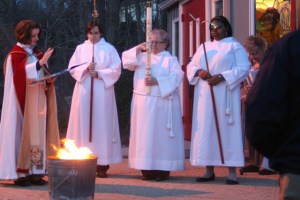
IMG_3202Our liturgy tonight operates a bit like a movie whose mode of telling stories is in flashbacks.  We start the movie with the scene we just heard.  Several women are gathered around the empty tomb, their mouths agape, and their minds racing.  And then, the flashbacks begin.

Mary the mother of James recalls that ancient story of creation.  That empty tomb reminds her of those words – tohu wabohu – the formless void.  She vaguely remembers what God said about creating humankind in God’s image.  And she hears those words repeated over and over again, “It was good; ki-tov”

Meanwhile, another woman flashes back to when humankind’s sinfulness so angered God that God flooded the earth.  For forty days, Noah knew the nothingness of that empty tomb in front her.  But she also remembers that covenant God made with Noah – that never again will there be a flood to destroy the earth.  Perhaps there is a rainbow in this tomb, and not only the watery floods that she sees.

Joanna looks into that empty tomb and remembers another time her people faced desperation.  She flashes back to the rushing Egyptians who have pinned her people to the Red Sea.  She remembers the panicked screams of her people toward Moses.  She remembers how God saved them then – how God created a way out of no way.  She wonders whether the empty tomb is not unlike that empty seabed – the one that the Israelites used to get to freedom.

Another woman stares into that vacant tomb and she remembers a different tomb.  She remembers the death and hopelessness of those bones in that valley – the thousands of devastated lives.  But then she remembers what God told Ezekiel.  She remembers the rattling of those bones coming together, and the way the breath of God, the ruah of God breathed life into those bones.  She wonders if she hears the faint ruah of God now coming out of that empty tomb.

But Mary Magdalene remembers a different story from Zephaniah.  She hears the words of that song in a fresh way today.  “Sing aloud, O daughter of Zion.”  Is this the day that God will save us?  Can her beloved Jesus be not missing, but raised?  Might Jesus be the one who will restore her fortunes?  She longs for God to be saying to her, “Rejoice and exult with all your heart, O daughter Jerusalem.”  “Please let this empty tomb be an occasion for rejoicing and not for more pain and suffering for my Lord,” Mary Magdalene prayers in her heart.

And then the movie brings us abruptly back to the empty tomb, the sound of silence like so many times before in their history.  The appearance of emptiness threatens their fragile, exhausted psyches.  Their unspoken memories fail to comfort them because they are unable to utter a word of remembrance and assurance to one another.

As outsiders watching this movie, as we watch those looking into the tomb, we begin to connect the various flashbacks.  The answers are there before the angels need to say a word.  God loves us and creates us in God’s image.  And we are not only good – but we are very good – wehineh-tov.  God promises to never destroy us again as God once did.  God promises liberation from oppression.  God promises restoration to our bodies and spirits.  God promises to bring us home.  God promises and God saves us time and again.  And now, with this Messiah who has finally arrived, God saves us once and for all.  What has felt like a defeat is now the reason to rejoice.  The smiles that spread across our faces are exact mirrors of the smiles that spread across the faces of those women at the tomb.  The smiles are smiles that happen as we connect the varied flashbacks, remembering our salvation history, and this final act of salvation through the death and resurrection of our Lord and Savior Jesus Christ.  That tomb is not a formless void, but the holy site where all our salvation narrative culminates.  That empty tomb is in fact not empty at all.  That tomb is full of life.  Tonight is a night for alleluias, for songs of joy, and for dancing.  The light shatters the darkness this night, and we celebrate the greatest victory of all time.  Alleluia! Christ is risen.  The Lord is risen indeed!!

Recent Posts

  • On the Myth and Magic of Advent…
  • On Risking Failure and Facing Fear…
  • Sermon – Luke 23.33-43, P29, YC, November 23, 2025
  • On Inhabiting Gratitude…
  • Sermon – Luke 20.27-38, P27, YC, November 9, 2025

Archives

  • December 2025
  • November 2025
  • October 2025
  • September 2025
  • August 2025
  • July 2025
  • June 2025
  • March 2025
  • February 2025
  • December 2024
  • November 2024
  • October 2024
  • September 2024
  • August 2024
  • July 2024
  • June 2024
  • May 2024
  • March 2024
  • February 2024
  • January 2024
  • December 2023
  • November 2023
  • October 2023
  • September 2023
  • August 2023
  • July 2023
  • June 2023
  • May 2023
  • March 2023
  • February 2023
  • January 2023
  • December 2022
  • November 2022
  • October 2022
  • June 2022
  • May 2022
  • January 2022
  • December 2021
  • November 2021
  • October 2021
  • September 2021
  • August 2021
  • June 2021
  • May 2021
  • April 2021
  • March 2021
  • February 2021
  • January 2021
  • December 2020
  • November 2020
  • October 2020
  • September 2020
  • August 2020
  • July 2020
  • June 2020
  • May 2020
  • April 2020
  • March 2020
  • February 2020
  • January 2020
  • December 2019
  • November 2019
  • October 2019
  • September 2019
  • August 2019
  • July 2019
  • June 2019
  • May 2019
  • April 2019
  • March 2019
  • February 2019
  • January 2019
  • December 2018
  • November 2018
  • October 2018
  • September 2018
  • August 2018
  • July 2018
  • June 2018
  • May 2018
  • April 2018
  • March 2018
  • February 2018
  • January 2018
  • December 2017
  • November 2017
  • October 2017
  • September 2017
  • August 2017
  • July 2017
  • June 2017
  • May 2017
  • April 2017
  • March 2017
  • February 2017
  • January 2017
  • December 2016
  • November 2016
  • October 2016
  • September 2016
  • August 2016
  • July 2016
  • June 2016
  • May 2016
  • April 2016
  • March 2016
  • February 2016
  • January 2016
  • December 2015
  • November 2015
  • October 2015
  • September 2015
  • August 2015
  • July 2015
  • June 2015
  • May 2015
  • April 2015
  • March 2015
  • February 2015
  • January 2015
  • December 2014
  • November 2014
  • October 2014
  • September 2014
  • August 2014
  • July 2014
  • June 2014
  • April 2014
  • March 2014
  • February 2014
  • January 2014
  • December 2013
  • November 2013
  • October 2013
  • September 2013
  • August 2013
  • July 2013
  • June 2013
  • May 2013
  • April 2013
  • March 2013
  • February 2013
  • January 2013
  • December 2012
  • November 2012
  • October 2012
  • September 2012

Categories

  • reflection
  • Sermons
  • Uncategorized

Meta

  • Create account
  • Log in
  • Entries feed
  • Comments feed
  • WordPress.com

Blog at WordPress.com.

  • Subscribe Subscribed
    • Seeking and Serving
    • Join 394 other subscribers
    • Already have a WordPress.com account? Log in now.
    • Seeking and Serving
    • Subscribe Subscribed
    • Sign up
    • Log in
    • Report this content
    • View site in Reader
    • Manage subscriptions
    • Collapse this bar
 

Loading Comments...