• About

Seeking and Serving

~ seek and serve Christ in all persons

Seeking and Serving

Tag Archives: yoke

Sermon – Matthew 11.25-30, St. Francis Feast, YB, September 29, 2024

02 Wednesday Oct 2024

Posted by jandrewsweckerly in Sermons

≈ Leave a comment

Tags

animals, blessing, interconnected, Jesus, poor, Sermon, St. Francis, stigmata, yoke

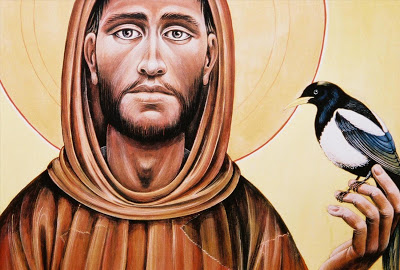
Today we honor the life and witness of St. Francis of Assisi.  St. Francis is well-known and beloved for myriad reasons.  Primarily, people tend to appreciate two things about him: his commitment to living in solidarity with the poor, which included dramatically stripping his clothing off, begging for food, and supporting the most needy; and, his affinity for the creatures of God, with stories of preaching to birds, negotiating with a violent wolf to make peace with the local town, and generally valuing the beasts of the earth.  But what we rarely talk about is the stigmata of St. Francis – those marks corresponding to the ones left on Jesus’ body by the crucifixion said to have been impressed by divine favor on devoted followers of Christ.

Here’s what we know about St. Francis’ stigmata.  He was praying on the Feast of the Cross, which falls on September 14.  His prayer that day to Jesus was that he might feel in his body and soul the pain that Jesus felt in the Passion.  But he also prayed to feel in equal measure the excessive love that Jesus felt that allowed him to endure pain for us.  We are told that in his intense prayer session, he saw a vision, and when he emerged, he had what looked like piercings in his hands and feet – or, stigmata.[i]  Now I don’t know how you feel about the existence of stigmata on certain saints, but I’ve always thought it was a little, well, weird – and even more heretical, maybe even unbelievable.

So, why, on this Sunday when all we want to do is bless and celebrate animals or remember the poor, do we need to talk about stigmata?  Believe me or not, there is actually a deep correlation with today’s gospel lesson.  Today, Jesus talks about yokes – those tools used to harness two animals for work.  The yoke allows the two not just to double their work, but to rely on one another – if one is tired, the other can push harder; and then the weaker one can later support the stronger one.  Yokes, like Jesus’ work, are easy and make the burden light. 

But beyond the mechanics of a good yoke, the yoke is also a good metaphor for how we see the gospel.  Being yoked to another makes you connected.  And once you are connected, and see how dependent upon one another you are, you begin to see how that connection extends beyond the two of you – that your yoked interconnection is a microcosm of the connectedness of all of God’s creation.  When Francis prayed fervently to both feel Jesus’ deepest physical pain as well as Jesus’ excessive outpouring of love, his resulting stigmata left a physical reminder of the ways in which, even in pain or great love, we are connected to one another.

Perhaps another example may help.  “Ramakrishna was a mystic who lived in India over a hundred years ago.  One day, as he was walking through the marketplace, he saw a servant boy being whipped by his master.  As he watched that boy being whipped, welts appeared on Ramakrishna’s own body.”  We are told that, “This suggests that this man had such a strong feeling for this boy that he could identify with him in the sufferings that he was enduring.”[ii]  Furthermore, “Like Ramakrishna, who was so at one with God that he could walk through the marketplace and become one with God’s creations, especially this poor servant, Francis so identified with the suffering of Jesus that he took on the wounds himself.”[iii]

What we see in Francis’ stigmata and even in the experience of the mystic Ramakrishna is that when we are living faithfully, we begin to see that we are yoked to one another.  We slowly begin to see all of humanity is connected.  And the more we spend time seeing the humanity in others – especially the humanity in those we would rather not – then we start to see that our interconnectedness extends even further – to God’s creation, to God’s creatures, to the cosmos.  If we open our hearts to one, we cannot help to open our hearts to all.  Francis’ love for the poor, Francis’ love for creatures, and even Francis’ stigmata are not disconnected – they are one in the same. 

In Psalm 148, a psalm sometimes read or sung on St. Francis’ feast day, we hear an invitation to all of God’s creation:  Mountains and all hills, fruit trees and all cedars;  Wild beasts and all cattle, creeping things and winged birds; Kings of the earth and all peoples, princes and all rulers of the world; Young men and maidens, old and young together.[iv]  We bless animals today because Francis reminded us how all of God’s creation is worthy of love and is interconnected.  But the invitation for us today is not just to love on cute dogs, cats, hamsters, and horses.  The invitation for us is to start claiming our yoked nature – yoked to those we love, yoked to our political opponents, yoked to those who have different ethics and values than ourselves, yoked to parents who make different parenting decisions, yoked to those with different skin color or sexual orientation or gender identity, yoked to those we see as deserving of God’s grace and those who are not.  Our yoked nature allows us to pray the Prayer of St. Francis from our Prayer Book:  “Lord, make us instruments of your peace. Where there is hatred, let us sow love; where there is injury, pardon; where there is discord, union; where there is doubt, faith; where there is despair, hope; where there is darkness, light; where there is sadness, joy. Grant that we may not so much seek to be consoled as to console; to be understood as to understand; to be loved as to love. For it is in giving that we receive; it is in pardoning that we are pardoned; and it is in dying that we are born to eternal life.”[v]  We can do the work of St. Francis because of the yoke of Jesus.  Thanks be to God.  Amen.


[i] Hilarion Kistner, O.F.M., The Gospels According to Saint Francis (Cincinnati:  Franciscan Media, 2014), 88-91.

[ii] Kistner, 87-88.

[iii] Kistner, 92.

[iv] Psalm 148.9-12.

[v] BCP, 833.
Sermon – Matthew 11.25-30, Feast of St. Francis, October 1, 2023

04 Wednesday Oct 2023

Posted by jandrewsweckerly in Sermons

≈ Leave a comment

Tags

blessing of animals, burden, creation, disciples, discipleship, easy, impact, Jesus, light, pets, Sermon, serve, St. Francis, yoke

“Come to me, all you that are weary and are carrying heavy burdens, and I will give you rest.”  Whether you are wearied from wrestling your pets this morning (or your kids!), weary from full fall schedules, or weary from illness, anxiety, or bad news, Jesus’ words are words of comfort today.  They remind us of our time of renewal in sabbatical, and we want to cozy into the Gospel words today.

But today is not about Jesus blessing times of rest.  Jesus is actually commissioning disciples.  At this point in Matthew’s gospel, Jesus has been describing the way of discipleship:  serving the poor, working for justice, striving for peace.  Jesus tells them the work will be hard and will make the disciples weary.  To those disciples, Jesus offers a way to reach comfort.  Jesus says, “Take my yoke upon you, and learn from me; for I am gentle and humble in heart, and you will find rest for your souls.  For my yoke is easy, and my burden is light.”

Now, I do not know how much you know about yokes, but I have been studying up on yokes this past week.  There are actually two kinds of yokes.  Some yokes are meant for one person.  Imagine, if you will, a person hauling water from a well in village, the yoke over her shoulders, while two buckets full of water hang below.  The yoke distributes the weight of the water, but the yoke is not exactly an easy yoke.  The other kind of yoke is meant for two animals – like two oxen working together.  If one ox gets tired, the other pushes a little harder; later the roles may reverse.  A good yoke balances the work between the animals, without chafing or rubbing.  The work is genuinely easier and lighter.

This second kind of yoke is the metaphor Jesus uses to depict discipleship.[i]  Jesus tells them the work of discipleship will be hard and wearisome.  But when yoked to Jesus, the work will feel light.  So often, when we think of disciples as easing suffering, fighting for the poor, struggling for justice, we think we need to solve the worlds’ problems on our own – that we must use our own gifts to make a difference.  We go unyoked, and we feel overwhelmed and disheartened.[ii]  Even when try to do good work:  building beds for kids in need, buying extra food for food collection Sunday, or donating money to events like our Murder Mystery – we can still become discouraged.  When we think we can go at it alone (or maybe even better than others), we do not get relief in Jesus’ yoke. 

St. Francis, who we honor today, knew all about the yoke of Jesus.  Francis came from a wealthy family, had a rambunctious youth, and enjoyed status and privilege.  But one day he encountered some beggars and lepers and everything changed.  Francis renounced his privilege and wealth, took on poverty, and honored the sick, poor, and disenfranchised.  What Francis discovered was his wealthy had become its own burden of sorts.  Once he yoked himself to Jesus, everything changed.  He began to see Jesus in everyone, even birds to which he preached and the animals for whom he advocated.  Francis yoked himself to Jesus and became a faithful steward of God’s creation – so faithful that we bless animals and rejoice in creation ourselves through music and scripture today.

Now, I know you maybe came today to bless your pet, or maybe to remember a beloved pet who showed you what unconditional love really is.  And while that will bring us comfort today, and we do so with love and laughter, we also do something much bigger.  Today we remember all the instances where we have felt love – in animals, in each other, even in Jesus – and we take that love not only as a comfort, but also as a commission.  Today Jesus invites us outside of ourselves – our worries, our woes, our weariness, and put our attention on those who may need love even more than we do. 

Do not get confused.  I am not asking you to add weight to that single yoke, asking you to add more water to your heavy buckets.  I am inviting you to take off the single yoke and step in a double yoke – to yoke yourself to Jesus, yoke yourself to other disciples in this room.  Take on that yoke of Christ because the yoke is easy and light – and will actually free up your burden.  Jesus will give you the comfort, encouragement, and strength you need.  And you will be enabled to stride forward making an impact right here in James City County.  We will do that work together, because the yoke is easy and the burden is light.  Amen.


[i][i] Douglas R. A. Hare, Matthew:  A Bible Commentary for Teaching and Preaching (Louisville:  John Knox Press, 1993), 129.

[ii] Barbara Brown Taylor, The Seeds of Heaven:  Sermons on the Gospel of Matthew (Louisville:  Westminster John Knox Press, 2004), 21.

Sermon – Matthew 11.25-30, St. Francis Feast, YC, October 2, 2022

05 Wednesday Oct 2022

Posted by jandrewsweckerly in Sermons

≈ Leave a comment

Tags

animals, blessing, Jesus Christ, light, peace, reconciliation, relationship, rest, sabbath, Sermon, St. Francis, truth, wolf, work, yoke

Today we honor the life of St. Francis of Assisi.  Francis is one of the most popular and admired saints of all time.  Most of us know the highlights of his story:  born the son of a wealthy man in 1182; had a conversion experience and devoted his life to Lady Poverty; shaped monastic and lay devotion; was a friend to all God’s creatures – being known to have preached to the birds.

But the story I like most is the story about St. Francis and the Wolf.  According to legend, there was a wolf that was terrorizing the town of Gubbio, killing and eating animals and people.  The villagers tried to fight back, but they too died at the jaws of the wolf.  Francis had pity on the townspeople and went out to meet the wolf.  When Francis found the wolf, he made the sign of the cross, and said, “Come to me, Brother Wolf.  In the name of Christ, I order you not to hurt anyone.”  In response, the wolf calmly laid down at Francis’ feet.  Francis then went on to explain to the wolf how he was terrorizing the people and other animals – all who were made in the image of God.  The wolf and Francis then made a pact that the wolf would no longer harm the townspeople and the townspeople would no longer try to hurt the wolf.  The two traveled into town to explain the pact they had formed.  The people were amazed as Francis and the wolf walked side-by-side into town.  Francis made the people pledge to feed the wolf and the wolf pledge not to harm anyone else.  From that day on, the wolf went door to door for food.  The wolf hurt no one and no one hurt the wolf; even the dogs did not bark at the wolf.[i]

What I love about this story of St. Francis is that the story is about reconciliation and relationship.  At the beginning of the story the town and the wolf are at an impasse – the wolf is hungry and getting attacked; the people are afraid and are lashing out.  What Francis does for both parties is shock them out of the comfortable.  For the wolf, no one has addressed the wolf kindly – they have either shut the wolf out or actively tried to kill him.  For the people, the wolf has not asked for help – he has simply and violently taken what he needed and wanted.  Francis manages to shock the wolf first – not through violence or force, but with the power of love and blessing.  By giving a blessing in the name of God, Francis is then able to implore the wolf to reciprocate with love.  Francis also manages to shock the village – not with a violent victory, but with a humble display of forgiveness and trust.  By walking into town with a tamed wolf at his side, Francis is able to encourage the town embrace, forgive, and care for the wolf.  Francis’ actions remind both parties that unless their relationships are reconciled, unrest and division will be the norm. 

The funny thing about this story is that the story is pretty ridiculous.  I mean, how many of us go around talking to wild animals, blessing them with the sign of the cross, expecting anything other than being attacked?  We will never really know whether the story is true.  But like any good Biblical story, whether the story is true is hardly the point: the point is that the stories point toward “Truth” with a capital “T.”  What this story teaches is peace and reconciliation only happen through meeting others where they are.  We cannot expect great change unless we are willing to get down in the trenches – to go out and meet that destructive wolf face-to-face.  The other thing this story teaches is relationships are at the heart of peace work.  Only when the wolf and the town begin to get to know each other and begin to form a relationship with one another can they move forward. 

This is the way life is under Jesus Christ.  In our gospel lesson today, Jesus says, “Come to me, all you that are weary and are carrying heavy burdens, and I will give you rest.  Take my yoke upon you, and learn from me; for I am gentle and humble in heart, and you will find rest for your souls.  For my yoke is easy, and my burden is light.”  Jesus’ words have layered meaning.  The first meaning we all catch is that Jesus offers us rest and refreshment.  Jesus encourages us to come to him, to cast our burdens and cares upon him, and to take rest, to take Sabbath in Christ.  Our souls will find peace in Christ Jesus.  The second meaning is that peace in Christ Jesus is not without work.  Jesus does not say come unto me and relax forever in happy retirement.  Jesus says we will still have to take on a yoke – the burden of disciple living.  Luckily, that burden of being Christ’s disciple will not be burdensome – it will be light.  Finally, not only will Jesus make the workload “light,” as in not heavy.  Jesus will also make us “light” – as in lights that shine into the darkness and refuse to allow the shadow to overwhelm.   We become the light when we work for reconciliation in our relationships with others. 

That is why we do a couple of special things today.  First, we ask for blessing on our animals – that God might help our relationship with our pet be one of blessing and light.  Second, we come to Jesus for Sabbath rest – that God might renew us on this Sabbath day, use the rest to fill us with light, and renew our commitment to be agents of reconciliation, gladly putting on Christ’s yoke.  Amen.


[i] Jack Wintz, “St. Francis and the Taming of the Wolf,” as found at https://www.franciscanmedia.org/franciscan-spirit-blog/st-francis-and-the-taming-of-the-wolf on September 30, 2022. 

Sermon – Matthew 11.25-30, Feast of St. Francis, YB, October 3, 2021

06 Wednesday Oct 2021

Posted by jandrewsweckerly in Sermons

≈ Leave a comment

Tags

animals, blessing, burden, creation, easy, God, Jesus, sacred, Sermon, St. Francis, wealth, work, yoke

Occasionally I wander the Hickory Neck property as a way of clearing my head.  I often end up over in the St. Francis Memorial Garden, reveling in the quiet in that remote corner behind the Historic Chapel.  The bucolic scene and the St. Francis statue make me imagine the peaceful walks he took in his journey to commune with God and God’s created order.  The funny thing is our celebrations of St. Francis today are nothing like those peaceful moments.  There is the chaos of the drive-thru, as confused pets worry they are headed toward the dreaded veterinarian or are confused by the people in clerical garb.  There is the hubbub of owners calming pets inside the New Chapel, the curiosity of what unique pets one may see, and the endless giggles and chuckles about unpredictable animals in an enclosed space.  The whole morning is a morning of contrasts.

The contradictions of this day are equally evident in our Gospel lesson.  Our gospel lesson closes with one of our favorite invitations from Jesus, “Come to me, all you that are weary and carrying heavy burdens, and I will give you rest.  Take my yoke upon you … and you will find rest for your souls.  For my yoke is easy, and my burden is light.”  Those words describe a loving, gentle Jesus, who enfolds us in a calm, affirming embrace.  At least, they should.  But if we read the words critically, there is more contrast in them than we might like to admit.  Yes, Jesus taking our heavy burdens and recognizing our weariness is balm for the soul.  But the last time I checked, yokes were not exactly tools for rest.  And even though Jesus promises his yoke is easy, the yoke is still a yoke – a tool for directing, guiding, ensuring productive work is done.  Having listened to the gospels these last weeks, we know this work is anything but light.  In the last few weeks in Mark’s gospel, Jesus told us we would have to take up our cross, suffer, and die; that discipleship would mean being servant of all; and that if our hand or eye were causing us to stumble, we should just cut them off!  That does not really sound like an easy yoke to me!

Part of what we appreciate about St. Francis, and why we celebrate him every year – besides having an excuse to have a day to honor our beloved animals – is St. Francis understood Jesus’ words in a tangible, personal way.  Francis grew up in the life of luxury.  He grew up in a privileged home, lived a life of young adult revelry, and could have easily assumed his father’s wealth in adulthood.  But there were these poor people everywhere he looked around town.[i]  And there was the day everything changed at the church of St. Mary of the Angles[ii], when Francis heard different words from Matthew’s gospel, just a chapter before what we heard today.  Jesus says, “Cure the sick, raise the dead, cleanse the lepers, cast out demons…Take no gold, or silver, or coper in your belts, no bag for your journey, or two tunics, or sandals, or a staff…”[iii]  For Francis, Jesus’ yoke felt light because the yoke of keeping up appearances, the yoke of ignoring the poor to enjoy your own wealth, the yoke of never feeling like you have enough was indeed a heavy yoke.  The yoke of another way – of the way of Jesus – helped Francis reframe his entire life.

That is what we celebrate too.  St. Francis, in his faith conversion, and in his ability to see the sacred in all of God’s creation, saw the truth of our gospel lesson today.  As one scholar explains, “The proper ordering of our relationship to Father and Son can be deemed ‘light’ and ‘easy’ because an improper relationship to them surely makes for a much harder and more restless life!”[iv]  Whether in the pure love between animals and owners, whether in peaceful moments with God’s creation, or whether in today’s gospel lesson and in Francis’ example, our invitation today is to let go of the hard and restless life and to take up the light burden of Jesus’ easy yoke.  The more we practice taking on that yoke, the more we find work that is meaningful, life-giving, and blessed.  And that is a yoke we can all enjoy!  Amen.


[i] Holy Women, Holy Men:  Celebrating the Saints (New York:  Church Publishing, 2010), 622.

[ii] Hilarion Kistner, O.F.M., The Gospels According to Saint Francis (Cincinnati:  Franciscan Media, 2014), 6-7.

[iii] Matthew 10.7-10

[iv] Colin Yuckman, “Commentary on Matthew 11:16-19, 25-30,” July 9, 2017, as found at https://www.workingpreacher.org/commentaries/revised-common-lectionary/ordinary-14/commentary-on-matthew-1116-19-25-30-4 on October 1, 2021.

Sermon – Matthew 11.25-30, St. Francis Feast, YA, October 4, 2020

07 Wednesday Oct 2020

Posted by jandrewsweckerly in Sermons

≈ Leave a comment

Tags

animals, blessing, Blessing of the Animals, connection, creation, God, humanity, interconnected, Jesus, poor, Sermon, solidarity, St. Francis, yoke

Today we honor the life and witness of St. Francis of Assisi.  St. Francis is well-known and beloved for myriad reasons.  Primarily, people tend to appreciate two things about him: his commitment to living in solidarity with the poor, which included dramatically stripping his clothing off, begging for food, and supporting the most needy; and, his affinity for the creatures of God, with stories of preaching to birds, negotiating with a violent wolf to make peace with the local town, and generally valuing the beasts of the earth.  The second component of his identity is why we do things like the Blessing of the Animals. The first component, we tend to get a little uncomfortable with – or at least like to admire his commitment to being in solidarity with the poor, but not actually imitate it. In fact, one author argues, “Of all the saints, Francis is the most popular and admired, but probably the least imitated.”[i]

This week I have struggled with which component to bring to the fore: Francis’ solidarity with the poor, or Francis’ love of creatures.  But as I looked to our gospel lesson, and started thinking about yokes, I realized, the two are not unrelated.  You see, yokes were used to harness two animals for work.  The yoke allowed the two not just to double their work, but to rely on one another – if one was tired, the other could push harder; and then the weaker one could later support the stronger one.  Yokes, like Jesus’ work, were easy and made the burden light. 

But beyond the mechanics of a good yoke, the yoke is also a good metaphor for how we see the gospel.  Being yoked to another makes you connected.  And once you are connected, and see how dependent upon one another you are, you begin to see how that connection extends beyond the two of you – that your yoked interconnection is a microcosm of the connectedness of all of God’s creation.  When Francis was experiencing his conversion, he heard a sermon on another Matthew text.  In Matthew 10, Jesus instructs the disciples to go and proclaim the good news, curing the sick, raising the dead, cleansing the lepers, and casting out demons.  All of this without pay, without backup supplies, and relying on the kindness of strangers.  After the priest explained the text to Francis, Francis’ response was, “This is what I wish, this is what I seek, this is what I long to do with all my heart.”[ii]

But what Francis learned and what we learn when we do likewise is helping the poor and the sick opens our eyes.  We slowly begin to see all of humanity is connected.  And the more we spend time seeing the humanity in others – especially the humanity in those we would rather not – then we start to see that our interconnectedness extends even further – to God’s creation, to God’s creatures, to the cosmos.  If we open our hearts to one, we cannot help to open our hearts to all.  Francis’ love for the poor and Francis’ love for creatures were not two separate things – they were one in the same. 

In our psalm today, we heard the invitation to all of God’s creation:  Mountains and all hills, fruit trees and all cedars;  Wild beasts and all cattle, creeping things and winged birds; Kings of the earth and all peoples, princes and all rulers of the world; Young men and maidens, old and young together.[iii]  We bless animals today because Francis reminded us how all of God’s creation is worthy of love.  But the invitation for us today is not just to love on cute dogs, cats, hamsters, and horses.  The invitation for us is to start claiming our yoked nature – yoked to those we love, yoked to our political opponents, yoked to those who have different ethics and values than ourselves, yoked to parents who make different parenting decisions, yoked to those with different skin color or sexual orientation, yoked to those we see as deserving of God’s grace and those who are not.  Our yoked nature allows us to pray the Prayer of St. Francis from our Prayer Book:  “Lord, make us instruments of your peace. Where there is hatred, let us sow love; where there is injury, pardon; where there is discord, union; where there is doubt, faith; where there is despair, hope; where there is darkness, light; where there is sadness, joy. Grant that we may not so much seek to be consoled as to console; to be understood as to understand; to be loved as to love. For it is in giving that we receive; it is in pardoning that we are pardoned; and it is in dying that we are born to eternal life.”[iv]  We can do the work of St. Francis because of the yoke of Jesus.  Thanks be to God.


[i] Holy Men, Holy Women:  Celebrating the Saints (New York:  The Church Pension Fund, 2010), 622.

[ii] Hilarion Kistner, The Gospels According to Saint Francis (Cincinnati:  Franciscan Media, 2014), 7-8.

[iii] Psalm 148.9-12.

[iv] BCP, 833.

Sermon – Matthew 11.16-19, 25-30, P9, YA, July 5, 2020

15 Wednesday Jul 2020

Posted by jandrewsweckerly in Sermons, Uncategorized

≈ Leave a comment

Tags

abdication, comfort, delightful, God, Jesus, light, meaning, pandemic, purpose, reckless, refreshment, rest, satisfying, Sermon, weary, yoke

In Compline, one of the prayers is for “we who are wearied by the changes and chances of this life.”[i]  I have been feeling that prayer these last several weeks – or even months.  The longer we stay in our homes, the longer this pandemic wages illness and death upon us, the longer the spread of virus takes away the everyday privileges we never fully appreciated, and the longer civil unrest forces us to look at our demons and sinfulness, we become more and more weary.  We do not have to ponder too long why cases of the pandemic are soaring this summer.  People who are wearied by the changes and chances of this life are so grief-stricken they are becoming reckless, self-centered, and indignant.

So, you can imagine my full-bodied relief when I heard the last verses of our Gospel lesson today.  “Come to me, all you that are weary and are carrying heavy burdens, and I will give you rest.”  Those words from Jesus are sweet comfort to us, who just want a break, who just want some semblance of normalcy, who just want peace.  Jesus’ words are a warm embrace in a time of touchlessness.  Jesus’ words are a balm to our country who this very weekend honors a liberty that many of our neighbors are reminding us is not felt by all our citizens.

But as scholar Thomas Long says, “What Jesus offers, however, is not a hammock, but a yoke.”[ii]  I know we want to linger on verse 28, but immediately after that comforting embrace, Jesus says, “Take my yoke upon you, and learn from me; for I am gentle and humble in heart, and you will find rest for your souls.  For my yoke is easy, and my burden is light.”  In the shift between these last verses, Jesus does a bit of a bait and switch.  He beckons us into his comforting arms, but also places a burden on our shoulders.

I confess, I have been a bit cranky about that switch.  Can’t we just have one week, one Sunday, one moment, where we abdicate responsibility, where we take a sabbath from all this work, where we binge watch television and eat crappy food?  Isn’t that what Jesus means when he says he will give us rest?!?

Fortunately for all of us, I had my tempter tantrum early in the week, and have had some time to sit with this yoke of Jesus’.  You see, when I am being honest, I know binge watching television or eating junk food is not actually restorative.  I feel stiff and tired after sitting for hours.  And when I eat unhealthily, the lingering stomachache or sluggishness is not actually as comforting as the comfort food implies.

What Jesus is suggesting today is not a restful, self-centered, time of abdication.  What Jesus is suggesting is we find rest in the things of life that matter.  As one scholar suggests, “we will find rest for carrying the burden of the gospel by living out the unique mission to which Jesus calls each of us.”[iii]  That yoke we may be skeptical of this week, is not actually a ploy or a trick by Jesus.  The reason Jesus says his yoke is easy and his burden is light is “because [his yoke] is the way of God, and [his yoke] is profoundly satisfying to the human soul.”[iv]

Jesus uses some strong imperatives today:  come to me, take my yoke, learn from me.  But Jesus is not being bossy.  Jesus is reminding us, in his ever so firm, but pastoral way, that the ways we are seeking rest and relief from weariness are not the ways to life.  The way to life, of true refreshment, of renewed spirits is through the yoke of Christ.  How is that possible?  As one scholar reminds us, “The easy yoke means having something to do:  a purpose that demands your all and summons forth your best.  [The easy yoke] means work that is motivated by a passionate desire to see God’s kingdom realized.  [The easy yoke] means work toward a certain future in which all of God’s dreams will finally come true.  To accept the yoke of the gentle and humble Lord is to embrace the worthy task that puts the soul at ease.”[v]  Jesus reminds us today that the rest we seek is not mind-numbing, emotion-numbing, spirit-numbing relief, but purposeful, meaning-filled, reward-making clarity.  When we harness ourselves to Christ, the burdens no longer feel like burdens, the work no longer feels like work, and the desire to be done turns to a desire for God’s delightful sense of purpose and meaning.  That is the kind of profound satisfaction Jesus offers today.  Thanks be to God!

[i] Book of Common Prayer, 133.

[ii] Thomas G. Long, Matthew (Louisville:  Westminster John Knox Press, 1997), 132.

[iii] Emilie M. Townes, “Theological Perspective,”  Feasting on the Word, Year A, Volume 3 (Louisville:  Westminster John Knox Press, 2011), 214.

[iv] Long, 132.

[v] Lance Pape, “Homiletical Perspective,” Feasting on the Word, Year A, Volume 3 (Louisville:  Westminster John Knox Press, 2011), 217.

Homily – Mt. 11.25-30, St. Francis Feast, YB, October 21, 2018

24 Wednesday Oct 2018

Posted by jandrewsweckerly in Sermons, Uncategorized

≈ Leave a comment

Tags

blessing, easy, healing, homily, hurt, Jesus Christ, light, love, pets, reconciliation, relationship, rest, sabbath, Sermon, St. Francis, village, wolf, yoke

FrancisOfAssisi

Photo credit:  http://thewildreed.blogspot.com/2007/10/st-francis-of-assisi-dancer-rebel.html

Today we honor the life of St. Francis of Assisi.  Francis is one of the most popular and admired saints of all time.  Most of us know the highlights of his story: born the son of a wealthy man in 1182; had a conversion experience and devoted his life to Lady Poverty; shaped monastic and lay devotion; was a friend to all God’s creatures – being known to have preached to the birds.  But the story I like most is the story about St. Francis and the Wolf.

According to legend, there was a wolf that was terrorizing a nearby town, killing and eating animals and people.  The villagers tried to fight back, but they too died at the jaws of the wolf.  Francis had pity on the people and went out to meet the wolf.  When Francis found the wolf, he made the sign of the cross, and said, “Come to me, Brother Wolf.  In the name of Christ, I order you not to hurt anyone.”  The wolf calmly laid down at Francis’ feet.  Francis then went on to explain to the wolf how the wolf was terrorizing the people and other animals – all who were made in the image of God.  The wolf and Francis then made a pact that the wolf would no longer harm the town and the town would no longer try to hurt the wolf.  The two traveled into town to explain the pact they had formed.  The people were amazed as Francis and the wolf walked side-by-side into town.  Francis made the people pledge to feed the wolf and the wolf pledge not to harm anyone else.  From that day on, the wolf went door to door for food.  The wolf hurt no one and no one hurt the wolf; even the dogs did not bark at the wolf.[i]

What I love about this story of St. Francis is that the story is about reconciliation and relationship.  At the beginning of the story the town and the wolf are at an impasse – the wolf is hungry and getting attacked; the people are afraid and are lashing out.  What Francis does for both parties is shock them out of the comfortable.  For the wolf, no one has addressed the wolf kindly – they have either shut the wolf out or actively tried to kill the wolf.  For the people, the wolf has not asked for help – he has simply and violently taken what he needed and wanted.  Francis manages to shock the wolf first – not through violence or force, but with the power of love and blessing.  By giving a blessing in the name of God, Francis is then able to implore the wolf to reciprocate with love.  Francis also manages to shock the village – not with a violent victory, but with a humble display of forgiveness and trust.  By walking into town with a tamed wolf at his side, Francis is able to encourage the town to embrace, forgive, and care for the wolf.  Francis’ actions remind both parties that unless their relationships are reconciled, unrest and division will be the norm.

The funny thing about this story is that the story is pretty ridiculous.  I mean, how many of us go around talking to wild animals, blessing them with the sign of the cross, expecting anything other than being attacked?  We will never really know whether the story is true.  But like any good Biblical story, or even any good midrash, whether the story is true is hardly the point: the point is that the stories point toward “Truth” with a capital “T.”  What this story teaches is that peace and reconciliation only happen through meeting others where they are.  We cannot expect great change unless we are willing to get down in the trenches – to go out and meet that destructive wolf face-to-face.  The other thing this story teaches is relationships are at the heart of reconciliation.  Only when the wolf and the town began to get to know each other and began to form a relationship with one another could they move forward.

This is the way life is under Jesus Christ.  In our gospel lesson today, Jesus says, “Come to me, all you that are weary and are carrying heavy burdens, and I will give you rest.  Take my yoke upon you, and learn from me; for I am gentle and humble in heart, and you will find rest for your souls.  For my yoke is easy, and my burden is light.”  Jesus’ words have layered meaning.  The first meaning we all catch is that Jesus offers us rest and refreshment.  Jesus encourages us to come to him, to cast our burdens and cares upon him, and to take rest, to take Sabbath in Christ.  Our souls will find peace in Christ Jesus.  The second meaning is that peace in Christ Jesus is not without work.  Jesus does not say come unto me and relax forever in happy retirement.  Jesus says we will still have to take on a yoke – the burden of disciple living.  But luckily, that burden of being Christ’s disciple will not be burdensome – it will be light.  Finally, not only will Jesus make the workload “light,” as in not heavy:  Jesus will also make us “light” – as in lights that shine into the darkness and refuse to allow the shadow to overwhelm[ii]; as in lights that shine on this very Holy Hill where Hickory Neck rests.  We become the light when we work for reconciliation in our relationships with others.

That is why we do so many special things today.  Today, we ask for prayers and then exchange signs of peace – that God might help us reconcile the relationships in our life that need healing.  Today, at our 9:00 am service, we ask for blessing on our animals – that God might help our relationship with our pet be one of blessing and light.  Today, we come to Jesus for Sabbath rest – that God might renew us on this Sabbath day, use the rest to fill us with light, and renew our commitment to be agents of reconciliation, gladly putting on Christ’s yoke.  Amen.

[i] John Feister, “Stories about St. Francis and the Animals,” October 4,2005, as found at https://faith32.livejournal.com/61897.html on October 18, 2018.

[ii] Mel Williams, “Let it go…and rest” Faith and Leadership, July 6, 2014 as found at http://www.faithandleadership.com/sermons/mel-williams-let-it-go%E2%80%A6and-rest  on October 18, 2018.

Homily – Matthew 11.25-30, Feast of St. Francis, October 23, 2016

26 Wednesday Oct 2016

Posted by jandrewsweckerly in Sermons, Uncategorized

≈ Leave a comment

Tags

animals, Blessing of the Animals, burden, creation, easy, homily, light, manageable, poverty, relationship, solidarity, St. Francis, wealth, yoke

Today we honor St. Francis of Assisi, one of the most beloved saints of the church.  Most of us think of Francis as the patron saint of animals and creation.  When we think of him we may think of a St. Francis statue in a garden.  We may think of various images of him preaching to birds.   Some of us may even recall that tale where Francis negotiated peace between a village and a wolf that had been terrorizing the town.  That is why when we celebrate St. Francis’ feast, we also bless animals – the creatures that were so dear to him.  That is also why we often worship outside – honoring God’s creation, which Francis loved so profoundly.

The challenge with honoring Francis in this way is that we forget the other parts of Francis’ life – quite frankly, the much more difficult parts of St. Francis’ life.  You see, Francis’ love of creation comes from a deeper place.  Francis first started his journey to God out of a new relationship with wealth.  Francis was the son of a wealthy businessman in the 1100s.  He had everything at his disposal, and his father wanted him to enjoy that privilege and pass that privilege to Francis’ own children.  But in his early twenties, Francis had an encounter with a beggar that changed everything.  Suddenly the trappings of wealth no longer felt like a safety net or source of comfort – they feel like a burden – a barrier to the life Christ calls us to lead.

And so, Francis renounced the wealth in his life, reportedly even stripping off the clothes his father had given him to show how fully committed he was to this new way of life.  He married “Lady Poverty,” and invited others to join him.  The lifestyle is so austere that many joke that that Francis is one of the most revered, and yet, least followed saints of our faith.

I remember in college having long conversations about living in solidarity with the poor.  We were presented the idea over and over again, but we could not get our heads around what living in solidarity with the poor meant.  Several graduates tried – volunteering for at least a year after college.  Some joined intentional Christian communities, in the hopes that living simple lives in community might help them get closer to that solidarity.  Some traveled to impoverished countries to serve among the poorest, while others worked in the nonprofit sector in the States.  But we always came back to one crucial question:  can we live in solidarity with the poor?  Most of us have a safety net, whether our safety net is family, wealth, education, or citizenship.  Can we even help the poor if we renounce everything like Francis?

I must confess, I do not think there is a good answer to the question about living in solidarity with the poor.  And I am not convinced that most of us can live like Francis, begging and living in tattered clothes.  But what Francis is trying to do is help us see how money gets in the way of our relationship with everything else.  That is why Jesus talked about money so much.  Jesus even led a life much more similar to Francis’ than ours – wandering through life, depending on the hospitality of strangers, and telling his disciples to give up staffs and bags when they go out to meet the people.  Both Jesus and Francis began to learn that living without the comfort of wealth meant entering oneself into a state of vulnerability – a state where true, holy, meaningful relationships begin; a state where everything’s value changes – down to the birds that sing, the creation that breathes beauty, and even the pets that show us unconditional love.

Of course, each of us has to discern what taking up Jesus’ or Francis’ way means for us, knowing that many of us have family obligations and debts that must be managed.  But what Jesus and Francis do today is invite us to not allow those burdens to become an excuse for not making ourselves vulnerable.  Jesus says today, “Take my yoke upon you, and learn from me; for I am gentle and humble in heart, and you will find rest for your souls. For my yoke is easy, and my burden is light.”  For those of you who have worked with farm animals, you know that yokes are meant to fit smoothly on to animals, distributing the weight and burden in a manageable way.[i]  That is what taking on the yoke of Christ, and walking the way of Francis is like – a life, that if taken on, is manageable.  We may be scared to put on our shoulders the burden of vulnerability.  But Jesus promises the burden is light, the yoke is easy.  And Francis shows us the world of beauty that opens when we simply let go.  Amen.

[i] Douglas R.A. Hare, Matthew, Interpretation:  A Bible Commentary for Teaching and Preaching (Louisville:  John Knox Press, 1993), 129

Homily – Matthew 11.25-30, St. Francis, October 4, 2015

07 Wednesday Oct 2015

Posted by jandrewsweckerly in Uncategorized

≈ Leave a comment

Tags

burden, comfort, crazy, discomfort, easy, give up, holy, homily, imitate, impossible, inspire, Jesus, life, light, missions, Pope Francis, saint, sanitized, St. Francis, uncomfortable, yoke

I once led a book group that read the book The Prison Angel.  The Prison Angel is the story of Mother Antonio, a woman of privilege from California who had a mid-life crisis, took on the role of a nun, went to the largest prison in Tijuana, Mexico, and began a ministry of transforming guards, inmates, and families connected to the prison.  Her work was amazing – the way that she was able to love everyone equally, the way that she was able to harness resources and get them where they needed to be, and the way that she was able to devote her life to this system – even living in her own prison cell for a while – were all examples of her awesome witness.  As we finished the book, I had hoped that people in our book group would be inspired, and might even consider their own contribution to a prison ministry.  Instead, the response was more like this:  Mother Antonio is truly amazing.  But let’s be honest.  I can’t be like her.  I’m not going to drop everything – my family and life – and become totally devoted to a ministry.  And just like that, I lost them.  No longer was Mother Antonio inspiring.  She was impossible.  And once she was impossible, no one felt compelled to do anything.  I definitely felt like I failed my mission of inspiration leading to action.

As I was preparing for today’s celebration of St. Francis, I ran across this quote:  “Of all the saints, Francis is the most popular and admired, but probably the least imitated.”[i]  You see, we have a sanitized version of Francis in our minds.  He was nice to animals and took care of the poor.  He devoted his life to Christ as a monk.  We even put up statues of Francis in our gardens and outside our churches.  When we think of Francis, we think of a gentle man gingerly allowing a bird to perch on his finger, and we smile.  We like our sanitized version of Francis because the real version is a little scary.  When Francis renounced his rather significant wealth, he stripped naked in front of his father and the bishop.  Francis didn’t just help the poor, he became poor, begging on the streets.  He worked with lepers – people no one wanted to touch, touching them with his bare hands and kissing them.  Barefoot, he preached in the streets about repentance.  He preached to the birds, and is rumored to have negotiated with a wolf.  If we met St. Francis today, most of us would not imitate or venerate him.  We would just see him as another homeless beggar with a serious case of mental illness.

That is the challenge for us when trying to live a holy life.  St. Francis is the obvious example today.  Though we love and admire St. Francis, few of are comfortable with his total identification with poverty, suffering, and care for our creation.  The same can be said of Jesus.  Though we profess that Jesus is our Lord and Savior, we regularly fail to live in the ways that Jesus taught – in fact, some of us have given up even trying.  Even looking toward a modern-day example of holy living trips us up.  When we watched Pope Francis come through last week, we marveled at his radical witness.  We loved what he had to say – except when he had something to say that made us uncomfortable or that we disagreed with.  When thinking about the radical life that is following Jesus – whether through the Pope, through St. Francis, or Jesus himself – most of us stumble and feel like giving up.

Luckily Jesus offers us a promise today.  Jesus says, “Come to me, all you that are weary and are carrying heavy burdens, and I will give you rest.  Take my yoke upon you, and learn from me; for I am gentle and humble in heart, and you will find rest for your souls.  For my yoke is easy, and my burden is light.”  My yoke is easy and my burden is light.  When we look at St. Francis’ witness and we think about the poverty, the preaching, and the penitence, we get nervous.  We like our stuff, we like being comfortable, and we like being Christians without having to be too loud about it.  When we think about St. Francis, we think of a yoke – but not a light one – one that is heavy and onerous.  But Jesus harkens us back to his original words.  My yoke is easy and my burden is light.

One of the reasons I am a proponent of international missions is that they help you experience reality in a totally different way.  When we go on local missions, we can keep our smart phones, we have access to clean, accessible health care, and we can always find a McDonalds for a burger fix.  But when we are in a rural town in a third world country, things change.  We may not get to shower everyday, we may have to boil our water before drinking it, we will eat food that you are not so sure about, and we pray that we don’t get too sick while abroad.  And forget about a cell phone and internet access.  Most of us don’t even take a watch or jewelry to ensure they do not get lost.  Now that may sound like torture to most of you.  But here is what we learn when we are stripped of comforts and living and working in a foreign setting:  We learn to appreciate your massive wealth comparable to the poor in the third world; we learn what hospitality – real hospitality in the face of nothing – really feels like; we forget about email, phone calls, and even stop obsessively checking the time, because those things do not really matter that week; we hear birds and other creatures in a way that we never have before – maybe because of their proximity, or maybe because we normally distract ourselves with a hundred other things; and – now this is the crazy one – we talk about Jesus and no one is uncomfortable (well, except maybe us because we haven’t done that very much).  When stripped of everything familiar, we discover that Jesus’ burden really is easy and his yoke truly is light.  And sometimes we need to be stripped of the familiar so that when we are back in our comfort zone, we can more tangibly remember how easy that burden was and how light that yoke felt.

You may not be able to go on an international mission trip.  But each of you has some experience – a heartfelt expression of gratitude when you cared for the poor, a prayer with someone who was really hurting, or surprisingly easy conversation in a coffee shop about church and your faith.  Though Jesus, St. Francis, and even the Pope sometimes go to extreme measures, they all ultimately are trying to do the same thing.  To remind us that Jesus’ burden is easy and his yoke is light.  And then they all invite us to get comfortable with discomfort or even with the label of being crazy – and to go and do likewise.  Amen.

[i] Holy Men, Holy Women:  Celebrating the Saints (New York:  The Church Pension Fund, 2010), 622.

Homily – Matthew 11.25-30, St. Francis, October 6, 2013

10 Thursday Oct 2013

Posted by jandrewsweckerly in Uncategorized

≈ Leave a comment

Tags

creator, gift, God, gratitude, homily, Jesus, life, possessions, St. Francis, stewardship, stuff, yoke

Today we honor the life and work of St. Francis of Assisi.  Francis was born in 1182, and was the son of prosperous merchant.  But later in life, he was moved by the beggars and lepers he saw and decided to devote his life to a life of poverty – despite his father’s intense opposition.  Francis gathered a community together – although his ideal of strict and absolute poverty was so stark that almost no one could maintain the ideal.  But what Francis was trying to get the brothers to see was that “stuff” got in the way of life with Christ.  Once he renounced his “stuff” he was better able to see – see his neighbors’ poverty and suffering.  And giving up his “stuff” allowed Francis to take in a bigger view of God’s creation.  Though we sometimes narrow in on Francis’ love of animals, St. Francis had a much larger sense of the creative God and God’s created world.  Francis reveled in the creator God, who time and again during the creation process saw that, “it was good.”

Our Sunday School children have been working on the creation story this Fall.  They are learning about the vast expanse of interstellar space, as well as this fragile earth, our island home.  They are learning about how God created plants and every living creature.  They are also learning about how we are created in God’s image and we are to be stewards of God’s creation.  They are learning how we are designed for goodness and generosity, and that all of life is a gift – that we do not own any of it.  St. Francis knew this well.  His understanding of life as a gift is why he could give up everything.

But we struggle – we clutch to our resources and we use words like “earned,” and “deserve” and forget words like “gift” and “generosity.”  St. Francis’ life is all well and good, but when we really look at our resources, we more often find our hands clenched around our possessions than our hands openly giving them away.  I invite us to ponder this contrast not to make us feel guilty, but to invite us to live into God’s generosity.  That is what St. Francis wanted too.  He did not want to guilt people, but to welcome people into the freedom of knowing that all we have is gift, and to live a life in celebration of that gift.  Francis had experienced this radical way of living into the people God calls us to be, and he wanted to share that blessing with others.

Our Gospel lesson today gives us some clues about what all this means in practice.  Jesus says, “Come to me, all you that are weary and are carrying heavy burdens, and I will give you rest.  Take my yoke upon you, and learn from me; for I am gentle and humble in heart, and you will find rest for your souls. For my yoke is easy, and my burden is light.”  Those words from Jesus are echoed in St. Francis’ life and witness.  We may not be able to walk around shoeless in the depths of winter like Francis, or even beg for our food, but when we enter into relationship with God with a greater sense of God’s invitation into the life of generosity, we can image and experience the light yoke.  This is the reflection work we will be doing throughout our stewardship season this fall – but Francis and Jesus give us a little preview about what stewardship really looks like.  So take a moment to start today.  Take in the beautiful creation of our property, as its Fall glory begins to unfold.  If you are an animal lover, look at the generous love of your pet.  Look at one another, remembering the vulnerable beauty of each person here – even those who annoy you the most.  Let this wonder and gratitude fill you up – so that you can slip on that light yoke of generosity and live into the goodness that God has created for you and has created you for.  Amen.

← Older posts

Recent Posts

  • On the Myth and Magic of Advent…
  • On Risking Failure and Facing Fear…
  • Sermon – Luke 23.33-43, P29, YC, November 23, 2025
  • On Inhabiting Gratitude…
  • Sermon – Luke 20.27-38, P27, YC, November 9, 2025

Archives

  • December 2025
  • November 2025
  • October 2025
  • September 2025
  • August 2025
  • July 2025
  • June 2025
  • March 2025
  • February 2025
  • December 2024
  • November 2024
  • October 2024
  • September 2024
  • August 2024
  • July 2024
  • June 2024
  • May 2024
  • March 2024
  • February 2024
  • January 2024
  • December 2023
  • November 2023
  • October 2023
  • September 2023
  • August 2023
  • July 2023
  • June 2023
  • May 2023
  • March 2023
  • February 2023
  • January 2023
  • December 2022
  • November 2022
  • October 2022
  • June 2022
  • May 2022
  • January 2022
  • December 2021
  • November 2021
  • October 2021
  • September 2021
  • August 2021
  • June 2021
  • May 2021
  • April 2021
  • March 2021
  • February 2021
  • January 2021
  • December 2020
  • November 2020
  • October 2020
  • September 2020
  • August 2020
  • July 2020
  • June 2020
  • May 2020
  • April 2020
  • March 2020
  • February 2020
  • January 2020
  • December 2019
  • November 2019
  • October 2019
  • September 2019
  • August 2019
  • July 2019
  • June 2019
  • May 2019
  • April 2019
  • March 2019
  • February 2019
  • January 2019
  • December 2018
  • November 2018
  • October 2018
  • September 2018
  • August 2018
  • July 2018
  • June 2018
  • May 2018
  • April 2018
  • March 2018
  • February 2018
  • January 2018
  • December 2017
  • November 2017
  • October 2017
  • September 2017
  • August 2017
  • July 2017
  • June 2017
  • May 2017
  • April 2017
  • March 2017
  • February 2017
  • January 2017
  • December 2016
  • November 2016
  • October 2016
  • September 2016
  • August 2016
  • July 2016
  • June 2016
  • May 2016
  • April 2016
  • March 2016
  • February 2016
  • January 2016
  • December 2015
  • November 2015
  • October 2015
  • September 2015
  • August 2015
  • July 2015
  • June 2015
  • May 2015
  • April 2015
  • March 2015
  • February 2015
  • January 2015
  • December 2014
  • November 2014
  • October 2014
  • September 2014
  • August 2014
  • July 2014
  • June 2014
  • April 2014
  • March 2014
  • February 2014
  • January 2014
  • December 2013
  • November 2013
  • October 2013
  • September 2013
  • August 2013
  • July 2013
  • June 2013
  • May 2013
  • April 2013
  • March 2013
  • February 2013
  • January 2013
  • December 2012
  • November 2012
  • October 2012
  • September 2012

Categories

  • reflection
  • Sermons
  • Uncategorized

Meta

  • Create account
  • Log in
  • Entries feed
  • Comments feed
  • WordPress.com

Blog at WordPress.com.

  • Subscribe Subscribed
    • Seeking and Serving
    • Join 394 other subscribers
    • Already have a WordPress.com account? Log in now.
    • Seeking and Serving
    • Subscribe Subscribed
    • Sign up
    • Log in
    • Report this content
    • View site in Reader
    • Manage subscriptions
    • Collapse this bar
 

Loading Comments...