
Tags
Communion Table, Episcopal Church, exclusion, faith, Holy Spirit, love, ministry, ordination, Philadelphia 11, Philadelphia Eleven, priesthood, question, women
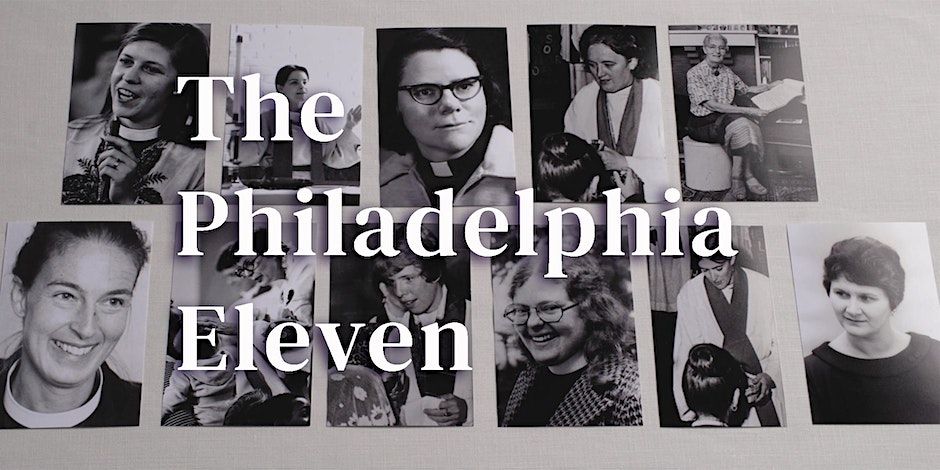
This past Sunday, the local Episcopal parishes in my town gathered to watch the documentary, The Philadelphia Eleven. The film details the history of women’s ordination in the Episcopal Church, and the first eleven women who were “irregularly ordained” in 1974 (i.e. ordained by Episcopal Bishops, but without the church’s General Convention sanctioning the ordination of women). The question of women’s ordination had come before General Convention many times before, but was always defeated. So, fifty years ago, a handful of women, along with male allies, decided they could not wait any longer. The film tells the story of the outrage the eleven women created, the abuse and death threats they faced, and the way that their diverse ministries led to the sanctioning of women’s ordination by General Convention in 1976.
I came into the Episcopal Church later in life. Although deeply involved in the United Methodist campus ministry at my college, an ecumenical trip with the Episcopal campus minister was my first real exposure to the liturgy and polity of the Episcopal Church. That campus minister was a woman, and at that point in my development, that did not seem abnormal. Then, a couple of years after college, I stumbled into the Episcopal Cathedral, whose dean was a woman. One of her assisting priests was also a woman. Those early mentors did not just normalize women’s ordination – it never occurred to me that there was a time when women were not priests. In fact, I remember an occasion when one of my own daughters as a young child asked me, “Can boys be priests?”
At this year’s General Convention of the Episcopal Church, we took the first steps to authorize the honoring of the Philadelphia Eleven in our set of honored saints we celebrate at weekday Eucharists. In the same city, where 51 years earlier the General Convention had denied women’s right to ordination, we agreed to honor the saints who pushed us to be better versions of the Church. All female clergy in the room were invited to stand to a roar of applause. I looked at the other women, many of whom I know and love, and I looked at the male clergy and laity whose eyes and smiles were full of admiration and respect, and I realized a couple of things. One, it is always a joy to celebrate when the Church gets something right – even if it takes a long time for the Church to get there. And two, I can be in ministry as my most authentic self is due to the suffering and courage of men and women I may never meet.
I share all this not to brag on the Episcopal Church – in fact, we still have a long way to go. Income disparity between male and female clergy is still a problem, as well as access to comparable positions. I have been the first female rector both times I have served as rector, and both times, people left the church when a woman was hired. But I share this story more because I wonder who else have we excluded from the Table. I share this story because I found myself wondering whether I would have risked being one of the Philadelphia Eleven, knowing the suffering that would come. I share this story because as someone who really appreciates rules and boundaries, I wonder which of those rules and boundaries the Holy Spirt keeps bumping against. While these may seem like big questions, or super-Church-nerdy questions, I think these questions are for all of us – an invitation to wonder who we have excluded in the communities of faith we love so much. The Philadelphia Eleven seem to be still asking us these questions fifty years later.
 Seeking and Serving