Sermon – Luke 21.25-36, A1, YC, November 28, 2021

Tags

, , , , , , , , , , , ,

As the passing of Thanksgiving brought on the presence of Christmas music radio stations, my husband and were talking about our favorite classics.  His grandfather and I both loved Nat King Cole’s “Christmas Song” with its images of, “chestnuts roasting on an open fire.”  Our conversation swept me up in wave of nostalgia as we talked about other favorites like Judy Garland’s “Have Yourself a Merry Little Christmas” or Mariah Carey’s admittedly cheesy “All I Want for Christmas is You.”  The tricky part about these songs though is that they do not connect me to the reality of my lifetime of Christmases.  Instead, they simply remind me of my idealized dream of Christmas – the glossy picture I have devised about the utter perfection of Christmas.

Our entrance into Advent is a lot like that contrast.  You might have come into church today totally excited about the hope and love of Advent as we await the perfect baby Jesus.  We imagine Advent as a sort of pregnancy, where we wait for four weeks to birth the Christ Child.  We cannot wait to hear those stories that are coming – of Mary and Joseph, of shepherds and angels, of wise men.  Advent in our minds is this great time of anticipation.

But the actual gospel text for today does little to fuel this happy anticipation.  Instead, our gospel lesson from Luke is an apocalyptic text about signs and fainting and fear.  “Stand up and raise your heads…Be on guard…Be alert at all times,” says Jesus.  The words from Jesus are not soothing or encouraging at all.  The kind of waiting Jesus describes does not sound like a joyful waiting for a birth but sounds more like the dreaded waiting for judgment. 

As modern Christians, we do not tend to enjoy apocalyptic scripture lessons for several reasons.  First, apocalyptic readings are usually weird.  We much more often associate these texts with crazy fanatics who make predictions about the end of the world that rarely come true.  We even make jokes with silly bumper stickers that say, “Jesus is coming.  Look busy.”  Second, we often do not understand what apocalyptic readings mean or how to interpret them.  That style of literature is totally foreign to us.  Even John Calvin, theologian and father of the Presbyterian Church, who wrote a commentary on every other book of the Bible, did not attempt to write about Revelation.[i]  If John Calvin cannot interpret apocalyptic literature, we do not have much hope for our own understanding.  And, finally, we do not tend to enjoy apocalyptic readings because we find them exhausting.  Even Will Willimon argues that, “It’s hard to stand on tiptoe for two thousand years.”[ii]  Our life is already full of anxiety these days.  Between the state of the economy, a devastating pandemic, deeply divisive political tensions, and our own financial, personal, and emotional anxieties, we have enough to worry about without having to also be anxious about Jesus’ return. 

Despite our hesitancy, there is good reason for us to turn to this kind of text.  The season of Advent reminds us that we cannot anticipate the first coming of Christ without also anticipating the second coming of Christ.  The two activities are intimately linked.  We celebrate the birth of this child because we know what this child will be.  We do not simply anticipate the Christ Child because he will be a cute baby.  We anticipate him because we know that he will be the Savior and Redeemer of the world and he promises to come again.  We anticipate this birth because of the joy of this specific person and Godhead, in whom we have redemption. 

In this time between the two advents, the Church invites us through Luke to live a little differently than normal.  This Advent, we are invited to step back and look at the whole of our Christian faith.  Sure, we may not want to be on guard at all times but being on guard from time to time is a good thing.  As Lewis Smedes argues the hardest part of anticipating the second coming of Jesus Christ is in “living the sort of life that makes people say, ‘Ah, so that’s how people are going to live when righteousness takes over our world.’”[iii]  This is our work this Advent.  Not just to look busy because Jesus is coming, but to be busy with works of righteousness.

There is a well-known story that happened in the colonial period of American history.  The Connecticut House of Representatives were going about their work on a sunny May day, when all of a sudden, an eclipse caught the entire legislature off guard.  Right in the middle of debate, everything went to darkness.  In the midst of panic over whether this might be the second coming, a motion was made to adjourn the legislature so that people could pray and prepare for the coming of the Lord.  In response, one legislator stood up and said, “Mr. Speaker, if it is not the end of the world and we adjourn, we shall appear to be fools.  If it is the end of the world, I choose to be found doing my duty.  I move you, sir, let candles be brought.”[iv]  Those men who expected Jesus went back to their desks and by candlelight resumed their debate. 

We too light candles in Advent.  We too move into a time of actively living in the time between two advents.  We too take on the intentional work of living as though righteousness has taken over the world.  Of course, we do not do this work alone.  We do this work “prayerfully, depending upon God to give strength to persevere despite temptation or persecution.”[v]  Jesus is coming.  With God’s help, instead of “looking busy” this Advent, we can be busy this Advent with works of righteousness.  Amen.       


[i] Cornelius Plantinga, Jr., “In the Interim,” Christian Century, vol. 117, no. 34, Dec. 6, 2000, 1271.

[ii] Will Willimon, as quoted by Plantinga, 1270.

[iii] Lewis Smedes, Standing on the Promises, as quoted by Plantinga, 1272.

[iv] Joanna M. Adams, “Light the Candles,” Christian Century, vol. 123, no. 24, Nov. 28, 2006, 18.

[v] Mariam J. Kamell, “Exegetical Perspective,” Feasting on the Word, Yr. C, Vol. 1 (Louisville: Westminster John Knox Press, 2009),25.
Sermon – John 18.33-37, P29, YB, November 21, 2021

Tags

, , , , , , , , ,

When I say the word “king,” the words that usually pop in our minds include:  ruler, power, authoritative, supreme, distant, dictator, or my personal favorite, Elvis.  Kings are a mixed bag for us, since Hickory Neck closed for over a hundred years after supporting one.  Equally messy was the king before the Revolutionary War who had a lot of impact in our lives – King Henry VIII.  If you remember, King Henry was the king who wanted to divorce his wife so that he could remarry.  When the Pope refused the King’s request, King Henry not only divorced his wife anyway, but he also started a revolution that led to the Anglican Church – our mother Church as Episcopalians.  If that is not power, I do not know what is!

Today, the Church celebrates Christ the King Sunday.  You would think on such a day, we would be hearing a text that glorifies Jesus, or that marks Jesus’ victory – such as the triumphal Palm Sunday lesson or an Easter or Ascension text.  Instead, we get the story of Jesus on trial with Pilate.  Jesus does not really look victorious in this passage – he has been humiliated, beaten, and is now being mocked by Pilate.  This is not exactly the image of Christ we may have had for Christ the King Sunday.  In fact, between Jesus and Pilate, Pilate plays the more stereotypical role of king.  Pilate uses power and authority for selfish ends with no concern for building community.  He hoards power and lords his power over people even to the point of destroying them, on a cross or otherwise.  Meanwhile, Jesus empowers others and uses his authority to wash the feet of those he leads.  He spends his life on them, and he gives his life to bring life.  Pilate’s rule brings about terror, even in the midst of calm.  Meanwhile, Jesus’ rule brings peace, even in the midst of terror.  Pilate’s followers imitate him by using violence to conquer and divide people by race, ethnicity, and nations.  Jesus’ followers put away the sword in order to invite and unify people.  Pilate’s authority originates from the will of Caesar and is always tenuous.  Meanwhile, Jesus’ authority originates from doing the will of God, and is eternal.[i]

So, if Jesus as a king is so different from any kings that we know, and our relationships with kings is tenuous at best, why do we celebrate Christ as King?  Christ the King Sunday is not that ancient of a concept in Church history.  In 1925, in the face of growing nationalism and secularism following World War I, Pope Pius XI established the feast of Christ the King.  The feast was meant to be a way of declaring where allegiances should be – not to a country, but to God.  Our allegiance should be to Jesus – our only ruler and power.  In a time of national pride, the Church boldly proclaimed, “We have no king but Jesus.”  Proclaiming Jesus as King is a fascinating reappropriation of the title “King.”  When the Church invites us to proclaim Christ as King, not only does the Church ask us to put Christ above any earthly ruler, the Church also asks us to redefine the concept of a king.  Jesus is a king who lays down his life for the sake of others; who endures humiliation and death for the salvation of people; who humbly cares for the poor, oppressed, imprisoned, and suffering.  This image does not sound anything like Henry VIII or even modern day presidents; and yet, this is what we proclaim today. 

So what does proclaiming Christ as King really look like today?  If Christ is King, then we are Christ’s people.  Those who have been baptized into Christ Jesus are, as the psalmist says, the people of his pasture and the sheep of his hand.  “Christ has made of us a people with his kingship.  And that kingship is unique, unlike any earthly kingship that is bound by geographic borders…  All are welcome, especially the chronically unwelcome ones.”[ii]  When we say that we are Christ’s people, we do not imply that we elected Jesus or that we hired Jesus as CEO.  We belong to Christ as his subjects – sharing the Eucharistic meal, sharing our lives, serving Christ as one, and resting our hopes in Christ.  Being the people of Christ impacts how we treat one another in this place, how we treat others outside of this place, and how we treat ourselves.    

At the end of another Church year, having lived through another cycle of hearing the stories of Jesus’ life, of being taught again through his miracles and parables, we come together to proclaim the truth of Christ’s kingship.  After another year of living our own lives – burying our loved ones, baptizing our children, celebrating marriage, mourning broken relationships, welcoming new families and ministries, struggling and thriving, surviving a pandemic – we bring all of our own experiences to the climax of this day as well.  We lay down all of this past year at the feet of the crucified, enthroned Christ, and we give thanks.[iii]  We are blessed to be a people ruled by a king who rules with love and mercy.  Being so blessed, we extend that kingly love and mercy to each other, to our neighbors, and to ourselves.  Amen. 


[i] Jaime Clark-Soles, as found on http://www.workingpreacher.org/preaching_print.aspx?commentary_id=1490 on November 23, 2012. 

[ii] Mary W. Anderson, “Royal Treatment,” Christian Century, vol. 120, no. 23, November 15, 2003, 18.

[iii] Anderson, 18.

On Shielding and Sharing Joy…

Tags

, , , , , , , , , , , ,

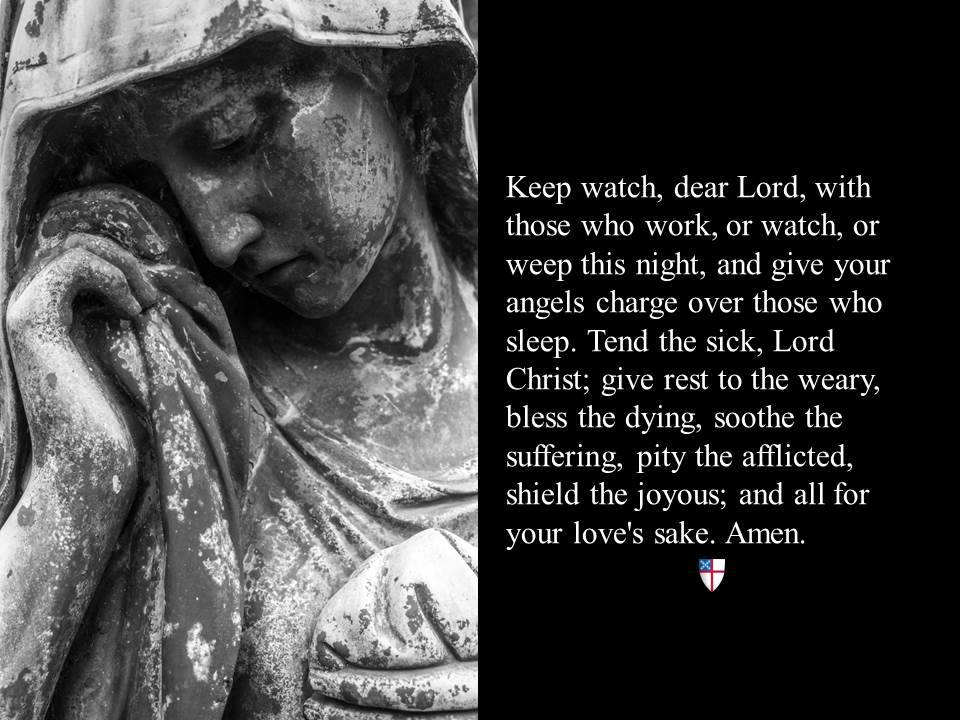
Photo credit: https://www.facebook.com/episcopalian/photos/keep-watch-dear-lord-with-those-who-work-or-watch-or-weep-this-night-and-give-yo/10155444636122925/

This month at Youth Group, before we began our closing prayer, the leader asked us each to name one good thing that had happened in the last week.  Immediately, the brows of each person in the room (adults included) furrowed as we tried to think back about something good in a sea of busyness.  Some of us struggled to remember anything good.  Others immediately burst forth with a fun thing they had gotten to do.  Some shyly shared an accomplishment for which they were proud.  And some were more abstract, like the beauty of the fall foliage.

I was struck by how each one of us in the room had to think quite hard about something good happening in our lives. I do not think we struggled because there is nothing good.  I think we struggled because our brains, or maybe our culture, has wired us to do the opposite – to complain about all the things going wrong, to see only the imperfections in life or in ourselves, to be discouraged by all that could be better in our circles.  A heart of gratitude or joy takes work.  Some of us come by gratitude and joy naturally, but most of us have been enculturated to see where there is want.  That’s why one of our favorite prayers from Compline has a line in its petitions to God for God to “shield the joyous.”[i] 

As we approach Thanksgiving Day next week, I wonder if this year you are still struggling to find the joy.  Maybe you still cannot gather safely with family, maybe you are worried about the safety of the children or the vulnerable in your family, or maybe you are just weary from this time of pandemic.  I suspect many of us are feeling critical of the imperfect and are having a hard time holding on to the perfect(ly good enough). 

My prayer for you this week is that God shields your joy.  But I invite you to consider partnering with God in this endeavor.  Each day until Thanksgiving Day, before you drift off to sleep, think back to one thing for which you grateful, that gave you joy, or was just a good moment.  The goodness does not have to be big or creative.  Start with something basic.  While you engage in this prayerful practice, I will be praying that God shields your joy, and I hope you will share your joy with someone else – so they can be shielded by God too. 


[i] Book of Common Prayer, 134.

Sermon – John 11.32-44, Isaiah 25.6-9, AS, YB, November 7, 2021

Tags

, , , , , , , , , , , , , , , , ,

Most Sundays we talk about Jesus’ life and witness and how we can emulate the Son of God.  Many years ago, there was even a campaign with the letters WWJD:  What Would Jesus Do.  But what we rarely talk about is how incredibly hard that ideal is – how hard as everyday humans emulating the Savior, who was both fully human and fully divine, really is.  So, in theory, a day like today should be a relief.  All Saints Sunday is a day we shift gears and talk about emulating people who were fully human.  Of course, that notion is tricky too.  By “saints” the church means those “persons of heroic sanctity, whose deeds were recalled with gratitude by

later generations.”[i]  These are people like St. Francis who shed his every earthly possession and obtained the stigmata, Mother Teresa who nursed this sickest of the sick and poorest of the poor, or even St. Margaret, who slayed her way out of a dragon after being tortured for her faith. 

I think that is why we often conflate All Saints and All Souls Day – the latter being a day when we remember all of those who have died in the hope of the resurrection.  These are the saints or souls who may not have been marked by heroic sanctity, but certainly had an impact on our lives.  These are the moms and dads, the spouses and friends, the children and lovers who may not have always been holy, but certainly taught us about the Christian faith and who we entrusted to the hope of the resurrection as we sat by their deathbeds or mourned their sudden deaths from afar.

We conflate the notion of All Souls Day into All Saints Day because there is something more human about All Souls Day – not only because we can relate to ordinary human life and death, but because the celebration today makes us feel like our humanity can be enough too.  That’s why I love the gospel lesson we get today.  In all the texts about Jesus’ healings, outwitting the challengers, and his ultimate sacrifice for us on the cross, today we get a text about Jesus being very human.  Before the amazing miracle of raising Lazarus from the dead, we are told, very simply, Jesus wept.  Caught up in the grief of his friends Martha and Mary and lost in his own overwhelming sense of loss, Jesus cries; not just a single, artistic tear, but a full-on bout of weeping.  In that solitary moment of grief, Jesus feels deeply, tangibly human.

I do not know about you, but that is what I need from Jesus today.  Later in our service we will list the names of the beautiful souls from Hickory Neck who died in the last year – those who made us laugh, sometimes made us angry, who put a smile on our face, and sometimes made us weep.  In the Prayers of the People, we will pray for the over 750,000 people who have died of COVID in the United States, mourning not just their loss, but the loss of our old “normal” and all that this pandemic has taken from us.  We mourn the ways in which many of the funerals we celebrated in the last year cheated us from each other’s presence – a reality that has still not be fully remedied.  In the midst of what has been a time of significant trauma, we need a Savior who weeps with us – and not just for the dear friend who has died, but also for the fact that his raising Lazarus will soon mean his own death.[ii]

That very gift of Jesus’ humanity today is what empowers us to boldly proclaim hope[iii] in the midst of sorrow, in the midst of trauma, in midst of this strange in-between time.  The words of Isaiah remind us of the promise, the promise that, “the Lord of hosts will make for all peoples a feast of rich food, a feast of well-aged wines, of rich food filled with marrow, of well-aged wines strained clear.  And he will destroy on this mountain the shroud that is cast over all peoples, the sheet that is spread over all nations; he will swallow up death forever.  Then the Lord God will wipe away the tears from all faces, and the disgrace of his people he will take away from all the earth, for the Lord has spoken.  It will be said on that day, Lo, this is our God; we have waited for him, so that he might save us.  This is the Lord for whom we have waited; let us be glad and rejoice in his salvation.”  On this All Saints Sunday, that is our hope for the week – the promise that the Lord God will wipe away tears – because God’s Son has known our tears – and that we will enjoy that rich feast with our loved ones again.  This in-between time is just that – a time in-between where the promise of new life is a rich promise indeed; one that gives us strength for the not-yet time.  Thanks be to God!


[i] Holy Women, Holy Men:  Celebrating the Saints, (New York:  The Church Pension Fund, 2010),664.

[ii] Debie Thomas, “When Jesus Weeps,” October 28, 2018, as found at https://www.journeywithjesus.net/essays/1999-when-jesus-weeps on November 5, 2021.

[iii] Kathryn M. Schifferdecker, “Mourn Loss, Proclaim Faith,” November 1, 2021, as found at https://www.workingpreacher.org/dear-working-preacher/mourn-loss-proclaim-faith on November 5, 2021.

Sermon – Mark 12.28-34, Deuteronomy 6.1-9, P26, YB, October 31, 2021

Tags

, , , , , , , , , , , , , ,

In preparation for a mission trip to Honduras, we did a lot of study on the history, politics, and economic development of the country.  Part of that preparation included reading Don’t Be Afraid, Gringo, the story of Honduran woman Eliva Alvarado.  Her story is the story of all campesinos – the poor and oppressed in her country.  Her story is the kind of story that stirs up righteous indignation and makes you want to hop on a plane to go fight for justice.  But in the conclusion of her story, she says to the reader that her ultimate desire is for us to stay where we are.  She does not want her story to inspire us to come there and “fix” things.  Instead, she implores us to fix ourselves – explore our own country’s policies and practices that abet the oppression by the privileged in her country. 

I remember when we got to her conclusion, the team sat in silence for a long time.  You could see the wheels churning in each of our minds – surely, we know what is best, surely we can fix things if we can just get there, surely there is a way around the way this woman has made us feel impotent.  And yet, there was profound truth in her words, and an understanding that to not listen to her final request would be worse than to have not read her words at all.  And so, we sat in pained silence, letting her charge sit uncomfortably with us.

Jesus creates a similar silence at the end of our gospel lesson today.  Jesus has been poked and prodded by one group after another at this point in Mark’s gospel.  In chapter 11, the chief priests, scribes, and elders question Jesus’ authority.  Early in chapter 12, the Pharisees and some Herodians try to trap Jesus with a question.  Finally, some Sadducees question Jesus about a theological issue.  Then today, a scribe asks a “palpably disarming” question – not one to test Jesus, but as one scholar says, an “invitation to the table of theological discourse.”[i]  The conversation today is about the greatest of the commandments. 

Jesus’ response is not new.  In fact, Jesus quotes the shema, the classic text we heard just this morning from Deuteronomy, “Hear, O Israel: The Lord is our God, the Lord alone. You shall love the Lord your God with all your heart, and with all your soul, and with all your might.”  This is a text the Israelites have emblazoned in the minds of their children, and repeated for generations, “Shema Yisrael, Adonai eloheinu, Adonai echad.”  “Hear, O Israel, The Lord is our God, the Lord alone (or the Lord is one).”  Jesus tweaks the answer only slightly from the original shema, adding that we should love the Lord our God with all our mind in addition to all our heart, soul, and strength.  And he adds that we should love our neighbor as ourselves.  But that notion is true to the original commandments as well.  When the scribe agrees with Jesus, saying loving God and neighbor as self is more important than any other ritual of the faith, the crowd falls silent, and we are told “no one dared to ask him any question.”  In other words, “Jesus’ critics were silenced and the effect was momentarily deafening.”[ii] 

So why is the crowd suddenly and dramatically silenced?  What’s the big deal about loving God and neighbor as self?  We talk about these commands all the time.  I mean, Bishop Curry has preached these words more times than I can count.  So why do Jesus’ words shock the room into silence?  One scholar suggests that the silence is so deafening because those gathered understood something about the reality of love that we modern Americans sometimes neglect.  As one scholar explains, “…sometimes — especially in western Christianity — we focus so hard on the emotive and affective aspects of love that we forget its rigor, its robustness, its discomfort.  We assume that loving God and our neighbors means expressing friendly sentiments to God in Sunday worship, and exchanging warm pleasantries with the people who live near us during the week.  We forget that in the scriptures, the call to love is a call to vulnerability, sacrifice, and suffering.  It’s a call to bear a cross and lay down our lives.  Biblical love is not an emotion we feel, it’s a path we travel.  As the children of God, we are called to walk in love. Think aerobic activity, not Hallmark sentiment.”[iii]  An invitation into that kind of radical love – the love of neighbors we would rather not love, the love that is as powerful as the natural, preserving love of self[iv], the love that is a response to the overwhelming love of God for us – that kind of invitation is sobering. 

I remember having read Elvia’s disinvitation to come to Honduras and “fix” things felt like a disempowering, painful rebuffing of love.  But I think I felt that way because we do not get to dictate what love of neighbor looks like.  True love of neighbor is not self-designed but is responsive – responsive to our love of God, and respectfully responsive to the self-articulation of needs by others.  Elvia’s self-articulation was deafeningly silencing the way Jesus’ invitation is too.  As scholar Debie Thomas explains, “Silence is the appropriate first response to the radical love we’re called to.  We dare not speak of [love] glibly.  We dare not cheapen [love] with shallow sentiment or piety.  Rather, [we] ask for the grace to receive [love] as the wise scribe received [love].  In awed and grateful silence.”[v]  Only when we have sat in the uncomfortable silence that recognizes the true love of God and neighbor as self are we ready to take up every perfect gift God has given us and travel the path of love.  Amen.


[i] Cynthia A. Jarvis, “Pastoral Perspective,” Feasting on the Word, Year B, Vol. 4 (Louisville: Westminster John Knox Press, 2009), 262.

[ii] Jarvis, 364.

[iii] Debie Thomas, “Walk in Love,” October 24, 2021, as found at https://www.journeywithjesus.net/lectionary-essays/current-essay?id=2944 on October 29, 2021.

[iv] Victor McCracken, “Theological Perspective,” Feasting on the Word, Year B, Vol. 4 (Louisville: Westminster John Knox Press, 2009), 262.

[v] Thomas.

On Redefining Sacraments…

Tags

, , , , , , ,

Photo credit: https://jacklondonoakland.org/new-events/virtual-coffee-hour-september-2020

This past Sunday was a day of celebration at Hickory Neck.  The bishop confirmed, received, and reaffirmed 16 parishioners, gave out blessings at our Drive-Thru Coffee Hour, and even celebrated Eucharist in our Historic Chapel.  It was a day of delight and joy and brought so many people together – both online and in person. 

But one of the things we tried for the first time since the pandemic was a “mini Coffee Hour”  We could not get past the idea of a celebration like this without a cake, so we safely served up cake and put coffee in safe, disposable containers, and we ate outside in a way that we have not done in ages.  It was a small thing in a lot of ways – something we have done thousands of times before the pandemic.  But it was anything but small.  As the organizer teared up talking about having Coffee Hour that day, I knew there was something much deeper happening.

Some people have joked that Coffee Hour is the eighth sacrament of the Episcopal Church.  I always scoffed at that idea, thinking it was much too disrespectful of the sacraments.  But in having Coffee Hour taken away during the pandemic and experiencing it again for the first time in 19 months, I now realize the truth hidden in those forced laughs about Coffee Hour’s sacramental status.  We are told in the Catechism that a sacrament is an outward and visible sign of an inward and spiritual grace, given by Christ as a sure and certain means by which we receive that grace.  Now I am not arguing that Jesus gives us coffee, but the cup of coffee one receives at Coffee Hour may in fact be that outward and visible sign of the grace of Coffee Hour – where sacred hospitality is offered, intimate Christ-like friendships are nurtured, and forgiveness, pastoral care, and sharing in mutual joy happens. 

I would not wish this pandemic on anyone.  But I am grateful for the fasting that it created which enabled me to see the fullness of holiness that happens in church:  in the pews, at the altar rail, and yes, at the coffee pot.  My hope is that we as a church figure out ways to offer those unauthorized sacraments in new and fresh ways as we continue to recover from this pandemic and live into community in restricted ways.  I wonder what ways we will be overwhelmed by God’s grace in these in-between times.

Sermon – Mark 10.17-31, P23, YB, October 10, 2021

Tags

, , , , , , , , , , ,

This Sunday, we kick off our stewardship season, whose theme is “Every Perfect Gift.”  I know a lot of people hear we have entered stewardship season and internally groan, knowing full well that we will have to spend the next few weeks talking about how we are sharing our time, talent, and treasure.  This can be especially hard for those of us who were raised to believe that there are certain taboo subjects in public – and money is definitely on the banned list.  I’m not sure why:  money is one of the topics Jesus talks about more than any in scripture.  But even Jesus seems incapable of eliminating Southern hospitality mores. 

Knowing our predisposition to loathe talking about money, imagine my own groan when I read today’s gospel lesson earlier this week.  This is the lesson we get on the kickoff of stewardship season?!?  A lesson about how the only proper relationship with money is to give money away to the poor and follow Jesus; a lesson that asserts getting a camel through the eye of a needle is easier than the rich to get into the kingdom of God.  And just in case any of us were hoping for an out, I already checked, and yes, we are considered “rich” by Jesus’ standards.  We might like to think ourselves exempt because we know plenty of people who have more than we do.  But given global standards, we certainly fall in the same category as the rich man in this text.

So, if your shoulders are already tensed, your foot is nervously tapping the ground, or your arms are crossed over your chest, I want you to take a deep breath in, and as you slowly exhale, allow the tension in your body to slowly release.  As you take in and release a second breath, I want you to clear you mind and listen to the text again with me with an open mind.  A man of deep faith runs to Jesus and throws himself at Jesus’ feet – he is already a faithful follower of God, and yet we see in him a yearning for deeper relationship, to align himself with the goodness of this man named Jesus.  He is a seeker, he is humble, he is passionate.  And, the text tells us, Jesus looks at him and loves him.  This is not a dependent clause.  This is a declarative, gracious, merciful statement of deep, abiding love.  Jesus looks at him and loves him.  Period. 

Many have described the next part of the story as an incisive judgment or a condemnation.[i]  But I see the next part of the story is an invitation – for the wealthy man, for the disciples, and for us.  The invitation is to contemplate the nature of our relationship with wealth.  Jesus never condemns wealth.  Jesus just knows that wealth has the power to corrupt: to corrupt our generous spirit, to corrupt our sense of self-worth, to corrupt our ability to see that every perfect gift comes from God – not from our hard work, our intelligence, or even our good looks. 

One of my favorite children’s sermons from my dad involved an apple.  He sat down with a paring knife and asked us kids to think of the apple as the money that we have.  He asked us, “What are some of the things we have to spend money on in life.”  The answers started flying:  housing, clothes, school supplies, food.  With each answer, he would slice off a part of the apple.  Then he leaned in and whispered, “Now what are the things we like to spend money on?”  We had those answer too:  bicycles, TVs, video games, candy!  With the last suggestion, we realized he had cut every last part of the apple away.  Then he looked at his empty hands and said, “Uh oh.  Did any of us save anything for the church?”  That morning, both the kids and the adults had guilty looks on their faces.  Fortunately, my dad had stashed a second apple and suggested we start over, this time giving the first slice to God.  We were amazed how we still had room for both needs and wants, even losing that crucial first slice.

That is the invitation of our stewardship season too:  to take a look at every perfect gift in our lives, to look at every perfect gift within ourselves, and to look at every perfect gift in others and to understand all that abundance comes from God.  When we allow ourselves to see the magnitude of that abundance, we can then see what Jesus is inviting the wealthy man, the disciples, and us into:  a posture of abundance, that sees all the perfect gifts we receive, we have, and others around us have and to become agents of abundance who, with relaxed shoulders, untensed bodies, and unfolded arms long to share that abundance.  Amen.        


[i] Debie Thomas, “What Must I Do?” October 3, 2021, as found at https://www.journeywithjesus.net/lectionary-essays/current-essay?id=2944 on October 8, 2021.

On the Power of Every Perfect Gift…

Tags

, , , , , , , , , , ,

Photo credit: https://www.tens.org/

Ministry is a funny endeavor because you can have a to-do list planned for any given day, but between drop-ins, unexpected calls, or pastoral events, your to-do list gets completely set aside.  Yesterday I had one of those days where I left the office thinking, “Man!  I only got a couple of things done today!  I’m so frustrated!”  But then I remembered that even though I personally only got a couple of things done, my staff picked up a lot of the floating to-do items and together, we actually got a lot of things done.  Suddenly a seemingly wasted day felt like a day of accomplishment.

The last two years have been years of transition for our staff.  A full-time priest left the staff right as COVID hit and was not replaced.  This past summer, we had an administrative staffing gap.  Suddenly, if things were getting done, they really were dependent upon my personally accomplishing them – which is never a sustainable model.  It was not until yesterday that a wave of gratitude overwhelmed me as I realized how much can be achieved when you are a part of team.

This week, we will kick off our stewardship season at Hickory Neck Episcopal Church, whose theme is Every Perfect Gift.  My experience this week made me remember how even our giving to church is a team effort.  We work hard to do our part – giving a tithe or other generous financial gift, our time, and our talent.  But our part does not sustain the work of ministry.  In order to reflect the fullness of the body of Christ, each of us needs to give Every Perfect Gift – those parts that make the whole better. 

As you think about your giving to the church, maybe your finances are making it such that you cannot give as much as you would like.  Or maybe you are giving in earnest, but feel like you are pulling more weight than others.  Or maybe you are taking a hard look at your budget and time and are considering how you can do more this year.  Just remember two things:  1) your gift is perfect and is a reflection of your gratitude to God for your many blessings – making your giving sacred; and 2) you are a part of a community where everyone does their part – where we all make an impact on our community because when we all share our every perfect gift, our collective effort is stunning.  You are in my prayers this year as you consider how you might share your perfect gifts with Hickory Neck!

Sermon – Matthew 11.25-30, Feast of St. Francis, YB, October 3, 2021

Tags

, , , , , , , , , , , ,

Occasionally I wander the Hickory Neck property as a way of clearing my head.  I often end up over in the St. Francis Memorial Garden, reveling in the quiet in that remote corner behind the Historic Chapel.  The bucolic scene and the St. Francis statue make me imagine the peaceful walks he took in his journey to commune with God and God’s created order.  The funny thing is our celebrations of St. Francis today are nothing like those peaceful moments.  There is the chaos of the drive-thru, as confused pets worry they are headed toward the dreaded veterinarian or are confused by the people in clerical garb.  There is the hubbub of owners calming pets inside the New Chapel, the curiosity of what unique pets one may see, and the endless giggles and chuckles about unpredictable animals in an enclosed space.  The whole morning is a morning of contrasts.

The contradictions of this day are equally evident in our Gospel lesson.  Our gospel lesson closes with one of our favorite invitations from Jesus, “Come to me, all you that are weary and carrying heavy burdens, and I will give you rest.  Take my yoke upon you … and you will find rest for your souls.  For my yoke is easy, and my burden is light.”  Those words describe a loving, gentle Jesus, who enfolds us in a calm, affirming embrace.  At least, they should.  But if we read the words critically, there is more contrast in them than we might like to admit.  Yes, Jesus taking our heavy burdens and recognizing our weariness is balm for the soul.  But the last time I checked, yokes were not exactly tools for rest.  And even though Jesus promises his yoke is easy, the yoke is still a yoke – a tool for directing, guiding, ensuring productive work is done.  Having listened to the gospels these last weeks, we know this work is anything but light.  In the last few weeks in Mark’s gospel, Jesus told us we would have to take up our cross, suffer, and die; that discipleship would mean being servant of all; and that if our hand or eye were causing us to stumble, we should just cut them off!  That does not really sound like an easy yoke to me!

Part of what we appreciate about St. Francis, and why we celebrate him every year – besides having an excuse to have a day to honor our beloved animals – is St. Francis understood Jesus’ words in a tangible, personal way.  Francis grew up in the life of luxury.  He grew up in a privileged home, lived a life of young adult revelry, and could have easily assumed his father’s wealth in adulthood.  But there were these poor people everywhere he looked around town.[i]  And there was the day everything changed at the church of St. Mary of the Angles[ii], when Francis heard different words from Matthew’s gospel, just a chapter before what we heard today.  Jesus says, “Cure the sick, raise the dead, cleanse the lepers, cast out demons…Take no gold, or silver, or coper in your belts, no bag for your journey, or two tunics, or sandals, or a staff…”[iii]  For Francis, Jesus’ yoke felt light because the yoke of keeping up appearances, the yoke of ignoring the poor to enjoy your own wealth, the yoke of never feeling like you have enough was indeed a heavy yoke.  The yoke of another way – of the way of Jesus – helped Francis reframe his entire life.

That is what we celebrate too.  St. Francis, in his faith conversion, and in his ability to see the sacred in all of God’s creation, saw the truth of our gospel lesson today.  As one scholar explains, “The proper ordering of our relationship to Father and Son can be deemed ‘light’ and ‘easy’ because an improper relationship to them surely makes for a much harder and more restless life!”[iv]  Whether in the pure love between animals and owners, whether in peaceful moments with God’s creation, or whether in today’s gospel lesson and in Francis’ example, our invitation today is to let go of the hard and restless life and to take up the light burden of Jesus’ easy yoke.  The more we practice taking on that yoke, the more we find work that is meaningful, life-giving, and blessed.  And that is a yoke we can all enjoy!  Amen.


[i] Holy Women, Holy Men:  Celebrating the Saints (New York:  Church Publishing, 2010), 622.

[ii] Hilarion Kistner, O.F.M., The Gospels According to Saint Francis (Cincinnati:  Franciscan Media, 2014), 6-7.

[iii] Matthew 10.7-10

[iv] Colin Yuckman, “Commentary on Matthew 11:16-19, 25-30,” July 9, 2017, as found at https://www.workingpreacher.org/commentaries/revised-common-lectionary/ordinary-14/commentary-on-matthew-1116-19-25-30-4 on October 1, 2021.

On Clearing the Way…

Tags

, , , , , , , , , , , , ,

Last week, I finally took on the task of clearing my desk.  In general, I am a “stacks” kind of person when it comes to organization.  I stack papers on my desk when I am done with them.  The stacks can get quite large, but I also know enough about the stacks that I can find papers if I need them.  Eventually, when the stacks get a little too big, I take a day and go through the whole assortment of stacks, tossing things or filing them when necessary.  But even though I love the satisfaction of the clean desk, the stack method is never really eliminated.

My periodic purging of the stacks normally works fine.  But when you’ve been through eighteen months of a pandemic and were super busy before the pandemic hit, let’s just say my stacks had gotten taller than my head when I was seated at my desk.  Because I had precious little time in the office in the last eighteen months, giving up a whole day or at least half a day purging seemed like a luxury I could not afford.  And so, week after week, I would promise myself, “Maybe next week…”

Sometimes, I think our relationship with God is a lot like that – especially during this pandemic.  Maybe we have prayer books we like, devotionals on our nightstand, or even a little prayer station at home with items like prayer beads or inspirational photos or trinkets.  But the survival patterns we have developed during this pandemic have meant the normal things that helped us feel close to God – the physical things or even the people from church we have not seen in eighteen months – have been absent for too long.  Maybe we have even made those same promises to ourselves, “Maybe next week…”

I wonder what that “thing” is for you:  What have you been putting off during this pandemic because you could not let it be a priority like it once was?  Maybe it has been taking care of yourself physically or emotionally, maybe it has been caring for others in ways that bring you joy, or maybe it has been connecting to a church community.  Whatever the “thing” is for you, maybe this week is the week when you take a deep breath, drop the things that have seemed essential until now, and give yourself a moment to take care of yourself – in ways that maybe seem luxurious, but in the end, might just be sacred necessities.