• About

Seeking and Serving

~ seek and serve Christ in all persons

Seeking and Serving

Tag Archives: Beatitudes

Sermon – Luke 6.20-31, AS, YC, November 2, 2025

05 Wednesday Nov 2025

Posted by jandrewsweckerly in Sermons

≈ Leave a comment

Tags

All Saints Sunday, Beatitudes, compassion, faithful, fragrance, God, Golden Rule, Jesus, justice, love, saint, scent, sensory, Sermon, witness

On the blog this week, I shared about friends of ours who are fragrance aficionados.  When we spend time together, we’ve taken to doing fragrance samplings with them – sort of like wine tastings, but with the focus on the sense of smell.  Invariably, I find a new fragrance I like that I had never heard of, but that brings me a sense of playful joy.  This past week I was sharing one of those fragrances with one of our daughters and she said, “It’s okay, but I prefer your ‘Mom smell.’”  While I wish there was a more attractive label to that particular fragrance, and while I suspect that “Mom smell” is some combination of the scents of my soap, hair products, and laundry detergent, I get what my daughter meant.  Just like fragrances can evoke memories of special places, fragrances can also recall to us people in our lives.  One whiff, and we are transported to another time and place, remembering what someone meant to us.

On this All Saints Sunday, we engage in a similar kind of sensory recalling.  In our case at Hickory Neck, instead of the sense of smell, we invoke the sense of touch – the feel of smooth or ridged ribbons running through our fingers as we tie them to the altar rail in memory of a saint of God, the feel of droplets of water landing on our heads and bodies as we recall our baptismal identity and the baptisms of saints who have died, and the feel of the wafer in our hands and mouth or the feel of the priest’s thumb as they rub a blessing on our forehead, as we engage in the earthly banquet, reminiscent of the heavenly banquet our loved ones are enjoying.

But just like scents have the power to remind us of beloved memories, so scents can remind us of painful memories.  While some of us may have a “Mom scent” we recall with love and affection or wistful memory, others of us didn’t have such beloved memories or experiences – and unfortunately, smells can recall those memories too.  As I was reading Luke’s gospel for today, that’s where I landed – that all of us – all of us saints of God – have the opportunity to live lives of good or ill – to leave behind fragrances that help or harm.  And since Luke’s language is entirely literal and not at all the flowery, spiritual language of Matthew’s beatitudes[i], we are very clear on Jesus’ words and meaning.  The blessings and woes of Luke’s beatitudes are straightforward and simple.  As one scholar puts it, “If you want anything to do with Jesus or the God who sent him, Luke says, you had better go find the poor, the hungry, the captives, the blind, and the outcast, and join Jesus, as Jesus cares for them.  The way we know who Jesus is, is to go where Jesus is, with the poor, the hungry, and the oppressed.”[ii]

While All Saints Sunday can take us to place of remembering loved ones and the saints of the church, tempting us to get lost in those memories, what All Saints Sunday ultimately hopes to impart is that the lives we live matter.  We remember the saints of the church and the lives of our loved ones we miss because they showed us what living lives that matter looked like.  We do not honor them because they were rich or well fed or joyful or respected.  We honor them because they loved their enemies, they did good to those who hated them, they blessed those who cursed them, and prayed for those who hurt them.  We honor them because they were nonviolent, because they gave sacrificially of their wealth, because they understood that poverty makes people desperate – and because they did to others as they would have them do to them.

We could easily leave here today with the commission to “go and do likewise,” as if Jesus’ words are a simple commission.  But nothing about what Jesus is saying is simple or easy.  Several years ago, I was talking to our children about the Golden Rule – those words we hear today about doing unto others as you would have them do unto you.  To my great shock, my children did not see the wisdom of the words at all.  Instead, their desires were rooted in a sense of justice or fairness.  “No way!” one said.  “I’ll do unto others what they do to me.”  What I had understood as simple, universal wisdom that is shared among faith traditions totally flies in the face of secular, American ideals.  Even Professor Johnson says about Luke’s text today, “It is not only greed that jeopardizes the wealthy Christian’s relationship with God, but the simple – and subtle – temptation to think we can take care of ourselves.”[iii]

Luke leaves us, then, with a challenging invitation.  As you tie on a ribbon to remember a loved one today, you can certainly recall whatever fragrance of theirs you miss.  But Luke asks you to go further – to recall the witness they left to you about living a faithful life, and be emboldened to start leaving your own faithful fragrance behind too.  Lean into those who have gone before to encourage your own witness of love, compassion, and justice.  Lean into the faithful who gather beside you in person every Sunday who struggle to live that Golden Rule with gusto instead of resentment.  Lean into Jesus, who walked before us in incarnate form, leaving behind the fragrance of incense – the fragrance of humility, compassion, and sacrificial love.  With them, you can then begin to create a signature fragrance of your own that will help draw others to God.  Amen. 


[i] Marjorie Procter-Smith, “Homiletical Perspective,” Feasting on the Word, Yr. C, Vol. 4 (Louisville:  Westminster John Knox Press, 2010), 239.

[ii] E. Elizabeth Johnson, “Exegetical Perspective,” Feasting on the Word, Yr. C, Vol. 4 (Louisville:  Westminster John Knox Press, 2010), 239.

[iii] Johnson, 241.

Sermon – Matthew 5.1-12, AS, YA, November 5, 2023

29 Wednesday Nov 2023

Posted by jandrewsweckerly in Sermons

≈ Leave a comment

Tags

All Saints, Beatitudes, bless, blessed, communion of saints, disciples, faith journey, faithful, holy, Jesus, right road, saints, unattainable

I once served at a church that decided to support a ministry for women exiting prison.  We decided to prepare ourselves for our engagement in the ministry by reading the book The Prison Angel, about a wealthy divorcee in California who has an epiphany about her call, and eventually becomes a nun that lives in the notorious prisons of Tiajuana, Mexico, serving the men and their families.  We spent weeks reading the book, reflecting on Mother Antonia’s stories, slowly grasping the realities of prison life and those who serve them.  I was feeling energized by how well prepared our book study group would be when we finally began serving our local ministry.  But on the last day of our study, one of our participants shared, “I don’t know.  I don’t think I could ever be as self-sacrificial as Mother Antonia.  She’s sort of superhuman and I just cannot imagine living that kind of life.”  I remember feeling completely deflated – here I was trying to inspire servanthood and instead, I had made servanthood feel unattainable.

Sometimes I fear All Saints Sunday does the same thing.  Certainly, that can happen as we think of those significant saints of the church, like St. Peter, St. Francis, or Mother Teresa.  But our feelings of inadequacy can happen with the personal saints of our lives – the souls of beloved parents, lovers, children, and friends.  We remember the faithful ways they lived and only see our own failings.  And then we go and read the Beatitudes from Matthew’s gospel, we can become downright despondent.  Maybe I have mourned or felt poor in spirit.   But do I hunger and thirst for righteousness?  Am I pure in heart?  As we grieve the violence in the Middle East, have I done anything tangible to be considered peacemaking?  Has anyone ever reviled or persecuted me for the sake of Jesus?  Instead of inspiring and uplifting us today, this feast day with Matthew’s gospel has the potential to leave us feeling unworthy and unmotivated in our journey to live faithfully.

I can assure you that is not the lectionary’s intent.  In fact, after weeks of stories about discipleship in Matthew, the lectionary takes us back to the fifth chapter of Matthew for a purpose.  Perhaps we should look at what the Beatitudes are not doing today before we look at what they are doing.  The Beatitudes are not “to do” items.  As scholar Debie Thomas explains, these are not suggestions, instructions, or commandments.  There is no sense of “should,” “must,” or “ought” in these words.  We are not to walk away from these words thinking we should “try very hard to be poorer, sadder, meeker, hungrier, thirstier, purer, more peaceable, and more persecuted…”[i]  Likewise, the Beatitudes are not meant to shame us.  Jesus is not attempting to make us feel like overprivileged wretches worthy of self-condemnation.  Likewise, Jesus is not telling us to grit our teeth through whatever suffering we are living through, knowing that relief comes after death.[ii]

Instead, the Beatitudes are redefining what our modern culture might define as “#blessed.”  When we talk about being blessed, we are usually referring to our bounty or at the very least, the goodness we see in an otherwise hard world.  Instead, theologian Stanley Hauerwas explains that by declaring the poor in spirit, the mourning, the meek, the merciful, and the peacemakers as blessed, Jesus is indicating the transformed world of the kingdom of God has begun.  “Each of the Beatitudes names a gift, but it is not presumed that everyone who is a follower of Jesus will possess each beatitude.  Rather, the gifts named in the Beatitudes suggest that the diversity of these gifts will be present in the community of those who have heard Jesus’s call to discipleship.  Indeed, to learn to be a disciple is to learn why we are dependent on those who mourn or who are meek, though we may not possess that gift ourselves.”[iii]

What is particularly helpful as we read these familiar words, then, is to clarify what we me by the literal word “blessed.”  Going back to the Hebrew scriptures here will help.  There are two words for “blessing” in Hebrew:  ’ashar and barak.  Barak means to “bow or stoop.”  For example, in Psalm 103, when we say “Bless the Lord my soul,” we mean “Bow to the Lord.”  But ’ashar literally means, “to find the right road.”  So, if we go back to Beatitudes, we instead hear “You are on the right road when you are poor in spirit; You are on the right road when you hunger and thirst for righteousness; you are on the right road when you are persecuted.”  Jesus is calling his disciples to hear and walk in the way of his will for our lives.[iv]

As we remember those saints who inspire us, as we recall those loved ones who taught us about how to live faithfully, as we hear Jesus’ beautiful blessings of all kinds of experiences in life, we are reminded today not to feel guilted into a more holy life.  We simply remember that the people sitting next to you today are all different points of the faith journey, with different blessings or things that feel like curses.  Because we choose to walk together, we will learn to be faithful people that, someday, someone else will remember – that someone else will tie a ribbon onto this altar rail to remember the ways you taught them what being “#blessed” really means.  Our invitation today is to celebrate the right road, knowing the fullness of that road is only visible through the communion of saints who walk the right road together.  Amen.


[i] Debie Thomas, Into the Mess and Other Jesus Stories:  Reflections on the Life of Christ (Eugene, OR:  Cascade Books, 2022),120.

[ii] Thomas, 120-121.

[iii] Stanley Hauerwas, Matthew:  Brazos Theological Commentary on the Bible (Grand Rapids:  Brazos Press, 2006), 63

[iv] Earl F. Palmer, “Pastoral Perspective,” Feasting on the Word, Yr. A, Vol. 4 (Louisville:  Westminster John Knox Press, 2011), 238

Sermon – Luke 6.20-31, AS, YC, November 6, 2022

23 Wednesday Nov 2022

Posted by jandrewsweckerly in Sermons

≈ Leave a comment

Tags

abundance, All Saints Sunday, Beatitudes, blessing, Jesus, saints, scripture, Sermon, trying, woe, yikes

Holy Scripture can be a real downer sometimes!  Maybe that sounds petulant, defeatist, or even a little like someone who just wants a saccharine-y Savior, but when I read passages like Luke’s gospel today, I get more than a little discouraged.  In Luke’s Sermon on the Plain, we hear Luke’s version of Jesus’ beatitudes.  They start off encouragingly enough.  Who wouldn’t want blessings for the poor, hungry, weeping, and persecuted?  But then come the woes.  Woe to the rich, those who are full, the laughing, the respected.  Woe to us, really.  I don’t know about you, but I had breakfast this morning, I was able to pay my bills this month (including my pledge), I certainly have received compliments on my work before, and you all know I have laughed recently – my laugh is the one marker that can help you find me in any room!  According to scripture, I am in a lot of woe! 

Of course, sometimes All Saints Day can feel like a day of woe anyway.  From early in the Church’s history, saints were those “persons of heroic sanctity, whose deeds were recalled with gratitude by later generations.”[i]  All Saints Day now is one of the seven principal feast days in the Episcopal Church, and the only one that can be transferred to a Sunday.  All Saints Day is also one of the prescribed days for baptism.[ii]  In other words, we value the life and witness of extremely pious, holy people so much we want the newly baptized to understand that sainthood is the goal. 

The good news is the original Greek may help us find our way out of deflation and into encouragement.  Because of the ways the “Blessed are…”s are paired with the “Woe to”s, we might interpret “woe” to mean “cursed.”  Cursed are those who are rich, have full bellies, are laughing, or are respected.  But that is not exactly what woe means.  According to scholar, Matt Skinner, “In this context, ‘woe’ functions as a sharp contrast to ‘blessed,’ yet the Greek word ouai does not mean ‘cursed’ or ‘unhappy.’  Certainly not ‘damned.’  Like the English word “yikes,” woe is more of an attention-getter and emotion-setter than a clear characterization or pronouncement.  Jesus therefore promises relief to some groups, to those people who suffer in this life.  To others, to folks who find existence rather enjoyable or easy, he cries, ‘Look out!’”[iii]

Another scholar echoes Skinner’s argument, reminding us that Jesus is not so much concerned that people are wealthy, well-fed, have pleasure, or enjoy respect; Jesus is very concerned with how those wealthy, well-fed, pleased, respected people treat the poor.  Amy-Jill Levine reminds us that the disciples are not destitute.  Four of them own boats and one of them is a tax collector.  And the majority of the minor figures in Luke’s gospel are not poor either:  “the ruler Jairus and his wife; the centurion with the sick child, Mary and Martha the householders, the various Pharisees as well as sinners and tax collectors with whom Jesus banquets, Zaccheus the chief tax collector…”[iv]  The existence of resources, blessings, and pleasure are not sinful in and of themselves.  The “woe” or the “yikes” is simply a reminder that what we do with those resources, blessings, and pleasure matters – a lot. 

 I am not sure any of us will ever be called saints in our day.  That is why I love so much how we honor all those faithful departed who have gone before on All Saints Day.  As we tie ribbons or type out names of mothers, brothers, lovers, children, and friends who have gone before, we honor not that they were saints, but perhaps that they were saint-like in their trying.  For all their foibles, the moments where they lacked compassion, where they got caught up in their selfishness, they also taught us how to love abundantly, how to care for others with empathy, and how to find moments of selflessness. 

Jesus’ woes are not meant to send us home with the mantra, “Woe is me!”  Jesus’ woes are meant to be our yikes!  Yikes, look at all the abundance in our lives.  Yikes, look at all the moments of pure joy and laughter.  Yikes, look at the ways others look up to us (even if they cannot verbalize their respect).  When we find ourselves in this life cocooned in goodness, the life of faith, the life of the saints, is to share our abundance, to use our abundance for good, to be agents of abundance in the world.  We will not always succeed.  But, yikes!  Our invitation today is to be saint-like in our trying.  Amen.


[i] Holy Women, Holy Men:  Celebrating the Saints (New York:  Church Publishing, 2010), 664.

[ii] Holy Women, Holy Men:  Celebrating the Saints (New York:  Church Publishing, 2010), 662.

[iii] Matt Skinner, “Commentary on Luke 6:20-31,” November 3, 2019, as found at https://www.workingpreacher.org/commentaries/revised-common-lectionary/all-saints-day-2/commentary-on-luke-620-31-4 on November 5, 2022.

[iv] Amy-Jill Levine and Ben Witherington, III, The Gospel of Luke:  New Cambridge Bible Commentary (Cambridge:  Cambridge University Press, 2018), 177.

Sermon – Luke 6.17-26, EP6, YC, February 12, 2022

25 Wednesday May 2022

Posted by jandrewsweckerly in Sermons

≈ Leave a comment

Tags

Beatitudes, comfort, Epiphany, God, Jesus, Luke, Matthew, revelations, Sermon, woe

Today’s gospel lesson is Luke’s version of what is called “the beatitudes” or set of blessings from Jesus.  Most of us are more familiar with, or maybe even prefer, Matthew’s version of the beatitudes.  Matthew’s version has eight blessings as opposed to Luke’s four.  Matthew’s version happens on a mountain and is part of a larger section called the “Sermon on the Mount.”  Matthew’s full sermon is 107 verses, whereas Luke’s is just 32.  Matthew’s version of the Beatitudes within the Sermon on the Mount is more poetic and flowery – claiming the “poor in spirit” are blessed, making us all feel included, whereas Luke simply says “blessed are you who are poor.”  Matthew’s version has been set to music by masters like Sweet Honey in the Rock.  However, some scholars argue that Matthew’s Beatitudes “domesticate the radical pronouncement so that it comfortably fits ‘us’ who by no means meet its criteria,” and that over generations “the prophetic word became hollow and even more watered down than Matthew had rendered it.”[i]

Luke’s version we hear today is quite different, and often sits with us much more uncomfortably.  Luke’s version of the Beatitudes is not delivered from high on a mountain, but instead on the plain, or on “‘a level place’ with the disciples and the multitude, not on a mount above them.”[ii]  Aesthetically, Luke’s version is more plain, more abrupt, and quite frankly, a little “judge-y.”  Whereas Matthew has eight blessings, Luke pairs his four blessings with four woes.  So, if the poor are blessed and to whom the kingdom of God belongs, woe to the rich, for they have received their consolation.   Whereas the hungry are blessed and promised full bellies, those who are full now are promised hunger later.  Even those laughing and honored in their communities are promised tears and shame.  There is no sentimentalizing Luke’s beatitudes.  Most of us read Luke’s gospel and know that we are in for a lot of woe!

Of course, there is a reason we get Luke’s beatitudes this Epiphany season.  In this season of revelations about Jesus’ identity, the beatitudes follow a long run of epiphanies.  We started with the Magi in early January; heard of Jesus’ baptism and the pronouncement of Jesus’ blessedness (and shared that same pronouncement with our beloved Reed and Zenora); we heard of the changing of water into wine in Cana; the pronouncement of Jesus as the coming of the Messiah – a message so strong he was almost pushed over a cliff; and last Sunday, of an instruction by Jesus that led to so much fish nets almost broke. 

Today’s beatitudes from Luke are another epiphany – but not an epiphany of who Jesus is:  more an epiphany about what life with Jesus is.  As we look at Luke’s beatitudes this week, I do not think Jesus is being all that judge-y after all.  We already see in this version that Jesus is not speaking down to us but speaking among us in the level plain.  We also find that although Jesus opens his mouth in Matthew’s version, in Luke’s version, Jesus focuses his eyes.[iii]  The text says, “Jesus looked up at his disciples…”  There is an intimacy to Luke’s version of these blessings.  But perhaps more telling is looking at the word “woe” itself.  Karoline Lewis tells us that the word “woe” in the Greek lexicon is an interjection.  “Jesus, is not about pitting blessings against curses or favor against judgment.  Jesus is trying to get the disciples’ attention.  He is trying to get our attention.”  And so, as Lewis argues, perhaps instead of reading these “woes” as curses – or as the word W-O-E – we should read the woes as “whoas” – W-H-O-A.[iv] 

“Whoa!  Listen closely,” Jesus says as he gets down to our level and looks us in the eyes.  Whoa, you who are comfortable.  “The poor and the hungry know the reality of their situation.  They are totally dependent on God and therefore are disposed to entrust themselves to God’s care and mercy, which is the foundation of grace and a right relationship with God.”  Us, however, whoa!  We are “disposed to take comfort in [ourselves] and [our] resources, thereby finding it more difficult to trust [ourselves] to the mercy and grace of God.”[v]  Jesus is not telling us to glorify suffering and persecution with the hope of a future reward.  Jesus is saying, “Whoa! It’s time to ‘reorient relationships and reverse social, economic, and political injustices so that [we] gain right standing in the eyes of God.’[vi]

Our invitation today is to hear what whoas God has for us today.  Maybe we have gotten a little too comfortable with our creature comforts, maybe we have forgotten the hungry, maybe we have ignored those who are grieving and struggling – especially in this pandemic, or maybe we have begun to believe the hype about ourselves – resting in the respect people grant us instead of earning that respect.  Jesus’ whoa today is not a curse.  Jesus’ whoa today is an intimate pulling aside and an invitation to remember what following Jesus is all about:  loving our neighbor, seeking and serving Christ in all persons, striving for justice and peace, and respecting the dignity of every human being.  We made those promises just a few short weeks ago.  Jesus is simply telling us, “Whoa!  Remember who you are as a disciple – as a baptized child of God.”  And I like to imagine, since we are on a level plain, Jesus gives us solid pat on the shoulder, and tells us to get back out there and share those blessings with others:  because he knows we can.  Amen.


[i] David L. Ostendorf, “Theological Perspective, Feasting on the Word, Year C, Vol. 1 (Louisville: Westminster John Knox Press, 2009), 356.

[ii] Ostendorf, 358.

[iii] Gay L. Byron, “Exegetical Perspective,” Feasting on the Word, Year C, Vol. 1 (Louisville: Westminster John Knox Press, 2009), 359.

[iv] Karoline Lewis, “Woes and Whoas,” February 6, 2022, as found at https://www.workingpreacher.org/dear-working-preacher/woes-and-whoas on February 12, 2022.

[v] Howard K. Gregory, “Pastoral Perspective,” Feasting on the Word, Year C, Vol. 1 (Louisville: Westminster John Knox Press, 2009), 358.

[vi] Byron, 361.

Sermon – Matthew 5.1-12, ASD, YA, November 1, 2020

05 Thursday Nov 2020

Posted by jandrewsweckerly in Sermons

≈ Leave a comment

Tags

Beatitudes, breathe, God, heaven, importance, Jesus, persecution, renewed, reward, Sermon, ultimate

There are certain events in life that when we stop and pay attention, bring into laser-sharp focus the importance of ultimate things:  baptisms, weddings, and funerals probably being the most significant.  For baptisms, we do not just celebrate because babies are cute or because adult baptisms feel empowering.  We celebrate by making promises to journey with the individual in their faith, and by renewing our own baptisms.  Similarly, we make promises to couples getting married.  There is even a prayer for already married couples in our liturgy, asking God to renew their promises to one another.  Of course, funerals can do the same thing.  They are not just sobering in their reminder of our own mortality, but also, they refocus us on the ultimate significance promised in Jesus Christ – eternal life.  All of these events in the life of the church offer us a sobering reminder of the importance of ultimate things.

In some ways, that is what Jesus is doing in the Beatitudes – that portion of the Sermon on the Mount found in Matthew’s gospel today.  Prior to these verses, Jesus has been healing the sick, proclaiming the gospel, and managing swarms of crowds who are drawn to his message and healing.  But in these verses, Jesus stops.  He sits down, gathers the disciples, and invites them to listen.  Jesus then shares the importance of ultimate things.  The disciples are seeing what he sees – the suffering, the pain, the agony.  Into that overwhelming need, Jesus does not teach them how to heal.  He does not teach them how preach.  He does not set a schedule for where they will go next or how many more they will heal.  Instead he lays out a series of blessings that remind the disciples what is ultimately important.  “Blessed are the poor in spirit, for theirs is the kingdom of heaven.  Blessed are those who mourn, for they will be comforted.  Blessed are the meek, for they will inherit the earth.  Blessed are those who hunger and thirst for righteousness, for they will be filled.  Blessed are the merciful, for they will receive mercy.  Blessed are the pure in heart, for they will see God.  Blessed are the peacemakers, for they will be called children of God.  Blessed are those who are persecuted for righteousness’ sake, for theirs is the kingdom of heaven.  Blessed are you when people revile you and persecute you and utter all kinds of evil against you falsely on my account. Rejoice and be glad, for your reward is great in heaven, for in the same way they persecuted the prophets who were before you.”  Jesus is more than willing to heal and soothe suffering.  But Jesus is also saying that our pain and our suffering mean something; our pain and suffering can and will be transformed.

We do something similar in our liturgical actions today as well.  We honor not just the saints who have gone before – those who have performed miracles or lived notable lives.  We honor all the “saints” – the label Saint Paul used for all Christians – the mothers, fathers, siblings, children, friends, lovers, and mentors who taught us about the ultimate things.  Even though the practice looks a little different this year, every year we tie ribbons on our altar rail to remember the ultimate things of this life – the wisdom our loved ones taught us.  In our socially distant worship service today, a couple will renew the wedding vows they made forty years ago because they want to remember the ultimate things of married life.  Even in the midst of pandemic, protests, and political campaigns, the Church today pauses this morning and reminds us of ultimate things. 

On this All Saints Day, the faithful stop, take a deep breath, pulling in the anxiety, the pain, the anger, and the suffering, and breathe out the words of Jesus, “Blessed are the poor in spirit…blessed are those who mourn…blessed are those who hunger, who are merciful, who are pure in heart, who are persecuted…blessed are the peacemakers…blessed are you.”  Our invitation today is to breathe in with the all the saints who have gone before, so that when we breathe out, we are renewed with the breath of ultimate things.  Keep doing the work of our Savior in this crazy time because you are blessed and will continue to be blessed.  Rejoice today and be exceedingly glad – for great is your reward in heaven.  Amen.

Sermon – Matthew 5.1-12, AS, YA, November 5, 2017

08 Wednesday Nov 2017

Posted by jandrewsweckerly in Sermons, Uncategorized

≈ Leave a comment

Tags

All Saints, Beatitudes, blessed, blessedness, extraordinary, God, grace, Jesus, love, martyr, ordinary, saints, Sermon, Sermon on the Mount, souls, unattainable, virtues

Today we honor All Saints Sunday, one of the major feasts of the Episcopal Church.  We recall this day all the faithful departed who lives were marked by heroic sanctity and whose deeds have been recalled and emulated from one generation to the next.  The celebration of these saints began as early as the late 200s, as churches began to honor those who gave up their lives for their faith, as well as those who lives were particularly exemplary.  Later, in the Roman Catholic and Eastern Orthodox traditions, sainthood became reserved for a select few who meet a certain set of requirements, which could include the performance of miracles or a particularly virtuous life.

On such a day of reverence for those whose virtuous lives remind us of God, our gospel lesson from Matthew is an intriguing choice.  Today’s gospel lesson is the beginning of what we call the Sermon on the Mount, that ministry-defining sermon by Jesus that tells us what we can expect from the Messiah.  He begins his long sermon with what we call The Beatitudes:  the famous listing of those whom we define as blessed.  The last two beatitudes make a lot of sense for today’s celebration:  Blessed are those who are persecuted for righteousness’ sake…Blessed are you when people revile you and persecute you and utter all kinds of evil against you falsely on my account.  Certainly martyrs fall into the category of sainthood.  But what about the other beatitudes?  What about those who mourn, who are poor in spirit, are meek?  Those characteristics seem much more passive than martyrdom, or even the actions I associate with most saints.

I think what has always challenged me about honoring the saints or even reading The Beatitudes is that they feel unattainable.  If Jesus is associating being blessed with grief, meekness, poverty, purity, peacemaking, and mercy, I am not sure I can attain those things.  In my mission travels, I have visited with a couple of L’Arche communities.  Founded by Jean Vanier, L’Arche communities are communities for people with developmental disabilities.  Some of those disabilities are quite severe, and others are so mild that the individuals are highly functional.  Rooted in The Beatitudes, L’Arche communities flip the notion of most group homes.  Those with developmental disabilities are called “core members.”  They are the center of the community, the most elevated and honored members of the community.  The people who are there to help them are called “assistants,” and they live among the core members.  Though society labels abled-bodied people as more valuable, in L’Arche communities, the able-bodied members are seen as mere helpers for the more revered members.

The use of The Beatitudes in shaping L’Arche communities only heightened my sense of inadequacy when reading those beautiful words.  Reading those words have often made me feel like an outsider – that unless I suffer grief, pain, persecution, I will never come close to God.  Unless I give up my life in the ways that many assistants do at L’Arche, or unless I give up my life as the martyrs do, my life will only be one of mediocrity.  I will never be able to achieve the checklist of virtues that The Beatitudes provide.

Luckily, I found some relief from the scholars this week. Stanley Hauerwas says about Jesus’ words today, “The sermon, therefore is not a list of requirements, but rather a description of the life of a people gathered by and around Jesus.  To be saved is to be so gathered.  That is why the Beatitudes are the interpretive key to the whole sermon – precisely because they are not recommendations.  No one is asked to go out and try to be poor in spirit or to mourn or to be meek.  Rather, Jesus is indicating that given the reality of the kingdom we should not be surprised to find among those who follow him those who are poor in spirit, those who mourn, those who are meek.”[i]  N.T. Wright concurs.  He says, “These ‘blessings,’ the ‘wonderful news’ that [Jesus is] announcing, are not saying ‘try hard to live like this.’  They are saying that people who already are like that are in good shape.”[ii]

Taking the pressure off a sense that I need to work harder to be like the saints or that I need to seek out ways to be mournful or meek, I found the text opened up something else this week.  Another scholar suggests we look at the beatitudes in this way, “Perhaps [Jesus is] challenging who we imagine being blessed in the first place.  Who is worthy of God’s attention.  Who deserves our attention, respect, and honor.  And by doing that, he’s also challenging our very understanding of blessedness itself and, by extension, challenging our culture’s view of, well, pretty much everything.  Blessing.  Power.  Success.  The good life.  Righteousness.  What is noble and admirable.  What is worth striving for and sacrificing for.  You name it.  Jesus seems to invite us to call into question our culturally-born and very much this-worldly view of all the categories with which we structure our life, navigate our decisions, and judge those around us.”[iii]

At our worship service on Wednesday night of this week, we shared who the saints are in our lives – the everyday people who taught us something about God.  There were all sorts of people named – mothers, fathers, grandparents.  One that struck me the most was the description of one such mother.  “She simply did her duty every day:  being a wife, being a mom, structuring the home.”  Though I have come to use saints in my prayer life as vehicles for deeper prayer and connection with God, more often, the people whose lives motivate me are just like that mom:  everyday people whose everyday lives point to the sacred – who reveal God to me in the basic ways they live their lives.

In the Episcopal Church, the day after All Saints’ Day is called All Souls’ Day.  This day was established in the tenth century as an extension of All Saints’ Day.  All Souls’ Day is the day the Church remembers the vast body of the faithful who, though no less members of the company of the redeemed, are unknown in the wider fellowship of the Church.  All Souls’ Day is a day for particular remembrance of family members and friends who, though no icon has ever been painted, showed us the beautiful life of holiness and righteousness.

The honoring of these lesser known saints seems to go much more richly with The Beatitudes to me.  If we know those who are meek, grieving, and poor in spirit are just as righteous as those who thirst and hunger for righteousness, we get to the heart of Jesus’ sermon today.  I imagine you all have a story.  Our family has been following a family whose ten-year old daughter had an awful case of cancer.  She has been fighting and fighting, and just last week Hospice was finally called in for support.  At dinner on Tuesday night, our eldest, just two years younger than our friend, said, unprompted, “I feel bad for kids with cancer who cannot trick-or-treat.”  The next morning, we found out that our little friend had passed that very night.  Lord knows, my child is not often a saint.  But that confluence of grief, suffering, and loss, brought us a little closer to blessedness.

Today, we will tie ribbons on our altar for all the saints and souls who have gone before us.  Maybe you will be tying your ribbon for a canonized saint, whose religious fervor has motivated you in your spiritual journey.  Maybe you will be tying your ribbon for a family saint, whose small, everyday witness taught you about the vastness of God’s love and grace.  Maybe you will be tying your ribbon for the random person you encountered who said something so profound you knew God was speaking right through them to you.  The saints we honor today are exemplary and ordinary.  The saints we honor today are people marked by action and advocacy, and people marked by everyday suffering.  The saints we honor today are people completely unlike us and just like us.  God has certainly inspired us by a host of other witnesses.  But God is also using each of you to inspire others in their journey.  Amen.

[i] Stanley Hauerwas, Matthew:  Brazos Theological Commentary on the Bible (Grand Rapids:  Brazos Press, 2006), 61.

[ii] N.T. Wright, Matthew for Everyone, Part 1 (Louisville:  Westminster John Knox Press, 2004), 36.

[iii] David Lose, “All Saints A:  Preaching a Beatitudes Inversion,” November 1, 2017, as found at http://www.davidlose.net/2017/11/all-saints-a-preaching-a-beatitudes-inversion/ on November 3, 2017.

Sermon – Matthew 5.1-12, All Saints Sunday, YA, November 2, 2014

05 Wednesday Nov 2014

Posted by jandrewsweckerly in Uncategorized

≈ Leave a comment

Tags

Beatitudes, blessed, discipleship, God, Jesus, journey, money, path, road, Sermon, stewardship, walking the way

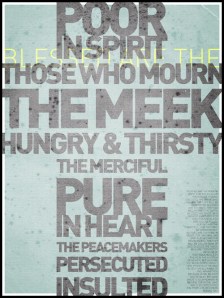
Courtesy of http://firecatching.blogspot.com/2011_04_01_archive.html

Courtesy of http://firecatching.blogspot.com/2011_04_01_archive.html

Today we hear one of the most beloved pieces of scripture.  The Beatitudes from Matthew’s gospel have been the source of inspiration for Christians for centuries, for artists and musicians, for entire ministries, and even for comedians like Monty Python.  As soon as we hear that phrase, “Blessed are…” our eyes close and we let the words flow over us.  We nod in assent, and maybe even whisper, “Yes!”  And as the preacher for In-Gathering Sunday, getting the Beatitudes in the lectionary is like being handed a silver platter.  What other inspiration can we need on a Sunday like this than to think about blessings?  That is what our Stewardship Committee has been encouraging us to do for weeks: to think about the ways that we are blessed and to return that blessing to this community through the gift of our financial resources.  That message could not be better captured than in the Beatitudes from our gospel lesson today.

Or at least that is what I thought before I started really working with the Beatitudes this week.  The more I poured over the text, the more I became confused.  Then the questions came pouring in:  What does it mean to be poor in spirit?  How do we know if we are pure in heart?  I might prefer peace, but could any of us in our everyday lives be considered peacemakers?  And those are just the surface level questions.  When we read at a deeper level, ethical questions begin to emerge.  Our news outlets have been flooded lately with people who are reviled, persecuted, and having evil uttered against them.  All we have to remember are Christians in Iraq, Palestine, or Burma whose very faith means a life of oppression and sometimes death.  Is the word for them today, “You are blessed”?  Many a liberation theologian has balked at the idea of Holy Scripture being used to keep down oppressed peoples.

Luckily, I stumbled on two things this week that opened up the Beatitudes for me in a fresh way.  First I began to look at what the word translated as “blessed” really means.  There are a couple of words in scripture that are translated in English as “blessed,” but they do not necessarily have the same meaning.  In our Beatitudes today, one scholar argues that the phrase translated as “blessed are you when…” is more rightly translated as “You are on the right road when…”  For example, “You are on the right road when you are poor in spirit.”[i]  So blessed does not really mean, “Happy are you when people persecute you,” but instead, “You are on the right road when people persecute you.”  Somehow this translation makes for a much more sober, honest rendering of Jesus’ words.  Jesus is not saying that these things are cause for happiness in a superficial way.  Jesus is saying that we are fortunate in those experiences because they point us to a deeper truth:  that we are heading in the right direction, making the right decisions, and living a meaningful life.

The other source of insight I found this week was from The Message’s translation of this text.  If you are not familiar with The Message, The Message is a paraphrase of the Bible:  not a literal translation of the Biblical language, but a modern rephrasing of the text to make the text more accessible.  Of course, biblical scholars often cringe when they hear certain paraphrases of key texts, but in the case of the Beatitudes, I found this paraphrase quite useful.

I have taken the two ideas – The Message’s paraphrase and the new introduction of “You are on the right road when…” and want to read for you my hybrid rephrasing of the Beatitudes.  Our text now goes like this:

You are on the right path when you’re at the end of your rope.  With less of you there is more of God and God’s rule.  You are on the right path when you feel you’ve lost what is most dear to you.  Only then can you be embraced by the One most dear to you.  You’re on the right path when you’re content with just who you are—no more, no less.  That’s the moment you find yourselves proud owners of everything that can’t be bought.  You’re on the right path when you’ve worked up a good appetite for God.  God’s food and drink in the best meal you’ll ever eat.  You’re on the right path when you care.  At the moment of being ‘care-full,’ you find yourselves cared for.  You’re on the right path when you get your inside world—your mind and heart—put right.  Then you can see God in the outside world.  You’re on the right path when you can show people how to cooperate instead of compete or fight.  That’s when you discover who you really are, and your place in God’s family.  You’re on the right path when your commitment to God provokes persecution.  The persecution drives you even deeper into God’s kingdom.  Not only that— You’re on the right path every time people put you down or throw you out or speak lies about you to discredit God.  What it means is that the truth is too close for comfort and they are uncomfortable.  You can be glad when that happens—give a cheer, even!—for though they don’t like it, God does!  And all heaven applauds.  And know that you are in good company.  God’s prophets and witnesses have always gotten into this kind of trouble.

This Stewardship Season, we have been talking about “Walking the Way.”  Certainly Walking the Way is a metaphor for our journey into a time of reflection about the value our money holds for us and how our relationship with that money is connected to our relationship with God.  But the Walking the Way metaphor is one that goes beyond just our money too.  Walking the Way is a metaphor for our entire journey with God – a path that is ever winding, has steep slopes at times, is sometimes full of potholes and rocks, and at other times is as smooth as a freshly paved road.  Our entire life is a journey – one in which we mature in faith from the time of our birth and baptism to the time of our old age and death.  We are constantly Walking the Way with Christ, growing, learning, messing up, and returning to a loving God.

What I like about this reworded rendition of the Beatitudes is the affirmation in them.  When we are on a journey, Walking the Way, we sometimes struggle to know whether we are on the right path.  We wonder if we are where we should be and whether God is really with us.  This rendition of the Beatitudes gives us a tiny glimpse into that affirmation:  You are on the right path when…  Of course, the description is not all roses.  Mourning, persecution, and making peace are not easy roads.  But a sign of true discipleship, of Walking the Way, are those times when the path is in fact quite rocky.  Then we know that we are on the right path, and Jesus is walking right beside us.  Amen.

[i] Earl F. Palmer, “Pastoral Perspective,” Feasting on the Word, Year A, Vol. 4 (Louisville: Westminster John Knox Press, 2011), 238.

Recent Posts

  • On the Myth and Magic of Advent…
  • On Risking Failure and Facing Fear…
  • Sermon – Luke 23.33-43, P29, YC, November 23, 2025
  • On Inhabiting Gratitude…
  • Sermon – Luke 20.27-38, P27, YC, November 9, 2025

Archives

  • December 2025
  • November 2025
  • October 2025
  • September 2025
  • August 2025
  • July 2025
  • June 2025
  • March 2025
  • February 2025
  • December 2024
  • November 2024
  • October 2024
  • September 2024
  • August 2024
  • July 2024
  • June 2024
  • May 2024
  • March 2024
  • February 2024
  • January 2024
  • December 2023
  • November 2023
  • October 2023
  • September 2023
  • August 2023
  • July 2023
  • June 2023
  • May 2023
  • March 2023
  • February 2023
  • January 2023
  • December 2022
  • November 2022
  • October 2022
  • June 2022
  • May 2022
  • January 2022
  • December 2021
  • November 2021
  • October 2021
  • September 2021
  • August 2021
  • June 2021
  • May 2021
  • April 2021
  • March 2021
  • February 2021
  • January 2021
  • December 2020
  • November 2020
  • October 2020
  • September 2020
  • August 2020
  • July 2020
  • June 2020
  • May 2020
  • April 2020
  • March 2020
  • February 2020
  • January 2020
  • December 2019
  • November 2019
  • October 2019
  • September 2019
  • August 2019
  • July 2019
  • June 2019
  • May 2019
  • April 2019
  • March 2019
  • February 2019
  • January 2019
  • December 2018
  • November 2018
  • October 2018
  • September 2018
  • August 2018
  • July 2018
  • June 2018
  • May 2018
  • April 2018
  • March 2018
  • February 2018
  • January 2018
  • December 2017
  • November 2017
  • October 2017
  • September 2017
  • August 2017
  • July 2017
  • June 2017
  • May 2017
  • April 2017
  • March 2017
  • February 2017
  • January 2017
  • December 2016
  • November 2016
  • October 2016
  • September 2016
  • August 2016
  • July 2016
  • June 2016
  • May 2016
  • April 2016
  • March 2016
  • February 2016
  • January 2016
  • December 2015
  • November 2015
  • October 2015
  • September 2015
  • August 2015
  • July 2015
  • June 2015
  • May 2015
  • April 2015
  • March 2015
  • February 2015
  • January 2015
  • December 2014
  • November 2014
  • October 2014
  • September 2014
  • August 2014
  • July 2014
  • June 2014
  • April 2014
  • March 2014
  • February 2014
  • January 2014
  • December 2013
  • November 2013
  • October 2013
  • September 2013
  • August 2013
  • July 2013
  • June 2013
  • May 2013
  • April 2013
  • March 2013
  • February 2013
  • January 2013
  • December 2012
  • November 2012
  • October 2012
  • September 2012

Categories

  • reflection
  • Sermons
  • Uncategorized

Meta

  • Create account
  • Log in
  • Entries feed
  • Comments feed
  • WordPress.com

Blog at WordPress.com.

  • Subscribe Subscribed
    • Seeking and Serving
    • Join 394 other subscribers
    • Already have a WordPress.com account? Log in now.
    • Seeking and Serving
    • Subscribe Subscribed
    • Sign up
    • Log in
    • Report this content
    • View site in Reader
    • Manage subscriptions
    • Collapse this bar
 

Loading Comments...