
• About

Seeking and Serving

~ seek and serve Christ in all persons

Seeking and Serving

Tag Archives: Easter Vigil

Sermon – Luke 24.1-12, EV, YC, April 19, 2025

18 Wednesday Jun 2025

Posted by jandrewsweckerly in Sermons

≈ Leave a comment

Tags

church, Easter Vigil, God, Jesus, love, salvation, Savior, Sermon, story

Tonight, we celebrate one of the most ancient, and in many traditions, the most important liturgies of the Church.  This is the festival of the resurrection of our Lord – despite what you may have learned about Easter Sunday.  Tonight is the night that we liturgically mark that shift from Lent and the Passion to our Lord and Savior’s Resurrection.  The church gives us this incredible gift tonight, and our job is to hearken back to an innocent sense of awe as we realize what God does through Jesus Christ.

Luckily the Church helps us hearken back to that innocent sense of awe through the structure of the liturgy.  I like to think the Church’s work in the Easter Vigil as being like that grandfather in the movie The Princess Bride, who visits his sick grandson to read him a fantastic tale.  In that movie, the grandson is skeptical – that in fact his grandfather might be planning to read him a boring or sappy story.  But the grandfather insists that this story is one of the greatest stories ever told – a story that his father read him, that he read to his son, and now, he would read to him, his grandson.

The Church is like that grandfather to us tonight, who gathers up the grandchildren around him, and says, “Let me tell you a story.  This story is greater than any other story you have ever heard.  This story is full of intrigue and surprise, full of the primal elements, full of drama and passion, and full of twists and turns you will not expect.  Do you want to hear the story?”  And before the grandfather can even begin, we, the grandchildren, are waiting with bated breath.

“Once upon a time, before there was time, or people, or even land or sky, the earth as we know the earth was a formless void – filled with watery chaos.  God created the world as we know the world, and proclaimed that creation, ‘good.’  Sometime later, that world fell into sin and God used water to cleanse the whole earth through flood.  To the one person God saved, God promised to never do such destruction again and made a covenant of protection.  Much later, the people of God were fleeing a horrible fate – an awful leader who had enslaved the people.  This time, God once again manipulated the water – both to save God’s people and to destroy those who wished to destroy God’s people.  On the other side of the sea, on dry land, the people rejoiced.  Later, the people fell away from God and although God was grieved, God spoke to the prophet Ezekiel.  God told Ezekiel to reassemble the dry bones of God’s people, and to breathe new life into them.  And the people lived again.  Much later, when the people had become dispersed and disheartened, God proclaimed new hope.  God proclaimed that God would gather God’s people again and would eliminate their despair.

“But after all of that – after creation and floods, after the division of the sea and the giving of new life to old bones, even after promising to save the people – after all of that, yet still the people of God lived in sin and in separation from God.  And, knowing no other way, God did something so unexpected, so wonderful that we could never repay God.  God sent God’s Son to live and breathe among us, to show us the way of faithful living and the way to eternal life.  And as if that were not enough, that same Son was betrayed by his friends, mocked and reviled, and killed on a cross.  That was a dark, painful time – darker and more painful than anything the people had known before.  And so, the people of God did the only thing they knew to do:  they mourned, they hid in fear, and a few brave women went to tend to this precious gift they had been given, making his death as sacred as they knew how. 

“But something amazing happened – something no one ever anticipated.  The Son of Man, the Prince of Peace, the Messiah, Jesus was not there.  And the disciples went from east to west, sharing the sacred and imperishable proclamation of eternal salvation.”

At the end of the film The Princess Bride, the grandfather finishes the book, and tells his grandson to go off to sleep.  The once skeptical grandson hesitantly addresses his grandfather, “Grandpa?  Maybe you could come over and read it again to me tomorrow?”  His grandfather smiles and responds, “As you wish.”  Those words are significant because in the story the grandfather tells, the main characters say, “As you wish,” as their code word for, “I love you.”  Tonight, we too hear the story of our salvation, the great sweeping of our history with our Lord, and the salvific work of our Savior Jesus Christ, and we too find ourselves strangely warmed, longing to perhaps hear the story again.  And to us, the Church says, “As you wish.”  Amen.
Sermon – Jeremiah 31.31-34, Psalm 51.1-13, L5, YB, March 17, 2024

27 Wednesday Mar 2024

Posted by jandrewsweckerly in Sermons

≈ Leave a comment

Tags

blessing, covenant, Easter Vigil, failing, God, heart, Jeremiah, Lent, lovingkindness, salvation narrative, Sermon, share

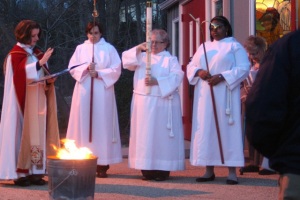
In just a couple of weeks, Hickory Neck will gather for what is my favorite service of the entire year:  the Easter Vigil.  Now I know, you may be thinking, “But what about Easter Sunday?” or even “But Christmas Eve is the best!”  For me, the very best of the Episcopal Church happens at the Easter Vigil.  The lights are turned down low, a fire erupts as we sing the haunting Exultet, we read stories from scripture that feel like the ones you would tell around a campfire, we baptize new Christians, and then, with bells and singing, the lights come up as we ring in Easter.  The rest of the service feels like celebrating Eucharist for the first time – with the news of the empty tomb and feasting at the family table.

Part of why I love the service so much is those stories we hear by the fire:  what we often refer to as the salvation narrative.  In these stories we hear how we were created in God’s image and made for goodness, and then we hear how time and again we fail to live up to that goodness, but time and again, God meets us where we are, renewing God’s covenantal relationship with us, forgiving us, and getting us back on our feet to serve the world in God’s name.  The repetition of God extending that grace again and again and again, no matter how grave our failings, can make any participant begin to think that maybe, just maybe, we stand invited to receive that hesed or as we translate the Hebrew, that lovingkindness, of God.

Although we do not hear the text from Jeremiah on Easter Vigil night, today, on this fifth Sunday in Lent, just a week before we start the descent into the cross and the grave of Holy Week, we get one last reminder of the kind of redemption that waits on the other side of Easter.  I do not how recently you’ve been reading Jeremiah in your spare time, but just as a refresher, Jeremiah is one of those books that is generally filled with bad news.  Israel disobeyed the law of God, and, as a consequence, they are overthrown by outside forces, the walls of Jerusalem fall, the temple is destroyed, and the Israelites themselves are banished to Babylon.  The situation is bleak, and the prophet Jeremiah has a lot to say in judgment of the people.[i] 

But today, all the way in chapter 31, we get what is called “The Book of Comfort,”[ii] in Jeremiah where, after much shame and judgment, the people are promised a new day where there will be a new covenant between God and the people.  This time, they won’t have to wait for teaching, and they won’t have to store the commandments in a holy place.  The holy word of God will be written on their hearts – able to go with them anywhere, to be not just in their minds or in their temple, but on their very souls – they will be God’s and God’s will be theirs.  For a people utterly destroyed, who have lost their spiritual home in addition to their literal home, this is good news indeed.

When I was in seminary, we went to Chapel everyday – sometimes multiple times a day.  The rhythm of regular worship meant that not only did the liturgy get written into your body, so did the space.  You began to know the particulars of certain seats – which ones experienced more of a draft and which pew had someone’s initials carved in and aged over.  You knew how certain steps would creak when someone would ascend the lectern and you have seen the pulpit sway with a particularly vigorous preacher.  But mostly, you had stared, for years at a time, at the window behind the altar, around which were painted the words, “Go ye into all the world and preach the gospel.”  Consciously and maybe more subconsciously, those words became ingrained in our minds seeing them every day. 

A year and a half after I graduated, that chapel burned down, along with that wall that had been seared into my mind.  I remember feeling bereft – like a part of me had died with the loss of that building.  Even today, when I visit the campus, worshiping in the beautiful new chapel, I still grieve when I see the preserved ruins where an outdoor altar remains.  It took me a long time to realize that although my heart ached for the physical space, those words – those words that Jesus spoke, “Go ye into all the world and preach the gospel,” were gone from the world – but not from my heart.  Though I might miss the building – in the same way so many of us missed the buildings of this campus in those early years of the pandemic, the experience of God is written in my heart.

As we walk this last week of Lent, and as we begin next week to walk steadily through Holy Week, perhaps with sins weighing on our hearts, or feelings of being a failure at faith or at life in general, or even just the restlessness that can come when we find ourselves disconnected from any kind of relationship with God, our worship today is all about renewing that covenantal relationship with God.  Even in our psalm today, we prayed, “Create in me a clean heart, O God, and renew a right spirit within me.” – those same words a priest prays before she consecrates the sacred meal.  The psalm tells us the very nature of our God is “steadfast love and abundant mercy, a God who is eternally ‘for us’ with the endless love of a mother for her child.  The God who is everlasting love will never abandon us, no matter what our guilt says.  Steadfast love and abundant mercy heal us not only of the stain of sin, but also of the lie of our worthlessness.”[iii]  So likewise, Jeremiah confirms that encouragement.  As one scholar explains, “God will write the capacity for keeping the covenant on the inward hearts of the people.  Hope for such transformed wills will lie with God’s grace, not in any hope for human perfection.”[iv]

Your promise today is blessing upon blessing – blessing of belonging, of permanence, of mercy and lovingkindness.  The invitation today is then up to you.  What will you do with that renewed covenantal relationship?  How will walk differently this week with the covenant of God written on your heart?  How will you treat your neighbors differently, yourself differently, and your God differently?  The blessing is yours to keep deep in your soul.  And the blessing is also yours to share with a world that needs that blessing so very deeply.  Your work this week is to find your unique place to share that blessing.  Amen.


[i] Woody Bartlett, “Homiletical Perspective,” Feasting on the Word, Year B, Vol. 2 (Louisville: Westminster John Knox Press, 2008), 123.

[ii] Jon L. Berquist, “Exegetical Perspective,” Feasting on the Word, Year B, Vol. 2 (Louisville: Westminster John Knox Press, 2008), 123.

[iii] Elizabeth Webb, “Commentary on Psalm 51:1-12,” March 17, 2024, as found at https://www.workingpreacher.org/commentaries/revised-common-lectionary/fifth-sunday-in-lent-2/commentary-on-psalm-511-12-6 on March 14, 2024.

[iv] Samuel K. Roberts, “Theological Perspective,” Feasting on the Word, Year B, Vol. 2 (Louisville: Westminster John Knox Press, 2008), 126.

Sermon – Gen., Ex., Ez., Zeph., Mt. 28.1-10, EV, YA, April 8, 2023

30 Tuesday May 2023

Posted by jandrewsweckerly in Sermons

≈ Leave a comment

Tags

alleluia, darkness, Easter Vigil, God, Jesus, joy, light, rejoice, salvation narrative, Sermon

If you have ever longed for a way to explain or express your faith to someone or even to yourself, this night, Easter Vigil, is the best articulation or encapsulation of our faith.  If ever you were hoping to showcase to a friend the best example of Church, this is the night in which the Church is at the Church’s fullest.  This night has everything – the drama of the Pascal fire and candle, the haunting beauty of the Exsultet, the narration of our salvation history, Baptism and Eucharist, and all the joy that comes with Easter.  After this night, the rest of our Easter celebrations pale in comparison.  This is the night. 

The challenge of Easter for us is that not only are we quick to forget the darkness of the past week, but also we are tempted to only celebrate what God has done in Jesus Christ, and not celebrate how extraordinary what God has done in Jesus Christ is in light of what God has done throughout all time.  Easter Vigil pulls us out of that desire to be narrowly focused and thrusts us back into the full story that is our story – the story that makes Jesus’ resurrection all the more powerful.  Easter Vigil gives us the opportunity to step out of the empty tomb, and to immediately recall all the other things that God has done for us – the ways that God has repeatedly delivered us – and to understand at a much deeper level the significance of this night.

Tonight, we hear five of the nine possible readings we could have read which narrate our salvation history.  First, we hear the creation story – that story wherein God takes a watery chaos and creates the earth and all that is in the earth:  the lights, the waters, the birds, the animals, the ground and vegetation, humanity, and Sabbath.  We hear again and again how God creates and how that creation is good.  We hear in this first reading the tender lovingkindness of God, the abundance of creation, and the glory of God.  Second, we hear the dramatic story of the flood, where our sinfulness drives God to flood the earth.  But the flood story is also a story of God’s mercy – a God who loves so much that God cannot totally annihilate God’s creation.  After the flood, God promises to never again harm creation so deeply.  Then we hear the Exodus story – that story where God takes God’s people out of slavery, frees them from Egypt, and guides them through the Red Sea to the final destruction of pharaoh’s army.  Despite the people’s groaning, their illogical desire to return to slavery rather than to trust in the Lord, and the people’s unworthiness of such grace, God saves the people, delivering them from bondage and death.  Next, we hear that haunting story from Ezekiel, where the prophet breathes breath back into a valley full of dry bones – the dry bones of the people Israel, symbolizing God’s restoration of Israel.  Finally, finally, we hear the Zephaniah story of the gathering of God’s people back together from exile – that story in which God promises to return God’s people to the Promised Land, to deliver them from their suffering at the hands of oppressors, and to restore their fortunes.  As an exiled people, who quite frankly deserved the loss of their land because of the ways they deserted God, this promise of being regathered is more than they could ever hope for or imagine.

In light of this salvation history – this snapshot way of showing how lovingly God creates us, how lovingly God forgives us, and how lovingly God returns to us time and again, despite our grievous sins – we then turn to Jesus’ story.  We see that as God’s people we have benefited from the many times that God has delivered us from oppression and suffering caused by our sinfulness; but in this final act by God, the giving of God’s Son Jesus Christ to suffering, persecution, and death, we see that Jesus’ resurrection means that we not only have a God that delivers us from the bondage of death in this world, but also we have a God that delivers us from bondage of death in the life to come.  Instead of taking away one more earthly oppressor, God takes away the oppressor of death – granting us forgiveness of our sins and eternal life.  This narrative, the story of the empty tomb is the last stop in that salvation narrative for us. 

This is the night – when we remember what God does for us at the Red Sea.  This is the night – when we recall that Christ died for our sins.  This is the night – when we proclaim that Christ has broken the bonds of death and given us eternal life.  And we remember all of that this night through our actions – the lighting of the Pascal candle, the reaffirmation of our baptismal covenant, and the receiving of bread and wine.  We hear the word of God, and we respond to the word of God through our liturgical actions. 

And so what does God call us to do in light of this night?  Rejoice now!  The whole earth – that earth that God created – rejoices because darkness is vanquished through Jesus Christ.  The heavenly chorus rejoices – shouting for the salvation fulfilled and completed in Christ the King.  The Church rejoices – we resound as a people, being glad for all that God does for us through Jesus Christ.  Like our ancestor the prophet Miriam who led the women in dancing and song, we too are bursting with praise and thanksgiving.  We praise God in song, prayer, and proclamation because we are so overwhelmed with the abundance of God’s love and grace for us.  We rejoice now, because like the Israelites on the other side of the Sea, we are awed by God, and can only offer our adoration.  We have no way of paying God back or thanking God enough.  And so, with great adoration and awe, we rejoice now.  And we leave this place, bursting with joy as we share the salvation story of all that God has done for us.  Rejoice now, Mother Church!  Alleluia!  Alleluia! 

Homily – Mark 16.1-8, EV, YB, March 31, 2018

12 Thursday Apr 2018

Posted by jandrewsweckerly in Sermons, Uncategorized

≈ Leave a comment

Tags

covenant, Easter Vigil, God, Jesus, learning, relationship, resurrection, silent, tomb, wonderful

I once worked with a parish who wanted to tweak their outreach efforts.  Instead of simply volunteering together with an outreach ministry or donating funds, they wanted to partner outreach and formation – what the secular world would call service learning.  And so, we experimented.  We gathered a team for six weeks in preparation for service with a transitional home for women coming out of prison.  The first week, two clients came to talk to us about their experiences with the ministry we were serving.  We heard stories of abuse, addition, and authority.  We learned about the things within their control and the things outside their control. Then we spent four weeks reading about a woman whose ministry in a prison led to her live and serve among the prisoners, guards, and families affected by the prison.  In the final week, the parishioners served a meal for the women in the transitional house, engaging in meaningful conversation as we ate.  When we gathered after our days of service, each participant felt as though their experience at the transitional home was much richer than the experience would have been had they simply showed up at the house with a hot meal, having never thought much about who they would encounter and why.  With old assumptions gone, parishioners were able to ask meaningful questions, understand how hard the road ahead would be, and share their own journeys.

Easter Vigil is a bit like that service learning group.  You see, we could gather tonight, and ring in Easter, happily celebrating the empty tomb the two Marys discover.  The miracle of that event, and the consequences of Christ’s resurrection are cause enough for a tremendous celebration.  But what we do tonight is not just jump into the resurrection.  First, we learn together why the resurrection is meaningful at all.  We start at the beginning, when the world was a formless void.  We learn about the creative God, who makes order out of a disordered world, who creates the beauty of the world around us, and who trusts us to care for that beauty.  But, of course, we fail at being stewards of God’s creation, and fall into sin so deep that God destroys most of the created order, saving one family from every species.  And God gives us a covenant – to never destroy the world again.  Generations later, as God helps us flee suffering and enslavement, God does the impossible – parts an entire sea so that we might be forever free.  Later, God is able to restore a valley of dry bones to life through God’s prophet Ezekiel.  God teaches us that even death and destruction can be restored.  Even as they are scattered in exile, God once again promises to restore the people.  Story after story after story tells us tonight that we belong to a God who creates us in beauty, stays in relationship, and restores us to wholeness.

When you know the breadth of our walk with God – when you remember all the pieces of what we know about God – then what happens to God’s Son this night makes more sense.  We can move from singing, “this is the night,” to singing, “how wonderful.”  “How wonderful and beyond our knowing, O God, is your mercy and loving-kindness to us, that to redeem a slave, you gave a Son.  How holy is this night, when wickedness is put to flight, and sin is washed away.  It restores innocence to the fallen, and joy to those who mourn.  It casts out pride and hatred, and brings peace and concord.  How blessed is this night, when earth and heaven are joined and man is reconciled to God.”[i]  What is shocking about this night is not just the empty tomb.  What is shocking is the empty tomb in light of all that has gone before – despite our sinfulness, the breaking of covenant after covenant, our unfaithfulness and lack of gratitude, God stays in relationship.  God keeps making creation new.  God goes a step further in the resurrection of Christ Jesus.

That is why I love that we get Mark’s gospel to close our learning tonight.  Ever the succinct writer, Mark describes for us perfectly how overwhelming God’s love and commitment is to us.  Despite all the drama of our relationship with God, despite all the unfaithfulness, and despite all the waywardness of our behavior, God’s love never ends.  That realization leads to the same sort of terror, amazement, and fear that the Marys experience – the experience of a theophany – of an encounter with or a revelation of God.[ii]  The women flee the tomb tonight and remain silent because they are completely overwhelmed by their encounter with God and God’s love.  On Palm Sunday we were silent at the tomb in grief and despair.  Tonight we are silent at the tomb in unspeakable joy.  The women at the tomb give us permission tonight not to describe the experience, but simply to allow the blessing of this night to overwhelm us.  We can go and tell the news to others tomorrow.  But for tonight, hold on to that marvelous, wonderous feeling of knowing that Christ has been raised.  Amen.  Alleluia.

[i] BCP, 287.

[ii] Gail R. O’Day, “Homiletical Perspective,” Feasting on the Word, Year B, Vol. 2 (Louisville:  Westminster John Knox Press, 2008), 357.

Sermon – Mark 16.1-8, EV, YB, April 4, 2015

15 Wednesday Apr 2015

Posted by jandrewsweckerly in Uncategorized

≈ Leave a comment

Tags

church, Easter Vigil, God, history, Jesus Christ, love, Princess Bride, salvation, Sermon, story

Tonight we celebrate one of the most ancient, and in many traditions, the most important liturgies of the Church.  This is the festival of the resurrection of our Lord – despite what you may have learned about Easter Sunday.  Tonight is the night that we liturgically mark that shift from Lent and the Passion to our Lord and Savior’s Resurrection.  The church gives us this incredible gift tonight, and our job is to hearken back to an innocent sense of awe as we realize what God does through Jesus Christ.

Luckily the Church helps us hearken back to that innocent sense of awe through the structure of the liturgy.  I like to think the Church’s work in the Easter Vigil as being like that Grandfather in the movie The Princess Bride, who visits his sick grandson to read him a fantastic story.  In that movie, the grandson is skeptical – that in fact his grandfather might be planning to read him a boring or sappy story.  But the grandfather insists that this story is one of the greatest stories ever told – a story that his father read him, that he read to his son, and now, he would read to him.

The Church is like that grandfather to us tonight, who gathers up the grandchildren around him, and says, “Let me tell you a story.  This story is greater than any other story you have ever heard.  This story is full of intrigue and surprise, full of the primal elements, full of drama and passion, and full of twists and turns you do not expect.  Do you want to hear the story?”  And before the grandfather can even begin, the grandchildren are waiting with baited breath.

“Once upon a time, before there was time, or people, or even land or sky, the earth as we know the earth was a formless void – filled with watery chaos.  God created the world as we know the world, and proclaimed that creation, ‘good.’  Sometime later, that world fell into sin and God used water to cleanse the whole earth through flood.  To the one person God saved, God promised to never do such destruction again and made a covenant of protection.  Much later, the people of God were fleeing a horrible fate – an awful leader who had enslaved the people.  This time, God once again manipulated the water – both to save God’s people and to destroy those who wished to destroy God’s people.  On the other side of the sea, on dry land, the people rejoiced.  Later, the people fell away from God and although God was grieved, God spoke to the prophet Ezekiel.  God told Ezekiel to reassemble the dry bones of God’s people, and to breathe new life into them.  And the people lived again.  Much later, when the people had become dispersed and disheartened, God proclaimed new hope.  God proclaimed that God would gather God’s people again and would eliminate their despair.

“But after all of that – after creation and floods, after the division of the sea and the giving of new life to old bones, even after promising to save the people – after all of that, yet still the people of God lived in sin and in separation from God.  And, knowing no other way, God did something so unexpected, so wonderful that we could never repay God.  God sent God’s Son to live and breathe among us, to show us the way of faithful living and the way to eternal life.  And as if that were not enough, that same Son was betrayed by his friends, mocked and reviled, and killed on a cross.  That was a dark, painful time – darker and more painful than anything the people had known before.  And so the people of God did the only thing they knew to do:  they mourned, they hid in fear, and a few brave women went to tend to this precious gift they had been given, making his death as sacred as they knew how.  But something amazing happened – something no one ever anticipated.  The Son of Man, the Prince of Peace, the Messiah, Jesus was not there.  And the disciples went from east to west, sharing the sacred and imperishable proclamation of eternal salvation.”

At the end of the film The Princess Bride, the grandfather finishes the book, and tells his grandson to go off to sleep.  The once skeptical grandson hesitantly addresses his grandfather, “Grandpa?  Maybe you could come over and read it again to me tomorrow.”  His grandfather smiles and responds, “As you wish.”  Those words are significant because in the story the grandfather tells, the main characters say, “As you wish,” as their code word for, “I love you.”  Tonight, we too hear the story of our salvation, the great sweeping of our history with our Lord, and the salvific work of our Savior Jesus Christ, and we too find ourselves strangely warmed, longing to perhaps hear the story again.  And to us, the Church says, “As you wish.”  Amen.

Sermon – Luke 24.1-12, EV, YC, March 30, 2013

10 Wednesday Apr 2013

Posted by jandrewsweckerly in Uncategorized

≈ Leave a comment

Tags

Easter Vigil, God, light, liturgy, Messiah, movie, salvation, Sermon, tomb

IMG_3202Our liturgy tonight operates a bit like a movie whose mode of telling stories is in flashbacks.  We start the movie with the scene we just heard.  Several women are gathered around the empty tomb, their mouths agape, and their minds racing.  And then, the flashbacks begin.

Mary the mother of James recalls that ancient story of creation.  That empty tomb reminds her of those words – tohu wabohu – the formless void.  She vaguely remembers what God said about creating humankind in God’s image.  And she hears those words repeated over and over again, “It was good; ki-tov”

Meanwhile, another woman flashes back to when humankind’s sinfulness so angered God that God flooded the earth.  For forty days, Noah knew the nothingness of that empty tomb in front her.  But she also remembers that covenant God made with Noah – that never again will there be a flood to destroy the earth.  Perhaps there is a rainbow in this tomb, and not only the watery floods that she sees.

Joanna looks into that empty tomb and remembers another time her people faced desperation.  She flashes back to the rushing Egyptians who have pinned her people to the Red Sea.  She remembers the panicked screams of her people toward Moses.  She remembers how God saved them then – how God created a way out of no way.  She wonders whether the empty tomb is not unlike that empty seabed – the one that the Israelites used to get to freedom.

Another woman stares into that vacant tomb and she remembers a different tomb.  She remembers the death and hopelessness of those bones in that valley – the thousands of devastated lives.  But then she remembers what God told Ezekiel.  She remembers the rattling of those bones coming together, and the way the breath of God, the ruah of God breathed life into those bones.  She wonders if she hears the faint ruah of God now coming out of that empty tomb.

But Mary Magdalene remembers a different story from Zephaniah.  She hears the words of that song in a fresh way today.  “Sing aloud, O daughter of Zion.”  Is this the day that God will save us?  Can her beloved Jesus be not missing, but raised?  Might Jesus be the one who will restore her fortunes?  She longs for God to be saying to her, “Rejoice and exult with all your heart, O daughter Jerusalem.”  “Please let this empty tomb be an occasion for rejoicing and not for more pain and suffering for my Lord,” Mary Magdalene prayers in her heart.

And then the movie brings us abruptly back to the empty tomb, the sound of silence like so many times before in their history.  The appearance of emptiness threatens their fragile, exhausted psyches.  Their unspoken memories fail to comfort them because they are unable to utter a word of remembrance and assurance to one another.

As outsiders watching this movie, as we watch those looking into the tomb, we begin to connect the various flashbacks.  The answers are there before the angels need to say a word.  God loves us and creates us in God’s image.  And we are not only good – but we are very good – wehineh-tov.  God promises to never destroy us again as God once did.  God promises liberation from oppression.  God promises restoration to our bodies and spirits.  God promises to bring us home.  God promises and God saves us time and again.  And now, with this Messiah who has finally arrived, God saves us once and for all.  What has felt like a defeat is now the reason to rejoice.  The smiles that spread across our faces are exact mirrors of the smiles that spread across the faces of those women at the tomb.  The smiles are smiles that happen as we connect the varied flashbacks, remembering our salvation history, and this final act of salvation through the death and resurrection of our Lord and Savior Jesus Christ.  That tomb is not a formless void, but the holy site where all our salvation narrative culminates.  That empty tomb is in fact not empty at all.  That tomb is full of life.  Tonight is a night for alleluias, for songs of joy, and for dancing.  The light shatters the darkness this night, and we celebrate the greatest victory of all time.  Alleluia! Christ is risen.  The Lord is risen indeed!!

Recent Posts

  • On the Myth and Magic of Advent…
  • On Risking Failure and Facing Fear…
  • Sermon – Luke 23.33-43, P29, YC, November 23, 2025
  • On Inhabiting Gratitude…
  • Sermon – Luke 20.27-38, P27, YC, November 9, 2025

Archives

  • December 2025
  • November 2025
  • October 2025
  • September 2025
  • August 2025
  • July 2025
  • June 2025
  • March 2025
  • February 2025
  • December 2024
  • November 2024
  • October 2024
  • September 2024
  • August 2024
  • July 2024
  • June 2024
  • May 2024
  • March 2024
  • February 2024
  • January 2024
  • December 2023
  • November 2023
  • October 2023
  • September 2023
  • August 2023
  • July 2023
  • June 2023
  • May 2023
  • March 2023
  • February 2023
  • January 2023
  • December 2022
  • November 2022
  • October 2022
  • June 2022
  • May 2022
  • January 2022
  • December 2021
  • November 2021
  • October 2021
  • September 2021
  • August 2021
  • June 2021
  • May 2021
  • April 2021
  • March 2021
  • February 2021
  • January 2021
  • December 2020
  • November 2020
  • October 2020
  • September 2020
  • August 2020
  • July 2020
  • June 2020
  • May 2020
  • April 2020
  • March 2020
  • February 2020
  • January 2020
  • December 2019
  • November 2019
  • October 2019
  • September 2019
  • August 2019
  • July 2019
  • June 2019
  • May 2019
  • April 2019
  • March 2019
  • February 2019
  • January 2019
  • December 2018
  • November 2018
  • October 2018
  • September 2018
  • August 2018
  • July 2018
  • June 2018
  • May 2018
  • April 2018
  • March 2018
  • February 2018
  • January 2018
  • December 2017
  • November 2017
  • October 2017
  • September 2017
  • August 2017
  • July 2017
  • June 2017
  • May 2017
  • April 2017
  • March 2017
  • February 2017
  • January 2017
  • December 2016
  • November 2016
  • October 2016
  • September 2016
  • August 2016
  • July 2016
  • June 2016
  • May 2016
  • April 2016
  • March 2016
  • February 2016
  • January 2016
  • December 2015
  • November 2015
  • October 2015
  • September 2015
  • August 2015
  • July 2015
  • June 2015
  • May 2015
  • April 2015
  • March 2015
  • February 2015
  • January 2015
  • December 2014
  • November 2014
  • October 2014
  • September 2014
  • August 2014
  • July 2014
  • June 2014
  • April 2014
  • March 2014
  • February 2014
  • January 2014
  • December 2013
  • November 2013
  • October 2013
  • September 2013
  • August 2013
  • July 2013
  • June 2013
  • May 2013
  • April 2013
  • March 2013
  • February 2013
  • January 2013
  • December 2012
  • November 2012
  • October 2012
  • September 2012

Categories

  • reflection
  • Sermons
  • Uncategorized

Meta

  • Create account
  • Log in
  • Entries feed
  • Comments feed
  • WordPress.com

Blog at WordPress.com.

  • Subscribe Subscribed
    • Seeking and Serving
    • Join 394 other subscribers
    • Already have a WordPress.com account? Log in now.
    • Seeking and Serving
    • Subscribe Subscribed
    • Sign up
    • Log in
    • Report this content
    • View site in Reader
    • Manage subscriptions
    • Collapse this bar
 

Loading Comments...