

• About

Seeking and Serving

~ seek and serve Christ in all persons

Seeking and Serving

Tag Archives: Holy Week

A few of my favorite things…

10 Wednesday Apr 2013

Posted by jandrewsweckerly in Uncategorized

≈ Leave a comment

Tags

God, Holy Week, liturgy, pilgrimage, spiritual

AlleluiaBWWhen I went on a choral pilgrimage in England a couple of years ago, I remember finding that each day I had a new favorite sacred space.  Not once did we visit a place and I say, “Oh, well that one wasn’t as good as yesterday.”  They all blew me away, and I had such a hard time naming a favorite when I returned home.

In some ways, Holy Week this year was like that for me.  Every liturgy of Holy Week brought its own unique gifts and made me feel like the next liturgy could not possibly top the one I had just experienced.  At St. Margaret’s, we began Holy Week a day early with our Cemetery Memorial Service on the Saturday before Palm Sunday.  I am always amazed at how our Cemetery manages to create a community of faith, despite the wide variety of Christian backgrounds present, and I am grateful for the honor of helping that community remember their loved ones every year.

The next day, on Palm Sunday, we began our second service at the Cemetery cross and processed our way into the church.  The sun was shining down on us, and our procession captured some of the joy of that day in Jerusalem for us.  It was the perfect setup for our Passion Narrative.

We came back together Monday night for compline.  I was amazed at how such a brief service could be so profoundly spiritual.  As we chanted “Jesus remember me,” I could hear the echoes of our Passion Narrative from the day before.  The next morning, I renewed my ordination vows with the clergy of our Diocese, and then came home for evensong led by our guitar group.  We hosted the local Lutheran church, and I loved the musical selections of our music leaders.  Their music brought a new flavor to Holy Week.

Wednesday, we headed over to the Lutheran church for a healing service.  There is something quite sacred about laying hands on both parishioners and complete strangers that is entirely humbling as a priest.  I really am so blessed to be entrusted with this ministry.  That same humility overwhelmed me during our footwashing service on Thursday.  The experience of both washing and having your feet washed is a profoundly intimate and sacred practice.  Leaving the church with the bare, stripped altar that night brought a deep quiet over me that lasted until Saturday.

Our Good Friday liturgy electrified the experience of silence.  Without music and adornments, the silence left us with nothing but ourselves to face.  Though we did not sing at that service, I could hear the words from that favorite hymn, “sometimes it causes me to tremble, tremble, tremble…”  That night, our confirmands led our Stations of the Cross service.  We used a devotional stations of the cross, and I was so proud of our confirmands.  Despite their initial nerves, they led as confident young adults, and invited us into deeper reflection on Jesus’ journey to death.

Saturday morning, we took a brief break from the solemnity of Holy Week, and welcomed tons of children to our campus for our Easter Egg hunt.  The laughter and enthusiasm of the children – whether with crafts, egg hunting, sack hopping, or simply running around – brought me back to why this life that Christ gives us is so precious.  Their energy brought me back to my favorite liturgy of all time – the Easter Vigil.  I cannot say enough about this service.  From hearing the haunting music and words of the Exultet, to listening to our salvation stories in darkness, to ringing in the alleluias, to feasting once again on the Eucharistic feast, that service is one of the most powerful service the Episcopal Church offers.

And after all of that, you might think Easter would be a let-down.  But looking at those much fuller pews just reminded me that no one can contain Easter joy.  Our alleluias are louder, and our hearts explode with love for Christ and one another.  There is no greater joy for us that day.

So you see, picking a favorite from Holy Week is actually quite difficult.  I think the difficulty in choosing a favorite is that each service captures an experience with God – and no one can rank or rate experiences with God.  They are all special in their unique ways, and would each suffice for spiritual strength for weeks.  So imagine my joy in experiencing them all in one week.  If going away for a pilgrimage is not an option for you, I invite you to consider using Holy Week as your spiritual pilgrimage next year.  I guarantee you, you won’t be able to pick a favorite!

Sermon – Luke 19.28-40, PS, YC, March 24, 2013

25 Monday Mar 2013

Posted by jandrewsweckerly in Uncategorized

≈ Leave a comment

Tags

Holy Week, Messiah, Palm Sunday, parenting, passion, prophecy, Sermon

palm-sunday-australiaWhen I was in third grade, I had one of those classic rite-of-passage moments.  The day started out simply enough.  At school, my friend, Buffy, who normally sat right behind me, was out sick that day.  On the way to lunch, another friend, Holly, lamented how much she missed having Buffy there.  I agreed, but casually mentioned that I was getting more work done because Buffy was not distracting me by talking so much.  The comment was a rare, blatantly honest comment about how, although I loved my friend Buffy, Buffy did tend to talk a little too much.  That moment of rare, brutal honest cost me dearly.  That night, Holly called to tell me how upset Buffy was that I said she talked too much.  I was devastated and embarrassed.  I could not believe Holly had betrayed my confidence and told Buffy what I said.  Now I was forced to call Buffy and figure out how to meaningfully apologize.  This was a tall order for a third grader.
What I remember most about that interaction is the presence of my mother.  Before I got up the courage to call Buffy to apologize, I came to my mother weeping.  I was weeping out of remorse, I was weeping out of embarrassment, and I was weeping because I felt like I had no legitimate excuse for my words.  How could I keep Buffy as a friend with her knowing how I felt about her talking habits?  My mother stood by my side, encouraging me to face my fears, assuring me that everything would eventually be okay.

As I look back at that day now as a parent, I can only imagine how my mother must have felt.  She must have felt awful for me, knowing how painful removing one’s foot from one’s mouth can be.  She must have known that this kind of grievance would take a long time to forgive, and that I would have to maintain a tone of repentance, without the assurance of forgiveness.  She must have anticipated how difficult my apology would be and how vulnerable offering that apology would make me.  But my mother must have also known that all of those experiences are a part of growing up and being in relationship with others.  She could not navigate my mess for me.  She could not take away my discomfort.  She knew I just needed to go through the experience, and would be transformed in the process.  I remember my mother being infinitely supportive; but years later, I imagine my mother must have felt impotent and helpless as I navigated the realities of growing up.

In some ways, I think that Holy Week leaves us with that same sense of impotence and helplessness.  We would love nothing more than to finish our worship today with Jesus’ story on that blessed Palm Sunday.  Everything is there.  The prophecies are being fulfilled:  Zechariah already foretold of how the Messiah would come triumphantly, but humbly, riding on a donkey.[i]  Everyone is already singing those words from the Psalms, “Blessed is the king who comes in the name of the Lord!”  There is no mistaking that the pieces of the puzzle are all present – Jesus is the long awaited Messiah and the people finally get it as they lay down their blankets and celebrate their king.  We should be able to say, “The end,” today and all go home, ready to celebrate again next week.

Unfortunately, we do not get off so easily.  Like a mother who wants to shield her children, we want to shield Jesus and ourselves from the pain that will come this Holy Week.  We want to skip the Passion Narrative – or at least save the narrative for Good Friday – delaying the inevitable.  But our liturgy today does not let us avoid the uncomfortable remainder of the story.  I have long been told that the reason we read the Palm liturgy along with the Passion Narrative is because so few church-goes actually attend Holy Week services.  But I think there is more to today’s liturgy than cramming everything into one Sunday.  I think we hear the Passion Narrative with the Palm liturgy because the Palm liturgy can only be understood in light of the Passion.  If we try to claim victory today with our palms, we miss the work of the Messiah.  We forget the rest of prophecy if we stop with the palms.  The palms simply mark our acknowledgment of Jesus’ identity as the Messiah.  The Passion gives us the consequences of Jesus’ identity as the Messiah.

Using the parenting lens this year has helped me with my normal disappointment in Palm Sunday.  Normally, Palm Sunday makes me feel like a failure.  Here I am in one moment singing, “All Glory, Laud, and Honor,” joining the festival procession with my palms, and the next moment shouting “Crucify him!”  This liturgy has always made me feel like a failure.  But the parenting lens changes things for me.  If I think of this day not as a failure on my part, but as the experience that Jesus must live through in order to free us from our sins, somehow I feel less impotent.  Somehow I am better able to sit with Jesus today, knowing that I cannot change his journey, but also knowing that his painful journey will lead to greater things.  Without the recognition of Jesus’ identity in the palms liturgy, and the shameful death of Jesus in the passion narrative, we cannot get through to the other side – to the Easter resurrection that awaits us.

So today, we take on the role of supportive parent.  We sit in the kitchen, pretending to read a magazine, while intently listening to the painful journey of Jesus.  If we are good parents, we let the drama unfold as the drama needs to unfold.  But we also keep watch, waiting to be called into the fray to offer our love and support.  We cannot control Jesus’ journey, and in the end, that is for the best – because the end of Jesus’ story is much better without our meddling ways anyway.  Amen.


[i] George W. Stroup, “Theological Perspective,” Feasting on the Word, Yr. C, Vol. 2 (Louisville: Westminster John Knox Press, 2009), 152.

Holy mess…

20 Wednesday Mar 2013

Posted by jandrewsweckerly in Uncategorized

≈ 2 Comments

Tags

Holy Week, incarnate, messy, Prayer Book

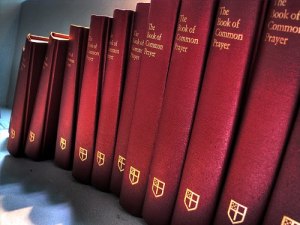
Last week I was officiating a committal service in our cemetery.  It had rained the day before, so not only was the ground very soggy, but also the dirt that I use to throw on the casket during the service was a bit wet too – despite the fact that we tried to keep it covered overnight.  What I did not realize was just how wet the dirt would be.  After I tossed the dirt, my hands we covered with crumbling mud.  Despite my efforts to rub the dirt off my hands, my Prayer Book pages got dirty and even the back of my Prayer Book had smudges on it.

As someone who loves books and likes to show my respect for books by caring for them gently, normally something like this would freak me out.  But my Prayer Book lives a very different life than my other books.  My Prayer Book has been sullied with dirt and sand from funerals and interments.  My Prayer Book has gotten damp from baptisms and the use of an aspergillum.  The pages in my Prayer Book that have the ordination liturgy have oil smears because the bishop anointed my hands so that I may anoint others.  No one could ever argue that my Prayer Book is pristine.

But that is exactly why I love my Prayer Book.  My sullied Prayer Book reminds me of the incarnate life we all live together.  Each dirt smear reminds me of a beloved parishioner, or a family who was completely unknown to me until they came to me for liturgical help.  Each hint of a drop of water reminds me of the babies and young adults I have baptized into the faith.  Those touches of oil remind me of the many times I have said healing prayers with others.  My Prayer Book caries in it the incarnate memories from this blessed vocation I am privileged to live.

As I think about next week – Holy Week in the Church – I am looking forward to more of those incarnate moments with others.  Palms that will be shoved into the back of my Prayer Book, Chrism that I will receive from the Diocese that may drip on those pages, water from the washing of feet that may splash into the book, and wax from the Vigil candles that may drip on a page of my beloved Prayer Book.  The liturgies of Holy Week not only encourage us to remember Jesus’ journey toward the cross and resurrection, but also the liturgies involve our senses, our bodies, and our messy incarnate ways.  I am looking forward to messy memories next week with St. Margaret’s!

Sermon – John 12.1-8, L5, YC, March 17, 2013

20 Wednesday Mar 2013

Posted by jandrewsweckerly in Uncategorized

≈ 2 Comments

Tags

community, death, faith journey, God, Holy Week, Jesus, Judas, Lazarus, Mary, poor, Sermon, tension

With Holy Week only a week away, today’s Gospel lesson throws us into preparation for that significant week.  Six days before the Passover – six days before Jesus will sit down with his disciples for their last meal together – Jesus sits down for another significant meal.  Jesus returns to Bethany, to the home of the family he loves – the home of Martha, Mary, and Lazarus.  The foreshadowing is all there.  Lazarus, and the lingering smell of his once-dead body, is at the table as a vivid reminder of the death that awaits Jesus.  The two of them sharing table fellowship together both brings to mind the resurrection of Lazarus, and foreshadows a more important resurrection that is soon to come.  Even Mary is preparing us and Jesus for his death, as she uses costly perfume, nard that she has saved for the day of Jesus’ burial, to anoint Jesus now.  Death is heavy in the room.  What sounds like a simple reunion of friends is actually the foretaste of what is to come in a mere week.

So in the midst of this sacred, significant moment, what does Judas do?  Judas totally misses what is happening in the moment.  On one level, Judas is right.  That bottle of nard – a whole pound of fragrance – would have cost about $20,000 in today’s terms[i].  Judas has spent years with Jesus hearing nothing but Jesus’ preference for the poor.  We cannot fault Judas for seeing the potential good that the same bottle could have done for the poor.  But like any good church member, Judas gets stuck in the ways he has learned.  Judas takes a really good practice – Jesus’ passion for the poor – and makes that practice rigid and lifeless.  This valued practice blinds him to the other realities that are unfolding right before him.

We behave like Judas all of the time.  We too have ideas about what we should do and how that should be done.  Our reasoning might be very informed and, under normal circumstances, deeply rooted in our faith and tradition.  But sometimes we too are off base.  We miss the big picture.  When I went on my mission trip to Honduras, we spent an entire winter and spring preparing for the trip.  One of the many books we read was a book by a woman named Elvia Alvarado.  Elvia was a poor Honduran woman who saw much strife in her country and who slowly became an organizer and advocate for change.  But along the way she tells of many atrocities that happened in Honduras to the poor.  As I read the book, I became more and more outraged and incensed about what was happening to the Honduran poor – so outraged that I wanted to go and do something, to make a difference for the people who could not speak for themselves.  But in her concluding remarks, Elvia says something quite shocking.  Elvia asks every gringo reader (gringos being white people from the United States) not to come to Honduras to solve their problems.  In fact she tells the gringos to stay where we are.  She says that this work is the Hondurans’ work to do.  But what she does charge the gringos with is working on our own stuff.  She asks us to look at the systems in our own country that encourage oppression – governmental trade policies, manufacturing and farming practices, and our own purchasing patterns.  Elvia’s words to me were like a slap in the face.  Elvia basically said to me, “Don’t bring your savior mentality down here and think that you will save us all.  Instead, stay at home and work on the ways that you and your country are a part of the problem.”

Elvia’s words to me and all of us are not unlike Jesus words to Judas that night.  What Elvia taught me is that we do not always have the whole picture.  We may have learned a lot, we may have spent a great deal of time studying our faith or developing our relationship with Christ, and we may feel like we have a pretty good idea about what God calls us to do and be.  But what we forget in our confidence is that God is always on the move, always breaking into the world in new ways, and always opening up new paths for us.  The moment that we think we have God figured out – and particularly the moment that we start telling others what they should and should not do – is the moment that Jesus slaps us in the face with another reality.

So if we are not to be imitating Judas in this story from scripture, what do we glean from Mary’s actions?  I once heard a story about an experience at a stewardship conference whose theme was generosity.  When one of the presenters spoke about offering a gift directly to God, the clergy began to yawn.  The presenter then pulled a $100 bill from his wallet, set it on fire in an ashtray, and prayed, “Lord, I offer this gift to you, and you alone.”  The reaction was electric.  Clergy began to fidget in their chairs, whispering about the legality of burning currency, and murmuring about how they would happily take any more money he felt like burning.  In that nervous room, the speaker asked, “Do you not understand?  I am offering it to God, and that means it is going to cease to be useful for the rest of us.”[ii]

In many ways, Mary “wastes” her perfume on Jesus much like this presenter wasted that $100.  But Jesus does not see Mary’s gift as wasteful.  He declares the gift to be appropriate in that moment, and is gracious enough to receive the gift with gratitude.  He understands that the extravagant gift is rooted in Mary’s confidence in the boundless capacity of God’s love.  “Mary pours out her whole bottle of perfume without regret because she knows it is only a trifle compared to the magnitude of God’s love that she sees in the Messiah before her.  Mary knows that Lazarus will die again, and she knows that Jesus will die, but she believes with even greater passion that Jesus can bring victory over death.”[iii]

This tense interaction between Jesus, Mary, and Judas invites us into another kind of tension.  The story invites us to live into the tension of what we know about God and what is still unfolding.  We need to learn the “rules” or the “law” of this crazy life of faith.  But we also need to learn the “way of being.”  We need to learn when to focus on the details and when to see the big picture.  We need to learn when the time has come to “waste” an extravagance on another.  When Jesus says, “You always have the poor with you,” Jesus is not giving us an out for caring for the poor.  Instead Jesus invites us into a “both-and” tension.  Yes, we are to care for the poor.  That is living into the law of our life together.  And, we also need to have the presence of mind to see when something so significant is happening, such as losing our Savior to the cross, that we pause our other work.  This is the way of being in our life together.

Ultimately, we need both Judas and Mary for our faith journey today.  We need that person in our community who will always remind us of the laws that we live by and who will always remind us of the ways things should be done.  But we also need that person in our community who is the crazy one who will open up for us the lavish ways of God and who will remind us to let go of the law enough to see God’s bigger picture.  Without each person in our community, including those individuals who have not yet come to St. Margaret’s, we only have a portion of the community we need to fully embody the community of faith.  Without the “both” and the “and” we are incomplete.  Sometimes that means we will not agree.  The “boths” and the “ands” of our community will experience a tension so strong that we may hear Jesus shouting, “Leave her alone.”  But both the “boths” and the “ands” need each other.  Jesus gives us all value today, but Jesus also requires us to value one another.  Amen.


[i] George W. Stroup, “Theological Perspective,” Feasting on the Word, Yr. C, Vol. 2 (Louisville: Westminster John Knox Press, 2009), 142.

[ii] William G. Carter, “Pastoral Perspective,” Feasting on the Word, Yr. C, Vol. 2 (Louisville: Westminster John Knox Press, 2009), 142.

[iii] Beth Sanders, “Heaven Scent,” Christian Century, vol. 124, no. 5, March 6, 2007, 19.

Newer posts →

Recent Posts

  • On the Myth and Magic of Advent…
  • On Risking Failure and Facing Fear…
  • Sermon – Luke 23.33-43, P29, YC, November 23, 2025
  • On Inhabiting Gratitude…
  • Sermon – Luke 20.27-38, P27, YC, November 9, 2025

Archives

  • December 2025
  • November 2025
  • October 2025
  • September 2025
  • August 2025
  • July 2025
  • June 2025
  • March 2025
  • February 2025
  • December 2024
  • November 2024
  • October 2024
  • September 2024
  • August 2024
  • July 2024
  • June 2024
  • May 2024
  • March 2024
  • February 2024
  • January 2024
  • December 2023
  • November 2023
  • October 2023
  • September 2023
  • August 2023
  • July 2023
  • June 2023
  • May 2023
  • March 2023
  • February 2023
  • January 2023
  • December 2022
  • November 2022
  • October 2022
  • June 2022
  • May 2022
  • January 2022
  • December 2021
  • November 2021
  • October 2021
  • September 2021
  • August 2021
  • June 2021
  • May 2021
  • April 2021
  • March 2021
  • February 2021
  • January 2021
  • December 2020
  • November 2020
  • October 2020
  • September 2020
  • August 2020
  • July 2020
  • June 2020
  • May 2020
  • April 2020
  • March 2020
  • February 2020
  • January 2020
  • December 2019
  • November 2019
  • October 2019
  • September 2019
  • August 2019
  • July 2019
  • June 2019
  • May 2019
  • April 2019
  • March 2019
  • February 2019
  • January 2019
  • December 2018
  • November 2018
  • October 2018
  • September 2018
  • August 2018
  • July 2018
  • June 2018
  • May 2018
  • April 2018
  • March 2018
  • February 2018
  • January 2018
  • December 2017
  • November 2017
  • October 2017
  • September 2017
  • August 2017
  • July 2017
  • June 2017
  • May 2017
  • April 2017
  • March 2017
  • February 2017
  • January 2017
  • December 2016
  • November 2016
  • October 2016
  • September 2016
  • August 2016
  • July 2016
  • June 2016
  • May 2016
  • April 2016
  • March 2016
  • February 2016
  • January 2016
  • December 2015
  • November 2015
  • October 2015
  • September 2015
  • August 2015
  • July 2015
  • June 2015
  • May 2015
  • April 2015
  • March 2015
  • February 2015
  • January 2015
  • December 2014
  • November 2014
  • October 2014
  • September 2014
  • August 2014
  • July 2014
  • June 2014
  • April 2014
  • March 2014
  • February 2014
  • January 2014
  • December 2013
  • November 2013
  • October 2013
  • September 2013
  • August 2013
  • July 2013
  • June 2013
  • May 2013
  • April 2013
  • March 2013
  • February 2013
  • January 2013
  • December 2012
  • November 2012
  • October 2012
  • September 2012

Categories

  • reflection
  • Sermons
  • Uncategorized

Meta

  • Create account
  • Log in
  • Entries feed
  • Comments feed
  • WordPress.com

Blog at WordPress.com.

  • Subscribe Subscribed
    • Seeking and Serving
    • Join 394 other subscribers
    • Already have a WordPress.com account? Log in now.
    • Seeking and Serving
    • Subscribe Subscribed
    • Sign up
    • Log in
    • Report this content
    • View site in Reader
    • Manage subscriptions
    • Collapse this bar
 

Loading Comments...