
• About

Seeking and Serving

~ seek and serve Christ in all persons

Seeking and Serving

Tag Archives: how

Sermon – Jeremiah 36.27-37.2, VTS Convocation Evensong, October 11, 2022

19 Wednesday Oct 2022

Posted by jandrewsweckerly in Sermons

≈ Leave a comment

Tags

church, God, how, Jeremiah, kingdom of God, love, normalcy, pandemic, poll, prophet, repeat, repent, rest, salvation narrative, Sermon, values, why

This sermon was delivered to Virginia Theological Seminary on the occasion of our annual Convocation for alumni, faculty and staff, and seminarians.
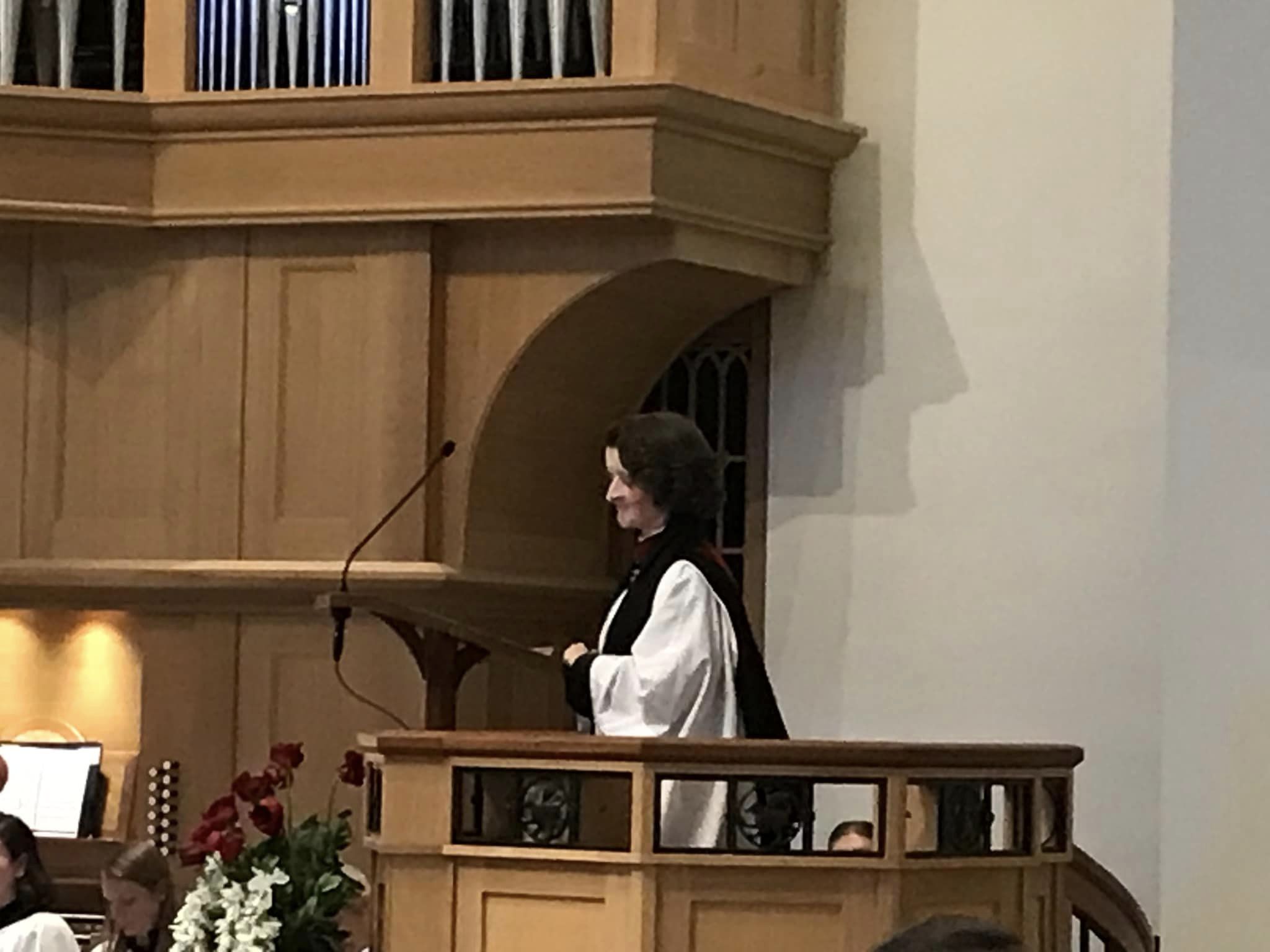
Photo credit: The Rev. Matthew Tucker

I live in a pretty “purple” district in Southern Virginia.  My Congressman represents a different party than my own, but I make a point to stay on his mailing list as a way to remind him that he represents a politically diverse district.  Every month he sends out polls, and I dutifully respond to them.  But with every survey I find myself frustrated.  My Congressman either has never taken a class in crafting an unbiased survey or he is simply not interested in different opinions.  The questions are always phrased something like, “In your opinion, how bad of a job is our president doing:  terrible, really bad, pretty bad, or I’m not sure.”  Or without any nuance or explanation about the background of the issue, the poll will ask something like, “The Congress wants to pay illegal immigrants who knowingly broke the law hundreds of thousands of dollars.  Should we pay these illegal immigrant criminals, yes or no?”  Or, one of my favorites, “Which of these issues should be the priority of Congress?” (PS, none of the options listed talk about caring for the poor or our neighbor, and there definitely isn’t an “other” category).  But I dutifully take the surveys, hoping my voice is part of my representative’s decision making.

I have been pondering the ministry of Jeremiah and thinking his prophetic ministry is a bit like trying to engage my Congressman.  For those of us not taking Old Testament this semester, Jeremiah is prophesying in a time of political decline.  The northern kingdom, Israel fell to Assyria nearly a hundred years before, and Judah remains in a tenuous situation.  The Assyrians are still in control, but in the course of the book of Jeremiah, Babylon defeats Assyria and takes control of Judah.  There are rebellions against Babylon, in particular by King Jehoiakim who we hear about today, but they are eventually unsuccessful.[i]  Like any good prophet, Jeremiah is attempting to get the people and king to repent and return to the Lord.  And like all people of all time, the people refuse to listen to God.  King Jehoiakim is particularly egregious in this refusal.  In fact, just verses before our reading, the King has his attendant read Jeremiah’s prophetic scroll three or four columns at a time, then cuts those columns off the scroll and throws them in a fire.  King Jehoiakim is not alarmed by the prophecy, and certainly not repentant. 

But here’s the funny part.  In the verses we read today, the Lord tells Jeremiah to rewrite the entire scroll and add in a little final judgment.  Like me, sitting down with yet another poll from my Congressman, he sits down and does the same thing over again.  I have been of two minds about this passage.  On the one hand, and no offense toward the Lord’s prophetic practices and policies, but how many times are we to keep doing the same thing and expecting different results.  As if King Jehoiakim is going to receive the second scroll and say, “Oh, a second scroll?  Okay, I guess I won’t burn this one and will change my ways!”  If this pandemic has taught us anything this pandemic has taught us we cannot keep doing Church the way we always have and expect the Church to thrive (or in biblical terms, to repent and return to the Lord).  This pandemic has made us nimble, agile, creative, and versatile.  This pandemic made us stop thinking about hybrid ministries and digital relevance and demanded we start doing and being those things.  And God help us if our churches just want to “return to normal” after the pandemic – if we just want to write another scroll. 

But as I mentioned, I am of two minds on this passage.  On the other hand, despite what seems like poor strategy on the Lord’s part, God’s covenantal relationship with us has never really made sense.  The entire salvation narrative is about failure after failure on our part as the people of God to listen and respond to the Lord.  Promise after promise, covenant after covenant, even the sending of God’s Son has meant the Lord’s corporate strategy is a case study in what not to do to thrive in business.  But that’s what we love about the Lord, right?  God keeps writing another scroll, God keeps giving another chance, God keeps holding out hope and promise because God’s love is not meted out in a logical, economical way.  Despite all of the innovation which has been entirely life giving during this pandemic, in some ways, what we have offered to a hurting world is the same as what we have always offered:  a community of faith, redeemed by God’s grace, commissioned to love God, self, and neighbor.  Perhaps that is why I am of two minds about this text.  Although this pandemic has not changed who we are and what we offer a broken world, this pandemic has changed how we are.  Our core values as the Episcopal Church have not changed.  But throughout this pandemic we have learned that how we go about living into those core values certainly can, should, and hopefully has changed.  And, as the Genesis writer would say, “…it was very good.”

In this particular season of the Church, many of us are feeling a longing for rest, for relief from constant pivoting, for a sense of normalcy.  Many of us would like to sit down and just write the same scroll over again.  In Jeremiah’s day that second scroll meant suffering and exile, and there would be more than twenty years before the people of God would see God’s promise of restoration realized.[ii]  But I do not think that is the invitation from scripture today.  I do not think the Lord is inviting the Church to write another scroll or fill out another poll.  We have a whole Bible full of examples of how doing the same thing over and over does not lead to the fulfillment of the kingdom of God.  Instead, the invitation from scripture today is to see the patterns of the resistance to love, and find a new way to love.  God is not inviting us to change our “who” or our “what,” but to change our “how.”  Your “how” might be different from mine.  But Jeremiah shows us time and again that the same repeated “how” does not turn hearts.  Our work in this season is to listen to what new “hows” the Holy Spirit is showing us, and then be willing to be vulnerable enough to try them.  Because, Lord knows, we do not need another scroll.  Amen. 


[i] Josey Bridges Synder, “Jeremiah,” The CEB Women’s Bible, (Nashville:  Common English Bible, 2016), 953.

[ii] 953.

Sermon – Lk 11.1-13, P12, YC, July 24, 2010

05 Wednesday Oct 2022

Posted by jandrewsweckerly in Sermons

≈ Leave a comment

Tags

abundance, accountability, disciples, God, how, Jesus, Lord's Prayer, mutual, pray, Sermon, vulnerable

The single most common topic I have been asked about in the course of my ministry, year in and year out, through crisis, through joys, through transitions, and change, young and old have approached me asking for one thing:  teach me how to pray.  The request is simple, yet complicated all at the same time.  You see, when someone asks me how they can pray a reel begins in my mind, flashing all the experiences of prayer I have seen in my lifetime:  the healing prayers that splayed someone to the ground in the Pentecostal church of my early childhood; the United Methodist prayers spoken extemporaneously from the heart; the hippy campus minister who always started prayer with silence so long you wondered if he had fallen asleep; the prayers written to accompany the prayer beads my fingers strung together; the stiff Episcopal collects that seem at the same time formulaic and beautiful; saying the Lord’s Prayer in Spanish, trying to keep up with the native speakers; silent prayers in the middle of the night as I seethed in my anger at God, with no words left; praying into a telephone that doubled as a speaker in the retirement home’s dining room; resorting to digital Pop-Up Prayers when a pandemic forced us into isolation.  When asked, “teach me to pray,” where can I possibly begin?!?

When the disciples ask Jesus to teach them how to pray, Jesus’ mind seems to be all over the place too.  Jesus begins his lesson with the actual text of the Lord’s Prayer.  Jesus says, “When you pray, say this…”  But Jesus does not stop his lesson there.  Jesus goes on to teach the disciples through three small vignettes. 

In the first vignette, the disciples hear about the man who refuses his friend bread in the middle of the night because he has already gone to bed.  The disciples learn through this funny battle of wills that their posture in prayer is to be persistently inquiring.  In fact, the word used in our translation today for “persistent” is also translated by some scholars as “shamelessness.” [i]  In the second vignette, the disciples are told in the instruction to ask, seek, and knock that God responds to their inquiries.  They learn here that their posture in prayer is a posture of action.  Prayer is to express their need to God, to search out God when they feel abandoned, and to cry out to God with a loud knock.  The final vignette compares the care of a parent with the care of God for the disciples.  The disciples learn that God’s love for them is greater than the instinctual, caring love of a parent for a child.  The disciples experience that abundance when they enter into a prayerful relationship with God. 

A vulnerable, active, abundant relationship with God sounds wonderful and easy enough.  The problem is the relationship Jesus describes is not easy.  We find it difficult to be continuously vulnerable, active, and overwhelmed by God in prayer.  In fact, we find simply remaining in prayer with God difficult.  When I was in seminary, I had a group of lay persons from my field education parish who met with me once a month to help me reflect on my ministry at the church.  One of my committee members, Joe, was notorious for keeping me on the spot in these meetings.  “So, Jennifer, how is your prayer life?” Joe would always ask me.  The first time he asked me that question, I stammered through some sort of reply about corporate and individual prayer.  But Joe wanted to know the specifics of what my prayer life entailed.  Joe’s monthly prodding was the first real experience I had with accountability in my prayer life.  Finally, after about a year of asking me about my prayer life, I asked Joe about his prayer life.  Joe explained that the reason he always asked me about my prayer life was because he struggled with his own prayer life.  His pushing me was a way of also pushing himself.  He knew that if I struggled to keep an engaged prayer life, he could gain some camaraderie in his own struggle; and if I was feeling particularly connected to God in prayer, he would be challenged to engage God with more intentionality.

The mutual support that Joe was unknowingly creating is the promise of our Gospel lesson today.  First Jesus gives the disciples words:  the Lord’s Prayer.  Once they own those words, they have an assuring entry into dialogue with God.  And once the disciples have that entry, they are assured of God’s presence in the prayer relationship.  God is the faithful friend, who gets up in the middle of the night to answer prayer.  God is the responding God who will answer, be present, and open doors through the prayer relationship.  God is the parent that our parents can never fully be because God’s love is more abundant than the disciples, as humans, can ever be.  Jesus does not promise that God will respond to the disciples’ prayers in a particular or specific way.  The disciples are not promised riches or earthly gain through a life in prayer.  But Jesus does promise that God will respond, will stay present with the disciples, and will love the disciples abundantly. 

Despite all the modes of prayer I have witnessed over time, perhaps the best advice is to start where Jesus does with the words of the Lord’s Prayer.  Jesus affirms for us today that if all you can pray is the Lord’s Prayer, then pray the Lord’s Prayer.  The vehicle of the Lord’s Prayer has the power to take us to that point of vulnerability with God.  The vehicle of the Lord’s Prayer has the power to push us to action, seeking God by asking for those basic needs, knowing that God provides beyond those needs.  The vehicle of the Lord’s Prayer has the power to remind us of the abundance we already experience – of daily food, of forgiveness of sins, of salvation.  Jesus’ words for you today are words of encouragement.  Your relationship through prayer with God is going to require you to be vulnerable and to engage, but your relationship through prayer with God will be marked with abundance.  And if you feel overwhelmed by that promise, then start today with these words, “Our Father, hallowed be your name…”  Amen.


[i] James A. Wallace, “Homiletical Perspective,” Feasting on the Word, Yr C, Vol. 3 (Louisville: Westminster John Knox Press, 2010), 291.

Recent Posts

  • On Sharing the Love…
  • Sermon – Micah 6.1-8, Matthew 5.1-12, EP4, YA, January 30, 2026
  • On Justice, Kindness, Humility, and the Messy Middle…
  • Feast of the Rev. Dr. Martin Luther King, Jr., January 18, 2026
  • On Peace, Love, and Conduits…

Archives

  • February 2026
  • January 2026
  • December 2025
  • November 2025
  • October 2025
  • September 2025
  • August 2025
  • July 2025
  • June 2025
  • March 2025
  • February 2025
  • December 2024
  • November 2024
  • October 2024
  • September 2024
  • August 2024
  • July 2024
  • June 2024
  • May 2024
  • March 2024
  • February 2024
  • January 2024
  • December 2023
  • November 2023
  • October 2023
  • September 2023
  • August 2023
  • July 2023
  • June 2023
  • May 2023
  • March 2023
  • February 2023
  • January 2023
  • December 2022
  • November 2022
  • October 2022
  • June 2022
  • May 2022
  • January 2022
  • December 2021
  • November 2021
  • October 2021
  • September 2021
  • August 2021
  • June 2021
  • May 2021
  • April 2021
  • March 2021
  • February 2021
  • January 2021
  • December 2020
  • November 2020
  • October 2020
  • September 2020
  • August 2020
  • July 2020
  • June 2020
  • May 2020
  • April 2020
  • March 2020
  • February 2020
  • January 2020
  • December 2019
  • November 2019
  • October 2019
  • September 2019
  • August 2019
  • July 2019
  • June 2019
  • May 2019
  • April 2019
  • March 2019
  • February 2019
  • January 2019
  • December 2018
  • November 2018
  • October 2018
  • September 2018
  • August 2018
  • July 2018
  • June 2018
  • May 2018
  • April 2018
  • March 2018
  • February 2018
  • January 2018
  • December 2017
  • November 2017
  • October 2017
  • September 2017
  • August 2017
  • July 2017
  • June 2017
  • May 2017
  • April 2017
  • March 2017
  • February 2017
  • January 2017
  • December 2016
  • November 2016
  • October 2016
  • September 2016
  • August 2016
  • July 2016
  • June 2016
  • May 2016
  • April 2016
  • March 2016
  • February 2016
  • January 2016
  • December 2015
  • November 2015
  • October 2015
  • September 2015
  • August 2015
  • July 2015
  • June 2015
  • May 2015
  • April 2015
  • March 2015
  • February 2015
  • January 2015
  • December 2014
  • November 2014
  • October 2014
  • September 2014
  • August 2014
  • July 2014
  • June 2014
  • April 2014
  • March 2014
  • February 2014
  • January 2014
  • December 2013
  • November 2013
  • October 2013
  • September 2013
  • August 2013
  • July 2013
  • June 2013
  • May 2013
  • April 2013
  • March 2013
  • February 2013
  • January 2013
  • December 2012
  • November 2012
  • October 2012
  • September 2012

Categories

  • reflection
  • Sermons
  • Uncategorized

Meta

  • Create account
  • Log in
  • Entries feed
  • Comments feed
  • WordPress.com

Blog at WordPress.com.

  • Subscribe Subscribed
    • Seeking and Serving
    • Join 395 other subscribers
    • Already have a WordPress.com account? Log in now.
    • Seeking and Serving
    • Subscribe Subscribed
    • Sign up
    • Log in
    • Report this content
    • View site in Reader
    • Manage subscriptions
    • Collapse this bar
 

Loading Comments...