
Tags
disciples, footwashing, humbling, Jesus, love, Maundy Thursday, messy, Sermon, vulnerable, wash

In my first year of seminary, we traveled to Burma for an Anglican Communion learning trip. For a portion of the trip, we led an educational component for the theological students, which closed with a foot washing experience. In my mind, the foot washing experience was so authentic: those with empirically more power serving those with less; the leaders becoming servants; and certainly, the tangible re-creation of Jesus’ experience, since in Burma everyone wears those plastic flip flops, so their feet really are dusty in the ways that I imagine those disciples’ feet were. The seven us of seminarians were feeling pretty good about ourselves – we were embodying the kind of love Jesus always talks about.
But then something unexpected happened. When we finished the last student, several students grabbed the arms of each us, and almost forcefully put us in the very chairs where we had been washing their feet – all with very little English to navigate the turning of the tables. The role reversal felt all wrong – we were the ones who should be washing them, not them washing us. Suddenly we were asked to be vulnerably touched, to humbly receive, and to ultimately right the balance of power between us. The unplanned reversal left us shaken and uncomfortable, and a whole less sure of ourselves.
As I have been thinking about this Maundy Thursday service this week, that’s kind of what this service is: messy. Jesus, the one with power, lowers himself to the floor and washes the disciples’ feet – something not even servants would normally do, as they would simply provide the water for you to do the work yourself. There are a few occasions where women might do this work, but certainly Jesus shouldn’t be stooping to women’s work.[i] There is all kinds of messiness about the appropriateness of Jesus’ humble act that makes the disciples feel quite vulnerable. But then there is the fact not only does Jesus do this humble, vulnerable act on his hands and knees, but also he does this for everyone, including Judas – his soon-to-be betrayer – and Peter – his soon-to-be denier. Jesus washes the feet of the faithful follower and stumbling follower alike. On the one hand, we can conceptualize how to humbly serve others – I imagine it gives us great satisfaction like we seminarians had in Burma. But humbly serving those who literally betray you and shun you – that’s something else altogether. All we have to do is imagine the politician who makes us the most angry, indignant, and rightly willing to protest. And then imagine kneeling down and washing his or her feet – humbling yourself before them, willing yourself to tenderly touch the very human skin of your so-called enemy.
And so, by the end of this passage – where Jesus has argued his way through this lesson of foot washing, and as the verses that were edited out of our passage tonight would have told us, Judas leaves to betray Jesus, we are told a major kernel of truth – a command that this whole night is named for (Maundy literally means in Latin “command” or “mandate.”[ii]). Jesus says, “I give you a new commandment, that you love one another. Just as I have loved you, you also should love one another. By this everyone will know that you are my disciples, if you have love for one another.” Now we all LOVE to talk about this new commandment – we love to talk about love. But those six words are the scary part of this commandment: Just as I have loved you. So that person who betrays us, denies us, works against goodness, who hurts us, who angers us – we are to love them just as much as the people we actually like. Jesus is asking a lot tonight, folks.
And so, in this service, in just a few minutes, we are going to do some messy things. We are going to literally wash each other’s feet. No matter how embarrassed we are by our imperfect feet, no matter how little we like being the recipient of care, no matter how much we might like the people in this room but we are not prepared to be really vulnerable with them – we will have the opportunity to both serve and be served tonight. Then we will gather around the altar rail – with people we like and maybe people who frustrate us, with people who agree with our political opinions and people who really do not, with people we may not even really know all that well – and we will receive the blessed sacrament, elbow to elbow with everyone. And then finally, we will watch as everything is taken away – the dishes from our feast, the adornments we love, the familiar things of comfort, even the light itself. And the priest will scrub down the altar, with a sound that sounds like the scrubbing away of everything familiar and comforting.
We do all these messy things because what Jesus asks of us is nothing short of messy. “Just as I have loved you, you also should love one another.” That is what we leave here tonight – on this Commandment Thursday – to go out in the world to do. To love – to messily, vulnerably, frustratingly, painfully do. To love – just as Jesus has messily, vulnerably, frustratingly, painfully loved us. That command is what we hold on tomorrow as we allow Jesus to walk to the cross. That command is what we hold on to through Saturday as he sits in tomb. That command is what we hold onto when we mourn the entirety of his life – “the whole witness of the Word made flesh.”[iii] That command is what we hold onto even when we joyously and fearfully celebrate what happens on Easter. But that command is especially what we hold on to in the days and weeks to come – in this year of 2024 as we try to love – just as Jesus has loved us. Jesus knows loving will be messy. But Jesus gives us the messy gifts tonight to help us love anyway. Amen.
[i] Mary Lousie Bringle, “Homiletical Perspective,” Feasting on the Word, Year B, Vol. 2 (Louisville: Westminster John Knox Press, 2008), 279.
[ii] James E. Lamkin, “Pastoral Perspective,” Feasting on the Word, Year B, Vol. 2 (Louisville: Westminster John Knox Press, 2008), 280.
[iii] Karoline M. Lewis, John: Fortress Biblical Preaching Commentaries (Minneapolis: Fortress Press, 2014), 179.
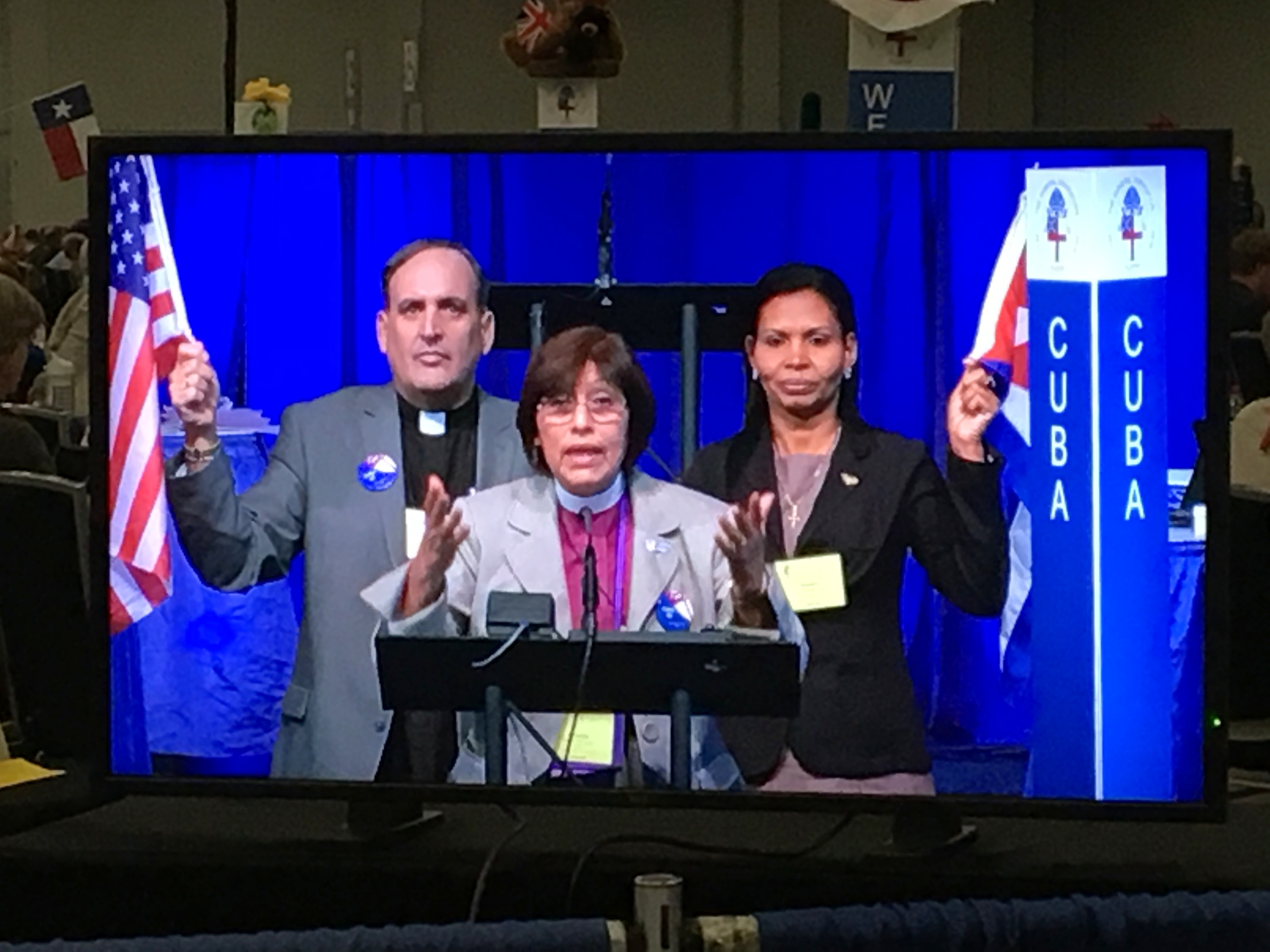 In 1966, in light of the Cuban Revolution and the political response of the United States, the House of Bishops voted to separate from the Diocese of Cuba from the Episcopal Church, leaving it an autonomous diocese without a provincial home. The clergy scattered, some returning or immigrating to the US, but some who remained in Cuba were imprisoned, executed, or disappeared; priests lost their pensions, and they operated in isolation from the Church. Cuba officially requested to be reaffiliated with the Episcopal Church and was given a list of requirements before admission. As of GC79, all of those conditions had been met. However, leading up to the resolution coming to the floor of both the Deputies and Bishops, there was controversy on what it would mean, how this admission might impact the admission of other Dioceses (or their exit), how to affirm already elected bishops (assuming they had not followed the current practices of approval for bishops in the Episcopal Church), among other concerns. In other words, there was a desire to right the wrong done 52 years ago, but some anxiety about the implications of the decision.
 Seeking and Serving