• About

Seeking and Serving

~ seek and serve Christ in all persons

Seeking and Serving

Tag Archives: impact

On the Risk of Anticipation…

12 Wednesday Mar 2025

Posted by jandrewsweckerly in reflection

≈ Leave a comment

Tags

anticipate, anticipation, control, dance, God, good, Holy Spirit, impact, Lent, movement, planner, spiritual

Photo Credit: https://www.pinterest.com/pin/tango–761882461966749050/

So, what does a Dancing with the Williamsburg Stars competitor do after the competition?  Well, in my case, you get back in the studio!  Before the competition even began, I already knew I wanted to keep dancing.  I was having such a great time stretching my mind and body learning new things that I knew it was a good physical, and spiritual, discipline I wanted to maintain. 

Now, you may be wondering how in the world ballroom dancing can be categorized as a spiritual discipline.  The truth is, I encounter the sacred in ballroom dance all the time.  I talked about it once before HERE.  This week, as I started my first post-competition class, we went back to basics, learning the rumba and cha-cha.  There’s a certain humbling that comes with learning a new dance that I had forgotten from when I started months ago.  As we progressed through the class, I felt like I was slowly getting the hang of the technicalities – that is, until we started turns.  At one point, my instructor said, “Stop anticipating!”  He reminded me that he would show me where to go, but if I anticipated what he was going to do next, I would mess up our unique dance.

Those two words have been rattling around in my head.  Stop anticipating.  You see, I am a planner by nature.  Anticipation is my jam.  I am constantly thinking ahead, wondering about decision trees and the potential impact of each branch.  I like thinking about the larger system and strategically guiding my parish in our next steps.  So, the idea of stopping anticipation seems anathema. 

But the more I thought about it, every good thing that has come about in my ministry was nothing I actually anticipated.  In my current parish, I might have conducted a needs assessment with the community, listened to my parish’s desires, and researched a particular new ministry.  But what I didn’t anticipate was an outside group needing space to do the exact ministry we were contemplating.  I might have envied other parishes with digital ministries, but what I never anticipated was a worldwide pandemic that would launch my church’s own digital ministry.  I might be dreaming with my parish about alternative revenue streams and the repurposing of our spaces, but what I didn’t anticipate was three conversations that fell into my lap in the course of three weeks about potential partnerships.  When I finished the planning and stop anticipating, God happened each time.

I wonder in what ways your anticipation is blocking the movement of the Holy Spirit.  In what ways are you anticipating a left-hand turn, only to discover, God is over the to right, ready for you, if you can just stop anticipating?  For those of you who are lifetime planners, I know this is hard spiritual work.  Perhaps this Lent, you can join me in my prayer, “Lord, help me stop anticipating.” 

On Looking Back to Look Forward…

20 Friday Oct 2023

Posted by jandrewsweckerly in reflection

≈ Leave a comment

Tags

church, Episcopal Church, formation, God, gospel, history, impact, seminary, stewardship

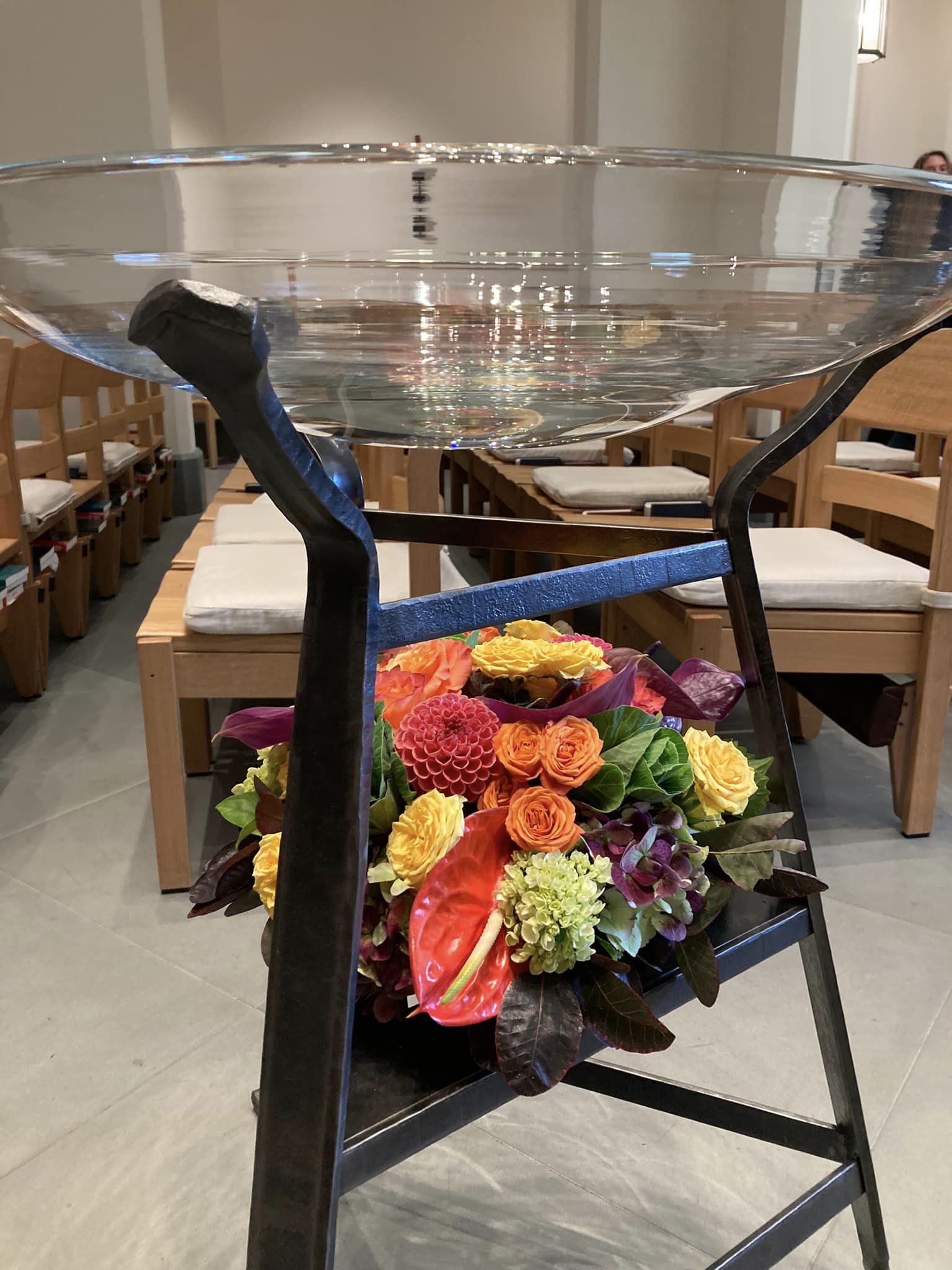
Font at Virginia Theological Seminary

I remember when I was a seminarian, sitting in daily worship, my eyes and mind would sometimes wander.  In particular, I was fascinated by the names or other small mementos carved into the old pews.  I always wondered who the mystery person was who left their mark, how long ago they carved it, and how they managed not to get caught.  What I loved about those small little marks was how they made me feel connected – connected to a long line of priests and lay leaders shaped by the seminary, all with varying gifts and talents, serving God in God’s church around the world.

Last week, my seminary honored 200 years of forming priests in the Episcopal Church.  Though those pews from the old chapel were lost in a fire, what struck me was the massive changes the seminary has seen.  From slaves who helped build and then worked on the property, wars that shaped the context for ministry dramatically for generations, fiduciary decisions that impacted the viability and structure of the seminary, the growing diversity of the student body as the Episcopal Church’s understanding of who can be called to ministry has expanded, and an evolving physical plant that has shifted what the school on the holy hill looks like – all of that change has made for a rich and layered history, of which I am a small part. 

But perhaps what speaks to me most about Virginia Theological Seminary is the ways that it also has a microcosmic impact on the church – namely, the ministry of every graduate from the seminary.  My time at VTS shaped and formed me into the priest I am today – from academic formation to liturgical formation, from learnings on leadership to the development of relationships, from shaping my spirituality to shaping my sense of the wider church.  And for every graduate like me, VTS has shaped thousands of others who go out into the world to preach the gospel.  That reality is what inspires my financial support every year – knowing the future generations I can support.

As my church journeys into stewardship season, a time of discernment about how we will support our church financially and with our time, I am reminded of how we all come to think about the stewardship of our resources.  Supporting my seminary and my church financially are ways I say to those institutions and my community that these institutions are important to me:  they have made an impact in my life, and have inspired me to make an impact on the them.  I would not be the priest, mother, or wife that I am without either my seminary or Hickory Neck Church.  What about you?  How has our church shaped your life?  What stories are the stories that make you eager to be a part of financially supporting ministries of impact?  I can’t wait to hear what inspires your giving!

Sermon – Matthew 11.25-30, Feast of St. Francis, October 1, 2023

04 Wednesday Oct 2023

Posted by jandrewsweckerly in Sermons

≈ Leave a comment

Tags

blessing of animals, burden, creation, disciples, discipleship, easy, impact, Jesus, light, pets, Sermon, serve, St. Francis, yoke

“Come to me, all you that are weary and are carrying heavy burdens, and I will give you rest.”  Whether you are wearied from wrestling your pets this morning (or your kids!), weary from full fall schedules, or weary from illness, anxiety, or bad news, Jesus’ words are words of comfort today.  They remind us of our time of renewal in sabbatical, and we want to cozy into the Gospel words today.

But today is not about Jesus blessing times of rest.  Jesus is actually commissioning disciples.  At this point in Matthew’s gospel, Jesus has been describing the way of discipleship:  serving the poor, working for justice, striving for peace.  Jesus tells them the work will be hard and will make the disciples weary.  To those disciples, Jesus offers a way to reach comfort.  Jesus says, “Take my yoke upon you, and learn from me; for I am gentle and humble in heart, and you will find rest for your souls.  For my yoke is easy, and my burden is light.”

Now, I do not know how much you know about yokes, but I have been studying up on yokes this past week.  There are actually two kinds of yokes.  Some yokes are meant for one person.  Imagine, if you will, a person hauling water from a well in village, the yoke over her shoulders, while two buckets full of water hang below.  The yoke distributes the weight of the water, but the yoke is not exactly an easy yoke.  The other kind of yoke is meant for two animals – like two oxen working together.  If one ox gets tired, the other pushes a little harder; later the roles may reverse.  A good yoke balances the work between the animals, without chafing or rubbing.  The work is genuinely easier and lighter.

This second kind of yoke is the metaphor Jesus uses to depict discipleship.[i]  Jesus tells them the work of discipleship will be hard and wearisome.  But when yoked to Jesus, the work will feel light.  So often, when we think of disciples as easing suffering, fighting for the poor, struggling for justice, we think we need to solve the worlds’ problems on our own – that we must use our own gifts to make a difference.  We go unyoked, and we feel overwhelmed and disheartened.[ii]  Even when try to do good work:  building beds for kids in need, buying extra food for food collection Sunday, or donating money to events like our Murder Mystery – we can still become discouraged.  When we think we can go at it alone (or maybe even better than others), we do not get relief in Jesus’ yoke. 

St. Francis, who we honor today, knew all about the yoke of Jesus.  Francis came from a wealthy family, had a rambunctious youth, and enjoyed status and privilege.  But one day he encountered some beggars and lepers and everything changed.  Francis renounced his privilege and wealth, took on poverty, and honored the sick, poor, and disenfranchised.  What Francis discovered was his wealthy had become its own burden of sorts.  Once he yoked himself to Jesus, everything changed.  He began to see Jesus in everyone, even birds to which he preached and the animals for whom he advocated.  Francis yoked himself to Jesus and became a faithful steward of God’s creation – so faithful that we bless animals and rejoice in creation ourselves through music and scripture today.

Now, I know you maybe came today to bless your pet, or maybe to remember a beloved pet who showed you what unconditional love really is.  And while that will bring us comfort today, and we do so with love and laughter, we also do something much bigger.  Today we remember all the instances where we have felt love – in animals, in each other, even in Jesus – and we take that love not only as a comfort, but also as a commission.  Today Jesus invites us outside of ourselves – our worries, our woes, our weariness, and put our attention on those who may need love even more than we do. 

Do not get confused.  I am not asking you to add weight to that single yoke, asking you to add more water to your heavy buckets.  I am inviting you to take off the single yoke and step in a double yoke – to yoke yourself to Jesus, yoke yourself to other disciples in this room.  Take on that yoke of Christ because the yoke is easy and light – and will actually free up your burden.  Jesus will give you the comfort, encouragement, and strength you need.  And you will be enabled to stride forward making an impact right here in James City County.  We will do that work together, because the yoke is easy and the burden is light.  Amen.


[i][i] Douglas R. A. Hare, Matthew:  A Bible Commentary for Teaching and Preaching (Louisville:  John Knox Press, 1993), 129.

[ii] Barbara Brown Taylor, The Seeds of Heaven:  Sermons on the Gospel of Matthew (Louisville:  Westminster John Knox Press, 2004), 21.

Sermon – Exodus 1.8-2.10, P16, YA, August 24, 2014

27 Wednesday Aug 2014

Posted by jandrewsweckerly in Uncategorized

≈ Leave a comment

Tags

change, choice, difference, Exodus, genocide, God, impact, midwives, other, Pharaoh, Puah, racism, Sermon, Shiphrah

We know exactly where our story is going today in Exodus when the introduction says, “Now a new king arose over Egypt, who did not know Joseph.”  This introduction is ominous because to not know Joseph is to not know how Joseph saved Egypt from famine, making Egypt a world leader in a time of crisis.  But on a more personal note, to not know Joseph means that the warm welcome the Israelites once received in gratitude for Joseph’s service has also been forgotten.  This is how Pharaoh’s reign of terror begins.  Not knowing the formerly friendly arrangement between these two very distinct groups, Pharaoh chooses prejudice and fear.  Afraid that this foreign group will pose a threat, Pharaoh strikes preemptively.  First, he enslaves the Israelites, forcing them into labor for Egypt.  But that kind of subjugation is not enough to assuage Pharaoh’s paranoia.  So Pharaoh starts another campaign – he enlists midwives to kill any male newborns, in the hopes of reducing the number of men who can revolt against his new stratified system.  And when that campaign does not work, Pharaoh extends his reach and calls upon all the Egyptians, instructing them to kill all Hebrew newborn boys that they encounter.

This story is scary because the story is a bit too familiar.  Just in the past several months we have witnessed similar violence and oppression of “the other.”  The advance of ISIS in Iraq is so extreme that their violence is being labeled as genocide.  Whole communities of faith, both Christian and other faiths, are either being displaced, murdered, or sold into slavery.  And though the players and terrain may be foreign to us, genocide is not.  Whether through Pharaoh thousands of years ago, in the Holocaust seventy years ago, or in Rwanda twenty years ago, we know the devastation, trauma, and scars that genocide leaves.  Each time we pray, “Never again,” and yet, here we find ourselves again in Iraq.

A more complicated version of oppression can be found much closer to home – in Ferguson, Missouri, in Staten Island, and yes, even in Plainview.  Though the recent cases are about the racial tensions between police officers and African-Americans, the truth is that racism is a reality throughout our country and involves a system of oppression that benefits some over others.  I remember when I first met my husband, Scott, we had a conversation about racism.  As young seventeen-year olds, we came from very different backgrounds.  He was a conservative Republican (though I think he was a Republican mostly in defiance of the long history of liberal democrats in his family – but that is another story).  He grew up in San Diego:  a military town across the border from Mexico.  His peers were people of every race, nationality, and geography, and what he saw was a mixture of people who seemed to function without much prejudice.  I, on the other hand, was an idealistic Democrat, who saw a very different world in rural Georgia and North Carolina.  I was a part of an organization as a young woman who did not welcome people of color – a fact I did not realize until I wanted to invite my African-American girlfriend to join.  At my high school, there were threats of the KKK coming by to intimidate the few African-Americans at our school.  So when Scott and I first began to talk about racism, you can imagine that we had very different opinions about the role that race places in our country.

The scary part for me in our news lately is that genocide and racism are two different expressions of the same problem.  Both stem from the recognition of difference – of there being one group of privilege and one group of disenfranchisement – or “the other.”  Once an “other” has been established, judgments of value are next.  Through those judgments of values emerges prejudice – and in the instance of race, racism.  When taken to the extreme, that prejudice can lead to genocide – a complete annihilation of “the other.”  So genocide and racism are just markers on a spectrum of reactions to difference.

Now many of you may be thinking, “Okay, so we cannot help but notice differences among us.  And if we notice differences, and the next natural step is a judgment of value, then what are we supposed to do?  How are we supposed to change our natural judgments?  Obviously most of us are opposed to the extreme of genocide, but can we really do anything about racism?”  As a person who has attended many anti-racism trainings and programs, this is where many of us are caught up short.  When we enter into discussion about this issue, we feel guilt, frustration, helplessness, defensiveness, confusion, anger, and shame.  Though most of us can agree that we do not want a society where prejudice exists, truthfully, we just do not even know where to start or what to do.

That is why I love this story from Exodus today.  Though Pharaoh brings the ugliness of our current events into light, the women in this story show the way toward salvation.  My favorite women are the midwives, Shiphrah and Puah.  Pharaoh tells the midwives that as the Hebrew women are delivering their children, if they deliver any male children, the midwives are to kill the boys immediately.  Shiphrah and Puah have several options here.  They can run away – out of fear of Pharaoh, they can disregard their charge from Pharaoh and run for safety.  They can stand up to Pharaoh, refusing to kill others, but face the consequences of Pharaoh’s anger.  But what they do instead is genius.  Instead, they disobey, but they disobey with cunning.  The midwives play into the prejudice of Pharaoh – that the Hebrews are somehow different.  So they come back to Pharaoh with farcical story about why they did not kill the babies, “Because the Hebrew women are not like the Egyptian women; for they are vigorous and give birth before the midwife comes to them.”  You can almost hear the feigned innocence and incompetence in their response.  Though we all know that the midwives basically lie to pharaoh, Amy Merrill Willis calls this act by the midwives a “gracious defiance,” because of the way “it embraces life and blurs Pharaoh’s attempts to draw lines of distinction between ‘us’ and ‘them,’ between Egyptian and Hebrew, between dominating and dominated.”[i]   Shiphrah and Puah show the world another way to respond to prejudice.  And their small act – their act of gracious defiance – changes the course of history.

What I love about Shiphrah and Puah’s story is that they basically teach us that we can all make a difference – in fact, we can all change the world.  Now I know that sounds idealistic or pie-in-the-sky, but think about this.  Shiphrah and Puah were of little consequence in their time.  They have very little power.  They work under Pharaoh and they are women in a time when women had even less power than they do today.  All they did in a little slice of history was disobey an order and tell a tiny little, but incredibly awesome, lie.  And from that small, tiny action, they save an entire people.

Andy Andrews wrote a book called The Butterfly Effect, in which he argues that each of us makes decisions every day that have a ripple effect on others, and that simple, courageous efforts can have an extraordinary impact.[ii]  The possibilities are endless:  the teacher who encourages a student who later befriends another student who is going through a rough patch; the grandfather who volunteers to read at the local elementary school who instills a love of reading in a child who later becomes a prolific writer; the parishioner who makes a sandwich for a client of the INN, who is no longer so hungry and disheartened that he cannot care for his struggling family; the young woman who helps a mom load groceries into her trunk who is then encouraged to be much more kind and patient with her rowdy, sometimes frustrating children.

The point is that when we talk about the world’s ills – racism, prejudice, or genocide – we often feel overwhelmed and incapable of affecting change.  But the truth is, we can be a part of changing the world every day.  The choices we make impact others and ripple out in much larger ways that we can imagine.  Sometimes our choices are bold and courageous, but sometimes they are small, often unnoticed choices.  But our choices have the potential to impact greater change than we know.  Thousands of years ago, Shiphrah and Puah were the gracious defiers who quietly and cunningly stood up to a bully and tyrant.  This week, you can be the gracious defier who chips away the world’s injustice.  The choice is yours – and the potential for goodness is great.  Amen.

[i] Amy Merrill Willis, “Commentary on Exodus 1:8-2:10,” as found at http://www.workingpreacher.org/preaching. aspx? commentary_ id=972 on August 19, 2014.

[ii] David Lose, “The Butterfly Effect,” as found at https://www.workingpreacher.org/craft.aspx?post=1599 on August 19, 2014.


Recent Posts

  • On the Myth and Magic of Advent…
  • On Risking Failure and Facing Fear…
  • Sermon – Luke 23.33-43, P29, YC, November 23, 2025
  • On Inhabiting Gratitude…
  • Sermon – Luke 20.27-38, P27, YC, November 9, 2025

Archives

  • December 2025
  • November 2025
  • October 2025
  • September 2025
  • August 2025
  • July 2025
  • June 2025
  • March 2025
  • February 2025
  • December 2024
  • November 2024
  • October 2024
  • September 2024
  • August 2024
  • July 2024
  • June 2024
  • May 2024
  • March 2024
  • February 2024
  • January 2024
  • December 2023
  • November 2023
  • October 2023
  • September 2023
  • August 2023
  • July 2023
  • June 2023
  • May 2023
  • March 2023
  • February 2023
  • January 2023
  • December 2022
  • November 2022
  • October 2022
  • June 2022
  • May 2022
  • January 2022
  • December 2021
  • November 2021
  • October 2021
  • September 2021
  • August 2021
  • June 2021
  • May 2021
  • April 2021
  • March 2021
  • February 2021
  • January 2021
  • December 2020
  • November 2020
  • October 2020
  • September 2020
  • August 2020
  • July 2020
  • June 2020
  • May 2020
  • April 2020
  • March 2020
  • February 2020
  • January 2020
  • December 2019
  • November 2019
  • October 2019
  • September 2019
  • August 2019
  • July 2019
  • June 2019
  • May 2019
  • April 2019
  • March 2019
  • February 2019
  • January 2019
  • December 2018
  • November 2018
  • October 2018
  • September 2018
  • August 2018
  • July 2018
  • June 2018
  • May 2018
  • April 2018
  • March 2018
  • February 2018
  • January 2018
  • December 2017
  • November 2017
  • October 2017
  • September 2017
  • August 2017
  • July 2017
  • June 2017
  • May 2017
  • April 2017
  • March 2017
  • February 2017
  • January 2017
  • December 2016
  • November 2016
  • October 2016
  • September 2016
  • August 2016
  • July 2016
  • June 2016
  • May 2016
  • April 2016
  • March 2016
  • February 2016
  • January 2016
  • December 2015
  • November 2015
  • October 2015
  • September 2015
  • August 2015
  • July 2015
  • June 2015
  • May 2015
  • April 2015
  • March 2015
  • February 2015
  • January 2015
  • December 2014
  • November 2014
  • October 2014
  • September 2014
  • August 2014
  • July 2014
  • June 2014
  • April 2014
  • March 2014
  • February 2014
  • January 2014
  • December 2013
  • November 2013
  • October 2013
  • September 2013
  • August 2013
  • July 2013
  • June 2013
  • May 2013
  • April 2013
  • March 2013
  • February 2013
  • January 2013
  • December 2012
  • November 2012
  • October 2012
  • September 2012

Categories

  • reflection
  • Sermons
  • Uncategorized

Meta

  • Create account
  • Log in
  • Entries feed
  • Comments feed
  • WordPress.com

Blog at WordPress.com.

  • Subscribe Subscribed
    • Seeking and Serving
    • Join 394 other subscribers
    • Already have a WordPress.com account? Log in now.
    • Seeking and Serving
    • Subscribe Subscribed
    • Sign up
    • Log in
    • Report this content
    • View site in Reader
    • Manage subscriptions
    • Collapse this bar
 

Loading Comments...