• About

Seeking and Serving

~ seek and serve Christ in all persons

Seeking and Serving

Tag Archives: injustice

Sabbatical Journey…on Burdens and Blessings

20 Tuesday Jun 2023

Posted by jandrewsweckerly in reflection

≈ Leave a comment

Tags

blessing, burden, gifts, God, Holy Spirit, injustice, journey, plan, renew, restore, sabbatical, sideways, travel, weary

My husband is a master planner, especially when it comes to travel.  So, when we embarked on this sabbatical adventure, I had no worries because I knew he had planned the trip, down to which rest areas we should use.  You might imagine that kind of exacting detail would translate to rigidity – someone who can become rattled when things do not go as planned.  But that is not the case with my husband.  In addition to being a master planner, he is also absolutely the person you want in the room when things go sideways.  He is able to quickly shift, make alterations, and carry things forward seamlessly.

Today, just day three of our twenty-one-day adventure, those skills came in very handy.  The first hiccup happened when our lunch plans got altered.  Our lunch date got called away (welcome to the life of a priest-parent!).  I was super sad about missing our visit but know all too well that things happen.  But when you travel with my super husband, all is not lost.  During lunch, my husband coordinated Plan B, and off we went to the Oklahoma City National Memorial.  I had only seen the site in pictures, but pictures cannot capture the power of seeing all those names, retelling the tragic story to our kids, noting small chairs for the children in daycare who died that day, and even worse, the one chair that indicated the death of a pregnant woman, with the unborn named child on her chair.  It was a powerful moment of sobriety and a reminder to all of us how much we need to savor one another.

Fast forward to our final destination.  We were all tired and a bit weary.  When we stopped at our hotel to check in, we figured the water gushing from a ceiling down the hall was a bad sign.  Sure enough, the hotel’s water had been shut down, with no estimated fix schedule.  Before we even got through the line to cancel our registration, my husband was already booking an alternative hotel on his phone, and then calling customer service to make sure our prior booking wouldn’t charge our card.  Our frazzled, anxious little family was on our way to a new hotel less than a block away within the half-hour.

It had been a heavy day.  We began the day with conversations about the Trail of Tears, why there are so many reservations in Oklahoma, and what we can do as consumers to support the economy of indigenous Americans.  We talked about Juneteenth, and wondered about our experiences in Little Rock and how much more work we have to do.  We recalled mass violence and the death penalty as we walked through the vivid artistry of the Oklahoma City National Memorial.  And we dealt with our own travel hiccups.  Needless to say, as walked in 100-degree weather to an impromptu dinner, we were all a bit worse for the wear.

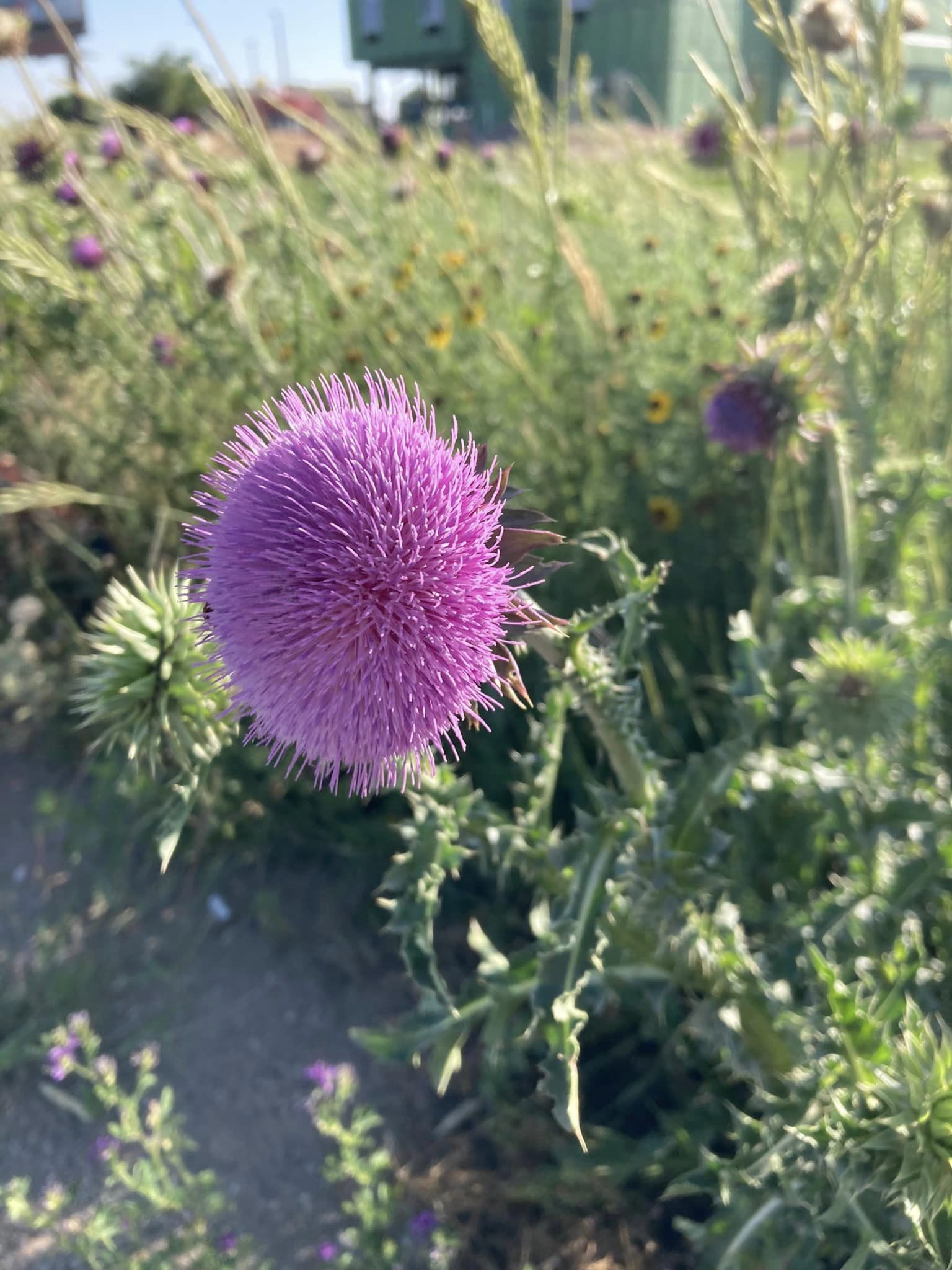
And then I saw it.  A beautiful, unusual flower lining the road of our walk.  It seemed silly to stop and take a picture of the flowers (or at least, so my then cranky family told me), but I knew this was the Holy Spirit’s way of telling me to look around at the blessings of the day:  to remember the constant invitation to think about injustice in all its forms and how we can be agents of change; to remember that even when things do not go your way, sometimes equally wonderful things happen; to remember that even in the midst of sweaty, weary, whiny messes, God uses the gifts of all of us (problem-solving husbands, caring strangers, and even nature herself) to renew and restore us.  What blessings has the Holy Spirit been trying to show you today?

Photo credit: Jennifer Andrews-Weckerly (reuse with permission)

Sermon – Isaiah 1.1, 10-20, P14, YC, August 11, 2019

14 Wednesday Aug 2019

Posted by jandrewsweckerly in Sermons, Uncategorized

≈ Leave a comment

Tags

action, blame, change, do something, God, guilt, hypocritical, injustice, innocent, love, meaning, renewal, Sermon, serve, strength, worship

One of the topics in Confirmation Class is how the Episcopal Church interprets and talks about Holy Scripture.  Confirmands are often surprised to hear the labels “Old Testament” and “New Testament” are not helpful labels.  Instead of calling the first portion of Holy Scripture the “Old Testament,” we call that portion the “Hebrew Scriptures.”  We make that change for two reasons.  One, we want to remind ourselves that the Christian Scriptures do not eliminate the importance of the Hebrew Scriptures – as if the “new” testament makes the “old” testament obsolete.  Two, the use of the “old” can connote irrelevance.  Neither of those things being true, we try to reframe our language.

Today’s Hebrew Scripture reading is a classic example of how our language can taint our interaction with Scripture.  Many of us hear the words of Isaiah and the judgment of Israel’s worship, and we slip into “they” language.  They are being as sinful as Sodom and Gomorrah – the same people who “had pride, excess of food, and prosperous ease, but did not aid the poor and needy.”[i].  Their worship, their sacrifice of animals, is meaningless to God.  Their prayers will be ignored by God.  They have blood on their hands.  The shifting of audience is easy enough for us; not being a community that offers sacrifices anymore, this piece of Scripture really can feel like an “old” testament.

That’s why I like one scholar’s rereading of this passage.  He argues we need to reframe today’s passage in our modern context.  Instead of condemning ancient practices, he rereads the text for the modern church as God saying thus:  “I hate your worship.  Your prayers make me sick.  I loathe your music.  Your sermons are a sacrilege.  Who asked for your offerings?  Your Holy Communion stinks.  I want none of it.”[ii]  I do not know about you, but that rewording made this passage come alive in ways “old” texts never do.  Suddenly, God is not talking about them; God is talking about us – our worship, our actions, our behavior.  With new ears for this text, God is not criticizing outdated, foreign practices – God is criticizing the thing we are right in the midst of: our worship, our music, our prayers, our communion, this very sermon!

Hearing this passage as a modern reading shook me up this week.  All week I have been pondering our worship – the primary marker of our identity.  Does our communion stink?  As I thought about the sacred meal this week, I could imagine how communion could be so rote communion loses its meaning.  But then I began to think about my experience with communion.  As a priest, I receive communion two to three times on a Sunday – sometimes more.  Despite that repetition, something about the physicality of communion keeps communion fresh.  Sometimes the wafers are stale, making them hard to swallow; sometimes the bread is dry and crumbly, making a huge mess around the altar; sometimes, especially by 11:15, my breakfast is so far gone that eating communion feels like a desperate attempt to ease the rumbling in my empty stomach.  The same happens with the wine:  sometimes the wine burns going down; sometimes the wine soothes a dry throat; sometimes I wish I could take a long draw of wine to wash down the gluten-free wafer that is stuck in my teeth.  Those experiences may sound silly or trivial, but I find God in every one of them:  How often have I longed for God the way I long for food when I am hungry?  How often have I cursed the mess of life before realizing Jesus makes our life messy?  How often has something from church or a word from God nagged at me like a wafer that scraped my throat on the way down.

I like thinking about those physical-spiritual connections in Eucharist because they do what God is challenging us to do in Isaiah today.  God is not saying worship is inherently bad.  The sacrificing of animals, the prayers, the offerings were all thing the community of God had been instructed to do.  There are whole books of the Bible that laboriously detail how to do these things, thoughtfully making concessions for those lacking the resources to make the recommending offerings.  God is not saying God hates the festivals, is repelled by their sacrifices, and will ignore their prayers because God finds them archaic or brutal or wrong.  God’s fervent and harsh criticism of their worship is the hypocrisy of their worship.  In verse fifteen, God says, “I will not listen; your hands are full of blood.”  What God is pointing out is the irony of their worship. Here they are, their hands covered in the blood of the sacrificed animals – what should be a pure, sacred offering to God for the blessings of this life.  But what God sees is different blood:  their raised hands are not simply covered in the holy blood of sacrifice; their raised hands are covered in the blood of the oppressed, the orphan, the widow.  God, rather bluntly, says, “Do not come to me with the pretense of humility and righteousness when nothing about your life is righteous.  Do not come to me as though you are pure and sanctified, when I see you covered in the blood of the innocent you trampled on the way into the temple.”

In the aftermath of two more mass shootings last weekend, the cities of Dayton and El Paso gathered in vigil, in prayer, and in conversation.  In Dayton, the governor offered the kind of speech one usually offers in times such as these – a sense of condolence, an encouragement to come together in mutual support, an acknowledgment of grief.  But the residents of Dayton were not having that speech this week.  As the governor was speaking, someone in the crowd shouted, “Do something!”  The governor continued his speech, and two more voices cried out the same call, “Do something! Do something!”  The governor maintained his cool and kept going with his scripted speech, but within moments, the crowd was chanting in one voice, “Do something!” so loudly the governor’s speech was completely inaudible.  Perhaps reflecting the tenor of a nation who is emotionally exhausted by the repeated trauma of mass shootings, the people of Dayton broke.  No longer content to receive prayers and idle words, the people of Dayton demanded the governor do something to change their reality.

I think that is what God is really upset about in our scripture lesson today.  God is not bored by their worship or saying the acts of worship of the Israelites are inherently bad.  What God is saying is their worship is invalidated by their actions outside the temple.  The people of God cannot do evil, ignore injustice, forget the oppressed, shun the orphaned, and leave the widowed behind while still seeking refuge in God.  God wants us to do something.  In fact, in verse seventeen, God says, “Learn to do good.”  We can pray all we want, we can mourn mass violence, we can even criticize politicians about their lack of action.  But God is looking straight into our eyes today and saying, “I am glad you are here and I love you.  But you need to do something.”  And if we are unclear about what that something is, God tells us right here in Isaiah:  cease doing evil, do good, seek justice, rescue the oppressed, defend the orphan, plead for the widow.  When tragedy strikes, when the world feels like the world is falling apart, when we feel helpless or overwhelmed by the evil of this time, God says your worship of God is odious unless you are doing something.

Now I do not want you to leave today thinking this service is meaningless.  Quite the contrary, “worship is essential for us and requires of us an awed and candid engagement with God that is life giving, community transforming, and world altering.”[iii]  What would be meaningless is for you to go through the motions, or for you to seek solace only, and not strength; pardon only, and not renewal.  The prayers, your offering, our music, the sacred meal are meant to empower us to go out in the world and do something.  I know that can be scary.  I know you may be thinking, “well, I have very strong opinions about guns and what our country should be doing.”  But I also know the people I have spoken to on both sides of the issue do not want the slaughter of innocents.  To that, God offers us encouragement.  God says in verse eighteen, “Come now, let us argue it out.”  God does not want you to run away from the evil of the world, but to dive in and figure out a way to do something.  God wants you to engage because God knows you can.  In fact, God says, “though your sins are like scarlet, they shall be like snow; though they are red like crimson, they shall become like wool.”  God does not hate our worship; but God does not tolerate our worship when our worship is void of action – when we forget the dismissal of our deacon, to go in peace, to love and serve the Lord.  Today, God invites us to wash the blood of the innocent off our hands, and to go out and do something:  to go in peace, to love and serve the Lord.  Amen.

[i] Ezekiel 16.49.

[ii] Paul Simpson Duke, “Homiletical Perspective,” Feasting on the Word, Yr. C, Vol. 3 (Louisville: Westminster John Knox Press, 2010), 319.

[iii] Duke, 321.

Sermon – Matthew 4.12-23, Isaiah 9.1-4, Psalm 27.1, EP3, YA, January 22, 2017

25 Wednesday Jan 2017

Posted by jandrewsweckerly in Sermons, Uncategorized

≈ Leave a comment

Tags

darkness, geography, hope, Inauguration, injustice, Jesus, light, location, map, Martin Luther King, ministry, mission, Naphtali, oppression, Sermon, Women's March, Zebulun

Our family loves maps.  Of course, Scott and I grew up in a time when paper maps were the only kind of maps.  Since I moved around a lot and he traveled a lot, we both learned to pour over maps.  As a couple, we had road atlases for every major city in which we lived.  Looking over maps helps us understand where we are going, how different areas connect, and what the big picture is.

What you do not get from maps are the stories behind the lines.  When I lived and worked in Durham, NC, working among the hungry and poor, I soon learned more about the roads I had seen on the map.  You see, a highway cuts through Durham and was put there many years ago.  Before the highway came, there was a thriving African American community, with many small businesses.  The highway cut through the neighborhoods and businesses, dividing people from one another socially, displacing longtime community leaders, and devastating many small businesses.  The highway was essentially like tossing a small bomb into the neighborhood – without ever letting the neighborhood rebuild.  But you do not learn that kind of information from the thick blue line that conveniently cuts through town and gets you from point A to point B much faster.

Our gospel lesson today tries to give us that same kind of insight.  What sounds like a basic cartography lesson quickly becomes a socio-political lesson.  Matthew tells us, “When Jesus heard that John had been arrested, he withdrew to Galilee.  He left Nazareth and made his home in Capernaum by the sea, in the territory of Zebulun and Naphtali…”  Most of us hear all those town and territory names and tune out.  We keep racing forward, looking for the action in the story.  Now the map lovers among us might pull out one of those bibles with a map and pinpoint Galilee, Nazareth, and Capernaum.  We probably won’t find the territories of Zebulun and Naphtali on the same map, but we figure we at least have a mental picture of the setting.

In this case, skimming means we miss Matthew’s subtlety.  You see, we could certainly find Galilee, Nazareth, and Capernaum on a map relative to Jesus’ day.  But the reason we don’t see the territories of Zebulun and Naphtali is because that is the land of Abraham’s sons – over 700 years prior to the time Jesus lived.  The land of Zebulun and Naphtali represent a land that was once promised land, but for centuries has been a land of unfulfilled promise.[i]  The Assyrians were the first to conquer the land.  But they were followed by Babylon, the Persians, the Greeks, and eventually the Romans.  That kind of perpetual occupation and oppression does something to your psyche.  Generations upon generations have lived under the shadow of a dream deferred.  They have lived in darkness.

Long before Jesus, Isaiah prophesied that things would change.  We hear in Isaiah speaking that very promise today.  “There will be no gloom for those who were in anguish,” Isaiah says.  “In the former time he brought into contempt the land of Zebulun and the land of Naphtali, but in the latter time he will make glorious the way of the sea, the land beyond the Jordan, Galilee of the nations.  The people who walked in darkness have seen a great light; those who lived in a land of deep darkness–on them light has shined.”  To this place – this place where grandparent after grandparent promised their grandchildren that we would know a brighter future – to this place of darkness, Jesus goes to start his ministry.  What seems like a superfluous geographical information is actually of singular importance in understanding what Jesus is about.  The particularity of his ministry matters.  Where he goes as God made manifest says something about the kind of kingdom that is inbreaking.  His location – a land of longstanding darkness – will become a land of great light.  His location will be the place where the people of God can actually pray the psalm we prayed today, “The Lord is my light and my salvation; whom then shall I fear?  The Lord is the strength of my life; of whom then shall I be afraid?”

This week has been a loaded week.  We started off by honoring the Rev. Dr. Martin Luther King, Jr., whose passionate pleas for justice for all inspired a nation.  Dr. King understood how much location mattered.  His march from Selma to Montgomery meant something to the people who lived in Alabama at the time.  His references to freedom ringing from the mountains of New York, the Alleghenies of Pennsylvania, the snow-capped Rockies of Colorado, the curvaceous slopes of California highlighted how different regions of our country experienced racism.[ii]  He understood the value of geography when he gave his “I have a dream” speech in front of the Lincoln Memorial – a president who presided at the time of the Civil War.  And his famous speech there inspired thousands of men and women to walk yesterday in the same location – because they knew that in order to talk about injustice, you go to the most famous place where speeches about injustice have been offered.  Even the inauguration this week in front of the Capitol Building in DC signified something – that no matter how we felt about this presidential election, the new president would do what every president has done – be sworn in just like all the others.  The location mattered.

I highlight all of this because I know many of us read these texts today and are feeling like we are in a place of darkness.  Some of us see our new President as bringing in a new era of light.  But others among us see the opposite – some of us here feel like we have welcomed in a new oppressor who will keep us in the darkness.  As I have prayed with you all this week – both in person, in conversation, and in my private prayers, I kept going back to the geographical lesson of Jesus and the beginning of his ministry.  If geography matters, what does that mean for us?  Where do we see the light dawning in our time?

No matter which candidate was yours last year, I keep remembering that no candidate would have been the bearer of the light.  Only Christ does that.  But that does not mean any of us are off the hook.  Democrats or Republicans, Southerners or Non-Southerners, Women or Men – God positions each of us in a particular geography with a particular mission to bring light to where God has planted us.  Whether you are thrilled or devastated by the state of our country’s leadership, God tells us today that our work is not done.[iii]

We often say about Hickory Neck that our mission is to keep burning our light on the hill.  This hill that we are planted on has a history too.  Over 200 years ago, the people who lived and witnessed to Jesus on this hill left.  They sided with the British and the British lost.  Talk about a devastated people!  But the light never went out.  Students came to this hill to learn and grow and play their part in this location’s narrative.  Soldiers and medics came to this hill to tend the sick, mend the wounded, and bury the dead during the Civil War.  When that war was over, students came back, to continue their learning and formation.  And, around 100 years ago, the people of God came back to this hill to start shining Christ’s light again.

Knowing that we have been planted on this hill in this time has given me hope.  No matter how divided we are as a country – no matter how divided we are within these very walls – God has asked us to be light on this hill.  That means that when our neighbors are freezing in the cold nights of winter, we are going to open our doors, cook some meals, pull some all-nighters, and witness Christ’s light and love.  That means when we start developing our vision for Hickory Neck, we are not looking for a vision for St. Swithins of anyplace, USA.[iv]  We are going to be looking at how we can make an impact on Toano, Upper James City County, Williamsburg, and Southern Virginia.  Whether we build that multigenerational day center or we find something else that matters to this particular geography, our location is part and parcel of our work to bring the light of Christ out into the world.

The darkness that many of us feel about our country is not likely to dissipate any time soon.  But that darkness does not eliminate our hope.  Our ancestors walked in the darkness for over seven centuries before the light of Christ came to them.  Our own country – from its treatment of native peoples to enslaved Africans – has been a land of darkness despite the many reminders of the light.  We can become overwhelmed in the vast story of history.  But our hope is in our geography – the current moment and place where God has placed us to beacons of hope and agents of change.  This space, with its many windows that pour in light, is meant to be a place that warms you by Christ’s light every week.  But this place is also a place that needs to shine its light off the hill – to be an agent for change, compassion, and care.   Our invitation this week is to drop our nets, and to take up our work being agents of light on this hill and beyond.  Amen.

[i] Karoline Lewis, “Mapping God’s Promises,” January 15, 2017, as found at http://www.workingpreacher.org/craft.aspx?post=4796 on January 18, 2017.

[ii] Lewis.

[iii] Fritz Wendt, “The Politics of Inauguration and Surrender—Matthew 4:12-23,” January 17, 2017, as found at http://www.politicaltheology.com/blog/the-politics-of-inauguration-and-surrender-matthew-412-23-fritz-wendt/ on January 18, 2017.

[iv] Lewis.

Recent Posts

  • On the Myth and Magic of Advent…
  • On Risking Failure and Facing Fear…
  • Sermon – Luke 23.33-43, P29, YC, November 23, 2025
  • On Inhabiting Gratitude…
  • Sermon – Luke 20.27-38, P27, YC, November 9, 2025

Archives

  • December 2025
  • November 2025
  • October 2025
  • September 2025
  • August 2025
  • July 2025
  • June 2025
  • March 2025
  • February 2025
  • December 2024
  • November 2024
  • October 2024
  • September 2024
  • August 2024
  • July 2024
  • June 2024
  • May 2024
  • March 2024
  • February 2024
  • January 2024
  • December 2023
  • November 2023
  • October 2023
  • September 2023
  • August 2023
  • July 2023
  • June 2023
  • May 2023
  • March 2023
  • February 2023
  • January 2023
  • December 2022
  • November 2022
  • October 2022
  • June 2022
  • May 2022
  • January 2022
  • December 2021
  • November 2021
  • October 2021
  • September 2021
  • August 2021
  • June 2021
  • May 2021
  • April 2021
  • March 2021
  • February 2021
  • January 2021
  • December 2020
  • November 2020
  • October 2020
  • September 2020
  • August 2020
  • July 2020
  • June 2020
  • May 2020
  • April 2020
  • March 2020
  • February 2020
  • January 2020
  • December 2019
  • November 2019
  • October 2019
  • September 2019
  • August 2019
  • July 2019
  • June 2019
  • May 2019
  • April 2019
  • March 2019
  • February 2019
  • January 2019
  • December 2018
  • November 2018
  • October 2018
  • September 2018
  • August 2018
  • July 2018
  • June 2018
  • May 2018
  • April 2018
  • March 2018
  • February 2018
  • January 2018
  • December 2017
  • November 2017
  • October 2017
  • September 2017
  • August 2017
  • July 2017
  • June 2017
  • May 2017
  • April 2017
  • March 2017
  • February 2017
  • January 2017
  • December 2016
  • November 2016
  • October 2016
  • September 2016
  • August 2016
  • July 2016
  • June 2016
  • May 2016
  • April 2016
  • March 2016
  • February 2016
  • January 2016
  • December 2015
  • November 2015
  • October 2015
  • September 2015
  • August 2015
  • July 2015
  • June 2015
  • May 2015
  • April 2015
  • March 2015
  • February 2015
  • January 2015
  • December 2014
  • November 2014
  • October 2014
  • September 2014
  • August 2014
  • July 2014
  • June 2014
  • April 2014
  • March 2014
  • February 2014
  • January 2014
  • December 2013
  • November 2013
  • October 2013
  • September 2013
  • August 2013
  • July 2013
  • June 2013
  • May 2013
  • April 2013
  • March 2013
  • February 2013
  • January 2013
  • December 2012
  • November 2012
  • October 2012
  • September 2012

Categories

  • reflection
  • Sermons
  • Uncategorized

Meta

  • Create account
  • Log in
  • Entries feed
  • Comments feed
  • WordPress.com

Blog at WordPress.com.

  • Subscribe Subscribed
    • Seeking and Serving
    • Join 394 other subscribers
    • Already have a WordPress.com account? Log in now.
    • Seeking and Serving
    • Subscribe Subscribed
    • Sign up
    • Log in
    • Report this content
    • View site in Reader
    • Manage subscriptions
    • Collapse this bar
 

Loading Comments...