• About

Seeking and Serving

~ seek and serve Christ in all persons

Seeking and Serving

Tag Archives: language

Sermon – Luke 11.1-13, P12, YC, July 28, 2019

31 Wednesday Jul 2019

Posted by jandrewsweckerly in Sermons, Uncategorized

≈ Leave a comment

Tags

authentic, disciples, God, honest, Jesus, language, Lord's Prayer, power, pray, prayer, real, relationship, Sermon, teach, vulnerable

One of the practices highly recommended to clergy is having a spiritual director.  My director is a professor I had in seminary.  He is wise and insightful, and always helps me not only see the bigger picture, but also see goodness in what sometimes feels like darkness.  But perhaps my favorite thing about him is the way he prays.  You would think with such a spiritual, learned man, his prayers would be profound and flowery – worthy of the kind of prayers we find in our own Prayer Book.  But instead, his prayers are the opposite.  They are awkward and fumbling.  You can hear long pauses in them as he struggles to articulate what he wants to say to God.  He uses everyday language, rarely capturing the phrases we normally hear in prayers.  The first several times I heard him pray, I was admittedly a little disappointed and, when I’m really being honest, a bit judgmental.  But in time, I began to see his prayers differently.  His prayers may not be artfully constructed or perfectly paced, but his prayers are never canned or artificial.  His prayers may not be theologically intricate, but his prayers are honest, vulnerable, and capture the deep profundity of whatever you have just shared.  His prayers are not pretty, but they are real and raw – more real than most prayers I have heard.

Of course, I am not the first person to wonder, worry, or wander through prayers.  Today, the disciples ask a simple favor of Jesus, “Lord, teach us to pray.”  The disciples at this point have seen Jesus pray many times.  They see how good he is and they see how important prayer is in his life.  In fact, in Luke’s gospel, Jesus is regularly found in prayer.[i]  They watch Jesus enter into prayer with God for months, and they long to be able to do that too.  And so they come to Jesus, and they vulnerably submit their request:  teach us to pray.

Their request is full of implications.  First is the admission that they do not have the first idea about what they are doing.  Maybe they learned some prayers in temple, or maybe their parents prayed with them.  But they realize in watching Jesus that they do not actually know how to pray themselves.  Not really.  Second, they see a real connection between Jesus and God that somehow is revealed in Jesus’ prayer life.  Perhaps they see how prayer strengthens him in his weakness and how he is more vulnerable with God than even with them.  They long for that kind of connection with God too, but still, they are not sure how the whole thing works.  Finally, a deeper implication is at hand in the disciples’ request.  Perhaps they are not only asking Jesus how to pray, but also wanting to know what is actually happening in prayer.  Perhaps they have tried praying on their own – for an illness, for a new job, for a broken relationship – but the prayer did not work.  They want Jesus to teach them the right way to pray so that the results they desire are fulfilled.

And so, Jesus responds.  Jesus gives them the ultimate prayer – the prayer we call The Lord’s Prayer.  The prayer Jesus gives them is so beautiful and powerful, that two thousand years later, people who never go to church seem to know this prayer.  This is the prayer we pray when we pray the rosary, when we end our days, and at the end of every Eucharistic Prayer.  This is the prayer we pray when we have no other words.  This is the prayer we teach our children to pray and we sing in our own unique Hickory Neck way.

But if you look at Luke’s version of this prayer, the prayer sounds a little more like one of the prayers my spiritual director might pray.  As one scholar says, “Pious convention has conditioned most of us to repeat this prayer so quietly and reverentially that we fail to recognize how we are risking an aggressiveness incommensurate with bourgeois manners.”[ii]  In other words, the Lord’s Prayer is kind of pushy.  There is no flowery language or even polite deference or usage of the word “please.”  Instead, Jesus just tells us to ask for a bunch of stuff:  give us, forgive us, lead us, deliver us.  And every week or even every day, we say the same words – give us, forgive us, lead us, deliver us.  And if we keep reading Luke’s gospel, after the prayer, we hear Jesus saying that our prayerful life with God is akin to being a pushy friend who through their shameless relentlessness[iii] is able to get a friend up out of bed in the middle of the night.

So why in the world do we teach our children this prayer when the prayer is so flagrantly pushy?  Next week Ella and Charlie will be receiving their First Holy Communion.  First Communion is not really the norm in the Episcopal Church.  As a priest, I first encountered First Holy Communion on Long Island, where the Episcopal Church was highly influenced by the Roman Catholic tradition.  Though the Episcopal Church’s theology is that any baptized person can receive communion, some families prefer their children to understand what Holy Communion means before receiving instead of learning to understand communion through experience.  There really is no wrong way to approach Eucharist, but if we are to do a First Holy Communion, one of the things we require candidates to do is learn the Lord’s Prayer.  In part we do that so that there is at least one part of the Eucharistic service they have memorized and in which they can fully participate.

But there is another reason we have candidates learn the Lord’s Prayer.  We want candidates to learn the Lord’s Prayer because the Lord’s Prayer teaches us about what our relationship with God is like.  Our relationship with God is not flowery or picture perfect.  We  may have moments of poetic beauty with God, but when our relationship with God is at its deepest, we cry ugly, full-bodied tears, we rage about injustice – both personal and in the world, we confess our shame and sorrow for the awful things we sometimes do, and we laugh and rejoice with the kind of dancing we would only do in the confines of our homes.  We do not use language with God containing the formality of language we use with strangers; we use language with God we would use with a friend who knows all our foibles and loves us anyway.  All of that is not to say the poignant prayers of the Prayer Book cannot inspire faithfulness; they can and do.  But we teach the Lord’s Prayer to our children so they know we can say unsure, vulnerable, real words to God.

That is what Jesus is really teaching the disciples.  Jesus does not tell the disciples to “ask, and it will be given you; search, and you will find; knock, and the door will be opened for you,” because he is saying prayer is a vending machine for our every wish.  Jesus tells us to ask, search, and knock, because prayer and our relationship with God is active and relational.  As one scholar asserts, Jesus teaches us the Lord’s Prayer because he wants his disciples to know, “prayer is not a meek, contrived, and merely ‘religious’ act; [prayer] is the act of human beings who know how hard it is to be human.  Real prayer cannot be faked.  [Real prayer’s] only prerequisites are sufficient self-knowledge to recognize the depths of our need, and enough humility to ask for help.”[iv]

This week, I invite you to take a cue from Jesus’ own relationship with God.  Maybe you will start with a prayer like my spiritual director’s – one that does not lead with preplanned words, but instead tries to authentically say the words on your heart; not a structured collect, but a raw conversation with God.  Jesus gives you permission to ask for those things you need, the forgiveness you desire, the protection you long for, and the deliverance you seek.  Jesus invites you to just be you – to be a human with the God who loves you and made you in God’s image.  And if all that fails, then you can say the Lord’s Prayer.  You can rest in the assurance that although Jesus’ prayer sure sounds pretty, his prayer is one of the most honest ones you can offer – the small step you can take in connecting back to your Lord and your God.  Amen.


[i] James A. Wallace, “Homiletical Perspective,” Feasting on the Word, Yr. C, Vol. 3 (Louisville: Westminster John Knox Press, 2010), 289.

[ii] Douglas John Hall, “Theological Perspective,” Feasting on the Word, Yr. C, Vol. 3 (Louisville: Westminster John Knox Press, 2010), 288, 290.

[iii] Wallace, 291.

[iv] Hall, 290.
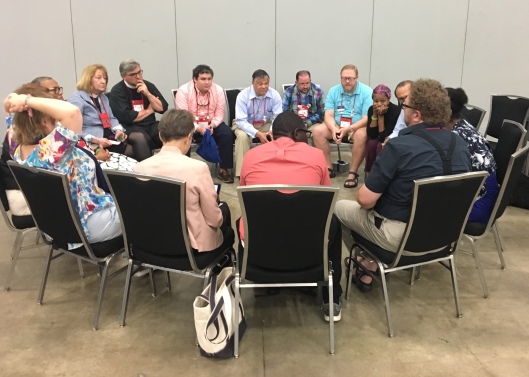
GC79: Respecting Dignity

25 Wednesday Jul 2018

Posted by jandrewsweckerly in Uncategorized

≈ Leave a comment

Tags

dignity, Episcopal Church, gender, General Convention, immigration, Jesus, language, outcast, race, respect, sexual orientation

IMG_1851

Photo credit:  Jennifer Andrews-Weckerly (permission for reuse)

One of the many takeaways from General Convention was the need to tend to those outside of the straight, white, male, able-bodied community.  There was a task force assembled before Convention to address issues raised by the #metoo movement.  Out of that group came many resolutions about sexual harassment and abuse, equality in payment and hiring, parenting accommodations, and eliminating bias in bishop searches.  Our African-American brothers and sisters also called for work on pay equity and broader issues, such as voter suppression.  Our foreign language speakers rallied for more translated liturgies and legislation, as well as increased interpreters throughout Convention.  Our disabled and deaf members lobbied for better accommodations during Convention.  Our LGBTQ members called for broader inclusion and more intentional expansive and inclusive language.  Our immigrant members also called for thoughtfulness about our ordination processes, noting that many dioceses are unwilling to consider entering into a formal discernment process with someone if their immigration status is not settled.

There are probably more issues I am forgetting, but what struck me about each of these movements is that they are not just General Convention issues or wider church issues.  These are issues for every parish.  At our own parish, we are struggling to provide hearing assistance to our hearing-impaired members due to lack of volunteers to run our sound system.  Having served on a Commission on Ministry (COM) in another diocese, I realize now how our restrictions around immigration could have limited the movement of the Holy Spirit.  Even the conversation about breastfeeding on the Convention floor made me realize that we all have work to do about making our worship spaces as welcoming as possible.  Having watched these issues unfold at General Convention, I am convinced that there are issues we are overlooking as well.

Jesus always struck me as someone who saw everyone – especially people that society, religious leaders, and even his disciples overlooked or dismissed.  He had a knack for seeing the marginalized, the oppressed, and those cast out or looked down upon.  He asked their stories, engaged them in conversation and relationship, he often restored them to health and status in the community.  He showed us what it means to respect the dignity of every human being.  When we reaffirm our baptismal covenant, or when we say, “The Episcopal Church Welcomes You,” how might we do a better job of bringing what we say in line with what we do?  General Convention’s work was a way of pointing us back to the work of Jesus.  How might Hickory Neck engage in this same work?  How might you engage in this same work in your everyday life?

Speaking my Language

11 Wednesday May 2016

Posted by jandrewsweckerly in Uncategorized

≈ 1 Comment

Tags

church, communicate, culture, hear, Holy Spirit, language, new, North, Pentecost, South, speak, tongues

Pentecost Sunday

Photo credit:  stbarts.org/worship/pentecost-languages/

As many of you know, I was raised in the South.  My San Diego-native husband tells me that when he met me in high school, I had an endearing North Carolina accent.  But after going to college with people from all over the country and living in Delaware, I found that my accent faded.  I tended to pick up phrases and patterns of speech from those around me.  Of course, one call from my Alabama-native mother, and all bets were off.  But about four years ago, my family moved to Long Island with our then two-year-old.  Surrounded by Long Islanders, she quickly started pronouncing vowels differently and dropping r’s.  I am not sure how much of the dialect I assimilated, but my ears certainly adjusted.

What I came to finally understand about all these dialects is that much more important than the sound of words are the culturally different ways people communicate with one another in different regions of the country.  My experience on Long Island was that people were very direct and incisive with their words.  Being from the South, this was more of a shock than the dialect.  In the South, people are indirect and subtle with their language.  Though I was raised to interpret conversations in the South, if I am honest, I found the Long Island way of communicating refreshing.  Although I sometimes felt like I was being slapped in the face by the brutal honesty of another person, when I went home, I knew where I stood.  That was not always the case in the South.  People are almost always polite, but hidden in the politeness are sometimes feeling of resentment or hurt, which cannot be addressed if you do not know how to hear the subtlety.

This Sunday, the Church is celebrating Pentecost.  If you remember the story from Acts, those gathered begin speaking in tongues.  The miracle was not in the speaking of tongues, but in the understanding of tongues by everyone gathered.  Each heard their own language and the message was clearly understood by all.  Having recently returned to the South, I find myself wondering in what ways the Church could be speaking more clearly.  I am not suggesting that one region of the country has the market on clear speech.  What I am suggesting is that as a Church, we are not always great at communicating the power of Christ in our lives.  We either get lost in “church speak,” or we try to academically explain matters of the heart, or, out of fear or discomfort, we do not speak at all.  As we honor the miracle of the work of the Holy Spirit over two thousand years ago, our invitation at Pentecost is to honor the ways in which the Holy Spirit can continue to enliven the church to speak understandably to a new generation.

Recent Posts

  • On the Myth and Magic of Advent…
  • On Risking Failure and Facing Fear…
  • Sermon – Luke 23.33-43, P29, YC, November 23, 2025
  • On Inhabiting Gratitude…
  • Sermon – Luke 20.27-38, P27, YC, November 9, 2025

Archives

  • December 2025
  • November 2025
  • October 2025
  • September 2025
  • August 2025
  • July 2025
  • June 2025
  • March 2025
  • February 2025
  • December 2024
  • November 2024
  • October 2024
  • September 2024
  • August 2024
  • July 2024
  • June 2024
  • May 2024
  • March 2024
  • February 2024
  • January 2024
  • December 2023
  • November 2023
  • October 2023
  • September 2023
  • August 2023
  • July 2023
  • June 2023
  • May 2023
  • March 2023
  • February 2023
  • January 2023
  • December 2022
  • November 2022
  • October 2022
  • June 2022
  • May 2022
  • January 2022
  • December 2021
  • November 2021
  • October 2021
  • September 2021
  • August 2021
  • June 2021
  • May 2021
  • April 2021
  • March 2021
  • February 2021
  • January 2021
  • December 2020
  • November 2020
  • October 2020
  • September 2020
  • August 2020
  • July 2020
  • June 2020
  • May 2020
  • April 2020
  • March 2020
  • February 2020
  • January 2020
  • December 2019
  • November 2019
  • October 2019
  • September 2019
  • August 2019
  • July 2019
  • June 2019
  • May 2019
  • April 2019
  • March 2019
  • February 2019
  • January 2019
  • December 2018
  • November 2018
  • October 2018
  • September 2018
  • August 2018
  • July 2018
  • June 2018
  • May 2018
  • April 2018
  • March 2018
  • February 2018
  • January 2018
  • December 2017
  • November 2017
  • October 2017
  • September 2017
  • August 2017
  • July 2017
  • June 2017
  • May 2017
  • April 2017
  • March 2017
  • February 2017
  • January 2017
  • December 2016
  • November 2016
  • October 2016
  • September 2016
  • August 2016
  • July 2016
  • June 2016
  • May 2016
  • April 2016
  • March 2016
  • February 2016
  • January 2016
  • December 2015
  • November 2015
  • October 2015
  • September 2015
  • August 2015
  • July 2015
  • June 2015
  • May 2015
  • April 2015
  • March 2015
  • February 2015
  • January 2015
  • December 2014
  • November 2014
  • October 2014
  • September 2014
  • August 2014
  • July 2014
  • June 2014
  • April 2014
  • March 2014
  • February 2014
  • January 2014
  • December 2013
  • November 2013
  • October 2013
  • September 2013
  • August 2013
  • July 2013
  • June 2013
  • May 2013
  • April 2013
  • March 2013
  • February 2013
  • January 2013
  • December 2012
  • November 2012
  • October 2012
  • September 2012

Categories

  • reflection
  • Sermons
  • Uncategorized

Meta

  • Create account
  • Log in
  • Entries feed
  • Comments feed
  • WordPress.com

Blog at WordPress.com.

  • Subscribe Subscribed
    • Seeking and Serving
    • Join 394 other subscribers
    • Already have a WordPress.com account? Log in now.
    • Seeking and Serving
    • Subscribe Subscribed
    • Sign up
    • Log in
    • Report this content
    • View site in Reader
    • Manage subscriptions
    • Collapse this bar
 

Loading Comments...