
• About

Seeking and Serving

~ seek and serve Christ in all persons

Seeking and Serving

Tag Archives: Martin Luther King

Feast of the Rev. Dr. Martin Luther King, Jr., January 18, 2026

28 Wednesday Jan 2026

Posted by jandrewsweckerly in Sermons

≈ Leave a comment

Tags

beloved community, darkness, enemy, forgive, hate, Jesus, light, love, Martin Luther King, MLK, Sermon
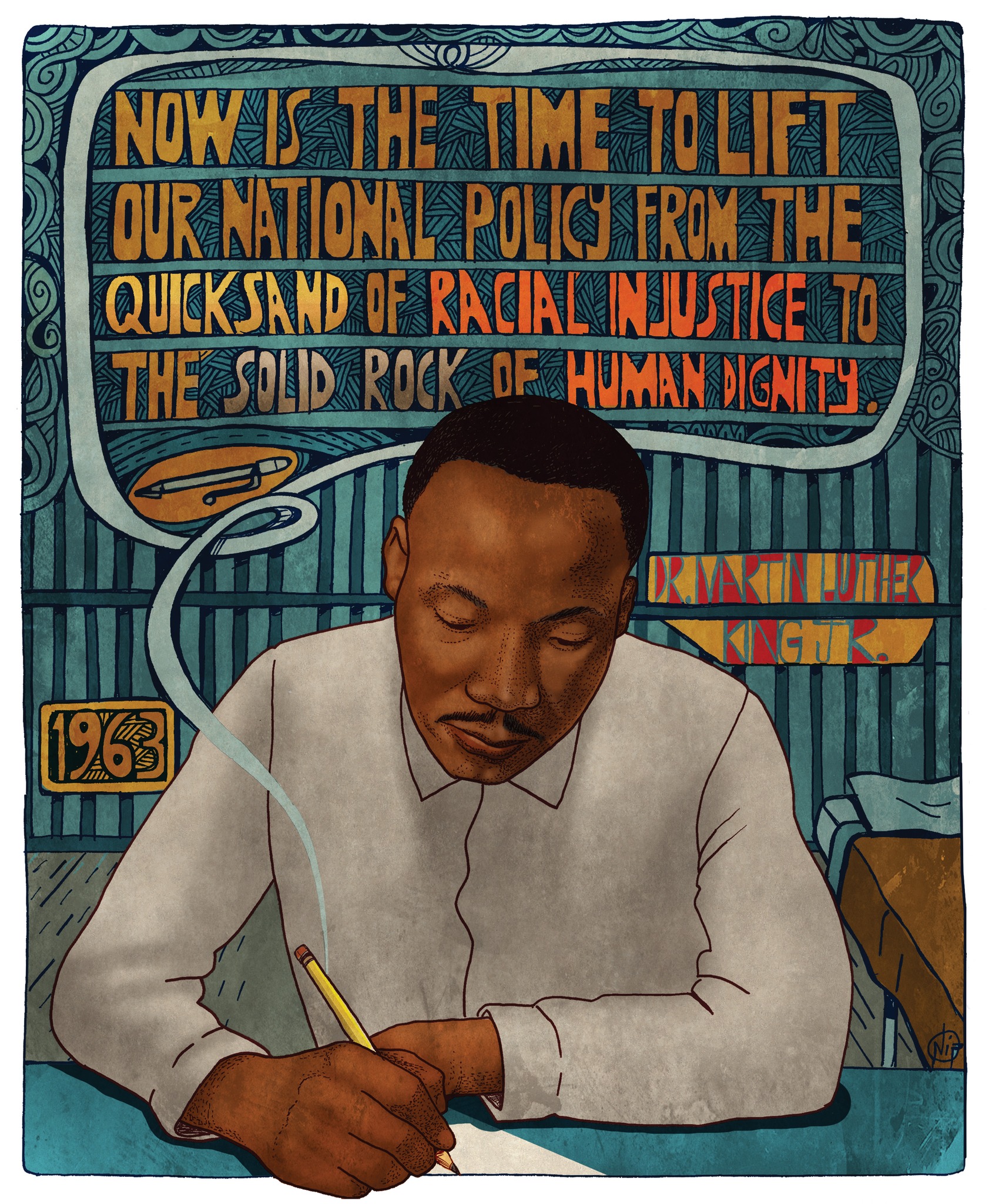
Artwork by Nip Rogers, created for Learning for Justice.

The following sermon was delivered in multiple voices at Hickory Neck Episcopal Church in honor of the feast of the Rev. Dr. Martin Luther King Jr. The text is exclusively Dr. King’s, and consists of excerpts from Loving your Enemies, from a sermon delivered at Dexter Avenue Baptist Church, Montgomery, Alabama, on November, 17 1957, and from Chapter Five of Strength to Love, © 1963 by Martin Luther King, Jr.

“Probably no admonition of Jesus has been more difficult to follow than the command to “love our enemies…”

“…I am certain that Jesus understood the difficulty inherent in the act of loving one’s enemy. He never joined the ranks of those who talk glibly about the easiness of the moral life. He realized that every genuine expression of love grows out of a consistent and total surrender to God…Our responsibility…is to discover the meaning of this command and seek passionately to live it out”

“…How do we love our enemies?

First, we must develop and maintain the capacity to forgive. He who is devoid of the power to forgive is devoid of the power to love. It is impossible even to begin the act of loving one’s enemies without the prior acceptance of the necessity, over and over again, of forgiving those who inflict evil and injury upon us. It is also necessary to realize that the forgiving act must always be initiated by the person who has been wronged…”

“…Forgiveness does not mean ignoring what has been done…It means, rather, that the evil act no longer remains as a barrier to the relationship…Certainly one can never forget, if that means erasing it totally from his mind. But…we forget in the sense that the evil deed is no longer a mental block impeding a new relationship…Forgiveness means reconciliation…The degree to which we are able to forgive determines the degree to which we are able to love our enemies.”

“Second, we must recognize that the evil deed of the enemy-neighbor…never quite expresses all that he is. An element of goodness may be found even in our worst enemy…This simply means that is some good in the worst of us and some evil in the best of us. When we discover this, we are less prone to hate our enemies…We recognize that…hate grows out of fear, pride, ignorance, prejudice, and misunderstanding, but in spite of this, we know God’s image is ineffably etched in (them).”

“Third, we must not seek to defeat or humiliate the enemy, but to win his friendship and understanding…Every word and deed must contribute to an understanding with the enemy and release those vast reservoirs of goodwill that have been blocked by impenetrable walls of  hate.”

“The meaning of love is not to be confused with some sentimental outpouring…In the Greek New Testament are three words for love.  The word eros is a sort of aesthetic or romantic love…philia, a reciprocal love and the intimate affection and friendship between friends. We love those whom we like, and we love because we are loved. The third word is agape, understanding and creative, redemptive goodwill for all…An overflowing love which seeks nothing in return…the love of God operating in the human heart…When Jesus bids us to love our enemies…he is speaking of agape, understanding and creative, redemptive goodwill for all…”

“Why should we love our enemies?

(First) …Returning hate for hate multiplies hate adding deeper darkness to a night already devoid of stars. Darkness cannot drive out darkness; only light can do that. Hate cannot drive out hate; only love can do that. Hate multiplies hate, violence multiplies violence, and toughness multiplies toughness in a descending spiral of destruction. So when Jesus says ‘Love your enemies,’ he is setting forth a profound and ultimately inescapable admonition. Have we not come to such an impasse in the modern world that we must love our enemies—or else?”

“Another reason why we must love our enemies is that hate scars the soul and distorts the personality. Mindful that hate is an evil and dangerous force, we too often think of what is does to the hated…But there is another side which we must not overlook. Hate is just as injurious to the person who hates. Like an unchecked cancer, hate corrodes the personality and eats away its vital unity. Hate destroys…(the) sense of values and objectivity.  It causes (one) to describe the beautiful as ugly and the ugly as beautiful, and to confuse the true with the false and the false with the true.”

“A third reason why we should love our enemies is that love is the only force capable of transforming an enemy into a friend. We never get rid of an enemy by meeting hate with hate; we get rid of an enemy by getting rid of enmity. By its very nature, hate destroys and tears down; by its very nature, love creates and builds up. Love transforms with redemptive power.”

“…An even more basic reason why we are commanded to love is expressed explicitly in Jesus’ words, ‘Love your enemies that you may be children of your father which is in heaven.’ …We must love our enemies because only by loving them can we know God and experience the beauty of his holiness. Of course, this is not practical. Life is a matter of dog eat dog. Am I saying that  Jesus commands us to love those who hurt and oppress us? Do I sound like most preachers – idealistic and impractical? My friends, we have followed the so-called practical way for too long a time now, and it has led inexorably to deeper confusion and chaos. For the salvation of our nation and the salvation of humankind, we must follow another way. This is the only way to create the beloved community.

Sermon – Matthew 4.12-23, Isaiah 9.1-4, Psalm 27.1, EP3, YA, January 22, 2017

25 Wednesday Jan 2017

Posted by jandrewsweckerly in Sermons, Uncategorized

≈ Leave a comment

Tags

darkness, geography, hope, Inauguration, injustice, Jesus, light, location, map, Martin Luther King, ministry, mission, Naphtali, oppression, Sermon, Women's March, Zebulun

Our family loves maps.  Of course, Scott and I grew up in a time when paper maps were the only kind of maps.  Since I moved around a lot and he traveled a lot, we both learned to pour over maps.  As a couple, we had road atlases for every major city in which we lived.  Looking over maps helps us understand where we are going, how different areas connect, and what the big picture is.

What you do not get from maps are the stories behind the lines.  When I lived and worked in Durham, NC, working among the hungry and poor, I soon learned more about the roads I had seen on the map.  You see, a highway cuts through Durham and was put there many years ago.  Before the highway came, there was a thriving African American community, with many small businesses.  The highway cut through the neighborhoods and businesses, dividing people from one another socially, displacing longtime community leaders, and devastating many small businesses.  The highway was essentially like tossing a small bomb into the neighborhood – without ever letting the neighborhood rebuild.  But you do not learn that kind of information from the thick blue line that conveniently cuts through town and gets you from point A to point B much faster.

Our gospel lesson today tries to give us that same kind of insight.  What sounds like a basic cartography lesson quickly becomes a socio-political lesson.  Matthew tells us, “When Jesus heard that John had been arrested, he withdrew to Galilee.  He left Nazareth and made his home in Capernaum by the sea, in the territory of Zebulun and Naphtali…”  Most of us hear all those town and territory names and tune out.  We keep racing forward, looking for the action in the story.  Now the map lovers among us might pull out one of those bibles with a map and pinpoint Galilee, Nazareth, and Capernaum.  We probably won’t find the territories of Zebulun and Naphtali on the same map, but we figure we at least have a mental picture of the setting.

In this case, skimming means we miss Matthew’s subtlety.  You see, we could certainly find Galilee, Nazareth, and Capernaum on a map relative to Jesus’ day.  But the reason we don’t see the territories of Zebulun and Naphtali is because that is the land of Abraham’s sons – over 700 years prior to the time Jesus lived.  The land of Zebulun and Naphtali represent a land that was once promised land, but for centuries has been a land of unfulfilled promise.[i]  The Assyrians were the first to conquer the land.  But they were followed by Babylon, the Persians, the Greeks, and eventually the Romans.  That kind of perpetual occupation and oppression does something to your psyche.  Generations upon generations have lived under the shadow of a dream deferred.  They have lived in darkness.

Long before Jesus, Isaiah prophesied that things would change.  We hear in Isaiah speaking that very promise today.  “There will be no gloom for those who were in anguish,” Isaiah says.  “In the former time he brought into contempt the land of Zebulun and the land of Naphtali, but in the latter time he will make glorious the way of the sea, the land beyond the Jordan, Galilee of the nations.  The people who walked in darkness have seen a great light; those who lived in a land of deep darkness–on them light has shined.”  To this place – this place where grandparent after grandparent promised their grandchildren that we would know a brighter future – to this place of darkness, Jesus goes to start his ministry.  What seems like a superfluous geographical information is actually of singular importance in understanding what Jesus is about.  The particularity of his ministry matters.  Where he goes as God made manifest says something about the kind of kingdom that is inbreaking.  His location – a land of longstanding darkness – will become a land of great light.  His location will be the place where the people of God can actually pray the psalm we prayed today, “The Lord is my light and my salvation; whom then shall I fear?  The Lord is the strength of my life; of whom then shall I be afraid?”

This week has been a loaded week.  We started off by honoring the Rev. Dr. Martin Luther King, Jr., whose passionate pleas for justice for all inspired a nation.  Dr. King understood how much location mattered.  His march from Selma to Montgomery meant something to the people who lived in Alabama at the time.  His references to freedom ringing from the mountains of New York, the Alleghenies of Pennsylvania, the snow-capped Rockies of Colorado, the curvaceous slopes of California highlighted how different regions of our country experienced racism.[ii]  He understood the value of geography when he gave his “I have a dream” speech in front of the Lincoln Memorial – a president who presided at the time of the Civil War.  And his famous speech there inspired thousands of men and women to walk yesterday in the same location – because they knew that in order to talk about injustice, you go to the most famous place where speeches about injustice have been offered.  Even the inauguration this week in front of the Capitol Building in DC signified something – that no matter how we felt about this presidential election, the new president would do what every president has done – be sworn in just like all the others.  The location mattered.

I highlight all of this because I know many of us read these texts today and are feeling like we are in a place of darkness.  Some of us see our new President as bringing in a new era of light.  But others among us see the opposite – some of us here feel like we have welcomed in a new oppressor who will keep us in the darkness.  As I have prayed with you all this week – both in person, in conversation, and in my private prayers, I kept going back to the geographical lesson of Jesus and the beginning of his ministry.  If geography matters, what does that mean for us?  Where do we see the light dawning in our time?

No matter which candidate was yours last year, I keep remembering that no candidate would have been the bearer of the light.  Only Christ does that.  But that does not mean any of us are off the hook.  Democrats or Republicans, Southerners or Non-Southerners, Women or Men – God positions each of us in a particular geography with a particular mission to bring light to where God has planted us.  Whether you are thrilled or devastated by the state of our country’s leadership, God tells us today that our work is not done.[iii]

We often say about Hickory Neck that our mission is to keep burning our light on the hill.  This hill that we are planted on has a history too.  Over 200 years ago, the people who lived and witnessed to Jesus on this hill left.  They sided with the British and the British lost.  Talk about a devastated people!  But the light never went out.  Students came to this hill to learn and grow and play their part in this location’s narrative.  Soldiers and medics came to this hill to tend the sick, mend the wounded, and bury the dead during the Civil War.  When that war was over, students came back, to continue their learning and formation.  And, around 100 years ago, the people of God came back to this hill to start shining Christ’s light again.

Knowing that we have been planted on this hill in this time has given me hope.  No matter how divided we are as a country – no matter how divided we are within these very walls – God has asked us to be light on this hill.  That means that when our neighbors are freezing in the cold nights of winter, we are going to open our doors, cook some meals, pull some all-nighters, and witness Christ’s light and love.  That means when we start developing our vision for Hickory Neck, we are not looking for a vision for St. Swithins of anyplace, USA.[iv]  We are going to be looking at how we can make an impact on Toano, Upper James City County, Williamsburg, and Southern Virginia.  Whether we build that multigenerational day center or we find something else that matters to this particular geography, our location is part and parcel of our work to bring the light of Christ out into the world.

The darkness that many of us feel about our country is not likely to dissipate any time soon.  But that darkness does not eliminate our hope.  Our ancestors walked in the darkness for over seven centuries before the light of Christ came to them.  Our own country – from its treatment of native peoples to enslaved Africans – has been a land of darkness despite the many reminders of the light.  We can become overwhelmed in the vast story of history.  But our hope is in our geography – the current moment and place where God has placed us to beacons of hope and agents of change.  This space, with its many windows that pour in light, is meant to be a place that warms you by Christ’s light every week.  But this place is also a place that needs to shine its light off the hill – to be an agent for change, compassion, and care.   Our invitation this week is to drop our nets, and to take up our work being agents of light on this hill and beyond.  Amen.

[i] Karoline Lewis, “Mapping God’s Promises,” January 15, 2017, as found at http://www.workingpreacher.org/craft.aspx?post=4796 on January 18, 2017.

[ii] Lewis.

[iii] Fritz Wendt, “The Politics of Inauguration and Surrender—Matthew 4:12-23,” January 17, 2017, as found at http://www.politicaltheology.com/blog/the-politics-of-inauguration-and-surrender-matthew-412-23-fritz-wendt/ on January 18, 2017.

[iv] Lewis.

Homily – Luke 6.27-36, Martin Luther King, Jr., January 15, 2015

21 Wednesday Jan 2015

Posted by jandrewsweckerly in Uncategorized

≈ Leave a comment

Tags

enemies, faith, grace, homily, Jesus, love, Martin Luther King, mercy, nonviolence, oppression, racism

Today we honor the life and work of The Rev. Dr. Martin Luther King, Jr.  Born on Jan. 15, 1929, Dr. King was the son and grandson of Baptist preachers.  After earning his Ph.D. in Systematic Theology from Boston University, he became pastor of a church in Montgomery, Alabama.  A year later, Dr. King was catapulted into national prominence as the leader of the Montgomery Bus Boycott initiated by Rosa Parks.  He was able to rally both whites and blacks with his nonviolent demonstrations and his ability to be an articulate prophet.  Dr. King’s work was instrumental to the passage of three Civil Rights acts in the 1960s.  He was constantly threatened, attacked, and jailed, but Dr. King refused to back down.  He was assassinated in Memphis in 1968 while advocating for local sanitation workers.

Dr. King was a man of tremendous faith, and I imagine he read the passage we heard today from Luke many times.  Jesus teaches those gathered to love:  love their enemies; love through non-violence; love by giving freely without expecting anything in return.  In a time when he had plenty of reasons to hate and be bitter, Dr. King chose love, over and over again.  When he was arrested, he loved; when he was stabbed, he loved; when he was threatened and his home bombed, he loved.

Malcolm X, a contemporary of Dr. King, disagreed with him on this point.  He did not believe in nonviolence.  He had seen too much pain, suffering, and degradation.  As his people were beaten, abused, and murdered, Malcolm X wanted to fight back.  Many people judge Malcolm X, saying he should have embraced nonviolence like Dr. King.  I think we judge because we have a hard time admitting that there is a part of us that is a fighter, too.  Nonviolence sounds fine until you are slapped in the face; nonviolence sounds romantic until your children are threatened; nonviolence sounds noble until you watch your brothers and sisters beaten and murdered.

What Dr. King does is inspire us – inspire us to live a Christ-like life in modern times.  We may be past segregation and legal oppression of people of color, but there is still racism and oppression, as seen by many recent cases in the news.  Jesus and Dr. King today invite us and remind us to be agents of love.  In a world that needs less violence, we can be agents of love, mercy and grace.  Amen.

Recent Posts

  • On Sharing the Love…
  • Sermon – Micah 6.1-8, Matthew 5.1-12, EP4, YA, January 30, 2026
  • On Justice, Kindness, Humility, and the Messy Middle…
  • Feast of the Rev. Dr. Martin Luther King, Jr., January 18, 2026
  • On Peace, Love, and Conduits…

Archives

  • February 2026
  • January 2026
  • December 2025
  • November 2025
  • October 2025
  • September 2025
  • August 2025
  • July 2025
  • June 2025
  • March 2025
  • February 2025
  • December 2024
  • November 2024
  • October 2024
  • September 2024
  • August 2024
  • July 2024
  • June 2024
  • May 2024
  • March 2024
  • February 2024
  • January 2024
  • December 2023
  • November 2023
  • October 2023
  • September 2023
  • August 2023
  • July 2023
  • June 2023
  • May 2023
  • March 2023
  • February 2023
  • January 2023
  • December 2022
  • November 2022
  • October 2022
  • June 2022
  • May 2022
  • January 2022
  • December 2021
  • November 2021
  • October 2021
  • September 2021
  • August 2021
  • June 2021
  • May 2021
  • April 2021
  • March 2021
  • February 2021
  • January 2021
  • December 2020
  • November 2020
  • October 2020
  • September 2020
  • August 2020
  • July 2020
  • June 2020
  • May 2020
  • April 2020
  • March 2020
  • February 2020
  • January 2020
  • December 2019
  • November 2019
  • October 2019
  • September 2019
  • August 2019
  • July 2019
  • June 2019
  • May 2019
  • April 2019
  • March 2019
  • February 2019
  • January 2019
  • December 2018
  • November 2018
  • October 2018
  • September 2018
  • August 2018
  • July 2018
  • June 2018
  • May 2018
  • April 2018
  • March 2018
  • February 2018
  • January 2018
  • December 2017
  • November 2017
  • October 2017
  • September 2017
  • August 2017
  • July 2017
  • June 2017
  • May 2017
  • April 2017
  • March 2017
  • February 2017
  • January 2017
  • December 2016
  • November 2016
  • October 2016
  • September 2016
  • August 2016
  • July 2016
  • June 2016
  • May 2016
  • April 2016
  • March 2016
  • February 2016
  • January 2016
  • December 2015
  • November 2015
  • October 2015
  • September 2015
  • August 2015
  • July 2015
  • June 2015
  • May 2015
  • April 2015
  • March 2015
  • February 2015
  • January 2015
  • December 2014
  • November 2014
  • October 2014
  • September 2014
  • August 2014
  • July 2014
  • June 2014
  • April 2014
  • March 2014
  • February 2014
  • January 2014
  • December 2013
  • November 2013
  • October 2013
  • September 2013
  • August 2013
  • July 2013
  • June 2013
  • May 2013
  • April 2013
  • March 2013
  • February 2013
  • January 2013
  • December 2012
  • November 2012
  • October 2012
  • September 2012

Categories

  • reflection
  • Sermons
  • Uncategorized

Meta

  • Create account
  • Log in
  • Entries feed
  • Comments feed
  • WordPress.com

Blog at WordPress.com.

  • Subscribe Subscribed
    • Seeking and Serving
    • Join 395 other subscribers
    • Already have a WordPress.com account? Log in now.
    • Seeking and Serving
    • Subscribe Subscribed
    • Sign up
    • Log in
    • Report this content
    • View site in Reader
    • Manage subscriptions
    • Collapse this bar
 

Loading Comments...