• About

Seeking and Serving

~ seek and serve Christ in all persons

Seeking and Serving

Tag Archives: Messiah

Sermon – Mark 8.31.38, L2, YB, February 25, 2018

28 Wednesday Feb 2018

Posted by jandrewsweckerly in Sermons, Uncategorized

≈ 2 Comments

Tags

cede, Christ, control, conversation, follow, God, guns, invest, Jesus, Messiah, outcome, Peter, relationship, self-interest, Sermon, solution

Last week, as Lent Madness started up, the first matchup was between Peter and Paul.  Our family had a lively debate about which saint we preferred, including how cool it was for Paul to change his mind so radically.  But I advocated for Peter because I love how human he is – always being both the Rock on which Christ will build his Church, and the “Satan” who gets so tripped up in his own desires that he forgets what Jesus is trying to do.  Sometimes Peter’s praise and condemnation happen within verses of each other.  Today is just such a day.  In the few verses before the gospel reading from Mark we heard today, Peter boldly professes that Jesus is the Messiah when none of the other disciples are able to do so.  But then today, as soon as Jesus starts talking about suffering, rejection, and death, Peter slips again.  Like a celebrity’s manager, Peter quietly pulls Jesus aside to remind him that talking about suffering, rejection, and death is not going to help his ratings with the crowds.

I imagine many of us here have had similar conversations with God.  Like Peter, we have taken certain risks in our lives to follow Christ.  We have been mocked by non-believers, we have had to defend our God when the news feed seems to suggest God is absent, we have given up countless invitations for brunch or simply sleeping in because we agreed to read scripture in church or teach Sunday School.  We have taken jobs out a sense of call or we have loved an enemy when we did not want to love her.  We have made sacrifices for our faith.  And like any relationship where we have committed time and energy, we become invested in the outcomes.  So, when someone does not recover from an illness, or when a child is lost too soon, we get angry with God.  When another shooting happens, or when we hear reports of genocide, we voice our frustration with God.  Even when we follow politics, we become convinced that God would want a particular outcome or a particular party to win.

But here’s the trouble.  You see, when we follow Jesus, when we give up things and commit to the relationship, we become invested.  The process is natural – any relationship in which we commit our time is one in which we become invested in the results.  But that is the scary thing about following Jesus.  Not only does Jesus want us to follow him, Jesus also wants us to let go of control in the relationship.  That’s where Peter stumbles today.  You see, he is a faithful follower of Jesus.  But somewhere along the way, his faithfulness is not offered out of a total trust in whatever Jesus has to offer, but is rooted in a conviction that Jesus will behave in a particular way:  the conquering Messiah – the one who will bring redemption.  His rebuking Jesus is because what Jesus says today does not jive with his expectations of the Messiah.  And because he has a relationship with Jesus, because he is invested in his relationship with Jesus, he tries to exert his will over Jesus – to convince him to look like the Messiah he wants.

I once served at a parish that had a longtime missional relationship with a village in the Dominican Republic.  When I got involved with the program, the relationship had been floundering.  The church had worked with the village to build a community center.  Once that was done, not wanting the relationship to end, the church tried some other efforts, including microfinance and teaching different industries.  Most of those efforts failed, and the teams that would travel to the village began to feel like they were wasting their time or were doing busy work.  The more the church tried to control the relationship, the less satisfying the relationship became.

I remember on one of our last nights in the DR talking to the local priest.  I shared with him our concern – that we feared the relationship had accomplished all it could and everything we were trying to do in the village was forcing the relationship to be something the relationship could not be.  The priest understood our predicament, and gave us his blessing to do whatever we needed to do.  I went home convinced the church would gracefully end the relationship.  Instead, years later, I found out the relationship was still going strong – but not because the church had done something.  Instead, when the church was finally willing to let go, to stop trying to control the relationship, and force their own outcome, the relationship took off.  The village came to the church with a new proposal.  Instead of one more coat of paint, or one more attempted microbusiness, the village wanted to build more buildings.  But this time, the buildings would not just service the village – they would serve as a high school for the region.  Last I heard, the government finally noticed what the village was doing, and began to support the school with infrastructure and teachers.

What the church had to learn, what we need to learn, what Peter eventually learns is taking up our cross to follow Jesus means being open to death.  Perhaps that sounds obvious to those of you who have read Jesus’ words time and again.  But this week, when I think about what being open to death means I think Jesus means being open to the death of our self-interest – of our will – of our desperate need for control.  Once we allow that to die, we start to find life – life in Christ as Christ would have us live life.  We find ourselves able to keep our minds on divine things, not on human things.

This past week of dealing with the aftermath of another school shooting, I have been struggling.  Every time our country faces another mass shooting, I feel like I need to do something, to change something, to push our leaders to do something different.  Every time we face another tragedy, I join Christians in prayer and grief.  But, as one Christian theologian points out, “There is something deeply hypocritical about praying for a problem you are unwilling to resolve.”[i]  And so this week, instead of just looking to like-minded people about what to do or whom to blame, I tried something else.  I called up a friend who has very different feelings about these things and asked him to help me understand his point of view on guns in our country.  Instead of trying to convince him of my view, I let go of my own stuff, and listened.  When I let go – when I was open to the death of my self-interest or longing for control, I found that we got a lot closer to a common solution.  We began to discover ways forward.

And then, as I found myself loosening my own grip on a solution, our young people started speaking up.  Instead of the adults in this country trying to tell students how to feel or behave, the students began to teach us.  If we can deny ourselves, let go of our death grip on this issue on either side, our young people are inviting us into a new way of entering this problem – of listening differently to one another and responding in a way that transforms both sides of the aisle.

I cannot imagine a better time for us to grapple with our relationships with God and with one another.  Many of you have already shared with me the ways in which you have taken on Lenten disciplines to help you deepen your relationship with Christ.  What Peter’s experience this week invites us to consider is how we might not simply deepen our relationship, but also how me might cede our self-interest in our relationship with Christ – not simply following Christ, but letting go of how we think that journey should look; not simply taking up our cross, but being open to the fact that we do not know what that will mean or what we will encounter.  If we can engage in that kind of relationship with Christ, then we might just be able to engage in that kind of relationship with one another – no longer maddeningly holding on to what we want in our relationships, but trusting that God is working among us when we let go.  Then we are finally taking up our crosses and following Christ – together.  Amen.

[i] Attributed to Miroslav Volf by Kirsten Powers, “Why ‘thoughts and prayers’ is starting to sound so profane,” Washington Post, Nov. 6, 2017, https://www.washingtonpost.com/news/acts-of-faith/wp/2017/10/03/why-thoughts-and-prayers-is-starting-to-sound-so-profane, as referenced by Karoline Lewis, “Open Speech,” Feb. 19, 2018, http://www.workingpreacher.org/craft.aspx?post=5066, as found on Feb. 22, 2018.

Sermon – Mark 9.2-9, TRNS, YB, February 10, 2018

14 Wednesday Feb 2018

Posted by jandrewsweckerly in Sermons, Uncategorized

≈ Leave a comment

Tags

Christ, disciples, Epiphany, God, Good News, Jesus, Lent, Mark, Messiah, mountain, Sermon, Son of God, Suffering Servant, Transfiguration

A couple of months ago, we entered into a new liturgical year.  When Advent started, we began another year of discovery, this year focusing on Mark’s gospel and Mark’s depiction of who Jesus is and what that depiction means for our journey with Christ.  Back in December, we began the journey with the very first words of Mark – the first verse of the first chapter of Mark.  Mark says, “The beginning of the good news of Jesus Christ, the Son of God.”  Now, I never thought much of Mark 1.1.  The line, “The beginning of the good news of Jesus Christ, the Son of God,” has always sounded to me like, “Once upon a time…”  But we know that Mark is the shortest gospel, and that Mark is the tightest writer of Jesus’ story.  So, what I should have remembered is that Mark does not throw away words.  Mark would never introduce his gospel with “Once upon a time.”  As a writer who does not mince words, instead Mark tells us everything we need to know about Jesus in one simple sentence:  The beginning of the good news of Jesus Christ, the Son of God.

So what does Mark tell us, and why I am taking us back to the beginning when our assigned reading is about the Transfiguration?   Because we need Mark’s first words before we can understand anything as dramatic as the Transfiguration.  When Mark says, “The beginning of the good news of Jesus Christ, the Son of God,” Mark tells us right away who Jesus is:  Jesus is the Christ, and Jesus is the Son of God.[i]  Jesus is the Christ, and Jesus is the Son of God.  First, Mark tells us Jesus is the Christ:  the Messiah, the person the people of God had been awaiting, the victorious redeemer of the people, the mighty restorer of the kingdom of God.  Since that day in December when we heard this brief introduction by Mark, we have been celebrating the Messiah.  We heard of a mother, shepherds, and kings who reveal this truth to us – a Messiah is born.  Then, Jesus is baptized, and disciples follow him, and miracles happen.  In Mark’s gospel, when Jesus asks who the disciples say that Jesus is, Peter boldly proclaims, “You are the Messiah.”  Even today, as Jesus’ clothes turn dazzling white, and Elijah and Moses appear, we are filled with anticipation:  this is what we have been waiting for – Jesus the Messiah!!

And yet, somehow in the birth stories, and the epiphanies, and the dramatic healing stories, we forget the other half of Mark’s introduction:  The beginning of the good news of Jesus Christ, the Son of God.  You see, Mark needs us to know that Jesus is the Messiah, the Christ.  But Jesus is equally something else:  the Son of God.  Now the Son of God is not just an honorific title.  Mark tells us something powerful when Mark tells us Jesus is the Son of God.  If you remember, in a few chapters beyond our reading in Mark today, Jesus will tell that familiar parable of some wicked tenants – tenants who are entrusted with the Master’s vineyard, but who kill the son of the landowner when the landowner sends his son to collect the harvest.  The Son of God is not a title of honor so much as a reminder of what will happen to Jesus.  The Son of God is destined to lay down his life for the people of God.  Jesus is the suffering servant we hear about in Isaiah – the one who makes the ultimate sacrifice so that new life might come.

So what does any of this have to do with the Transfiguration?  Pretty much everything.  You see, in this victorious Messiah-like last epiphany moment before we head into Lent, when the disciples are so overwhelmed by the drama of their Messiah gathered with Moses and Elijah, God says something simple to the disciples, “This is my Son, the Beloved.”  You see, just days before the Transfiguration of Jesus, Peter had insightfully proclaimed that Jesus is the Messiah – the same thing that Mark proclaims from the beginning of Mark’s gospel.  But Peter forgot the other part of Mark’s introduction.  The beginning of the good news of Jesus Christ, the Son of God.  Jesus is both the Christ, the Messiah, and the Son of God, the suffering servant.  Jesus is always both.

I remember in my very first interview with the Commission on Ministry – the group who helps those discerning a call to ordained ministry – in that first interview, the Commission asked me this question:  Who is Jesus to you?  I remember at the time thinking what a weird question that was.  I mean, we have the whole of the New Testament that tells us who Jesus is.  But since I was sitting before a body of people who could determine my fate, I figured I had better come up with something better than, “That’s a weird question.”  And so I started to ramble on about the things that were enlivening my faith journey – Jesus’ preference for the poor, his passion for justice, and his call to being in community.  Not once did I remember Mark’s simple words – that Jesus is the Christ and the Son of God.  I did what Peter does today – what we all do in our faith journey.  I looked at Jesus and pulled out the stuff I liked:  the advocate for justice.  Peter pulls out what he likes:  the Christ, the victorious Messiah.  But what the Transfiguration today reminds of is that we can never pick and choose what we like about Jesus.  Jesus is always both the Christ, the Messiah, and the Son of God, the suffering servant.

So why does any of this matter?  Well, in part, this fundamental clarity about Jesus is important because we are at a fulcrum in Mark’s gospel.  We have journeyed with Jesus, experienced epiphanies, ascended the mountain and seen the radiance of our God.  All of that excitement could lead us to think we have arrived, that our victory has already come, that Christ is simply the Messiah. The temptation is for us to linger on the mountain, to stay with the Jesus who makes us feel good, who makes us feel powerful, who makes us feel victorious, who dazzles us with shiny clothes.  And in some ways, that is what today is all about.  We celebrate the Feast of the Transfiguration because we need to know Jesus is the Christ – the Messiah.

But as we begin Lent this week, we descend this mountain and walk our way to another mountain – the mountain of Calvary that reminds us of the other truth of Jesus:  that Jesus is the Son of God, sent to redeem us through the darkness of the cross.[ii]  Even on the mountain of Transfiguration, God reminds us of this truth.  God does not shout to the disciples, “Jesus is the Messiah!!”  Instead, God whispers the gentle reminder, “This is my Son, the beloved.”  Even God knows we will want to linger on the goodness of who Jesus is – the brilliance of a Messiah.  But as Mark tells us from the beginning:  The beginning of the good news of Jesus the Christ, the Son of God.  Jesus is both the Christ and the Son of God.

This week we will begin the long journey of Lent.  We will be reflecting on our relationship with Jesus, our failings and faults, and our gifts and goodness.  The work will feel hard and tedious at times, and on those days we are feeling particularly low, we may want to have Jesus the Christ stand up for us, and bring in a mighty victory.  But as we walk from today’s mountain to Good Friday’s mountain, we also hold in tension with Jesus the Christ, Jesus the Son of God.  In our weakness, we find a savior who is also weak.  In our dark days, we find a savior mired in darkness.  In our despairing, we find a savior lost in despair too.  Jesus’ identity as the Son of God gives us as much comfort as Jesus’ identity as the mighty Messiah.  When we hold all of who Jesus is in our hearts, we can be more tender with all of who we are.

I am eager to walk the Lenten walk with you.  I am eager to hear about your struggles and victories, your darkness and light.  I am eager to be surrounded by a community of people working through valley of two mountains so that we can come through the redemption of the resurrection.  Today’s Feast of the Transfiguration offers you sustenance for the valley, fuel for the work, fire for the renewal.  This is the beginning of the good news of Jesus the Christ, the son of God.  Amen.

[i] This understanding of Jesus’ identity was presented by Thomas P. Long at a lecture on February 9, 2018.

[ii] The idea of framing Lent between two mountains come from Rolf Jacobson, in the Sermon Brainwave podcast, “#585 –Transfiguration of Our Lord,” February 3, 2018, http://www.workingpreacher.org/brainwave.aspx?podcast_id=977, as found on February 7, 2018.

Sermon – Matthew 25.31-46, P29, YA, November 26, 2017

29 Wednesday Nov 2017

Posted by jandrewsweckerly in Sermons, Uncategorized

≈ Leave a comment

Tags

American, Christ the King, Christian, feeding, God, imprisoned, Jesus, king, kingdom of God, Messiah, naked, politics, Sermon, sick, stranger, Thanksgiving, thirst, vocation

This past weekend we celebrated one of the most significant American holidays.  Thanksgiving has evolved over time, but generally involves people gathering with family, friends, or neighbors over a meal to give thanks for the blessings of life.  The concept sounds rather innocuous, but the meal can be fraught with challenges.  A few days before Thanksgiving this year, I caught the results of a poll.  The poll said almost 70% of people were hoping to avoid talking about politics with their family this Thanksgiving holiday.  According to the survey, the percentage of people wanting to avoid talking about politics is one of the highest in years.  Even though the numbers are unprecedented, the results are probably not a surprise to anyone here.  Politics is one of those topics polite conversations are supposed to avoid anyway.  But given the especially high tensions of our political climate lately, I can totally understand why almost three-fourths of us would want to avoid talking about our country’s deep divisions and political differences.  No need to ruin a day of attempted unity with a conversation about the very thing that divides us most deeply.

So, on the Sunday following the day when everyone wants to avoid talking politics, what are we going to do?  Talk politics.  Now before you get too anxious, do not worry.  We are not invited to talk American politics.  Today, our readings invite us to talk about biblical politics.  Today, we celebrate Christ the King Sunday – the last Sunday in the liturgical year before we start Advent next week.  The feast of Christ the King is not actually that old of a feast.  Pope Pius XI established the feast day in 1925 in response to growing secularism and a deemphasis on the primacy of Christ.  At the time, Europe was seeing a rise in non-Christian dictators, many of whom were seeking to influence authority over the Church.  Pope Pius wanted to remind the Church who was the head of the church, and the primacy of Christ for the Church’s identity.  Establishing Christ the King Sunday was not only a bold move by Pope Pius, the feast day was also needed if the Church were going to remain loyal to its identity.

The historical setting of the creation of the holiday is not all that unique from the biblical struggle with kingship.  If you remember, God is not at all on board when the people ask for a king.  You see, the people of God have already been on a long journey.  Abraham had settled them in a faraway land, which God had promised would be their land.  But famine struck, and the people were forced to flee to Egypt for sustenance, submitting themselves to a pharaoh – a new king of sorts.  For a while, that arrangement was not so bad.  But a new pharaoh meant a harsh life of enslavement.  So, God once again led the people out of the rule of a king, into the wilderness and eventually the promised land.  And what do the people ask for upon their arrival?  A king!  You see, they have been watching the other nations who have kings, and they want their own.  God wants them to see how God is their king.  But eventually God submits, giving them their hearts’ desire.  As predicted, an earthly king does not go well.  Sure, there are moments of enjoyment and blessing.  There are even some kings who do well – king David and Solomon.  But even the good kings come with human flaws.  As time goes on, the bad kings outnumber the good ones, and eventually the kingdom of God is ripped apart, and the peoples are scattered.

That is where we pick up things today in Ezekiel.  Recognizing the earthly kings have not worked so well, God promises to take the throne back, to become the people’s king once again.  God becoming king means the people will be gathered once again in their promised land.  They will have their wounds bound, their stomachs filled, and their thirst quenched.  They will return to an abundant land, with the rule of a comforting shepherd.  The promise to the wearied people of God is assuring and soothing; a balm to a scattered, disheartened people.  Their failures are ever before them:  their insistence on an earthly king have gotten them where they are today.  But admitting failure hardly seems onerous with the promise of redemption by God.

By the time we get to our gospel reading today, the people are yet again under an oppressive rule.  Rome has put her heavy hand on the people of God, and their hoped-for Messiah has not arrived.  The expectation of the Messiah was for a mighty, God-ordained leader who would vindicate the people, and establish a time of prosperity, power, and peace.  There are rumors that Jesus might be that Messiah, but much of what he has to say does not jive with what they are expecting.  Take today’s lesson, for example.  Jesus tells them the reign of God will entail feeding the poor, giving drink to the thirsty, welcoming the stranger, clothing the naked, tending the sick, and visiting the imprisoned.  Those are all certainly good things to do, but they are not exactly what the people are thinking of when they imagine a Messiah.  Though those tasks are noble, they do not indicate a people who have triumphed over oppressive rule.

I suspect we know a little about that sense of disappointment and disorientation.  Now I know I said I was not going to talk about politics, but stay with me for a bit.  You see, no matter who our leader is, we will never be truly happy with an elected, human leader.  Human leaders, like those leaders in the times of Ezekiel are flawed.  Think of your favorite president in American history – the president that really represented the goodness of American ideals.  Think of all the great things he did, the advancements he made, the ways in which he made us a better country.  Now, in balance with all that goodness, think of all the flaws he had.  Every president had them.  For every advancement he made, there was an advancement he neglected.  For every inspiring quote he had, there were things he said that would make us shudder.  For every injustice he corrected, there were injustices he ignored.

That is the funny thing about being both an American and a Christian.  Though we have probably structured the government with the most potential for justice and balanced leadership, we still fall short of the goal – because we are human.  And because nothing we make or conceive or structure will be perfect, we lean into our Christian identity for guidance, comfort, and strength.  You see, the only king who will ever bring about a perfect kingdom is Christ.  And yet, even “perfection” is redefined by Christ.  The kingdom of God is not reproduced through democracy, socialism, monarchy, oligarchy, or totalitarianism.  The perfect system in Christ involves each us feeding the poor, giving water to those who thirst, welcoming the stranger, clothing the naked, tending the sick, and visiting the imprisoned.

I can imagine what you are thinking, because I am thinking the same thing.  Those jobs all sound nice, but how do we ensure justice, safety, and structure?  How do we govern?  The good news is, just as we talked about last week, we all have a vocation.  If feeding, sating, welcoming, clothing, tending, and visiting are the parameters of perfection, we are each to use our gifts to achieve that perfection.  So maybe your vocation is to physically feed the poor and sate the thirsty.  Maybe your vocation is to advocate for those in prison.  Maybe your vocation is to govern with the intention of creating laws that will tend the sick and clothe the naked.  How we approach perfection will vary widely, but that we strive toward perfection is what Christ asks today.  Christ is not actually all that worried about who our king is or what kind of government we choose.  Christ is concerned that our lives reflect his true kingship over us.  Christ wants us to live lives that, upon observation by others, make obvious who is our king.

Our invitation this week is to take stock of our daily living, making sure we have aligned our lives with the kingdom of God.  If you have gotten off track, there is time and support for correcting course.[i]  If you have mastered feeding the hungry, but are not so great at welcoming the stranger, this community is here to help you expand your kingdom work.  And if you are not sure you can get on board with this kingdom work at all, you may need to do what we all avoided this Thanksgiving – get to a table and start talking politics.  Jesus promises to be with us, joining us in the conversation, blessing our ponderings.  With Christ the King on our side, the work does not feel like work, the conversation does not feel like a curse, and the results produce much more for which to be thankful.  Amen.

[i] Stanley Hauerwas, Matthew:  Brazos Theological Commentary on the Bible (Grand Rapids:  Brazos Press, 2006), 212.

Sermon Luke 21.5-19, Isaiah 65.17-25, P28, YC, November 13, 2016

23 Wednesday Nov 2016

Posted by jandrewsweckerly in Sermons, Uncategorized

≈ Leave a comment

Tags

church, disagree, diversity, election, Episcopal Church, ethics, God, Jesus, kingdom of God, kingdom of man, love, Messiah, politics, Sermon, vote

One of the things you will learn about me as we grow together is that I generally avoid politics in the pulpit.  I avoid talking about politics because one of the blessings of the Episcopal Church is that we represent a wide range of political viewpoints.   Though some would like to categorize our church as liberal because of some of our national Church decisions, our membership is diverse.  Most of the time our diversity is a gift.  Our diversity means that we cannot become an echo chamber, always preaching to the proverbial choir.  We will have differences of opinion, we will argue and debate about how scripture is applied in modern life, and we will be forced to agree to disagree when we come to the table each week.  We are one of the rare denominations who walk that fine line well, and that ability is one of the things I love about the Episcopal Church.

The curse of our diversity means that we will rarely be on the same page about an issue on any given Sunday.  That reality is most glaringly obvious on a Sunday like this one:  the first Sunday after one of the most contentious elections in modern history.  As I step into this pulpit today, I am aware that there are people in this room who feel like we made a good decision on Tuesday – a decisive vote to do business differently on a national level.  I am aware that there are people in this room who are gravely disappointed by the decision we made on Tuesday.  They feel a range of emotions, including sadness, disappointment, hurt, anger, fear, and threat.  I am also aware that there are people in this room who do not put too much credence in what happened Tuesday.  They may have voted, but they did not feel like there were any good options, and so they were resigned to be dissatisfied with whatever the outcome would be.

The trouble with our scripture lessons from Luke and Isaiah today is that they tempt us to conflate what has happened in our political sphere this week with the kingdom of God.  Teaching at the Temple, Jesus predicts the destruction of the Temple.  When asked when this will take place and what the signs will be, Jesus’ answer is dire.  He warns of false prophets; wars and insurrections; nations rising up against each other; earthquakes, famines, and plagues; betrayals by family and friends; and personal arrests and persecutions.  Conversely, Isaiah prophesies of the coming kingdom:  where there will be no weeping or distress; people will live into old age; people will stay on their land and their fruits will prosper; and the wolf and the lamb will feed together.  We could look at these two worlds – the world of destruction and judgment and the world of the peaceful kingdom and easily say, “Well because my candidate won or lost, we will be dealing with either the day of doom or the day of the peaceful kingdom.”  The scripture today tantalizingly tempts us to look at these last five days and say with either dread or joy, “The kingdom of God has come near.”  But I would argue that that kind of conflating is not only false, but also ascribes too much power to humans.

Eight years ago, I voted for Barak Obama.  I remember feeling like he could bring us into a new era.  He talked about hope, and I felt filled with a sense of hope and renewal.  He made a lot of promises, many of which felt in line with what I would call gospel living.  When he took office, I remember holding on to that sense of hope.  I should not have been surprised years later when I became disappointed with some of Obama’s decisions.  My idyllic sense of hope began to deflate, and I remember several people talking about how disappointed they were – as if Obama was a false prophet or failed messiah.  As soon as that rhetoric surfaced, I realized the fatal flaw of my vote of confidence in Obama.  I had placed Obama in the role of Messiah – someone who would bring about the reign of God.  Suddenly, I realized how unfair, and quite frankly, unchristian, that expectation was.  Obama would never be the Messiah I wanted because I already had a Messiah.  No president could ever represent Christ effectively, because we only have one Messiah.  Not until I had that realization was I able to see politics a little differently.  Though I strongly encourage us all to be involved in the political life of our country, and I also strongly encourage us to use our Christian ethics as a moral compass in electing officials, I am also keenly aware that no political servant can ever be a messiah, because every political servant is a flawed human, just like you and me.  Likewise, I am also ever more aware that Jesus was not a Democrat or a Republican, because political parties are made up of flawed human beings with flawed abilities to fully represent the gospel of Jesus Christ.

So where does that leave us?  Are we supposed to step back from political activism if the political system is inherently flawed?  Scholars have debated this issue for centuries.  In their book Resident Aliens, Stanley Hauerwas and Will Willimon argued that Christians should be in the world, but not of the world.  They argued that, “The Confessing church does not take as its primary aim the transformation of the world through the political route of the State.  Instead, [the Church] seeks to transform the world by creating a counterculture of people who live under the reign of Jesus.  In this counterculture ‘people are faithful to their promises, love their enemies, tell the truth, honor the poor, suffer for righteousness, and thereby testify to the amazing community-creating power of God.  The confessing church has no interest in withdrawing from the world, but it is not surprised when its witness evokes hostility from the world’ (46).  In doing so this counterculture church becomes the people of the cross, demonstrating God’s love for the world.  The most ‘effective’ thing the church can do is to become the ‘actual creation of a living, breathing, visible community of faith’ (46) in a hostile world.”[i]

Here is what I know:  the kingdom of man is not like the kingdom of God.  I say that not as an excuse to hide in a bubble, but as a salve for our wounded spirits when we see how far apart the kingdom of man can be from the kingdom of God.  We could leave church today with our hands thrown up in the air, feeling like the two are different and there is nothing we can do to change it.  But that is not what Hauerwas, Willimon, or even Jesus want from us today.  In Jesus’ prediction of doom and personal persecution, Jesus also says something simple and almost comical.  He says, “This will give you an opportunity to testify.”[ii]  Our political system is not perfect.  We are not a perfect country.  We hurt each other and we suffer at the hand of one another.  But that lack of perfection and the presence of hurt is no excuse to not work on bringing about the kingdom of God here on earth.  The prophecy of Isaiah is not some pie-in-the-sky dream about what happens when we die.  The coming of Jesus meant the inbreaking of the kingdom here on earth.  In Christ’s absence, our work is turning this kingdom of man into the kingdom of God.  The vision from Isaiah is just that:  a vision for us to align our steps, and to do our work.  The vision of Isaiah is not a Republican vision or a Democrat vision.  The vision of Isaiah is the vision of God:  of taking “the original creation that the Divine called good,” and “transforming that creation into something new.”[iii]

After this contentious election, I would love to tell you that everything will be okay – that God will magically make things right.  But Jesus tells us today that he needs us to do our work.  When Jesus tells those gathered that they will have the opportunity to testify, he also tells them, “make up your minds not to prepare your defense in advance; for I will give you words and a wisdom that none of your opponents will be able to withstand or contradict.”[iv]  Things will be bad before the kingdom of God reigns over the kingdom of man.  Our political systems are not capable or perhaps even interested in bringing about the reign of God.  That work is ours to do.  But Jesus promises that he will be with us, giving us the words as we work, empowering us to right the ills of this world, strengthening us for work of kingdom making.  And you are in the right place this morning to prepare yourself for that work.  Today and every Sunday we offer you the chance to cry out to God, to confess your own complicity with sin, to learn and be formed into a disciple of Christ, to be strengthened with the holy meal, and then to get back out there in the work of bringing about the kingdom of God.  If you need to linger today a little longer at the altar rail, with your anger or your grief at what happened this week, by all means do it.  If you are emboldened by what happened this week, then take that sense of victory and turn it into kingdom work.  But before you leave today, remember that each of us, in all our diverse opinions and experiences are needed to testify and help each other testify.  We need each other and our Messiah, the Christ.  He will give us the words when the time comes so that we can create a world where the lion and the lamb feast together.  Amen.

[i] Steven Kopp, “Book Summary: Resident Aliens by Stanley Hauerwas,” August 21, 2015, as found at https://slasherpastor.wordpress.com/2015/08/21/book-summary-resident-aliens-by-stanley-hauerwas/ on November 11, 2016.  The page numbers are page citations from Hauerwas and Willimon’s book.

[ii] Luke 21.13.

[iii] Mary Eleanor Johns, “Pastoral Perspective,” Feasting on the Word, Yr. C, Vol. 4 (Louisville: Westminster John Knox Press, 2010), 290.

[iv] Luke 21.14-15.

Sermon – Luke 24.1-12, EV, YC, March 30, 2013

10 Wednesday Apr 2013

Posted by jandrewsweckerly in Uncategorized

≈ Leave a comment

Tags

Easter Vigil, God, light, liturgy, Messiah, movie, salvation, Sermon, tomb

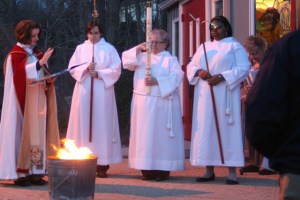
IMG_3202Our liturgy tonight operates a bit like a movie whose mode of telling stories is in flashbacks.  We start the movie with the scene we just heard.  Several women are gathered around the empty tomb, their mouths agape, and their minds racing.  And then, the flashbacks begin.

Mary the mother of James recalls that ancient story of creation.  That empty tomb reminds her of those words – tohu wabohu – the formless void.  She vaguely remembers what God said about creating humankind in God’s image.  And she hears those words repeated over and over again, “It was good; ki-tov”

Meanwhile, another woman flashes back to when humankind’s sinfulness so angered God that God flooded the earth.  For forty days, Noah knew the nothingness of that empty tomb in front her.  But she also remembers that covenant God made with Noah – that never again will there be a flood to destroy the earth.  Perhaps there is a rainbow in this tomb, and not only the watery floods that she sees.

Joanna looks into that empty tomb and remembers another time her people faced desperation.  She flashes back to the rushing Egyptians who have pinned her people to the Red Sea.  She remembers the panicked screams of her people toward Moses.  She remembers how God saved them then – how God created a way out of no way.  She wonders whether the empty tomb is not unlike that empty seabed – the one that the Israelites used to get to freedom.

Another woman stares into that vacant tomb and she remembers a different tomb.  She remembers the death and hopelessness of those bones in that valley – the thousands of devastated lives.  But then she remembers what God told Ezekiel.  She remembers the rattling of those bones coming together, and the way the breath of God, the ruah of God breathed life into those bones.  She wonders if she hears the faint ruah of God now coming out of that empty tomb.

But Mary Magdalene remembers a different story from Zephaniah.  She hears the words of that song in a fresh way today.  “Sing aloud, O daughter of Zion.”  Is this the day that God will save us?  Can her beloved Jesus be not missing, but raised?  Might Jesus be the one who will restore her fortunes?  She longs for God to be saying to her, “Rejoice and exult with all your heart, O daughter Jerusalem.”  “Please let this empty tomb be an occasion for rejoicing and not for more pain and suffering for my Lord,” Mary Magdalene prayers in her heart.

And then the movie brings us abruptly back to the empty tomb, the sound of silence like so many times before in their history.  The appearance of emptiness threatens their fragile, exhausted psyches.  Their unspoken memories fail to comfort them because they are unable to utter a word of remembrance and assurance to one another.

As outsiders watching this movie, as we watch those looking into the tomb, we begin to connect the various flashbacks.  The answers are there before the angels need to say a word.  God loves us and creates us in God’s image.  And we are not only good – but we are very good – wehineh-tov.  God promises to never destroy us again as God once did.  God promises liberation from oppression.  God promises restoration to our bodies and spirits.  God promises to bring us home.  God promises and God saves us time and again.  And now, with this Messiah who has finally arrived, God saves us once and for all.  What has felt like a defeat is now the reason to rejoice.  The smiles that spread across our faces are exact mirrors of the smiles that spread across the faces of those women at the tomb.  The smiles are smiles that happen as we connect the varied flashbacks, remembering our salvation history, and this final act of salvation through the death and resurrection of our Lord and Savior Jesus Christ.  That tomb is not a formless void, but the holy site where all our salvation narrative culminates.  That empty tomb is in fact not empty at all.  That tomb is full of life.  Tonight is a night for alleluias, for songs of joy, and for dancing.  The light shatters the darkness this night, and we celebrate the greatest victory of all time.  Alleluia! Christ is risen.  The Lord is risen indeed!!

Sermon – Luke 19.28-40, PS, YC, March 24, 2013

25 Monday Mar 2013

Posted by jandrewsweckerly in Uncategorized

≈ Leave a comment

Tags

Holy Week, Messiah, Palm Sunday, parenting, passion, prophecy, Sermon

palm-sunday-australiaWhen I was in third grade, I had one of those classic rite-of-passage moments.  The day started out simply enough.  At school, my friend, Buffy, who normally sat right behind me, was out sick that day.  On the way to lunch, another friend, Holly, lamented how much she missed having Buffy there.  I agreed, but casually mentioned that I was getting more work done because Buffy was not distracting me by talking so much.  The comment was a rare, blatantly honest comment about how, although I loved my friend Buffy, Buffy did tend to talk a little too much.  That moment of rare, brutal honest cost me dearly.  That night, Holly called to tell me how upset Buffy was that I said she talked too much.  I was devastated and embarrassed.  I could not believe Holly had betrayed my confidence and told Buffy what I said.  Now I was forced to call Buffy and figure out how to meaningfully apologize.  This was a tall order for a third grader.

What I remember most about that interaction is the presence of my mother.  Before I got up the courage to call Buffy to apologize, I came to my mother weeping.  I was weeping out of remorse, I was weeping out of embarrassment, and I was weeping because I felt like I had no legitimate excuse for my words.  How could I keep Buffy as a friend with her knowing how I felt about her talking habits?  My mother stood by my side, encouraging me to face my fears, assuring me that everything would eventually be okay.

As I look back at that day now as a parent, I can only imagine how my mother must have felt.  She must have felt awful for me, knowing how painful removing one’s foot from one’s mouth can be.  She must have known that this kind of grievance would take a long time to forgive, and that I would have to maintain a tone of repentance, without the assurance of forgiveness.  She must have anticipated how difficult my apology would be and how vulnerable offering that apology would make me.  But my mother must have also known that all of those experiences are a part of growing up and being in relationship with others.  She could not navigate my mess for me.  She could not take away my discomfort.  She knew I just needed to go through the experience, and would be transformed in the process.  I remember my mother being infinitely supportive; but years later, I imagine my mother must have felt impotent and helpless as I navigated the realities of growing up.

In some ways, I think that Holy Week leaves us with that same sense of impotence and helplessness.  We would love nothing more than to finish our worship today with Jesus’ story on that blessed Palm Sunday.  Everything is there.  The prophecies are being fulfilled:  Zechariah already foretold of how the Messiah would come triumphantly, but humbly, riding on a donkey.[i]  Everyone is already singing those words from the Psalms, “Blessed is the king who comes in the name of the Lord!”  There is no mistaking that the pieces of the puzzle are all present – Jesus is the long awaited Messiah and the people finally get it as they lay down their blankets and celebrate their king.  We should be able to say, “The end,” today and all go home, ready to celebrate again next week.

Unfortunately, we do not get off so easily.  Like a mother who wants to shield her children, we want to shield Jesus and ourselves from the pain that will come this Holy Week.  We want to skip the Passion Narrative – or at least save the narrative for Good Friday – delaying the inevitable.  But our liturgy today does not let us avoid the uncomfortable remainder of the story.  I have long been told that the reason we read the Palm liturgy along with the Passion Narrative is because so few church-goes actually attend Holy Week services.  But I think there is more to today’s liturgy than cramming everything into one Sunday.  I think we hear the Passion Narrative with the Palm liturgy because the Palm liturgy can only be understood in light of the Passion.  If we try to claim victory today with our palms, we miss the work of the Messiah.  We forget the rest of prophecy if we stop with the palms.  The palms simply mark our acknowledgment of Jesus’ identity as the Messiah.  The Passion gives us the consequences of Jesus’ identity as the Messiah.

Using the parenting lens this year has helped me with my normal disappointment in Palm Sunday.  Normally, Palm Sunday makes me feel like a failure.  Here I am in one moment singing, “All Glory, Laud, and Honor,” joining the festival procession with my palms, and the next moment shouting “Crucify him!”  This liturgy has always made me feel like a failure.  But the parenting lens changes things for me.  If I think of this day not as a failure on my part, but as the experience that Jesus must live through in order to free us from our sins, somehow I feel less impotent.  Somehow I am better able to sit with Jesus today, knowing that I cannot change his journey, but also knowing that his painful journey will lead to greater things.  Without the recognition of Jesus’ identity in the palms liturgy, and the shameful death of Jesus in the passion narrative, we cannot get through to the other side – to the Easter resurrection that awaits us.

So today, we take on the role of supportive parent.  We sit in the kitchen, pretending to read a magazine, while intently listening to the painful journey of Jesus.  If we are good parents, we let the drama unfold as the drama needs to unfold.  But we also keep watch, waiting to be called into the fray to offer our love and support.  We cannot control Jesus’ journey, and in the end, that is for the best – because the end of Jesus’ story is much better without our meddling ways anyway.  Amen.


[i] George W. Stroup, “Theological Perspective,” Feasting on the Word, Yr. C, Vol. 2 (Louisville: Westminster John Knox Press, 2009), 152.

Homily – Matthew 16.13-19, Confession of St. Peter the Apostle, January 17, 2013

14 Thursday Feb 2013

Posted by jandrewsweckerly in Uncategorized

≈ Leave a comment

Tags

celebrate, confession, homily, Jesus, Messiah, St. Peter

I got a little behind posting my homilies from our Thursday Eucharists.  The next few entries will catch us up!

Today we honor the Confession of St. Peter the Apostle:  that moment when Peter declares that Jesus Christ is the Messiah.  Peter is one of my favorite characters in the New Testament, mostly because he is always messing up.  He is the rock on which Jesus will build his Church – he even renamed Peter for this reason.  But Peter is always messing up, sinking in the sea, offering to build tabernacles at the Transfiguration, and denying Jesus Christ three times.

I don’t love that Peter messes up because I am superior to Peter.  I love that Peter messes up because I mess up so much too.  I am always doubting God.  I am always misunderstanding what God is doing.  I am always denying my Lord – in small and big ways.  Somehow, if Peter can do all these things and still be loved by Jesus, maybe there is hope for me.  What I love about today’s feast day, though, is that today celebrates a day when Peter gets it right – no beating up Peter; no making excuses.  Today is a day that Peter gets it, and we the church rejoice.

What is even more redeeming to me is that Jesus declares how Peter achieves this moment of clarity.  “For flesh and blood has not revealed this to you, but my father in heaven.”  Peter does not achieve this clarity or earn it or do it on his own – only through God can he be this clear-headed rock of the Church, declaring, “You are the Messiah.”

This is how we, too, follow the life of Christ and our call in that life.  Only through God, who alone can make us all clear-headed, impassioned lovers of Jesus Christ.  We will continue to mess up, just like Peter, but we will have our moments.  Moments we make God proud, maybe even moments that make the church want to celebrate these proud moments.  Because not only do we celebrate our victories, we celebrate the One who makes those victories possible.  Amen.

Sermon – Luke 4.14-21, EP3, YC, January 27, 2013

30 Wednesday Jan 2013

Posted by jandrewsweckerly in Uncategorized

≈ Leave a comment

Tags

change, Jesus, Messiah, power, Sermon, words

The word is spreading.  The new rabbi in town is incredible!  He is clearly filled with the Spirit.  He has become quite the sensation in Galilee and everyone expects his appearance in Nazareth to be impressive – what home town would not love to see their son come home and preach a good word?!  Nazareth, expecting to be proud and wowed, sits in the synagogue.  And then it happens – Jesus does not preach a scintillating sermon.  Instead, he finds a bold text – a text from Isaiah that we all know contains the words that the Messiah will use – reads the text, and then he just sits down.  The room is silent.  We all just stare.  The shock is heavy in the room and words fail us all.  Our minds are running amok with questions.  Did he just read that text from Isaiah?  Is he saying he is the Messiah?  Is he the Messiah?  What does this mean?  What does he mean the scripture is fulfilled?  Of course, no one says those words aloud.  We just stare.  We stare in silence.

Words have mighty power in our lives.  As we celebrated the Rev. Dr. Martin Luther King this past week, I have read countless quotes from his life and ministry.  He was a man who knew how to use words powerfully.  In an age where we are barraged by words – in media, in politics, in books – we sometimes forget the power of words.  We tend to skim words, to gloss over them, looking to quickly glean information because we are inundated with words.  In our haste, we forget the power of words.

The catch with words is that words have the power to make both positive change and to get us into trouble.  My grandfather always used to say, never put anything in print that you do not want the world to see.  We have watched these last months how words can cause trouble.  This fall’s political campaign led to many people saying words they regret.  Just in the past two weeks, two big athletes, Lance Armstrong and Manti Te’o, realized the chaos that their words could produce.  Teens every week are terrorized by the words of cyberbullying – with reputations ruined worldwide when seemingly private photos or acts are posted on Facebook for all to see.[i]

This is why that silent synagogue is so powerful today.  Jesus takes words that everyone knows, and he changes them.  The Messiah, the anointed one, has been long awaited:  so long awaited, that I doubt many people still believed the Messiah would come in their time.  So Joe’s boy rolling up into the synagogue and declaring that he is the anointed Messiah is a big deal.  These are words of power and weight – so heavy that the room is completely silent.

Part of the weight of Jesus’ words comes from whom he is claiming to be.  The other part of the weight of Jesus words is interpreting what they mean for the world now.  For Jesus, and for his followers, these words from Isaiah through Jesus become a mission statement of sorts.[ii]  If you remember, in Luke’s gospel Jesus is baptized, goes into the wilderness to be tempted, and this is the first that we really hear from Jesus.  These words are not just bold words – these words will define the entire remainder of Luke’s gospel.  If you were writing one of those fifth-grade book reports, you can almost hear the introduction, “The theme of Luke’s gospel is that Jesus brings good news to the poor, release to the captives, recovery of sight to the blind, freedom to the oppressed, and the year of the Lord’s favor.”  For the rest of this lectionary year we will be hearing stories of Jesus fulfilling these words – good news, release, sight, freedom, favor.  This is what Jesus’ ministry is about.  Jesus takes the words from Isaiah and he changes them.  And through changing them, he changes the world.

A video has been circulating this week called, “The Power of Words.”  In it, a blind man is sitting on a sidewalk, with a cardboard sign that reads, “I’m blind.  Please help.”  As he sits there, two or three of the tens of people who pass by actually drop a coin or two in front of him.  He silently feels for the coin and then puts the coin in his tin can.  Finally a woman sees him and stops.  She silently picks up his sign, turns the piece of cardboard over and writes something else on the sign.  Without a word, she walks away.  In the next several scenes everyone stops and gives the blind man handfuls of coins.  The woman eventually returns, and dumbfounded, the man asks her, “What did you do to my sign?”  She simply replies, “I wrote the same, but different words.”  As she walks away, we see that what she wrote is, “It’s a beautiful day and I can’t see it.”  She took a sign that said, “I’m blind.  Please help,” and she changed the words to, “It’s a beautiful day and I can’t see it.”  The video ends with these words, “Change your words.  Change the world.”[iii]  What the woman in this video does is she takes something we see everyday – a man asking for help, and makes him not so “everyday.”  By changing the words on his sign, she helps all see with fresh eyes.  Suffering and pain no longer seems acceptable simply because of her words.  She changes people with her words

This is what Jesus does in that temple.  He takes words with a certain set of values and meaning, and he changes them.  No longer will good news, release, sight, freedom, and favor be a future dream.  They will change now with Jesus Christ.  So perhaps part of the silence in that synagogue comes from the joyful realization that this liberation might actually happen in their time.  But another part of that silence comes from the implications.  If the Messiah is here, offering liberation from poverty, imprisonment, blindness, and oppression, then that means that the people of God will have to start living like the Messiah is here.  They too will have to work to bring good news to the poor.  They too will have to work to release the captives.  They too will have to care for the blind and the oppressed.  They too will have to honor the year of the Lord’s favor, the Jubilee Year when debts are forgiven, slaves are freed, and lands are left to rest.  Jesus’ words not only change the people of God’s reality, Jesus’ words will change the world, and the people of God’s behavior in that word.  This is big, silence-making news.

Jesus’ words change us too.  We too are left in silence as the weight of Jesus’ words hit us.  If we are to follow Jesus, we too are to be working for the poor, the imprisoned, the blind, and the oppressed.  As that reality waves over us, we too are silenced by the questions.  What does that mean for us?  How will this change my walk with God?  How uncomfortable is this work going to be?  How joyful will this work be?  Pondering these and probably many more questions is a good thing, even more so with Lent on the horizon and the looming of our own Jubilee year here at St. Margaret’s.  With the text ending as the text does today, we are invited to tarry in that silent pondering today.  But know that the pondering is not indefinite.  Jesus’ words hint at the immediacy of the work that is needed.  “Today this scripture has been fulfilled in your hearing.”  So do the pondering you need to do.  But know that Jesus is waiting at the back door, ready for you to join him in the messianic work of good news, release, sight, freedom, and favor.  Amen.


[i] Idea recently confirmed in this piece on NPR: http://www.wnyc.org/shows/rookies/articles/radio-rookies/2012/dec/28/sexual-cyberbullying-modern-day-letter/.

[ii] Ernest Hess, “Homiletical Perspective,” Feasting on the Word, Yr. C, Vol. 1 (Louisville:  Westminster John Knox Press, 2009), 287.

[iii] http://www.youtube.com/watch?v=Hzgzim5m7oU

Newer posts →

Recent Posts

  • On the Myth and Magic of Advent…
  • On Risking Failure and Facing Fear…
  • Sermon – Luke 23.33-43, P29, YC, November 23, 2025
  • On Inhabiting Gratitude…
  • Sermon – Luke 20.27-38, P27, YC, November 9, 2025

Archives

  • December 2025
  • November 2025
  • October 2025
  • September 2025
  • August 2025
  • July 2025
  • June 2025
  • March 2025
  • February 2025
  • December 2024
  • November 2024
  • October 2024
  • September 2024
  • August 2024
  • July 2024
  • June 2024
  • May 2024
  • March 2024
  • February 2024
  • January 2024
  • December 2023
  • November 2023
  • October 2023
  • September 2023
  • August 2023
  • July 2023
  • June 2023
  • May 2023
  • March 2023
  • February 2023
  • January 2023
  • December 2022
  • November 2022
  • October 2022
  • June 2022
  • May 2022
  • January 2022
  • December 2021
  • November 2021
  • October 2021
  • September 2021
  • August 2021
  • June 2021
  • May 2021
  • April 2021
  • March 2021
  • February 2021
  • January 2021
  • December 2020
  • November 2020
  • October 2020
  • September 2020
  • August 2020
  • July 2020
  • June 2020
  • May 2020
  • April 2020
  • March 2020
  • February 2020
  • January 2020
  • December 2019
  • November 2019
  • October 2019
  • September 2019
  • August 2019
  • July 2019
  • June 2019
  • May 2019
  • April 2019
  • March 2019
  • February 2019
  • January 2019
  • December 2018
  • November 2018
  • October 2018
  • September 2018
  • August 2018
  • July 2018
  • June 2018
  • May 2018
  • April 2018
  • March 2018
  • February 2018
  • January 2018
  • December 2017
  • November 2017
  • October 2017
  • September 2017
  • August 2017
  • July 2017
  • June 2017
  • May 2017
  • April 2017
  • March 2017
  • February 2017
  • January 2017
  • December 2016
  • November 2016
  • October 2016
  • September 2016
  • August 2016
  • July 2016
  • June 2016
  • May 2016
  • April 2016
  • March 2016
  • February 2016
  • January 2016
  • December 2015
  • November 2015
  • October 2015
  • September 2015
  • August 2015
  • July 2015
  • June 2015
  • May 2015
  • April 2015
  • March 2015
  • February 2015
  • January 2015
  • December 2014
  • November 2014
  • October 2014
  • September 2014
  • August 2014
  • July 2014
  • June 2014
  • April 2014
  • March 2014
  • February 2014
  • January 2014
  • December 2013
  • November 2013
  • October 2013
  • September 2013
  • August 2013
  • July 2013
  • June 2013
  • May 2013
  • April 2013
  • March 2013
  • February 2013
  • January 2013
  • December 2012
  • November 2012
  • October 2012
  • September 2012

Categories

  • reflection
  • Sermons
  • Uncategorized

Meta

  • Create account
  • Log in
  • Entries feed
  • Comments feed
  • WordPress.com

Blog at WordPress.com.

  • Subscribe Subscribed
    • Seeking and Serving
    • Join 394 other subscribers
    • Already have a WordPress.com account? Log in now.
    • Seeking and Serving
    • Subscribe Subscribed
    • Sign up
    • Log in
    • Report this content
    • View site in Reader
    • Manage subscriptions
    • Collapse this bar
 

Loading Comments...