
• About

Seeking and Serving

~ seek and serve Christ in all persons

Seeking and Serving

Tag Archives: possessions

Sermon – Luke 14.25-33, P18, YC, September 8, 2019

11 Wednesday Sep 2019

Posted by jandrewsweckerly in Sermons, Uncategorized

≈ Leave a comment

Tags

blessing, community, cost, cross, decisions, discipleship, easy, hard, hate, Jesus, light, possessions, priorities, rainbows, Sermon, sunshine

One of the things I enjoyed about living on Long Island was the directness of communication.  Now do not get me wrong, having been raised in the South, I know all too well that when your mom says, “You’re wearing that?” or if your grandma says, “Don’t you want to wear lipstick?” or if your friend says, “Well those new shoes are utilitarian,” they are not actually saying what they mean.  On Long Island things are much clearer.  Instead you’ll be told, “Don’t wear that,” “Put on some lipstick; I’ll show you which one,” and “Those shoes are awful.”  The words always sting, but at least you know you what people think.

Today’s gospel has me convinced some of Jesus’ relatives were from Long Island.  In these short eight verses, Jesus says if we want to follow him, we will need to sell our possessions, carry our cross, and hate our parents, spouse, children, siblings, and even life itself.  I have to say, on this Rally Sunday, on the day we return to the fullness of Hickory Neck, and we feast and laugh and worship together, I could have used a little more southern-speak from Jesus today.  At least Jesus could have saved the hard sell for Stewardship season!

But as we start putting our calendars together for the fall, as our children sign up for the extracurricular activities, and as we think about what ministries we may want to try at Hickory Neck this fall, I suppose there is no time like the present to get real.  This is a season of hard choices.  I know in our household alone, there were two awesome opportunities for afterschool activities that fell on the exact same time and day.  And so we had to make a hard decision.  As I have mapped out my own calendar, I have realized that there are things I can say yes to and things to which I have to say no.  And on the really tricky days, there are times when our family has to bring in a third adult to help us juggle four people’s commitments.  This is a season of hard choices and consequences.  This is a season of priorities.

I do not actually think Jesus is being harsh today.  I know we sometimes get so used to the inclusive, loving, embracing God that we forget that following Jesus is not all rainbows and sunshine.  Jesus, like our beloved Long Islanders, is not harsh – just honest.  And Jesus is not saying there will be no health, healing, and wholeness; no justice, mercy, and grace; no forgiveness, salvation, and eternal life.  But Jesus is saying those things will cost us.  All those rainbows and sunshine we will receive come at the cost of redistributing wealth, of being faithful even when being faithful gets us ostracized from our social circles, of being intolerant of injustice even if doing so risks our most valued relationships with others.

If we can agree that Jesus is just being honest, understanding why he is setting such a high standard can be helpful.  Starting with one of the trickier things Jesus says today may be best.  Jesus says in the final verse today, “None of you can become my disciple if you do not give up all your possessions.”  Though money is a taboo subject for most people, Jesus talks about money perhaps more than any other subject in scripture.  Jesus talks about money so much because Jesus knows the power money has over us.  Jesus tells us to give up our possessions, to stop worrying about what is mine because my obsession with owning, possessing, or claiming things as my own can make me think ownership is my exclusive, inviolable right.  Jesus knows having possessions can make me think all things are my own:  my money, my time, my comfortable lifestyle, my political or religious beliefs, my closest relationship, my independence.  Jesus knows when I get possessive, I cling to things that are not God, and create habits in myself leading me to smother, not love; to exploit, not steward; to hoard, not appreciate.[i]

On the podcast “On Being,” Rabbi Amichai Lau-Lavie retells an old Talmudic parable.  In the parable there is “a ship that is sailing, and there are many cabins.  And one of the people in the cabins on the lower floor decides to dig a hole in the floor of his cabin, and does so, and sure enough, the ship begins to sink.  And the other passengers suddenly discover what’s going on and see this guy with a hole in the floor.  And they say, ‘What are you doing?’ And he says, ‘Well, it’s my cabin. I paid for it.’  And down goes the ship.”[ii]  What this parable and what Jesus are trying to do is help us see that possessions tempt us to live like the man in the cabin – to believe our ownership negates our relationship to others.  Our possessions can create an obsession with “me, me, me,” with a disregard for the “we” to which we belong as followers of Christ.

Jesus also says in verse 27, “Whoever does not carry the cross and follow me cannot be my disciple.”  Part of Jesus’ cross is a redefining of the “we,” we were just talking about.  If you have read your September Nuggets, our newsletter, you know one of the rallying calls of stewardship this fall is going to be “We are Hickory Neck!”  When I thought about that call, I immediately thought about the movie We Are Marshall.  In the film, the rally call “We Are,” answered vigorously by “Marshall!” is a definitive moment about not letting tragedy overcome goodness – not letting death squash life.  When we start our own rallying, “We are Hickory Neck,” we probably all have things about Hickory Neck that are dear to our heart, that inspire our belonging here, and motivate our involvement here.  One of the things we are doing in the call, “We are Hickory Neck,” is also defining who the “we” is in that call.  In carrying our cross as Jesus invites today, we are not just talking about personal sacrifice.  We are also asking, to whom and for whom we are responsible.  We are widening the circle of “my people,” to consider who the people are we will love, welcome, serve, and for which we would make sacrifices.  We are taking on the task of widening our “we” to be broader and riskier than we have previously embraced.  By taking up our cross, we are saying the whole ship, not just my cabin on the ship, but the whole ship has an irrefutable claim on my life.[iii]

Perhaps the hardest thing Jesus says comes right at the beginning, in verse 26.  Jesus says, “Whoever comes to me and does not hate father and mother, wife and children, brothers and sisters, yes, and even life itself, cannot be my disciple.”  Hate is a strong word – a word we have banned in our home, especially when talking about other family members.  I will not be going home today and telling our children they can pick up that word again.  But I do think Jesus uses a powerful word because the power of discipleship will involve taking on some powerful experiences.  We will need to be willing to hate some things about this life.  We will need to ask which customs, beliefs, or traditions we have inherited we need to renounce in order to follow Jesus.  We will need to look at what baggage we need to abandon, what ties we must loosen, what relationships we must subordinate.  What scholar Debie Thomas says is “Jesus spoke his hard words about ‘hating’ one’s family in a cultural context where the extended family was the source of a person’s security and stability.  Jewish families in first century Palestine were self-sustaining economic units.  No one in their right mind would leave such a unit behind in order to follow a homeless, controversial preacher into some uncertain future.”  What Thomas asks us to consider is what sources of modern-day security and stability we trust more than we trust God.[iv]

So if this is what discipleship looks like, where is the Good News in Jesus’ challenge today?  Why would we do all this hard stuff?  We do all the hard stuff of discipleship because of the rainbows and sunshine.  We give up a sense of possession, we take on crosses, and we renounce things we have loved because we have experienced the rainbows and sunshine of Hickory Neck:  we have experienced life-altering community here; we have experienced love, joy, and blessing we did not know we needed here; we have found purpose, meaning, and value here.  We also take on Jesus’ intense notion of discipleship because we have experienced the rainbows and sunshine of the world around us:  we have experienced the profundity of loving our neighbor as ourselves; we have experienced the blessing of seeing God in someone we thought unworthy of our love; we have experienced being transformed by walking right out of our comfort zones into life-giving discomfort zones.  We accept the invitation of illogical discipleship because of the more cosmic rainbows and sunshine of faith:  of being known and accepted by a loving, living God; of the promise of forgiveness of our most heinous sins; of the reality of eternal life made possible through Jesus’ life, death, and resurrection.  Once we start thinking about the rewards of the life of discipleship, the cost seems surmountable.  Once we look at the depth of Christ’s rainbows and sunshine, letting go of possessions, taking up crosses, and hating the stuff of life that only brings death seems much less scary.  Once we realize we may not be able to do whatever we want to in our cabin, we realize we have a ship full of people ready to hold our hands as we take on the burden of discipleship together – because the burden is easy and the yoke is light.  Amen.

[i] Debie Thomas, “What It Will Cost You,” Journey with Jesus, September 1, 2019, as found at https://www.journeywithjesus.net/lectionary-essays/current-essay?id=2346 on September 4, 2019.

[ii] Amichai Lau-Lavee, “First Aid for Spiritual Seekers,” On Being with Krista Tippet, July 13, 2017, as found at https://onbeing.org/programs/amichai-lau-lavie-first-aid-for-spiritual-seekers/ on September 6, 2019.

[iii] Thomas.

[iv] Thomas.
Homily – Matthew 11.25-30, St. Francis, October 6, 2013

10 Thursday Oct 2013

Posted by jandrewsweckerly in Uncategorized

≈ Leave a comment

Tags

creator, gift, God, gratitude, homily, Jesus, life, possessions, St. Francis, stewardship, stuff, yoke

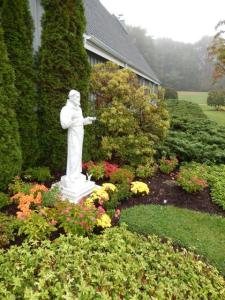
Today we honor the life and work of St. Francis of Assisi.  Francis was born in 1182, and was the son of prosperous merchant.  But later in life, he was moved by the beggars and lepers he saw and decided to devote his life to a life of poverty – despite his father’s intense opposition.  Francis gathered a community together – although his ideal of strict and absolute poverty was so stark that almost no one could maintain the ideal.  But what Francis was trying to get the brothers to see was that “stuff” got in the way of life with Christ.  Once he renounced his “stuff” he was better able to see – see his neighbors’ poverty and suffering.  And giving up his “stuff” allowed Francis to take in a bigger view of God’s creation.  Though we sometimes narrow in on Francis’ love of animals, St. Francis had a much larger sense of the creative God and God’s created world.  Francis reveled in the creator God, who time and again during the creation process saw that, “it was good.”

Our Sunday School children have been working on the creation story this Fall.  They are learning about the vast expanse of interstellar space, as well as this fragile earth, our island home.  They are learning about how God created plants and every living creature.  They are also learning about how we are created in God’s image and we are to be stewards of God’s creation.  They are learning how we are designed for goodness and generosity, and that all of life is a gift – that we do not own any of it.  St. Francis knew this well.  His understanding of life as a gift is why he could give up everything.

But we struggle – we clutch to our resources and we use words like “earned,” and “deserve” and forget words like “gift” and “generosity.”  St. Francis’ life is all well and good, but when we really look at our resources, we more often find our hands clenched around our possessions than our hands openly giving them away.  I invite us to ponder this contrast not to make us feel guilty, but to invite us to live into God’s generosity.  That is what St. Francis wanted too.  He did not want to guilt people, but to welcome people into the freedom of knowing that all we have is gift, and to live a life in celebration of that gift.  Francis had experienced this radical way of living into the people God calls us to be, and he wanted to share that blessing with others.

Our Gospel lesson today gives us some clues about what all this means in practice.  Jesus says, “Come to me, all you that are weary and are carrying heavy burdens, and I will give you rest.  Take my yoke upon you, and learn from me; for I am gentle and humble in heart, and you will find rest for your souls. For my yoke is easy, and my burden is light.”  Those words from Jesus are echoed in St. Francis’ life and witness.  We may not be able to walk around shoeless in the depths of winter like Francis, or even beg for our food, but when we enter into relationship with God with a greater sense of God’s invitation into the life of generosity, we can image and experience the light yoke.  This is the reflection work we will be doing throughout our stewardship season this fall – but Francis and Jesus give us a little preview about what stewardship really looks like.  So take a moment to start today.  Take in the beautiful creation of our property, as its Fall glory begins to unfold.  If you are an animal lover, look at the generous love of your pet.  Look at one another, remembering the vulnerable beauty of each person here – even those who annoy you the most.  Let this wonder and gratitude fill you up – so that you can slip on that light yoke of generosity and live into the goodness that God has created for you and has created you for.  Amen.

Sermon – Luke 12.32-40, P14, YC, August 11, 2013

18 Sunday Aug 2013

Posted by jandrewsweckerly in Uncategorized

≈ Leave a comment

Tags

blessing, Jesus, money, possessions, Sermon, stuff, treasure, uncomfortable

A few weeks ago, a parishioner told me about how he had run into a guy in the parking lot of a grocery store he frequents.  He knew the man to be homeless, and as he was doing his own grocery shopping, he purchased a couple of bags of food for the man.  When he stopped by the car to deliver the bags, the man was overcome with gratitude.  The homeless man’s gushing evoked something in this parishioner, and he found that he just opened his wallet and gave the man all the cash he had too.  That is the funny thing about generosity.  Generosity is kind of addictive.  When we see how much something small means to someone else, we find we want to do more.  And in some strange way, our entire perspective shifts.  Those pennies we were pinching now just seem like pennies:  their value and meaning shift.

This is what Jesus has been trying to get at these last two weeks.  If you remember, last week, Jesus told the parable of a man who was scolded for storing up his excess produce in larger barns, especially since that man would die that very night.  Today, Jesus talks more about the “stuff,” of life.  Jesus says, “Sell your possessions, and give alms.  Make purses for yourselves that do not wear out, an unfailing treasure in heaven, where no thief comes near and no moth destroys.  For where your treasure is, there your heart will be also.”  Now I know:  most of us check out when Jesus says, “Sell your possessions.”  There are very few of us who can truly part with all of our possessions.  But what Jesus is really trying to get at is in the last sentence.  “For where your treasure is, there your heart will be also.”  Jesus wants his followers to see that the stuff of life is neither important nor unimportant.  But our attitude toward our stuff is what is important.

I worked at a parish when I was in seminary that was planning a remodeling of their building.  As different schematics were presented, the number one complaint I heard was, “We need more storage space.”  No matter how many different ways the architect and priest presented new layouts, the complaint about storage space kept arising.  When I finally asked the priest why they did not just put in more storage space into the plans, the priest told me this:  “You know what, Jennifer?  I do not want to put in more storage space because I know they will fill it.”  I was confused at first, wondering whether that might be the point – the parish had stuff they needed to store, hence the request for more space.  But eventually, what I came to see the priest as arguing was that no matter how much space they created, the parish would simply accumulate more stuff to keep storing.  Anyone who has upgraded from a smaller living space to a larger one knows how true this can be.  The more space we have, the more we tend to fill the space with stuff.

The trouble is not inherent in the stuff.  Our stuff is not necessarily evil.  The trouble with our stuff is that much like the land owner last week, when we get so focused on storing and maintaining stuff, our focus or our heart becomes fixed on the stuff and not the potential for the stuff.  Seven years ago, Scott and I moved to a one-bedroom apartment at seminary.  We had more things than could move with us, so we got a storage unit back in Delaware.  When we finally moved to Long Island, we emptied that storage unit.  As I was looking for something in the basement the other day, I realized I have a ton more dishes in the basement than I ever use.  Part of me wanted to get them out and start using them.  But then part of me wondered whether if I could survive for seven years without those casserole dishes and extra glassware, maybe I did not actually need them.  That conclusion has led to some challenging thoughts about the potential for our stuff.

Now I know these texts the last two weeks make us feel uncomfortable.  We do not like talking about money or our stuff in church.  We do not even like talking about those topics in stewardship season, let alone in the comfort of summer!  But we get these texts this time of year because their message is important for us to hear everyday.  When we are so burdened with stress or anxiety about money or our stuff, or even the stuff we want to have but do not have, then our bodies become tense, and our hands tightly closed.  The trouble with those tightly closed hands is that we cannot receive God in the ways that God desires to come to us.  The warnings later in today’s text about being ready are not to “‘Be ready so that you will avoid punishment,’ but, rather, ‘Be ready so that you will receive blessing.’”[i]

That is why Jesus wants us to be aware about where our treasure is.  In fact, we hear his longing in his first words today, “Do not be afraid, little flock, for it is your Father’s good pleasure to give you the kingdom.”  In other words, you do not need store up things or tarry in anxiety about the earthly stuff.  Our God, that loving father, is pleased to give you all the blessings of the kingdom; and not just in the heavenly kingdom, but here and now.

The question for us this week, then, is what “stuff” is getting in our way of receiving God’s blessing?  What are our arms so full of that we cannot have open arms to receive God’s blessing?  For me, I have been working on letting go not just of the physical stuff of life, but more my own emotional stuff.  Just last week, Simone and I went away for a week at the beach where we would share an 11-room house with other families.  I spent the weeks leading up to the trip worrying about what to bring, how I would haul all the beach “stuff” to and from the beach by myself, what toys or videos we would need for entertainment, and how I would manage the different meal schedule – since meals were served about two hours later than in the Andrews-Weckerly house.  Now certainly my weeks of preparation meant that I was well prepared.  But what I missed in all that preparation was that there would be ten other families present.  My concerns about being the sole parent for the week and how I would manage became all about me.  I forgot that God was giving me the blessing of ten other parents and at least two other sets of siblings to help me cope.  People chipped in with entertaining my child, by aiding with discipline, and with finding creative alternatives when the rains came.  I spent weeks trying to figure all this out by myself, when if I had just heard God’s word for me today, “Do not be afraid, little flock, for it is your Father’s good pleasure to give you the kingdom,” I might have been able to open my arms a lot sooner for God’s blessing.

The question is the same for all of us.  We all can stand to think about where our treasure is today.  Because God longs for our hearts to be in the blessings that God already decided to give to us.  What do you need to let go of today in order to open your arms for God’s blessing?  Amen.


[i] Audrey West, “Theological Perspective,” Feasting on the Word, Yr. C, Vol. 3 (Louisville: Westminster John Knox Press, 2010), 336.

Recent Posts

  • On the Myth and Magic of Advent…
  • On Risking Failure and Facing Fear…
  • Sermon – Luke 23.33-43, P29, YC, November 23, 2025
  • On Inhabiting Gratitude…
  • Sermon – Luke 20.27-38, P27, YC, November 9, 2025

Archives

  • December 2025
  • November 2025
  • October 2025
  • September 2025
  • August 2025
  • July 2025
  • June 2025
  • March 2025
  • February 2025
  • December 2024
  • November 2024
  • October 2024
  • September 2024
  • August 2024
  • July 2024
  • June 2024
  • May 2024
  • March 2024
  • February 2024
  • January 2024
  • December 2023
  • November 2023
  • October 2023
  • September 2023
  • August 2023
  • July 2023
  • June 2023
  • May 2023
  • March 2023
  • February 2023
  • January 2023
  • December 2022
  • November 2022
  • October 2022
  • June 2022
  • May 2022
  • January 2022
  • December 2021
  • November 2021
  • October 2021
  • September 2021
  • August 2021
  • June 2021
  • May 2021
  • April 2021
  • March 2021
  • February 2021
  • January 2021
  • December 2020
  • November 2020
  • October 2020
  • September 2020
  • August 2020
  • July 2020
  • June 2020
  • May 2020
  • April 2020
  • March 2020
  • February 2020
  • January 2020
  • December 2019
  • November 2019
  • October 2019
  • September 2019
  • August 2019
  • July 2019
  • June 2019
  • May 2019
  • April 2019
  • March 2019
  • February 2019
  • January 2019
  • December 2018
  • November 2018
  • October 2018
  • September 2018
  • August 2018
  • July 2018
  • June 2018
  • May 2018
  • April 2018
  • March 2018
  • February 2018
  • January 2018
  • December 2017
  • November 2017
  • October 2017
  • September 2017
  • August 2017
  • July 2017
  • June 2017
  • May 2017
  • April 2017
  • March 2017
  • February 2017
  • January 2017
  • December 2016
  • November 2016
  • October 2016
  • September 2016
  • August 2016
  • July 2016
  • June 2016
  • May 2016
  • April 2016
  • March 2016
  • February 2016
  • January 2016
  • December 2015
  • November 2015
  • October 2015
  • September 2015
  • August 2015
  • July 2015
  • June 2015
  • May 2015
  • April 2015
  • March 2015
  • February 2015
  • January 2015
  • December 2014
  • November 2014
  • October 2014
  • September 2014
  • August 2014
  • July 2014
  • June 2014
  • April 2014
  • March 2014
  • February 2014
  • January 2014
  • December 2013
  • November 2013
  • October 2013
  • September 2013
  • August 2013
  • July 2013
  • June 2013
  • May 2013
  • April 2013
  • March 2013
  • February 2013
  • January 2013
  • December 2012
  • November 2012
  • October 2012
  • September 2012

Categories

  • reflection
  • Sermons
  • Uncategorized

Meta

  • Create account
  • Log in
  • Entries feed
  • Comments feed
  • WordPress.com

Blog at WordPress.com.

  • Subscribe Subscribed
    • Seeking and Serving
    • Join 394 other subscribers
    • Already have a WordPress.com account? Log in now.
    • Seeking and Serving
    • Subscribe Subscribed
    • Sign up
    • Log in
    • Report this content
    • View site in Reader
    • Manage subscriptions
    • Collapse this bar
 

Loading Comments...