
• About

Seeking and Serving

~ seek and serve Christ in all persons

Seeking and Serving

Tag Archives: prophet

Sermon – Jeremiah 36.27-37.2, VTS Convocation Evensong, October 11, 2022

19 Wednesday Oct 2022

Posted by jandrewsweckerly in Sermons

≈ Leave a comment

Tags

church, God, how, Jeremiah, kingdom of God, love, normalcy, pandemic, poll, prophet, repeat, repent, rest, salvation narrative, Sermon, values, why

This sermon was delivered to Virginia Theological Seminary on the occasion of our annual Convocation for alumni, faculty and staff, and seminarians.
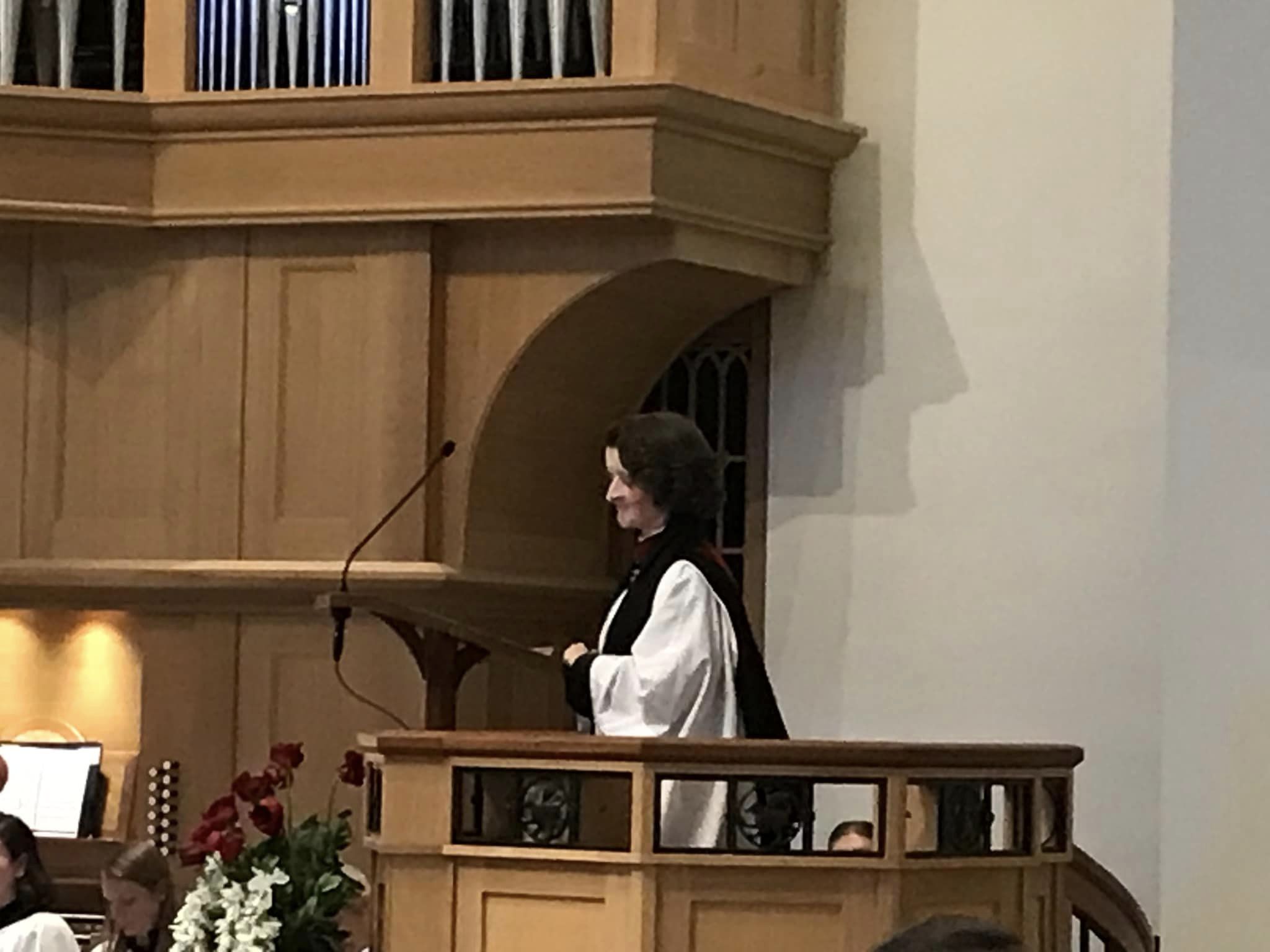
Photo credit: The Rev. Matthew Tucker

I live in a pretty “purple” district in Southern Virginia.  My Congressman represents a different party than my own, but I make a point to stay on his mailing list as a way to remind him that he represents a politically diverse district.  Every month he sends out polls, and I dutifully respond to them.  But with every survey I find myself frustrated.  My Congressman either has never taken a class in crafting an unbiased survey or he is simply not interested in different opinions.  The questions are always phrased something like, “In your opinion, how bad of a job is our president doing:  terrible, really bad, pretty bad, or I’m not sure.”  Or without any nuance or explanation about the background of the issue, the poll will ask something like, “The Congress wants to pay illegal immigrants who knowingly broke the law hundreds of thousands of dollars.  Should we pay these illegal immigrant criminals, yes or no?”  Or, one of my favorites, “Which of these issues should be the priority of Congress?” (PS, none of the options listed talk about caring for the poor or our neighbor, and there definitely isn’t an “other” category).  But I dutifully take the surveys, hoping my voice is part of my representative’s decision making.

I have been pondering the ministry of Jeremiah and thinking his prophetic ministry is a bit like trying to engage my Congressman.  For those of us not taking Old Testament this semester, Jeremiah is prophesying in a time of political decline.  The northern kingdom, Israel fell to Assyria nearly a hundred years before, and Judah remains in a tenuous situation.  The Assyrians are still in control, but in the course of the book of Jeremiah, Babylon defeats Assyria and takes control of Judah.  There are rebellions against Babylon, in particular by King Jehoiakim who we hear about today, but they are eventually unsuccessful.[i]  Like any good prophet, Jeremiah is attempting to get the people and king to repent and return to the Lord.  And like all people of all time, the people refuse to listen to God.  King Jehoiakim is particularly egregious in this refusal.  In fact, just verses before our reading, the King has his attendant read Jeremiah’s prophetic scroll three or four columns at a time, then cuts those columns off the scroll and throws them in a fire.  King Jehoiakim is not alarmed by the prophecy, and certainly not repentant. 

But here’s the funny part.  In the verses we read today, the Lord tells Jeremiah to rewrite the entire scroll and add in a little final judgment.  Like me, sitting down with yet another poll from my Congressman, he sits down and does the same thing over again.  I have been of two minds about this passage.  On the one hand, and no offense toward the Lord’s prophetic practices and policies, but how many times are we to keep doing the same thing and expecting different results.  As if King Jehoiakim is going to receive the second scroll and say, “Oh, a second scroll?  Okay, I guess I won’t burn this one and will change my ways!”  If this pandemic has taught us anything this pandemic has taught us we cannot keep doing Church the way we always have and expect the Church to thrive (or in biblical terms, to repent and return to the Lord).  This pandemic has made us nimble, agile, creative, and versatile.  This pandemic made us stop thinking about hybrid ministries and digital relevance and demanded we start doing and being those things.  And God help us if our churches just want to “return to normal” after the pandemic – if we just want to write another scroll. 

But as I mentioned, I am of two minds on this passage.  On the other hand, despite what seems like poor strategy on the Lord’s part, God’s covenantal relationship with us has never really made sense.  The entire salvation narrative is about failure after failure on our part as the people of God to listen and respond to the Lord.  Promise after promise, covenant after covenant, even the sending of God’s Son has meant the Lord’s corporate strategy is a case study in what not to do to thrive in business.  But that’s what we love about the Lord, right?  God keeps writing another scroll, God keeps giving another chance, God keeps holding out hope and promise because God’s love is not meted out in a logical, economical way.  Despite all of the innovation which has been entirely life giving during this pandemic, in some ways, what we have offered to a hurting world is the same as what we have always offered:  a community of faith, redeemed by God’s grace, commissioned to love God, self, and neighbor.  Perhaps that is why I am of two minds about this text.  Although this pandemic has not changed who we are and what we offer a broken world, this pandemic has changed how we are.  Our core values as the Episcopal Church have not changed.  But throughout this pandemic we have learned that how we go about living into those core values certainly can, should, and hopefully has changed.  And, as the Genesis writer would say, “…it was very good.”

In this particular season of the Church, many of us are feeling a longing for rest, for relief from constant pivoting, for a sense of normalcy.  Many of us would like to sit down and just write the same scroll over again.  In Jeremiah’s day that second scroll meant suffering and exile, and there would be more than twenty years before the people of God would see God’s promise of restoration realized.[ii]  But I do not think that is the invitation from scripture today.  I do not think the Lord is inviting the Church to write another scroll or fill out another poll.  We have a whole Bible full of examples of how doing the same thing over and over does not lead to the fulfillment of the kingdom of God.  Instead, the invitation from scripture today is to see the patterns of the resistance to love, and find a new way to love.  God is not inviting us to change our “who” or our “what,” but to change our “how.”  Your “how” might be different from mine.  But Jeremiah shows us time and again that the same repeated “how” does not turn hearts.  Our work in this season is to listen to what new “hows” the Holy Spirit is showing us, and then be willing to be vulnerable enough to try them.  Because, Lord knows, we do not need another scroll.  Amen. 


[i] Josey Bridges Synder, “Jeremiah,” The CEB Women’s Bible, (Nashville:  Common English Bible, 2016), 953.

[ii] 953.

Sermon – Jonah 3.10-4.11, Matthew 20.1-16, P20, YA, September 20, 2020

23 Wednesday Sep 2020

Posted by jandrewsweckerly in Sermons

≈ Leave a comment

Tags

anger, angry, emotions, God, grace, Jesus, Jonah, justice, laborers, mercy, parable, prophet, Sermon, steadfast love

Today, we hear some of the most fabulous stories in scripture.  The first is one of my favorites – the complete and utter temper tantrum of Jonah.  Jonah, the “anti-prophet”[i] who runs from God’s call so vigorously he risks an entire boat’s crew, and is swallowed and regurgitated by a large fish before doing what God tells him to do.  He finally goes to Nineveh, preaching the shortest, most reluctant sermon ever, and when the people repent and God relents from punishment, Jonah loses his mind.  Maybe Jonah hoped that Nineveh, home of the Assyrians who have battled and ruined the Northern empire of Israel, would finally get what they deserve.  Instead they get God’s mercy and grace.  Jonah is angry because he loathes the very nature of God – the God who is gracious, merciful, slow to anger, and abounding in steadfast love.  Jonah only wants that kind of God for himself – not for his people’s mortal enemies.  Jonah is angry.  In his tempter-tantrum-throwing words, “Angry enough to die!”

The characters in Matthew are not much different.  After laboring in the fields all day, as various workers are brought in from the marketplace, even up until the last hour, the day laborers are distributed their pay.  When the landowner gives those who worked an hour the same as those who worked all day – even though technically, the longest working laborers received exactly what the landowner promised – a living wage that can feed their families – the longest working laborers cannot see and praise the landowner’s generosity toward others.  No, they grumble – a pastime of God’s people from the beginning of time.[ii]  Everyone wants a gracious God – until that grace is extended in ways that violate our precarious notions of justice.  The problem, as once scholar submits, is “Justice and grace cannot be reconciled with one another.”  And yet, “they are both part of the character of God.”[iii]

Now I would love to stand here with you today and patronize these characters.  But those kinds of sentiments let us off all too easily.  If we have not acknowledged our own Jonah-like temper tantrums or our grumbled against God’s gracious mercy in the last six months, we are not paying attention.  Everything about our nation’s conversations right now are about justice, mercy, and grace:  conversations about race and privilege; anger at foreign countries where not only a pandemic originated, but where economic policies are cutting us off at the ankles; an election that has us so polarized we no longer see the humanity in our political enemies; an economy where the rich are either getting richer or are tending to their own, especially when related to the education of their children, while the poor are simply praying to keep their jobs and their homes where their kids are struggling to learn; where the death of an iconic judicial leader has us not just grieving, but taking up arms about the process of electing the next Supreme Court Justice before we’ve even uttered the words, “Rest in Peace.”  The list goes on and on, and I am sure at some point in the last six months we have all been “angry enough to die.”

I understand our emotions are raw right now.  Lord knows, I think every person in my household burst into tears about something this week.  Even the notion of singing the psalmist’s words today feels impossible when we think of “the other.”  But we have to remember when we say, “The Lord is gracious and merciful, slow to anger and abounding in steadfast love,”[iv] those words are for us too.  As much as Jonah runs, deceives, puts others in danger, resists God, half-heartedly does his work, stomps away from God, shows his anger, God keeps pursuing him.  Over and over, despite Jonah’s not deserving, God is gracious with him, full of mercy and steadfast love.  And despite the longest laborers’ grumbling, God provides them with their daily needs.  In God’s question to Jonah, “Is it right for you to be angry about the bush?” are a host of modern-day questions, articulated by a scholar.  She asks, “Could it be any more obvious that we — all of us, every single one of us — are wholly dependent on each other for our survival and well-being?  That the future of Creation itself depends on human beings recognizing our fundamental interconnectedness, and acting in concert for the good of all?  That what’s “fair” for me isn’t good enough if it leaves you in the darkness to die?  That my sense of “justice” is not just if it mocks the tender, weeping heart of God?  That the vineyards of this world thrive only when everyone — everyone — has a place of dignity and purpose within them?  That the time for all selfish and stingy notions of fairness is over?”[v]

I know today’s lessons are hard.  But when we allow ourselves to be fully consumed by God’s grace, mercy, and abundantly steadfast love, our hearts soften a bit – maybe just a tiny sliver.  That sliver is God’s gift to you this week – the gift that will enable us all to see we are all in this together.  God needs me, you, us, and them – however you are defining “them” this week.  God is not asking us to roll over and stop fighting for justice.  But God is inviting us to remember each other’s humanity while doing justice, loving mercy, and walking humbly with our God.  Today’s lessons remind us we can – we can see with the eyes of God’s grace, mercy, and love because we have experienced that same grace, mercy, and love.  When we start seeing with God’s eyes, we will be empowered to find a way forward despite ourselves.  Thanks be to God.


[i] C. Davis Hankins, “Exegetical Perspective,” Feasting on the Word, Year A, Vol. 4 (Louisville: Westminster John Knox Press, 2011), 75.

[ii] Kathryn D. Blanchard, “Theological Perspective,” Feasting on the Word, Year A, Vol. 4 (Louisville: Westminster John Knox Press, 2011), 94.

[iii] Lewis R. Donelson, “Exegetical Perspective,” Feasting on the Word, Year A, Vol. 4 (Louisville: Westminster John Knox Press, 2011), 97.

[iv] Psalm 145.8

[v] Debie Thomas, “On Fairness,” September 13, 2020, as found at https://www.journeywithjesus.net/lectionary-essays/current-essay?fbclid=IwAR1uTVaenGNYgJX-mpph8V_97k_S-kIWEbuuSMwkzJKLohX0XbYvuveEk9k on September 17, 2020.

Sermon – Jeremiah 1.4-10, P16, YC, August 21, 2016

07 Wednesday Sep 2016

Posted by jandrewsweckerly in Uncategorized

≈ Leave a comment

Tags

called, calling, church, God, Jeremiah, ministry, priest, prophet, Sermon, vocation

“What do you want to be when you grow up?”  I have lost count of how many times we have asked that question to our oldest daughter.  The answer varies widely depending on what phase she is in or what they have been talking about in school.  I confess that there have been times when I was disappointed when she changed her mind – “author and illustrator” was my favorite, though “engineer” was a pretty good one recently.  But my all-time favorite conversation about what she wanted to be when she grew up was actually a conversation about priesthood.  I asked her my typical question, “So have you decided what you want to be when you grow up?”  She replied thoughtfully, “I can’t decide.  There are too many options.”  Sympathetically I said, “I totally understand.  It took me years to decide what I wanted to be.”  And without a beat, she replied, with disgust, “And you decided to become a priest?!?”

The thing is, I do not think my daughter’s reaction is all that different than most people.  Very few people ever imagine themselves being ordained.  The vocation seems too foreign, to require some mysterious amount of holiness, or to just be too weird.  All of that makes sense to me – not everyone feels called to the priesthood.  But too often acknowledging we do not want to be a priest means that we stop using “call” language altogether.  Instead of being able to talk about what we feel called to do in life, we instead talk about what we want to be when we grow up.  A calling, a ministry, or even a vocation is something that clergy people do, not what we all do.

At least, that is what the secular world would have us believe.  The church says something a bit different.  Throughout our liturgies and Prayer Book, we talk about the ministry of all people.  Our Catechism defines the ministers of the Church as lay persons, bishops, priests, and deacons.  The Catechism further states that the ministry of lay persons is to represent Christ and his Church; to bear witness to him wherever they may be; and, according to the gifts given them, to carry on Christ’s work of reconciliation in the world; and to take their place in the life, worship, and governance of the Church.”[i]  In the baptismal covenant, we all promise to proclaim, by word and example, the Good News of God in Christ, to seek and serve Christ in all persons, and to strive for justice and peace.  Now some of you may argue that you do those things – just not as your daily work.  You are happy to be involved in church, but you do not see your life as a student, a secular worker, or a retiree as a vocation.

And stories like the one we hear in Jeremiah do not help us in this distinction.  You see, we hear Jeremiah’s call today like we hear the call of most prophets – and rightly so, since Jeremiah is so similar to other prophets.  Like Moses, Isaiah, and Ezekiel, Jeremiah balks at the idea that God may be calling him to do something.  Jeremiah protests that he is too young.  Similarly, Moses tried to argue he was unskilled, Isaiah that he was unworthy, and Ezekiel that he did not know what to say.[ii]  When God calls people to do big things, they often push back and seek an out.  In most cases, their fear is legitimate.  Being a prophet is often a thankless job – which can certainly lead to suffering, if not death.  But invariably, God reassures the person being called.  In Jeremiah’s case, God tells Jeremiah that he was born for this job.  “Before I formed you in the womb I knew you; and before you were born I consecrated you; I appointed you a prophet to the nations.”

All of that sounds nice. In fact, many of us love this verse from scripture because the verse gives us a sense of comfort, belonging, and affirmation – a sense that we are all known by God.[iii]  But what we forget is that in knowing Jeremiah so deeply, God also knows that Jeremiah will have to do a really hard job.  The touchy-feely part of the text starts to wane when we hear the part about being a prophet – especially a prophet who will need to fear others.  But here’s the real problem with Jeremiah’s call:  we do not think God similarly calls us.  Not even all priests see themselves as prophets.  Prophets, priests, deacons – those are jobs that other people do.  Those are not jobs we do.  We go to school everyday.  We are teachers, financial consultants, government workers, stay-at-home parents, or journalists.  We are retired and are done with the “job” part of our lives.  We hear stories like the call narratives of Jeremiah, Moses, Ezekiel, and Isaiah, and we can keep ourselves at a safe distance because those are the jobs that those people do.

But remember that catechism and baptismal covenant?  The truth is we are all called to something.  We all have a vocation.  That calling or vocation may be our jobs or what we do every day.  We may live out our vocation as a student when we stand up to a bully, play with the new kid who seems lonely, or help tutor the troublemaker clearly needs help.  We live out our vocations at work when we advocate for justice for our coworkers, when we offer an ear to a coworker who is struggling, or when we organize a volunteer day for our company.  We live out our vocations as retirees when we volunteer at the local homeless shelter, when we treat with dignity the workers we encounter who provide us services, and when we use our time to advocate for the poor.

But vocation is sometimes found outside of those typical confines.  Sometimes living into our vocation means calling that person who has been on our minds – only to discover how much they needed a word of encouragement.  Sometimes living into our vocation means helping the mom in front of us in the grocery store line who is clearly juggling children, groceries, and dealing with a cashier who has never handled food stamps or WIC benefits.  Sometimes living into our vocation means praising and giving thanks to a preschool teacher who just got chewed out by a parent who thinks their child is just fine (when you suspect the child is actually really hard for the teacher to manage).

This fall, we will be starting up an adult education series called Discovery Class.  The class is for newcomers and members alike, who want to learn more about our Episcopal Identity, the work of Hickory Neck, and how we can connect to a ministry.  In the final session, participants will take a survey to help us discern how our gifts might best tie in with a ministry at Hickory Neck.  The survey is a great resource because sometimes teachers are the best matches for Sunday School and Youth Group leadership.  But sometimes, best matches for Sunday School and Youth Group are retirees who have been around the block and get how hard the teenage years are.  Likewise, someone may have been may have been in construction or administration during their career, but really want to learn how to arrange flowers with the Flower Guild, or play with babies in the nursery.  Though many of us have vocations and callings out in the world, sometimes the church is another place where our vocations and callings feed us and others.

So if we are willing to agree that we all have a calling or vocation, recognizing that some vocations can change and evolve over time, how do we know if we are living into our calling?  The true test of a vocation might be something like this:  whatever in your life is the most intimidating, daunting, or even terrifying task (be it teaching teenagers, asking for money for church, or praying in front of a group), and yet, when you try doing that task gives you an odd sense of deep satisfaction and meaning, is probably your vocation.  Prophets would not go kicking and screaming if being a prophet was easy.  And yet, prophets would not say yes without the assurance that God is with them, empowering them to be God’s agents.[iv]

This fall, I hope we will all prayerfully consider what ministry God is calling us to do.  Paul says in his letter to the Ephesians, “I therefore, the prisoner in the Lord, beg you to lead a life worthy of the calling to which you have been called, …The gifts he gave were that some would be apostles, some prophets, some evangelists, some pastors and teachers, to equip the saints for the work of ministry, for building up the body of Christ, until all of us come to the unity of the faith and of the knowledge of the Son of God, to maturity, to the measure of the full stature of Christ.”[v]  Though Church is certainly meant to give us comfort and encouragement each week, Church is also the place that strengthens us and sends us out into the world to do the work Christ has given us to do.  One of my favorite church signs looked simple enough from the road – with the name of the church emblazed on front, as you drove into the parking lot.  But on the backside, as you were leaving church each week, the sign had a separate message.  The sign read, “Go in Peace to Love and Serve the Lord.”  That is our dismissal this and every week – to not just consume Church, but to use Church as our foundation to go out into the world to love and serve.  And our response is, as always, “Thanks be to God!”  Amen.

[i][i] BCP, 855.

[ii] Bruce C. Birch, “Exegetical Perspective,” Feasting on the Word, Yr. C, Vol. 3 (Louisville: Westminster John Knox Press, 2010), 367.

[iii] John t. DeBevoise, “Pastoral Perspective,” Feasting on the Word, Yr. C, Vol. 3 (Louisville: Westminster John Knox Press, 2010), 364.

[iv] Thomas R. Steagald, “Theological Perspective,” Feasting on the Word, Yr. C, Vol. 3 (Louisville: Westminster John Knox Press, 2010), 366, 368.

[v] Ephesians 4.1, 11-13.

Recent Posts

  • On the Myth and Magic of Advent…
  • On Risking Failure and Facing Fear…
  • Sermon – Luke 23.33-43, P29, YC, November 23, 2025
  • On Inhabiting Gratitude…
  • Sermon – Luke 20.27-38, P27, YC, November 9, 2025

Archives

  • December 2025
  • November 2025
  • October 2025
  • September 2025
  • August 2025
  • July 2025
  • June 2025
  • March 2025
  • February 2025
  • December 2024
  • November 2024
  • October 2024
  • September 2024
  • August 2024
  • July 2024
  • June 2024
  • May 2024
  • March 2024
  • February 2024
  • January 2024
  • December 2023
  • November 2023
  • October 2023
  • September 2023
  • August 2023
  • July 2023
  • June 2023
  • May 2023
  • March 2023
  • February 2023
  • January 2023
  • December 2022
  • November 2022
  • October 2022
  • June 2022
  • May 2022
  • January 2022
  • December 2021
  • November 2021
  • October 2021
  • September 2021
  • August 2021
  • June 2021
  • May 2021
  • April 2021
  • March 2021
  • February 2021
  • January 2021
  • December 2020
  • November 2020
  • October 2020
  • September 2020
  • August 2020
  • July 2020
  • June 2020
  • May 2020
  • April 2020
  • March 2020
  • February 2020
  • January 2020
  • December 2019
  • November 2019
  • October 2019
  • September 2019
  • August 2019
  • July 2019
  • June 2019
  • May 2019
  • April 2019
  • March 2019
  • February 2019
  • January 2019
  • December 2018
  • November 2018
  • October 2018
  • September 2018
  • August 2018
  • July 2018
  • June 2018
  • May 2018
  • April 2018
  • March 2018
  • February 2018
  • January 2018
  • December 2017
  • November 2017
  • October 2017
  • September 2017
  • August 2017
  • July 2017
  • June 2017
  • May 2017
  • April 2017
  • March 2017
  • February 2017
  • January 2017
  • December 2016
  • November 2016
  • October 2016
  • September 2016
  • August 2016
  • July 2016
  • June 2016
  • May 2016
  • April 2016
  • March 2016
  • February 2016
  • January 2016
  • December 2015
  • November 2015
  • October 2015
  • September 2015
  • August 2015
  • July 2015
  • June 2015
  • May 2015
  • April 2015
  • March 2015
  • February 2015
  • January 2015
  • December 2014
  • November 2014
  • October 2014
  • September 2014
  • August 2014
  • July 2014
  • June 2014
  • April 2014
  • March 2014
  • February 2014
  • January 2014
  • December 2013
  • November 2013
  • October 2013
  • September 2013
  • August 2013
  • July 2013
  • June 2013
  • May 2013
  • April 2013
  • March 2013
  • February 2013
  • January 2013
  • December 2012
  • November 2012
  • October 2012
  • September 2012

Categories

  • reflection
  • Sermons
  • Uncategorized

Meta

  • Create account
  • Log in
  • Entries feed
  • Comments feed
  • WordPress.com

Blog at WordPress.com.

  • Subscribe Subscribed
    • Seeking and Serving
    • Join 394 other subscribers
    • Already have a WordPress.com account? Log in now.
    • Seeking and Serving
    • Subscribe Subscribed
    • Sign up
    • Log in
    • Report this content
    • View site in Reader
    • Manage subscriptions
    • Collapse this bar
 

Loading Comments...