
• About

Seeking and Serving

~ seek and serve Christ in all persons

Seeking and Serving

Tag Archives: right

Sermon – Luke 15.1-3, 11b-32, L4, YC, March 30, 2025

18 Wednesday Jun 2025

Posted by jandrewsweckerly in Sermons

≈ Leave a comment

Tags

choice, darkness, distance, envy, forgive, God, Jesus, prodigal son, relationship, responsible, right, Sermon

Having studied family systems, and living in a nuclear family with three first-born children, I am keenly aware of, if not wholly empathetic to the older brother in the story we traditionally call that parable of the prodigal son found in Luke’s gospel.  This is such a complex, intriguing story, that our attention is often focused just by naming this parable “The parable of the prodigal son.”  But a seminary professor once warned me that what we call parables highly influences our understanding of them.  I think that is why this year, being so captivated by the older brother, I might rename this story what scholar Rolf Jacobson calls the story:  The Lament of the Responsible Child.[i]

By renaming this parable The Lament of the Responsible Child, we immediately are able to reconsider his story – perhaps not as the petulant stick in the mud, but the justifiably angry family member.  The older son has done what has been expected of him.  He is obedient, hard-working, and would have never insulted his father as deeply as his younger brother does.  He is the consummate good and faithful servant.  And so, when his father, who, by the way, has never given much praise for the older son’s obedience, throws a party for his wayward brother, the older son finally snaps.  He throws a first-class temper tantrum, refusing to come into the party and then yells at his father about the injustice of such a party.

What is so visceral about the older son is we know his reaction all too well.  Two strong emotions take over the older son.  First, he is struck with a serious case of envy.  The older son sees the party for his wayward brother, and covets the party.  Out of respect of family tradition and cultural mores, he never asked for even the smallest of parties for himself and his friends.  But even responsible children get sucked into envy’s power.  I remember when our girls were younger reading one of the Berenstain Bears children’s books call the “Green-Eyed Monster.”  In the book, Brother Bear is celebrating his birthday, receiving gifts.  Sister Bear is mostly fine with this arrangement, remembering her own birthday party earlier in the year.  That is, until Brother Bear gets the most beautiful, sleek bicycle she has ever seen.  Then the Green-Eyed Monster takes over.  But just so that the adults do not think they are immune, before the story ends, Papa Bear gets a visit from the Green-Eyed Monster too when a neighbor gets a fancy new car.  The point is that envy and jealousy are all too familiar to us.

But envy isn’t the only emotion that takes over for the responsible child.  The other emotion that takes over is self-righteous indignation.  The older son is legitimately right about his younger brother.  His younger brother did sin, was disrespectful, behaved selfishly, and disgraced the entire family.  The younger brother does not deserve the reception he receives.  That is exactly what makes the reception so full of grace.  But the older son is so blinded by his self-righteous indignation, that he cannot see the blessing of his father’s reaction.  As one person describes his situation, the older brother is “standing outside in the dark, perfectly right and perfectly alone.”[ii]  Perfectly right, and perfectly alone.

 When I conduct premarital counseling with couples, we talk about the ways that spouses and partners behave in disagreements.  Every family and couple has them, and so our counseling focuses on handling disagreements in healthy ways.  I once had a priest tell me that the three most important words for any marriage are, “I.  Am.  Sorry.”  They sound like three words that are simple enough to say.  But, somehow, we have a hard time saying them.  Partly we struggle with saying them because we think they mean admitting guilt or, even worse, defeat.  Very few of us like to lose.  But that same priest told me, the next three most important words are, “You.  Are.  Forgiven.”  As hard as apologizing can be, sometimes forgiving can be even more difficult.  But forgiveness is the only thing that can keep our relationships in balance.  Ideally, by one person saying, “I am sorry,” and the other saying, “You are forgiven,” both parties give up some of their power.  Both parties submit something of themselves to the other.  When one party is unwilling to say one of those things, they become like the responsible child – perhaps perfectly in the right, but also perfectly alone in their rightness.

What the older brother teaches us is that sometimes we have a choice between being right and being in relationship.  In some ways, much like the younger son has been in a distant country, the older son is also in a distant country.  He has cutoff connection to his brother, to his father, and even to those who have gathered to rejoice over the new life his brother has been given.[iii]  In choosing to be right, he stands out in the darkness, unable to rejoice in another’s joy, closed off to the hope of redemption and reconciliation.  In endless paintings, woodcuts, and sculptures of this scene, whether Rembrandt, Jan Shoger, or Margaret Adams Parker, the older son stands at a distance, hands or arms crossed in front of him, cold and rigid.  Artists capture what our minds have already imagined – the guarded, distant body language of one choosing rightness over relationship.

Perhaps why the responsible child’s story is lingering with me is because we do not know how he responds to the father’s invitation – the invitation into his joy – to celebrate a reconciled relationship – much like the reconciliation the older brother can enjoy if the older brother just comes into the room.  The story ends with the ultimate cliffhanger that does not let you know whether the older son remains outside the party or comes inside the party.  Certainly the father’s desire is for him to come in, but we do not know whether the son chooses rightness or relationship.  I have wondered what would happen if the older brother went into the party.  What if the younger brother fell at his brother’s feet too, saying those three hardest words, “I am sorry.”  What if the two men simply embraced – saving words for later.  What if the joy and laughter of that room cracked through the older brother’s tough exterior, and warmth began to seep into his heart.  What if…

In many ways, I think the story ends openly to remind us that we too have a choice.  We too can choose to be right – to hold on to the things in life about which we are justifiably angry and disappointed.  We have every right to protect ourselves and even our family and friends from the kinds of behaviors that hurt us emotionally.  We can be guarded and keep our distance – standing out in the darkness of rightness.  Or we can choose to come into the party, and see what happens.  We may not be able to say “I am sorry,” or even, “You are forgiven,” but we can at least step through the door, into the warm glow of a room that is bursting with abundant grace and love for us and for all – that place where all are forgiven and all are loved.  Amen.


[i] Rolf Jacobson, as shared on “Sermon Brainwave:  #1014: Fourth Sunday in Lent (C) – Mar. 30, 2025,” March 11, 2025, as found at https://www.workingpreacher.org/podcasts/1014-third-sunday-in-lent-c-mar-30-2025 on March 27, 2025.

[ii] Barbara Brown Taylor, “The Evils of Pride and Self-Righteousness,” Living Pulpit, vol. 1, no. 4, O-D 1992, 39.

[iii] David Lose, “Preaching the Prodigal,” March 3, 2013, as found at https://www.workingpreacher.org/dear-working-preacher/preaching-the-prodigal on March 27, 2025.
Sermon – Mark 11.1-11, Mark 14.1-15.47, PS, YB, March 24, 2024

27 Wednesday Mar 2024

Posted by jandrewsweckerly in Sermons

≈ Leave a comment

Tags

God, Great Litany, Hosanna, Jesus, messiness, Palm Sunday, palms, passion, right, save, Sermon, sins

I don’t know if you remember, but back on the first Sunday of Lent about six weeks ago, we said a very long series of prayers at the beginning of the service called the Great Litany – or as my younger daughter calls them, “That time where you talked [sang] a really long time.”  Though I heard a few groans that morning when folks realized we would be praying for a long time, what I love about that Great Litany is that the litany somehow manages to encapsulate every single flaw in the human condition and the way those flaws pull us out of right relationship with God:  pride, hypocrisy, hatred, and envy; hardness of heart and sinful affections; oppression, violence, and war; and maybe the worst – dying suddenly and unprepared.

The list goes on and on, but what really gets me is how everything we started praying about in the beginning of Lent comes to the fore today in our liturgies.  I have always thought what the people do in the palm procession is where the people get things right and everything after in the Passion Narrative is where the people mess up.  But even in the Palm Narrative we mess up:  from pride in what feels like the Messiah coming to take down the powers that be, to a murderous desire to put down the oppressors that they assume Jesus will do when they shout, “Hosanna,” or “Save us,” as “Hosanna” is translated.[i]  And then we hear how the rest goes:  betrayal by loyal followers, to disciples too sleepy to keep vigil and pray, to abandoning Jesus, to mockery and violence, to conflict avoidance, hatred, and definitely a lot of hardness of heart. 

At the end of the Palm Narrative today, we are told that after the procession, Jesus goes into the temple in Jerusalem, and Jesus looks around at everything.  This may seem like a throwaway comment or a passing glance, but scholar Matt Skinner argues this is not a casual looking around at Jerusalem.  He says, “There is power in that glare.”  Jesus is setting his eyes and his heart to the work of provoking that he is about to do and he knows will lead to his death.[ii]  He is preparing for the holy, sacred work of resistance that will lead to both his demise, and ultimately to our redemption – our actual saving.  Maybe not the kind of saving we want, but the saving we need.

And that’s what brings me back to that long Great Litany from six weeks ago.  We did indeed confess a whole bunch of sins.  But you know what we also did?  We asked God to right things.  We prayed for grace to hear and receive God’s word, that God might empower us to go out in the world and share the Good News, that we might – in our several callings – serve the common good, that God might heal the brokenness in all of us and in the world.  This journey of Holy Week is not just about the despair and awfulness of our condition and the condition of the world.  This week, shockingly enough, is also about hope.  Frederick Buechner said of this day, “Despair and hope.  They travel the road to Jerusalem together, as together they travel every road we take — despair at what in our madness we are bringing down on our own heads and hope in him who travels the road with us and for us and who is the only one of us all who is not mad.”[iii] 

That is the messiness of us and of this most sacred week we now enter.  As scholar Debie Thomas writes, “I am known and held by a God who is too big for thin, one-dimensional truths — even my own, most cherished, one-dimensional truths.  I am held by a God who sticks with me even when I won’t stick with God.  A God who accepts my worship even when it is mingy, half-baked, and selfish.  A God who knows all the reasons my heart cries, ‘Save now!’ and carries those broken, strangled cries to the cross on my behalf. 

“Welcome to Holy Week.  Here we are, and here is our God.  Here are our hosannas, broken and earnest, hopeful and hungry.  Here is all that is unbearable, and all that promises to end in light brighter than we can imagine.  Blessed is the One who comes to die so that we will live.”[iv]  That journey starts today.  Your invitation is to join us everyday until we can shout our Easter praises.  Amen.       


[i]  John R. Donahue and Daniel J. Harrington, The Gospel of Mark:  Sacra Pagina (Collegeville, MN:  Liturgical Press, 2002), 322.

[ii]  Matt Skinner, as discussed in the podcast, “Sermon Brainwave:  #954: Palm/Passion Sunday – Mar. 24, 2024,” March 17, 2024, as found at https://www.workingpreacher.org/podcasts/954-palm-passion-sunday-mar-24-2024 on March 20, 2024.

[iii] As quoted by Debie Thomas, “Save Us, We Pray,” March 21, 2021, as found at https://www.journeywithjesus.net/essays/2958-save-us-we-pray on March 22, 2024.

[iv] Thomas.

Sermon – Mark 7.24-27, P18, YB, September 9, 2018

12 Wednesday Sep 2018

Posted by jandrewsweckerly in Sermons, Uncategorized

≈ Leave a comment

Tags

abundance, amends, dog, insult, Jesus, learn, limitations, painful, possibilities, redemption, right, Sermon, shame, Syrophoenecian Woman, words, wrong

This week I came back to work excited for a new program year and rejoining you in worship together.  I felt well rested, and ready to preach today.  I caught up with the staff and lay leaders, dug into the onslaught of emails, had some pastoral visits, and then finally sat down to read the lessons for today.  After reading the gospel, I momentarily considered calling Charlie to say, “Are you sure you don’t want to preach this week too?”

If you were listening as we proclaimed the “Good News” of God in Christ today, you might not have felt like this was very good news.  Within Mark’s gospel lesson is one of the very few stories in Holy Scripture about Jesus where we get very uncomfortable.  We are told Jesus has set out to get away.  He wants some rest and to be alone after weeks of healing, miracles, and debates with Pharisees.  In the midst of trying to get some peace and quiet, a woman comes to him, asking for another healing.  The story at this point could go in a couple of directions:  Jesus could agree to heal her daughter out of compassion; Jesus could engage the mother in conversation; or the disciples might intervene to help Jesus get some rest – and maybe Jesus would protest and heal the girl anyway.  We know Jesus is likely tired and needs some serious alone time.  But even in the midst of fatigue and a need to escape the constant pressure of the crowds, we find Jesus’ words to the Syrophoenician woman unpalatable. Jesus says, “Let the children be fed first, for it is not fair to take the children’s food and throw it to the dogs.”

We know a few things.  We know this is a woman and women in Jesus’ day have less power and would not customarily approach a man without a husband or male family member intervening.  But this woman is no ordinary woman – the original Greek text tells us she is a woman of means, a “lady.”[i] We also know that she is Syrophoenician and Greek – a comment on her culture and ethnicity – as well as the fact that she is a Gentile, and not a Jew.  We know her daughter has a demon, so in Jewish minds this woman and her child are impure.  We even know from scholars that this particular area of geography has a history of tensions between Gentiles and Jews, with many Jews being mistreated by Gentiles.[ii]  Finally, we know Jesus understands his ministry is about redeeming the people of Israel first.[iii]  Eventually the Gentiles will be included, in fact, he even says so in his insulting comment; but the Gentiles are not Jesus’ primary mission.  But even with all of that:  the cultural norms, the racial and ethnic tensions, the purity laws, and the God-given mission, Jesus’ words have a tone of disdain and degradation that we simply do not associate with Jesus.  Jesus’ words are uniquely harsh:  no other supplicant in the gospel is treated in this manner.[iv]  This is not the Jesus we know.  To look at this suffering woman and to call her and her child dogs makes our stomachs turn.  We are embarrassed by Jesus, and would rather sweep this particular story under the proverbial rug.

I have been wondering all week why this story about Jesus bothers us so much.  Countless scholars have tried to justify Jesus’ action or mitigate the brutality of his statements or soften Jesus’ words. But after pondering Jesus’ words this week, I realized what bothers us so much about Jesus’ words.  What bothers us is we see ourselves in his brutal behavior.  We do not like Jesus’ harsh treatment of this woman because we do not like to ponder the times when we have acted similarly.  We do not want to examine too closely those times when we have treated persons of color like dogs – through segregation, lynching, fire hoses, criminalization, or exclusion from opportunities.  We do not want to examine too closely those times when we have treated persons of other ethnicities like dogs – migrant workers who take jobs, extremists who commit violence, illegal immigrants who want free healthcare or education.  We do not want to examine too closely those times when we have treated women like dogs – refusing safe, affordable birth control and childcare, ignoring sexual assault, leaving unresolved wage gaps.  Because even if we have never called one of those groups, “dogs,” we have either thought the word, “dog,” or our actions have indicated we think of those groups as dogs.  And when someone shines a light on our incongruous behavior, we feel exposed as being uniquely harsh as Jesus is harsh.  We do not like Jesus’ behavior because we do not like our own behavior.  And Jesus is supposed to be the good one.  Jesus is that one about whom we proclaim “and yet He did not sin.”

Here is the good news though:  what is brilliant about this story is the very fact that we see ourselves in Jesus today. As much as we see the bad in Jesus, we also find redemption in Jesus today.  The good news about Jesus’ awful behavior is that he finds a formidable opponent today.  This Syrophoenician woman does not cower, or feel defeated, or walk away.  Quite the contrary, she takes Jesus’ words – his exclusion, his justification, his arrogance, and she turns them back on Jesus.  Jesus thinks she is a dog unworthy of the children’s food.  Fine.  She reminds him that even dogs get crumbs from under the table.  The woman does not contradict the system, or take a deserved stand for dignity, or try to fight Jesus’ presumptions.  She simply reminds Jesus that there is enough for everyone – even in the scraps.  She does not defend herself – she holds a mirror up to Jesus.  And this – this is the best part – this is where something tremendous happens.  Jesus says, “You’re right.”  Jesus acknowledges he is wrong.  Jesus heals and restores her daughter to health.  And, most importantly, Jesus redefines his entire ministry – no longer maintaining redemption of the Jews first and, maybe if there is time, the Gentiles.  Jesus expands his abundance and wideness of mercy for all.

What I love about this story is two-fold.  First, I love that the Syrophoenician woman is a woman who sees abundance in the face of humiliation.  The woman is unwilling to believe she is unworthy of God’s grace and abundance.  She boldly, humbly demands that abundance from the person of Jesus.  Second, I love that we actually get to see Jesus’ humanity in this story.  We could spend hours debating scripture and tradition and the creeds about whether Jesus can be sinful and what that means for our faith.  But one of the things we say about Jesus is that he is fully divine and fully human.  And we all know in this room being fully human means messing up, saying awful things, and sometimes being a failure.  But being human also means righting our wrongs, making amends, and taking our learnings from failures and turning them into future goodness.

What Jesus says today is awful, and we should feel his words as embarrassing, shameful words.  What we sometimes say and do is awful, and we should regard those actions as embarrassing and shameful too.  But what Jesus does today is also beautiful.  Jesus not only changes his mind, he expands the wideness of the kingdom of God.[v]  What the Syrophoenician woman does is make a claim on abundance and hold up a mirror to Jesus to see where he limiting abundance.  Her invitation to Jesus is her invitation to us today too.  Where are we limiting abundance and shutting down possibilities for blessing?  The Syrophoenician woman today asks us to look at the mirror and let go of a sense that there are limited resources and particular protocols about those resources.  She invites us to look at our lives, at the ministry of Hickory Neck, and the community around us and see the opportunities to choose abundance over limitations, to see grace over judgment, to see divinity over humanity.  With her mirror, and Jesus’ example, the possibilities for new life and ministry are endless.  And that’s a Jesus, and a you and me, and a Hickory Neck of which we can all be proud.  That’s a ministry that is expansive and explosive with grace, and dignity, and love.  That’s a church who is doing exciting things and I want to be a part!  Come and join us!

[i] Daniel J. Harrington, ed., Sacra Pagina:  The Gospel of Mark (Collegeville:  The Liturgical Press, 2002), 233.

[ii] Harrington, 232.

[iii] Douglas R. A. Hare, “Exegetical Perspective,” Feasting on the Word, Yr. B, vol. 4 (Louisville:  Westminster John Knox Press, 2009), 47.

[iv] Harrington, 233-234.

[v] Dawn Ottoni Wilhelm, “Homiletical Perspective,” Feasting on the Word, Yr. B, vol. 4 (Louisville:  Westminster John Knox Press, 2009), 49.

GC79: Reconciliation in Real Time

20 Friday Jul 2018

Posted by jandrewsweckerly in Uncategorized

≈ Leave a comment

Tags

anxiety, bishops, change, cheer, concern, Cuba, Episcopal Church, family, General Convention, God, home, House of Bishops, humbling, mercy, reconciliation, right, wrong

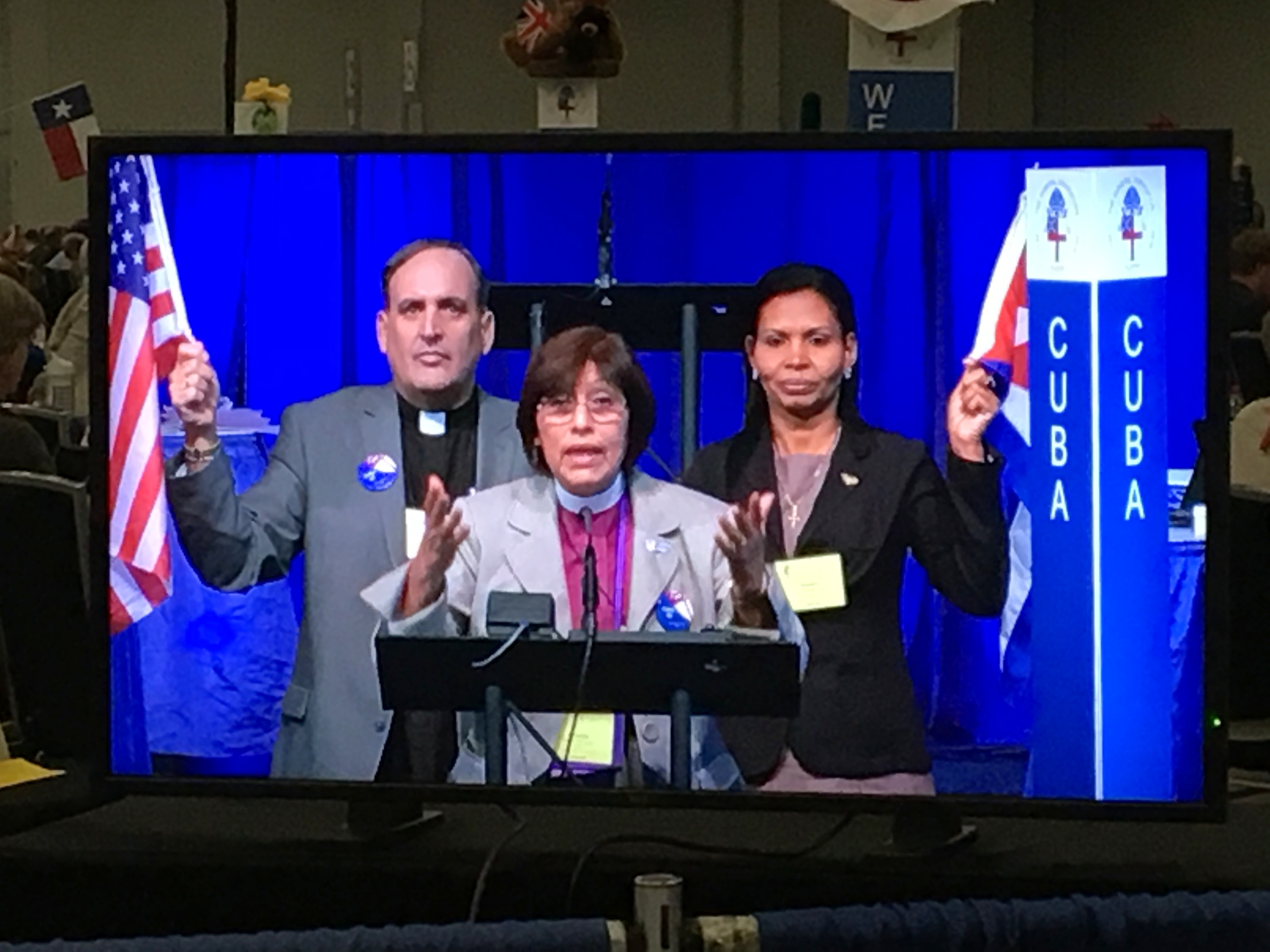
IMG_1927In 1966, in light of the Cuban Revolution and the political response of the United States, the House of Bishops voted to separate from the Diocese of Cuba from the Episcopal Church, leaving it an autonomous diocese without a provincial home.  The clergy scattered, some returning or immigrating to the US, but some who remained in Cuba were imprisoned, executed, or disappeared; priests lost their pensions, and they operated in isolation from the Church.  Cuba officially requested to be reaffiliated with the Episcopal Church and was given a list of requirements before admission.  As of GC79, all of those conditions had been met.  However, leading up to the resolution coming to the floor of both the Deputies and Bishops, there was controversy on what it would mean, how this admission might impact the admission of other Dioceses (or their exit), how to affirm already elected bishops (assuming they had not followed the current practices of approval for bishops in the Episcopal Church), among other concerns.  In other words, there was a desire to right the wrong done 52 years ago, but some anxiety about the implications of the decision.

As an alternate deputy, I had the leisure of observing either House.  On Tuesday, I happened to be observing the House of Bishops when resolution A238 came to the floor.  Each testimony pleaded for righting the wrong done by the House of Bishops in 1966.  Retired bishop Leo Frade from the Diocese of Southeast Florida spoke passionately about the resolution.  As a Cuban American who had been a part of the Church in Cuba, he got quite emotional in his plea for the bishops to do the right thing.  When it came time for the vote, the vote was a unanimous approval for readmittance.  The entire house – bishops and visitors – exploded.  Cheers and clapping filled the room, and the standing ovation lasted several minutes.  Unbeknownst to me, the Bishop of Cuba was present and was invited to approach the platform to address the House.  Bishop Curry embraced her.  The House broke into singing the Doxology.

Bishop Griselda Delgado’s speech was the most humbling.  Despite every reason to feel resentful or hurt, Bishop Delgado communicated nothing but forgiveness and reconciliation.  “We are family,” she insisted.  And although we severed the relationship so many years ago, she insisted, “Cuba never left.”  Her sentiments struck me as the exact way that God sees us.  When we reject God, God never leaves us.  When we abandon God, we do not abandon our familial ties with God.  Bishop Delgado’s profound sense of right relationship, reconciliation, and forgiveness brought the House to tears.  We did not deserve her mercy, and yet there she was, offering mercy.  When Bishop Delgado said, “The Holy Spirit is here,” I knew she was right.  In response, Presiding Bishop Curry said, “The Bishop may take her seat at Table 7.”  Those words were words of righting a wrong – fully, completely, unconditionally.

The experience the next day was equally powerful in the House of Deputies.  They too needed to approve the resolution, and it also passed unanimously.  Bishop Delgado spoke there too, but equally powerful was the triangular sign with the word, “Cuba” written on it.  It was processed to a table, and the deputies from Cuba were seated in the House of Deputies.  “Welcome home,” pronounced President Jennings.

What I loved about the approval of this resolution was seeing how legislation can powerfully effect change.  Sometimes, in the weeds of parliamentary procedure, and canonical revisions, one can wonder if all we are doing is navel gazing.  But on these days, we watched first-hand the commitment to change, the willingness to boldly repent, and the receiving of mercy.  Surely the presence of this Lord has been in this place!

Recent Posts

  • On the Myth and Magic of Advent…
  • On Risking Failure and Facing Fear…
  • Sermon – Luke 23.33-43, P29, YC, November 23, 2025
  • On Inhabiting Gratitude…
  • Sermon – Luke 20.27-38, P27, YC, November 9, 2025

Archives

  • December 2025
  • November 2025
  • October 2025
  • September 2025
  • August 2025
  • July 2025
  • June 2025
  • March 2025
  • February 2025
  • December 2024
  • November 2024
  • October 2024
  • September 2024
  • August 2024
  • July 2024
  • June 2024
  • May 2024
  • March 2024
  • February 2024
  • January 2024
  • December 2023
  • November 2023
  • October 2023
  • September 2023
  • August 2023
  • July 2023
  • June 2023
  • May 2023
  • March 2023
  • February 2023
  • January 2023
  • December 2022
  • November 2022
  • October 2022
  • June 2022
  • May 2022
  • January 2022
  • December 2021
  • November 2021
  • October 2021
  • September 2021
  • August 2021
  • June 2021
  • May 2021
  • April 2021
  • March 2021
  • February 2021
  • January 2021
  • December 2020
  • November 2020
  • October 2020
  • September 2020
  • August 2020
  • July 2020
  • June 2020
  • May 2020
  • April 2020
  • March 2020
  • February 2020
  • January 2020
  • December 2019
  • November 2019
  • October 2019
  • September 2019
  • August 2019
  • July 2019
  • June 2019
  • May 2019
  • April 2019
  • March 2019
  • February 2019
  • January 2019
  • December 2018
  • November 2018
  • October 2018
  • September 2018
  • August 2018
  • July 2018
  • June 2018
  • May 2018
  • April 2018
  • March 2018
  • February 2018
  • January 2018
  • December 2017
  • November 2017
  • October 2017
  • September 2017
  • August 2017
  • July 2017
  • June 2017
  • May 2017
  • April 2017
  • March 2017
  • February 2017
  • January 2017
  • December 2016
  • November 2016
  • October 2016
  • September 2016
  • August 2016
  • July 2016
  • June 2016
  • May 2016
  • April 2016
  • March 2016
  • February 2016
  • January 2016
  • December 2015
  • November 2015
  • October 2015
  • September 2015
  • August 2015
  • July 2015
  • June 2015
  • May 2015
  • April 2015
  • March 2015
  • February 2015
  • January 2015
  • December 2014
  • November 2014
  • October 2014
  • September 2014
  • August 2014
  • July 2014
  • June 2014
  • April 2014
  • March 2014
  • February 2014
  • January 2014
  • December 2013
  • November 2013
  • October 2013
  • September 2013
  • August 2013
  • July 2013
  • June 2013
  • May 2013
  • April 2013
  • March 2013
  • February 2013
  • January 2013
  • December 2012
  • November 2012
  • October 2012
  • September 2012

Categories

  • reflection
  • Sermons
  • Uncategorized

Meta

  • Create account
  • Log in
  • Entries feed
  • Comments feed
  • WordPress.com

Blog at WordPress.com.

  • Subscribe Subscribed
    • Seeking and Serving
    • Join 394 other subscribers
    • Already have a WordPress.com account? Log in now.
    • Seeking and Serving
    • Subscribe Subscribed
    • Sign up
    • Log in
    • Report this content
    • View site in Reader
    • Manage subscriptions
    • Collapse this bar
 

Loading Comments...