
• About

Seeking and Serving

~ seek and serve Christ in all persons

Seeking and Serving

Tag Archives: salvation narrative

Sermon – Jeremiah 31.31-34, Psalm 51.1-13, L5, YB, March 17, 2024

27 Wednesday Mar 2024

Posted by jandrewsweckerly in Sermons

≈ Leave a comment

Tags

blessing, covenant, Easter Vigil, failing, God, heart, Jeremiah, Lent, lovingkindness, salvation narrative, Sermon, share

In just a couple of weeks, Hickory Neck will gather for what is my favorite service of the entire year:  the Easter Vigil.  Now I know, you may be thinking, “But what about Easter Sunday?” or even “But Christmas Eve is the best!”  For me, the very best of the Episcopal Church happens at the Easter Vigil.  The lights are turned down low, a fire erupts as we sing the haunting Exultet, we read stories from scripture that feel like the ones you would tell around a campfire, we baptize new Christians, and then, with bells and singing, the lights come up as we ring in Easter.  The rest of the service feels like celebrating Eucharist for the first time – with the news of the empty tomb and feasting at the family table.

Part of why I love the service so much is those stories we hear by the fire:  what we often refer to as the salvation narrative.  In these stories we hear how we were created in God’s image and made for goodness, and then we hear how time and again we fail to live up to that goodness, but time and again, God meets us where we are, renewing God’s covenantal relationship with us, forgiving us, and getting us back on our feet to serve the world in God’s name.  The repetition of God extending that grace again and again and again, no matter how grave our failings, can make any participant begin to think that maybe, just maybe, we stand invited to receive that hesed or as we translate the Hebrew, that lovingkindness, of God.

Although we do not hear the text from Jeremiah on Easter Vigil night, today, on this fifth Sunday in Lent, just a week before we start the descent into the cross and the grave of Holy Week, we get one last reminder of the kind of redemption that waits on the other side of Easter.  I do not how recently you’ve been reading Jeremiah in your spare time, but just as a refresher, Jeremiah is one of those books that is generally filled with bad news.  Israel disobeyed the law of God, and, as a consequence, they are overthrown by outside forces, the walls of Jerusalem fall, the temple is destroyed, and the Israelites themselves are banished to Babylon.  The situation is bleak, and the prophet Jeremiah has a lot to say in judgment of the people.[i] 

But today, all the way in chapter 31, we get what is called “The Book of Comfort,”[ii] in Jeremiah where, after much shame and judgment, the people are promised a new day where there will be a new covenant between God and the people.  This time, they won’t have to wait for teaching, and they won’t have to store the commandments in a holy place.  The holy word of God will be written on their hearts – able to go with them anywhere, to be not just in their minds or in their temple, but on their very souls – they will be God’s and God’s will be theirs.  For a people utterly destroyed, who have lost their spiritual home in addition to their literal home, this is good news indeed.

When I was in seminary, we went to Chapel everyday – sometimes multiple times a day.  The rhythm of regular worship meant that not only did the liturgy get written into your body, so did the space.  You began to know the particulars of certain seats – which ones experienced more of a draft and which pew had someone’s initials carved in and aged over.  You knew how certain steps would creak when someone would ascend the lectern and you have seen the pulpit sway with a particularly vigorous preacher.  But mostly, you had stared, for years at a time, at the window behind the altar, around which were painted the words, “Go ye into all the world and preach the gospel.”  Consciously and maybe more subconsciously, those words became ingrained in our minds seeing them every day. 

A year and a half after I graduated, that chapel burned down, along with that wall that had been seared into my mind.  I remember feeling bereft – like a part of me had died with the loss of that building.  Even today, when I visit the campus, worshiping in the beautiful new chapel, I still grieve when I see the preserved ruins where an outdoor altar remains.  It took me a long time to realize that although my heart ached for the physical space, those words – those words that Jesus spoke, “Go ye into all the world and preach the gospel,” were gone from the world – but not from my heart.  Though I might miss the building – in the same way so many of us missed the buildings of this campus in those early years of the pandemic, the experience of God is written in my heart.

As we walk this last week of Lent, and as we begin next week to walk steadily through Holy Week, perhaps with sins weighing on our hearts, or feelings of being a failure at faith or at life in general, or even just the restlessness that can come when we find ourselves disconnected from any kind of relationship with God, our worship today is all about renewing that covenantal relationship with God.  Even in our psalm today, we prayed, “Create in me a clean heart, O God, and renew a right spirit within me.” – those same words a priest prays before she consecrates the sacred meal.  The psalm tells us the very nature of our God is “steadfast love and abundant mercy, a God who is eternally ‘for us’ with the endless love of a mother for her child.  The God who is everlasting love will never abandon us, no matter what our guilt says.  Steadfast love and abundant mercy heal us not only of the stain of sin, but also of the lie of our worthlessness.”[iii]  So likewise, Jeremiah confirms that encouragement.  As one scholar explains, “God will write the capacity for keeping the covenant on the inward hearts of the people.  Hope for such transformed wills will lie with God’s grace, not in any hope for human perfection.”[iv]

Your promise today is blessing upon blessing – blessing of belonging, of permanence, of mercy and lovingkindness.  The invitation today is then up to you.  What will you do with that renewed covenantal relationship?  How will walk differently this week with the covenant of God written on your heart?  How will you treat your neighbors differently, yourself differently, and your God differently?  The blessing is yours to keep deep in your soul.  And the blessing is also yours to share with a world that needs that blessing so very deeply.  Your work this week is to find your unique place to share that blessing.  Amen.


[i] Woody Bartlett, “Homiletical Perspective,” Feasting on the Word, Year B, Vol. 2 (Louisville: Westminster John Knox Press, 2008), 123.

[ii] Jon L. Berquist, “Exegetical Perspective,” Feasting on the Word, Year B, Vol. 2 (Louisville: Westminster John Knox Press, 2008), 123.

[iii] Elizabeth Webb, “Commentary on Psalm 51:1-12,” March 17, 2024, as found at https://www.workingpreacher.org/commentaries/revised-common-lectionary/fifth-sunday-in-lent-2/commentary-on-psalm-511-12-6 on March 14, 2024.

[iv] Samuel K. Roberts, “Theological Perspective,” Feasting on the Word, Year B, Vol. 2 (Louisville: Westminster John Knox Press, 2008), 126.
Sermon – Gen., Ex., Ez., Zeph., Mt. 28.1-10, EV, YA, April 8, 2023

30 Tuesday May 2023

Posted by jandrewsweckerly in Sermons

≈ Leave a comment

Tags

alleluia, darkness, Easter Vigil, God, Jesus, joy, light, rejoice, salvation narrative, Sermon

If you have ever longed for a way to explain or express your faith to someone or even to yourself, this night, Easter Vigil, is the best articulation or encapsulation of our faith.  If ever you were hoping to showcase to a friend the best example of Church, this is the night in which the Church is at the Church’s fullest.  This night has everything – the drama of the Pascal fire and candle, the haunting beauty of the Exsultet, the narration of our salvation history, Baptism and Eucharist, and all the joy that comes with Easter.  After this night, the rest of our Easter celebrations pale in comparison.  This is the night. 

The challenge of Easter for us is that not only are we quick to forget the darkness of the past week, but also we are tempted to only celebrate what God has done in Jesus Christ, and not celebrate how extraordinary what God has done in Jesus Christ is in light of what God has done throughout all time.  Easter Vigil pulls us out of that desire to be narrowly focused and thrusts us back into the full story that is our story – the story that makes Jesus’ resurrection all the more powerful.  Easter Vigil gives us the opportunity to step out of the empty tomb, and to immediately recall all the other things that God has done for us – the ways that God has repeatedly delivered us – and to understand at a much deeper level the significance of this night.

Tonight, we hear five of the nine possible readings we could have read which narrate our salvation history.  First, we hear the creation story – that story wherein God takes a watery chaos and creates the earth and all that is in the earth:  the lights, the waters, the birds, the animals, the ground and vegetation, humanity, and Sabbath.  We hear again and again how God creates and how that creation is good.  We hear in this first reading the tender lovingkindness of God, the abundance of creation, and the glory of God.  Second, we hear the dramatic story of the flood, where our sinfulness drives God to flood the earth.  But the flood story is also a story of God’s mercy – a God who loves so much that God cannot totally annihilate God’s creation.  After the flood, God promises to never again harm creation so deeply.  Then we hear the Exodus story – that story where God takes God’s people out of slavery, frees them from Egypt, and guides them through the Red Sea to the final destruction of pharaoh’s army.  Despite the people’s groaning, their illogical desire to return to slavery rather than to trust in the Lord, and the people’s unworthiness of such grace, God saves the people, delivering them from bondage and death.  Next, we hear that haunting story from Ezekiel, where the prophet breathes breath back into a valley full of dry bones – the dry bones of the people Israel, symbolizing God’s restoration of Israel.  Finally, finally, we hear the Zephaniah story of the gathering of God’s people back together from exile – that story in which God promises to return God’s people to the Promised Land, to deliver them from their suffering at the hands of oppressors, and to restore their fortunes.  As an exiled people, who quite frankly deserved the loss of their land because of the ways they deserted God, this promise of being regathered is more than they could ever hope for or imagine.

In light of this salvation history – this snapshot way of showing how lovingly God creates us, how lovingly God forgives us, and how lovingly God returns to us time and again, despite our grievous sins – we then turn to Jesus’ story.  We see that as God’s people we have benefited from the many times that God has delivered us from oppression and suffering caused by our sinfulness; but in this final act by God, the giving of God’s Son Jesus Christ to suffering, persecution, and death, we see that Jesus’ resurrection means that we not only have a God that delivers us from the bondage of death in this world, but also we have a God that delivers us from bondage of death in the life to come.  Instead of taking away one more earthly oppressor, God takes away the oppressor of death – granting us forgiveness of our sins and eternal life.  This narrative, the story of the empty tomb is the last stop in that salvation narrative for us. 

This is the night – when we remember what God does for us at the Red Sea.  This is the night – when we recall that Christ died for our sins.  This is the night – when we proclaim that Christ has broken the bonds of death and given us eternal life.  And we remember all of that this night through our actions – the lighting of the Pascal candle, the reaffirmation of our baptismal covenant, and the receiving of bread and wine.  We hear the word of God, and we respond to the word of God through our liturgical actions. 

And so what does God call us to do in light of this night?  Rejoice now!  The whole earth – that earth that God created – rejoices because darkness is vanquished through Jesus Christ.  The heavenly chorus rejoices – shouting for the salvation fulfilled and completed in Christ the King.  The Church rejoices – we resound as a people, being glad for all that God does for us through Jesus Christ.  Like our ancestor the prophet Miriam who led the women in dancing and song, we too are bursting with praise and thanksgiving.  We praise God in song, prayer, and proclamation because we are so overwhelmed with the abundance of God’s love and grace for us.  We rejoice now, because like the Israelites on the other side of the Sea, we are awed by God, and can only offer our adoration.  We have no way of paying God back or thanking God enough.  And so, with great adoration and awe, we rejoice now.  And we leave this place, bursting with joy as we share the salvation story of all that God has done for us.  Rejoice now, Mother Church!  Alleluia!  Alleluia! 

Sermon – Jeremiah 36.27-37.2, VTS Convocation Evensong, October 11, 2022

19 Wednesday Oct 2022

Posted by jandrewsweckerly in Sermons

≈ Leave a comment

Tags

church, God, how, Jeremiah, kingdom of God, love, normalcy, pandemic, poll, prophet, repeat, repent, rest, salvation narrative, Sermon, values, why

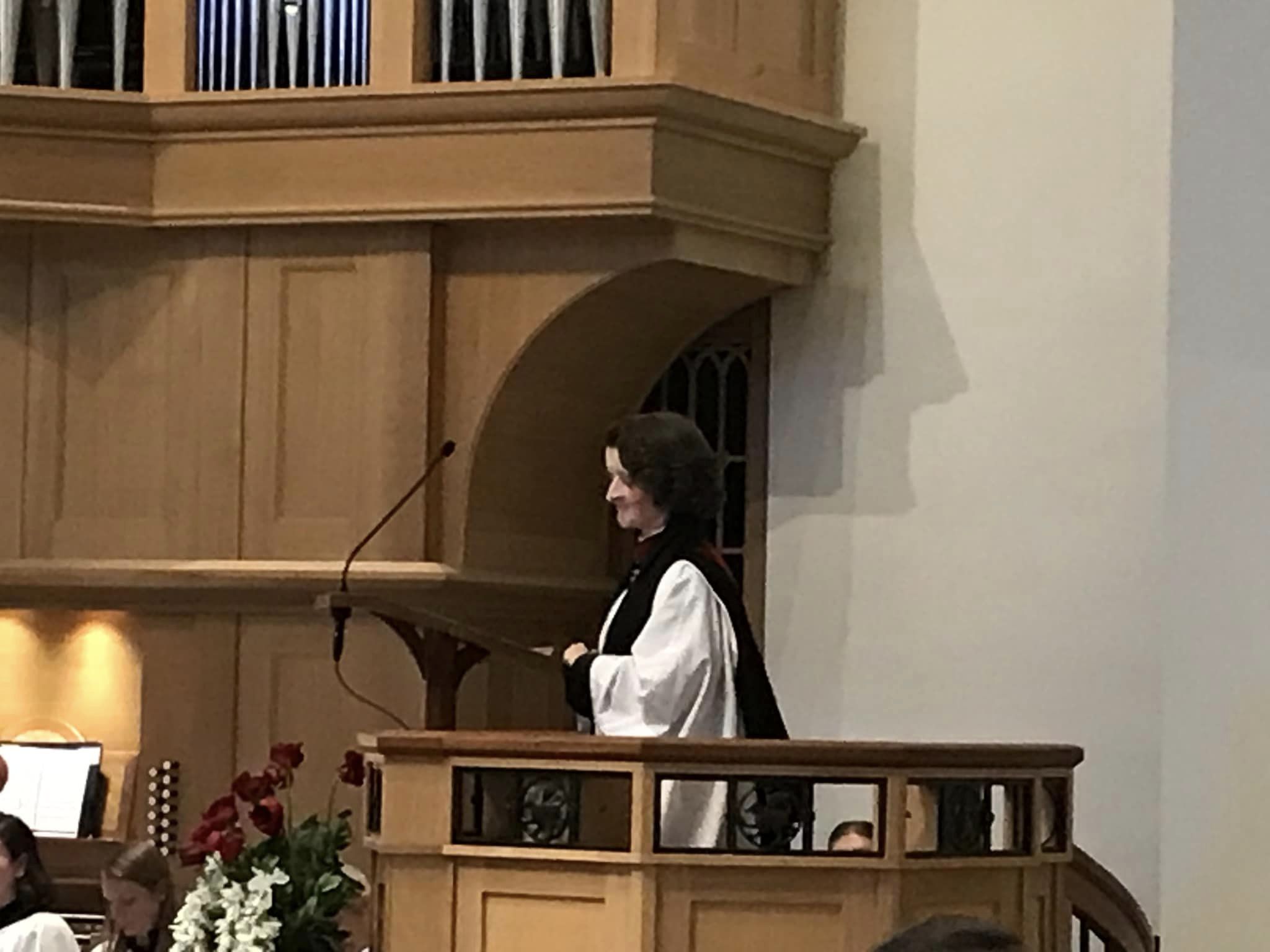
This sermon was delivered to Virginia Theological Seminary on the occasion of our annual Convocation for alumni, faculty and staff, and seminarians.

Photo credit: The Rev. Matthew Tucker

I live in a pretty “purple” district in Southern Virginia.  My Congressman represents a different party than my own, but I make a point to stay on his mailing list as a way to remind him that he represents a politically diverse district.  Every month he sends out polls, and I dutifully respond to them.  But with every survey I find myself frustrated.  My Congressman either has never taken a class in crafting an unbiased survey or he is simply not interested in different opinions.  The questions are always phrased something like, “In your opinion, how bad of a job is our president doing:  terrible, really bad, pretty bad, or I’m not sure.”  Or without any nuance or explanation about the background of the issue, the poll will ask something like, “The Congress wants to pay illegal immigrants who knowingly broke the law hundreds of thousands of dollars.  Should we pay these illegal immigrant criminals, yes or no?”  Or, one of my favorites, “Which of these issues should be the priority of Congress?” (PS, none of the options listed talk about caring for the poor or our neighbor, and there definitely isn’t an “other” category).  But I dutifully take the surveys, hoping my voice is part of my representative’s decision making.

I have been pondering the ministry of Jeremiah and thinking his prophetic ministry is a bit like trying to engage my Congressman.  For those of us not taking Old Testament this semester, Jeremiah is prophesying in a time of political decline.  The northern kingdom, Israel fell to Assyria nearly a hundred years before, and Judah remains in a tenuous situation.  The Assyrians are still in control, but in the course of the book of Jeremiah, Babylon defeats Assyria and takes control of Judah.  There are rebellions against Babylon, in particular by King Jehoiakim who we hear about today, but they are eventually unsuccessful.[i]  Like any good prophet, Jeremiah is attempting to get the people and king to repent and return to the Lord.  And like all people of all time, the people refuse to listen to God.  King Jehoiakim is particularly egregious in this refusal.  In fact, just verses before our reading, the King has his attendant read Jeremiah’s prophetic scroll three or four columns at a time, then cuts those columns off the scroll and throws them in a fire.  King Jehoiakim is not alarmed by the prophecy, and certainly not repentant. 

But here’s the funny part.  In the verses we read today, the Lord tells Jeremiah to rewrite the entire scroll and add in a little final judgment.  Like me, sitting down with yet another poll from my Congressman, he sits down and does the same thing over again.  I have been of two minds about this passage.  On the one hand, and no offense toward the Lord’s prophetic practices and policies, but how many times are we to keep doing the same thing and expecting different results.  As if King Jehoiakim is going to receive the second scroll and say, “Oh, a second scroll?  Okay, I guess I won’t burn this one and will change my ways!”  If this pandemic has taught us anything this pandemic has taught us we cannot keep doing Church the way we always have and expect the Church to thrive (or in biblical terms, to repent and return to the Lord).  This pandemic has made us nimble, agile, creative, and versatile.  This pandemic made us stop thinking about hybrid ministries and digital relevance and demanded we start doing and being those things.  And God help us if our churches just want to “return to normal” after the pandemic – if we just want to write another scroll. 

But as I mentioned, I am of two minds on this passage.  On the other hand, despite what seems like poor strategy on the Lord’s part, God’s covenantal relationship with us has never really made sense.  The entire salvation narrative is about failure after failure on our part as the people of God to listen and respond to the Lord.  Promise after promise, covenant after covenant, even the sending of God’s Son has meant the Lord’s corporate strategy is a case study in what not to do to thrive in business.  But that’s what we love about the Lord, right?  God keeps writing another scroll, God keeps giving another chance, God keeps holding out hope and promise because God’s love is not meted out in a logical, economical way.  Despite all of the innovation which has been entirely life giving during this pandemic, in some ways, what we have offered to a hurting world is the same as what we have always offered:  a community of faith, redeemed by God’s grace, commissioned to love God, self, and neighbor.  Perhaps that is why I am of two minds about this text.  Although this pandemic has not changed who we are and what we offer a broken world, this pandemic has changed how we are.  Our core values as the Episcopal Church have not changed.  But throughout this pandemic we have learned that how we go about living into those core values certainly can, should, and hopefully has changed.  And, as the Genesis writer would say, “…it was very good.”

In this particular season of the Church, many of us are feeling a longing for rest, for relief from constant pivoting, for a sense of normalcy.  Many of us would like to sit down and just write the same scroll over again.  In Jeremiah’s day that second scroll meant suffering and exile, and there would be more than twenty years before the people of God would see God’s promise of restoration realized.[ii]  But I do not think that is the invitation from scripture today.  I do not think the Lord is inviting the Church to write another scroll or fill out another poll.  We have a whole Bible full of examples of how doing the same thing over and over does not lead to the fulfillment of the kingdom of God.  Instead, the invitation from scripture today is to see the patterns of the resistance to love, and find a new way to love.  God is not inviting us to change our “who” or our “what,” but to change our “how.”  Your “how” might be different from mine.  But Jeremiah shows us time and again that the same repeated “how” does not turn hearts.  Our work in this season is to listen to what new “hows” the Holy Spirit is showing us, and then be willing to be vulnerable enough to try them.  Because, Lord knows, we do not need another scroll.  Amen. 


[i] Josey Bridges Synder, “Jeremiah,” The CEB Women’s Bible, (Nashville:  Common English Bible, 2016), 953.

[ii] 953.

Sermon – Genesis 7.1-5, 11-18, 8.6-18, 9.8-13, UJCCM Lenten Series, March 9, 2022

25 Wednesday May 2022

Posted by jandrewsweckerly in Sermons

≈ Leave a comment

Tags

ark, ecumenical, flood, God, history, judgment, Lent, Noah, pandemic, relationships, salvation, salvation narrative, saving, Sermon, transforming

This Lent, we as an ecumenical body in Upper James City County are retelling the “salvation narrative” – or at least that is the fancy phrase we use to describe the body of stories that show us time and again God’s saving deeds in history, and how those stories inform how we understand what will happen on Easter Sunday – how the life, death, and resurrection of Jesus will bring the fullness of redemption.  We started last week with the story of creation – the ways in which God lovingly called the created order good and made us in God’s image.  Tonight, we shift to another of the legendary stories – the story of the flood.

This is a story we know and love:  we use Noah’s ark as artwork in babies’ nurseries, I have Noah’s ark in the form of Christmas ornaments, we even sing songs about how God told Noah to build an “ark-y, ark-y” made of “bark-y, bark-y.”  I think we love this story so much because of the good news at the end.  But before we get to the end, we have to wade through a whole lot of a horrible beginning and middle.  You see, despite the goodness of creation, of the ways in which we were made in God’s image, we humans fall into sinfulness.  We do not hear much of that part of the story tonight.  Despite all the verses we did hear, what we do not hear is how horribly sinful humanity has become in Noah’s time.  This sinfulness grieves God so very much that God set God’s mind to do a terrible, awful thing[i].  Those waters out of which God formed the earth – those waters that God used a dome to separate – separate the waters from the waters, God uses to destroy the beautiful creation God has made.  God removes the dome, and the waters came down from the skies and the waters rise up from the ground.[ii] 

From the beginning of this horrible decision, God makes a choice – a choice to save some life instead of recreating life again[iii].  And so, on that ark that Noah builds, floats the people who will repopulate the earth, and the animals that will restore the created order.  We hear very little in scripture what those days are like[iv]:  the panic of rising waters, the death all around them, the solitude and silence of watery chaos, the noise of a bizarrely filled boat.  We have only our imagination to fill in what those desperate days may have been like. 

In some ways, I think Lent is a lot like those days on the boat.  There is the obvious forty days connection, but more telling is the stark reality of sinfulness and judgment.  Imagining the depravity of those days that would drive God to destroy most of creation is not as hard as we might like to think.  Sometimes, I wonder if God is not similarly grieved by us today.  Here we are after two years of a pandemic where our own country spent more time arguing over the supremacy of personal freedom over the call to love one another.  Here we are, for likely the millionth time debating whether there is such a thing as a just war as we watch civilians and children slaughtered in Ukraine.  Here we are divided by political party, divided by socioeconomic status, divided by race, divided by theology into denominations and faiths.  Here we are, refusing as individuals to love all our neighbors as ourselves, and love the Lord our God.  Lent is our season to float in the lapping waters of our sinfulness, wondering whether we should be on that boat or not.

But here’s the funny story about the flood.  This story is not about you.  This story is not even really about Noah, or the animals God saved, or even the rainbow at the end of the story we like to cling to so desperately.  This story is not about our sinfulness and brokenness and inability to live into the image of God in which we are created.  No, this is a story about God.  Everything in this story that we value, that makes this story a “salvation narrative,” is about God’s actions.  The reason we do not hear all the gory details about the lead-up to the flood – the details that even movies have been made about – is because this is a story about salvation, not judgment – on what God does to preserve creation.[v]

One of the exercises I have done with young adults is to talk about images of God.  We create a safe space where we can talk about those images – not just the ones the church likes us to see – of the shepherd caring for the flock, even at times with a lamb on his shoulders, or of the saccharine-y Jesus’ we hang around that look more like an American Jesus than a Middle Eastern Jesus.  Instead, we try to get real with the youth.  The images they often have are of a foreboding man on a throne, an intimidating father figure, or a judge behind a bench.  And when we adults are honest, our images are pretty similar.  But the images of God in this story, as one scholar writes are “striking:  a God who expresses sorrow and regret; a God who judges, but doesn’t want to, and then not in arbitrary or annihilative ways; a God who goes beyond justice and determines to save some creatures, including every animal and bird; a God who commits to the future of a less than perfect world; a God open to change and doing things in new ways; a God who promises never to do this again.  The story reveals and resolves a fundamental tension within God, emphasizing finally, not a God who decides to destroy, but a God who wills to save, who is committed to change based on experience with the world and who promises to stand by the creation.”[vi]

That’s the funny thing about this story.  The flood seems like a story for Lent because we find ourselves as sinful as Noah’s world, and we know we need to change our ways.  Lent is all about repentance after all – a turning from our sinfulness and returning to God.  But here’s the thing: even after the flood (and let’s be honest, even after this Lent), the people will keep going back to sinning.  I mean, we’re just in chapter nine of Genesis:  there is a whole lot more sinning left in the Old Testament for us to read.  Scholars argue, “The flood has effected no change in humankind.  But [the flood] has effected an irreversible change in God.”[vii]  This salvation narrative tells us more about God than ourselves.  God establishes the covenant with humanity and creation to never flood the earth again.  Certainly, there may be judgment again, but never the kind that annihilates the earth.  That rainbow that we love is not meant to remind us of God’s promise, but to remind God of the covenant – the restraint God promises to keep in the midst of well-deserved judgment.[viii]  Every promise God makes, all the salvation narratives we will hear the rest of this Lent, are made possible by the foundation of the promise God makes to Noah.[ix]

So, if this salvation narrative is not about us, does that mean we get a free pass for Lent?  Not exactly.  The real question for us tonight, based on everything we just learned (or remembered) about God, is “So what?”  Professor Patricia Tull argues, “Scripture says that a good and wise God created us good.  We’re capable of great evil, as the flood story says and as we know every day.  But God means for us to be transformed, just as the flood transformed God’s intentions.”[x]  Lent is our opportunity to mirror God’s transformation of intention.  What in your life this year needs transforming?  What have you been holding on to – a grudge, a hurt, an anger, a self-righteous indignation – needs to be released?  God learned in the flood that God could not change humanity – but God could change God’s relationship with humanity.  Our invitation this Lent is not necessarily to change ourselves, and certainly not to try to change others (which never goes well), but to transform our relationships – our relationship with God, our relationships with others, and even our relationship with ourselves.  Use the watery chaos of this Lent to listen through the noise of animals around you to hear the promise of the rainbow come Easter.  Amen.


[i] Leander E. Keck, ed, The New Interpreter’s Bible, vol. 1 (Nashville:  Abingdon Press, 1994), 394.

[ii] Keck, 392.

[iii] Keck, 394.

[iv] Keck, 389.

[v] Keck, 389.

[vi] Keck, 395.

[vii] Keck, 395.

[viii] Keck, 400.

[ix] Keck, 401.

[x] Patricia Tull, “Commentary on Genesis 7:1-5, 11-18; 8:6-18; 9:8-13,” April 15, 2017, as found at https://www.workingpreacher.org/commentaries/revised-common-lectionary/vigil-of-easter-3/commentary-on-genesis-71-5-11-18-86-18-98-13 on March 9, 2022.

Recent Posts

  • On the Myth and Magic of Advent…
  • On Risking Failure and Facing Fear…
  • Sermon – Luke 23.33-43, P29, YC, November 23, 2025
  • On Inhabiting Gratitude…
  • Sermon – Luke 20.27-38, P27, YC, November 9, 2025

Archives

  • December 2025
  • November 2025
  • October 2025
  • September 2025
  • August 2025
  • July 2025
  • June 2025
  • March 2025
  • February 2025
  • December 2024
  • November 2024
  • October 2024
  • September 2024
  • August 2024
  • July 2024
  • June 2024
  • May 2024
  • March 2024
  • February 2024
  • January 2024
  • December 2023
  • November 2023
  • October 2023
  • September 2023
  • August 2023
  • July 2023
  • June 2023
  • May 2023
  • March 2023
  • February 2023
  • January 2023
  • December 2022
  • November 2022
  • October 2022
  • June 2022
  • May 2022
  • January 2022
  • December 2021
  • November 2021
  • October 2021
  • September 2021
  • August 2021
  • June 2021
  • May 2021
  • April 2021
  • March 2021
  • February 2021
  • January 2021
  • December 2020
  • November 2020
  • October 2020
  • September 2020
  • August 2020
  • July 2020
  • June 2020
  • May 2020
  • April 2020
  • March 2020
  • February 2020
  • January 2020
  • December 2019
  • November 2019
  • October 2019
  • September 2019
  • August 2019
  • July 2019
  • June 2019
  • May 2019
  • April 2019
  • March 2019
  • February 2019
  • January 2019
  • December 2018
  • November 2018
  • October 2018
  • September 2018
  • August 2018
  • July 2018
  • June 2018
  • May 2018
  • April 2018
  • March 2018
  • February 2018
  • January 2018
  • December 2017
  • November 2017
  • October 2017
  • September 2017
  • August 2017
  • July 2017
  • June 2017
  • May 2017
  • April 2017
  • March 2017
  • February 2017
  • January 2017
  • December 2016
  • November 2016
  • October 2016
  • September 2016
  • August 2016
  • July 2016
  • June 2016
  • May 2016
  • April 2016
  • March 2016
  • February 2016
  • January 2016
  • December 2015
  • November 2015
  • October 2015
  • September 2015
  • August 2015
  • July 2015
  • June 2015
  • May 2015
  • April 2015
  • March 2015
  • February 2015
  • January 2015
  • December 2014
  • November 2014
  • October 2014
  • September 2014
  • August 2014
  • July 2014
  • June 2014
  • April 2014
  • March 2014
  • February 2014
  • January 2014
  • December 2013
  • November 2013
  • October 2013
  • September 2013
  • August 2013
  • July 2013
  • June 2013
  • May 2013
  • April 2013
  • March 2013
  • February 2013
  • January 2013
  • December 2012
  • November 2012
  • October 2012
  • September 2012

Categories

  • reflection
  • Sermons
  • Uncategorized

Meta

  • Create account
  • Log in
  • Entries feed
  • Comments feed
  • WordPress.com

Blog at WordPress.com.

  • Subscribe Subscribed
    • Seeking and Serving
    • Join 394 other subscribers
    • Already have a WordPress.com account? Log in now.
    • Seeking and Serving
    • Subscribe Subscribed
    • Sign up
    • Log in
    • Report this content
    • View site in Reader
    • Manage subscriptions
    • Collapse this bar
 

Loading Comments...