• About

Seeking and Serving

~ seek and serve Christ in all persons

Seeking and Serving

Tag Archives: song

Sabbatical Journey…On Seeing through Song

28 Wednesday Jun 2023

Posted by jandrewsweckerly in reflection

≈ Leave a comment

Tags

anxiety, creation, enormity, gift, God, great, Holy Spirit, inexpressible, inspiration, longing, song

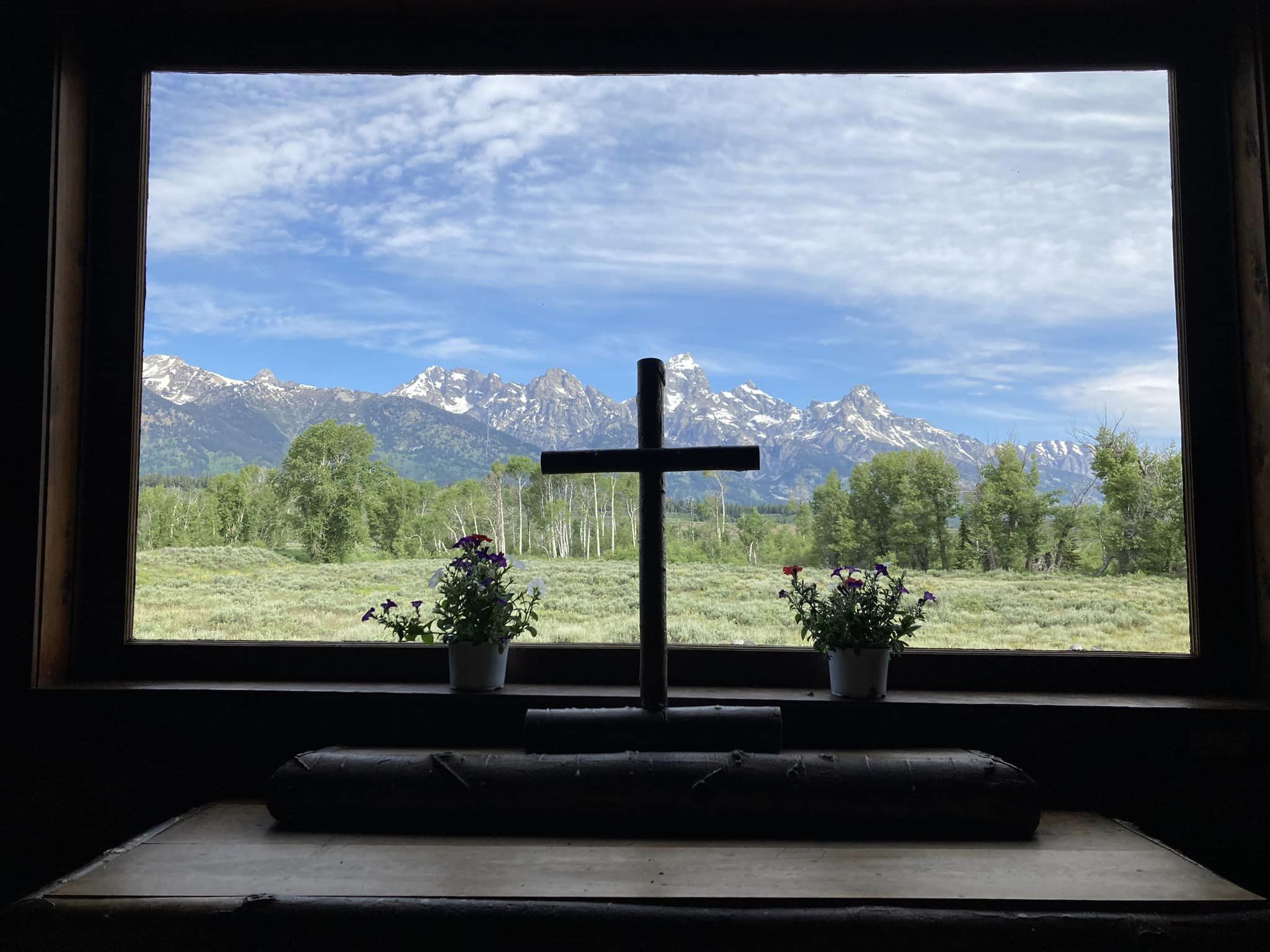
Chapel of the Transfiguration, Episcopal, Grand Teton National Park (reuse with permission only)

After a day of exploring the magnificent Grand Tetons, seeing beautiful waterfalls, peaceful lakes and rivers, we closed the day with a covered wagon dinner and show.  I had been pondering the beauty of this day, when the western quartet closed the show with the old hymn, “How Great Thou Art.”  If you are not familiar with the hymn, the lyrics are:

O Lord my God, when I in awesome wonder
Consider all the works Thy hands have made,
I see the stars, I hear the rolling thunder,
Thy pow’r thru-out the universe displayed!

Chorus
Then sings my soul, my Savior God, to Thee;
How great Thou art, how great Thou art!
Then sings my soul, my Savior God, to Thee;
How great Thou art, how great Thou art!

When thru the woods and forest glades I wander

And hear the birds sing sweetly in the trees,
When I look down from lofty mountain grandeur
And hear the brook and feel the gentle breeze,

Repeat Chorus

I could not have asked for a better summary of this day.  As I saw the enormity of the mountains, I stood I awesome wonder.  As I listened to a different familiar hymn being played in rustic chapel, I remember thinking I could look at the views all day from that beautiful space.  As I watched the calm lake, I marveled at the reflection of God’s creation.  As I heard the roar of waterfalls, I felt in my chest the way that God’s love sometimes roaringly overpowers me.  And as the mist of the falls kissed my face, I remember thinking, “My God, how great thou art!”

Sometimes words fail me, especially when encountering so much of God’s inspiring creation.  So often, the artistry of song has helped me shape words my mouth could not.  Tonight, singing that song “How Great Thou Art,” with the help of guitars and a fiddle, I knew immediately those were the words I could not articulate all day.  Other times, sacred songs have come to me in sorrow, in anxiety, and in longing.  I hardly ever choose the songs.  And sometimes I must sit in silence for a long while before the songs pop into my head.  In these times, the songs feel like gifts from God, who knows I need a way to express the inexpressible.

What songs are you longing to hear?  I would love to hear how the Holy Spirit has flitted through your longing heart and given you a song.       

On Jesus, Love, Me, and You…

17 Wednesday Jul 2019

Posted by jandrewsweckerly in Uncategorized

≈ 1 Comment

Tags

Christ, intergenerational, Jesus, Jesus Loves Me, love, meaning, ministry, neighbors, profound, relationship, Savior, simple, song, together, walk

Jesus-Loves-Me-this-I-Know

Photo credit:  https://mandjsquared.com/index.php/product/jesus-loves-me-this-i-know/

After welcoming The Kensington School, an independent child development center, on to the Hickory Neck property, the two communities have sought ways to enter into mutual relationship.  One of those efforts has been offering a voluntary Godly Play class for students of the school.  We began the class in the fall, and have had over 18 children registered for the class.  We recently changed the day of the week the class is offered, and so yesterday, I was finally able to join the class.  The children were full of life and wonder, and I loved to watch them engage in the story.  But probably one of my favorite parts was singing Jesus Loves Me with the children.  They clearly knew the words, and it was fun to sing such a familiar childhood song – so simple and, especially in these days, so profound.

My day carried on like any other adventurous day in ministry, and that afternoon, I celebrated Eucharist at a local retirement home.  We usually sing a few songs, and the chaplain always reminds me that familiar songs are important, as they bring up many fond memories for the residents.  So, without thinking, I chose two, and midway through the final song, I realized I had subconsciously chosen the very song I had sung early that morning – Jesus Loves Me.  The same feelings emerged, especially as many of the retirees in that space are in bodies that no longer do all the things they used to do.  But they can sing about the love of a Savior – that they, even in their weakened states, are loved.

I have been thinking about a couple of things since then.  Hickory Neck has been articulating its mission in Upper James City County, and one of the tenets of our mission is to engage in intergenerational ministry.  Knowing our unique setting – a community comprised predominantly of young families and a large retirement community – our parish seeks to minister to both, and in fact, we believe our ministry will be richer as both young and old walk together in Christ.  Yesterday’s convergence of three and four year-olds singing the same words as ninety-three and ninety-four year-olds made me hopeful about the potential of Hickory Neck’s ministry.

But yesterday’s experience also made me think about all of us in the middle – those of us who are twenty-three and twenty-four to sixty-three and sixty-four; those of us who are busily going about life, trying to do our part to make the world a better place, and trying to find meaning and joy in this world.  For those of us in the middle, I wonder if we might hear the words of a song that seems almost childishly simple as instead something profoundly important about ourselves and our neighbors.  Yes, Jesus loves me.  But, Jesus also loves you.  And, from what I know about Jesus, he especially loves those whom we would like to deem “other,” or as unworthy of God’s love.  Jesus loves them too.  Perhaps we in the middle can take a cue from those at the beginning and those near the end and remember the simple, profound words that can hold us together, and help us love better.

Sermon – Isaiah 40.1-11, A2, YA, Advent Lessons and Carols, December 4, 2016

08 Thursday Dec 2016

Posted by jandrewsweckerly in Sermons, Uncategorized

≈ Leave a comment

Tags

Advent, Christ Child, Christmas, Episcopal Church, hope, Isaiah, Jesse, Jesus, joy, Lessons and Carols, rooting, season, Sermon, song, story

The season of Advent and I have not always been friends.  In fact, the first Advent I experienced in the Episcopal Church almost ended my relationship with the Episcopal Church.  You see, I grew up in a Christian tradition that treated Advent as the beginning of the Christmas season.  Starting on Advent One, we were singing Christmas carols, making our way through all the old favorites.  The tradition felt perfect – instead of focusing on a secularized Christmas, the Christmas hymns during Advent reminded us all of the “reason for the season.”  Besides, there are so many familiar Christmas hymns, that there would be no way to enjoy them all during the short two weeks of Christmastide.  Since our tradition also did not have services on Christmas Eve or Christmas Day, you had to squeeze in all the “Joy to the Worlds,” “Oh Holy Nights,” and “Away in the Mangers,” that you could before the holiday was over.  In that tradition, Advent felt like a family gathering around a fire, singing songs of familiarity and comfort.

Of course, the Episcopal Church we landed in did nothing of the sort.  The songs I heard during that first Advent were dreadful.  They were slow and full of melancholy.  They sounded as though whomever wrote them was hunkered down, alone, in a room without a fireplace.  They had a hollow, haunted feeling to them, and the tunes were difficult to follow.  I remember that first Advent feeling like all the joy had been taken out of Christmas, and all that was left was a sad sense of unfamiliarity.

So, if that were my first experience of Advent in the Episcopal Church, why in the world would I agree to having not just Lessons and Carols today – but Advent Lessons and Carols?  I not only agreed to, but begged for, Advent Lessons and Carols because this service attempts to capture what the whole season of Advent does in the Episcopal tradition.  Advent is not meant to be four weeks of celebrating the birth of the Christ Child.  Advent is meant to be four weeks of helping us understand the enormity of what happens on the fateful night of Christ’s birth.  And so, like the people of faith always have, we go back and tell the story.  We tell our story.  We set the scene of Jesus’ birth by using our story to understand the context of the monumental event of the nativity.

First, we go all the way back to the garden of Eden.  Then, we remember the words of the prophets who told of a messiah, an anointed one from the house of David – and yet, better than David.  We hear words of comfort, words of preparation, and words of promise.  We hear of a young, inexperienced woman and the announcement that she gets of a coming child.  And we even hear from Jesus himself, who tells us of the call for repentance in the face of fulfilled promise.  All of that – from Eden, to failed kings and judges, to wearied exiled people, to scared, young women, to the message of repentance all are needed to remember why that infant in a humble manger is so important.  His story is bigger.   His story starts long before his own story starts.  His story is our story.

I am especially grateful for the rooting that Advent provides this year because I have been feeling pretty rootless lately.  With all the noise of world news lately, we can easily become lost.  We can get caught up in the heat of politics, pandering, and promises and forget to whom we belong.  We can see destruction all around us and wonder whether hope is lost.  Into the face of that loss, destruction, and longing, Isaiah says today, “A shoot shall come out from the stump of Jesse, and a branch shall grow out of his roots.”  At the time of Isaiah’s oracle, the people of God had been in a time of high tensions.  “…The northern kingdom of Israel and the Aramaeans of Damascus tried to force Judah and King Ahaz to join their rebellion against Assyria.  On Isaiah’s advice, Ahaz refused; but then, instead of joining the rebel alliance, he called Assyria to intervene.”[i]  Of course, this led to disaster and eventually the end of the northern kingdom.  You can imagine Isaiah’s frustration with a king who does not trust God, and who only half-way follows God’s instructions.  And with the massive destruction of the northern kingdom, Isaiah could have been tempted to lose hope.  But the text we get today is not a text of damnation or even chastising.  Instead, Isaiah is able to hold on to hope.  In the midst of what feels like total destruction, Isaiah proclaims, “A shoot shall come out from the stump of Jesse, and a branch shall grow out of his roots.”

Those of you who read my blog know I am not all that great with plants.  Most plants survive only a few weeks, maybe months if I am lucky.  The running joke is that I pretty much have a brown thumb instead of a green thumb.  The one exception is a little bonsai plant that my husband and I were given as a wedding present.  Somehow, miracle of all miracles, I have managed to keep that plant alive for the fifteen years since our wedding.  I had taken to calling it our “love plant,” because I surmised that only our love was keeping the plant going.  But when we moved to Williamsburg, having the brown thumb that I do, I assumed that the plant would be just fine sitting in my car for a few days.  When we finally moved into our house, I realized something was wrong.  The heat of the day must have scorched the plant, because every leaf was turning brown.  Within a week of moving in, all the leaves had fallen and even those 15-year old branches were looking withered beyond repair.  I was pretty sure the plant was dead, but I couldn’t bear to toss our love plant.  For some odd reason, I kept watering the plant, hoping something would happen.  But even plant-lovers who saw my plant looked at me with pitying eyes when I showed them the plant.  Two months later, I looked over at our sad, presumably dead plant, and at the base of that bonsai plant were two little new shoots of growth.  I couldn’t believe it!  After a period of mourning, new life was emerging.  Hope emerged that our withered love plant might just have a little more life left.

Isaiah’s promise is similarly powerful.  “Out of something that appears finished, lifeless, left behind, comes the sign of new life – a green sprig.”[ii]  As Christians, we certainly understand the green sprig from the stump of Jesse to be Jesus Christ.  He is the only one who can redeem and bring new life.  He is the one who brings us hope.   In a few weeks, we will not just be celebrating the birth of a cute baby.  We will be celebrating the shoot from the stump of Jesse – a branch that will bring new life out of destruction, pain, and suffering.  In our world of destruction, pain, and suffering, I cannot imagine a better message of hope.

Once I understood the significance of Advent in the greater faith narrative, my years-long loathing of Episcopal Advent began to fade.  The more reserved songs of Advent slowly began to feel less like dirges and more like raw, vulnerable songs of hope.  Suddenly the soprano voices singing the high notes of “Jesus Christ, the Apple Tree,” the phrase, “Most highly favored lady,” and the comforting alleluias of “Let all Mortal Flesh Keep Silence,” became welcome, comforting friends, and not the nemeses I once imagined.  Finally, after years of dread, instead, I found Advent in the Episcopal Church to be a gift – a time set apart to gather around with family and tell the old stories – our story, and prepare our hearts for the new shoot from the root of Jesse.

The telling of our story is not just important for understanding who the Christ Child is.  The telling of our story is also important for understanding who we are in relation to the Christ Child and the world.  When we understand ourselves to be redeemed by the shoot of the stump of Jesse, the way we operate in the world changes.  We look at a world of destruction, pain, and suffering through the lens of hope.  And when we look through the lens of hope, we are not a defeated people, but a people who see promise, even when others cannot see that same promise.  We know what the shoot from the stump of Jesse has done, is doing, and will do.  And that means our whole way of being changes.  Our story changes.  Our song changes.  And we change too.  Thanks be to God!

[i] Bruce C. Birch, “Exegetical Perspective,” Feasting on the Word, Yr. A, Vol. 1 (Louisville:  Westminster John Knox Press, 2010), 27.

[ii] Stacey Simpson Duke, “Pastoral Perspective,” Feasting on the Word, Yr. A, Vol. 1 (Louisville:  Westminster John Knox Press, 2010), 28.

Homily – Philippians 4.4-9, Psalm 34.1-8, Luke 6.17-23, Thomas a Kempis, July 24, 2014

21 Thursday Aug 2014

Posted by jandrewsweckerly in Uncategorized

≈ Leave a comment

Tags

faith, God, homily, power, song, Thomas a Kempis, words

Today’s lessons are all filled with song.  The New Testament lesson instructs, “Rejoice in the LORD always.”  That simple phrase has been sung by huge gospel choirs who sing, “Rejoice in the LORD always, again I say, rejoice!”  Our psalmist says, “Taste and see that the LORD is good.” Most of us know that familiar communion hymn, “Taste and see, taste and see, the goodness of the LORD…”  Finally we hear the Beatitudes as told by Luke, “Blessed are you who are poor.”  The a cappela group Sweet Honey in the Rock put the Beatitudes to song as well.  Their rendition of the Beatitudes is so beautiful that the words sound different once you have heard the group sing them.  Many of the hymns and songs we know and love are steeped in the words of scripture and breathe new life into words that may have become stale to us.

Thomas a Kempis knew something about the power of words.  Born Thomas Hammerken in 1380, Thomas was a member of the order of the Brethren of the Common Life.  The group cultivated a biblical piety that stressed the inner life and the practice of virtues.  Their spirituality has influenced both Catholic and Protestant traditions of prayer and meditation. But Thomas is mostly known for his writing.  “The Imitation of Christ” has been translated into more languages than any other book except the Holy Scriptures. Millions of Christians have found his work to be a true treasure.  Thomas used the power of words to inspire the faith of others for hundreds of years.

What Thomas and our lessons remind us of is the power of words to motivate faith.  Sometimes, as in our lessons today, we need the sound of song to make those words come alive.  Sometimes, we need the inspiration of a profound writer to make the words breathe anew.  Today we celebrate the blessing of Thomas and of the many writers and songwriters who have inspired our faith.  We thank God for these witnesses and their gift of words to us.  Amen.

Homily – Psalm 150, St. Cecilia, November 21, 2013

27 Wednesday Nov 2013

Posted by jandrewsweckerly in Uncategorized

≈ Leave a comment

Tags

Cecilia, God, homily, music, praise, song

Music has a unique power in our lives.  There are those songs that remind us of a romance, those songs that we played over and over in a rough patch in our lives, and those songs that always bring a smile to our faces and make us want to dance.  Music has a similar power in our faith lives too.  There are those songs that always make us cry or remember a loved one, those songs that fill us with joy at the remembrance of a special connection to God on a retreat or revival, and those songs whose words capture what we cannot capture better with hours of trying.  Music helps us connect to the awesome power of God and to express the full range of the emotional journal of walking with God.

Cecilia, who we honor today, reveled in singing passionately the praises of God.  Known as the patron saint of singer, organ builders, musicians and poets, Cecilia is venerated as a martyr.  Of noble birth, Cecilia was betrothed to a pagan, who she eventually converted by her witness – along with his brother.  But because of their conversion and her role with them, all three were eventually martyred around 230 during a time of Roman persecution of Christians.  Cecilia’s life has inspired countless artists and composers over the centuries.

Though we may turn to spiritual music for different seasons of our lives, what Cecilia invites us into today is a passion for praise.  Now I know what you may be thinking – that I am asking you to be some constant ray of sunshine who continually pretends everything is ok.  To be honest I know some people who are like that and I do not get it.  How can anyone be that happy all the time?  Does God really want us to stuff our true emotions, pain, and hurt, and pretend all is well?

That is not what a passion for praise is really about.  The psalm we all read today is full of praise: “Praise God in his holy temple … praise him for his mighty acts … praise him with lyre and harp … with resounding cymbals.”  In these six short verses, we are told to praise God 11 times.  I think what the psalmist gets and what Cecilia got is that praise is the vehicle that gets us through pain to God.  Almost like making yourself smile until the smile becomes real, when we praise God, even if we do not feel like praising, eventually our praise overwhelms us, and we cannot help but be lead closer to joy.  Our invitation today is to a life of praise – annoying, hard, gentle, forgiving, joyful, real praise.  Amen.

Homily – Philippians 4.4-9, Thomas Ken, March 21, 2013

10 Wednesday Apr 2013

Posted by jandrewsweckerly in Uncategorized

≈ Leave a comment

Tags

God, homily, integrity, joy, song, Thomas Ken

Thomas Ken was the Bishop of Bath and Wells, and served as a priest and chaplain in the late 1600s.  His ministry was marked by his relationships to royalty.  His challenge was that he had a fierce sense of integrity – one that got him into trouble when he refused to condone poor behavior by royals.  His conscience meant that he had to step down from his see for a time, but he refused to let go of his morals.  Given the trials he faced – losing his jobs and being relocated for his opinions and actions, Ken was still able to hold on to his joy, writing many works and hymns – the most popular being our Doxology, “Praise God from whom all blessings flow.”

There are few of us who manage to maintain such a strong sense of integrity and such joy; we like to make things easier for everyone, avoiding conflict if possible.  And whether we are avoiding conflict or are standing our ground like Ken, we can get down in the dumps about our lot in life; this life God has “blessed” us with can make us feel not blessed at all.  The trials and burdens of life are just that, and we more often feel stooped over with the weight of the world than foot-loose and fancy-free.

But what our lessons and what Thomas Ken encourage us to do today is to hang on to joy.  In fact, our Epistle lesson, our Psalm, and Ken’s doxology point us toward joy through song.  From Philippians we hear, “Rejoice in the LORD always; again I will say, Rejoice.”  If you haven’t heard the gospel group Israel Houghton and New Breed sing this refrain, you don’t know the power of these words to revive a soul.  From Psalms we hear, “Taste and see that the LORD is good.”  I have sung these words from our LEVAS hymnal more times that I can count – but the words always bring a soulful smile to my heart.  And who hasn’t been moved by our doxology?  My family sings this at every Andrews gathering, and just the words bring back joyous memories from my childhood and adulthood.

Conflicts and challenges and trouble are inevitable, especially if we hold on to any sense of integrity.  But today we are invited to hold on to joy anyway.  Whether through the testimony of Ken, the words of Scripture, or the power of song, we are invited into the joy that only comes from God and is the only joy that can overcome adversity.  So come to the table – taste and see that the LORD is good.  Amen.

Advent Clearing…

12 Wednesday Dec 2012

Posted by jandrewsweckerly in Uncategorized

≈ Leave a comment

Tags

Advent, God, Hurricane Sandy, relationship with God, song, spiritual journey

clear pathOne of the constant sounds here on Long Island since “Superstorm Sandy” is the sound of chainsaws.  The sound is so constant that the hum of the chainsaws has almost become white noise…almost.  The noise is not quite soothing enough to truly be white noise.  Instead it is a humming reminder of all the work still left to be done here.  As we slowly try to clear the property around our homes and businesses, the work seems endless.  Piles of stacked wood along the roads demonstrate signs of progress, but there are still roads that are occasionally closed as work crews continue clearing what looks like a dropped box of toothpicks.

I wonder if that constant hum might be our Advent theme song this year.  We too need to clear out the debris of our lives that keeps us from connecting to God.  This past Sunday, John the Baptist called us to “Prepare the way for the LORD’s coming!  Clear the road for him!”  (New Living Translation)  Our Advent time of preparation can be a time of clearing out what is keeping us away from God.  Whether our debris is the rapid pace of life, the to-do list (that conveniently does not include prayer), or our own self-centeredness, we all have debris that blocks our path to God.

Clearing debris is not easy work, and does not come naturally.  In fact, our more natural state is to keep the debris in place so as to avoid true intimacy with God.  That is why an Advent theme song is helpful.  We need the din of humming chainsaws to pull us back into the work of clearing debris.  Or perhaps you prefer an actual hymn as your theme song.  Personally, I love Let All Mortal Flesh Keep Silence.  Or maybe your Advent calendar or devotions are your theme song this year.  Whatever brings you back to the work of clearing debris, working your way closer to a deeper relationship with God is what might make this Advent sacred for you.  Crank up the music, and continue to enjoy a blessed Advent!

Recent Posts

  • On the Myth and Magic of Advent…
  • On Risking Failure and Facing Fear…
  • Sermon – Luke 23.33-43, P29, YC, November 23, 2025
  • On Inhabiting Gratitude…
  • Sermon – Luke 20.27-38, P27, YC, November 9, 2025

Archives

  • December 2025
  • November 2025
  • October 2025
  • September 2025
  • August 2025
  • July 2025
  • June 2025
  • March 2025
  • February 2025
  • December 2024
  • November 2024
  • October 2024
  • September 2024
  • August 2024
  • July 2024
  • June 2024
  • May 2024
  • March 2024
  • February 2024
  • January 2024
  • December 2023
  • November 2023
  • October 2023
  • September 2023
  • August 2023
  • July 2023
  • June 2023
  • May 2023
  • March 2023
  • February 2023
  • January 2023
  • December 2022
  • November 2022
  • October 2022
  • June 2022
  • May 2022
  • January 2022
  • December 2021
  • November 2021
  • October 2021
  • September 2021
  • August 2021
  • June 2021
  • May 2021
  • April 2021
  • March 2021
  • February 2021
  • January 2021
  • December 2020
  • November 2020
  • October 2020
  • September 2020
  • August 2020
  • July 2020
  • June 2020
  • May 2020
  • April 2020
  • March 2020
  • February 2020
  • January 2020
  • December 2019
  • November 2019
  • October 2019
  • September 2019
  • August 2019
  • July 2019
  • June 2019
  • May 2019
  • April 2019
  • March 2019
  • February 2019
  • January 2019
  • December 2018
  • November 2018
  • October 2018
  • September 2018
  • August 2018
  • July 2018
  • June 2018
  • May 2018
  • April 2018
  • March 2018
  • February 2018
  • January 2018
  • December 2017
  • November 2017
  • October 2017
  • September 2017
  • August 2017
  • July 2017
  • June 2017
  • May 2017
  • April 2017
  • March 2017
  • February 2017
  • January 2017
  • December 2016
  • November 2016
  • October 2016
  • September 2016
  • August 2016
  • July 2016
  • June 2016
  • May 2016
  • April 2016
  • March 2016
  • February 2016
  • January 2016
  • December 2015
  • November 2015
  • October 2015
  • September 2015
  • August 2015
  • July 2015
  • June 2015
  • May 2015
  • April 2015
  • March 2015
  • February 2015
  • January 2015
  • December 2014
  • November 2014
  • October 2014
  • September 2014
  • August 2014
  • July 2014
  • June 2014
  • April 2014
  • March 2014
  • February 2014
  • January 2014
  • December 2013
  • November 2013
  • October 2013
  • September 2013
  • August 2013
  • July 2013
  • June 2013
  • May 2013
  • April 2013
  • March 2013
  • February 2013
  • January 2013
  • December 2012
  • November 2012
  • October 2012
  • September 2012

Categories

  • reflection
  • Sermons
  • Uncategorized

Meta

  • Create account
  • Log in
  • Entries feed
  • Comments feed
  • WordPress.com

Blog at WordPress.com.

  • Subscribe Subscribed
    • Seeking and Serving
    • Join 394 other subscribers
    • Already have a WordPress.com account? Log in now.
    • Seeking and Serving
    • Subscribe Subscribed
    • Sign up
    • Log in
    • Report this content
    • View site in Reader
    • Manage subscriptions
    • Collapse this bar
 

Loading Comments...