
Tags
animals, blessing, church, connected, creation, God, Jesus, pets, saint, Sermon, St. Francis, yoked
I was talking to a friend recently who had been on a road trip. She had stopped for gas and was standing by her car when another car pulled up next to her. A family piled out of the car, followed by the family’s dog. My friend was paralyzed in place. The dog looked exactly like her beloved dog Buddy who had passed away four years ago. Her eyes immediately watered, and even though four years had passed, an ache appeared in her chest that she thought had long ago gone away forever. “I just really miss that dog,” she explained later – surprising even herself at how her grief lingered.
I have sometimes wondered if our celebration of St. Francis and the Blessing of the Animals is not a little gimmicky. We even took our celebration on the road yesterday for the first time, offering to bless animals and their owners whom we have never met, who maybe never harken the door of any church, let alone Hickory Neck’s doors. But as I thought about my friend’s lingering grief over her dog who had passed, and as I have heard countless stories over the years of cats, horses, Guinea pigs, goats, and even chickens who have been a source of joy, companionship, sometimes consternation, but always love, I understand more fully why we commit to blessing animals and their owners, even if on the surface the practice may seem like a gimmick.
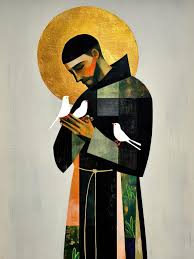
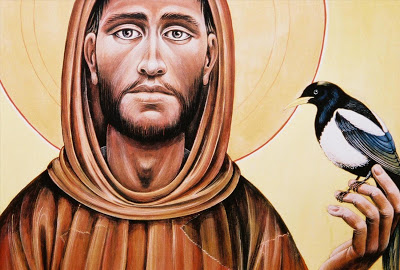
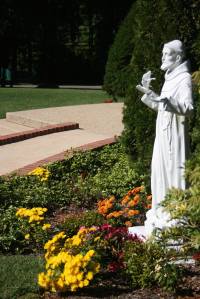
We engage in the blessing of animals because of the inspiration that comes from St. Francis of Assisi. St. Francis is one of the most beloved saints of the Church. Most of us think of Francis as the patron saint of animals and creation. When we think of him, we may think of a St. Francis statue in a garden. We may think of various images of him preaching to birds. Some of us may even recall that tale where Francis negotiated peace between a village and a wolf that had been terrorizing the town. His understanding of animals as his brothers and sisters is why we bless animals on his feast day – the creatures that were so dear to him. That is also why when we say the Eucharistic prayer [at 10:00 am] today, we will use Prayer C – the one that praises, “the vast expanse of interstellar space, galaxies, suns, and the planets in their courses, and this fragile earth, our island home.”[i]
At the heart of our blessings yesterday and today is an understanding that St. Francis had mastered and we continue to understand – that we are bound to all of the creation God created – to the earth, to the earth’s animals, and to one another – even the other humans or other creation we may not like. Jesus reminds us of the nature of that bond today in his words about following him. In Matthew’s gospel, Jesus says, “Come to me, all you that are weary and are carrying heavy burdens, and I will give you rest. Take my yoke upon you, and learn from me; for I am gentle and humble in heart, and you will find rest for your souls. For my yoke is easy, and my burden is light.” Those yokes Jesus talks about were used to harness two animals for work. The yoke allowed the two not just to double their work, but to rely on one another – if one was tired, the other could push harder; and then the weaker one could later support the stronger one. Yokes, like Jesus’ work, were easy and made the burden light.
But beyond the mechanics of a good yoke, the yoke is also a good metaphor for how we see the gospel. Being yoked to another makes you connected. And once you are connected, and see how dependent upon one another you are, you begin to see how that connection extends beyond the two of you – that your yoked interconnection is a microcosm of the connectedness of all of God’s creation. Francis, who was just as known for helping the poor as he was for befriending animals, understood that all humanity is connected. He learned that the more we spend time seeing the humanity in others – especially the humanity in those we would rather not – then we start to see that our interconnectedness extends even further – to God’s creation, to God’s creatures, to the cosmos. If we open our hearts to one, we cannot help but to open our hearts to all. Francis’ love for the poor and Francis’ love for creatures were not two separate things – they were one in the same.
The invitation for us is to start claiming our yoked nature – yoked to those we love, yoked to our political opponents, yoked to those who have different ethics and values than ourselves, yoked to parents who make different parenting decisions, yoked to those with different skin color or sexual orientation, yoked to those we see as deserving of God’s grace and those who are not. Our yoked nature allows us to pray [and later sing] the Prayer of St. Francis from our Prayer Book: “Lord, make us instruments of your peace. Where there is hatred, let us sow love; where there is injury, pardon; where there is discord, union; where there is doubt, faith; where there is despair, hope; where there is darkness, light; where there is sadness, joy. Grant that we may not so much seek to be consoled as to console; to be understood as to understand; to be loved as to love. For it is in giving that we receive; it is in pardoning that we are pardoned; and it is in dying that we are born to eternal life.”[ii] We can do the work of St. Francis, blessing animals, humans, and all creation, because of the yoke of Jesus. Thanks be to God. Amen.
[i] BCP, 370.
[ii] BCP, 833.
 But the story I like most is the story about St. Francis and the Wolf. According to legend, there was a wolf that was terrorizing the town of Gubbio, killing and eating animals and people. The villagers tried to fight back, but they too died at the jaws of the wolf. Francis had pity on the townspeople and went out to meet the wolf. When Francis found the wolf, he made the sign of the cross, and said, “Come to me, Brother Wolf. In the name of Christ, I order you not to hurt anyone.” In response, the wolf calmly laid down at Francis’ feet. Francis then went on to explain to the wolf how he was terrorizing the people and other animals – all who were made in the image of God. The wolf and Francis then made a pact that he would no longer harm the townspeople and the townspeople would no longer try to hurt the wolf. The two traveled into town to explain the pact they had formed. The people were amazed as Francis and the wolf walked side-by-side into town. Francis made the people pledge to feed the wolf and the wolf pledge not to harm anyone else. From that day on, the wolf went door to door for food. The wolf hurt no one and no one hurt the wolf; even the dogs did not bark at the wolf.
 Seeking and Serving