• About

Seeking and Serving

~ seek and serve Christ in all persons

Seeking and Serving

Tag Archives: transformative

Sermon – John 15.9-17, Acts 10.44-48, E6, YB, May 5, 2024

08 Wednesday May 2024

Posted by jandrewsweckerly in Sermons

≈ Leave a comment

Tags

abide, boundaries, circular, hard, Jesus, John, love, messy, repetitive, sacred, Sermon, source, strength, transformative

When I was curate, I served with two other full-time priests.  That meant after about two years, I got used to our very different styles of preaching, but also some of the themes of our preaching.  I remember at one point, my Rector was preaching and I had the distinct thought, “Here we go again.  Another sermon about love!  Ugh!”  I remember being almost irritated thinking, surely there were other topics to preach about.

Sometimes I think we experience John’s gospel in the same way.  John’s gospel is repetitive and circular from the very beginning, “In the beginning was the Word, and the Word was with God, and the Word was God.  He was in the beginning with God.  All things came into being through him, and without him not one thing came into being.”[i]  But John is not the only one who is repetitive and circular – Jesus in John’s gospel is repetitive and circular too.  In the first five verses of John’s gospel today we heard the word “love” eight times.  “As the Father has loved me, so I have loved you; abide in my love.  If you keep my commandments, you will abide in my love, just as I have kept my Father’s commandments and abide in his love.”[ii]  And the funny thing about the gospel today is this is not the first time Jesus talks about love.  As I was reading verse 12, which says, “This is my commandment, that you love one another as I have loved you,” I immediately thought, “Oh, we must be reading the same text we read on Maundy Thursday!”  But you know what?  On Maundy Thursday, we read a passage from two chapters before what we heard today.  The words there are strikingly similar though.  On that night of washing feet, Jesus says, “I give you a new commandment, that you love one another.  Just as I have loved you, you also should love one another.”[iii]

So what is the deal with Jesus talking about love over and over again?  Scholar Karoline Lewis argues that you cannot summarize Jesus in one sentence, so of course we have lots of sentences – even if they are repetitive.[iv]  But I think there is something deeper here.  I think Jesus knew that we, as humans, easily distracted.  “Yeah, yeah, yeah Jesus, I got it.  Love my neighbor! Oh look at that shiny thing over there!”  But even more importantly, I think Jesus knew that love – loving neighbor, loving self, loving God, loving others as Jesus loved is not easy.  Loving as Jesus loves means loving people that others (and even sometimes ourselves) would rather hate.  Loving as Jesus loves means mingling with people that society calls unlovable, difficult, and even evil.  Loving as Jesus loves means seeing dignity and worth in every human being – even when they hurt us, say awful things, or are just so different that they make us uncomfortable.  All we have to do is think about what we have been hearing in the lessons from Acts last week and this week to know that loving means letting people into your circle that you had no intention of letting in – breaking those boundaries that Father Charles talked about last week.  For Peter and the early disciples, that meant Jesus was not just for the Jews, but for Jew and Gentile alike.  And not just as charity, but as a way that transformed the entire community of Jesus followers – such that we find Peter dining and staying with Gentiles – who definitely are not kosher and might even be holding fast to other gods while committing to Jesus. 

So how are we supposed to do this really hard work?  How are we supposed to pull together the strength to love as Jesus loves?  I found comfort in words from scholar Debie Thomas this week.  If you remember, last week we heard the verses from John right before our Gospel lesson today, where Jesus declares he is the vine and we are the branches – he is the vine that we are to abide in.  Debie Thomas says, “My problem is that I often treat Jesus as a role model, and then despair when I can’t live up to his high standards.  But abiding in something is not the same as emulating it.  In the vine-and-branches metaphor, Jesus’s love is not our example; it’s our source.  It’s where our love originates and deepens.  Where it replenishes itself.  In other words, if we don’t abide, we can’t love.  Jesus’s commandment to us is not that we wear ourselves out, trying to conjure love from our own easily depleted resources.  Rather, it’s that we abide in the holy place where divine love becomes possible.  That we make our home in Jesus’s love — the most abundant and inexhaustible love in existence.”[v]

Yes, we will continue to hear about loving others because love is the most important message of Jesus.  And yes, loving will feel nearly impossible at times.  But as Thomas reminds us, “As is so often the case in our lives as Christians, Jesus’s commandment leads us straight to paradox: we are called to action via rest.  Called to become love as we abide in love.  In other words, we will become what we attend to; we will give away what we take in.  The commandment — or better yet, the invitation — is to drink our fill of the Source, which is Christ, spill over to bless the world, and then return to the Source for a fresh in-filling.  This is our movement, our rhythm, our dance.  Over and over again.  This is where we begin and end and begin again.  ‘Love one another as I have loved you.’ ‘Abide in my love.’  These are finally not two separate actions.  They are one and the same.  One ‘impossible’ commandment to save the world.  It’s all about love.”[vi] 

That is our invitation today – to become love and to abide in love.  Perhaps in reverse order:  maybe we need to abide in Jesus’ love in order to know how to love.  But either way, we repetitively and circularly are invited to love – to love as Christ has loved.  Loving will be hard, loving will be messy, loving will be wearying.  But loving will also be beautiful, loving will life-giving, loving will be transformative – certainly of the other, but mostly of ourselves.  We can do that hard, messy, beautiful, sacred work by returning to the source of love and strength.  We can love as Jesus loves because Jesus first loved us.  Amen.


[i] John 1.1-3.

[ii] John 15.9-10.

[iii] John 13.34.

[iv] Karoline Lewis, as explained in the podcast “#963: Sixth Sunday of Easter – May 5, 2024” Sermon Brainwave, April 28, 2024, as found at https://www.workingpreacher.org/podcasts/963-sixth-sunday-of-easter-may-5-2024 on May 2, 2024

[v] Debie Thomas, “It’s All About Love,” May 2, 2021, as found at https://www.journeywithjesus.net/essays/3003-it-s-all-about-love on May 3, 2024.

[vi] Thomas.
On Politics at the Table…

30 Wednesday May 2018

Posted by jandrewsweckerly in Uncategorized

≈ Leave a comment

Tags

Bishop Curry, church, Eucharistic Table, God, gospel, hope, Jesus, love, politics, Reclaiming Jesus, table, transformative, truth

Last week I talked about Presiding Bishop Michael Curry’s sermon at the Royal Wedding.  His sermon on the transformative power of love created shock waves – one, because most people weren’t expecting such a powerful sermon on a royal wedding day; but two, because his words resonated so deeply with people.  He created a spark of hope, a sense of clarity of purpose, and a renewed passion for justice and compassion.   The message was not new:  he simply preached the gospel of Jesus, a two-thousand-year old message.  And yet, the gospel, like it does for every generation, spoke a word of truth.

But after appearances on the Today Show, Good Morning America, The View, and countless other programs, it would be easy to soften Bishop Curry’s message, to say, “Yes!  Love is the answer!” and walk away with a warm fuzzy feeling.  The trouble is, Bishop Curry’s sermon was not just about the easy parts of love.  Bishop Curry preached about the action of love.  If we find the message of love compelling, then we have to start living lives of love.  And that is where his powerful message starts getting uncomfortable.

5b0830721a00002700cdfc6f

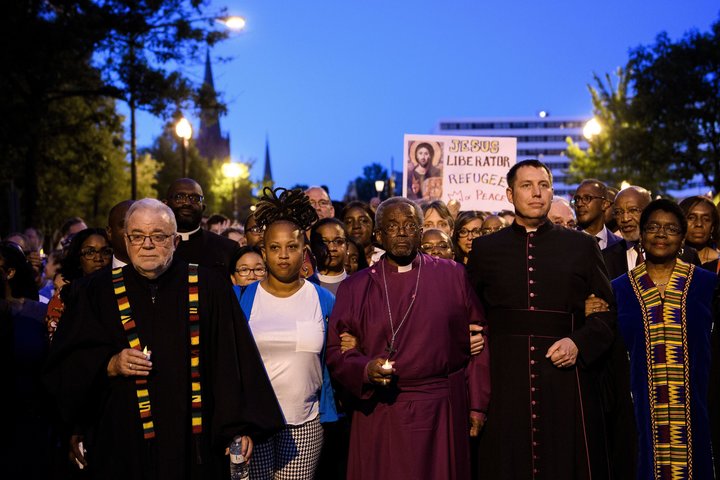
Photo credit:  https://www.huffingtonpost.com/entry/bishop-michael-curry-joins-christian-march-to-white-house-to-reclaim-jesus_us_5b07261ae4b0fdb2aa51b060

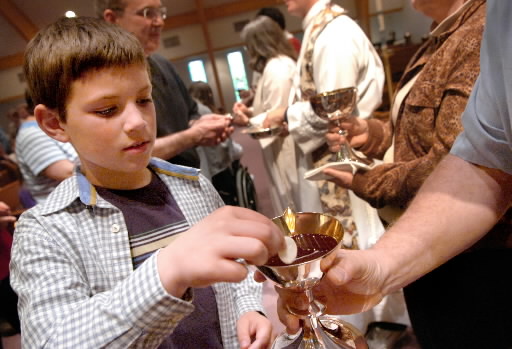
Less than a week after his historic sermon, Bishop Curry joined prominent faith leaders from all over the country in a movement called, “Reclaiming Jesus.”  A video explaining the movement can be found here.  Now if you have spent any time with me, you know that I am very hesitant to talk politics in the pulpit or even publicly.  I have always served in churches that were a wonderfully complicated mixture of political opinions.  The Eucharistic Table is the thing that brings us together, kneeling before God, shoulder to shoulder with fellow church members whose bumper stickers promote the exact opposite opinion of our own.

But just because I do not believe Jesus was a Democrat or a Republican, does not mean that I do no think Jesus and the Gospel are not political.  In fact, Jesus’ very life was ended because he was too “political” – because his message of love made people uncomfortable.  That is what the Reclaiming Jesus movement is about – reminding us that the Church still has a message of love – and that message is not passive or polite but is quite active and alarming.

This week, I am taking the warm, encouraging feelings I had from Bishop Curry’s sermon and listening once again to his words about what love in the world means.  I invite you to join me.  Join me in hearing what in the Reclaiming Jesus message makes you uncomfortable.  Join me in pondering how both political parties get it a little bit wrong and a little bit right.  Join me in remembering that Jesus’ message of love is not the same as an invitation to “avoid politics.”  The question is how we can do politics better.  How can we be an example of what it means to don different bumper stickers and work together for justice, peace, and love?  What Bishop Curry preached at the Royal Wedding sounded beautiful – just like Jesus’ own words.  But what Bishop Curry and Jesus called for was not just beautiful.  It is hard, confusing, challenging work – and even harder to do when we disagree so deeply.  Thank God for the Eucharistic Table!  It is the only promise to me that we can do this – that we can be political agents of love together.  I hope you will join me!

chalice-emhc

Photo credit:  http://www.freerepublic.com/focus/religion/3163266/posts

Homily – Ecclesiasticus 38.1–8, William W. Mayo, Charles F. Menninger, and Their Sons, March 6, 2014

14 Friday Mar 2014

Posted by jandrewsweckerly in Uncategorized

≈ Leave a comment

Tags

baptismal covenant, calling, doctor, God, healing, health, homily, Mayo, Menninger, transformative

Today we honor William W. Mayo, Charles F. Menninger and their sons.  The Mayo family name is probably the most familiar to us.  They built the first general hospital in Minnesota.  In 1883, when a devastating tornado hit, the Episcopalian Mayos joined the Roman Catholic Sisters of St. Francis to respond to the disaster.  Their work together developed a new type of patient care that emphasized the whole person – spiritually as well as physically.  Building on the vision of doctors working as a team with other medical professionals, not just as solo diagnosticians, the Mayo Clinic eventually emerged as a model for integrating person-centered medical care with the best in cutting-edge scientific and medical research.

The Menninger family were pioneers in establishing a new kind of psychiatric treatment facility in Kansas in 1925.  They helped transform the care of the mentally ill in ways that were more medically effective and more humane.  They were involved in advocacy and public policy development to support the needs of the mentally ill.  One of the sons, Dr. Karl Menninger, wrote a book in 1973 about how recognizing sin, within us and among us, is a key component in personal and relational health.  Both the Mayo and Menninger families’ work was transformative because of their commitment to treating the whole person – physically, emotionally and spiritually.

It is most appropriate then that today we read from Ecclesiasticus a passage honoring physicians.  The first time I heard this passage was at a funeral for a doctor.  I thought the blessing of physicians was a bit odd at first – why out of all the professions should they receive praise?  Certainly Jesus had an affinity for healing, and we have all been blessed by some medical professional at some point in our lives – truly we would be lost without our doctors.  But I think of all the other, professionals and vocations that are also blessings and wonder why physicians?  Once I was at an airport and saw a large group of those serving in the military returning home.  All those in the airport stopped what they were doing and clapped.  A friend near me wondered aloud, why we do not honor others in the same way – why no standing ovation for teachers, social workers, sanitation workers, and stay-at-home parents?  What would our world look like if we could praise each of us for the ways we actively live into God’s call in our lives?

That is really why we celebrate the Mayos and Menningers today.  Not because they are physicians, but because of the way in which they are physicians.  Their respect for the dignity of every human being is more to be commended than anything.  That is what the Mayos, Menningers, and our lesson invite us into today – to live more fully into our baptismal covenant and to our calls.  Amen.


Sermon – Matthew 4.12-23, E3, YA, January 26, 2014

29 Wednesday Jan 2014

Posted by jandrewsweckerly in Uncategorized

≈ Leave a comment

Tags

call, extraordinary, fishers of people, God, immediately, Jesus, ministry, ordinary, relationship, transformative

The first time I sensed a call to ordained ministry was in my last year of college.  The sense of call was strong and I felt like I could hear God’s word to me as clear as a bell.  And so what did I do?  I ran the other way…for a long time.  I remember thinking, “Oh, no.  I can’t do that.  How about I choose how I will serve God?”  And so off I went to my first my position after college.  When that was done, I knew the position was not quite the right fit, so I tried something a little closer to what felt like my call.  And of course, within a year or two, that did not quite feel right either.  And so I began to try to figure out how else God might be calling me.  Around and around I went with this game until finally someone just said straight out, “I think you ought to become an Episcopal priest.”  Even with that direct, irrefutable statement from a live person, I still could not say yes.  I took another whole year in discernment before I was finally ready to say yes to God. 

Needless to say, my response to God’s call was nothing like the response of the disciples in today’s Gospel.  Matthew says that Peter and Andrew immediately left their nets and followed Jesus.  Immediately they left.  The Message translation of this verse says, “They didn’t ask questions, but simply dropped their nets and followed.”  I do not know about you, but the idea of following Jesus immediately, and especially following Jesus without asking any questions seems ludicrous to me.  That act of leaving immediately is equally shocking in Jesus’ day too.  The disciples follow Jesus without qualification or questions.  They leave behind their entire profession, which is quite likely a lucrative business at the time.  All of this without any assurances that they will be provided for or have the ability to improve their financial standing by following Jesus.  Finally, following Jesus immediately means leaving behind families.[i]  This last shocker is perhaps the most unsettling because this is all happening in a time when family connections are “a primary source both of identity and honor,” and at a time when caring for one’s parents is “rooted both in cultural custom and in biblical law.”[ii]  This call narrative is as shocking then as the narrative is shocking now.

In our Adult Forum series last week, we talked about discerning God’s call in our lives.  We opened by reading this text from Isaiah 42, “Here is my servant, whom I uphold, my chosen, in whom my soul delights; I have put my spirit upon him; he will bring forth justice to the nations.  He will not cry or lift up his voice, or make it heard in the street; a bruised reed he will not break, and a dimly burning wick he will not quench; he will faithfully bring forth justice.”[iii]  Our class then reread the Isaiah passage, inserting our names in the passage.  So we heard statements like, “Kurt will bring forth justice to the nations,” or “I have put my spirit upon Barbara.”  We realized two things once we put our own names into the passage.  One, when we hear the words, “called to ministry,” we often think of clergy, missionaries, or people from scripture – not everyday people from Long Island.  Second, many of us do not think of ourselves as being called to a ministry.  We may volunteer at church or help out others, but we rarely use “call” language to describe what we do with our time, especially if our secular work does not feel particularly tied to our sacred beliefs.  But then we read the Catechism in the back of the Prayer Book.  The first persons listed as being ministers of the Church are lay persons, and according to the Catechism, the ministry of the laity, “…is to represent Christ and his Church; to bear witness to him wherever they may be; and, according to the gifts given them, to carry on Christ’s work of reconciliation in the world.”[iv]  So not only were we grappling with the idea of being ministers, we were grappling with the idea that those call stories are not just for someone else – we have a call story too.

Once we come around to the idea that we are all called by God, the big question then becomes, can we imagine responding to God’s call immediately like the disciples do with Jesus today?  Do we hear God’s invitation into ministry or a new vocation and immediately drop our nets, without question or delay?  Perhaps a better place to begin is to look back at Matthew’s text and see exactly what Jesus calls those first disciples to do.  Jesus says to follow him and he will make them fishers of people.  I have always read that invitation and basically translated the invitation as Jesus is going to teach them to be evangelists, converting others to Christ.  But as I read this week, I stumbled across a new interpretation of that phrase.  One scholar suggests that inviting the disciples to be fishers of people is an invitation to be in relationship – with Jesus, with each other, and with all the various people they will meet over the next few years, or perhaps even over the rest of their lives. 

If being fishers of people means being in relationship, what does that actually look like?  Exploring Jesus’ relationship with his disciples gives us some clues.  Being fishers of people means “bearing each other’s burdens, caring for each other and especially the vulnerable, holding onto each other through thick and thin, always with the hope and promise of God’s abundant grace.”[v]  Why would Jesus call people into relationship in this way?  Because by calling ordinary people in the midst of their ordinary lives into relationship with the ordinary people all around them, extraordinary things happen. 

So what does that look like here at St. Margaret’s?  In some ways many of us are already fishers of people.  We care for one another in this community, visit one another especially in crisis or illness.  But we also are in relationship with our neighbors – the staff at the local high school who connects us with those in need; our interfaith brothers and sisters as we make sandwiches together for the hungry; the people we meet, both at local ministries, but even our AHRC neighbors as we grow vegetables together.  And the invitation to be fishers of people keeps finding new manifestations here.  Our Outreach Committee is exploring a relationship with a community in Haiti – one facilitated by our relationship with another local parish here in Nassau County.  Though I know many of us are hesitant about international service, imagine what our dropping our nets without question and following Jesus might look like in that relationship.  Meanwhile, as we consider the possibility of a pilgrimage, we consider the ways that we will forge new relationships – with God, with one another, and certainly with people we have never met before.  Even something as simple as our new sponsorship of a Plainview Little League team this year has the potential for being a place to be fishers of people – where we can meet local parents while taking in a game and rooting for our team. 

These very real invitations into new relationships are scary or perhaps seem frivolous to us now.  But the power of Jesus’ invitation to be fishers of people is transformative.  First, accepting the invitation to be fishers of people transforms us.  When we enter into relationships with others, those interactions change us forever.  They help us see God in new ways, they help us reshape our worldview, and they help us to better understand our calling – that ministry that we all have.  Being fishers of people transforms not just us, but also transforms those with whom we are in relationship.  For many years, the staff at AHRC saw St. Margaret’s as distant, if not even inhospitable neighbors.  But now, the staff knows our names, sees new hope in our relationship, and perhaps even sees the love of Jesus through us.  Finally, being fishers of people transforms not just us and those with whom we are in relationship; being fishers of people transforms the kingdom of God here and now.  Our relationships have an impact way beyond the relationships themselves.  Others see the quality of our relationships and they see something intriguing, something inviting, and something inclusive.  Through those relationships, we invite others in, and the kingdom of earth begins to look a lot more like the kingdom of God.  You may not be able to drop your nets immediately today to follow Jesus.  But if you cannot drop them today, know that Jesus’ invitation to follow him is waiting for you and that God will empower you to say yes when you are ready.  Amen.


[i] Troy A. Miller, “Exegetical Perspective,” Feasting on the Word, Yr. A., Vol. 1 (Louisville: Westminster John Knox Press, 2010), 289.

[ii] Judith Jones, “Commentary on Matthew 4.12-23,” as found at http://www.workingpreacher.org/preaching.aspx? commentary_id=1972 on January 23, 2014.

[iii] Isaiah 42.1-3 

[iv] BCP, 855.

[v] David Lose, “Fishers of People,” as found at http://www.workingpreacher.org/craft.aspx?post=3018 on January 23, 2014.

Recent Posts

  • On the Nose…
  • On Commitments and Gratitude…
  • Sermon – Luke 17.11-19, P23, YC, October 12, 2025
  • Sermon – Matthew 11.25-30, St. Francis Feast, YC, October 5, 2025
  • On Finding Commonality and Church…

Archives

  • October 2025
  • September 2025
  • August 2025
  • July 2025
  • June 2025
  • March 2025
  • February 2025
  • December 2024
  • November 2024
  • October 2024
  • September 2024
  • August 2024
  • July 2024
  • June 2024
  • May 2024
  • March 2024
  • February 2024
  • January 2024
  • December 2023
  • November 2023
  • October 2023
  • September 2023
  • August 2023
  • July 2023
  • June 2023
  • May 2023
  • March 2023
  • February 2023
  • January 2023
  • December 2022
  • November 2022
  • October 2022
  • June 2022
  • May 2022
  • January 2022
  • December 2021
  • November 2021
  • October 2021
  • September 2021
  • August 2021
  • June 2021
  • May 2021
  • April 2021
  • March 2021
  • February 2021
  • January 2021
  • December 2020
  • November 2020
  • October 2020
  • September 2020
  • August 2020
  • July 2020
  • June 2020
  • May 2020
  • April 2020
  • March 2020
  • February 2020
  • January 2020
  • December 2019
  • November 2019
  • October 2019
  • September 2019
  • August 2019
  • July 2019
  • June 2019
  • May 2019
  • April 2019
  • March 2019
  • February 2019
  • January 2019
  • December 2018
  • November 2018
  • October 2018
  • September 2018
  • August 2018
  • July 2018
  • June 2018
  • May 2018
  • April 2018
  • March 2018
  • February 2018
  • January 2018
  • December 2017
  • November 2017
  • October 2017
  • September 2017
  • August 2017
  • July 2017
  • June 2017
  • May 2017
  • April 2017
  • March 2017
  • February 2017
  • January 2017
  • December 2016
  • November 2016
  • October 2016
  • September 2016
  • August 2016
  • July 2016
  • June 2016
  • May 2016
  • April 2016
  • March 2016
  • February 2016
  • January 2016
  • December 2015
  • November 2015
  • October 2015
  • September 2015
  • August 2015
  • July 2015
  • June 2015
  • May 2015
  • April 2015
  • March 2015
  • February 2015
  • January 2015
  • December 2014
  • November 2014
  • October 2014
  • September 2014
  • August 2014
  • July 2014
  • June 2014
  • April 2014
  • March 2014
  • February 2014
  • January 2014
  • December 2013
  • November 2013
  • October 2013
  • September 2013
  • August 2013
  • July 2013
  • June 2013
  • May 2013
  • April 2013
  • March 2013
  • February 2013
  • January 2013
  • December 2012
  • November 2012
  • October 2012
  • September 2012

Categories

  • reflection
  • Sermons
  • Uncategorized

Meta

  • Create account
  • Log in
  • Entries feed
  • Comments feed
  • WordPress.com

Blog at WordPress.com.

  • Subscribe Subscribed
    • Seeking and Serving
    • Join 393 other subscribers
    • Already have a WordPress.com account? Log in now.
    • Seeking and Serving
    • Subscribe Subscribed
    • Sign up
    • Log in
    • Report this content
    • View site in Reader
    • Manage subscriptions
    • Collapse this bar
 

Loading Comments...