• About

Seeking and Serving

~ seek and serve Christ in all persons

Seeking and Serving

Tag Archives: yes

On Risking Failure and Facing Fear…

03 Wednesday Dec 2025

Posted by jandrewsweckerly in reflection

≈ Leave a comment

Tags

anxiety, challenge, failure, fear, God, growth, hesitant, Holy Spirit, invitations, Jesus, joy, new, risk, try, yes

Photo credit: https://stock.adobe.com/search?k=parachute+jump+plane

I was listening to a podcast this week that was talking about how, as they mature, adults have a harder time trying new things because they have a deeper understanding, and perhaps fear of, failure.  Children don’t have this same hesitancy.  They try new things, figure out what works and what doesn’t, and keep at it.  There is a freedom in their development that allows them not to hold back or be afraid, but to keep trying out new experiences and challenges.

As one of my daughters ages, she is heading into that in-between time where she doesn’t have the same innocent willingness to try and fail, and is starting to understand that failures or inadequacies are sometimes noticed by others negatively.  She is trying out a new extracurricular this fall, and hated the first session.  As we headed into the second session, she pulled out all the stops about why she shouldn’t have to go back:  she wasn’t good enough, people weren’t nice, she would bring down the group through her inexperience.  In a moment of weakness, I almost caved.  I know how big those feelings are.  I palpably remember the anxiety that kind of experience brings, and I wanted to protect her from that hurt. 

When she came out of the second practice, she was a different person.  She was smiling, had a lightness to her step, and a warmth about her.  “That was fun!” she said.  As I listened to her describe the session, I was overwhelmed with two realizations.  First, I realized how close I came to cutting off a growth experience – how she would have never had learned the feeling of what it means to push through fear and find joy.  And second, I realized I needed to take a long look at where I am cutting off growth experiences in my own life.  Masked with the label, “wisdom,” how often do I fail to risk?

I wonder what growth opportunities are being presented to you today.  It doesn’t have to be something big or dramatically different.  Part of creating an openness to growth means being open to the little invitations – talking to a stranger when that’s not something you would normally do, reaching out for support when you don’t like feeling dependent upon someone, saying yes to an invitation to something that is not at all in your comfort zone but you admittedly have never tried to know for sure.  Those yeses prepare us for the yeses the Holy Spirit desires in each of our lives.  Those invitations are often God’s quiet invitations into God’s joy.  Those experiences are often pathways to the incarnate Jesus in your life.  I can’t wait to hear what you say yes to this week!

On the Blessing of No…

05 Wednesday Jun 2024

Posted by jandrewsweckerly in reflection

≈ Leave a comment

Tags

bishop, ego, faith, good, Holy Spirit, image of God, learning, lose, no, opportunity, priest, self-confidence, transform, win, yes

Photo credit: https://toledoparent.com/online-exclusives/learning-to-say-no/

For weeks my fourth grader has been talking about running for Student Body President.  I was admittedly proud of her gumption, but also wildly (and quietly) nervous on her behalf.  She is a genial, vibrant, beloved individual and I feared what losing an election at her age might do to her self-esteem.  But even with gentle warning, she was determined.  So, we worked on her speech and filled out the paperwork.  The “primary” involved whittling down a group of 12 students to three – no speeches or posters, just a raw “popularity contest” among the fourth graders.  Last night she returned home only a little disappointed that she had not been elected to the final ballot. 

I do not know why I doubted her capacity to maintain her self-confidence in the face of such a loss.  I have been modeling the same for her for years – sometimes you win and sometimes you lose.  Sometimes you get a yes, and sometimes you get a no.  These lessons have certainly happened verbally and in low-risk ways, like in card games.  But the lesson has been learned in big ways too – like a lost bishop’s election.  Though I loathed the very public nature of a bishop’s search, I do not think I fully understood the power of letting my girls watch me not only be nominated, but make very public presentations, and then not be elected.

Without realizing it, I have been teaching my girls the power of a good “no.”  Almost all the good things that have happened to me – jobs, schools, auditions – were preceded by a solid no.  The student government election I did not win, the audition where I did not make the cut, the job I really wanted and did not get.  Every single one of those no’s profoundly taught me something about myself I did not know, and every single one of those no’s led to another opportunity that could only open up because of the no that happened first. 

The experience of no’s can be brutal to the ego.  But I wouldn’t be the spouse, mother, priest, or human that I am today without all those no’s.  And now I know that learning was not just for me – it was for my children too.  And maybe those no’s have been for some of you as well.  I wonder what no’s you are facing these days.  I wonder what you have learned from the times you received a no.  I suspect the Holy Spirit has been transforming you so that when you get a yes, you come to that yes as your most powerful self – the self that was made in God’s image and is beautiful and beloved.

On Not Really Being Alone…

16 Wednesday Aug 2023

Posted by jandrewsweckerly in reflection

≈ 1 Comment

Tags

alone, anxiety, challenges, companions, creation, curse, encourage, fear, friend, God, gratitude, panic, prayer, sabbatical, stranger, yes

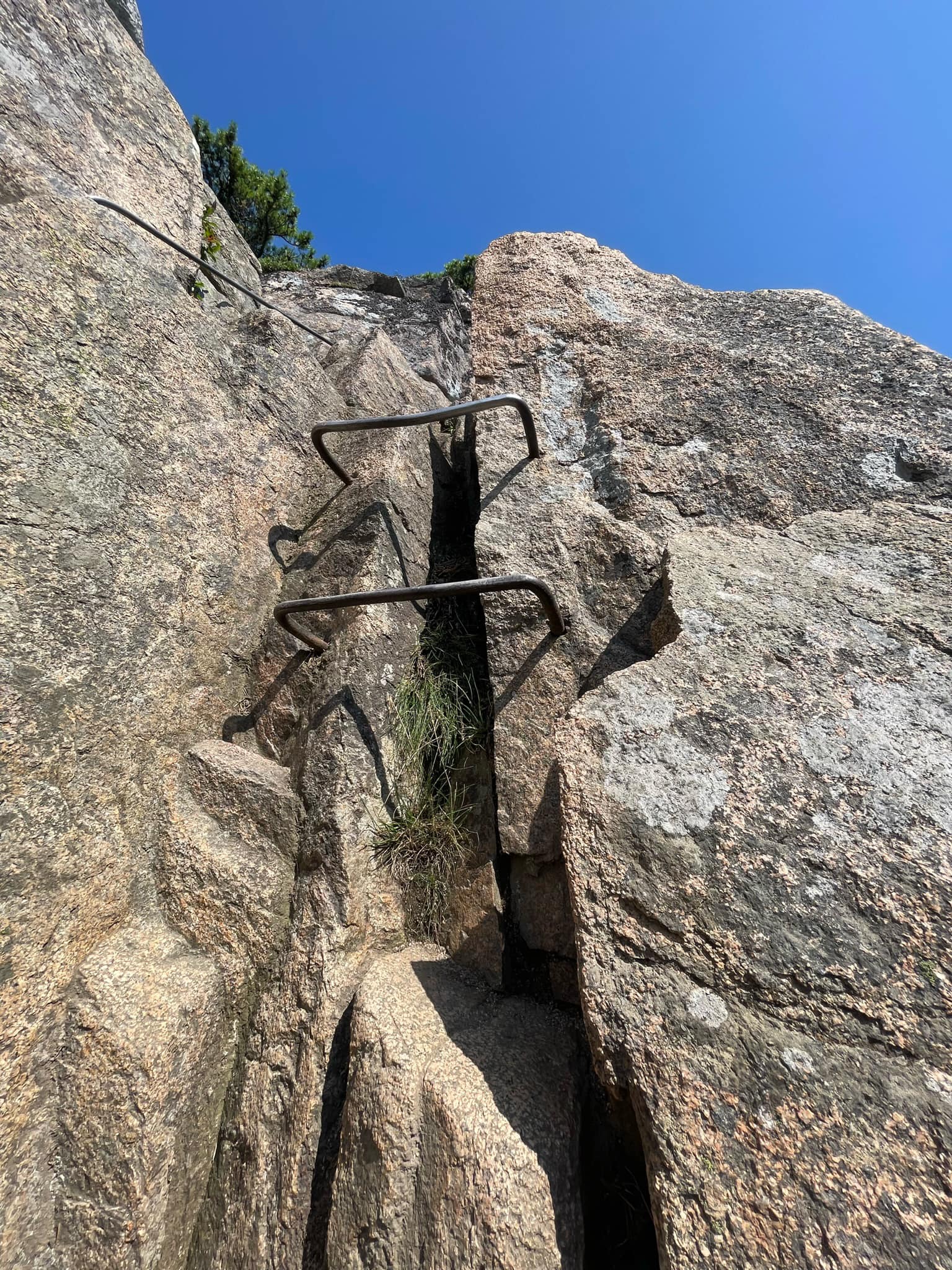
Beehive Trail Iron Rungs, Acadia National Park (Photo credit: Elaine Ho; reuse with permission)

Last week, I finished up my sabbatical on a trip with college friends to Acadia National Park.  Having been friends for over 26 years, and having traveled together, domestically and abroad, we know each other well – each other’s habits, weaknesses, and strengths.  We know who is most likely to get up early for exercise, who you don’t talk to before they’ve had coffee, and who is a total chicken when it comes to anything adventure related.  That last one would be me.  But since we all know how tentative I am, we all know they will push me to try new adventures anyway, and I will say yes – even if I grumble, curse, and sometimes pray my way through the adventures.

This year’s adventure was hiking the Beehive Loop Trail – a trail with a steep mountain cliff, boulders, exposed ledges, and iron rungs.  We’ve done hikes before, and I’m relatively fit, but this was definitely a difficulty I have never tried and would certainly not have tried of my own volition.  But this is what we do, and so off I went.  I knew the trail was no joke when the first part of the “trail” was actually just a path of small boulders to navigate over.  As we made our way up, I could see the views were going to be amazing.  But I stopped when I got to the first real set of iron rungs.  After a few deep breaths, some encouraging words whispered in my ear, I grabbed the first rung.  As I scanned for where to place my feet, I could see worn footholds from thousands of hikers before me.  As we walked along ledges, the skinny tree trunks I used as handholds were smooth from those same thousands of hikers who had grabbed them before me.  When the hikers in front of us were moving slowly and we just had to stand on narrow ledges waiting for our turn, I hugged the rock cliff beside us. 

Nature’s handrails, Beehive Trail, Acadia National Park (Photo credit: Elizabeth Shows Caffey; reuse with permission)

During that hike, I slowly realized the reason I say yes to these challenging women is not because I’m avoiding conflict or caving to peer pressure.  I say yes because I am never alone in my yes.  Whether it is my amazing friend who refuses to bound ahead because she knows that if I slip or start to panic, she will catch me and encourage me ever so gently.  Whether it is the guidance of travelers before me who have left their wisdom behind.  Whether it is in God’s creation herself who stands strong when we need her.  So, as I mutter the reminder, “I love these women…” like it’s both a curse and a blessing, I am reminding myself I am not alone.  When I sigh in profound gratitude, “Thank you, tree,” I am reminding myself that God has not left me comfortless.  When I watch out-of-shape elders, and seemingly too young youngsters, being cheered on and reaching the top, I am reminded that none of us is alone. 

I wonder what challenges you are facing today that feel like a challenge you are facing alone.  I could have faced that mountain ledge or those crazy iron rungs and thought, “I am utterly alone in this.  Only I can take each step, ascend each level.  This is my battle to face.”  But just as I was never alone – and not just with my three other friends, but with countless generations of hikers, and centuries old formations of God’s creation, we are not alone in the challenges we face either.  How many times have we cried out to God for help, only to find a friend or stranger unexpectedly accompanying us?  Sometimes that worn foothold is hard to notice in the face of panic.  Sometimes the smoothness of that tree trunk is barely noticeable because we are gripping so hard or trying to move forward so quickly.  But God is with us, giving us companions for the journey.  We are not alone.

On the Power of Yes…

19 Wednesday Oct 2022

Posted by jandrewsweckerly in reflection

≈ 1 Comment

Tags

ask, complicate, expectation, God, inconvenient, invitation, joy, no, opportunity, parenting, plan, talent, time, treasure, unexpected, yes

Photo credit: https://www.psychologytoday.com/us/blog/darwins-subterranean-world/201809/the-power-yes

The last couple of weeks, I have been hit by unexpected asks.  While away on a work-related trip, I got an urgent text from one of my daughters needing help on a homework assignment.  While I was not required to be somewhere else, I certainly had other work plans for that hour that I would need to forego.  Just this past Monday, our unofficial laundry day, my other daughter asked if we could play games after dinner.  I assure you I had a mound of laundry that needed switching out, meaning I would not finish laundry that night.  Meanwhile, a long-time friend is in town and would like to renew his wedding vows at my church this Sunday.  This Sunday already feels like an “overbooked” Sunday with picking up Fall Festival wares, welcoming a new staff member, and hosting a notable guest preacher. 

I tend to be a planner who gets in my head how things are going to go.  Unexpected asks often mean foregoing a plan, shifting expectations, and at a base level, saying no to something else in order to say yes to the ask.  And if I am really being honest, my gut reaction is often to say “no.”  No is easier.  No does not complicate your life, does not require you to do any work, and does not mean having to problem-solve.  There are countless parenting studies that say the best method of parenting is to find as many yeses as you can.  The idea is not to become a parent-doormat, but to build up children’s self-esteem and confidence, improve emotional intelligence, and develop trust in the parent-child bond.  Yes-parenting is a response to research that says parents say no to children about 400 times a day!

I am not saying I have mastered yes-parenting, but I have begun to wonder about the power of yes.  That hour of homework-help last week meant a deeper connection with my daughter at the end of the call and a sense of accomplishment on my own part (trust me, parenting more often makes you feel like a failure than an accomplishment).  That hour of playing games brought back so many fond memories of playing games with my parents and even my children (before technology took hold!).  And those renewed wedding vows are going to make this Sunday one of the most exciting Sundays we have had in a while.  How can I say no to more joy?

I wonder what yeses you are being invited into this week.  Sometimes they are tiny yeses:  agreeing to take a picture for strangers with their cell phone.  Sometimes the yeses are inconvenient:  giving up on your planned activity to help with something else.  And sometimes the yeses are huge:  taking a new job, going on a date with someone new, trying a new activity to meet new friends.  God is constantly offering opportunities for us to say yes:  yeses that involve our time, talent, and treasure.  Our invitation this week is to start saying yes – maybe tiny yeses, but maybe some really big ones.  I cannot wait to hear about your yes adventures!

Sermon – Matthew 13.31-33, 44-52, P12, YA, July 26, 2020

29 Wednesday Jul 2020

Posted by jandrewsweckerly in Sermons, Uncategorized

≈ Leave a comment

Tags

disciples, disturbing, embrace, Jesus, kingdom of God, mustard seed, parables, pearl, Sermon, surprising, treasure, understand, unsettling, yeast, yes

In today’s gospel lesson, full of six very different rapid-fire parables by Jesus, the line that jumps out at me most is in verse 51.  Jesus says to the disciples, “Have you understood all this?” and the disciples answer, “Yes.”  Now, after a week of pouring over this text, I still cannot figure out whether we are supposed to laugh at this line – because who could so simply understand such vivid parables by Jesus; whether I am supposed to feel a kinship with this line – because I have heard these parables a million times and feel pretty confident I understand them too; or whether I am supposed to be intimidated by this line – because if the disciples, who rarely understand anything, so simply understand these parables, maybe I am doing something wrong.

Part of the challenge is context is really important for today’s gospel lesson.  Much like Jesus tells these parables in rapid-fire succession, we could consume the images in a rapid way:  a tiny seed that grows into huge plant, a woman adding yeast to bread, a man finding treasure, a merchant finding a sought-after pearl, a net catching fish.  The images are basic enough that we could read them and figure out what Jesus is saying about the kingdom.  In fact, the disciples’ simple “yes” doesn’t seem so funny or intimidating after all.

But there is more to these images than our modern eyes often catch.  That beloved mustard seed we know so well, that we maybe rolled around between our fingers in Sunday School class, is a little more complicated.  Ever the fan of the underdog, we Americans might see this mustard seed as the metaphor of the little guy winning.  But the context we miss is the mustard plant is a weed, an ancient version of kudzu, that consumes valuable garden space that most farmers would have pulled from a field[i].  And although we might be used to throwing yeast into bread, yeast in Jesus’ day was seen as evil or unclean, a symbol of corruption and impurity[ii].  And let’s not forget the merchant, who at the time was not a respected businessman, but someone who would have been socially suspect, using excessive funds for a luxury item, an item that has nonkosher origins, who in spending everything, who loses his identity as a merchant because he has nothing to buy or sell.[iii]  So when Jesus says the kingdom of God is like invasive weed, a corrupting yeast, or a shady merchant, our simple “yes,” about understanding might be premature.

What we learn about the kingdom of God in these parables is rich and layered.  The kingdom of God is surprising:  something seemingly small and worthless can be a place of shelter and nurture.[iv] The kingdom of God unsettling:  where something seemingly corrupt can secretly grow goodness to feed hundreds.  The kingdom of God is disturbing:  where unsuspecting individuals are inspired to seemingly irrational behavior that glorifies God.

I am still not sure how we should interpret the disciples’ “yes” today when Jesus asks them if they understand.  Perhaps their yes is followed by ellipses and a question mark – a tentative commitment to keep listening because what Jesus is saying is so overwhelming, “yes” is all they can say.  Perhaps their yes is a quiet yes because they understand how their lives are about to be upended.  Perhaps their yes is a bold declarative, comical on the surface because who can really understand Jesus, but also admirable, because despite how surprising, unsettling, and disturbing this kingdom is, they are all in with Jesus.

Our invitation this week is proclaim a yes for Jesus too.  In a time of a worldwide health crisis, of political unrest, and of societal upheaval, Jesus invites us to see the kingdom not as escape from the world, but a way of being that embraces surprising, unsettling, disturbing love and grace of God that will change us completely and transform the world beautifully.  Your yes today can be tentative, sober, or declarative.  You are in good company either way.  But your invitation is to say yes regardless – and then buckle up for the ride.  Amen.

[i] J. David Waugh, “Exegetical Perspective,” Feasting on the Word, Year A, Vol. 3 (Louisville: Westminster John Knox Press, 2011), 287.

[ii] Talitha J. Arnold, “Pastoral Perspective,” Feasting on the Word, Year A, Vol. 3 (Louisville: Westminster John Knox Press, 2011), 286.

[iii] Amy-Jill Levine, Short Stories by Jesus:  The Enigmatic Parables of a Controversial Rabbi (New York:  Harper One, 2014), 160-161

[iv] Waugh, 287.

Sermon – Luke 5.1-11, Isaiah 6.1-8, EP5, YC, February 10, 2019

13 Wednesday Feb 2019

Posted by jandrewsweckerly in Sermons, Uncategorized

≈ Leave a comment

Tags

call narrative, calling, dramatic, fear, fish, God, Jesus, ordinary, Peter, resist, Sermon, servant, Simon, yes

Stories of God calling individuals into a new mission, or “call narratives,” as we label them, are some of our most beloved stories from scripture.  They are all pretty dramatic:  God speaking to Moses from a burning bush, God having Jonah thrown overboard and swallowed by a fish, God sending an angel to Mary, or today, a seraph placing a burning hot coal on Isaiah’s lips.  At first, almost everyone one of the characters resists – with protests about how they are not good public speakers, how they do not agree with God’s mission, how the thing God is proposing is biologically impossible, or how they are so full of sin, they could not possibly do whatever God has proposed.  And yet, after much arguing with God, each individual usually agrees – and often says the words we hear in Isaiah today, “hineni,” or “Here I am;” send me.  The whole process is very dramatic and awe-inspiring.  We love to hear and reread these stories and we love to see individuals rise to the occasion.

But here’s the problem with call narratives.  The stories are so dramatic and the responses are so confident and selfless, that we cannot see ourselves in them.  Those are stories that happen to those people.  We are not Moseses, Isaiahs, Marys, or Jonahs (ok, maybe we are a little like Jonah, but even his story is a bit extreme!).  We can certainly relate to the resistance each servant offers to God, but the call is a bit harder for us to imagine.  God doesn’t come to us in dramatic ways, and we definitely do not feel like God is doing something dramatic in us to change the world.  The last time we checked, we were not being asked to lead a people out of slavery from a dictator, use our bodies for immaculate conception, or even go around proclaiming judgement to the world.  Those sorts of dramatic things are things other people do; not us.

I think that is why I like Luke’s version of Simon Peter’s call narrative.  This pericope, as Bob taught us last week, or this piece of scripture might be the story we need to help us see call narratives are not just about those people.  The way we get there though, is not jumping right to overflowing boats, full of fish.  The way we get there is looking at all the seemingly innocuous parts of the story.

The first small detail of the story that can sneak past us is how Jesus starts teaching.  The text says, “while Jesus was standing beside the lake of Gennesaret, and the crowd was pressing in on him … He got into one of the boats.”  Jesus does not ask permission of Simon to get in his boat.  Jesus does not negotiate the terms of using Simon’s boat for a period of time.  Jesus literally just gets on the boat. He does not seem to care that Simon and his crew have had a total failure of a night of fishing, and are probably both exhausted and frustrated.  Jesus just gets on the boat with a word to Simon.  As scholar David Lose argues, what we learn about in this brazen action is “sometimes God doesn’t ask our permission to get involved in our life, to encounter us with grace, God just goes ahead and does it.”[i]

Then something even more odd happens.  When Jesus finally does get around to asking Simon to push the boat out a bit so he can teach, Simon just does what Jesus asks.  We have no idea why.  Perhaps he simply responds because he knows this is just the way Jesus is.  We know that Simon Peter already had an encounter with Jesus at this point in Luke’s gospel, when Jesus healed his mother-in-law.  Maybe Simon was so grateful for that healing that he pushed the boat out to sea out of a sense of gratitude or obligation.  Or maybe Simon Peter was just that kind of guy – the kind of guy who even when he is bone tired and frustrated would still lend you a helping hand.[ii]  Regardless, his immediate and silent acquiescence tells us something.

Then another funny thing happens.  The text tells us when Jesus is done teaching, Jesus speaks to Peter.  That half sentence almost seems like a throw-away transition.  But even in this transition, we see something special.  What we see in this transition is even “when he’s all done teaching, Jesus isn’t actually all done.  In fact, that he’s just getting started.  Because God’s like that, always up to more than we imagine.”[iii]

Then comes Jesus’ request – to put the nets back out again.  Now, remember that Simon Peter and his crew have just spent the early hours of the morning cleaning all those nets.  So already, Jesus is asking a lot to this worn down, frustrated crew.  But Jesus’ request is funny in another way.  Jesus does not suggest they try his new and improved fishing method.  Jesus does not suggest a new body of water or a different location.  Jesus does not give them new nets to try.  He just asked them to do the exact same thing they had been trying all night.  The only difference this time, as Lose points out, is “… Jesus spoke to them and they do what he says and the word Jesus spoke makes it different, because God’s Word always does what it says, even when those hearing that Word fall short or even have a hard time believing it.”[iv]  God’s Word changes everything.

Now what happens next is pretty typical.  When the miracle of all those fish happens, and Peter senses Jesus offering a call to him, Peter protests as many a servant has – saying he is a sinner.  But what is interesting in this call narrative is Jesus’ response.  Jesus does not say that Simon’s sins are forgiven, or do some symbolic act to cleanse Simon’s sinfulness.  No, Jesus says, “Do not be afraid.”  Sure, Jesus offers forgiveness of sins.  But Jesus offers so much more.  Jesus offers encouragement and comfort.  Instead of simply insisting Simon can answer the call, Jesus instead offers the words of a pastor.  Those words, “do not be afraid,” will be words we hear over and over again in Luke’s gospel.  Part of this call narrative is a reminder that we do not have to be afraid anymore!

Then Jesus tells Peter something even more incredible.  This miracle he just witnessed is nothing.  Peter is going to do something even greater – be a fisherman of people – “catching people up in the unimaginable and life-changing grace of God.”[v]  Simon Peter really was not someone special.  Simon was not so gifted that he was already a leader in the community.  No, Jesus just picks an average fisherman for this incredible new mission.  That’s something else we learn about God in this passage; this is “how God works, always choosing the unlikeliest of characters through whom to work, putting aside all their doubts and fears and excuses and professed shortcomings to do marvelous things through them.”

And this is how we get back to each person in this room.  Despite the fact that call narratives can be dramatic, call narratives are also full of ordinary little things that remind of us the kind of God we have; the reasons why we trust this incredible, loving God; how woefully unprepared and unworthy any of us really are; and how through our relationship with God we find ourselves saying yes, saying hineni, without an exclamation point, but with scared-out-of-our-minds trust.

We may think call narratives are something that biblical heroes experience.  But the reality is, each one of us here has a call narrative.  Sometimes they are dramatic, but most of the time, they are gradual calls that evolve as we deepen our relationship with Christ, as we slowly, quietly keep saying hineni, as we try, fail, and try again to figure out what God wants us to do with our lives, and as we suddenly realize we are doing it.  We are leaving boats full of fish to follow Christ.  We changing the course of our lives in incremental ways.  We are finally able to see ourselves as Christ sees us – as individuals gifted with special gifts that enable us to share God’s love in our own little piece of this big world.  Do not be afraid, friends.  The secret of you already following God’s call is safe here.  Just keep saying yes, keep saying your quiet hineni and God will keep using you in powerful, dramatic ways.  Amen.


[i] David Lose, “Epiphany 5C: Lots to Love,” February 5, 2019, as found on February 6, 2019, at http://www.davidlose.net/2019/02/epiphany-5-c-lots-to-love/.

[ii] Lose.

[iii] Lose.

[iv] Lose.

[v][v] Lose.

Recent Posts

  • On the Myth and Magic of Advent…
  • On Risking Failure and Facing Fear…
  • Sermon – Luke 23.33-43, P29, YC, November 23, 2025
  • On Inhabiting Gratitude…
  • Sermon – Luke 20.27-38, P27, YC, November 9, 2025

Archives

  • December 2025
  • November 2025
  • October 2025
  • September 2025
  • August 2025
  • July 2025
  • June 2025
  • March 2025
  • February 2025
  • December 2024
  • November 2024
  • October 2024
  • September 2024
  • August 2024
  • July 2024
  • June 2024
  • May 2024
  • March 2024
  • February 2024
  • January 2024
  • December 2023
  • November 2023
  • October 2023
  • September 2023
  • August 2023
  • July 2023
  • June 2023
  • May 2023
  • March 2023
  • February 2023
  • January 2023
  • December 2022
  • November 2022
  • October 2022
  • June 2022
  • May 2022
  • January 2022
  • December 2021
  • November 2021
  • October 2021
  • September 2021
  • August 2021
  • June 2021
  • May 2021
  • April 2021
  • March 2021
  • February 2021
  • January 2021
  • December 2020
  • November 2020
  • October 2020
  • September 2020
  • August 2020
  • July 2020
  • June 2020
  • May 2020
  • April 2020
  • March 2020
  • February 2020
  • January 2020
  • December 2019
  • November 2019
  • October 2019
  • September 2019
  • August 2019
  • July 2019
  • June 2019
  • May 2019
  • April 2019
  • March 2019
  • February 2019
  • January 2019
  • December 2018
  • November 2018
  • October 2018
  • September 2018
  • August 2018
  • July 2018
  • June 2018
  • May 2018
  • April 2018
  • March 2018
  • February 2018
  • January 2018
  • December 2017
  • November 2017
  • October 2017
  • September 2017
  • August 2017
  • July 2017
  • June 2017
  • May 2017
  • April 2017
  • March 2017
  • February 2017
  • January 2017
  • December 2016
  • November 2016
  • October 2016
  • September 2016
  • August 2016
  • July 2016
  • June 2016
  • May 2016
  • April 2016
  • March 2016
  • February 2016
  • January 2016
  • December 2015
  • November 2015
  • October 2015
  • September 2015
  • August 2015
  • July 2015
  • June 2015
  • May 2015
  • April 2015
  • March 2015
  • February 2015
  • January 2015
  • December 2014
  • November 2014
  • October 2014
  • September 2014
  • August 2014
  • July 2014
  • June 2014
  • April 2014
  • March 2014
  • February 2014
  • January 2014
  • December 2013
  • November 2013
  • October 2013
  • September 2013
  • August 2013
  • July 2013
  • June 2013
  • May 2013
  • April 2013
  • March 2013
  • February 2013
  • January 2013
  • December 2012
  • November 2012
  • October 2012
  • September 2012

Categories

  • reflection
  • Sermons
  • Uncategorized

Meta

  • Create account
  • Log in
  • Entries feed
  • Comments feed
  • WordPress.com

Blog at WordPress.com.

  • Subscribe Subscribed
    • Seeking and Serving
    • Join 394 other subscribers
    • Already have a WordPress.com account? Log in now.
    • Seeking and Serving
    • Subscribe Subscribed
    • Sign up
    • Log in
    • Report this content
    • View site in Reader
    • Manage subscriptions
    • Collapse this bar
 

Loading Comments...