
• About

Seeking and Serving

~ seek and serve Christ in all persons

Seeking and Serving

Monthly Archives: December 2012

Sermon – John 1.1-18, C1, YC, December 30, 2012

31 Monday Dec 2012

Posted by jandrewsweckerly in Uncategorized

≈ Leave a comment

Tags

Christmas, darkness, grace, Jesus, light, power, Sermon

Our Christmas text today from John sounds more like the introduction to a dramatic movie – you can almost hear James Earl Jones’ deep voice saying the words, “In the beginning was the Word, and the Word was with God, and the Word was God.”  Of course, John’s version of the story is not as action packed as Luke’s version of the story.  Luke’s story of an evil empire, of a scandalous marriage and birth, of magnificent angels, and of rebellious shepherds is much more like the Christmas blockbuster we would all flock to the theaters to see.  John’s version of the story is a little more like the movie at the independent film theater that you might be dragged to with your artsy friend – or maybe you would just wait until the film came out on DVD, to watch if you had time.  John’s story is less engaging because he takes us away from the dramatic and relatable details of that holy night, and takes us to the cosmic understanding of that night.  The language is beautiful, but we have a difficult time finding a way to connect to the story.

The good news is that John gives us more than we realize at first glance.  “In the beginning was the Word, and the Word was with God, and the Word was God.”  The beginning of John reminds us of the beginning of another great story of our faith – the beginning of Genesis.[i]  We hear the similarities from Genesis:  “In the beginning when God created the heavens and the earth, the earth was a formless void and darkness covered the face of the deep…”  We can hear James Earl Jones’ introduction here too.  In Genesis the world was in darkness and chaos – “tohu wavohu” are the Hebrew words for this dark chaos, this formless void.  By referencing this time of darkness from Genesis, John hints that when Jesus is made flesh among us, the world has fallen once again into a time of darkness.  In fact, even though God forms the world and gives the world light, the light seems to battle with darkness from the earliest days.  Though God gives the world covenants, laws, judges, kings, and prophets, the darkness still fights with the light.[ii]

And so, in the midst of this struggle between darkness and light, we pick up the story with John.  God, unwilling to cede the world to darkness, takes on flesh.  Jesus Christ becomes the incredible gift to us – God incarnate to show us the way to lightness.  Of course, Moses and Job saw glimpses of God’s glory and light.  But when the Word becomes flesh, God puts flesh on light, glory, grace, and truth, “so that followers who want to know how [light, glory, grace, and truth] sound and act have someone to show them.”[iii]  John does not start his gospel telling us the story of Jesus’ incarnation; Instead, John tells us of the significance of Jesus’ incarnation.  John cuts right to the importance of this event instead of letting us linger in the blockbuster version of the story.

What is challenging about John’s version of the story is that John immediately invites us into a choice when we hear the significance of Jesus becoming incarnate.  John explains, “[Jesus] came to what was his own, and his own people did not accept him.  But to all who received him, who believed in his name, he gave power to become children of God…”  When we hear these words we often think of those people who did not accept Jesus.  We hear John’s words in the past tense, thinking ourselves as separate from a time when Jesus had to be accepted or not.  Unfortunately, we do not get off so easily.  We too can be people who do not accept Jesus, and who do not live in the light.  We turn our eyes from those in prison, from those barely keeping out of poverty, and from those victims of discrimination and intimidation.  We allow the darkness to spread, not claiming the light of Jesus in our lives, and not shining the light of Christ into the darkness.

I stumbled on a commercial recently about parenting.  The commercial shows three quick vignettes – a father drinking milk from the carton, a dad shoving some dropped trashed under a bench, and a mother yelling angrily at the car in front of her.  At the end of each scene, a child is shown to be watching, taking in every last bit of behavior from the parents.  The commercial warns parents that children are constantly watching, listening, and learning from all of us.  We are our children’s teachers and children learn by imitating us.  The commercial is eye-catching in its honesty and simplicity.

What John is arguing for today is somewhat like this commercial.  Like children and parents, the world is watching us.  The world, knowing us to be persons of faith can see when we are agents of the darkness or of the light.  A few weeks ago, when a police officer gave shoes to a homeless man, the world saw his light.  When young dancers agreed to perform during their Christmas Break to raise funds for the victims of Hurricane Sandy, the world saw their light.  When we empty our pockets and purchase gifts for those suffering right here in Plainview, our community sees our light.  Whether we want to admit the reality or not, the world is watching us for some hint of light in this world that can be so dark.

Being an agent of light can feel like an overwhelming responsibility.  But John’s gospel gives us two words of encouragement.  John first tells us that to those who claim the light, who claim Jesus in their lives, God gives power to become children of God.  In other words, God will give us the power to become the light in the world.  Second, John tells us that we have all received, grace upon grace.  God’s grace can lift us up out of the darkness, and allow us to shine Christ’s light in the world.  Through God’s grace and power, we can be agents of light.  We can be agents of light in a world that still struggles with darkness.  We can be agents of light because “The light shines in the darkness, and the darkness did not overcome it.”  Amen.


[i] Paul J. Achtemeier, “Exegetical Perspective,” Feasting on the Word, Yr. C, Vol. 1 (Louisville: Westminster John Knox Press, 2009),189.

[ii] David Lose, as found on http://www.workingpreacher.org/preaching.aspx?lect_date=12/25/2010&tab=4 on December 28, 2012.

[iii] Barbara Brown Taylor, “Homiletical Perspective,” Feasting on the Word, Yr. C, Vol. 1 (Louisville: Westminster John Knox Press, 2009),191.
Sermon – Luke 2.8-20, CD, YC, December 25, 2012

27 Thursday Dec 2012

Posted by jandrewsweckerly in Uncategorized

≈ Leave a comment

Tags

action, Christmas, fear, gather, glorify, go, God, Sermon, shepherds

In the wake of the tragedy in Newtown, fear has been a rampant part of our lives.  Parents have been afraid for the safety of their children.  I talked to many parents who really did not want to send their kids back to school in those first days, even though they knew logically that this was not an option.  We have also turned into a country fearful about guns – either fearful that they will be taken away from us or fearful that they will be used as a crutch to solve society’s ills instead of more peaceful means.  And at a time when we focus on the Christ Child today, many of us fear the loss of innocence.  We long for a more simple time – a moment of pure clarity when everything is made plain.

Over two thousand years ago on this day, things were made plain for a rag-tag team of shepherds.  “Do not be afraid,” the angel says.  “I am bringing you good news of great joy for all the people.”  Good news.  Great joy.  All the people.  These are words that do not strike fear in the hearts of the shepherds.  They are words that instead set them free from fear.  They are words that open up a window into hope.  They are words that fill them with joy.  For if this is good news of great joy for all people, then even people like unsavory, undesired, unloved shepherds are included in this news.  And with this outpouring of good news, the shepherds are blown away by the most awesome chorus of voices praising God’s name.  Fear is a fleeting feeling for these shepherds.

This fearless joy can be our gift too.  We can let go of our angst about safety, about politics, about control, and take hold of the Good News of the Christ Child.  We can gather around the host of angels and let the Good News rain down on us, and liberate us from fear.

Of course, that certainly sounds easy, and maybe even feels easy on this holiest of days.  But can we really expect us to be able to live free from fear?  The shepherds help us answer that question.  The response of the shepherds is full of immediate action.  The shepherds go with haste to find Mary, Joseph, and the child lying in a manger.  The shepherds gather with the Holy Family, and share their story.  Finally, the shepherds go out glorifying and praising God.  The shepherds go, gather, and glorify.

This is the invitation of the gospel for us today.  We too are to go, gather, and glorify.  First, we are invited to go.  When God speaks to us, we are to respond.  The shepherds go with haste.  And so, instead of pondering things in their hearts, or worrying about whether they might run into trouble along the way (which would have been a valid concern given the registration taking place in Bethlehem by Augustus and Quirinius)[i], the shepherds go with haste.  So our first invitation is to let go of our fears and simply act.  Act with immediacy when God calls us.

Next, the gospel invites us to gather.  This incredible God experience does not happen for the sole benefit of the shepherds.  The shepherds gather, creating a community of faith who share the Good News.  We too are invited to gather with a community of faith.  We do that today, as we gather on this holy day.  But we are invited to gather regularly, so that we can share in the faith journey together, making sense of God’s call as a community.  This work of discernment is not done alone.  We need a community of faith to shape us and form us.

Finally, the gospel invites us to glorify.  The Shepherds leave that manger scene with nothing in their hearts but praise of God.  Glorifying God seems so simple, but sometimes glorifying God is what is the most difficult for us.  We become so accustomed to coming to God, asking for things – for healing, for direction, for peace.  We struggle with God, and long for God.  But we sometimes forget to simply glorify God.  Just two weeks ago, we heard in the letter to the Philippians the call to “Rejoice in the Lord always; again I will say, Rejoice.”  This is one of those days when we really need a large gospel choir who can lead us into glorifying God with those words, “Rejoice in the Lord always, again I say, again I say, Rejoice!”  Sometimes we simply need to let go of everything and glorify God.

This Christmas, the Church does not let us go home with a message of comfort without action.  Instead, the Gospel is full of action:  go, gather, and glorify.  Now, I know you want to go home, eat a feast with friends or family, watch some basketball, and enjoy a day free of the obligations of work, school, and to-do lists.  But remember that even those meals, those times with others can be a place to go, gather, and glorify.  Go to your next stop with joy overflowing from the news of angels.  Gather with a community, not letting the opening of presents override your telling of the miracle of the Christ Child.  And glorify God – in your prayers over your meal, in your conversations with others.  Perhaps focusing on glorifying God will get you out of the normal kvetching that often happens at Christmas meals.  So, go, gather, and glorify.  May this be our work this Christmastide.  Amen.


[i] Michael S. Bennett, “Pastoral Perspective,” Feasting on the Word, Yr. C, Vol. 1 (Louisville: Westminster John Knox Press, 2009),118.

Sermon – Luke 2.1-20, CE, YC, December 24, 2012

27 Thursday Dec 2012

Posted by jandrewsweckerly in Uncategorized

≈ Leave a comment

Tags

Christmas, comfort, familiarity, Jesus, peace, Sermon

When my daughter was first able to express her desire for a particular bedtime book, I found that she wanted to read the same book over and over again.  After a while, I knew the words and images of Goodnight Moon by heart.  Knowing them by heart meant that I always knew how many more pages we had to go, and what the next rhyme would be.  I knew which pages would be in color and which ones would be in black and white.  I remember several times trying to convince my daughter to try one of the other lovely books on her shelf, but she wanted the familiar.  Just the other day, I stumbled across Goodnight Moon at the bottom of a stack of books, and a broad smile spread across my face.  I sat down and turned the pages on my own.  Memories of rocking my much smaller daughter to sleep, of turning on her music mobile, and of tiptoeing out of the room flooded my mind.  Rereading those words and seeing the pictures again brought to mind a very happy time.

Sometimes I think the Christmas story from Luke is like that for all of us.  We have heard the words hundreds of times – from priests, in pageants, and even in “A Charlie Brown Christmas.”  We long for the familiarity of the words.  We close our eyes as the words wash over us, the familiarity giving us a sense of peace and calm.  This is why we came here tonight – to have the familiar story retold to us, to center and ground us in the story of our ancestors.

In truth, we all could use a familiar comforting story lately.  We have had a rough couple of months.  Between the mess of Superstorm Sandy and the tragedy in Newtown, Connecticut, we are emotionally exhausted.  Add on to that the normal stress of Christmas – traveling to be with family or hosting people, running around trying to get the perfect Christmas presents, making sure the kitchen is stocked with the ingredients for everyone’s favorite recipes, and getting out those Christmas cards.  The roads are crazy with traffic and our minds are in a hundred different places.  Although we come to Church nicely dressed on Christmas Eve, our appearance only masks the chaos within ourselves.  In the midst of all of this, we long for a familiar, soothing story.  We need a “once upon a time,” story where we can turn off our minds and settle into the goodness of God’s incarnate son.

The problem with this desire for comforting familiarity is that Jesus’ birth story is not exactly a comforting story.  We prefer to hear the story this way:  “Once upon a time, there were two people in love who were given the gift of birthing God incarnate.  And when this sweet baby was born, angels appeared to shepherds who came to celebrate the Christ Child.  And they all lived happily ever after.”  We do the same thing with our own family stories:  “Once upon a time, grandma and grandpa had mommy and daddy who had me.  Every Christmas we gathered together and celebrated with our whole family in great joy, peace, and harmony.”  We leave out the part where our drunk uncle always marred the celebration, our grandma always managed to insult our mother, and we always just wanted the day to be over so we could go home and sleep off weeks of Christmas anticipation finally fulfilled.

When we treat Christ’s story as a “once upon a time” story, we forget the real details too.  A very pregnant Mary and a troubled Joseph have just taken a long journey, bowing to the demands of the empire.  The city is so crowded, they are forced to sleep and birth their first child among hay and animals.  Later, angels in their astounding and shocking glory appear to shepherds – the lowest on the social strata – to share the news of Jesus’ birth.  These grubby men with their loud animals barge in on what is already a messy temporary home to share the angels’ story with Mary and Joseph.  In the framework of an oppressive empire, we find our savior being born not in the majesty due a king, but in a very normal, vulnerable, if not impoverished setting.  When the news is announced, the news does not come to the Temple priests or religious leaders of the time.  Instead, the news is given to nobodies, with little influence or power.  This amazing, incredible thing – God taking on human flesh, becoming incarnate to save us, happens in the form of a vulnerable baby in a nondescript setting.[i]  This version of the story does not have quite the same ring as the “once upon a time” version we most prefer.

The good news is that the messy, uncomfortable, tense version of this story has much more meaning than our glossy version of the story.  As strange as this may sound, Jesus’ birth happening in this un-peaceful setting is what makes this story so full of peace.  From the very birth of Jesus, we discover what this new life will be about – the poor, the marginalized, and the outcast.[ii]  Why would this kind of news be good news for us?  This is good news because not only does Jesus give us our mission from the very beginning of his life – to serve the poor, marginalized, and outcast – but also Jesus reminds us that we too are impoverished without God.  As Bede reminds us, “Though he was rich, yet for our sake he became poor, so that by his poverty we might become rich.”[iii]

You may not know this about me, but I am a big fan of religious art, especially art portraying Mary and child.  Certainly fine art depictions and iconography of Mary and Jesus are fascinating, but what I most like are renderings that catch me off guard.  One of my favorites is an icon from Cameroon, depicting a very African Mary and Jesus.  A more recent addition to my collection is of a dimly lit room, with a sweaty, exhausted Mary, messily splayed out on a make-shift bed, surrounded by women helping her recover from childbirth.  In the dim background, a baby is being held, without much detail, but a light halo around his head.  Something about the raw, gritty nature of the scene opened up for me something fresh about that night.

What I like about this painting is that it offers the raw, real version of the Christmas story.  The painting takes us out of the idealized “Silent Night,” version of Christmas, and throws us into a night that is much messier.  Besides, there was little about that night that was silent.  Surely Mary cried out in childbirth, Jesus screamed as a newborn, and there was a commotion with all those animals around.  Surely the heavenly host singing did not make for a silent night.  Surely that noisy night was as loud, noisy, and messy as our lives.

And that is where I find comfort in the birth story tonight.  Imagine your favorite aunt leaning over to whisper in your ear a story like this:  “Once upon a time, two scared young people said yes to God, and in the most socially unacceptable way, brought a young baby into this world.  They did not have a nice place to stay, but they made due.  Later, a crew of crusty sheep keepers came and told them a fantastic story of angels affirming what Mary and Joseph knew all along – their precious little son who had already caused so much trouble for them was actually going to save the world.  And as all those gathered around looked at one another – disrespected shepherds, a socially outcast couple, and a vulnerable little baby – they laughed.  The laughed because they knew the truth – God has a funny way of breaking into the world and bringing salvation to those of us who need saving!”

Now maybe this version is not the version you needed to bring you that sense of longed for familiarity.  Maybe you just want to hear, “And lo, the angel of the Lord came upon them, and the glory of the Lord shone round about them: and they were sore afraid.”  But this rougher version offers us the interpretation we need to understand why tonight’s familiar story is so full of hope.  For if God can redeem the messiness of the world, maybe God can redeem the messiness of our lives too.  Amen.


[i] Charles L. Campbell, “Homiletical Perspective,” Feasting on the Word, Yr. C, Vol. 1 (Louisville: Westminster John Knox Press, 2009),121.

[ii] Robert Redman, “Theological Perspective,” Feasting on the Word, Yr. C, Vol. 1 (Louisville: Westminster John Knox Press, 2009),120.

[iii] Redman, 120.

Sermon – John 14.1-6, Cemetery Christmas Memorial Service, December 22, 2012

23 Sunday Dec 2012

Posted by jandrewsweckerly in Uncategorized

≈ Leave a comment

Tags

blue, Christmas, death, grief, Jesus, Newtown, Sermon, St. Thomas, suffering

Less than two weeks ago, I would have told you that St. Margaret’s was progressing nicely toward Christmas, ready to celebrate the birth of the Christ Child.  We have had a blessed Advent, and have been looking forward to some wonderful liturgies, including this service.  But then tragedy struck Newtown, Connecticut, and since that time, many of our parishioners have been struggling not only to find their “Christmas Spirit” again, but have even been struggling with God in all this.  I have heard all sorts of questions from our parishioners.  “What kind of God allows this to happen?”  “Where was God when those poor children were being slaughtered?”  “How are we to trust God now?”

I imagine the emotional state of those who are active here at St. Margaret’s is a bit close to what many of you have already been struggling with for months or even years.  Christmas is one of the hardest holidays in the face of grief.  Parishes around the country celebrate “Blue Christmas” services because despite what all the media hype tells us, Christmas can be very hard for many of us.  All of the forced happiness and gift giving masks the pain, loneliness, and heartache that Christmas can bring.  When we are blessed to have our family around, we are reminded of the deep dysfunction and hurt that families sometimes create.  When we are away from family, we long for some idealized version of Christmas we have imagined in our heads.  And when we have lost someone to life beyond this life, we are reminded of all the Christmases we had with them, wishing we could have just a few more.  When faced with the kind of death we saw in Newtown, Christmas can be a time when we would rather rage at God than meekly sit at the Christ Child’s feet.

And so, today we gather.  We gather to lift up our “blue” feelings, our pain and our suffering, our anger and our sense of loss back to God.  We come today to lift that back to God, because we really do not know what else to do with all of that “stuff” inside of us.  Of course, we all experience death differently.  For some of us, the death of our loved one is recent, and the pain is as fresh as the day we lost them.  For others, our loved one has been gone for a while, but the hurt still lingers and catches us off guard at times.  And for others, our loved one has been gone for a long time, but the hollow in our heart will never fully close.

We come to God with all of our “stuff” because somewhere in the depths of our beings we know that God – and only God – can handle our “stuff.”  God can handle our anger, our pain, and our grief.  God can take our frustration, our fickleness, and our fears.  God can handle our lost hope, our distant hearts, and our distrust.  We know all of this because we see how Jesus treats Thomas in the gospel lesson we hear today.  Thomas is the one among the disciples who is always brutally honest, saying what no one else is willing to say, even if what he has to say does not portray himself in the best light.  This Thomas is the Thomas who refuses to believe in the risen Christ until he touches his wounds.  And today, in our gospel lesson, this Thomas is the panicked disciple who worries about how to find the way to this spacious dwelling place that Jesus has just described.  Jesus does not rebuke Thomas for his questions or even for his implicit doubts.  Instead, Jesus stays in relationship with Thomas, teaching him patiently what he needs to learn.

Jesus is patient with Thomas because the words that Jesus offers that day are critically important for Thomas to understand.  Jesus is explaining to Thomas and the other disciples gathered what they can now expect about the experience of death.  Through Jesus, they are promised resurrection life.  They are promised a dwelling place with abundant rooms – a place where Jesus will take them himself.  “Do not let your hearts be troubled.”  Jesus words are like the words of a soothing mother, teaching the disciples that the experience of death is changed through the life and death of our savior Jesus Christ.

In times of grief, whether grief over violence against children, or the grief over our own loved ones, Jesus words are what we cling to this holiday season.  If we can hear those words, “Do not let your hearts be troubled,” we may use this as our mantra to get us through this challenging time.  Do not let your hearts be troubled.  But if we cannot hear those words today, then remember Jesus’ presence with Thomas, even in the midst of Thomas’ confusion and pain.  Jesus stays with Thomas, helping him through this news.  So even if we need to be angry with God or are not ready to let our hearts stop being troubled, Jesus will stay with us.  Jesus is infinitely patient, preparing the way for us.  May you find some peace this Christmas season from Christ’s presence with you.  Amen.

Homily – John 20.24-29, St. Thomas, December 20, 2012

23 Sunday Dec 2012

Posted by jandrewsweckerly in Uncategorized

≈ Leave a comment

Tags

doubt, faith, homily, Jesus, journey, St. Thomas

In the wake of the tragedy in Newtown, I am grateful for the feast of St. Thomas.  “Doubting Thomas” is how most of us remember him.  When the disciples tell Thomas of their post-resurrection encounter with Jesus, Thomas refuses to believe unless he sees it himself – and not just sees, but touches Jesus’ wounds.  Talk about a literal, tangible faith!

Sometimes I think Thomas gets a bad rep.  Everyone likes to wag their fingers at Thomas, shaking their heads at his silly lack of faith.  Not only does this behavior disregard how utterly unimaginable Jesus’ resurrection was, this behavior also ignores the times when we too have been doubters.

Just this past week alone, in the face of unimaginable cruelty and suffering, many of us have doubted God’s presence.  Our faith took a real hit as we struggled to make sense of the tragedy.  We all struggle with doubt from time to time – even if we are embarrassed to admit it.  In fact, I think most of us are embarrassed, which is why we do not talk about doubt enough and why we finger wag at someone like Thomas instead of ourselves.

The gift of Thomas today is his permission.  Thomas’ witness is that struggling with our faith is okay.  In fact, Jesus will stay in relationship with us and will help us along the way.  I don’t think Jesus just happens to stop by the second time – he knew Thomas needed to see him.  Thomas’s life and witness encourages us to be fully human and honest in our faith journey – acknowledging those times when doubt is our overriding experience.

There is a modern cartoon floating around the Internet that recalls the story about “Footprints in the Sand.”  The man asks why there is only one set of footprints, as though Jesus left him – but Jesus clarifies that he was carrying the man then.  But in the cartoon, Jesus also says, “That long groove over there is when I dragged you for a while.”  The cartoon is meant to be funny, but I think it further highlights how infinitely accepting and patient Jesus is with our faith journey – including the doubts.  Being honest about the fullness of our faith experience is the invitation from Thomas today.  Thank you, Thomas, for encouraging us into an honest faith walk.

Homily – John 1.9-13, St. Lucy (Lucia), December 13, 2012

19 Wednesday Dec 2012

Posted by jandrewsweckerly in Uncategorized

≈ Leave a comment

Tags

Advent, homily, light, St. Lucy

Today we celebrate the feast of St. Lucy, a martyr in the early 300’s, a particularly brutal time of early Christian persecution.  Although not much is known about the details of Lucy’s life, she was known for her purity of life and the gentleness of her spirit.  Because of her name, meaning “light,” and her feast day being on what was the shortest day of the year for centuries, Lucy became associated with light.  In Sweden, a young girl from the family dresses in pure white and wears a crown of lighted candles on her head.  She serves her family special foods and in praise of her service, she is called Lucy for the day.

In the middle of Advent, celebrating Lucy is most appropriate.  Advent is a season of dimmed lights – a vigil we hold as we await the bright light of the incarnate Christ.  We tone down our liturgies, take on a more penitential tone, and spend more time in silence before God.  At this time of year, the days shorten, dawn comes earlier every day, and we journey through John the Baptist’s message of repentance.  In the midst of this darkness, we could all use a little light today.

Advent is tricky in this way.  Advent calls us into a countercultural experience – as Christians we are to hold off on celebrating Christmas.  I grew up in the faith tradition that did not guard Advent so stringently.  When I settled in the Episcopal Church, I remember hating Advent at first.  The music was drab, the liturgies felt dull.  The rest of the world was frolicking in Christmas cheer and the Episcopal Church was closing that door for two more weeks!  I remember thinking of the Episcopal Church as the “Debbie Downer” of Christmas.

Years later I came to appreciate the church’s gift of Advent.  That focus on a modest, dimmed, quiet helps guide us in a secular world that tries to pull us from the true focus of Christmas.  So we honor the shortened period of light on the earth.  We slow down and redirect our lives, and we take on the yoke of waiting.

What Lucy does today is to encourage us on the journey with a bit of light.  She does not turn up all the lights, but her candles give us an inkling of the blinding light of Christ that is to come into the world.  Lucy gives us hope and comfort as her flickering flames light us through these last 10 days of Advent.  Like Lucy, we too can be lights in the world that lead others to Christ and share the way to the path of salvation.  Amen.

Advent transition…

19 Wednesday Dec 2012

Posted by jandrewsweckerly in Uncategorized

≈ Leave a comment

Tags

Advent, Christmas, grief, incarnation, liturgy, Newtown

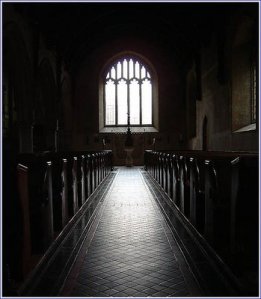
dark churchThis Advent has been a bit of an emotional rollercoaster.  Here in Plainview, at the beginning of Advent we were just getting back into a “normal” rhythm post-Hurricane Sandy.  One of my parishioners even noted that he realized I was “back in the game” when he got a flurry of church emails from me.  On Second Advent, we had our Annual Meeting, and we were all pleasantly surprised that an Annual Meeting could actually be quite fun and reinvigorating.  We were all heading toward the Christmas apex when the shooting in Newtown last Friday threw us for a loop.  Advent Three was one of the most mournful Sundays we have had in a while.  Many parishioners shared with me that they wanted to be in Church because they needed it.  We shared sadness, fears, and tears.  We lingered a little longer at Coffee Hour, needing the community of faith to help us process the event.  We all seem to be struggling to hold on to the “Christmas spirit.”

In the midst of this emotional rollercoaster, St. Margaret’s heads into a four-day series of liturgies that leads us to the manger.  I would be a little more anxious about how I was going to revive my own “Christmas spirit,” if the liturgies were not laid out as they are.  I am relieved to start our four days with our Cemetery Memorial services.  Every year we invite parishioners and family members who have loved ones buried in our cemetery to come for one of two memorial services.  We pray the burial office, listen to a necrology, and sing Christmas hymns.  The service is not simply for those whose names will be read.  This service really is becoming a “Blue Christmas” service – a service to recognize that Christmas is not always the happy version of perfection that commercials would have us believe.  Christmas is rife with baggage from our past, strife within families, feelings of loneliness or grief, and a general desire to pull inward during a season that tries to shove us outward.  In the wake of the shooting in Newtown, I am especially grateful for these liturgies.

After we get through these services, we move into Advent Lessons and Carols the next day.  On this last Sunday in Advent, we get the chance to really ease our way out of Advent and into Christmas by lingering in Advent through scripture and songs.  I am grateful for the gentle transition and pray that it will allow me the space to turn my thoughts and emotions to the blessing of Christ’s incarnation.

Perhaps after these liturgies I will be ready for our family service on Christmas Eve.  I am looking forward to the revamped service, in which our children and families will play an active leadership role in worship.  In a time when we have been mourning the loss of God’s beloved children, I cannot think of a better way to embrace Jesus’ command to, “Let the little children come to me.”  Perhaps by then I will be relieved to join the choir in singing those long-awaited Christmas hymns and to enter into the Holy Night of Christmas Midnight Mass.

Of course, if all of that does not do the trick, certainly the spoken service on Christmas Day might.  The quiet of that service is a nice place to recenter in the midst of a crazy time.  Sure, opening presents will be fun, especially with my more aware three-year old, but the quiet of church may be the safe haven we all need to ground the day in Christ Jesus.  It is at times like this that I am grateful for the ways in which the Episcopal Church is a church rooted in rich liturgies.  Come join us!

Sermon – Luke 3.7-18, A3, YC, December 16, 2012

17 Monday Dec 2012

Posted by jandrewsweckerly in Uncategorized

≈ Leave a comment

Tags

Advent, God, Newtown, repentance, seeking, Sermon, serving, sharing, sin

I have been reeling since hearing the news of the shooting tragedy in Newtown, Connecticut on Friday.  The emotions alone are still raw.  The image of twenty-seven families losing a child or parent is heart-wrenching.  At a time when many of them were probably gearing up for the holidays, now they are planning funeral liturgies.  The image of hundreds of families gratefully greeting their children is tainted by what will be weeks if not years of therapy for innocence lost.  I know my own child is still recovering from fears from Hurricane Sandy – I can only imagine the fears these families will have to process.  The image of police officers and first responders flooding the scene, faithfully doing their jobs is marred by the probability that they too will need months and years to process the scene:  not with the eyes of professionals, but with the eyes of human beings.  As one FBI officer explained, although they are trained to do their jobs professionally, they are not unfeeling robots.

We too are left with a swirl of emotions.  I have felt deep sadness, confusion, shock, anger, and frustration.  With few answers to questions, we do not know who to blame or how to respond.  As you watch the news and follow social media, you can already hear the call to demonize guns, the mental health field, government, and the shooter.  In some ways, blaming someone or something would make the whole experience easier.  Otherwise, we are left bereft, feeling God’s absence or at least questioning God’s presence in suffering.

I wondered today, then if John the Baptist’s message this Advent was even relevant.  Perhaps we could turn somewhere else altogether today for solace.  But the more I thought about the gospel lesson, the more I realized John’s message of repentance is exactly what we need today.  On this “Stir Up Sunday,” John’s message of repentance stirs up in us our own culpability in the presence of sin in this world.  While I desire to point a finger at someone else for the sinfulness of the world, John the Baptist tells me, to look at my own sinfulness today.  John says, “Do not begin to say to yourselves, ‘We have Abraham as our ancestor’; for I tell you, God is able from these stones to raise up children of Abraham.”  In other words, do not let your redeemed status, your chosen status, let you get complacent about your sinfulness.  In today’s terms, do not let your identity as not being the shooter let you believe yourself to be free of sin.

As our confirmands prepare for confirmation this spring, they are working through a curriculum that keeps pointing them back to the Catechism.  In our Catechism are a series of questions I find helpful today.  Turn, if you will, with me to page 848 of your Prayer Books.  Here are the questions on sin:

What is sin?  Sin is the seeking of our own will instead of the will of God, thus distorting our relationship with God, with other people, and with all creation.  How does sin have power over us?  Sin has power over us because we lose our liberty when our relationship with God is distorted.  What is redemption?  Redemption is the act of God which sets us free from the power of evil, sin, and death.  How did God prepare us for redemption?  God sent the prophets (like John the Baptist!) to call us back to himself, to show us our need for redemption, and to announce the coming of the Messiah.  What is meant by the Messiah?  The Messiah is one sent by God to free us from the power of sin, so that with the help of God we may live in harmony with God, within ourselves, with our neighbors, and with all creation.

This Advent, and in light of this tragedy, we are all invited to reflect on how our sinfulness pulls us away from God, one another, and all creation.

As dark and disheartening as John’s message may feel today, our gospel lesson does not leave us without guidance.  Three times, in response to John’s call to repentance, different groups of people ask the same question, “What then should we do?”  That question has been echoing with me all week, especially after Friday.  What then should we do?  To each group in the text, John has different advice – advice that is specific to their lot in life.  To the crowds he says, “Whoever has two coats must share with anyone who has none; and whoever has food must do likewise.”  To the crowds, John gives them the work of justice.  They are to share their abundance with others.  This is their work of repentance.  To the tax collectors, John says, “Collect no more than the amount prescribed for you.”  Tax collectors were able to survive by charging more than the base tax – their comfort came from these overages.  John challenges this widely accepted practice with another call to justice.  The tax collectors are not to abuse their positions of power.  This is their work of repentance.  To the soldiers, John says, “Do not extort money from anyone by threats or false accusations, and be satisfied with your wages.”  The soldiers used violence and manipulation for their own personal gain.  John challenges them to rule with justice.  The soldiers are to care for the people, not abuse them.  This is their work of repentance.  For each person, John saw a unique way of living a repentant life based on the vocations and values of that specific individual.[i]

Asking the question, “What then should we do?” is where John tries to get us today.  At this time of year, when we receive the most requests for contributions to churches, nonprofits, and universities, opportunities abound for goodness.  In the wake of Hurricane Sandy, as we learn of our neighbors here in Plainview – students and teachers at the school just down Washington Avenue – who need our help, opportunities abound for goodness.  In the wake of national violence, as we make sense of suffering and pain and as we enter into authentic conversation with our neighbors, opportunities abound for goodness.

The opportunities for goodness, the answer to the question “What then shall we do?” are found in our baptismal covenant.  As we discussed last week at our Annual Meeting, I have been discerning with our Vestry about who St. Margaret’s is and what our work is to be about.  We have wondered together this past year about what is the message that we want to convey to others about our identity.  Out of that discernment has emerged three verbs:  seeking, serving, and sharing.  We are a community that is seeking a deeper relationship with Christ, where seekers can simply be seekers on the journey with us.  We are a community that is serving our neighbors, loving and caring for them.  And we are a community that is sharing the good news of St. Margaret’s and the Good News of Christ Jesus with our community.  In these three words, seeking, serving, and sharing, we are, as our baptismal covenant suggests, proclaiming by word and example the Good News of God in Christ and seeking and serving Christ in all persons, loving our neighbor as our selves.  So when we look at that question of “What then shall we do?” our answer is to be a people seeking, serving, and sharing.

Luckily, our lectionary does not give us with a strong challenge without some encouragement.  We hear the comforting words from another of God’s prophets, Zephaniah.  “Do not fear, O Zion; do not let your hands grow weak.  The LORD, your God, is in your midst…he will rejoice over you with gladness, he will renew you in his love; he will exult over you with loud singing.”  In the face of tragedy, God does not leave us without work to do.  As we repent of our sins, what we shall do is to seek, serve, and share.  But in case that work feels like work, God encourages us in the journey.  Do not fear.  Do not let your hands grow weak.  God will renew you in God’s love.  Our work is laid out before us – we can get out there, seeking, serving, and sharing, because God will renew us in love.  Amen.


[i] Kathy Beach-Verhey, “Homiletical Perspective,” Feasting on the Word, Yr. C, Vol. 1 (Louisville: Westminster John Knox Press, 2009),71.

Advent Clearing…

12 Wednesday Dec 2012

Posted by jandrewsweckerly in Uncategorized

≈ Leave a comment

Tags

Advent, God, Hurricane Sandy, relationship with God, song, spiritual journey

clear pathOne of the constant sounds here on Long Island since “Superstorm Sandy” is the sound of chainsaws.  The sound is so constant that the hum of the chainsaws has almost become white noise…almost.  The noise is not quite soothing enough to truly be white noise.  Instead it is a humming reminder of all the work still left to be done here.  As we slowly try to clear the property around our homes and businesses, the work seems endless.  Piles of stacked wood along the roads demonstrate signs of progress, but there are still roads that are occasionally closed as work crews continue clearing what looks like a dropped box of toothpicks.

I wonder if that constant hum might be our Advent theme song this year.  We too need to clear out the debris of our lives that keeps us from connecting to God.  This past Sunday, John the Baptist called us to “Prepare the way for the LORD’s coming!  Clear the road for him!”  (New Living Translation)  Our Advent time of preparation can be a time of clearing out what is keeping us away from God.  Whether our debris is the rapid pace of life, the to-do list (that conveniently does not include prayer), or our own self-centeredness, we all have debris that blocks our path to God.

Clearing debris is not easy work, and does not come naturally.  In fact, our more natural state is to keep the debris in place so as to avoid true intimacy with God.  That is why an Advent theme song is helpful.  We need the din of humming chainsaws to pull us back into the work of clearing debris.  Or perhaps you prefer an actual hymn as your theme song.  Personally, I love Let All Mortal Flesh Keep Silence.  Or maybe your Advent calendar or devotions are your theme song this year.  Whatever brings you back to the work of clearing debris, working your way closer to a deeper relationship with God is what might make this Advent sacred for you.  Crank up the music, and continue to enjoy a blessed Advent!

Homily – 1 John 4.7-14, Feast of St. Nicholas, December 6, 2012

12 Wednesday Dec 2012

Posted by jandrewsweckerly in Uncategorized

≈ Leave a comment

Tags

gift, giving, God, love, St. Nicholas

As Simone becomes older, I have been wondering what to tell her about Santa Claus.  I have been worried about creating an “I want” monster, especially when I want her to think about giving, not receiving.  I am also aware of how Santa Claus has become the icon for secular Christmas, a holiday whose focus is to be the Christ child.  What is a mother to do, who simply wants to raise a happy, humble child but also help her navigate being a Christian in a secular world?

I wonder how Santa Claus, or Nicholas, Bishop of Myra, would feel about the modern challenges of Christmas.  Even though today is St. Nicholas’ feast day, the details about St. Nicholas’ life are a bit unclear.  Living in Asia around the 300s, what seems to be agreed upon is his care for sailors and seafarers, for children and the poor.  There are legends of him being a gift bearer – whether the gifts were small coins in children’s shoes or bags of gold for poor women.  What does seem certain is that Nicholas had a love of people, and he expressed that love through tokens of affection – unexpected gifts for all.

Our challenge 1700 years later is that gift giving and the sharing of love has become tainted by our consumerist society.  Now we often give gifts because we feel like we have to; we don’t want to leave someone out or not reciprocate in gift giving; we may feel pressure to buy or to get just the right thing – especially on tight budgets; and we don’t want to be embarrassed by getting a smaller gift for someone than they give us.  We can get so stressed about gift giving that we forget why we wanted to give something in the first place.

We get some encouragement today from our Epistle lesson.  “Beloved, let us love one another, because love is from God; … if we love one another, God lives in us, and his love is perfected in us.”  This is where the gift giving started – out of love. But love doesn’t have to be expressed in gifts – we love because loving is holy work.  Loving transforms others and transforms us.  God is made manifest in those expressions of love.

I think St. Nicholas got this.  He didn’t give gifts because of some cute letter from a child.  He gave because he was so filled with love that he could not live another way.  The gifts were an expression of the God who was transforming him and others.

So this year, find a way to make this Christmas about love.  Presents aren’t inherently bad – St. Nicholas gave with the best of them.  But remember why you are giving them – a full heart that witnesses the exorbitant love of God for all.

← Older posts

Recent Posts

  • On the Myth and Magic of Advent…
  • On Risking Failure and Facing Fear…
  • Sermon – Luke 23.33-43, P29, YC, November 23, 2025
  • On Inhabiting Gratitude…
  • Sermon – Luke 20.27-38, P27, YC, November 9, 2025

Archives

  • December 2025
  • November 2025
  • October 2025
  • September 2025
  • August 2025
  • July 2025
  • June 2025
  • March 2025
  • February 2025
  • December 2024
  • November 2024
  • October 2024
  • September 2024
  • August 2024
  • July 2024
  • June 2024
  • May 2024
  • March 2024
  • February 2024
  • January 2024
  • December 2023
  • November 2023
  • October 2023
  • September 2023
  • August 2023
  • July 2023
  • June 2023
  • May 2023
  • March 2023
  • February 2023
  • January 2023
  • December 2022
  • November 2022
  • October 2022
  • June 2022
  • May 2022
  • January 2022
  • December 2021
  • November 2021
  • October 2021
  • September 2021
  • August 2021
  • June 2021
  • May 2021
  • April 2021
  • March 2021
  • February 2021
  • January 2021
  • December 2020
  • November 2020
  • October 2020
  • September 2020
  • August 2020
  • July 2020
  • June 2020
  • May 2020
  • April 2020
  • March 2020
  • February 2020
  • January 2020
  • December 2019
  • November 2019
  • October 2019
  • September 2019
  • August 2019
  • July 2019
  • June 2019
  • May 2019
  • April 2019
  • March 2019
  • February 2019
  • January 2019
  • December 2018
  • November 2018
  • October 2018
  • September 2018
  • August 2018
  • July 2018
  • June 2018
  • May 2018
  • April 2018
  • March 2018
  • February 2018
  • January 2018
  • December 2017
  • November 2017
  • October 2017
  • September 2017
  • August 2017
  • July 2017
  • June 2017
  • May 2017
  • April 2017
  • March 2017
  • February 2017
  • January 2017
  • December 2016
  • November 2016
  • October 2016
  • September 2016
  • August 2016
  • July 2016
  • June 2016
  • May 2016
  • April 2016
  • March 2016
  • February 2016
  • January 2016
  • December 2015
  • November 2015
  • October 2015
  • September 2015
  • August 2015
  • July 2015
  • June 2015
  • May 2015
  • April 2015
  • March 2015
  • February 2015
  • January 2015
  • December 2014
  • November 2014
  • October 2014
  • September 2014
  • August 2014
  • July 2014
  • June 2014
  • April 2014
  • March 2014
  • February 2014
  • January 2014
  • December 2013
  • November 2013
  • October 2013
  • September 2013
  • August 2013
  • July 2013
  • June 2013
  • May 2013
  • April 2013
  • March 2013
  • February 2013
  • January 2013
  • December 2012
  • November 2012
  • October 2012
  • September 2012

Categories

  • reflection
  • Sermons
  • Uncategorized

Meta

  • Create account
  • Log in
  • Entries feed
  • Comments feed
  • WordPress.com

Blog at WordPress.com.

  • Subscribe Subscribed
    • Seeking and Serving
    • Join 394 other subscribers
    • Already have a WordPress.com account? Log in now.
    • Seeking and Serving
    • Subscribe Subscribed
    • Sign up
    • Log in
    • Report this content
    • View site in Reader
    • Manage subscriptions
    • Collapse this bar
 

Loading Comments...