• About

Seeking and Serving

~ seek and serve Christ in all persons

Seeking and Serving

Monthly Archives: July 2013

Namaste…

31 Wednesday Jul 2013

Posted by jandrewsweckerly in Uncategorized

≈ 1 Comment

Tags

God, Namaste, practice, prayer, yoga

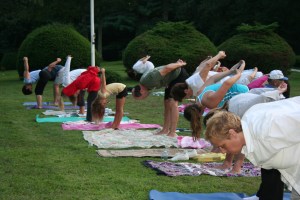
IMG_7618Tonight our parish is having Yoga on the Lawn.  This was an event we tried last year and loved, and so we decided to get outdoors again this year.  Though I am not always consistent in my practice, yoga has been a formative part of my health and spirituality.  Some may wonder whether yoga and Christianity can go together, but I found a link very early in life.  A priest at the Cathedral in Delaware was a yoga instructor, and I remember how his language completely transformed my experience.  Instead of bowing to the “light” in one another when we said, “Namaste,” this priest would have us bow to the “Christ” in one another.  Suddenly, my enjoyment of yoga made a lot more sense.

Having just preached on Luke’s version of the Lord’s Prayer this past Sunday, I find the practice of yoga fortuitous tonight.  Prayer is one of those things that we all struggle with, and in many ways, the challenges in yoga are very similar.  When practicing yoga, I have sometimes found that it took me the entire class to finally clear my head and just be present with my practice.  Our prayer life can be like that too.  We can be “praying” for quite some time before we are actually engaged in the prayer or listening for God.  We are very good at filling silence when it comes to our prayer life.

Our entering into yoga with a longing for connection to God can be much the disciples’ longing for Jesus to teach them to pray.  The first step is showing up.  The next step is committing to being present.  And the final step is keeping a forgiving heart that can quietly let intrusive thoughts go when they interrupt us.  In yoga, as in prayer, we work to clear the way for God.  The rest happens in spite of us.  Namaste.

Sermon – Luke 11.1-13, P12, YC, July 28, 2013

31 Wednesday Jul 2013

Posted by jandrewsweckerly in Uncategorized

≈ Leave a comment

Tags

disciples, God, Jesus, Lord's Prayer, prayer, relationship, Sermon

During seminary, one of the requirements for becoming a priest is to serve for eight weeks in a hospital setting as a chaplain.  Now one might think that there is a hospital chaplaincy course or that the hospital gives chaplains training on how to be a chaplain.  But the truth is, we received two day of “training,” half of which was about just being in hospital, not about how to be a chaplain.  Needless to say, on day three, when the supervisor told us to go to our floors and to get to work, I was almost stunned into inaction.  What would I say?  What was I supposed to do? 

Of course, only hours into the job, I realized how much I had underestimated the challenges.  Not only did I have no idea how to enter a room and strike up a conversation that was not like the ones they were having with every doctor and nurse, I also had no idea how to pray appropriately for the Roman Catholic, the Pentecostal, the Jew, the United Methodist, the Episcopalian, and the uncertain person who was not sure about God but was still willing to let me pray.  I remember sharing my anxiety with a fellow Episcopalian and he simply said, “Oh, I always just pray prayers using the same format as the collects in the Book of Common Prayer.”  Despite my love for the collects in our Prayerbook, an entire childhood of praying like a Methodist meant that his advice offered little encouragement. 

The truth is I am not sure most of us are ever really taught how to pray.  We know a good prayer when we hear one, and we may even write down a prayer we like, but very few of us volunteer to lead prayer at the opening of a meeting or over a meal.  Part of the problem is that most of us think there is a right way to pray.  We imagine there is some magical formula like my friend from seminary suggested, or we worry that our extemporaneous prayer will not be smooth enough or use holy enough words.  We worry that the way that we pray somehow suggests the quality of Christian we are.  Prayer, like biblical literacy, is one of those areas that we get completely anxious about when pressed in public.

The good news is that we are in good company.  We hear in our gospel lesson today one of the disciples say to Jesus, “Lord, teach us to pray.”  The disciples at this point have seen Jesus pray many times.  They see how good he is and they see how important prayer is in his life.  In fact, in Luke’s gospel, Jesus is regularly found in prayer.[i]  They watch Jesus enter into prayer with God for months, and they long to be able to do that too.  And so they come to Jesus, and they vulnerably submit their request:  teach us to pray. 

Their question is full of implications.  First is the admission that they do not have the first idea about what they are doing.  Maybe they learned some prayers in temple, or maybe their parents prayed with them.  But they realize in watching Jesus that they do not actually know how to pray themselves.  Not really.  Second, they see a real connection between Jesus and God that somehow is revealed in Jesus’ prayer life.  Perhaps they see how prayer strengthens him in his weakness and how he is more vulnerable with God than even with them.  They long for that kind of connection with God too, but still, they are not sure how the whole thing works.  Finally, a deeper implication is at hand in the disciples’ question.  Perhaps they are not only asking Jesus how to pray, but also wanting to know what is actually happening in prayer.  Perhaps they have tried praying on their own – for an illness, for a new job, for a broken relationship – but the prayer did not work.  They want Jesus to teach them the right way to pray so that the results they desire are fulfilled.

In some ways, Jesus does that.  First, Jesus gives them a simple prayer.  When you pray, pray this.  The prayer is one that countless Christians have etched into their minds for over two thousand years.  Many of us have distinctive memories of learning the Lord’s Prayer, while others of us just simply know the prayer without remembering how the prayer became ingrained into our conscience.  The Lord’s Prayer is perhaps the only part of a funeral that everyone – even those who never go to church – seem to know and can recite.  This is the same prayer that we say every Sunday, that we teach our children, that we say near death, that we pray when we cannot muster up any other words.  In this way, Jesus teaches the disciples and all of us to pray. 

But then, Jesus goes on to really teach the disciples about prayer.  He tells this funny parable about a man who awakens his friend in the dead of the night because another friend has come to his house and he has no food to feed him.  The man in bed refuses at first, but after much persistence, he caves and gives his friend what he needs.  At the end of the parable, Jesus says, “Ask, and it will be given you; search, and you will find; knock, and the door will be opened for you.”  Yes, Jesus gives the disciples the words they can use to pray.  But Jesus is also trying to teach them about what prayer really is.  Jesus presents this parable of two friends in a relationship that involves give and take.  Jesus is trying to teach the disciples that prayer is about relationship.  The prayer relationship with God is one in which the disciples will be coming in the middle of the night asking for very inconvenient things.  The prayer relationship is active, deeply personal, and will involve asking for what they really need.[ii]  In fact, Jesus says of the man in the parable, “because of his persistence he will get up and give him whatever he needs.”  Another translation of the word “persistence,” is “shamelessness.”[iii]  In other words, Jesus teaches the disciples that this prayerful relationship holds nothing back, cannot be embarrassed, and certainly does not worry about pretenses.

Unfortunately, we may hear those words about asking, searching, and knocking and remember every time that our prayers have not been answered, when we have not found, and the door has not been opened.  But Jesus is inviting us today to reframe prayer not as something we do with the expectation of an exchange:  I ask for healing, or a job, or a romantic partner, and God gives that to me.  We are still to come to God with those pains:  the longing for healing, the desire for vocational fulfillment, and the hope for partner who makes us happy and whole.  But instead of bringing those things to God because we want them solved, Jesus suggests that we bring those things to God so that all of ourselves is nakedly before God.  Only then can we have the intimacy with God that we desire and the realness of relationship we long to have. 

Now where this gets messy is when we start trying to understand why things happen – when we are not healed and people tell us, “It was God’s will,” or “Everything happens for a reason.”  But those answers hold little weight when a child dies or when someone loses their home.  I cannot believe in a God who wills those things to happen.  In fact, when a teen asks me why their parents are still getting divorced even though they prayed for the divorce not to happen, or when a mom loses a pregnancy and wants to know why God would let that happen, my answer has most often been, “I don’t know.”  I do not know why our physical ailments are not healed and why horrible or disappointing things happen to us.  All I do know is that God longs for us to bring all of that to God in prayer. 

So when I am angry, God wants me to let God have it.  When I am sad, God wants me to pour out my heart.  When I am lost, God wants me to share my wandering self.  And when I am not even sure God is with me or loves me, God wants me to just come and sit, even if I do not have words or if I do not feel like I can really trust God anymore.  When the disciples ask Jesus to teach them to pray, Jesus gives them a simple, straightforward prayer, teaching them and us that we do not need holy words or even our own words – especially when we cannot find our own words.  But Jesus teaches us all so much more.  Jesus teaches us to be shamelessly honest about what we need whenever we are in need.  And Jesus teaches us that prayer is based on trust – not a trust that everything works out for the best or that we will get exactly what we want – but a trust that God is listening and God loves us and all the world.[iv]  Jesus’ teaching is not tidy – but Jesus’ teaching invites us in, encourages us, and holds us in this wonderful journey with God – the one who we come to know through prayer.  Amen.


[i] James A. Wallace, “Homiletical Perspective,” Feasting on the Word, Yr. C, Vol. 3 (Louisville: Westminster John Knox Press, 2010), 289.

[ii] Elisabeth Johnson, “Commentary on Luke 11.1-13,” as found at http://www.workingpreacher.org/preaching.aspx? commentary_id=1724 on July 25, 2013. 

[iii] Wallace, 291.

[iv] David Lose, “Teach Us to Pray,” as found at http://www.workingpreacher.org/craft.aspx?m=4377&post=2654 on July 25, 2013.

Homily – Matthew 20:20-28, St. James the Apostle, July 25, 2013

31 Wednesday Jul 2013

Posted by jandrewsweckerly in Uncategorized

≈ Leave a comment

Tags

Camino, homily, humility, Jesus, journey, St. James, the way

Today we honor St. James the Apostle.  James, his brother John, and Peter formed that inner circle of disciples who saw Jesus’ Transfiguration, the raising of Jairus’ daughter, and the agony in the garden.  Like anyone given preferential treatment, we find that James sometimes let his status go to his head.  As we hear in the gospel lesson today, James’ mother comes to Jesus Christ, asking whether her sons might sit at Jesus Christ’s right and left hand in the kingdom.  I have always imagined the boys put their mother up to this.  Alternatively, I can also imagine the boys endlessly arguing about preference and the mother just wanting to shut them up.

We have all had James moments.  We have imagined ourselves with a bit more esteem than we should.  Whether in our schooling, our work, our parenting, or even our church leadership, we have had those moments when we have thought of ourselves as more important than we should.  Even the most humble among us have fallen into the trap – we figure out how to master something and we prefer others to do it our way too.

To us and to James, Jesus says: Whoever wishes to be great among you must be your servant and whoever wishes to be first among you must be your slave.  James learned this lesson the hard way.  James, who proclaimed he was able to drink the cup Jesus was about to drink, found out hat he really would have to by laying his life aside for others.  He found out that being great meant dying for the Good News.

St. James is especially revered in Spain.  Pilgrims for centuries have walked the Camino to honor James in his final resting place.  The Camino, the walk, is much like the spiritual journal of James too.  He went from being a puffed-up disciple to a martyr in Jesus’ name.  He journeyed into the kind of humility Jesus demanded from the beginning.

The good news for James and for us is that we continue to journey toward embodying this humility.  We too are invited along the “way.”  We may not be able to make it there immediately.  But if we journey with James on this way, we might find the way a little easier.  Amen.

Homily – Luke 11.5-10, Elizabeth Cady Stanton, Amelia Bloomer, Sojourner Truth, and Harriet Ross Tubman, July 18, 2013

31 Wednesday Jul 2013

Posted by jandrewsweckerly in Uncategorized

≈ Leave a comment

Tags

ask, Bloomer, boldness, fear, God, homily, Jesus, knock, search, Stanton, truth, Tubman

I have always loved this passage from Luke:  I love the image of the tired friend shouting out the door to leave him alone because he is already in bed.  And I love that the man will not back down.  Only through this annoying, persistent pleading does the man get the friend to finally get up and help him.  From the friend’s perspective, the man is annoying and troublesome, but for the man, he just keeps pushing until his friend does the right thing.

Too often we are unlike the man knocking at the door.  We worry about asking for help or bothering someone, and so we go without or we suffer.  We become paralyzed by the fear of rejection, so we cannot even knock on the door.  Or, at the first sign of adversity, we back off.  We do not want to be rejected twice, and so we scurry away.  We are unwilling to do what our gospel lesson encourages – to ask, to search, or to knock – even though Jesus promises that when we ask, it will be given to us; and when we seek, we will find, and when we knock, the door will be opened for us.  Despite those promises, we find ourselves lost in fear.

That is why today we celebrate Elizabeth Cady Stanton, Amelia Bloomer, Sojourner Truth, and Harriet Ross Tubman.  Truthfully, each woman deserves her own feast day.  Elizabeth helped organize the first Women’s Rights Convention in 1848, and she challenged the church for using Scripture to oppress women.  Amelia, known for wearing pants – a scandal at the time – also challenged the church for its manipulation of Scripture to oppress women.  Sojourner, born as a slave, became a voice for the oppression of not just women, but black women especially.  She fought for women’s rights and for abolition, even speaking at Elizabeth’s Women’s Rights Convention, where she gave her famous speech, “Ain’t I a Woman?”  Harriet, also born a slave, not only escaped slavery, but also returned to free more than 300 people.  She too navigated the fight both for women and for African-Americans.  I suppose the reason our lectionary combines these extraordinary witnesses is because these women had no fear of asking, no opposition to searching, and no hesitation about knocking.  They were just like the man in our gospel lesson today who just kept at it until his friend did the right thing.

Today we are invited into that boldness.  We are invited to let go of whatever holds us back and to ask, to search, and to knock.  Jesus promises all will be given to us, all will be found, and all will be answered.  Amen.

Homily – Proverbs 2:1-9, St. Benedict of Nursia, July 11, 2013

31 Wednesday Jul 2013

Posted by jandrewsweckerly in Uncategorized

≈ Leave a comment

Tags

Benedict of Nursia, God, homily, insight, rule

When I was at Mepkin Abbey last month, I took a tour of the monastery grounds led by a volunteer.  At some point, she started talking about the monks and wondered out loud how they do it – cut off from the world, without even TV shows.  At first, I totally sympathized with her thought – I wasn’t sure how long I could go without texting, Facebook, checking NPR, etc.  My tour guide concluded that for her, the answer was that she could never do it.  But the question got me thinking about the monk’s motivation:  Though connection with others is hugely important to my life, what do I miss out on when my life is so full?

Benedict of Nursia had a sense of what was missing.  In the early 500s, Rome was being taken over by various barbarian tribes.  Benedict’s response was retreat – to be closer to God he had to retreat.  In the years to come, he wrote the rule that has influenced all of Western monasticism.  He structured the day around liturgical prayer, spiritual reading, work, eating, and sleeping.  That was it.  Simple and focused.  His rule became the rule that countless others would continue to follow.

Though I love monasteries, clearly I never chose to stay in one permanently.  I love the clarity and wisdom I have found in keeping the hours, but for those of us who do not live the monastic life, is that clarity and wisdom and insight unavailable to us?  Proverbs sheds some light on the matter.  The author gives us three “ifs”:  1) If you accept my words , 2) if you cry out for insight, and 3) if you seek understanding like silver.  If these things, then, 1) you will understand, 2) you will find the knowledge of God, and 3) you will be given wisdom from the Lord.  

Our invitation today is to figure out how to do these things in a setting that bombards us with distraction.  One gift Benedict gives to all people is the concept of a rule.  You may not follow his rule in his way, but we probably all need a rule to help us accept God’s words, cry out for insight, and seek understanding.  The abundance of this world is truly a gift – but if we allow ourselves to get lost in that abundance, we can find ourselves no longer longing for a connection to God.  Benedict and Proverbs assure us we can still find a way to God and insight, even in the midst this life.  Amen.

Taking a seat…

24 Wednesday Jul 2013

Posted by jandrewsweckerly in Uncategorized

≈ 2 Comments

Tags

conversation, encounter, God, Holy Spirit, stranger

On the last day of my spiritual retreat last month, I headed down to the river toward my favorite bench so that I could watch the water and be silent with God one more time.  As I approached the bench, I noticed a woman sitting in a camping chair beside the bench.  I thought about going somewhere else, but I figured since we were still on the monastery grounds, maybe she would not mind just continuing to be in silence next to me.  When I quietly asked her if I could sit at the other end of the bench, she politely agreed.

The silence only lasted about five minutes.  She asked me what I was doing there, and slowly, despite my best efforts at being quiet, she drew me into a conversation.  The conversation that unfolded was surprisingly deep.  We talked about commonalties of geography, faith, and family.  A lapsed Roman Catholic, she had never met a female priest before.  There were many questions about the Episcopal Church – including what she called our “recent controversies.”  I cautiously proceeded, wondering what exactly she thought about our Church, assuming the “recent controversies” she mentioned were about our struggles around our relationship with our LGBT brothers and sisters.  I realized we were both being cautious with one another when, an hour later, she finally began talking about her gay son and how their relationship has evolved over the years.  Toward the end of our conversation, she showed me a devotional book she had been reading.  I asked her if I could write down the title, and before I knew it, she was insisting that I take the book.  She even gave me a bookmark with her name on it so that I would have something by which to remember our conversation.

courtesy of http://imthelittlemissfit.wordpress.com/2013/07/06/a-random-ball-pit-and-two-complete-strangers/

courtesy of http://imthelittlemissfit.wordpress.com/2013/07/06/a-random-ball-pit-and-two-complete-strangers/

I left that conversation, feeling more buoyant than I had for much of my retreat.  In fact, that conversation reminded me of a video from the website, Soul Pancake.  Take five minutes to watch the video by clicking here – trust me:  it is worth your time.

I realized if the people from that video and I could have such a random, meaningful, spiritual conversations with a total stranger, surely I could do the same at home.  So that has been the encouragement for getting myself and our parishioners out into the community to do just that.  Of course, the work is harder than it seems.  I have done the first step – getting myself into non-church public places where I can at least encounter strangers.  The next step – figuring out how to start the random conversations – is a bit trickier.  My hope is that if I keep placing myself in situations where encounter can happen, perhaps I will listen a little more intently to the nudging of the Holy Spirit to join someone on a bench or in a ball pit.  Who knows what can happen?

Sermon – Ecclesiasticus 51.9-12, Feast of St. Margaret of Antioch (Transferred), July 21, 2013

24 Wednesday Jul 2013

Posted by jandrewsweckerly in Uncategorized

≈ Leave a comment

Tags

Ecclesiasticus, feast, God, martyr, prayer, saint, Sermon, St. Margaret of Antioch

Today we celebrate the feast of St. Margaret of Antioch, our patron saint.  The legends vary widely about Margaret, but in general, her story goes a bit like this.  Margaret was born to a pagan father, but Margaret was raised by a nurse.  The nurse introduced Margaret to Christianity, and the father disowned her.  As a young teen, she devoted herself to Jesus Christ, vowing to remain his bride for the rest of her life.  A few years later, a wealthy man passed her way and requested to take her as his mistress.  She refused, and he had her imprisoned and beaten.  Her captors felt sorry for her and begged her to submit to the man, but she assured them that though they saw suffering, she saw her pain as “sweeter than cream.”[i]  In her weakened state, she is believed to have faced a dragon, though some refer to the dragon as a demon or Satan himself.  The dragon tried to swallow her, and with a cross she held in her hand, she defeated the dragon.  Of course, this victory did not seal her fate.  Still refusing to submit to the rich man, she was eventually beheaded.

When I explain to outsiders about which Margaret is our patron saint, I often explain how we picked the weird one.  First of all, relating to martyrs is always difficult for modern Christians.  Few of us will ever face torture or persecution for our faith.  Though we may admire their commitment, imagining how we would show similar dedication is challenging.  Furthermore, relating to someone who commits their virginity to Jesus Christ might be difficult for many of us.  Though we may admire nuns and monks today, whose lives also involve a commitment to chastity, very few of us can imagine such a rule for ourselves.  Besides, we get entirely uncomfortable just talking about sex in church.  Add in the bizarre story about the dragon, and most of us start to mentally check out or at least assign Margaret to the category of fiction.  This distance creates a barrier for finding meaningful connection to Margaret.

Of course, some of our resistance is aided by our conflicted feelings about the value of saints.  What I appreciate about saints in the Episcopal Church is that we have a broader definition of saints than the Roman Catholic Church.  We have a wider variety of saints that are commemorated throughout the year, and in fact, our weekly Thursday Eucharist here at St. Margaret’s always focuses on a saint of the church.  What I find most appealing about saints is that they can often be aids for us in prayer.  Either we can pray to be more like a certain saint, or we can use saints as a vehicle through whom we pray to God.  St. Margaret of Antioch was known as the patron saint of women in childbirth.  “Because of the promises made just before Margaret’s death to assist anyone – especially women in childbirth – who has [St. Margaret’s] life written down, reads it, or has it read to them…[some of the copies of her story were] written on long strips of parchment which were fastened around the abdomens of women in labor.”[ii]  Though that practice may sound silly to us now, who has not prayed to St. Anthony when they lost something, or purchased a St. Joseph when trying to sell a home?

Perhaps where we find the most help today in understanding St. Margaret is from our reading from Ecclesiasticus.  The author begins the final chapter with these words, “And I sent up my prayer from the earth, and begged for rescue from death.  I cried out, ‘Lord, you are my Father; do not forsake me in the days of trouble, when there is no help against the proud.’”  I imagine Margaret cried out to God in a similar way in that prison cell.  I imagine there was nothing but prayer on her lips.  But even more than crying out to God in her pain and suffering, I imagine that Margaret more so prayed the words that the author of Ecclesiasticus also prayed, “I will praise your name continually, and will sing hymns of thanksgiving.”  Despite her many trials – being disowned, being captured and tortured, and being threatened with death – she somehow saw the sweetness of Christ in all of her trials.  She could still come to God in praise and thanksgiving, despite facing circumstance that called for nothing of the sort.

St. Margaret has a lot to teach us about today about prayer.  I was just in conversation with someone this week about their prayer life, and they confessed how good they are with their “thank yous and pleases” to God, but how rarely their prayer life is filled with adoration of God.  We all struggle with this kind of prayer relationship with God.  We are quite good at coming to God when we need something, and we occasionally remember to thank God for our blessings.  But rarely do we stand before God, arms and hands open and just stand in awe of our God.  We get caught up in a relationship with God as an exchange, and we forget how huge our God is and how tremendous God’s presence in our lives is.

Today, Margaret invites us to remember the awesomeness of our God.  She reminds us of the incredible work began here in Plainview fifty years ago in her name.  And she invites us into a prayer of adoration for the bountiful grace that awaits us in our next fifty years.  For the First Communion we celebrate today, for the bountiful produce that our Garden of Eatin’ is producing, for the blessing of Holy Matrimony that a couple plans for this afternoon, for the blessed fellowship we enjoyed yesterday at the Gibsons’, for the gift of life and ministry in this place, and for the saint who reminds us of the awesomeness of our God, we will praise the Lord’s name continually, and we will sing hymns of thanksgiving this day.  Amen.


[i] Sherry L. Reams, ed., Middle English Legends of Women Saints (Kalamazoo: Medieval Institute Publications, 2003), 119.

[ii] Reams, 111.

While you were sleeping…

17 Wednesday Jul 2013

Posted by jandrewsweckerly in Uncategorized

≈ Leave a comment

Tags

frustration, God, love, patience, peace, sleeping, toddler

I am in the stage of parenting where many parents with older kids look at me sympathetically and promise me that things will get better.  They lament about how it was the threes, not the twos, that were “terrible.”  They promise me that by age five, a certain shift happens.  And some days, those words are enough to help me take a deep breath as my child is screaming angrily for no apparent reason, or hitting, or kicking, or you name it.  I love my daughter dearly, but the last several months of her development have been challenging, to say the least.  And certainly, it feels like she brings out the worst in me too.  So what seems like the glorious bliss of parenthood is quite often a complicated, guilt-provoking mess.

-courtesy of http://howmanyarethere.net/how-many-hours-a-child-must-sleep-in-a-day/

courtesy of http://howmanyarethere.net/how-many-hours-a-child-must-sleep-in-a-day/

But just the other night, as my daughter “attempted,” to fall asleep, she finally asked if I would come in and rock her to sleep.  Not getting the chance to cuddle her often, I agreed.  As we were rocking, she started lightly snoring, and as I looked at her relaxed face, my perception of her totally changed.  She seemed not like a temperamental, trying toddler, but just a sweet little kid.  The lull of sleep had smoothed out the anger and frustration from her face, and made her look peaceful and lovely.  And in that moment, my love for her exploded, my forgiveness of her craziness overflowed, and my own frustration faded quickly away.

It occurred to me that my perspective in that moment must be God’s perspective of all of us.  The God who loves us all so profoundly must only be able to do that if that God can see us for who we really are – that version of ourselves when we sleep:  utterly human, vulnerable, and lovable.  The anxiety is gone from our face and all that remains are the everyday functions of being human – breathing in and out, while our body is restored to refreshment and wholeness.

Having watched the news recently, especially the Zimmerman/Martin case, I have had some pretty hostile feelings about the people involved in the case, the people reporting on the case, and even toward people whom I know who seem unconvinced of the problems in our justice system.  And everyday, I deal with family, friends, and, yes, even parishioners who frustrate me to no end.  But I have been wondering about how I might begin to think of those objects of my frustration in their sleep.  If I could see them vulnerably, peacefully sleeping, might I begin to see them with the eyes of God?  I am not suggesting that forgiveness will come easily or even soon.  But what I am wondering is whether seeing others through God’s love might at least give me the patience to try one more day of walking in God’s love too.

Sermon – Luke 10.25-37, P10, YC, July 14, 2013

17 Wednesday Jul 2013

Posted by jandrewsweckerly in Uncategorized

≈ Leave a comment

Tags

ESPN, God, Good Samaritan, Jesus, love, messy, relationship, Sermon, the other

Lisa had produced lots of stories like this over the last ten years.  They were human-interest stories for ESPN – the stories that drew people into the private pain and sacred celebrations behind their beloved sports.  Lisa loved her work, but she had never gotten as involved as she did four years ago.  In 2009 she met Leroy and Dartanyon – two high school wrestlers from a poor Cleveland school who were fighting against all odds.  Dartanyon was homeless and legally blind and Leroy had lost parts of both legs in a train accident.  Dartanyon often carried Leroy to classes up stairs, while Leroy helped Dartanyon with his homework.  Their story was so potent for Lisa that she could not walk away.  Over the course of four years, she would find herself doing everything from helping Dartanyon obtain his birth certificate, to ensuring they had food everyday; from helping them fill out financial aid forms for college, to connecting Dartanyon to a Paralympic coach.

When I saw Lisa’s story this week, I could not help but to think about the Good Samaritan from the gospel lesson today.  Most of us know this story well, and pretty much all of us want to strive to be a Good Samaritan; so much so that we spend time volunteering, we give money to aid important causes, and we even occasionally give a dollar to that guy on the corner.  But what struck me this week about the story of the Good Samaritan is that we often simplify the example of the Samaritan. We read this story and we know that we should not be like the lawyer or the priest or the Levite.  We should help others like the Samaritan.  The problem though with this simplified response to Jesus’ command to “Go and do likewise,” is that we skim over all the work the Samaritan did.  The text says the Samaritan, “went to [the victim] and bandaged his wounds, having poured oil and wine on them.  Then he put him on his own animal, brought him to an inn, and took care of him.  The next day he took out two denarii, gave them to the innkeeper, and said, ‘Take care of him; and when I come back, I will repay you whatever more you spend.’”

Several things strike me about this account.  First of all, there is a longevity to the care of the Samaritan.  The Samaritan does not simply give the man some bandages, or a cloak, or even some money, and then leave.  The Samaritan does not simply help the man to a local hospital or inn and then carry on with his life.  The Samaritan does not even care for the man overnight, and then depart, having certainly done his duty.  No, the Samaritan even pays for the man to stay and promises to return and pay for whatever else is due.  This is not a one-time exchange, or even a short-term exchange.  This exchange is a commitment to the long haul – a dedication not just to help but to be in relationship.  This is what Jesus means when he says we are to “go and do likewise.”

What is tricky about this kind of relationship is that this kind of relationship is messy.  Though there is some debate among scholars, many seem to think that the victim on the side of the road was a Jew.[i]  So not only was this victim beaten, robbed, and abandoned by those who should have cared for the victim, he was helped and tended to by a Samaritan – a man who was his enemy.  The Jews and Samaritans had a long-standing conflict.  The Jews had a very low opinion of the Samaritans.  Samaritans were seen as second-class citizens to be avoided at all costs.  So imagine when the victim woke up at that inn to find a Samaritan nursing him back to health.

Not to mention how complicated this is for the Samaritan.  He knows how most Jews feel about him.  He may have even felt the same way about the Jewish people.  But somehow, his sense of pity gets the best of him, and he finds himself not just asking if the guy is okay, but spending his time and resources on this complete stranger who is his enemy as well.  This encounter between these two men is not simply a one-way, clean exchange of helper and helped.  This is a messy encounter that leaves the two in a strange relationship that can only be possible through God’s grace.  Whatever biases the Jew had against Samaritans had to have been called into question that next morning.  Hatred of another cannot remain when one is the recipient of love as deep as the Samaritan shows.  And whatever biases the Samaritan had against Jews had to have weakened that day too.  You cannot dress a man’s wounds, care for him overnight, and return to check in on him without some of your defenses coming down.  The kind of neighborliness that Jesus is inviting people into is messy, complicated, and a bit scary.

Lisa, Leroy, and Dartanyon knew a little about this kind of messiness.  Dartanyon and Leroy not only faced the challenges of their own physical limitations, they also lived in a world of struggle.  Their school was a school marked by violence and active police presence.  Books were handed out and locked back up after each class.  Less than forty percent would ever graduate and untold numbers were left pregnant.  And white people were not necessarily seen as allies.  Meanwhile, Lisa had grown up on the other side of Cleveland.  Her parents scraped together money just so that she would not have to go to school with those her parents would call, “those people.”  Lisa and Leroy and Dartanyon grew up knowing each other as “the other,” and any attempt at a relationship brought these biases, baggage, and burdens to the foreground.

The funny thing is that when we read our gospel lesson day, we can feel that Jesus is scolding the lawyer in some way.  But I think what is actually happening here is a bit of healthy challenge.  Jesus fully admits that if the lawyer simply does what the law calls for:  to love the Lord your God with all your heart, and with all your soul, and with all your strength, and with all your mind; and your neighbor as yourself – then the lawyer will be fine.  Jesus is saying that even the slightest effort of loving God and loving neighbor is good and to be commended.  But in the story of the Good Samaritan, Jesus is hinting to the lawyer that there is a potential for more – a potential to know God more fully and to love more deeply than he could even imagine is possible.  And that kind of amped up grace and blessing can only come from messy, complicated, scary relationships with the other.

Recently, while Lisa, Leroy, and Dartanyon prepared for a follow-up story with ESPN, Dartanyon quietly asked Lisa the question that probably many others had wondered about but never asked.  “Why did you stay?”  Lisa’s response was automatic.  “I love you,” she answered.  “That’s what I thought you’d say,” he replied.  “But … why … why did you stick around and do everything you did?”  Lisa’s response was long and complicated because their relationship was messy, complicated, and at times maybe even scary.  But after much reflection, Lisa concludes, “I stayed because we can change the world only when we enter into another’s world.”[ii]  Though I have no idea whether Lisa is a person of faith, Lisa is preaching Jesus’ words today with her life.  She understands that being neighbors means not just helping people, but entering into their lives, and taking on whatever messiness that involves – because only then can we know the kind of love Jesus has for us.  In that sacred, vulnerable, tenuous reality that is relationship with the other is where we experience Jesus and the love Jesus has for all of us – even those we might label as the other.  Jesus knows how hard this will be.  But Jesus tells us to “Go and do likewise,” anyway because Jesus knows that we can.  Amen.


[i] Matthew L. Skinner, “Exegetical Perspective,” Feasting on the Word, Yr. C, Vol. 3 (Louisville: Westminster John Knox Press, 2010), 241.

[ii] Lisa M. Fenn, “‘Carry On’: Why I Stayed,” as found on http://espn.go.com/espn/otl/story/_/id/9454322/why-stayed on July 9, 2013.

Harboring hope…

10 Wednesday Jul 2013

Posted by jandrewsweckerly in Uncategorized

≈ Leave a comment

Tags

church, God, hope, summer

-Photo courtesy of http://cbfportal.wordpress.com/2012/06/20/hope-beckons-lessons-from-worship-with-bwim/

-Photo courtesy of http://cbfportal.wordpress.com/2012/06/20/hope-beckons-lessons-from-worship-with-bwim/

I have begun to think about summer as a time of hope.  Summer brings a sense of unrestrained possibility.  The days are longer, encouraging us to get out of bed and get busy with life, and then leaving us more time for evening enjoyment.  We tend to take our vacations in the summer, creating a hopeful anticipation of what adventures could await.  We slow down a bit, giving us time to rekindle the hope that we bury in the wintertime.  We reconnect with God’s creation, feeling the freedom that the outdoors brings and feeling a renewed hopefulness about life.

Though summers are often busy in the church, with days full of planning, there is a sense of hopefulness about our faith life that comes this time of the year too.  This is the time that we take to dream and imagine how our life together might be better.  We slow down to read curricula, imagining what transformation might happen among our children and adults.  We look at our calendars, feeling a sense that anything is possible for the program year.  We take time to talk to one another to imagine what opportunities beckon – a process that can only take place once we have slowed down and made space for deep listening.  Once we are in the midst of the program year, much of that hopeful anticipation fades because we are too busy executing our plans to dream up new ideas.  But now, now is a time of simmering hope.

Our invitation is to let this hopefulness fill our beings.  Our invitation is to drink in this hopefulness like a thirst that longs for quenching.  Our invitation is to stoke this hope so that it might burn ever brighter, creating a slow burn that lasts us through the long winter months.  This hopefulness is our summer gift from God, prodding us on to live our faith bigger, brighter, and bolder than ever.

← Older posts

Recent Posts

  • On the Myth and Magic of Advent…
  • On Risking Failure and Facing Fear…
  • Sermon – Luke 23.33-43, P29, YC, November 23, 2025
  • On Inhabiting Gratitude…
  • Sermon – Luke 20.27-38, P27, YC, November 9, 2025

Archives

  • December 2025
  • November 2025
  • October 2025
  • September 2025
  • August 2025
  • July 2025
  • June 2025
  • March 2025
  • February 2025
  • December 2024
  • November 2024
  • October 2024
  • September 2024
  • August 2024
  • July 2024
  • June 2024
  • May 2024
  • March 2024
  • February 2024
  • January 2024
  • December 2023
  • November 2023
  • October 2023
  • September 2023
  • August 2023
  • July 2023
  • June 2023
  • May 2023
  • March 2023
  • February 2023
  • January 2023
  • December 2022
  • November 2022
  • October 2022
  • June 2022
  • May 2022
  • January 2022
  • December 2021
  • November 2021
  • October 2021
  • September 2021
  • August 2021
  • June 2021
  • May 2021
  • April 2021
  • March 2021
  • February 2021
  • January 2021
  • December 2020
  • November 2020
  • October 2020
  • September 2020
  • August 2020
  • July 2020
  • June 2020
  • May 2020
  • April 2020
  • March 2020
  • February 2020
  • January 2020
  • December 2019
  • November 2019
  • October 2019
  • September 2019
  • August 2019
  • July 2019
  • June 2019
  • May 2019
  • April 2019
  • March 2019
  • February 2019
  • January 2019
  • December 2018
  • November 2018
  • October 2018
  • September 2018
  • August 2018
  • July 2018
  • June 2018
  • May 2018
  • April 2018
  • March 2018
  • February 2018
  • January 2018
  • December 2017
  • November 2017
  • October 2017
  • September 2017
  • August 2017
  • July 2017
  • June 2017
  • May 2017
  • April 2017
  • March 2017
  • February 2017
  • January 2017
  • December 2016
  • November 2016
  • October 2016
  • September 2016
  • August 2016
  • July 2016
  • June 2016
  • May 2016
  • April 2016
  • March 2016
  • February 2016
  • January 2016
  • December 2015
  • November 2015
  • October 2015
  • September 2015
  • August 2015
  • July 2015
  • June 2015
  • May 2015
  • April 2015
  • March 2015
  • February 2015
  • January 2015
  • December 2014
  • November 2014
  • October 2014
  • September 2014
  • August 2014
  • July 2014
  • June 2014
  • April 2014
  • March 2014
  • February 2014
  • January 2014
  • December 2013
  • November 2013
  • October 2013
  • September 2013
  • August 2013
  • July 2013
  • June 2013
  • May 2013
  • April 2013
  • March 2013
  • February 2013
  • January 2013
  • December 2012
  • November 2012
  • October 2012
  • September 2012

Categories

  • reflection
  • Sermons
  • Uncategorized

Meta

  • Create account
  • Log in
  • Entries feed
  • Comments feed
  • WordPress.com

Blog at WordPress.com.

  • Subscribe Subscribed
    • Seeking and Serving
    • Join 394 other subscribers
    • Already have a WordPress.com account? Log in now.
    • Seeking and Serving
    • Subscribe Subscribed
    • Sign up
    • Log in
    • Report this content
    • View site in Reader
    • Manage subscriptions
    • Collapse this bar
 

Loading Comments...