• About

Seeking and Serving

~ seek and serve Christ in all persons

Seeking and Serving

Category Archives: Uncategorized

On Sacred Ground and Stories…

23 Wednesday Sep 2020

Posted by jandrewsweckerly in Uncategorized

≈ Leave a comment

Tags

God, holy, Moses, power, sacred, sacred ground, story, struggle, tender

Photo credit: https://gracechurchanderson.com/2017/09/holy-ground/

Last week, our parish kicked off a program called “Sacred Ground.”  The program comes out of the Episcopal Church and is meant to be a program to help Caucasians begin (or continue) to wrestle with the issue of racism.  As part of the introductory materials, Bishop Michael Curry retells Moses’ call narrative.  If you remember, God tells Moses to take off his shoes beside the burning bush because he is standing on holy ground.  Bishop Curry submits that the ground is holy not because of the fire but because it is the place where God tells God’s story.  Curry further suggests that anytime someone shares their story, we are standing on sacred ground with them.

As our group began to tell our stories, I began to realize perhaps this is why we are struggling as a country and community these days.  So often we assume we know people’s stories based on their political stances, their social media posts, or even our chitchat with them on a daily basis.  But every person has a story – a journey of joys and sorrows, a path of successes and failures, and a walk of pride and shame.  And until we make space to hear that story, we will judge, assume, and desecrate the holiness of others.

This week I came across a story of a project in Denmark called the Human Library.  People go to public libraries and instead of borrowing books they “borrow” people.  Each person is given a “title,” such as “Unemployed,” “Refugee,” or “Bipolar.”  When you borrow the person, you sit with them for thirty minutes and hear their story.  The idea is to break down prejudice through the power of story.

This week I invite you to reach out to someone you do not know much about – someone you only know superficially, someone different from you, or someone you already know will rub you the wrong way and ask if you can hear their story.  In this time of social distancing, maybe you start with projects like Humans of New York or StoryCorps.  But maybe you use a phone, FaceTime, or outdoor coffee as your method to connect with someone local.  Either way, this week I invite you to take off your shoes and stand on some holy ground with one another and your God.  Perhaps once we all have our shoes off, we will find ourselves walking much more tenderly with one another.

On Grief, Fairies, and Grace…

17 Thursday Sep 2020

Posted by jandrewsweckerly in Uncategorized

≈ Leave a comment

Tags

abnormal, coping, fairy, feelings, gentle, God, grace, grief, light, lost, normal, pandemic, virus

Photo credit: https://childrengrieve.org/resources/about-childhood-grief

A dear friend of mine once talked about the experience of a “grief fairy.”  This fairy was the metaphorical way she explained how grief was not a simple, linear process from tragic event through grief to wholeness.  Instead, she imagined grief as a fairy who would, out of nowhere, lighten upon your shoulder and all of a sudden you went from fine, or at least managing, to not fine at all.

In some ways, I feel like this pandemic has become the same way.  We have begun to convince ourselves that we had our chance to be sad in the first few months of the virus, or even in these last six months.  But by now we should be adjusted, used to the “new normal,” and ready to get moving.  All the markers are there:  Summer has pretty much ended; the children are back to school – if not in person, certainly online; some employers are expecting workers to return to the workplace; churches kicked off their program years – even if they were missing the normal parish parties and picnics; and things like elections are rapidly approaching.  For all intents and purposes, we should be putting on our game faces and getting back to “normal.”

The problem is nothing is truly normal.  And every time we run into anything abnormal, we are reminded of our grief over what has been lost during this time.  We have become quite good at coping, to be sure, but somehow, that fairy keeps landing on our shoulder, reminding us of our grief in big and small ways:  when the kid’s back to school photos are missing pictures of the school bus; when a visit to someone sick is either not allowed, or has enough restrictions that we do not even bother; when the church year begins, but we’re still watching online; when we go to run a quick errand and realize we left our mask at home.   

My prayer for all of us is that we be a bit gentler – with each other, but especially with ourselves.  If you are feeling frustrated about your inability to keep your game face on, take the game face off and let yourself acknowledge the grief still lingering among us.  If you are surprised by a sudden surge of feelings about something seemingly small, remember that grief during this time is not linear, and that the fairy will keep on visiting.  If you are feeling alone in your ability to keep it all together, lean into your faith community to remember God’s grace for all of us.  We are all in this together.  We will have days of strength and days of weakness.  But God is present in all of it, always holding out the light to get us through the darkness. 

On Humanity, Anxiety, and God’s Love…

09 Wednesday Sep 2020

Posted by jandrewsweckerly in Uncategorized

≈ Leave a comment

Tags

anxiety, care, God, humanity, Jesus, letting go, love, parenting, reassurance, school, stress

Photo credit: https://www.coloradodepressioncenter.org/new-anxiety-program-resource/stress-anxiety-emotion-fear-wooden/

This week has been the week I have been dreading for months:  back to school.  Initially I was dreading it because we had no idea what would happen – whether school would be virtual or some hybrid of virtual and in-person.  Then, I was anxious about how to actually help a first grader and sixth grader do virtual school at the same time – all while working myself.  Because this would all be new, I felt like I was staring into a black hole of knowledge, with no way to know what to really expect.  On the one hand, not knowing meant I had no choice but to, “Let go, and let God.”  On the other hand, I’m really terrible at letting go.

Our first day finally arrived yesterday, and some of the anxieties I had felt were founded.  The first few hours were spent dashing up and down the stairs of our home, juggling one child on the second floor and the other on the first floor, or tag-teaming with my spouse.  Fortunately, the two girls started school an hour apart, so I could manage the stress of one child at a time.  However, there were moments when Zoom meetings started at the same time – and some of those times were times when the technology was just not working.  Knowing full well that calm can produce more calm, I put on my “Zen face.”  But on the inside, I kept thinking there was no way this would be sustainable.

But by midday, both girls had found a rhythm.  The elder was especially becoming more independent and her usual confident self, and the younger quickly learned how to go with the flow, finding educational things to fill empty holes, and navigate new systems.  I was even able to find ways to squeeze in my own work throughout the day, do a livestream set of prayers, and catch up on pastoral care calls.  Despite the initial chaos, the day went so well, I felt confident we could do this!

Throughout the day, images and verses from scripture kept popping up in my mind:  Jesus asking Peter why he doubted while walking across water; Jesus reminding us how if the flowers of the field and the birds of the air are cared for, how much more are we loved and valued; or angels at the tomb telling Mary Magdalene and the other women not to be afraid.  Time and time again in scripture, we hear the refrain, “Do not be afraid.”  We hear that phrase not because we should try to become perfect, anxiety-free humans.  We hear that phrase because anxiety is normal – but so is God’s love and care for us.  I do not know what anxieties you are holding today, but my hope is you can remember God’s abundant love and care for you – whether you hear those words from God, whether you feel that in your heart through the Spirit, or whether a friend, family member, or a stranger is God’s messenger of hope to you today.  Wherever the reassurance comes from, do not be afraid – you are loved and cared for – and you’ve got this!!

On God, Scripture, and Politics…

02 Wednesday Sep 2020

Posted by jandrewsweckerly in Uncategorized

≈ Leave a comment

Tags

abundant, Bible, challenge, covenant, disciple, forgiving, God, love, neighbor, politics, question, reading, relationship, scripture, witness

heart-light-bible_si

Photo credit:  https://www1.cbn.com/teaching/bible-verses-love

This week, our church will finish our summer 90-Day Bible Reading Challenge.  At the beginning of the summer, I wanted to find something we could do as a community.  I was also aware the Bible was being used as a prop and as a symbol for certain political opinions.  I figured if Hickory Neck is helping form faithful disciples who can participate fully in civic life, we should know what is in the Bible – all of it!  And so, we began a reading journey.

The days and nights were long.  Twelve pages a day does not sound like much, but for anyone who got behind (or who like me, is still behind), we learned that twelve daily pages of biblical text was no simple feat.  We journeyed through fun, familiar stories, we drudged through laws and genealogies, we read stories that were repeated in other books.  We asked questions, we struggled with cultural differences, and we found some surprises.  We realized the Hebrew Scriptures (Old Testament) comprises two-thirds of the Bible.  We fell in love with new books, laughed, and found modern parallels to life today.

This summer, I realized the gift of the 90-Day Bible Challenge was not just a reading journey – it was a journey into deeper relationship with God.  The Challenge did not allow us to dive deeply into our questions, particular stories, or even cultural issues.  Instead, the Challenge reminded us of who God is – a loving, forgiving, graceful God, whose commitment to covenantal relationship with God’s people is of utmost importance – even when we fail to be faithful over and over and over again.  In fact, watching the people God fail so many times helps us understand the tremendous depth of God’s love for us.  And seeing that overarching covenantal relationship from God’s perspective inspires in us a desire to reflect that abundant, forgiving, graceful love out in the world.

Thank you, Hickory Neck, for reminding me why the Bible is not a book that is to collect dust on the shelf or to only be consumed in small pieces during Sunday services, but a collection of books that speaks powerfully to this time – in ways that cannot be coopted by political agendas of the day, but whose witness of love does have powerful political consequences.  I am grateful for the reading journey that became a journey into deeper relationship with God and with neighbor.

Sermon – Matthew 16.21-28, P17, YA, August 30, 2020

02 Wednesday Sep 2020

Posted by jandrewsweckerly in Sermons, Uncategorized

≈ Leave a comment

Tags

control, cross, follow, God, Jesus, life, listen, love, Messiah, pandemic, Peter, resurrection, Sermon, suffering

I have to tell you, I have been dreading this gospel text all week.  We are in a season of life that feels completely out of our control:  whether we direct our attention to the looming presidential election in just ten weeks, the fires and hurricanes bearing down on our neighbors, the impending start of a new school year – whose daily schedule is still unclear, or the ever pervasive global pandemic and the way the pandemic has disrupted our physical, emotional, spiritual, and financial lives.  Even planning this year’s church calendar with our Vestry this past month felt like a game of pin the tail on the donkey – as we tried to guess where our lives would be in two, four, or even six months.

As experts in living an out-of-control life, we can totally understand Peter’s actions in our gospel lesson today.  An impending sense of doom and the anxiety-provoking lack of control lead Peter to rebuke Jesus, declaring vehemently that Jesus must never experience the great suffering and death Jesus predicts for himself.  Peter, who literally two verses before this text is praised for his bold proclamation of Jesus’ identity as the Messiah, is severely scolded by Jesus.  “Get behind me, Satan!” Jesus yells.  Peter, who has just been called the rock on which Jesus would build his Church, is now a stumbling block, getting in the way of Christ’s mission.  We understand Peter’s actions though.  When Peter declares Jesus the Messiah, he means a triumphal, redeeming Messiah, not one heading to death.  Peter’s Messiah is not supposed to behave this way, and Peter will not stand idly by and let his Messiah self-destruct.

Our tendency is to look at Peter and shake our heads.  Poor Peter – always getting things wrong:  sinking in the water when walking to Jesus, misunderstanding what Messiahship means, getting confused at the Transfiguration, insisting he will never abandon Jesus at the end.  But we have to be really careful with Peter because Peter is not that much different than each of us.  We have all had those instances where we rebuked God for one reason or another.  We too have faced hurricane forecasts and have rebuked God.  As we have watched our political life crumble, we have rebuked God.  As colleges close, mandated technology gets delayed two weeks after school starts, and school schedules are still unknown, we have rebuked God.  As friends are infected, lose jobs, or die from the pandemic, we have rebuked God.  Like Peter, we too have yelled out, “God forbid it!”  We have seen the darkness and pain looming ahead and have desired with every inch of our being to stop the suffering.

And yet, suffering is what Jesus predicts for all of us.  Jesus says, “If any want to become my followers, let them deny themselves and take up their cross and follow me.  For those who want to save their life will lose it, and those who lose their life for my sake will find it.”  Jesus’s words make us very uncomfortable and confuse our notions of a loving, grace-filled God who beckons us to come to God when we are weary.  We hear these words about suffering, recalling all of the pain in our lives – the loss, the heartache, the loneliness – and we cannot imagine that God plans for us to suffer in these ways.  Predestined suffering does not fit our understanding of who God is.  And yet, here we are with Jesus’ words today.

What helps me with this text is to go back to Peter.  What is interesting about Peter’s rebuking of Jesus is that he seems to rebuke all of what Jesus says without actually listening to all of what Jesus says.  Jesus says he, “must go to Jerusalem and undergo great suffering at the hands of the elders and chief priests and scribes, and be killed, and on the third day be raised.”  Peter hears the suffering and the killing part and seems to totally miss the part about being raised on the third day.  If Peter had been listening, he would have heard the good news imbedded in Jesus’ words.  He would have heard the promise of resurrection, the promise of everlasting life, the promise of resurrection life for all of us.  Yes, the road will be dark and painful – maybe even unbearable – but there is goodness at the end of that road.  God’s promise of salvation, of resurrection on the third day, is good news for Peter.  Suddenly Jesus’ scolding of Peter seems much more justified.

The invitation for us today the same:  to listen.  Listen to the entirety of what Christ is saying to us.  If we get lost in the words about suffering and death, then we become like Peter.  Now I am not arguing Jesus is encouraging us to go recklessly surfing in this hurricane of life.  Instead, Jesus is inviting us into a life that matters – a life lived not inwardly guarding our own comfort, but a life that lets go of control, not worrying about the cost for self, but a life that is poured out for others.  We can enter into that ambiguous place because God promises us that even if our lives end in the process, God has more life in store for us.  Jesus’ invitation to take up our crosses is not an invitation into death, but an invitation into life.[i]  This week, boldly take up your cross; knowing that on the third day, Christ will be raised.  Resurrection life awaits!  Amen.

[i] Barbara Brown Taylor, The Seeds of Heaven: Sermons on the Gospel of Matthew (Louisville: Westminster John Knox Press, 2004), 80.

On Wrestling with Healing…

19 Wednesday Aug 2020

Posted by jandrewsweckerly in Uncategorized

≈ Leave a comment

Tags

Bible, disciple, gift, healing, Jesus, ministry, power, scripture, vocation

healing hands

Photo credit: https://www.womansday.com/life/g25224950/healing-prayers/

This summer, my parish is participating in a 90-Day Bible Reading Challenge.  It’s been a powerful journey and companion during this pandemic time.  One of the lessons we have already learned this summer is reading the Bible at a rapid pace is different than in-depth Bible Study.  You tend to get the big picture of God and the people of faith, see patterns more easily, and catch things by reading the books in order as opposed to hearing snippets, like we do on Sundays.

As we have been reading through Matthew, something caught my attention this time.  From the beginning of Jesus’ ministry, he is constantly healing people.  Not just one or two famous stories we may remember, but constantly healing, sometimes healing whole crowds of sick people.  In chapter ten, when Jesus sends out his twelve disciples, he doesn’t tell them to teach people or preach the gospel.  He gives them authority to drive out evil spirits and to heal every disease and sickness.  Jesus also does a lot of teaching in Matthew, but I was surprised to remember how ubiquitous Jesus’ healing ministry is.

Reading Matthew’s Gospel in a rapid, big-picture way, I have been reminded how much Jesus’ healing ministry makes me a bit uncomfortable.  I am generally comfortable with preaching and teaching, but, as one of Jesus’ disciples, healing is not a power I would ever claim.  Additionally, as modern readers, I think healing and miracles are one of those things that lead to all sorts of questions.  Does Jesus really heal people?  When we think of healing, do we soften the words, making the healing more figurative than literal?  If Jesus heals all those people in his time, what do we do with all the people who are not healed in our time, especially as we face a worldwide pandemic?  Shouldn’t healing just be limited to medical professionals and those gifted with the charism of healing, as opposed to all of us as followers of Christ?

Here’s what I do know.  The healing Jesus does allows individuals to reenter communal life, fully participating in the community, and being restored as an equal.  Also, the healing Jesus does clears the way for those individuals to do good with their lives, not only helping others, but also showing others the way to Christ.  As I think about those who are suffering in our communities, part of the healing that is needed is the healing that will restore them to full participation in life – eliminating poverty, hunger, homelessness, and discrimination of any kind.  Making health care, childcare, affordable food, and affordable housing accessible to all.  We may not have the vocation of physical or mental healing, but we all have the vocation of healing our society, respecting the dignity of every human being, and striving for justice and peace among all people.  Perhaps when Jesus sent out those disciples to heal, they all healed others in the ways they knew how.  But they all went out to heal.  We can go and do likewise – healing this world that needs healing so much!

Sermon – Matthew 15.10-28, P15, YA, August 16, 2020

19 Wednesday Aug 2020

Posted by jandrewsweckerly in Sermons, Uncategorized

≈ Leave a comment

Tags

abundance, boundary, Canaanite woman, Elijah, faith, humble, loud, love, mercy, persistence, quiet, scarcity, Sermon, story, talking

If you joined us last Sunday, or saw the archived video of church, you know we talked about how Elijah spent a lot of time talking at God instead of listening to God.  In the cave, wind, earthquake, and fire passed by, but only in the sound of sheer silence could Elijah hear God.  What’s funny is today’s Gospel seems to say the complete opposite.  Instead of the Canaanite woman needing to be silent to hear God, her persistent talking to Jesus is what seems to be the instruction of the gospel.  So, either Holy Scripture has completely lost her mind, your preacher is highly confused (or did not look ahead), or something else is going on here.

Taking a closer look at the texts might help.  You see, when Elijah keeps talking and talking, Elijah has turned in on himself, is wallowing in fear, and cannot see out of his desperation.  And instead of looking to God for relief, he gets caught up in blaming others, self-pity, and an inflated sense of ego.  The Canaanite woman is completely different.  She is an outsider on every level – she’s from Tyre and Sidon – regions who are oppressing the Israelites; historically, she a Canaanite, the land Joshua conquered with the Israelites; she is a Gentile, who does not worship God and is not a part of God’s redemptive plan; she is not only a woman, but also an unnamed woman, with lower social status, whose daughter is unclean and tormented by a demon; and she is not just talking to a man in public, but shouting and making a scene.  Despite all the things that societally should keep her from pursuing Jesus, and despite the ways Jesus ignores her and insults her, she will not stop talking until she gets a blessing.  And in this instance, Jesus rewards her persistent talking.

So what is happening?  Why is Elijah’s persistence shut down, and the Canaanite woman’s persistence encouraged?  Here is the real difference between Elijah and the Canaanite woman.  Elijah looks at his life and sees scarcity.  The Canaanite woman looks at her life and sees abundance.  Now, we would need about an hour to talk about the dialogue between Jesus and the Canaanite woman, because I have a lot to say about Jesus’ behavior.  But since we are limited today, I want to shift our focus on the woman.  You see, despite the fact Jesus ignores her, and despite the fact Jesus seems to think Israelite election means Gentiles are excluded from his attention, this woman sees abundance in Israel’s election for all.  “While mercy may begin with Israel, she knows [that mercy] cannot end there, because of the very nature of Israel’s God.  [That mercy] overflows to others in the house – even to the ‘the dogs’.”[i]  And so she keeps talking, violates boundaries set up because of ethnicity, heritage, religion, gender, and demon possession.[ii]  Unlike last week when Jesus says Peter is of little faith, this woman’s persistence leads Jesus to say, “Great is your faith!”  Elijah and the Canaanite woman both are looking at a bleak situation.  But whereas Elijah sees scarcity, the Canaanite sees abundance – and she is willing to talk, to verbally engage God until God allows justice and unrestrained abundance.

So, which is the way?  Are we to be silent and humble before our God, or are we to keep coming at God until God’s mercy overflows?  The answer is, “it’s complicated.” Truthfully, the differences between Elijah and the Canaanite woman say more about the individuals than they say about God.  What happens to each character is the same:  when Elijah is able to stand in the sheer silence of God, Elijah slowly sees the abundance God has already provided for Elijah;  when the Canaanite woman persists with Jesus, the abundance she identifies is provided for her.  Either way, the answer is the same – God’s love and mercy is overflowing, obliterates manmade boundaries of ethnicity, faith, gender, and power, and can transform the world.

Our invitation this week is to ponder our own place in God’s story.  Maybe we are Elijahs who are going to need some TLC and some humbled silence to experience God’s abundance.  Maybe we are Canaanite women who need to shout from the mountaintop for justice and grace to experience God’s abundance.  Or maybe we will experience God’s abundance another way – through the stranger, the innocence of a child, or an intentional relationship with someone many may see as an enemy.  But the invitation is not just to consider where you are in God’s story.  The invitation is to acknowledge where you are in God’s story, and consider what you will do when you finally come to terms with God’s abundant mercy and love all around you.  That is where your story begins.  Amen.

[i] Iwan Russell-Jones, “Theological Perspective,” Feasting on the Word, Year A, Vol. 3 (Louisville: Westminster John Knox Press, 2011), 360.

[ii] Jae Won Lee, “Exegetical Perspective,” Feasting on the Word, Year A, Vol. 3 (Louisville: Westminster John Knox Press, 2011), 361.

Sermon – 1 Kings 19.9-18, P14, YA, August 9, 2020

19 Wednesday Aug 2020

Posted by jandrewsweckerly in Sermons, Uncategorized

≈ Leave a comment

Tags

Elijah, encouragement, faithfulness, God, listen, quiet, Sermon, silence, sound, speaking

Today’s sermon is offered as the height of irony.  The art of preaching is based on the spoken word.  Fortunately for you, we are Episcopalians, so our sermons are usually under fifteen minutes – and in the times of livestreaming, we shorten them down to less than ten.  In other traditions, the spoken word of the sermon can last thirty minutes to an hour.  In fact, I used to worship at a church where scheduling lunches after worship was nearly impossible because depending on how much the preacher got going, lunch could be a noon, at one, or even approaching two in the afternoon.

I say this is the height of irony because our scripture lessons today seem to point to one instruction:  to stop talking.  Poor Elijah has sunken into a funk.  He shuts down the prophets of Baal in a dramatic, showy display of confidence and trust in God.  But as soon as Queen Jezebel threatens to retaliate by taking Elijah’s life, Elijah flees and becomes so despondent in the wilderness, he would rather the Lord take his life.  Though God shows infinite compassion, tending to Elijah’s needs for food and shelter, when Elijah dejectedly goes all the way to Mt. Sinai, God finally asks a loaded question, “What are you doing here, Elijah?”  Elijah’s response is to start talking – a lot.  He goes on and on, justifying what a great prophet and servant he has been, how he has defended God’s honor, and punished sinners.  Then he complains about how despite his valiant work, his life is threatened, and he is the only one left defending God.

As if to demonstrate how Elijah needs to stop talking and start listening, God makes a dramatic point.  A great wind passes by Elijah’s cave, then an earthquake, and even a fire.  But not until there is the sound of sheer silence does God appear.  Once again, God, in the sound of sheer silence asks, “What are you doing here, Elijah?”  Now this is the point at which Elijah should have gotten the hint:  answers are not in the noise of wind, earthquakes, and fire – not even in endless talking.  Answers are found in the profound silence of God.  But Elijah does not get the hint, and proceeds to answer God with the exact same verbose explanation.

With the exception of those who live in religious orders, most of us struggle with the sheer silence of God.  Our prayers to God are full of words – petitions for loved ones, diatribes of lament over our fractured political state, or words of anger at God when we feel abandoned, anxious, or overwhelmed.  Even our own liturgical tradition is rooted in words.  We are quite good at talking to God.  Our challenge is not in finding words; our challenge in relationship with God is in not using words – in making room for the sound of sheer silence.  Anyone who has been to a Taizé worship service knows that in the long periods of silence – three to five minutes even – the first couple of minutes are filled with the shuffling discomfort of those gathered.  In our resistance to silence is a resistance to God:  perhaps a fear that we will not be able to hear God, or worse, a fear of what we will hear from God.

Professor Christopher Davis says, “One of the hardest lessons we have to learn is that God is in the quiet, the gentle influences that are ever around us, working with us, for us, and on us, without any visible or audible indicators of activity.  We must learn to listen for the God who is quiet and gentle.”[i]  In Elijah’s story, God makes this point dramatically – offering some of the loudest acts of nature to contrast the sound of sheer silence.  Now the good news is God does not see Elijah’s inability to stop talking as justification to abandon Elijah.  In fact, not only does God quietly tell Elijah he is not alone – there are still seven thousand in Israel who are as faithful as Elijah.  But God also provides a solution for Elijah – kings and a prophetic successor, Elisha, who will take up the mantle when Elijah can no longer keep going.

The promise is the same for us.  Even if we are unable to stop talking at God – Lord knows in the middle of this pandemic, with what feels like the world crumbling around us, we have a lot to say to God.  Our invitation though, is to take a pause, maybe even a deep breath, and listen for the sound of sheer silence.  In that silence, God is finally able to speak to us, showing us the signs of encouragement all around us, pointing us to signs of God’s faithfulness in what can feel like abandonment, and helping us physically turn to God when our bodies are much more trained to stay in tense resistance in some attempt to control the chaos all around us.  This week, the Lord reminds us that we cannot always talk our way out of the cacophony of life.  Sometimes only the sheer silence of God’s presence can speak to us.  When God asks us this week, “what are you doing here?” our invitation is not to justify ourselves with words, but to ponder anew with God in the silence.  Whether we speak or manage to stay silent, God is there:  but today, God offers us the gentle reminder that we will find hearing God a whole lot easier if we can simply stand with God in the sheer sound of silence.  Amen.


[i] Christopher Davis, “Commentary on 1 Kings 19:9-18,” August 9, 2020, as found at http://www.workingpreacher.org/preaching.aspx?commentary_id=4556 on August 7, 2020.

On God’s Humming…

05 Wednesday Aug 2020

Posted by jandrewsweckerly in Uncategorized

≈ 1 Comment

Tags

anxiety, calm, faith, giraffe, God, Holy Spirit, pandemic, peace, relax

giraffe

Photo credit:  https://dailyhive.com/seattle/zoom-call-animal-visitors

On vacation last week, my family and I visited a “safari park” – basically a drive-through petting zoo where you can roll down your window and feed the animals.  I confess, I was not looking forward to this part of our vacation adventures.  In general, animals make me a little nervous.  They are usually bigger than me, and I find them to be unpredictable and capable of causing harm, intentionally or not.  So, the idea of one of those, sometimes very large, animals poking its head in my safe space terrified me.  But I bit my tongue and took one for the team as we drove into the park.

It turned out most of the family had a good time on the safari, especially as we got further into the park.  But the anxiety in my gut never relaxed.  For a solid 30-45 minutes, I was on edge, trying to put on my “everything’s fine” face for the kids.  It was not until we made our way to the walking zoo section of the park and were feeding a giraffe that the tension in my body slowly eased.  The giraffe’s head was huge, but his eating was calm and collected.  And after all the lettuce was gone, he just hung out – not looking for more food.  My daughter, who is obsessed with giraffes, held a full nonverbal conversation with the giraffe, and even I found my muscles slowly relaxing as I gazed into his calm, soothing eyes.

Later, as we were reading about giraffes, I learned giraffes make a soothing humming-type noise inaudible to the human ear but meant to help them stay connected to their young and fellow giraffes.  Even though I did not hear the noise, I am convinced the giraffe must have been humming for us that day – sensing our anxiety, and longing to offer us a calming peace.

As we journey through this time of pandemic life, I am increasingly aware of the low (and sometimes high) level of anxiety within which we are all operating.  Over time, that anxiety wears on you – whether you find yourself snapping at someone, bursting into tears unexpectedly, or distancing from emotional connections.  In this time of ongoing anxiety, I have been thinking we all need a soothing sound that can help us let go of the tensions in our shoulders, relax the muscles in our jaw, and release the tightness in our chest.  For some of us that happens through yoga, through a phone call to a friend, or through watching a funny movie.  Lately, I have been wondering if God is not providing that soundless, soothing hum we have not acknowledged.  Perhaps God is placing people, animals, or encounters (even virtual ones) in our path that can help us let go of some of our anxiety, take a deep breath of the Spirit’s calming peace, and allow us to refocus on our faith – a faith which can feel adrift in the sea of closed church buildings, social distancing, and self-quarantines. My prayer for you is you hear God’s humming this week as we turn the page on another pandemic week.

On New Songs…

29 Wednesday Jul 2020

Posted by jandrewsweckerly in Sermons, Uncategorized

≈ Leave a comment

Tags

God, grace, gracious, Holy Spirit, Jesus, light, Lord, love, moving, new song, praise, Psalm, reflection, Sermon, sing, suffering

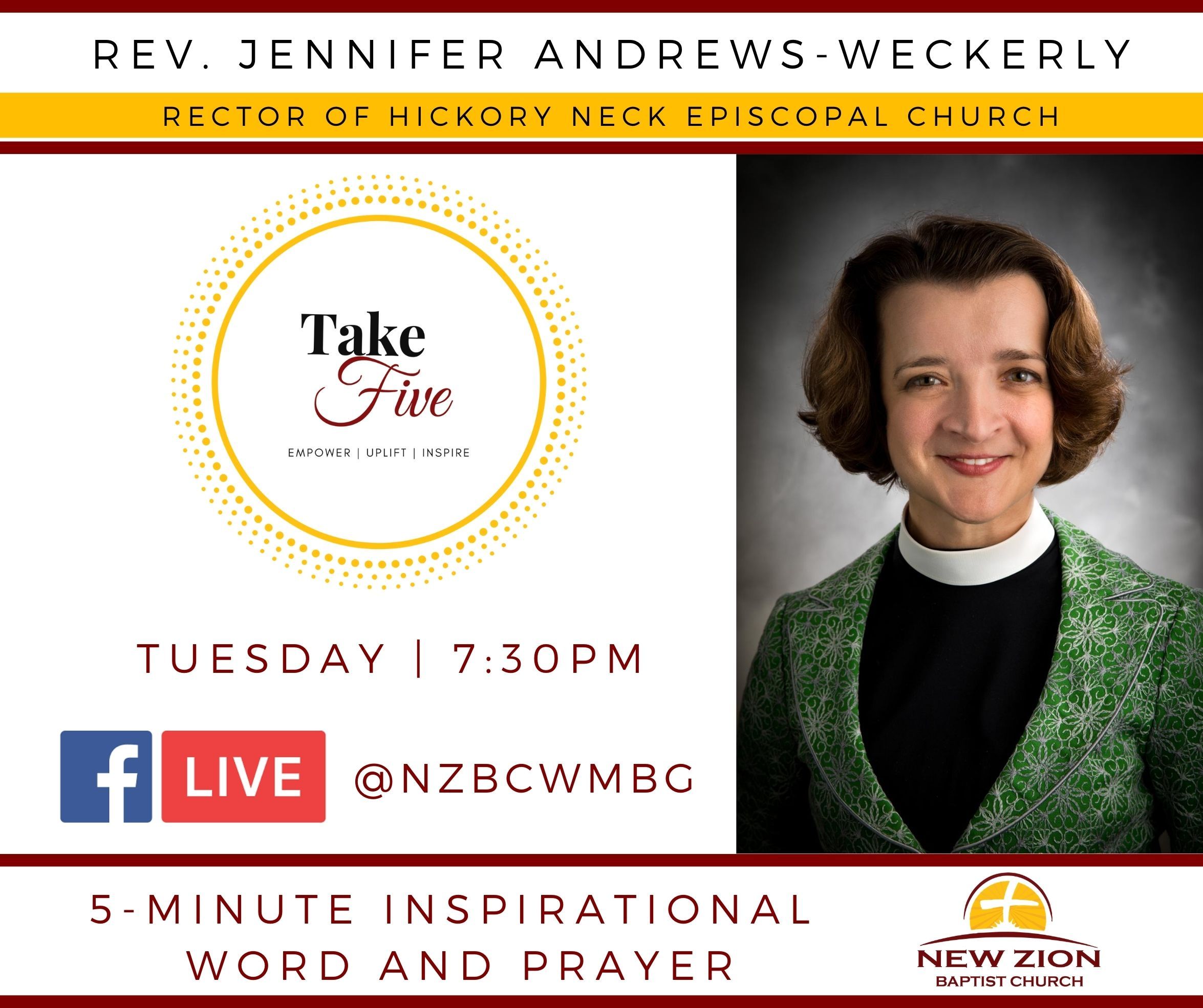
Take Five Speakers-Rev. Jennifer Andrews-WeckerlyThis reflection was offered through the livestream program called “Take Five” at New Zion Baptist Church on July 28, 2020.  This is the text from that talk.

Tonight we turn to Psalm 149, which says, “Praise the Lord.  Sing to the Lord a new song, his praise in the assembly of the saints.  Let Israel rejoice in their Maker; let the people of Zion be glad in their King.  Let them praise his name with dancing and make music to him with tambourine and harp.  For the Lord takes delight in his people; he crowns the humble with victory.  Let the saints rejoice in this honor and sing for joy on their beds.”

Now I know what you may be thinking.  Really?  You want us to talk about praising God?  We’ve got a worldwide pandemic, which our country is becoming one of the worst handlers of in the world, which disproportionately is affecting people of color, and has become so politicized that we are no longer worried about the sanctity of human life, but are instead arguing about rights and the ethics of sacrificing life for some contrived greater good.  Not only that, we are in a crucible around racism, that alternatively gives us great hope for change and makes us despondent about how far we really have to go.  Add to that the emotional, spiritual, financial, and physical toll of this time, a time when we seem incapable of respecting the dignity of every human being, and you want to talk about singing to the Lord a new song?

I don’t know about you, but when I am feeling the weight of the world, and when I am longing for a word from God, an old song is usually where I return.  Every once in a while, when I slow down enough not to just to pray to God, but to actually listen to God, those old timey hymns from my childhood come back.  Their words speak to my ache, or let me wallow in my despair.  They talk about sweet, sweet Spirits, and walks through garden alone with Jesus, and balms in Gilead.  When I talk to Jesus, I want an old song.

But that is not what the psalmist says.  We are not asked to recall the old songs; we are invited to sing a new song.  In fact, seven times in the psalms, we are invited to sing a new song to the Lord.  As a fellow pastor says, “New songs of praise are appropriate for new rescues and fresh manifestations of grace.  As long as God is gracious toward us, as long as he keeps showing us his power, and wowing us with his works, it is fitting that we not just sing old songs inspired by his past grace, but also that we sing new songs about his ever-streaming, never-ceasing grace.”[i]

In this time of utter upheaval, unrest, and unevenness, two things are happening.  One, God is still moving.  The Spirit’s movement may be hard to see or hear in the cacophony of noise.  But I know in talking to New Zion’s leadership, talking to the folks at Hickory Neck Church, and talking to our neighbors here in James City County, Jesus is still moving.  I know that you are finding moments of grace, even in the darkness of this time.  I know that you are seeing shreds of hope, even in what feels like the disappointing failures of our nation.  Two, despite how comforting those old songs are, I am guessing the Holy Spirit has whispering some new songs in your ear.  You may not be sure of the words, and you may be straining to hear the tune.  But in the depths of your heart, where we fear change and we harbor anxiety, we know that only a new song can help get us out of this mess.

So, here’s the good news.  We are not on our own to birth these new songs.  Psalm 40 says, “I waited patiently for the Lord; he turned to me and heard my cry.  He lifted me out of the slimy pit, out of the mud and mire; he set my feet on a rock and gave me a firm place to stand.  He put a new song in my mouth, a hymn of praise to our God.  Many will see and fear the Lord and put their trust in him.”  God put a new song in my mouth, says the psalmist.  Not I, out of my genius, wrote a new song.  Not, I worked hard and put in the time, and out of my labor created a new song.  Not, I listened to what others were singing and sang their songs.  No, the psalmist says, God put a new song in my mouth.  Our invitation tonight is to open ourselves to that new song.  Our invitation is to concede that during this time – a time unlike anything any of us has experienced – God is providing something new – new grace and new songs (which might be even better than that old favorite).  Our invitation tonight is to sing the new song God gives us out in the world – to trust in the wisdom of the words and notes Jesus is giving us and shout them out to a world that desperately needs to hear that new song.

Let us pray.  Holy and creative God, we know that you see our suffering and our cries.  We know that you see us patiently waiting on you to lift us up out of the mud and mire, to put us on a firm place to stand.  Help us to trust that you will put a new song in our mouths – a song to give voice to your ever-streaming, never-ceasing grace.  When we finally hear your new song, help us to sing that song – help us to praise your name with dancing, and make music with tambourine and harp.  Help us to remember that when we sing your new song, we shine your light into the world, helping your transformative, life-giving love take root, and disrupt the injustice of our day.  We praise you, Lord, and we bless you, and we sing a new song with you.  Amen.

[i] David Mathis, “Sing a New Song,” May 4, 2014, as found at https://www.desiringgod.org/articles/sing-a-new-song on July 27, 2020.


← Older posts
Newer posts →

Recent Posts

  • On the Myth and Magic of Advent…
  • On Risking Failure and Facing Fear…
  • Sermon – Luke 23.33-43, P29, YC, November 23, 2025
  • On Inhabiting Gratitude…
  • Sermon – Luke 20.27-38, P27, YC, November 9, 2025

Archives

  • December 2025
  • November 2025
  • October 2025
  • September 2025
  • August 2025
  • July 2025
  • June 2025
  • March 2025
  • February 2025
  • December 2024
  • November 2024
  • October 2024
  • September 2024
  • August 2024
  • July 2024
  • June 2024
  • May 2024
  • March 2024
  • February 2024
  • January 2024
  • December 2023
  • November 2023
  • October 2023
  • September 2023
  • August 2023
  • July 2023
  • June 2023
  • May 2023
  • March 2023
  • February 2023
  • January 2023
  • December 2022
  • November 2022
  • October 2022
  • June 2022
  • May 2022
  • January 2022
  • December 2021
  • November 2021
  • October 2021
  • September 2021
  • August 2021
  • June 2021
  • May 2021
  • April 2021
  • March 2021
  • February 2021
  • January 2021
  • December 2020
  • November 2020
  • October 2020
  • September 2020
  • August 2020
  • July 2020
  • June 2020
  • May 2020
  • April 2020
  • March 2020
  • February 2020
  • January 2020
  • December 2019
  • November 2019
  • October 2019
  • September 2019
  • August 2019
  • July 2019
  • June 2019
  • May 2019
  • April 2019
  • March 2019
  • February 2019
  • January 2019
  • December 2018
  • November 2018
  • October 2018
  • September 2018
  • August 2018
  • July 2018
  • June 2018
  • May 2018
  • April 2018
  • March 2018
  • February 2018
  • January 2018
  • December 2017
  • November 2017
  • October 2017
  • September 2017
  • August 2017
  • July 2017
  • June 2017
  • May 2017
  • April 2017
  • March 2017
  • February 2017
  • January 2017
  • December 2016
  • November 2016
  • October 2016
  • September 2016
  • August 2016
  • July 2016
  • June 2016
  • May 2016
  • April 2016
  • March 2016
  • February 2016
  • January 2016
  • December 2015
  • November 2015
  • October 2015
  • September 2015
  • August 2015
  • July 2015
  • June 2015
  • May 2015
  • April 2015
  • March 2015
  • February 2015
  • January 2015
  • December 2014
  • November 2014
  • October 2014
  • September 2014
  • August 2014
  • July 2014
  • June 2014
  • April 2014
  • March 2014
  • February 2014
  • January 2014
  • December 2013
  • November 2013
  • October 2013
  • September 2013
  • August 2013
  • July 2013
  • June 2013
  • May 2013
  • April 2013
  • March 2013
  • February 2013
  • January 2013
  • December 2012
  • November 2012
  • October 2012
  • September 2012

Categories

  • reflection
  • Sermons
  • Uncategorized

Meta

  • Create account
  • Log in
  • Entries feed
  • Comments feed
  • WordPress.com

Blog at WordPress.com.

  • Subscribe Subscribed
    • Seeking and Serving
    • Join 394 other subscribers
    • Already have a WordPress.com account? Log in now.
    • Seeking and Serving
    • Subscribe Subscribed
    • Sign up
    • Log in
    • Report this content
    • View site in Reader
    • Manage subscriptions
    • Collapse this bar
 

Loading Comments...