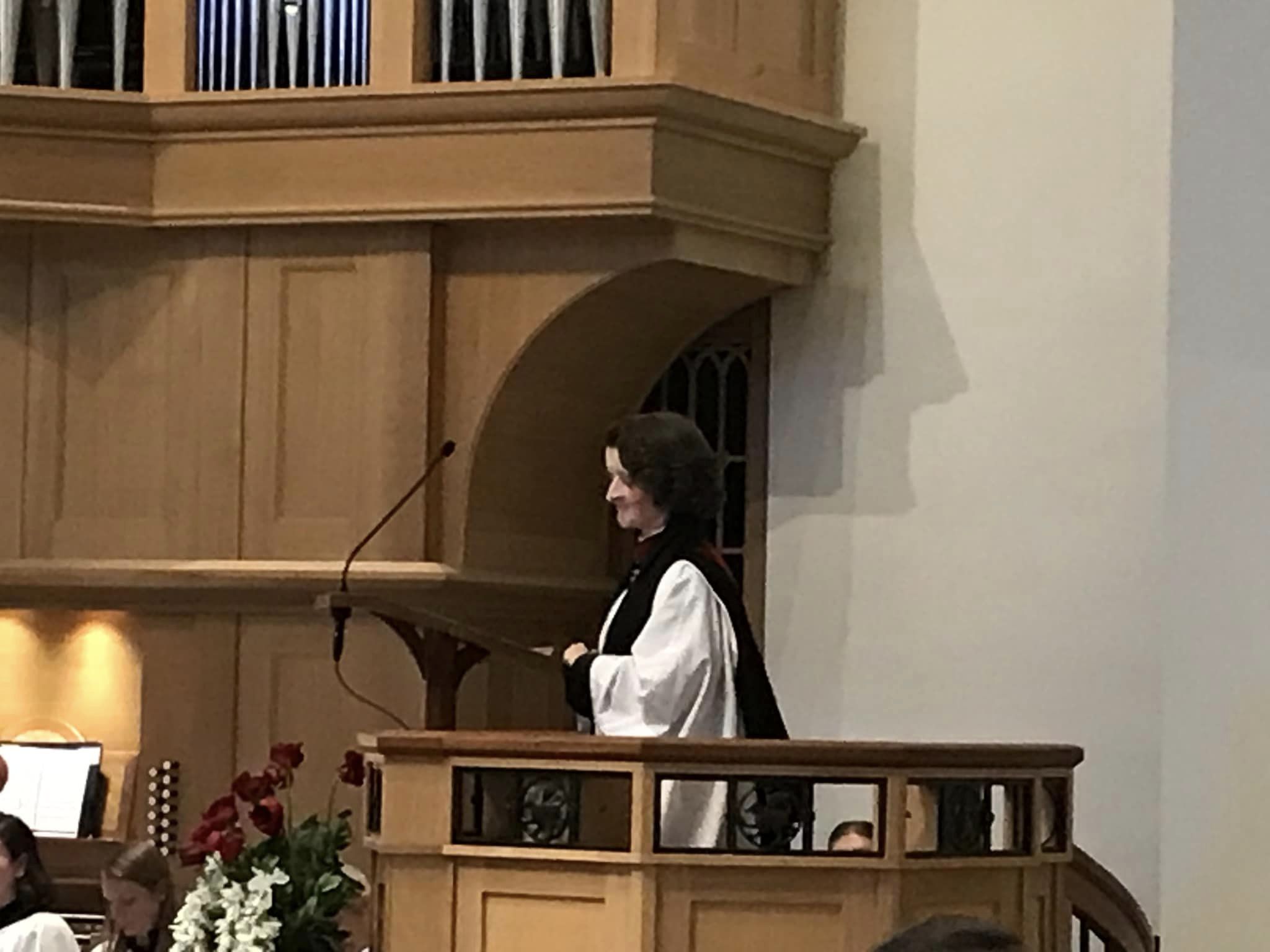
Sermon – John 21.1-19, E3, YC, May 1, 2022

Tags

, , , , , , , , ,

One of the things I found fascinating about the pandemic was the coping mechanisms people developed.  For some coping took the form of fitness or wellness – instead of exercising a couple days a week, a daily run or walk was the way many kept their sanity.  For others, picking up new hobbies, like baking bread, did the trick.  We even had shortages of flour and yeast so many people were baking.  For others they turned to less healthy outlets – shopping (online, of course), drinking one more glass of wine, or binge watching one more show, sacrificing sleep and anything else productive.  All those coping mechanisms did just that – helped us cope with a world that was falling apart around us.  And since we could not control the availability of vaccines, the mandates for masks, the requirements to isolate, what we could do was the familiar – go for a run, use our baking skills, escape into the familiar.

Coping is exactly what Peter does in our gospel lesson today.  His world has been upended, his hope destroyed, his shame irrecoverable.  The finality of the cross breaks him, the empty tomb leaves him dumbfounded, and the resurrected Lord standing with his wounds before him has him in shock.  And so, he mumbles to the other disciples, “I am going fishing.”  The other disciples go with him – likely relieved for the sense of familiarity, grateful for something to do that they are actually good at, and likely a bit afraid to stay where they are doing nothing. 

We did a similar thing here at Hickory Neck during the pandemic.  In March of 2020, as the bishop was closing all church campuses for the first time, I was in a hospital waiting room, cancelling a Vestry Meeting, messaging our staff, and trying to listen to post-operation care for my daughter from the nurse.  The world was imploding and like a dazed Peter I said, “Let’s worship anyway.  I mean, I know how to use Facebook Live.”  And so that is what we did:  we worshipped online – not just one day, but every day; we offered pastoral care – not in person, but on the phone, by text, by email, and by card; eventually, we figured out how to help others and began offering to pick up groceries, care for the sick remotely, and deliver prescriptions. 

But a funny thing happened along the way.  As we dove into our coping mechanisms, albeit in creative ways, we started reaching new people.  When Pop-Up Prayers started, people we had never met before – sometimes people who are literal next-door neighbors – started tuning in to our prayers.  People who had always wondered about us were finally able to take a peek without having to cross our threshold; and they liked what they saw so much they started coming in person long before our longtime members ever did.  People who moved here during the pandemic and were longing to find a new community of support were able to come here – either virtually or masked and distanced.  They were willing to sacrifice discomfort just to find a sliver of comfort here.  What initially felt like a coping mechanism suddenly transformed our ministry altogether.

One of the more dramatic parts of today’s gospel is the conversation between Peter and Jesus over a charcoal fire.  The only other time a charcoal fire is mentioned in John’s gospel is the one Peter warms himself by as he denies Jesus three times.  In the synoptic gospels of Matthew, Mark, and Luke, Peter denies that he knows Jesus; in John’s gospel, he denies his very discipleship.[i]  “Aren’t you one of his disciples?” was the question they had asked him three times.  And so, Jesus asks Peter three questions as a mirror to those three questions Peter was asked.  Many scholars argue this interaction is Jesus’ way of forgiving Peter, or Jesus’ way of reinstating Peter as a disciple, or even Peter’s rehabilitation after a failure of loyalty.  But as Karoline Lewis argues, “None of these summaries adequately recognizes the significance of Jesus’ request of Peter.  Peter is not simply restored to his role as disciple, but he will have to imagine discipleship in an entirely different way.”[ii]

Our work this week is to figure out how, in the midst of a post-pandemic Eastertide, how are we being invited to redefine our discipleship.  I know as we have returned to the altar rail and begun to share the common cup, many of us have sighed with relief.  Some of us have been begging to drop the annoying gift of Zoom, and some have wondered if we really have to keep thinking about livestreaming everything.  And yet, when Jesus asks Peter to feed his sheep, “Jesus essentially asks Peter to be the good shepherd for the sake of God’s love for the world when Jesus cannot be…the demands of discipleship take on a more acute and critical role.”  In other words, as Lewis says, “Jesus is asking Peter to be the ‘I AM’ in the world.”[iii]

That is our invitation too.  Just this week I experienced two church and diocesan meetings where people would not be able to participate without Zoom.  Just this week, I visited and spoke with suffering parishioners who said the livestreamed services are their lifelines right now.  And just last week, a visitor explained how perusing our website helped in the decision to take the next step through our door.  This pandemic has stretched us, challenged us, and invigorated us.  But the reward of getting through to the other side is not to go back to “normal.”  The reward is we have learned a new way to be disciples of Jesus – and Jesus is asking us to consider how we – corporately and individually – can be the “I AM” in a world that wants to know God.  Jesus promises today to help us along the way – showing us where to cast our nets again, feeding us abundantly, and reminding us again and again how to be love in the world.  Our invitation is to consider how Jesus is already transforming our coping mechanisms into gifts of love for the world.  And then, in our discomfort, to stand up and follow him.  Amen.


[i] Karoline M. Lewis, John: Fortress Biblical Preaching Commentaries (Minneapolis:  Fortress Press, 2014), 255.

[ii] Lewis, 256.

[iii] Lewis, 256-257.

Sermon – Luke 24.1-12, EV/ED, YC, April 16, 2022

Tags

, , , , , , , , , , ,

For anyone who has grown up where there is significant snow or ice, you learn a new way of walking during wintery weather.  You cannot just boldly and carefreely step out of the house or car.  You learn a technique that admittedly looks silly from afar but can save many a bruised bottom.  You sort of extend your leg and toe and test out the asphalt.  If that feels steady, you put more of your weight on the foot.  If you are not entirely sure, you can lean back a bit to keep search for an ice-free zone.  Like I said, the technique looks a bit ridiculous, but saves you more often than not.

I have been entering into this new era of pandemic in the same tentative way.  Much of our life has begun to resemble what we remember as “normal”:  no masks required in most places, the elimination of social distancing, the occasional handshake or hug – even the church has reintroduced the common communion cup.  But even with all the changes, I still feel a deep-seeded hesitancy in my being.  I thought when all these things changed, I would want to party and celebrate.  Instead, I find myself leaning back and tipping my toe into the new normal.  My body has been on a rollercoaster for far too long to trust this new, exciting time.

A similar thing seems to be happening in our Easter story today.  The women are initially terrified about the news of the empty tomb.  As they remember Jesus’ foretelling of the event, they excitedly embrace the resurrection – only to have the disciples not believe them.  Peter must go see the empty tomb for himself before he will believe the women.  But his response to the empty tomb is to go home – amazed, certainly – but quietly returning home.  They are not singing the alleluias like we do today.  They are not running around town sharing the Good News.  The are gingerly dipping their toes into Christ’s resurrection, still not sure they can trust the joy of Easter.

Sometimes we are like that.  Last night, we spent an hour retelling the salvation narrative of God – story after story of God’s faithfulness and commitment to save the people, no matter how grave their sinfulness or disloyalty.  Last night, we reaffirmed all the good things about our baptism – the very things that make us faithful Christians – even though we struggle everyday to live into our Christian identity.  Today we are saying countless alleluias, proclaiming the tremendous news of the empty tomb, despite the fact we have sometimes felt far away from God during these last two years.  We are in this sacred place together with people who believe, or want to believe, maybe in new garb, maybe with festive meals waiting for us, and yet there is a hesitancy deep inside us – an unwillingness to fully let go of the weight of all that has been in our lives and believe the alleluias our liturgy has us say.

For us, today, the promise is we are in good company.  What God does in the resurrection of Jesus is unfathomable in Jesus’ day – of course the disciples thought the women were telling an idle tale (and their doubt was not just because they kept forgetting Jesus treated women as equal leaders).  When you have watched your whole life crumble, every dream of what you thought life with Jesus would be disintegrate in 24 hours, pivoting to news this tremendously good is not easy.  And besides, there is a lot more to happen – appearances by Jesus, more teaching, and finally the empowerment to share the Good News from the Holy Spirit.  The toe dipping into Easter joy today is totally reasonable and human.

So is your toe dipping today.  If you are not ready to throw off your outer garment and shout at the mountaintops, “Jesus is Risen!  All is well in the world!” that is totally reasonable and human.  The Church is here to keep telling you the story, to send women with a fantastic tale, to remind you hope is still possible, and joy is inevitable.  But the Church is also here to sit with you in quiet rooms, holding your hand, and whispering Good News until you are ready to step firmly onto the ground without hesitation.  Spring has melted the ice, Easter has brought promise, and Jesus lives.  We are here to take the first steps together.  Amen.

Sermon – Luke 19.28-40, PS, YC, April 10, 2022

Tags

, , , , , , , , ,

When I was in third grade, I had one of those classic rite-of-passage moments.  The day started out simply enough.  At school, my friend, Buffy, who normally sat right behind me, was out sick that day.  On the way to lunch, another friend, Holly, lamented how much she missed having Buffy there.  I agreed, but casually mentioned that I was getting more work done because Buffy was not distracting me by talking so much.  The comment was a rare, blatantly honest statement about how, although I loved my friend Buffy, Buffy did tend to talk a little too much.  That moment of rare, brutal honesty cost me dearly.  That night, Holly called to tell me how upset Buffy was that I said she talked too much.  I was devastated and embarrassed.  I could not believe Holly had betrayed my confidence and told Buffy what I said.  Now I was forced to call Buffy and figure out how to meaningfully apologize:  a tall order for a third grader.

What I remember most about that interaction is the presence of my mother.  Before I got up the courage to call Buffy to apologize, I came to my mother weeping.  I was weeping out of remorse, I was weeping out of embarrassment, and I was weeping because I felt like I had no legitimate excuse for my words.  How could I keep Buffy as a friend with her knowing how I felt about her talking habits?  My mother stood by my side, encouraging me to face my fears, assuring me everything would eventually be okay. 

As I look back at that day now as a parent, I can only imagine how my mother must have felt.  She must have felt awful for me, knowing how painful removing one’s foot from one’s mouth can be.  She must have known this kind of grievance could take a long time to forgive, and I would have to maintain a tone of repentance, without the assurance of forgiveness.  She must have anticipated how difficult my apology would be and how vulnerable offering that apology would make me.  But my mother must have also known all of those experiences are a part of growing up and being in relationship with others.  She could not navigate my mess for me.  She could not take away my discomfort.  She knew I just needed to go through the experience, and would be transformed in the process.  I remember my mother being infinitely supportive; but years later, I imagine my mother must have felt helpless as I navigated the realities of growing up. 

In some ways, I think Holy Week leaves us with the same sense of helplessness.  We would love nothing more than to finish our worship today with Jesus’ story on that blessed Palm Sunday.  Everything is there.  The prophecies are being fulfilled:  Zechariah already foretold of how the Messiah would come triumphantly, but humbly, riding on a donkey.[i]  Everyone is already singing those words from the Psalms, “Blessed is the king who comes in the name of the Lord!”  There is no mistaking the pieces of the puzzle are all present – the people finally understand Jesus is the long-awaited Messiah and they lay down their blankets to celebrate their king.  We should be able to say, “The End,” and all go home, ready to celebrate again next week. 

Unfortunately, we do not get off so easily.  Like a mother who wants to shield her children, we want to shield Jesus and ourselves from the pain that will come this Holy Week.  We want to skip the Passion Narrative – or at least save the narrative for Good Friday – delaying the inevitable.  But our liturgy today does not let us avoid the uncomfortable remainder of the story.  I have long been told the reason we read the Palm Liturgy along with the Passion Narrative on Palm Sunday is because so few church-goers actually attend Holy Week services.  But I think there is more to today’s liturgy than cramming everything into one Sunday.  I think we hear the Passion Narrative with the Palm Liturgy because the Palm Liturgy can only be understood in light of the Passion.  If we try to claim victory today with our palms, we miss the work of the Messiah.  We forget the rest of prophecy if we stop with the palms.  The palms simply mark our acknowledgment of Jesus’ identity as the Messiah.  The Passion gives us the consequences of Jesus’ identity as the Messiah.

Using the parenting lens this year has helped me with my normal discomfort on Palm Sunday.  Normally, Palm Sunday makes me feel like a failure.  Here I am in one moment singing, “All Glory, Laud, and Honor,” joining the festival procession with my palms, and the next moment shouting “Crucify him!”  This liturgy always makes me feel like a failure.  But the parenting lens changes things for me.  If I think of this day not as a failure on my part, but as the experience Jesus must live through in order to free us from our sins, somehow, I feel less impotent.  Somehow, I am better able to sit with Jesus today, knowing I cannot change his journey, but also knowing his painful journey will lead to greater things.  Without the recognition of Jesus’ identity in the Palms Liturgy, and the shameful death of Jesus in the Passion Narrative, we cannot get through to the other side – to the Easter resurrection that awaits us. 

So today, we take on the role of supportive parent.  We sit in the kitchen, pretending to read a magazine, while intently listening to the painful journey of Jesus.  If we are good parents, we let the drama unfold as the drama needs to unfold.  But we also keep watch, waiting to be called into the fray to offer our love and support.  We cannot control Jesus’ journey, and in the end, that is for the best – because the end of Jesus’ story is much better without our meddling anyway.  Amen.


[i] George W. Stroup, “Theological Perspective,” Feasting on the Word, Yr. C, Vol. 2 (Louisville: Westminster John Knox Press, 2009), 152.

Sermon – Luke 13.1-9, L3, YC, March 20, 2022

Tags

, , , , , , , , , , ,

As I have been watching the news about Ukraine, I find that I am in equal measures blown away by the fortitude and commitment of Ukrainians – who by all accounts had no chance in beating powerful Russia, and devastated by the suffering of Ukrainians – starving and trapped inside surrounded cities, attempting to protect children by writing the word “children” outside a safe house, only to have that safe space bombed, and even having maternity wards being fair game for destruction.  As my heart ached the question, “Why?” this week, I was so grateful when I read today’s gospel and see those gathering around Jesus asking Jesus the same question.

In Luke’s gospel today, the people come with two concerns to Jesus.  They want to know why Galilean Jews have suffered at the hand of Pilate, and why many were killed when the tower of Siloam collapsed.  I feel a solidarity in their painful questions, and I have a hopeful longing when Jesus opens his mouth.  But what comes next feels like Jesus has not heard us at all.  In answer to their question of why there has been suffering, Jesus tells this story:  Once upon a time, there was a fig tree that was not bearing fruit and had not borne fruit for three years.  Fed up, the vineyard owner decided to cut down the unproductive tree.  But before the vineyard owner could touch the tree, the gardener made one last plea.  The gardener asked for one more year.  In that year, the gardener would dig around the tree, spreading manure at the roots of the tree.  If after a year of such care the tree still did not produce fruit, then the owner could chop down the tree. 

Now maybe you hear Jesus’ parable today, and you can immediately see the correlation between the question why there is suffering in the world and the parable of the unproductive fig tree.  I was not so lucky this week.  In fact, I found myself staring blankly at this text for days.  Certainly, I understand the question the people ask, since I have been asking that same question for weeks.  And I think I somewhat understand the parable – I mean, what better parable for Lent than one about repentance.  But what I did not understand was why Jesus told this parable to answer our question of why there is suffering in the world.

Fortunately, I stumbled on the work of a biblical scholar.  She describes the idea by poet and healer Pádraig Ó Tuama of the “Buddhist concept of ‘mu,’ or un-asking.  If someone asks a question that’s too small, flat, or confining, Ó Tuama writes, you can answer with this word mu, which means, ‘Un-ask the question, because there’s a better question to be asked.’  A wiser question, a deeper question, a truer question.  A question that expands possibility, and resists fear.”[i]  I think what the poet and the scholar are pointing to is a little like that movie The Karate Kid from the 1980s.  In the movie, the main character wants an old man to teach him karate so he can stand up to the high school bully.  And so, what are the first things the old teacher has him do?  Paint a fence, wax a car, and sand a wooden walkway.  This desperate teen asks for help, and at first glance, the wise teacher is responding in a totally disconnected way.

Of course, in the movie we learn that the teacher’s method is anything but disconnected.  Painting, waxing, and sanding all incorporate the skills needed to master karate.  Jesus is a similar sensei in his telling of this cryptic parable.  In order to help us shift our work of repentance on this third week of Lent, when we ask why, Jesus says “mu.”  As Debie Thomas argues, Jesus “…says “mu” because “why” is just plain not a life-giving question.  Why hasn’t the fig tree produced fruit yet?  Um, here’s the manure, and here’s a spade — get to work.  Why do terrible, painful, completely unfair things happen in this world?  Um, go weep with someone who’s weeping.  Go fight for the justice you long to see.  Go confront evil where it needs confronting.  Go learn the art of patient, hope-filled tending.  Go cultivate beautiful things.  Go look your own sin in the eye and repent of it while you can.  In short: imagine a deeper story.  Ask a better question.  Live a better answer.”[ii] 

Jesus is not unfeeling about our angst about suffering in the world.  I suspect Jesus is grateful for our empathetic hearts.  But this cryptic parable this week is meant to shift us a quarter turn so that we move out of empathetic paralysis and into repentant productivity.  We learn from the parable we will not do this work alone.  We unproductive, rooted trees cannot exactly fertilize and aerate our own soil.  God, the gardener, who graciously asks for more time, will do that work as we focus on moving from being empathetic fig trees with no sustaining fruit, to humble, repentant fig trees who work on improving our own sinful behavior before becoming overwhelmed with the rest of the sinful world.  God will likely have to shovel a lot of manure to help transform our unproductive soil.  But as we weep with others, grab our own spades, confront evil in our own life, and fight for justice through hope-filled tending, we begin the work of asking better questions and living better answers.  Amen.


[i] Debie Thomas, “What Are You Asking?” March 13, 2022, as found at https://www.journeywithjesus.net/lectionary-essays/current-essay?id=2944 on March 19, 2022.

[ii] Thomas.

Sermon – Luke 13.31-35, Psalm 27, L2, YC, March 13, 2022

Tags

, , , , , , , , , , , , ,

When you listen to enough sermons in the Episcopal Church, you will eventually realize the preacher is using a set of lessons from what we call “the lectionary.” Unlike in other denominations, the Episcopal preacher doesn’t really get to go “off script” or preach a particular passage to promote an agenda.  And if you have visited other Episcopal Churches, you quickly learn that we all use the lectionary – whether you watch the broadcast of the National Cathedral or the broadcast of Hickory Neck, you will hear a sermon on the same scripture lessons.  But what you might not know is that within the lectionary there are two “tracks” – one where you read through the Old Testament in a semi-continuous way, and one where you jump around in the Old Testament to allow all the readings to have a similar theme as the Gospel.  Hickory Neck is currently following the thematic readings track.

What is interesting about that thematic track is you would think the Old Testament readings and Gospel would be similar.  But this week, the reality is quite the opposite.  In our Psalm today, we have the ideal follower of God.  The psalmist proclaims things like, “The Lord is my light and my salvation; whom shall I fear?” and the Lord will “hide me in his shelter in the day of trouble; he will conceal me under the cover of his tent; he will set me high on a rock,” and “Teach me your way, O Lord, and lead me on a level path” and finally, “I believe that I shall see the goodness of the Lord in the land of the living.”  The psalmist is a faithful follower of God, totally leaning into God for strength and protection, trusting in the Lord’s goodness, wanting to keep learning and being led.  The words of this psalm indicate a confidence in God, a trust in God’s protection, and reliance on the Lord.

And yet, everything in the Gospel text depicts followers of Jesus that are anything but confident, trusting, and reliant.  As Jesus makes his way to Jerusalem, we hear a lament so profound as to cause shame and a sense of failure.  Jesus says, “Jerusalem, Jerusalem, the city that kills the prophets and stones those who are sent to it!  How often have I desired to gather your children together as a hen gathers her brood under her wings, and you were not willing!”  As one scholar describes Jesus, “He longs and grieves for his lost and wandering children.  For the little ones who will not come home.  For the city that will not welcome its savior.  For the endangered multitudes who refuse to recognize the peril that awaits them.  His is the lamentation of long, thwarted, and helpless yearning — ‘How often have I desired to gather you.’”[i]

Jesus’ lamentation describes the very opposite of the followers in Psalm 27.  Whereas the psalmist has confidence, trust, and reliance, the followers of God in Jesus’ day are lost, mistrusting, and defiant.  In this thematic year of the lectionary, how do we hold these contradictory images in tension with one another?  The reality is the two are not all that different.  In fact, I wonder if our work this Lent is in confessing the ways in which we are those lost, mistrusting, defiant chicks, fighting against the care of our mothering God so that we can be the followers of Christ who can profess psalms with confidence, trust, and reliance. 

This week, I invite you to consider the ways in which you are running away from your protective mother hen Jesus.  How are you fighting against Jesus’ care, Jesus’ love, and Jesus’ grace?  Who in your life is offering you care, love, and grace that you are resisting:  maybe because you do not like to be vulnerable, or you do not like to admit your need, or you just do not like other people in your business?  That care, love, and grace is coming from all directions, and our invitation is to simply say yes – to let ourselves be gathered in by this community and those who love you.  And if that hurdle is just too high this week, perhaps your invitation is to read Psalm 27 every morning this week – and nights too if you need – maybe even singing the Taizé song, “The Lord is my light,” until the repetition convinces you – so that the words of Psalm 27 no longer feel aspirational and become truth.  That way, the next time someone needs you to gather them in, you will have a psalm you can share with the authenticity, grace, and love that has been shown to you this week.  Amen.


[i] Debie Thomas, “I Have Longed,” March 6, 2022, as found at https://www.journeywithjesus.net/lectionary-essays/current-essay?id=2944 on March 12, 2022.

Sermon – Genesis 7.1-5, 11-18, 8.6-18, 9.8-13, UJCCM Lenten Series, March 9, 2022

Tags

, , , , , , , , , , , , , ,

This Lent, we as an ecumenical body in Upper James City County are retelling the “salvation narrative” – or at least that is the fancy phrase we use to describe the body of stories that show us time and again God’s saving deeds in history, and how those stories inform how we understand what will happen on Easter Sunday – how the life, death, and resurrection of Jesus will bring the fullness of redemption.  We started last week with the story of creation – the ways in which God lovingly called the created order good and made us in God’s image.  Tonight, we shift to another of the legendary stories – the story of the flood.

This is a story we know and love:  we use Noah’s ark as artwork in babies’ nurseries, I have Noah’s ark in the form of Christmas ornaments, we even sing songs about how God told Noah to build an “ark-y, ark-y” made of “bark-y, bark-y.”  I think we love this story so much because of the good news at the end.  But before we get to the end, we have to wade through a whole lot of a horrible beginning and middle.  You see, despite the goodness of creation, of the ways in which we were made in God’s image, we humans fall into sinfulness.  We do not hear much of that part of the story tonight.  Despite all the verses we did hear, what we do not hear is how horribly sinful humanity has become in Noah’s time.  This sinfulness grieves God so very much that God set God’s mind to do a terrible, awful thing[i].  Those waters out of which God formed the earth – those waters that God used a dome to separate – separate the waters from the waters, God uses to destroy the beautiful creation God has made.  God removes the dome, and the waters came down from the skies and the waters rise up from the ground.[ii] 

From the beginning of this horrible decision, God makes a choice – a choice to save some life instead of recreating life again[iii].  And so, on that ark that Noah builds, floats the people who will repopulate the earth, and the animals that will restore the created order.  We hear very little in scripture what those days are like[iv]:  the panic of rising waters, the death all around them, the solitude and silence of watery chaos, the noise of a bizarrely filled boat.  We have only our imagination to fill in what those desperate days may have been like. 

In some ways, I think Lent is a lot like those days on the boat.  There is the obvious forty days connection, but more telling is the stark reality of sinfulness and judgment.  Imagining the depravity of those days that would drive God to destroy most of creation is not as hard as we might like to think.  Sometimes, I wonder if God is not similarly grieved by us today.  Here we are after two years of a pandemic where our own country spent more time arguing over the supremacy of personal freedom over the call to love one another.  Here we are, for likely the millionth time debating whether there is such a thing as a just war as we watch civilians and children slaughtered in Ukraine.  Here we are divided by political party, divided by socioeconomic status, divided by race, divided by theology into denominations and faiths.  Here we are, refusing as individuals to love all our neighbors as ourselves, and love the Lord our God.  Lent is our season to float in the lapping waters of our sinfulness, wondering whether we should be on that boat or not.

But here’s the funny story about the flood.  This story is not about you.  This story is not even really about Noah, or the animals God saved, or even the rainbow at the end of the story we like to cling to so desperately.  This story is not about our sinfulness and brokenness and inability to live into the image of God in which we are created.  No, this is a story about God.  Everything in this story that we value, that makes this story a “salvation narrative,” is about God’s actions.  The reason we do not hear all the gory details about the lead-up to the flood – the details that even movies have been made about – is because this is a story about salvation, not judgment – on what God does to preserve creation.[v]

One of the exercises I have done with young adults is to talk about images of God.  We create a safe space where we can talk about those images – not just the ones the church likes us to see – of the shepherd caring for the flock, even at times with a lamb on his shoulders, or of the saccharine-y Jesus’ we hang around that look more like an American Jesus than a Middle Eastern Jesus.  Instead, we try to get real with the youth.  The images they often have are of a foreboding man on a throne, an intimidating father figure, or a judge behind a bench.  And when we adults are honest, our images are pretty similar.  But the images of God in this story, as one scholar writes are “striking:  a God who expresses sorrow and regret; a God who judges, but doesn’t want to, and then not in arbitrary or annihilative ways; a God who goes beyond justice and determines to save some creatures, including every animal and bird; a God who commits to the future of a less than perfect world; a God open to change and doing things in new ways; a God who promises never to do this again.  The story reveals and resolves a fundamental tension within God, emphasizing finally, not a God who decides to destroy, but a God who wills to save, who is committed to change based on experience with the world and who promises to stand by the creation.”[vi]

That’s the funny thing about this story.  The flood seems like a story for Lent because we find ourselves as sinful as Noah’s world, and we know we need to change our ways.  Lent is all about repentance after all – a turning from our sinfulness and returning to God.  But here’s the thing: even after the flood (and let’s be honest, even after this Lent), the people will keep going back to sinning.  I mean, we’re just in chapter nine of Genesis:  there is a whole lot more sinning left in the Old Testament for us to read.  Scholars argue, “The flood has effected no change in humankind.  But [the flood] has effected an irreversible change in God.”[vii]  This salvation narrative tells us more about God than ourselves.  God establishes the covenant with humanity and creation to never flood the earth again.  Certainly, there may be judgment again, but never the kind that annihilates the earth.  That rainbow that we love is not meant to remind us of God’s promise, but to remind God of the covenant – the restraint God promises to keep in the midst of well-deserved judgment.[viii]  Every promise God makes, all the salvation narratives we will hear the rest of this Lent, are made possible by the foundation of the promise God makes to Noah.[ix]

So, if this salvation narrative is not about us, does that mean we get a free pass for Lent?  Not exactly.  The real question for us tonight, based on everything we just learned (or remembered) about God, is “So what?”  Professor Patricia Tull argues, “Scripture says that a good and wise God created us good.  We’re capable of great evil, as the flood story says and as we know every day.  But God means for us to be transformed, just as the flood transformed God’s intentions.”[x]  Lent is our opportunity to mirror God’s transformation of intention.  What in your life this year needs transforming?  What have you been holding on to – a grudge, a hurt, an anger, a self-righteous indignation – needs to be released?  God learned in the flood that God could not change humanity – but God could change God’s relationship with humanity.  Our invitation this Lent is not necessarily to change ourselves, and certainly not to try to change others (which never goes well), but to transform our relationships – our relationship with God, our relationships with others, and even our relationship with ourselves.  Use the watery chaos of this Lent to listen through the noise of animals around you to hear the promise of the rainbow come Easter.  Amen.


[i] Leander E. Keck, ed, The New Interpreter’s Bible, vol. 1 (Nashville:  Abingdon Press, 1994), 394.

[ii] Keck, 392.

[iii] Keck, 394.

[iv] Keck, 389.

[v] Keck, 389.

[vi] Keck, 395.

[vii] Keck, 395.

[viii] Keck, 400.

[ix] Keck, 401.

[x] Patricia Tull, “Commentary on Genesis 7:1-5, 11-18; 8:6-18; 9:8-13,” April 15, 2017, as found at https://www.workingpreacher.org/commentaries/revised-common-lectionary/vigil-of-easter-3/commentary-on-genesis-71-5-11-18-86-18-98-13 on March 9, 2022.

Sermon – Luke 4.1-13, L1, YC, March 6, 2022

Tags

, , , , , , , , , , , ,

Having grown up in the mostly Methodist and Baptist South, I grew up a culture that had no problem talking about the devil or Satan.  If you are starting to doubt yourself or are feeling abandoned in some way, a Methodist or Baptist would easily declare, “That’s just the devil trying to pull you away from the Lord.”  My experience with Episcopalians is we are not as comfortable talking about the devil and labeling the devil’s work in our lives.  I am not sure why we get so skittish talking about the devil.  Even the Great Litany, which we [prayed] sang this morning had a lot of “devil” references.  My suspicion is our hesitancy is a fear of sounding superstitious, a general lack of understanding or comfort with talking about the devil, or maybe a little disbelief.  But I must admit, when I have been told that my current troubles were due to the devil meddling in my relationship with God, I have felt oddly better.  There is something quite freeing about naming the devil in the midst of our lives.

Our gospel lesson today highlights why we are so skittish about the devil.  The devil works in the thin space between good and evil.  The three temptations of Jesus from the devil are just ambiguous enough that Jesus could reason his way into responding positively to the devil.  First the devil asks Jesus to turn a stone into bread.  Now if Jesus decides to do such a thing out of self-serving relief, we might align his actions with the devil.  But if Jesus turns the “abundant stones that cover Israel’s landscape into ample food to feed the many hungry people in a land often wracked by famine,”[i] then in good conscience, he might begin to consider the devil’s tempting offer. 

Next, the devil tempts Jesus with the power to rule over all the kingdoms of the world.  Now if Jesus decides to take such authority out of a desire for power and greed, we could easily deem his action as rooted in self-serving sin.  But, if Jesus agrees to take that authority so that he can rule the world with justice, then the deal with the devil becomes a bit murkier.  All we need to remember is heavy hand of Rome in Jesus’ day[ii] or the suffering in Ukraine today to wonder about the devil’s offer of turning suffering to justice.

Finally, the devil tempts Jesus to prove God’s protective care.  Now if Jesus were jumping from the pinnacle of the temple just to show off how protected he is, then we could judge Jesus to be behaving in a sinful way.  But Jesus is committing to a tremendous journey.  Seeking some assurance God will care for Jesus does not seem like that much to ask.  The devil’s work is to constantly keep picking away at trusting relationships with God, fostering mistrust between God and God’s people.[iii]

Several years ago, the film Doubt received several Oscar nominations.  The movie explored a Catholic Church and School where the head nun accused the priest of sexual misconduct.  But the story is presented so ambiguously that even by the end of the movie the viewer is not sure if abuse took place or not.  This is that thin place between truth and lies, between trust and mistrust where the devil thrives.  And truthfully, even in the movie, with whom the devil is cooperating is unclear.  This is the danger in all our lives today – the lines between God’s work and the devil’s work are so close that we have a hard time naming the devil in our lives.

Luckily Jesus’ responses to the devil give us some guidance today.  In each of the three temptations, Jesus leans on his deep understanding of Holy Scripture.  We see how powerful Jesus’ scriptural responses are because the devil attempts to distort this strength as well.  In the third temptation, the devil quotes scripture himself, trying to lure Jesus back into that thin place.  But Jesus cannot be fooled.  Jesus knows that the devil is using partial scripture citations that can be misleading out of context.[iv]  Jesus knows a dependence on Holy Scripture will support him in his weakness.

As we begin our Lenten journey, today’s gospel lesson gives us much to ponder.  First, we are invited into a time of pondering how the devil might be acting in the thin spaces between our faithfulness and sinfulness, manipulating our mistrust of God for the devil’s gain.  To understand how the devil might be acting, we will need to first label the areas of our lives with which we do not entrust to God: a particular relationship, a big decision, something challenging at work or at home, or an uncertain future.  These are areas that are most susceptible to the devil squeezing his way into our lives.  Next, Jesus invites us into a deeper relationship with Scripture this Lent.  We have already seen how Holy Scripture sustains Jesus at his weakest hour.  Whatever your Lenten practice, consider how you might incorporate some Scripture reading into your week, whether on your own or with one of our Lenten offerings.  You may be surprised at the parallels in scripture and your own life.  Finally, we are invited this Lent to lean into one another and to God.  If Jesus can lean on God in his weakness, we can lean on God in our weakness too, even if we are not totally ready to trust God with all of ourselves.  Just admitting our hesitancy is the first step to kicking the devil out of our thin spaces.  Amen.


[i] Sharon H. Ringe, “Exegetical Perspective,” Feasting on the Word, Yr. C, Vol. 2 (Louisville: Westminster John Knox Press, 2009), 47.

[ii] Ringe, 49.

[iii] David Lose, as found on http://www.workingpreacher.org/dear_wp.aspx?article_id=668 on February 15, 2013.

[iv] Darrell Jodock, “Antidote for Temptation,” Christian Century, vol. 112, no. 6, Feb. 22, 1995, 203. 

Sermon – Matthew 6.1-6, 16-21, AW, YC, March 2, 2022

Tags

, , , , , , , , , , , ,

For those of you who have known me for some time, you know that Lent has always been my favorite liturgical season.  Lent is a season marked by profound honesty about the brokenness and sinfulness of our lives, the confessing of the darkness of our souls, and the desperate searching for a way back to the unimaginable grace and love that God shows us undeservedly.  Perhaps that description sounds a bit morbid and unappealing, but I find the raw truth of Lent to be refreshing in a world that brushes over and hides imperfection.

Despite my love of the sobering ritual of Lent though, the last two years Lent has felt like too much of a burden to bear.  Being in a pandemic, wading through political divisions, and our country’s institutional racism being exposed felt like too much.  We have been lonely, scared, angry, and, at times, lost.  Both of the last two Lent’s have felt like the “Lentiest Lents we have ever Lented.”  And as your clergy, and as a fellow disciple of Christ, I felt like asking us to waltz into the dance of Lent was just all too much. 

But this year feels different.  I would not say we are on the other side of this pandemic, and I would certainly not say we are back to “normal” – though I am not sure we will ever go back to the old normal.  Instead, I rather feel like we are standing on a board, balanced on a fulcrum.  We are not still climbing our way over this pandemic, and we are also not coming down from the apex of this pandemic.  Instead, we are balancing a foot on each side of the board – steady, but using every muscle in our body to keep balance, wanting to breathe a sigh of relief being at the peak, but not yet able to relax on solid ground.

That is why I am so very grateful for our text from Matthew this Ash Wednesday.  In years past, I always found this text rather sanctimonious.  Here we are at a service where we will spread ashes on our forehead – a very public sign of our faith – listening to a text telling us not to be pious before others, not to give alms in a showy way, and not to pray so as to draw attention to our holiness.  The contradiction between written word and physical act have never felt more at odds than on Ash Wednesday.

But I think I had Matthew’s gospel all wrong before this year.  This text is not really about shaming self-righteous behavior.  This text is about honesty, vulnerability, and humility.  If we are showy with our piety, alms giving, prayer, and fasting, our discipleship becomes about dishonesty.  Instead, Matthew is simply asking us to be real:  real with others, real with ourselves, real with God. 

That is the invitation this Lent.  Not to take on some pious Biblical study (though we will offer that this year on Sunday mornings), not to brag about Lenten disciplines (though we will encourage you into a little light competition this year), and not to commit to something that is so unreachable that you quit within the first two weeks.  Instead, this Lent is about honestly claiming the hurt of these last two years:  of confessing our isolation and the ways that isolation has hurt (perhaps by finding one of the planned opportunities for connection), of facing the mental health strain this pandemic has created and seeking companions on the journey (whether in an upcoming support group or through a new Stephen Minister), of confessing that we are not fine (and coming to church to find those who are also not fine).  Those Lenten disciplines will give us some stability on that wobbly board of pandemic life and may give us the assurance of the presence of God in the midst of life we need to come down the peak of this pandemic.

However you enter this Lent, whatever practices you take up or give up, however you engage in the offerings of formation this Lent, the Church invites you this year to be honest:  be honest in the struggle, be honest in the failings, be honest in the hope.  Your being real this year may just allow someone to experience the realness of Jesus in their own lives.  And we could all use a little more Jesus this year.  Amen.

Sermon – Luke 9.28-36 (37-43), TRS, YC, February 27, 2022

Tags

, , , , , , , , , , ,

Well, we finally made it.  After a season of epiphanies about Jesus:  from the Magi with gifts, the voice of God at Jesus’ baptism, the water into wine, the fishes bursting from nets, and lessons about life with Jesus from the Sermon on the Plain, we get to the mother of all epiphanies – Transfiguration Sunday.  In this event is everything we need to know about Jesus.  Luke tells us everything starts with prayer – life with Jesus is rooted in prayerful relationship with God.  Then, Jesus’ divinity is revealed as his entire appearance changes, with everything becoming dazzling white.  Moses and Elijah appear, which many argue represents the prophets and the law confirming Jesus’ identity and significance.  We even hear a conversation between the three figures about Jesus’ pending journey to Jerusalem and ultimate departure.  And, as if we needed to know even more about who Jesus is, God comes down in a cloud and says, clear as a bell, “This is my Son, my Chosen; listen to him!”  We can’t get a lesson more epiphanic than this!

This story in Luke is so dramatic, that the lectionary says we can skip the next seven verses.  If you notice in your bulletin, those verses are in parenthesis.  And if I am really honest, as your preacher, I seriously considered eliminating those verses today.  I wanted to stay on that mountaintop with Peter, John, and James.  I want to be overwhelmed by the majesty of the moment, I want to gobble up the crystal clarity of this event, I want to breathe in the confidence of that comes from knowing this is the Messiah, the answer.  I might even want to build those dwellings or booths Peter is talking about for Jesus, Moses, and Elijah.  This is a mountain of wonder, of joy, of understanding, of specialness, of the sacred.  I want to stay here.

But the text is not having such comfort today.  Nope, in Luke, the very next thing that happens after this rich, shocking, full epiphany and the disciples’ stunned silence, is they go back down the mountain and face another person who needs to be healed.  And this is not a simple request for healing, but a report that the man begged Jesus’ disciples to cast out the demon first, but they could not.  So not only do Jesus and his disciples go back to work, but also we learn that the disciples are not very good at the work.  In other words, they have work to do.

Sometimes, when we are tired and weary – and believe me, we have had a lot of tired and weary in the last two years – in those times we slip into the mode of thinking Church is an “escape from” place.  We face illness, and death, and war, and suffering, and poverty, and discrimination, and persecution, and brokenness every single day of the week, and we just want our mini-Easter on Sundays.  We want to climb a mountain, pray with Jesus, and bask in Jesus’ radiance.  And that is okay.  Luke would not tell us so many times in his gospel that Jesus escapes to pray if Jesus’ praying (and our praying) were not important.  But the danger in thinking of Church as an “escape from” place is that we risk not seeing the brilliance of Jesus in all the other days.

A couple of weeks ago, I was at a doctor’s office that serves patients from a broad range of socioeconomic backgrounds.  One such client had arrived for one of the daily walk-in appointments only to be told arriving at 9:00 am meant he had missed the available appointments.  The staff very graciously gave him a list of other places he could try and encouraged him to come back earlier next time.  The client sat there a bit stunned and dejected and I began to avert my eyes to give him some privacy for his grief.  But a minute or so later, an older gentleman came up to him and asked to see the paper the staff had given him.  He proceeded to show the younger man which alternatives were best, and then whispered the secret that although the staff said to come at 7:00 am, the real trick was to arrive by 6:00 am.  The young man’s face slowly relaxed under the loving tutelage of his elder fellow struggler in life.

Luke does not leave us on the mountaintop because Luke knows the danger the artificial divide between the sacred and the secular.  As scholar Debie Thomas warns, “Desperate for the mountain, we miss the God of the valley, the conference room, the pharmacy, the school yard.”[i]  The story of the healing in the valley is the “so what?” of this last grand epiphany story before we head into Lent.  “The story of the transfiguration of Jesus loses its power if [the transfiguration] does not include that moment when Jesus and the disciples come down from the mountain.”  By seeing Jesus differently today, we are enabled to see ourselves and others differently too.[ii]  We are able to see God in an elderly struggling man taking a young struggling man under his wings.  We are able to see God in the way an older child shepherds a younger child to Children’s Chapel.  We are able to see God in our gut-wrenching conversations of the presence of evil in the world and how to navigate war in a way that demonstrates all life is sacred.

This week, our invitation is to take this hour not as an “escape from” but as an “empowerment to” – an empowerment to go out in the world seeing the God of the valley, the God of the medical clinic, the God of the grocery store, the God of the Zoom meeting, and to be agents of God in all those places.  We come from a long line of disciples who were not always good at healing the suffering of this world.  But we enter a season of intentionality in these coming six weeks that will embolden us to keep trying.  We know from this hour of empowerment who Jesus is.  Now we get the chance to show Jesus’ face to others in our everyday lives.  Amen.


[i] Rohr summary about the sacred and the secular and quote from Debie Thomas, “Down from the Mountain” February 19, 2022, as found at https://www.journeywithjesus.net/lectionary-essays/current-essay?id=2944 on February 26, 2022.

[ii] Lori Brandt Hale, “Theological Perspective,” Feasting on the Word, Year C, Vol. 1 (Louisville: Westminster John Knox Press, 2009), 456.

Sermon – Luke 6.27-38, EP7, YC, February 20, 2022

Tags

, , , , , , ,

Last week, we talked about the differences between Matthew’s version of Jesus’ famous beatitudes from the Sermon on the Mount and Luke’s version of the same beatitudes from the Sermon on the Plain.  If you recall, in Luke’s version, Jesus comes down to a level place, and speaks to the disciples eye to eye, conveying an intimacy to his instructions with the disciples.  In Luke’s beatitudes, the epiphany we have is not so much about Jesus’ identity, like in the visitation of the magi, his baptism, or in the wedding of Cana, but instead is an epiphany about what living with Jesus will be like:  loving our neighbor, seeking and serving Christ in others, striving for justice and peace, and respecting the dignity of every human being – the very promises we make in our baptismal covenant.

In today’s lesson, Jesus goes from making eye contact with us to turning our eyes to make eye contact with those around us.  When we love our neighbor, seek and serve Christ in others, strive for justice and peace, and respect the dignity of every human being, Jesus tells us those neighbors and those others must include our enemies.  And this is where this week’s epiphany becomes more difficult.  This passage often hits us in the gut by that simple word, “enemies.”  Our minds go to the worst:  the violent murderer, the manipulative sexual offender, the blatant endorser of racial discrimination, or the oppressive governmental dictator.  But the harder enemies are those “little” enemies much closer to home:  the disruptive neighbor who disrespects common space, the colleague with whom you avoid certain topics of discussion to keep the peace, the student at school who is so subtle with their bullying no one else sees her as a bully, or that anonymous writer in the Last Word whose opinion makes you seethe with anger.  When we consider those “little enemies,” Jesus’ instruction to not judge, not condemn, to forgive, to share, and to love become a checklist of good behavior we are not sure we can keep. 

A few years ago, the Greater Williamsburg area kicked off a commitment to becoming a community of kindness with a rallying event.  The former Mayor of Anaheim, California, Tom Tait, who had run on a campaign of kindness, was the keynote speaker.  Mayor Tait talked about his time on City Council in Anaheim, how part of his work felt like a game of whack-a-mole.  Each month, some crisis or community problem would arise – violence in the community, the prevalence of drugs, problems in the public schools.  And the City Council’s response felt trying to put a Band-Aid on another problem – to whack at the problem to temporarily knock the problem out.  But those solutions never really made a deep impact.  What Mayor Tait saw was all those problems were like symptoms – symptoms of a city that was facing an internal sickness.  The only way to heal the internal sickness was to commit as a city to transform their entire way of operating.  Mayor Tait believed transformation would occur by committing to kindness.  To many, the idea sounded a little too pie-in-the-sky.  But once elected, Mayor Tait was forced to try to live out the reality of kindness.  With every decision, every major action, the community wondered together what would reflect kindness.  And slowly, the illness in the system began to heal.  Kindness was not a Band-Aid, but a system-altering antidote to a host of problems.

In a lot of ways, that is what Jesus is talking about today.  Yes, the things Jesus is talking about are commands – a list of ways to love one another – even our enemies.  But Jesus is not just talking about commands.  As one scholar describes, “Jesus isn’t offering a set of simple rules by which to get by or get ahead in this world but is inviting us into a whole other world.  A world that is not about measuring and counting and weighing and competing and judging and paying back and hating and all the rest.  But instead is about love. Love for those who have loved you.  Love for those who haven’t.  Love even for those who have hated you.  That love gets expressed in all kinds of creative ways, but often come through by caring – extending care and compassion and help and comfort to those in need – and forgiveness – not paying back but instead releasing one’s claim on another and opening up a future where a relationship of …love is still possible.”[i] 

What Jesus is doing is trying to, “inculcate, and illustrate, an attitude of heart, a lightness of spirit in the face of all that the world can throw at you.”  We are to assume this new way of being because “that’s what God is like.  God is generous to all people, generous…to a fault:  [God] provides good things for all to enjoy, the undeserving as well as the deserving.  [God] is astonishingly merciful…”  As N. T. Wright adds, “…this list of instructions is all about which God you believe in – and about the way of life that follows as a result.”[ii]  When we take Jesus seriously, and embrace this new way of being, the way that leads to love, life can be “exuberant, different, astonishing.  People [will] stare.”[iii]

That is our epiphany invitation today:  to loosen our grip on love and allow love to flow as freely as the abundance of God’s love for the world.  This is not an invitation to grin and bear niceness, like a grumbled “bless his heart.”  Instead, this is an invitation to live in way that is contrary to our very human nature.[iv]  As you imagine all those little enemies you may be feeling today’s invitation is impossible.  And on your own, loving those little enemies is impossible.  But you are not on your own.  Not here at Hickory Neck.  You have a community of faithful seekers – of people who long to follow Jesus – and who have just as many little enemies as you – in fact some of them may even be in this room.  But with Christ and this community of the faithful, we leave this place knowing that the Holy Spirit will enable us to let go of our desperate, possessing grip on God’s love, and instead allow that love to flow through us to everyone – because there is more than enough love for us all to share.  Thanks be to God!  Amen.


[i] David Lose, “Epiphany 7 C:  Command or Promise?” February 22, 2019, as found at http://www.davidlose.net/2019/02/epiphany-7-c-command-or-promise/ on February 19, 2022.

[ii] N.T. Wright, Luke for Everyone (Louisville:  Westminster John Knox Press, 2004), 73-74.

[iii] Wright, 74.

[iv] Charles Bugg, “Pastoral Perspective,” Feasting on the Word, Year C, Vol. 1 (Louisville: Westminster John Knox Press, 2009), 384.