• About

Seeking and Serving

~ seek and serve Christ in all persons

Seeking and Serving

Tag Archives: attention

Sermon – Matthew 2.1-12, EPD, YB, January 7, 2024

14 Wednesday Feb 2024

Posted by jandrewsweckerly in Sermons

≈ Leave a comment

Tags

attention, Epiphany, faith, fear, God, Jesus, joy, learning, magi, mess, pilgrimage, questions, Sermon, wonder

When you are preparing for ordination, you get asked lots of “big picture” questions:  Who is Jesus to you?  Why do you think you need to be a priest to live out your call?  Where do you see God in your daily life?  Fortunately, or not, those are not really questions we ask each other in our everyday lives.  We sort of settle into a comfort zone with our faith, hoping that just being in church, or maybe being in a study group, or doing some sort of devotional practice will help us grow in faith.  We likely feel connected to God, but we may not regularly engage in the rigorous questioning of our faith.

Our gospel lesson today opens up for us how easily we can miss the activity of God if we aren’t paying attention.  Today we celebrate the feast of the Epiphany – the revelation of Jesus’ identity as the Messiah through the journey of the Magi.  But before we get to those cool, and slightly odd gifts, we learn a lot about the context of Jesus’ arrival.  First, we are told about King Herod – a man desperate to hold on to power by whatever means possible.  Who, when hearing a child has been born, a tiny little baby – who might, one day – threaten his power, is terrified.  And so, Herod goes to the scholars to confirm where this threat is.  Then, he proceeds to meet with the Magi in secret, pretending that he too wants to honor this new leader (as if that would ever be something a paranoid, power-hungry leader would do), and schemes to make sure he can find this threat through the Magi.  And we learn, well after this passage, that his terror is so strong that he kills a whole generation of male children to ensure this supposed future king cannot threaten his power.  Herod is so obsessed with power, he is blind to the extraordinary thing happening in front of him.[i]

Then we are told about the people of faith.  We are told that the Magi’s news terrifies all of Jerusalem too.  For a people of faith who were eagerly awaiting a Messiah, we now see how the system of oppression and fear that Herod has created has paralyzed them.  Though a Messiah would free them, they only know that in their day-to-day life, any threat to Herod means havoc and suffering in their lives.  Even the Biblical Scholars of Herod’s day miss the movement of God.  They very clearly state that the Messiah is to be born in Bethlehem.  One would think that even if strangers tell you the Messiah has come, your scholarly training might make you curious enough to follow the Magi and see if a revolution is coming.  But even their academic training does not embolden them for action.[ii]

Instead, strangers to faith – the “unchurched” as we might call them today – are the ones able to point to God.  These are people who study.  These are people who do not just bury themselves in books, but also keenly pay attention to the world around them.  These are people courageous enough to confirm their conclusions – even if confirmation means traveling quite far.  These are people willing to ask for directions, open to help to understand their suspicions.  These are people capable of great joy, gratitude, and reverence for something that is not even a part of their sense of identity.  And they are vigilant and attentive, willing to keep responding upon further dreams and insight, going another way to their home.[iii]

The good news for us today is that even when we are overwhelmed by fear, even when we are stuck in our faith life, even when we have the truth in our hands but are missing the living Lord, God will find ways to break through the mess of life and break into our lives.  As one scholars says, “Just as the powers that be try and fail to prevent the resurrection, so they try and fail to prevent the birth of God’s child.  God’s purposes cannot be thwarted; God’s purposes will prevail.”[iv]  If, then, God appears anyway, our invitation is to open our hearts, minds, and lives to receptivity to that presence.  Maybe that happens in your daily spiritual practices of prayer, journaling, or study.  Maybe that happens by surrounding yourself with people – churchy types or those foreign to the faith – who are already attuned to God and can help you see the movement of the Spirit in your own life.  Or maybe that happens simply by committing not just to being in church regularly, but being fully present when you are here, cultivating the practice of openness to Jesus.  The promise of accepting that invitation is a journey of adventure, not unlike the Magi – full of learning, joy, and wonder.  Come join the great pilgrimage!


[i] William R. Herzog, II, “Exegetical Perspective,” Feasting on the Word, Yr. B, Vol. 1 (Louisville: Westminster John Knox Press, 2008), 215.

[ii] James C. Howell, “Theological Perspective,” Feasting on the Word, Yr. B, Vol. 1 (Louisville: Westminster John Knox Press, 2008), 214.

[iii] William V. Arnold, “Pastoral Perspective,” Feasting on the Word, Yr. B, Vol. 1 (Louisville: Westminster John Knox Press, 2008), 212, 214.

[iv] Herzog, 217.

Sermon – Matthew 24.36-44, Isaiah 2.1-5, Psalm 122, Romans 13.11-14, A1, YA, December 1, 2019

04 Wednesday Dec 2019

Posted by jandrewsweckerly in Sermons, Uncategorized

≈ Leave a comment

Tags

Advent, attention, attuned, bury, cope, dramatic, Jesus, keep watch, light, ordinary, parenting, promise, scary, second coming, Sermon

One of the cooler things about my grandmother was a unique skill she had.  She could hold her fingers just so, making a perfect circle between her middle finger and thumb, place the circle in her mouth, and create a whistle so loud it could be heard across a large campus or a packed room, full of people.  The sound was as loud as any instrument you could produce, and the tone was so distinct, you knew right away my grandmother trying to get your attention.  I always thought the gift was super cool, longing to master the gift myself.  But my dad, on the other hand, hated that sound.  Having grown up with my grandmother, he associated the sound with being in trouble.  And he was not alone.  My grandmother’s whistle was so loud and so distinct, the entire neighborhood knew the sound – and also knew the Andrews kids must be in trouble.  Other kids would tell my dad, “You better hurry!”  My grandmother did not need to raise her voice, or call out for her children.  One loud whistle, and the kids knew the whistle meant drop everything you were doing and come immediately.

Today’s gospel lesson has the same kind of impact.  Matthew’s gospel talks of the second coming, a return so shocking people will be caught unawares, with neighbors, family, and friends suddenly disappearing, or swept away unexpectedly, like the people outside of Noah’s ark.  The images are so vivid and alarming, whole book and film series have been created depicting what this dramatic second coming will be like.  Countless street corner preachers have used these images to drive people to Jesus out of fear.  Unfortunately for Jesus, these preachers, books, and films have been so dramatically fantastical, that Jesus’ words have lost their sense of realism.  We hear these words now and either roll our eyes is disbelief, brush them off in discomfort, or walk away in disdain.

Now, I am not suggesting you start watching or reading the Left Behind series, and I acknowledge the two-thousand-year delay in this second coming can leave us a bit skeptical.  But I do think there is an invitation today to step into the parts of the images that are disorienting or even unsettling.  Most of the images Jesus uses today are of people doing their everyday activities:  eating, drinking, working in the fields, preparing daily meals.  These are the activities of life:  reading the paper, driving the kids to school or practice, studying for a test, tending our gardens, preparing dinner.  The space Jesus is talking about is the space in life that can become so routine we can almost do them without thinking.  In fact, sometimes, the routine is so powerful we become absorbed in the routine – not just out of habit, but also because of desire.  Burying our heads in the sand of the ordinary is one of the ways we cope with the world around us.  When the world seems overwhelming or hard, we bury ourselves in routine, leaving little space in our minds, hearts, and spirits for much else.

The problem with burying our heads in the ordinary is that we start missing things.  We pass by the children boarding a school bus from a local motel without thinking.  We ignore how much desolation, deception, and destruction is all around us by avoiding the news.  We stop noticing that elder in church whose health is starting to isolate them from the community.  And we have every reason to bury ourselves – the chaos and need in the world can be thoroughly overwhelming at times.  We all know there are much more unhealthy coping mechanisms, so burying our heads in the ordinary seems pretty tame in comparison.  My family will be the first to tell you that when mommy starts randomly deep cleaning a part of the house, something big has gone awry.

But here’s the thing:  Jesus is not telling us to avoid the ordinary.  Jesus knows as much as anyone we need food to eat – everyday.  What Jesus is asking us to do is keep a part of ourselves out of the ordinary.  Jesus wants our ears to be attuned for his distinctive whistle – the whistle that can grab our attention whether we are in the middle of a conversation, are knee deep in a project, or are binge-watching the latest Netflix release.  But the reasons Jesus wants us to have our ears attuned for his whistle may not be as nefarious as they seem.  In turning to our other three lessons today, we begin to see the light.  Isaiah tells in the days to come, the Lord will be doing some mighty things – beating swords into ploughshares, and spears into pruning-hooks.  Nation will not lift up sword against nation, nor shall they learn war any more.  Isaiah’s message of peace is a message of joy and action.  Isaiah whistles to us, “O house of Jacob, come, let us walk in the light of the Lord!”[i]

The psalmist’s whistle is similar.  “Let us go to the house of the Lord,” she says.  Out of the ordinary, and into the house of God, we hear a new prayer for us.  “May they prosper who love you.  Peace be within your walls and quietness within your towers.  For my brethren and companions’ sake, I pray for your prosperity.  Because of the house of the Lord our God, I will seek to do you good.”[ii]  Can you imagine missing such a beautiful blessing because we were working through our shopping list during mass or afraid of what we would find in the Lord’s house?

Paul whistles to us too.  “Wake up,” Paul says in Romans.  “The night is far gone, the day is near.  Let us then lay aside the works of darkness and put on the armor of light; let us live honorably as in the day…”[iii] Paul’s call for attention is a call to goodness, an invitation into a community of light – in clothing ourselves with that light.

If Jesus’s images felt threatening or scary, enough to drive our heads into the ordinary, the rest of our lessons tell us why we should, in fact, pull our heads out, and keep watch this Advent.  When we do, we hear some stunningly wonderful news – news of peace and harmony, news of blessing and soothing, news of light in a world of darkness.  Perhaps Jesus’ whistle was a bit more like my grandmothers – the whistle that let you and everyone around know you were in trouble.  But the rest of the lectionary today tells us the whistle is a gift – an invitation to turn into the light.

One of the things I loved about WMBGkind, the kindness movement happening in our community, was that the movement opened a real window into the light.  After reading the Last Word in The Virginia Gazette for several years, I had begun to bury my own head – reading the whole paper and then stopping short on the last page so I did not have to read the vitriol in our community.  But once I started paying attention to acts of kindness in our community, my perspective shifted.  I skimmed the Last Word to find the thank you notes – the notes of thanks for big and tiny acts of kindness.  I started to notice photos of countless churches, organizations, and businesses giving back to the community.  I started noticing neighbors holding doors for one another, kids picking up litter, and strangers giving up their time to help someone else.

I have seen the same sense of light here at Hickory Neck too.  As we talked about shining our light this year during Stewardship season, I saw parishioners trying out new ministries.  I watched parishioners increase pledges and talk excitedly about what a difference we could make in our community.  I have watched as longtimers offer lovingkindness to newcomers, as newcomers give of their time to welcome others, and as parishioners and clergy share laughter, love, and levity.  When I listen to the whistle of scripture, I hear light, I hear promise, and I hear invitation.

As a mother of five children, I know we often teased my grandmother for her ominous whistle.  My guess is her whistle was a necessary tool in her parenting toolbelt.  But I found myself wondering this week what might have happened if she had used the same whistle to deliver other news:  hugs and words of affirmation; a quiet whisper in their ear saying, “I just wanted you to know that I love you.”  Instead of the whistle being an ominous sound, the whistle could have been a song of promise.  That’s what today’s lessons offer to us:  a song of promise.  Sure, they may be jarring to the ear at first.  But when we really listen, we hear their promise in the depths of our souls – in places we bury when we bury ourselves in the ordinary.  Our invitation this Advent is to pay attention.  Keep awake therefore, for you do not know on what day your Lord is coming.  Amen.

[i] Isaiah 2.5

[ii] Psalm 122.6-9

[iii] Romans 13.12-13a

On Grace, Love, and Humor…

14 Wednesday Aug 2019

Posted by jandrewsweckerly in Uncategorized

≈ Leave a comment

Tags

attention, beloved, God, grace, health, humor, Kingdom, love, pattern, push, sick, unconditional, vacation, well

FeverFighters

Photo credit:  https://www.unitypoint.org/livewell/article.aspx?id=f76749ae-debc-43f3-8168-7969460772cf

One of the things I typically do before a vacation is frantically try to get as much done as possible, working late nights until basically throwing my weary self into a car before letting myself slip into vacation mode.  I run hard partly because I want to have as much done before I leave as possible, setting others up for success; but I run hard partly because I know the to-do list will be even bigger when I return.  The down side to this model is I sometimes push so hard part of my vacation is recovering from the cold I catch in wearing my body down.

But this week, something comical happened.  I had been toying with working on my day off to make sure everything got done before vacation.  And then, days before, my daughter got a fever.  For those of you familiar with childcare, you know a child has to be 24-hour fever free to return to care.  Not only did her fever not ease on my day off, the fever didn’t break until the next day – leaving me precious little time to accomplish my to-do list.

At that point, I just started chuckling.  God has a tremendous sense of humor – and a somewhat mischievous way of getting my attention.  After years of the repeated pattern, if I was unwilling to change my behavior, something stepped in my way (a fever, namely) to force me to break the pattern.  Suddenly, all that stuff that just had to get done would have to wait.  The abruptness was frustrating, and I still squeezed in a few things between videos and meals, but my usually hidden, under the surface high-stress levels just could not continue.  However, it is hard to be frustrated when the roadblock is a red-cheeked, clammy little one who just wants to cuddle and falls asleep at strange times.

I began to wonder yesterday how I might be more measured with my own health and the generosity of a God who loves our hard work for the kingdom, but also loves us unconditionally.  What are some of the patterns you find yourself falling into that disregard the reality that you are made in God’s image and are loved unconditionally?  How might you receive that grace more gracefully this week?  In what ways is God inviting you to shift that grimace to a smirk to a smile?  My hope for you this week is you allow God’s love to wash over you, breathe in God’s unconditional grace, and then share that love with someone else who is pushing so hard they forgot their belovedness too.

Sermon – Romans 5.1-5, John 16.12-15, TS, YC, May 22, 2016

25 Wednesday May 2016

Posted by jandrewsweckerly in Sermons, Uncategorized

≈ Leave a comment

Tags

activity, attention, community, disciples, doctrine, faith, God, grace, grow, guide, heresy, Holy Spirit, Jesus, learn, love, seminary, Sermon, suffering, theology, Trinity, Trinity Sunday, world

In seminary one of my favorite professors was our theology professor.  I did not like her because of the subject she taught.  In fact, her class was one of the classes that gave me the most headaches as I struggled to understand theological arguments.  Instead, what I liked about her was the way that she taught.  She had a dizzying intellect, and yet she had the ability to gently make you feel like you were not an idiot.  Someone in class would ask a question, trying to get their head around a theological concept.  Her soft response would be, “Oh, yes, yes, I could see how you might get to that conclusion.  So-and-so also argued that heresy in the fourth century.”  Or she might answer, “Oh yes, that heresy is one of the church’s favorite,” and then go on to explain how the church struggled to counter the heresy.  What I loved about her responses was she let you know that although you clearly did not understand the theological concept, you were not the first person to struggle to understand and you will not be the last.  Struggling to understand and articulate a cogent theological concept without slipping into a heretical argument is a basic part of being a Christian.

What I loved about the pastoral nature of my professor’s responses was she understood that being able to articulate a definition of God is incredibly difficult.  More important to her than you getting that articulation correct was your engagement with the concept.  Perhaps she understood that theologians for centuries have tried to do the same thing – define who God is and what God means.  That may be why she never seemed bothered by our heresies – because she knew that her role, and in fact the role of the church, is to be involved in the ongoing endeavor of naming God’s activity in our world.[i]  That is the same work that we do every year on the feast of Trinity Sunday – embracing the endeavor of naming God’s activity in our world.

To help us in that endeavor, we get two great pieces of scripture today.  In our gospel lesson from John, Jesus tells the disciples that the Spirit will guide the disciples into all truth.  Jesus’ promise to the disciples tells us those closest to Jesus, those who have been sitting at Jesus’ feet, learning truth from the source, are still going to need help.  The disciples, who will be commissioned to go out into the world to share the Good News, will not do that work alone.  The Spirit will go with them, helping them to continue to learn and grow into the fullness of faith.

I was recently invited to come to Sunday School for a little round of “stump the priest.”  I laughed at the title, but inside I was thinking, “What if they ask a question that really does stump me?!?”  Luckily, a cooler head prevailed.  The truth is they probably will stump me – several times over.  But that will give us a chance to talk about how the Spirit guides us into all truth – in childhood, in young adulthood, and into our older years.  But more importantly, I hope that we get the chance to talk about how the community of faith is a vital part of that learning of all truth.  We are certainly dependent on the Spirit, but we are also dependent on each other, because the Spirit so often speaks to us through people and the words of those around us.[ii]

That is one of the things I love most about being in the Episcopal Church.  The Episcopal Church has always been a place where ambiguity is okay.  As David Lose explains, “…being part of being a Trinitarian community [means] striving to be a place that knows it doesn’t have all the answers, and so consequently makes space for conversation and values those who bring different voices and experiences into its midst.  Conversation, valuing difference, being inclusive – these things aren’t easy, but genuine community, while challenging, is also creative, productive, and enriching.”[iii]

The other great piece of learning today comes from our reading in Romans.  On the surface, this piece of scripture has always troubled me.  Paul’s claim that suffering produces endurance, endurance produces character, and character produces hope, has always sounded a little dismissive about suffering.  But I do not think Paul meant for this formula of suffering leading to hope was not meant to be prescriptive, but descriptive.[iv]  In other words, he is not saying those who are suffering should be grateful.  What he is saying is those who are suffering have the opportunity to not waste the pain.  Peter Steinke says, “We ‘waste’ suffering if we gloss over, deny, avoid, or neglect its message…. If, however, we can learn from pain, [pain] is not wasted but a source of life and health.”[v]  My suspicion is that Paul is trying to capture what we learn from our gospel lesson today.  Even in the midst of suffering the Holy Spirit and the community of faith can guide us into all truth.

I have been a part of parishes that have a communal component to their premarital counseling.  In addition to meeting with the priest, each engaged couple is partnered with a married couple in the parish for mentoring.  One would think that the married couple’s job is to tell the engaged couple how to do everything and give them advice.  But more often, the couples end up talking about how hard marriage is, what struggles they have dealt with, and how they got through the suffering.  The relationships between the mentors and the mentees often last well beyond the wedding.  When done with honesty, vulnerability, and compassion, the couples realize that they gain strength from one another and find a place where they can go when they are looking for truth and guidance.

Our gospel and epistle lessons today weave together an understanding of the Trinity that is both vertical and horizontal.[vi]  Vertically, we learn that our understanding of God is ever changing and dynamic – much like God is ever changing and dynamic.  I think that is why my professor was so open to us stepping into and out of heresies and doctrine.  She knew that every Christian had to take that journey of steps and missteps.  But I think she also understood that truth was ever evolving and that the Spirit was with us in that journey.  She was not worried about us because, “…a critical characteristic of faith is an ever-striving and dynamic making sense of God.  The Trinity [cannot] be the only way to get God.  [That theology] is as limited and finite as our humanity.  [The theology of the Trinity] is one attempt of the church to articulate the being of God in a particular time and place.”[vii]  We will continue to walk toward truth in our own time and place too.

Horizontally, our lessons teach us that we find our way to that truth the Spirit is showing us through the vehicle of those around us – both those in the church, and those outside our walls.  I cannot count the number of times I have learned something profound about God by someone who never harkens the door a church.  Our job is to pay attention:  pay attention to the way that God is using others to show us more about God; pay attention to the ways God invites us to interpret our sufferings with others; pay attention to those who are struggling toward truth along with us.  We will surely step into heresy now and then.  But we will also step into God’s love and grace through the guidance of the Holy Spirit and those around us.  Amen.

[i] Karoline Lewis, “Trinity Talk,” May 15, 2016, as found on http://www.workingpreacher.org/craft.aspx?post=4648 on May 18, 2016.

[ii] David Lose, “Trinity C:  Don’t Mention the Trinity,” May 17, 2016, as found on http://www.davidlose.net/2016/05/trinity-c-shh-dont-mention-the-trinity/ on May 18, 2016.

[iii] Lose.

[iv] Richard L. Sheffield, “Homiletical Perspective,” Feasting on the Word, Yr. C, Vol. 3 (Louisville: Westminster John Knox Press, 2010), 39.

[v][v] Sheffield, 41.

[vi] Lose.

[vii] Lewis.

Advent attention…

05 Thursday Dec 2013

Posted by jandrewsweckerly in Uncategorized

≈ 2 Comments

Tags

Advent, attention, God, music, pilgrimage, sacred, secular

Courtesy of http://www.metmuseum.org/exhibitions/listings/2013/janet-cardiff/slideshow

Courtesy of http://www.metmuseum.org/exhibitions/listings/2013/janet-cardiff/slideshow

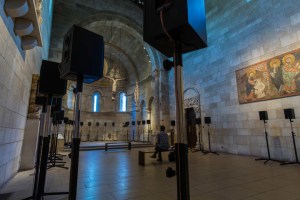
This week, several parishioners and I embarked on a “mini-pilgrimage” to the Cloisters in the City.  Though I loved many parts of the Cloisters, I found that I was most drawn to a sound installation by Janet Cardiff of The Forty Part Motet.  Cardiff positioned forty high-fidelity speakers on stands in a large oval in the middle of the Fuentidueña Chapel.  The motet is a reworking of the forty-part motet Spem in alium (which translates as “In No Other Is My Hope,”) by Thomas Tallis.  One part is played in each speaker in the room, and if you stand in the center and close your eyes, you can almost imagine yourself sitting in the chancel of a Cathedral listening to those beautiful voices.  And because the speakers are setup in the Chapel, which features the late twelfth-century apse from the church of San Martín at Fuentidueña, near Segovia, Spain, you really can transport yourself into sacred beauty of the music.

Part of what I loved about the installation was the way in which it froze me in my path.  No longer was I ready to hustle through the exhibits – instead I was transfixed in one place, just listening.  And even more strange was that I was not the only one – the whole room was filled with people just standing and listening to the incredible sound.  I was fascinated by the way such beautiful music held us captive, arresting our attention.

As I venture into Advent, I wonder how we might hold on to that sense of arrested attention on God.  Advent is a season often co-opted by the world around us.  I can count countless secular things that send us into a flurry – buying gifts, decorating houses, hosting and attending parties, and generally running around chaotically.  But our sacred worlds can keep us just as busy.  I know that in our parish during the month of December we have an Annual Meeting, a Bishop’s Visit, our 50th Anniversary Gala, the decorating our church with greens, and the flurry of Christmas worship services.

Our invitation this week might be to find small ways to commit arrested attention to God.  Maybe our way will be simply stopping for a prayer.  Maybe our way will be dropping everything we had planned and stopping to visit with an elderly person, with someone who is sick, or with a child.  Or maybe it is a more intentional commitment to being fully present wherever you are – putting aside the other forty things that also need to be done immediately, and just giving yourself over to the task or experience at hand fully.  If we can isolate our attention, and arrest our harried selves, maybe we can find our way back to the God who loves us and simply wants a bit of our arrested attention too.

Recent Posts

  • On the Myth and Magic of Advent…
  • On Risking Failure and Facing Fear…
  • Sermon – Luke 23.33-43, P29, YC, November 23, 2025
  • On Inhabiting Gratitude…
  • Sermon – Luke 20.27-38, P27, YC, November 9, 2025

Archives

  • December 2025
  • November 2025
  • October 2025
  • September 2025
  • August 2025
  • July 2025
  • June 2025
  • March 2025
  • February 2025
  • December 2024
  • November 2024
  • October 2024
  • September 2024
  • August 2024
  • July 2024
  • June 2024
  • May 2024
  • March 2024
  • February 2024
  • January 2024
  • December 2023
  • November 2023
  • October 2023
  • September 2023
  • August 2023
  • July 2023
  • June 2023
  • May 2023
  • March 2023
  • February 2023
  • January 2023
  • December 2022
  • November 2022
  • October 2022
  • June 2022
  • May 2022
  • January 2022
  • December 2021
  • November 2021
  • October 2021
  • September 2021
  • August 2021
  • June 2021
  • May 2021
  • April 2021
  • March 2021
  • February 2021
  • January 2021
  • December 2020
  • November 2020
  • October 2020
  • September 2020
  • August 2020
  • July 2020
  • June 2020
  • May 2020
  • April 2020
  • March 2020
  • February 2020
  • January 2020
  • December 2019
  • November 2019
  • October 2019
  • September 2019
  • August 2019
  • July 2019
  • June 2019
  • May 2019
  • April 2019
  • March 2019
  • February 2019
  • January 2019
  • December 2018
  • November 2018
  • October 2018
  • September 2018
  • August 2018
  • July 2018
  • June 2018
  • May 2018
  • April 2018
  • March 2018
  • February 2018
  • January 2018
  • December 2017
  • November 2017
  • October 2017
  • September 2017
  • August 2017
  • July 2017
  • June 2017
  • May 2017
  • April 2017
  • March 2017
  • February 2017
  • January 2017
  • December 2016
  • November 2016
  • October 2016
  • September 2016
  • August 2016
  • July 2016
  • June 2016
  • May 2016
  • April 2016
  • March 2016
  • February 2016
  • January 2016
  • December 2015
  • November 2015
  • October 2015
  • September 2015
  • August 2015
  • July 2015
  • June 2015
  • May 2015
  • April 2015
  • March 2015
  • February 2015
  • January 2015
  • December 2014
  • November 2014
  • October 2014
  • September 2014
  • August 2014
  • July 2014
  • June 2014
  • April 2014
  • March 2014
  • February 2014
  • January 2014
  • December 2013
  • November 2013
  • October 2013
  • September 2013
  • August 2013
  • July 2013
  • June 2013
  • May 2013
  • April 2013
  • March 2013
  • February 2013
  • January 2013
  • December 2012
  • November 2012
  • October 2012
  • September 2012

Categories

  • reflection
  • Sermons
  • Uncategorized

Meta

  • Create account
  • Log in
  • Entries feed
  • Comments feed
  • WordPress.com

Blog at WordPress.com.

  • Subscribe Subscribed
    • Seeking and Serving
    • Join 394 other subscribers
    • Already have a WordPress.com account? Log in now.
    • Seeking and Serving
    • Subscribe Subscribed
    • Sign up
    • Log in
    • Report this content
    • View site in Reader
    • Manage subscriptions
    • Collapse this bar
 

Loading Comments...