• About

Seeking and Serving

~ seek and serve Christ in all persons

Seeking and Serving

Tag Archives: connection

Sermon – Mark 5.21-43, P8, YB, July 1, 2018

04 Wednesday Jul 2018

Posted by jandrewsweckerly in Sermons, Uncategorized

≈ Leave a comment

Tags

connection, intimacy, Jairus, Jesus, Mark, need, power, relationship, Sermon, story, storytelling, woman

I once had a parishioner who was both the best and the worst storyteller.  He was the best because his stories were always fascinating, funny, and fantastic.  Not only did he have an intriguing life, he also just had a real gift for telling stories in ways that brought them to life in your mind’s eye.  But he was also not the best storyteller because he was easily distracted.  He would be in the middle of a story and then veer off course, “Which reminds me of the time…” he would say, and off he would go.  Sometimes he would go back to the other story, but you had to really pay attention to remind him of where he had started.  Sometimes the dropped ending on a story would come back to me days later and I would wonder, “I wonder what happened after he dropped that note to his secret love…”

Mark’s storytelling today is a bit like that parishioner’s way of telling stories.  After the fantastic stories of the calming of the sea, and the healing of a demon-possessed man, Mark tells us of Jesus’ next dramatic moment.  Jairus approaches Jesus and falls at Jesus’ feet, begging him to heal his dying twelve-year old daughter.  This whole event is a big deal because if you remember, many of the other synagogue leaders were suspicious of Jesus, and even plotting against him.  For a synagogue leader to approach Jesus for help is a huge break in rank.  Jesus goes with Jairus without comment, but before we can find out what happens, Mark basically says, “Speaking of which, there was this woman who approached Jesus without Jesus knowing.  You won’t believe what happened…”  And off Mark goes telling another fantastic story.

This time, we learn of a woman who is a total outcast.  She has been hemorrhaging for twelve years, she is destitute because she has spent all her money on doctors – to no avail, and let’s not forget she is a woman.  We can almost imagine the clandestine approach of this triple outcast weaving her way into the crowd just to touch Jesus’ garment.  To her credit, the simple touch works!  Now, the story really could end there, but Mark tells us something even more fascinating – Jesus stops dead in his tracks, demanding to know who touched him.  In a crowd of thousands, he wants to know which person touched him?!?  The woman comes forward for what should be a great castigation and humiliation.  Instead, her honesty and vulnerability open Jesus up to giving even more blessing.  Not only has her faith in him made her well, he offers her the peace, health, and wholeness that will allow her full integration back into society – a double gift!

Now the good news is that Mark is not as bad of a storyteller as my former parishioner.  Mark jumps back to Jairus’ story – but the news is bad.  The daughter has died!  Everyone thinks the cause is lost, but Jesus encourages Jairus to believe.  So off they go, but this time with only Peter, James, and John.  The gathered crowd mocks Jesus’ assertion that the girl is just sleeping.  But when the six of them go in, Jesus quite simply takes her by the hand, calls the girl to get up, and then asks them to give her some food – dying can really take a toll after all!

You might be shaking your head at Mark at this point, wondering if we can’t just focus on one of these stories – truly either is powerful enough on its own.  But Mark is not really like my former parishioner – he does not simply tell stories because he is good at telling stories, or because he likes to entertain guests.  In fact, Mark does this more than once in his gospel.  The biblical critics call this practice “intercalation,” but many people just call this a Markan sandwich.[i]  As N.T. Wright explains, by sandwiching the stories together, “The flavour of the outer story adds zest to the inner one; the taste of the inner one is meant in turn to permeate the outer one.”[ii]

So what do we learn about Jesus through Mark’s sandwiching these stories together?  Well, let’s start with how they are different.  Jairus is an insider – as a male synagogue leader, he is well-known and respected in the community, presumably with some power and influence.[iii]  Meanwhile, the bleeding woman is an outsider – a female, impure, impoverished outcast.[iv]  Jairus publicly invites Jesus to touch his dying daughter; the woman secretly touches Jesus’ cloak herself.  Jairus’ daughter is just a girl, but the woman has lived a longer life.  More interesting though is how the two stories are alike.  Both Jairus and the woman kneel before Jesus.  “Both victims of illness are female and ritually unclean, one as a result of death and one as a result of hemorrhage; both represent the significance of the number twelve in Jewish tradition (the twelve years of hemorrhage and the twelve-year old girl); and both are regarded as ‘daughters’ (the little girl being Jairus’s daughter and the woman who is addressed by Jesus as ‘Daughter’).  An act of touch restores both women to new life even as those surrounding them lack understanding.”[v]

Mark uses these two stories together because we need their differences and similarities to teach us something about Jesus and about ourselves.  We learn from Mark’s sandwich that Jesus is present with both the powerful and the powerless alike.  Both requests, despite the baggage both a synagogue leader and an impure woman bring, are honored by Jesus.  What we note though is Jesus tends the woman first.  Now some scholars might argue the pause in the story, and the death of the girl before Jesus gets there, are meant to build suspense.[vi]  But equally important is that Jesus stops for the person without power first[vii] – even taking precious time to not just heal her but demand to be in conversation and relationship with her.  He could have kept walking, knowing that his power had flowed out but staying the course with the good deed he was about to perform.  But instead, he stops everything, everyone, and demands a connection – one that leads not just to healing but total restoration within the community – shalom.[viii]  Jesus also shows us about the wideness of family.  A few weeks ago, we read the gospel lesson where Jesus questioned the crowd about who his mother and brothers and sister were.  Today he keeps expanding the circle.  The powerful and persecuting are his family; the most ostracized outcasts are his family; even the vulnerable children are his family.  Finally, Jesus teaches us that healing or the good works we do are meant to be within the context of relationship.  That Jesus tends the bleeding woman and the young girl is much less important than how he tends the two females.  Jesus’ help is not about an impersonal exchange – a few coins dropped in a hat or a check written to a charity – though those are necessary too.  Equally important to dropping a coin in a hat might be stopping to talk to the person asking for a handout.  In addition to contributing to a favorite charity, knowing the stories of specific clients is equally important.

What is hidden in these two tales about Jesus is the “flash of precious intimacy between two human beings who are socially very distant from each other.”  As one scholar explains, what Jesus brings alive for us today is “Our relationships – in the church, in friendships, and in marriage – are not just something extra added on to life for distraction and entertainment, as if we would be complete human beings in individual isolation.  Relationship, ‘touch,’ if you will, makes us human and whole.  As the contemporary Scottish philosopher John Macmurray once phrased it, ‘I need “you” in order to be myself.’”[ix]  What Jesus’ actions and Mark’s adept way at combining stories do today is invite us to consider not what we do, but how we do what we do.  Jesus invites us to slow down – to take those moments when someone’s pain is presented to us, and not just offer help, but stop long enough to make a connection – to develop intimacy with others.  “A teacher once remarked, ‘You know…my whole life I have been complaining that my work was constantly interrupted, until I discovered that my interruptions were my work.’”[x]  Jesus also invites us to care for everyone – rich, poor, young, and old – but he especially wants us to start with those most in need.  Finally, Jesus invites us today to see, really see, where people are, and to be a people of compassion, healing, and love.  Before you know it, you may be the one at coffee hour, veering off one story to tell yet another story, all highlighting the wonderful, lifegiving, challenging ways that stepping into relationship with others has changed your walk with Jesus.  I can’t wait to try to track your stories!  Amen.

[i] Karoline Lewis, “A Lesson from Mark,” June 25, 2018, as found at http://www.workingpreacher.org/craft.aspx?post=5184 on June 28, 2018.

[ii] N.T. Wright, Mark for Everyone (Louisville:  Westminster John Knox Press, 2004), 58.

[iii] Efrain Agosto, “Exegetical Perspective,” Feasting on the Word, Yr. B, Vol. 3 (Louisville:  Westminster John Knox Press, 2009), 189.

[iv] John R. Donahue, S.J. and Daniel J. Harrington, S.J., The Gospel of Mark, Sacra Pagina Series, vol. 2 (Collegeville:  The Liturgical Press, 2002), 174.

[v] Beverly Zink-Sawyer, “Homiletical Perspective,” Feasting on the Word, Yr. B, Vol. 3 (Louisville:  Westminster John Knox Press, 2009), 191.

[vi] Lamar Williamson, Jr., Mark, Interpretation:  A Bible Commentary for Teaching and Preaching (Louisville:  Westminster John Knox Press, 1983), 108.

[vii] Mark D. W. Edington, “Theological Perspective,” Feasting on the Word, Yr. B, Vol. 3 (Louisville:  Westminster John Knox Press, 2009), 192.

[viii] Williamson, 109.

[ix] Michael L. Lindvall, “Pastoral Perspective,” Feasting on the Word, Yr. B, Vol. 3 (Louisville:  Westminster John Knox Press, 2009), 192.

[x] Williamson, 112 (quoting Henri J.M. Nouwen, Reaching Out, p. 36).

On Prayer and Connection…

07 Wednesday Mar 2018

Posted by jandrewsweckerly in Uncategorized

≈ Leave a comment

Tags

church, community, connection, God, intentional, petitions, practice, prayer, worthy

39753-women-praying-1200.1200w.tn

Photo credit:  https://www.crosswalk.com/slideshows/10-issues-your-church-should-be-praying-together-about.html

When I was in college, I was involved in the Wesley Fellowship, the United Methodist Campus Ministry.  We gathered every Sunday night for fellowship, a program, and worship.  One of the student leadership roles was the “student pastor” – basically a student who volunteered to be a pastoral presence in the community.  One of the student pastors during my time in Wesley would always carry a small notebook to our Sunday gatherings.  When we got to the time of open prayer requests during worship, he would write notes in his notebook.  Initially, the practice struck me as odd.  What was he writing?  What did he do with those notes?  Assuming he used the notes for his personal prayers that week, did he use them as a checklist?  I never got up the courage to ask any of my questions, so I was left with a bit of skepticism and suspicion.  But also, a little bit of hope – even if he did not use the notes for his prayer life, at least whatever requests were mentioned seemed worthy of his writing them down.

This Lent, I realized that I have basically and unintentionally started doing something similar.  We are trying a new ministry this year at Hickory Neck where each week, 3-6 parishioners or parish families received a postcard from the clergy.  The postcard basically says “I am praying for you this week, and if you want to talk or have coffee, I would love to meet with you.”  Knowing how caught up in the busyness of life I can get, I decided to put the names of those for whom I am praying as an appointment on my calendar.  Everyday, I get a little ping on my phone, reminding me to pray for a specific set of people.  Meanwhile, our church is also hosting a Facebook Live broadcast of compline, or evening prayers, once a week.  In the morning, we put a post on our page, asking for prayer requests, and during the broadcast, people can also submit requests through the website.  This week, I have been using those petitions as another addition to my metaphorical prayer journal.

What I am learning from the two practices, and also incorporating into my prayer life in general, is a more intentional practice of prayer.  When a parishioner tells me about a concern during coffee hour, or when someone drops by my office with a concern, instead of just praying for those concerns as they come in, I incorporate them into my prayers throughout that week.  These practices are having the consequence of making me feel much more connected with my faith community, with the community beyond our church, and with God.  What are some of the practices you have picked up lately – intentional or not – that have brought you closer to God, the church, and the community?  Is there some small change you can make in your daily routine that might help you strengthen those connections?  I look forward to hearing your reflections.


On Presumed Barriers…

31 Wednesday May 2017

Posted by jandrewsweckerly in Uncategorized

≈ Leave a comment

Tags

barriers, communicate, community, connect, connection, different, Holy Spirit, languages, Pentecost, united

Pentecost Languages

Photo credit:  https://www.pinterest.com/dcntgirl/pentecost-sunday/

Most of my travels have been to places where I knew or was learning the language.  And if I did not know the language, a few team members did, so we were able to communicate in at least a basic way.  The exception to that pattern was my trip to Myanmar.  There were eight of us on the team, and none of us spoke Burmese.  Most of the time, that was not a problem because we had a local translator.  But on our first Sunday, we were divided into groups and sent to Anglican churches.  When my partner and I sat down, we were handed a prayer book and a hymnal (familiar accoutrements for Episcopalians).  We even had parishioners nearby who would help us find the page we were on during the service.  But the prayer books and hymnals were completely in Burmese – a very pretty language to look at, but completely indecipherable to an English-speaking American.

So we did all we could do.  We smiled and nodded as others helped us.  We sat and stood as others sat and stood.  We closed our eyes when it was obvious we were praying.  We knew when the sermon was being delivered, even if we couldn’t understand it.  But my favorite part came about two-thirds of the way through the service.  One of the hymns was announced.  We stood up with everyone else and prepared to stand silently again.  Then all of a sudden, the people were singing a tune we knew.  All of the tension and anxiety in my body melted away as a broad smile crossed my face.  I quietly sang the words I could remember in English.  Finally, I felt like a full participant in the body as we worshiped.

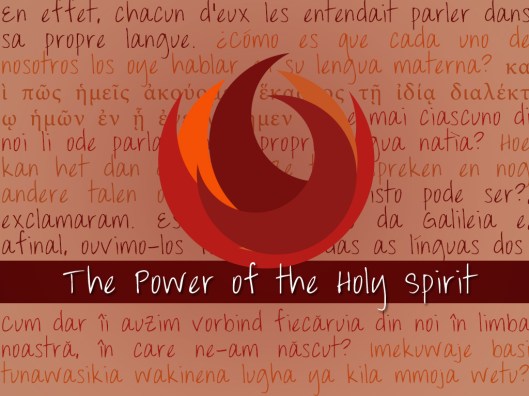
This Sunday, we will celebrate Pentecost.  Even though we will be experimenting with using foreign languages at Hickory Neck, I am not sure we will ever grasp the fullness of that first Pentecost experience – the chaos of languages, and yet the clarity of understanding by each in their own tongue.  But what I hope we get a small taste of is the experience of being united by the Holy Spirit.  That Sunday in Myanmar was a bit like that first experience with the Holy Spirit.  In the desire to connect, communicate, and create community, we were able to do that through the power of song.  On this coming Sunday, we will do that through the written word in our native tongues.  What I hope the day challenges us to do going forward is to seek ways to find common languages – to connect, communicate, and create community with people who are unlike us.  Whether they speak another language, hold another faith, are of a different race or socioeconomic class, there are “languages” that can create barriers to true connection.  I suspect the Holy Spirit is with us when we are willing to work through the barriers.  And if my experience in Myanmar gives any clue, the Holy Spirit will work its magic to help us connect, communicate, and create community.  Then our work really begins.

On Roots and Relationships…

25 Wednesday Jan 2017

Posted by jandrewsweckerly in Uncategorized

≈ Leave a comment

Tags

connection, God, Jesus, parable, relationship, roots, strength, tree, weeds, wheat, yoga

ficus_roots_tree

Photo credit:  www.arborcentre.co.uk/tree-root-subsidence-damage.html

I recently started a new yoga class.  Over the years I have learned that every yoga teacher has their own language and philosophy about the practice.  I had a teacher who used to tell us that when we are feeling discomfort, we shouldn’t label it as “pain” but “awareness.”  We had tons of fun talking about how much awareness I was having as I labored with my first child.  I had another teacher who was also a priest.  Instead of saying that he honored the “light” in each of us, he would say, “I honor the Christ in each of you.”  Anytime a teacher talks about honoring the light in me now, my brain automatically translates it to “Christ.”

This new teacher has added another phrase to my list of favorites – an image, actually.  Like many other teachers, when we practice “tree” pose she has us imagine our legs as having roots that extend deeply into the earth, grounding us.  But she added another element to that image.  As we stood there – young, old, black, white, small, and large – she asked us to imagine our roots intermingling with one another’s roots.  She went on to explain how we are stronger with our interwoven roots than we are on our own.  I immediately regarded the people in that room differently – wondering what their stories were, what brought them to that room, and what about our differences and similarities might make us stronger – what might make our community stronger.

I left that room feeling a sense of embrace and comradery.  I felt the power of all the students in the class carrying me through the day.  But in the weeks since then, and especially in light of our current political climate, I have found myself wondering what it might mean that my roots are interwoven with those who are not like me at all.  What if my roots are tied in with those who disagree with me, who marginalize those I support, and who seem to be working against what I stand for?

The realization reminded me of Jesus’ parable of the weeds (Matthew 13.24-30).  A man sows good seed in his field, but in the night, an enemy sows weeds among the good seed.  The man’s workers want to know if they should pull the weeds, but the farmer knows pulling the weeds will destroy the wheat.  So they must wait until the harvest time to separate the good from the evil.  Now, before you go too far, thinking you know who are the wheat and the weeds, two things.  First, it is God who makes those judgments in the parable.  But second, the wheat cannot survive without the weeds among it.  You might imagine the wheat tolerates the weeds, but I wonder if the weeds make the wheat better – challenge the wheat to be wise, discerning, and strong.  And perhaps the wheat encourages the weeds to do likewise.  I think my yogi’s description of intertwining roots applies.  We are stronger tied together than trying to remove ourselves or ignore the roots around us.  My prayer for us this week is that we start looking at the diversity of our intertwined roots and work toward engagement, discernment, and relationship – instead of hacking away at roots that might be our own.

Come and See!

11 Wednesday Jan 2017

Posted by jandrewsweckerly in Uncategorized

≈ Leave a comment

Tags

church, come, community, connection, gospel, internet, isolation, Jesus, physical, prayer, see, snow, virtual

This past weekend, Williamsburg was hit with over a foot of snow.  Living in an area without many plows, and serving in a church without a Rectory on the campus, I knew that Sunday services at Hickory Neck would be nearly impossible.  Our parking lot did not get plowed until early Monday morning, and many of our parishioners live on rural roads.  With great disappointment, I cancelled all Sunday services.  But then my husband turned to me with a twinkle in his eye and said, “You should lead Morning Prayer on Facebook Live!”

That night I put together a video to tell people what we were going to do and where they should go to join me in worship.  And on Sunday morning, at 10:00 am, I went live.  By the time we had finished, there were over 60 views.  By the time we got to the end of the day, there were over 300 views.  By Tuesday night, there were over 700 views.  The positive feedback poured in – from our parishioners, from their neighbors, and from dozens of people who were snowed in all up and down the Atlantic coast.

As I have thought about the experience, I realized what a gift technology can be.  Isolated in homes, people were able to come together and pray the same prayers, hear the same readings, confess our sins, lift up our intercessions and thanksgivings, and give glory to God.  So often we talk about the challenge of the church is being tied to the walls of the physical building, not taking the Gospel out in the world.  Our experience on Facebook felt like a little way of getting ourselves out in the world, and sharing the beauty of worship in virtual community.

Of course, I don’t think church can always be expressed in virtual ways.  Being physically present with one another allows us to engage all our senses, to read the body language of someone who is suffering or experiencing joy, and to engage in the holy meal that brings us together despite our divisions.  But the experience certainly made me realize that we can supplement that communal physical experience with communal virtual experiences.  And once you show your neighbor that cool video from your church, then, like Jesus in our Gospel lesson this coming Sunday, you can say, “Come and see!”[i]

come-see

Photo credit:  https://www.queertheology.com/john-1-29-42


[i] John 1.39.

God and cell phones…

03 Wednesday Dec 2014

Posted by jandrewsweckerly in Uncategorized

≈ Leave a comment

Tags

Advent, connection, disconnected, God, prayer, relationship, technology

To see me now, you might not guess the initial reluctance I experienced with using a cell phone.  My progress was slow from owning one at all, to learning to text, to using a smart phone, to now using my agile phone.  Part of my reluctance was what such usage would mean – being able to be reached at all times; work emails invading “down time,” making me feel like I am never truly off; decreased patience with others who are not as technologically savvy; and constant usage for everyday needs.  I still try to resist looking at my phone constantly – I put it down during dinner time, I try not to respond to emails on my day off, I sometimes wait to look up something until I am at my computer.  But I still have those moments when my daughter impatiently waits while I finish one quick text or email to someone.  Though I ask her to hold on while I finish, I worry that I am becoming what I feared.

But there are also days when I am really grateful for my phone.  I currently have a parishioner who in the last stages of life.  The family and I know that the parishioner could go at any time, and so we are keep watch, spending time together, and holding each other in prayer.  I am keeping my phone especially close, checking for texted updates or for the dreaded call.  I even keep my phone on my nightstand in case I need to run to the hospital overnight.  That may sound unpleasant to some, but what I have come to see these last few weeks is that my phone is becoming not just a tool for pastoral care (a way for parishioners to reach me for emergencies), but it is also becoming a tool for my prayer life.  When I check my phone and there are no messages about this parishioner, I use the moment as a reminder to pray – pray for the parishioner, the parishioner’s family, and talk with God about the hard stuff of life.  Who would have thought that this little phone – a thing which I had once associated with menace, annoyance, and disconnectedness – could also be a tool for deep connection, prayer, and blessing?

Courtesy of http://episcopaldigitalnetwork.com/ens/2014/11/12/anglicans-invited-to-celebrate-advent-using-your-camera-phones/

Courtesy of http://episcopaldigitalnetwork.com/ens/2014/11/12/anglicans-invited-to-celebrate-advent-using-your-camera-phones/ Check out their website for a concrete way of using technology this Advent!

What I love about this tiny revelation is that it points to a larger truth.  God is constantly working through us in the current age.  It may sound silly, but I think God can work through our technology – through my little cell phone – for good, inviting me back into relationship with God, and working through it to connect us to one another.  The trick is keeping a watchful eye for God when it could otherwise be easy to miss God.  Of course, that is not a new problem.  God has been inviting God’s people into relationship from the beginning of time – and we have regularly been resistant.  The trick for staying connected is finding those things that help us return to the LORD:  whether it is a cell phone, a strategically placed Prayer Book that reminds us to pray, a set of prayer beads that you keep in your pocket, or a regular commitment to church attendance.  I wonder what things in your life might be repurposed to help you reconnect with the holy this week.


Newer posts →

Recent Posts

  • On the Myth and Magic of Advent…
  • On Risking Failure and Facing Fear…
  • Sermon – Luke 23.33-43, P29, YC, November 23, 2025
  • On Inhabiting Gratitude…
  • Sermon – Luke 20.27-38, P27, YC, November 9, 2025

Archives

  • December 2025
  • November 2025
  • October 2025
  • September 2025
  • August 2025
  • July 2025
  • June 2025
  • March 2025
  • February 2025
  • December 2024
  • November 2024
  • October 2024
  • September 2024
  • August 2024
  • July 2024
  • June 2024
  • May 2024
  • March 2024
  • February 2024
  • January 2024
  • December 2023
  • November 2023
  • October 2023
  • September 2023
  • August 2023
  • July 2023
  • June 2023
  • May 2023
  • March 2023
  • February 2023
  • January 2023
  • December 2022
  • November 2022
  • October 2022
  • June 2022
  • May 2022
  • January 2022
  • December 2021
  • November 2021
  • October 2021
  • September 2021
  • August 2021
  • June 2021
  • May 2021
  • April 2021
  • March 2021
  • February 2021
  • January 2021
  • December 2020
  • November 2020
  • October 2020
  • September 2020
  • August 2020
  • July 2020
  • June 2020
  • May 2020
  • April 2020
  • March 2020
  • February 2020
  • January 2020
  • December 2019
  • November 2019
  • October 2019
  • September 2019
  • August 2019
  • July 2019
  • June 2019
  • May 2019
  • April 2019
  • March 2019
  • February 2019
  • January 2019
  • December 2018
  • November 2018
  • October 2018
  • September 2018
  • August 2018
  • July 2018
  • June 2018
  • May 2018
  • April 2018
  • March 2018
  • February 2018
  • January 2018
  • December 2017
  • November 2017
  • October 2017
  • September 2017
  • August 2017
  • July 2017
  • June 2017
  • May 2017
  • April 2017
  • March 2017
  • February 2017
  • January 2017
  • December 2016
  • November 2016
  • October 2016
  • September 2016
  • August 2016
  • July 2016
  • June 2016
  • May 2016
  • April 2016
  • March 2016
  • February 2016
  • January 2016
  • December 2015
  • November 2015
  • October 2015
  • September 2015
  • August 2015
  • July 2015
  • June 2015
  • May 2015
  • April 2015
  • March 2015
  • February 2015
  • January 2015
  • December 2014
  • November 2014
  • October 2014
  • September 2014
  • August 2014
  • July 2014
  • June 2014
  • April 2014
  • March 2014
  • February 2014
  • January 2014
  • December 2013
  • November 2013
  • October 2013
  • September 2013
  • August 2013
  • July 2013
  • June 2013
  • May 2013
  • April 2013
  • March 2013
  • February 2013
  • January 2013
  • December 2012
  • November 2012
  • October 2012
  • September 2012

Categories

  • reflection
  • Sermons
  • Uncategorized

Meta

  • Create account
  • Log in
  • Entries feed
  • Comments feed
  • WordPress.com

Blog at WordPress.com.

  • Subscribe Subscribed
    • Seeking and Serving
    • Join 394 other subscribers
    • Already have a WordPress.com account? Log in now.
    • Seeking and Serving
    • Subscribe Subscribed
    • Sign up
    • Log in
    • Report this content
    • View site in Reader
    • Manage subscriptions
    • Collapse this bar
 

Loading Comments...