• About

Seeking and Serving

~ seek and serve Christ in all persons

Seeking and Serving

Tag Archives: diverse

Sermon – John 17.20-26, E7, YC, May 28, 2022

01 Wednesday Jun 2022

Posted by jandrewsweckerly in Sermons

≈ Leave a comment

Tags

children, diverse, God, grief, gun control, I AM, Jesus, love, mass shooting, political, relationship, Sermon, unity, witness

On this last Sunday of Eastertide, we finally arrive at what is referred to as the High Priestly Prayer in John’s Gospel.  We have heard the stories about the empty tomb, Jesus’ appearances to the disciples, stories about how they are to be a people of love, and Jesus’ ascension into heaven.  As our final lesson, as is true for every seventh Sunday in Eastertide in the three-year lectionary cycle, we hear the final prayer Jesus says before his trial and crucifixion.  In this year’s section of the High Priestly Prayer, Jesus asks for one thing:  unity.  He prays the disciples and all the people who will become believers may be one.

As I have watched our country over the last week, we as Americans, and most definitely we as followers of Christ, have been showing anything BUT unity.  You would think a mass shooting of children would have brought us together.  And maybe for a moment, we were united in action – deep grief and despair at the loss of young life.  We all seem to be of one mind in one area only – that none of us wants our young school children to die.  But as soon as the tears subside and we open our mouths, any conversation about what our response should be sends us flying to opposite camps, no one staying in the same room to talk about a uniting action to protect life.

I have always been so very proud of the ways that Hickory Neck is a place where people of all political persuasions gather at a common table.  You only need to take a look around the bumper stickers in the parking lot to know we are not of one mind when talking politics.  But we are of one mind about Jesus – and so we sit next to people who likely voted for a different political candidate than we did, we pray next to people who go to opposite rallies than we do, and we kneel at the altar rail, rubbing elbows with someone who we, outside of church, might refer to as “those people.”  I cannot tell you the number of people who have asked me, “How in the world can you do that?  How do you even preach the gospel in such a diverse room?”  Usually my answer is pretty simple – we focus on what unites us – the one thing we all long for:  a place at the Table where all are welcome.

Now, I say that all that time, and usually people leave me alone about that answer.  But I think secretly, they are thinking, “Ok!  That sounds all well and good but just wait – there is no way you can keep up that ruse.  Something is going to give!”  And in many ways, they are right.  We live and witness in a precarious reality.  That’s why I think what Jesus does in this prayer today is so very important.  We often define “unity” as everyone being of the same mind.  But that is not what Jesus means in John’s gospel.  As scholar Karoline Lewis explains, “Their unity is not a made-up concept but is based on the unity between the Father and the Son.  Answering the question of what this unity looks like gives us the definition of what unity is.  For this Gospel, unity with God means making God known.  [Unity] means being the ‘I AM’ in the world.  [Unity] means knowing that, in the midst of all that would seek to undermine that unity, you are at the bosom of the Father.”[i]

So how can we be the “I AM” in the world?  What does being at the bosom of the Father look like when we all want to protect life but cannot seem to find a way forward?  Scholar Meda Stamper qualifies that unity comes through love.  She says, “This love clearly cannot depend on feelings of attraction, desire, affection or even liking.  [Love] is a behavior-shaping attitude toward the world, which is both a gift we cannot manufacture and a choice to live into the promises of that gift that is already given.  We cannot paste [love] onto ourselves.  Like branches of a vine, we live in something larger than ourselves, in which we are nurtured to bear fruit by the Spirit dwelling in us (about which we read in the Pentecost passage for next week).  But because we are more than vines, we also become more loving by choosing to follow Jesus’ model and teachings (13:14-15) about what love is: tending, feeding, bearing witness, and breaking barriers for love—societal barriers and also barriers we set up for ourselves, including some that we may think make us rightly religious but which do not make us loving.”[ii]

The way forward to be a people of unity through love starts here at Hickory Neck.  We certainly have taken the first step by assembling a group of people who are united in relationship with God even though we are not united in political persuasion.  But that is the tremendous blessing:  we have a place to start.  The only way we are ever going to make our way to the unity Jesus wants for us is to gather in our dis-unity and find a way forward through our relationships.  The reason we are facing a carbon copy of Sandy Hook ten years later is because we never sat down with people of a different mind about gun control.  We simply did what we always do – we divided into camps about the right solution, and then locked horns in a stalemate that led to little change.  Our gospel this Sunday invites us into a different way.  Our gospel invites us into true unity through our relationship with God and one another.  Only when we agree to not just rub elbows at the altar rail, but also rub elbows at houses of legislature will we find a way of tangibly witnessing the love of Jesus  – so that we are one as the Father and Son are one.  Amen.


[i] Karoline Lewis, John: Fortress Biblical Preaching Commentaries (Minneapolis:  Fortress Press, 2014), 213.

[ii] Meda Stamper, “Commentary on John 17:20-26,” May 29, 2022, as found at https://www.workingpreacher.org/commentaries/revised-common-lectionary/seventh-sunday-of-easter-3/commentary-on-john-1720-26-5 on May 27, 2022.
The Pilgrim’s Way…Day 8

14 Friday Feb 2020

Posted by jandrewsweckerly in Uncategorized

≈ Leave a comment

Tags

beginning, canticles, Christ, diverse, end, evensong, God, grow, Holy Spirit, longing, pilgrimage, prayers, question, songs, stories, variety, wandering, Westminster Abbey

84540568_2896312937091614_6368332770682339328_n

Photo credit:  Jennifer Andrews-Weckerly; reuse with permission only

Sixteen pilgrims from Hickory Neck Church traveled to England for 8 days of pilgrimage.  Our focus was on choral music, hearing Evensong or Choral Mass at a Cathedral, Minster, or college everyday.  This is the last entry, initially posted on our church Facebook page.  For those of you who do not follow us on Facebook, I am repeating the journey’s daily entries here.  Enjoy!

London – Westminster Abbey

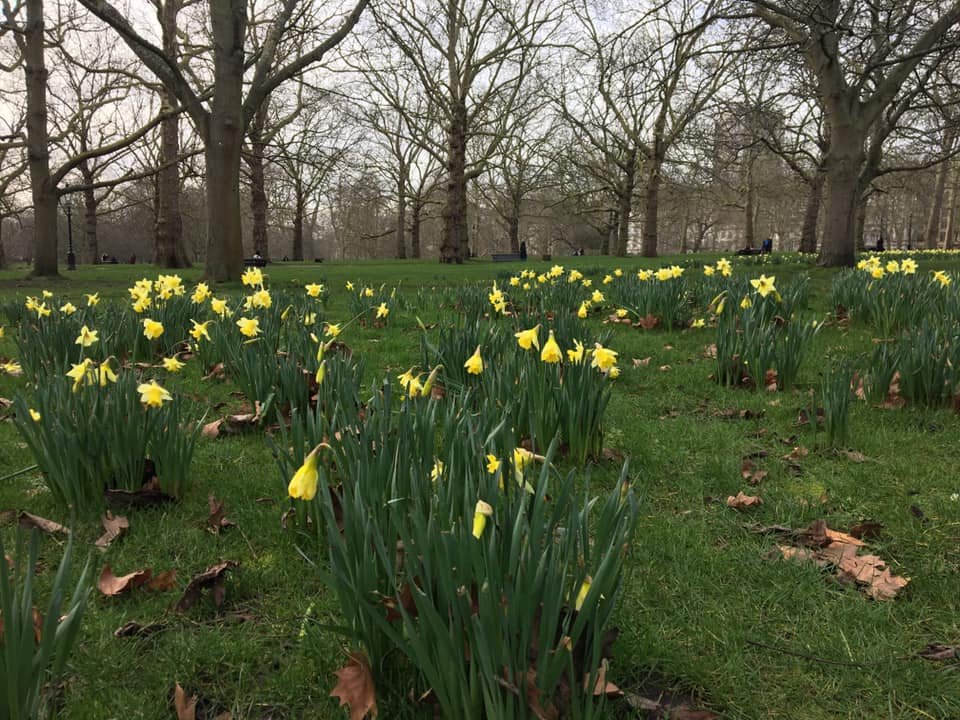
The full last day of our pilgrimage was a free day until Evensong. What was fascinating was how varied our experiences were. Some pilgrims chose museums, some did tours of government-related buildings (historic and modern), some did touristy things, and some rested or visited local friends. I was surprised by the limited overlap in our choices, and realized how diverse our interests really are.

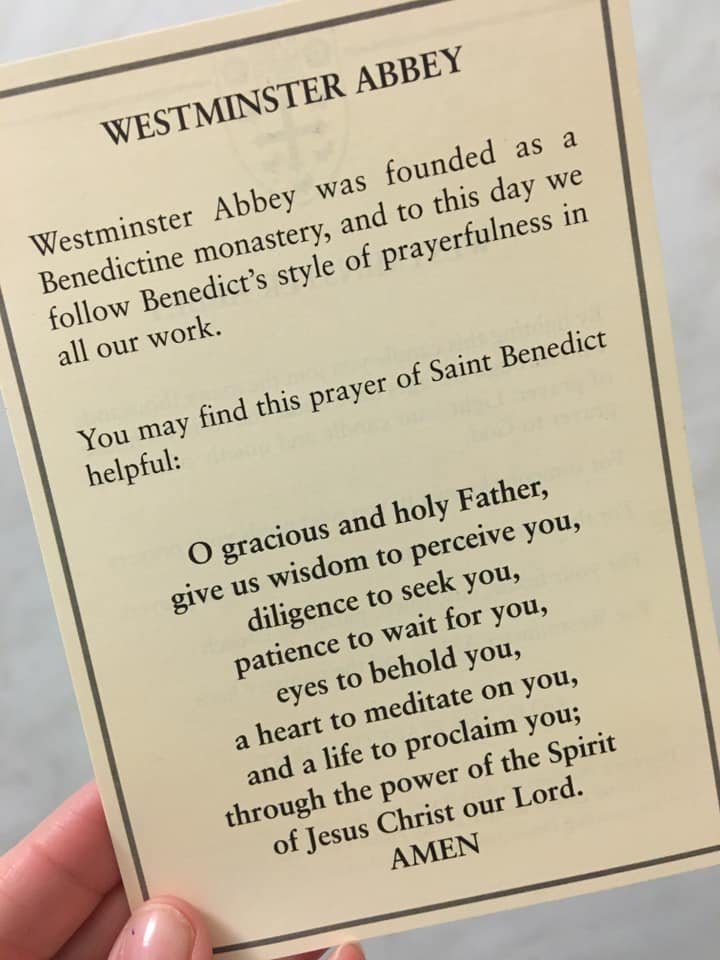
That is part of what has been so beautiful about this experience. We represent a variety of ages and phases of life, backgrounds, and spiritual journeys. And yet, we all had a longing for something – a desire to know God more fully, to walk with Christ more intentionally, and experience the Holy Spirit more playfully. The commonality in our diversity made Evensong even more beautiful tonight. We gathered back in from our wandering and settled into the prayers, canticles, and songs that have rooted us this entire pilgrimage. As the boys and men artfully played one another’s voices against each other, sounds seemed to be all over the place, and yet majestically all together. Our journey mirrored the singing at Westminster Abbey in profound ways.

As we return from our pilgrimage, I encourage you to ask questions, to hear stories, and to grow with us. Our pilgrimage may feel like it is ending, but our pilgrimage is just beginning with you.

85023488_2896313000424941_3665780026227294208_n

Photo credit:  Jennifer Andrews-Weckerly; reuse with permission only

On Being an American and a Christian…

03 Wednesday Jul 2019

Posted by jandrewsweckerly in Uncategorized

≈ 3 Comments

Tags

American, asylum, baptism, children, Christian, complicated, Detention, diverse, faith, God, gospel, immigration, Jesus, politics

6d4151a40a463e26db746895528eb216

Photo credit:  https://www.pinterest.com/pin/439734351090290865/

Last week, several of the interfaith clergy in our community published a litany for children in detention centers.  They requested clergy leaders read the litany in their homes of worship – not in a special vigil, but in the heart of where weekly prayer and formation take place.  The litany was beautiful, and spoke to much of my own sense of despair about our treatment of children.  But I found myself in a quandary.  You see, my parish is a diverse one.  We pride ourselves on being Christians of varying political opinions who respect one another enough to honor our political differences by kneeling as equals at the Lord’s table.  In order to maintain that sense of respect, I am very careful about how I talk about current events.  My goal is always to preach the gospel of Jesus Christ, with the charge that we should engage in politics with the Gospel always in the forefront.

But the issue of children in detention centers tugs at me at two levels.  On the one hand, this is very much an issue of politics – of how we manage the flow of immigrants and those seeking asylum into our country.  I know our parishioners are of a divided mind on this issue – as is most of the country.  The issue of our borders is vastly layered – were it not so, there would be clear, easy answers to very difficult questions.  In addition to being a political, economical, sociological issue, this is a spiritual one as well.  One’s sense of gratitude for our country’s blessings, one’s baptismal covenant to respect the dignity of every human being, and one’s understanding of Christ’s command to love God and love neighbor collide with the realities of limited resources, stretched budgets, and funding priorities.

On the other hand, these are children.  These are eight-year-olds caring for unrelated infants.  These are nursing teen mothers with no diapers or place to lay their heads.  These are toddlers who have no way to wash their hands or clean their soiled clothing.  I look at my own children, who have every comfort they could ever need, and when I imagine them soiled, hungry, deprived of sleep, and so afraid that the color has drained from their faces, my heart shatters.  I know this issue is truly complicated, and I know that philosophically we as a country need to decide how we will manage the treatment of our neighbors.  But when I am hesitant to pray for the welfare of children in detention because it is politically complicated, I realize I am failing to live the Gospel life.

I cannot say I will ever be able to pray the litany presented by my interfaith brothers and sisters.  Though it is beautiful, it is also politically motivated.  But what I can tell you is, as a pastor and baptized child of God, I am praying for those children, praying for their mothers and fathers, and praying for our own souls as we figure out how to reckon politics and human dignity – how to be Americans and Christians.  Given our country’s history, it would seem those two things fit together easily.  But to be a good American and to be a good Christian both take intentionality, discernment, and prayer.  May God bless us all as we seek to harmonize the two.

Sermon – 1 Corinthians 12.1-11, EP2, YC, January 20, 2013

23 Wednesday Jan 2013

Posted by jandrewsweckerly in Uncategorized

≈ Leave a comment

Tags

church, Corinth, diverse, gifts, God, Sermon, spiritual gifts

About two thousand years ago, the Christian community that had formed in Corinth was a diverse group.  There were Greeks and Jews, slaves and free people, men and women, rich and poor.  Their only unifying tie was that they all confessed Jesus as Lord.  And like any good church, they were of a divided mind.  We learn from their correspondence with Paul, that they are particularly divided about what spiritual gifts are to be the most highly valued.  The running argument is that the gift of ecstatic speech is the most important, and those displaying that gift should be given higher importance in the community.[i]  Unable to settle this argument among themselves, they turn to Paul.

Unfortunately for those arguing for singling out the gifted, Paul proclaims a different reality – everyone is gifted.  Simply by proclaiming Jesus as Lord, each person is given a gift.  The gifts may be different, and there will be a diversity of gifts.  This diversity of gifts is necessary for the community, making the community richer and helping the community to see the fullness of God.

Paul’s explanation sounds lovely.  Everyone is special and everyone has gifts.  But truthfully, in the depths of our hearts, we do not really agree with Paul.  We have lived in a cutthroat, competitive world too long to know that not all gifts are really valued equally – not even in the Church.  Sure, some people are gifted teachers, or seem especially spiritual – but what we really need are people skilled in finances.  Or maybe we really value people who are wise or people who are good with technology.  Whatever the thing is that we value, the point is that we rank gifts.  And although we might not want to admit the fact, as modern Americans, we tend to roll our eyes at Paul, seeing his explanation on gifts as cute, but not really helpful if a church is going to succeed.

When I was in college I went to a multicultural church in a small city.  The church was primarily African-American and African, but several Anglos from the community and from the local college joined the dynamic parish.  As the parish grew, we often had conversations about what our diversity meant and how we would negotiate each others’ differences.  But one day, the pastor had an idea that he charged ahead with before really getting buy-in from the church.  He invited two local group homes to bring their residents to church on Sundays.  The residents had mental and physical disabilities, and many of them were in wheelchairs.  Some were more verbal than others, but many of those who were verbal could not form clear words.  You could tell right away that the church members were uncomfortable.  We did not know how to handle the outbursts or the behavior of the group home members.  Luckily, the pastor was much more generous than we were.  He noticed that the outbursts were not random.  In fact, sometimes a yell sounded a lot like an “Amen!”  And so in the church’s customary call-and-response format, the pastor engaged the group home members just like he did the rest of the church members.

That church learned relatively quickly what Paul was trying to teach the members of the church in Corinth.  Whereas the church in Corinth sees its own diversity and wants to begin ranking gifts, Paul is trying to explain that their diversity is their gift.  Every person in that community is needed to make the community whole.  The full range of gifts means that the community is richer and can live out the community’s call more fully.  Without the interpreter of tongues, the speaker of tongues is useless.  The healers heal the community.  The miracle workers help the community see God.  The prophets help send the people out beyond the community.  Only together can they live into the fullness of faith.  Each person is indeed gifted – but not for the sake of personal pride.  The gift’s purpose is to edify the entire community.[ii]

Furthermore, what Paul is also trying to explain is the gifts are not just for the person, or for the community.  The diversity of gifts tells them something about God.  The diversity of gifts gives the community a glimpse into the diversity of God.[iii]  Only when all those diverse gifts are being enfleshed does the community in Corinth begin to get a glimpse into the fullness of God.  Paul knows that understanding God fully is impossible – we are made in God’s image, but we are not God.  Only through the diversity of their diverse Corinth church, and through the diversity of their gifts, do they begin to see a glimpse of the diversity of God.

At that church in college, we had been pretty proud of ourselves.  We were a diverse parish in a community with a rough history of racial discrimination.  But those group home members made us realize we were still not living into the fullness of the body of Christ.  Without those group home members pushing us out of our comfort zone, we were keeping our identity within our own parameters, not God’s parameters.  Truthfully, the presence of the group home members made us wonder who else we were excluding.  We did not need long to look around our community and figure out who we had been excluding.  The apartment complex next to the church was clearly inhabited by many Hispanics, a group not present in our community.  Only once the group home members opened our eyes were we able to see how much we had been limiting God and how much richer we could be if we opened our doors to our neighbors.  One could argue that our group home members had the spiritual gift of prophesy.

So why is Paul’s letter so important to St. Margaret’s?  This past Wednesday, about eight St. Margaret’s parishioners went over to Plainview Reformed Church to make sandwiches for the INN.  Most of us had been there before, and we fell into a quick rhythm.  Some of us were good at scooping – which is a delicate skill because if you use too much, we cannot make enough sandwiches.  Some of us were good at spreading – an important skill if you do not want to tear the bread.  Others were good baggers.  Now bagging a sandwich may sound simple to you, but as the activity leaders kept reminding us, a sandwich bag that is messy on the inside or out sends the message that the sandwiches were made without much thought – or even without much love.  Even the youngest children who put stickers on the sandwich bags had an important role.  Without the sticker, the sandwich is just another sandwich.  With the sticker, the bag says that someone made this sandwich, and personalized the sandwich just for you – because you are special and worthy.  As that interfaith community gathered, with people of all ages, shapes, sizes, and abilities, we were a lot like that community in Corinth.

What Paul’s letter and our sandwich-making this week show us is that only when we all engage in ministry are we fully living into the life of faith.  Only when all our skills are being used are we even able to see a glimpse of the fullness of God.  Our invitations this week are several.  First, Paul invites us to discern our spiritual gifts.  Now, because you work in construction, you might have been roped into serving on the Buildings and Grounds Committee.  Or because you have young children, you might have been recruited to teach Sunday School.  But sometimes, what we do professionally does not translate to a spiritual gift.  Our best teachers, our wisest decision-makers, our most spiritual people of prayer might not do those things professionally or obviously.  Today Paul invites each of us to ponder whether we are using our spiritual gifts for the betterment of this community.  Second, Paul invites us to consider how each person here might help us to better see a glimpse of God.  That means that after church or during coffee hour, we might need to sit with someone we do not normally sit with and have a meaningful conversation.  And yes, you can have a meaningful conversation with a three-year old or a sixteen-year old.  Finally, Paul invites us to consider who is not here, helping us know God more deeply.  I have heard time and again how much we want to grow as a community.  For many of us, that desire is more out of a sense of preservation – we need to grow to continue to be a church here in Plainview.  But I wonder if we might instead begin to think of our growth as necessary for us to more fully see God.  We may know all sorts of people in our everyday lives who do not fit the St. Margaret’s mold.  Those are the people we need to invite to Church.  That neighbor you got to know when we all lost electricity during the Hurricane.  That woman with the purple hair who cuts your hair at the salon.  The waiter at your favorite restaurant who you have come to know.  Until we invite those people, we will not experience the fullness of God’s gifts for us.  The invitations from Paul today abound.  I look forward to hearing how your homework goes!  Amen.


[i] Karen Stokes, “Pastoral Perspective,” Feasting on the Word, Yr. C, Vol. 1 (Louisville: Westminster John Knox Press, 2009), 254.

[ii] Lee C. Barrett, “Theological Perspective,” Feasting on the Word, Yr. C, Vol. 1 (Louisville: Westminster John Knox Press, 2009), 256.

[iii] Troy Miller, “Exegetical Perspective,” Feasting on the Word, Yr. C, Vol. 1 (Louisville: Westminster John Knox Press, 2009), 257.

Recent Posts

  • On the Myth and Magic of Advent…
  • On Risking Failure and Facing Fear…
  • Sermon – Luke 23.33-43, P29, YC, November 23, 2025
  • On Inhabiting Gratitude…
  • Sermon – Luke 20.27-38, P27, YC, November 9, 2025

Archives

  • December 2025
  • November 2025
  • October 2025
  • September 2025
  • August 2025
  • July 2025
  • June 2025
  • March 2025
  • February 2025
  • December 2024
  • November 2024
  • October 2024
  • September 2024
  • August 2024
  • July 2024
  • June 2024
  • May 2024
  • March 2024
  • February 2024
  • January 2024
  • December 2023
  • November 2023
  • October 2023
  • September 2023
  • August 2023
  • July 2023
  • June 2023
  • May 2023
  • March 2023
  • February 2023
  • January 2023
  • December 2022
  • November 2022
  • October 2022
  • June 2022
  • May 2022
  • January 2022
  • December 2021
  • November 2021
  • October 2021
  • September 2021
  • August 2021
  • June 2021
  • May 2021
  • April 2021
  • March 2021
  • February 2021
  • January 2021
  • December 2020
  • November 2020
  • October 2020
  • September 2020
  • August 2020
  • July 2020
  • June 2020
  • May 2020
  • April 2020
  • March 2020
  • February 2020
  • January 2020
  • December 2019
  • November 2019
  • October 2019
  • September 2019
  • August 2019
  • July 2019
  • June 2019
  • May 2019
  • April 2019
  • March 2019
  • February 2019
  • January 2019
  • December 2018
  • November 2018
  • October 2018
  • September 2018
  • August 2018
  • July 2018
  • June 2018
  • May 2018
  • April 2018
  • March 2018
  • February 2018
  • January 2018
  • December 2017
  • November 2017
  • October 2017
  • September 2017
  • August 2017
  • July 2017
  • June 2017
  • May 2017
  • April 2017
  • March 2017
  • February 2017
  • January 2017
  • December 2016
  • November 2016
  • October 2016
  • September 2016
  • August 2016
  • July 2016
  • June 2016
  • May 2016
  • April 2016
  • March 2016
  • February 2016
  • January 2016
  • December 2015
  • November 2015
  • October 2015
  • September 2015
  • August 2015
  • July 2015
  • June 2015
  • May 2015
  • April 2015
  • March 2015
  • February 2015
  • January 2015
  • December 2014
  • November 2014
  • October 2014
  • September 2014
  • August 2014
  • July 2014
  • June 2014
  • April 2014
  • March 2014
  • February 2014
  • January 2014
  • December 2013
  • November 2013
  • October 2013
  • September 2013
  • August 2013
  • July 2013
  • June 2013
  • May 2013
  • April 2013
  • March 2013
  • February 2013
  • January 2013
  • December 2012
  • November 2012
  • October 2012
  • September 2012

Categories

  • reflection
  • Sermons
  • Uncategorized

Meta

  • Create account
  • Log in
  • Entries feed
  • Comments feed
  • WordPress.com

Blog at WordPress.com.

  • Subscribe Subscribed
    • Seeking and Serving
    • Join 394 other subscribers
    • Already have a WordPress.com account? Log in now.
    • Seeking and Serving
    • Subscribe Subscribed
    • Sign up
    • Log in
    • Report this content
    • View site in Reader
    • Manage subscriptions
    • Collapse this bar
 

Loading Comments...