
• About

Seeking and Serving

~ seek and serve Christ in all persons

Seeking and Serving

Tag Archives: feeding

Sermon – John 6.1-21, P12, YB, July 28, 2024

28 Wednesday Aug 2024

Posted by jandrewsweckerly in Sermons

≈ Leave a comment

Tags

abundance, abundant, bread, church, fear, feeding, God, Jesus, scarcity

This spring and summer your Vestry has been reading Mark Elsdon’s book We Aren’t Broke:  Uncovering Hidden Resources for Mission and Ministry.  Elsdon’s primary argument is that churches and faith communities have more resources than they realize and often neglect to utilize those latent resources as alternative sources of revenue and mission.  In his own setting, a campus ministry in the Midwest that no longer had students, they converted the parking lot of their worship space to a high-rise apartment building for students, with designated intentional communities for students.  The rental income from the apartments became a revenue stream that supported both the housing ministry and the worshiping community that emerged.  Whether churches repurpose their existing buildings for coworking space, redesignate green space for affordable housing, or simply rent their land for use by a business like a childcare center, Elsdon’s argument is that churches have an abundance at their fingertips that they rarely recognize or utilize.

As our Vestry has been dreaming about abundance and creative repurposing of resources, I have been seeing a lot of parallels from Elsdon’s vision and today’s gospel lesson.  Because every gospel has a version of the Jesus’ miracle of feeding a mass of people, and because this story is beloved, we sometimes gloss over this story without really hearing the story.  As scholar Karoline Lewis argues, “…a comparison of John and the Synoptic Gospels yields important differences and underscores particular theological themes in the Gospel of John.  The setting has a specific detail unique to John:  that of much grass (6:10).  This description alludes to and foreshadows the presentation of Jesus as the Good Shepherd in chapter 10.  The pasture for the sheep signals provision and abundance of life and this abundance is clearly present in the feeding of the five thousand.”[i]  In a place where there is abundant space, where an enormously abundant amount of people gets to eat until they are full, and there is an abundance of leftovers – twelve whole baskets to be exact – Jesus gives us insight into the abundant life that is found in him. 

But abundant thinking is not how most of us are hardwired.  As one pastor describes, “Much of the time our faith mirrors that of Philip and Andrew, who could not see past the six months’ wages or the meager five loaves and two fish.  We tend to base our living on our own scarcity or even on our own fears of insufficiency.  So we hoard and save and worry and end up living life in small and safe measures.  We pull back when we should push forward.  We give in to our fear of a shortfall rather than exercising faith in God’s abundance.  But Christians are constantly on call to go places where we have never been, to do things that we have never attempted, and to be things we have never envisioned.”[ii]

For those of you who have been around the Episcopal Church very long, you may know that we have something called “the reserve sacrament” – a fancy phrase for leftover communion.  When we celebrate the Great Thanksgiving, if any wine or bread is leftover, we set the elements aside in a safe place – in the New Chapel, we use the aumbry.  We then use the reserve sacrament the next week, or when your clergy take communion out to our homebound members.  But the holy meal we consume each week rarely needs that reserve.  I remember distinctly being asked once to come and deliver communion to a dying parishioner.  I came with a few reserve wafers in my kit and my flask of reserve wine.  But when I arrived, there were probably ten to twelve people in the room.  And although I expected some of them to say, “Oh, no thanks – no communion for me,” they all wanted to consume.  And so, I found myself making tiny wafers even tinier so that everyone might share the sacred meal with their grandma one last time.

Now, I am not suggesting Jesus gave super tiny bites to everyone on that huge area of “much grass.”  In fact, John’s gospel says they don’t just get what they need, they get as much bread and fish as they want – and there are still leftovers!  What I am saying is, Jesus is inviting us today to see with eyes of abundance.  To look at a room full of grieving people and figure out a way to make much bread out of little.  To talk to a business owner who serves our community and see what creative ways we can use our blessings to bless others.  To know that there is a shortage of housing for the workforce in our community and imagine if some of our property might be the solution.  I have been to enough potluck dinners at churches in my lifetime that we almost never finish every morsel of food – in fact, usually we are all taking at least a portion or two home of what we brought.  Jesus is inviting us into being a potluck community:  to see the abundance all around us, to remember where that abundance comes from, and to live and love abundantly in ministry without fear of scarcity.  As one scholar says, Jesus “…gives bread because he is Bread.  He makes possible the gathering of the body so that we might become his body, the church.”[iii]  Our invitation is to honor his generous, abundant legacy in the way we live, move, and have our being – as His Church in the world.  Amen.


[i] Karoline Lewis, John: Fortress Biblical Preaching Commentaries (Minneapolis:  Fortress Press, 2014), 83.

[ii] Charles Hoffman, “More than Enough,” Christian Century, July 25, 2006, vol. 123, no. 15, 18.

[iii] Debie Thomas, “The Miracle of Gathering,” July 18, 2021, as found at https://www.journeywithjesus.net/essays/3081-the-miracle-of-gathering on July 26, 2024.
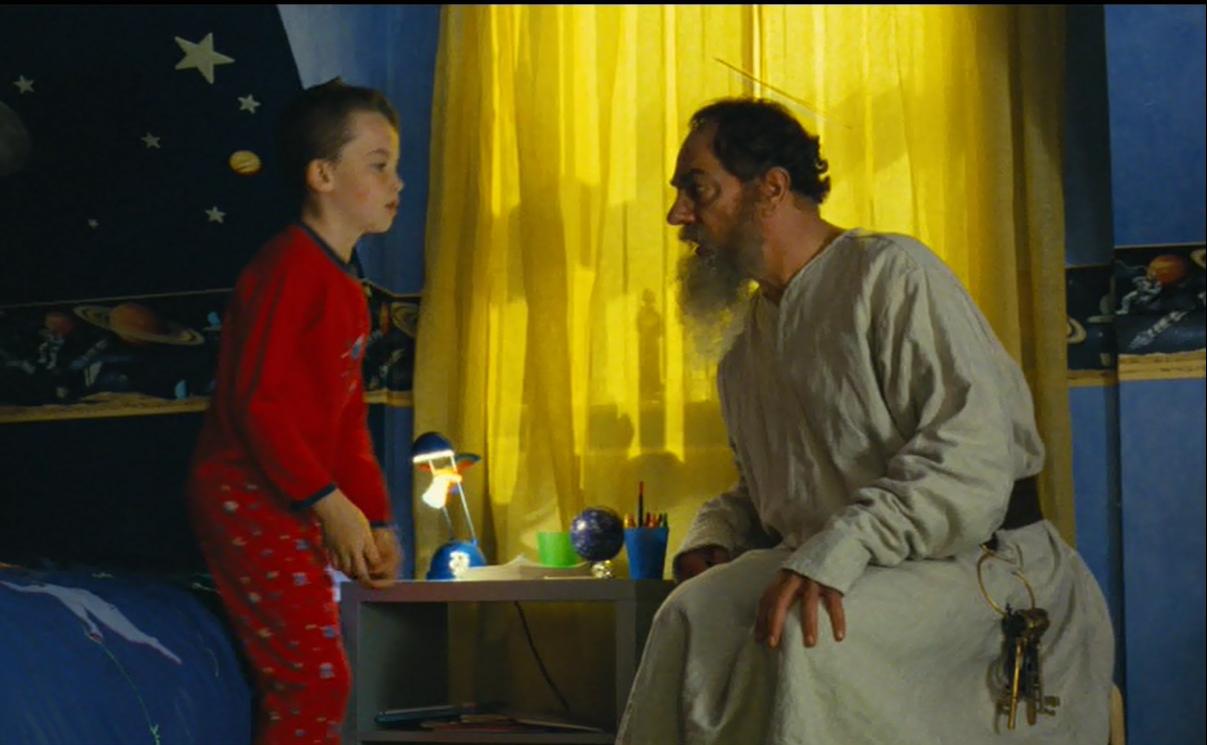
On Looking for Miracles…

24 Wednesday Jul 2019

Posted by jandrewsweckerly in Uncategorized

≈ Leave a comment

Tags

behavior, change, community, feeding, generosity, God, hoarding, miracle, prayer, security, selfishness, sharing, St. Peter, substance

St. Peter

Photo Credit:  https://www.imdb.com/title/tt0366777/mediaviewer/rm1454393856

This past Sunday, our parish gathered to watch the film Millions (2004).  The film tells the story of two brothers who accidentally come into the possession of a bag with cash, and what they each want to do with the money.  The younger brother, still reeling from their mother’s death, regularly has visions of and conversations with saints, where he discusses the moral issues of how to handle the money.  My favorite scene is between the younger brother and St. Peter.  As St. Peter is talking to him about miracles, he tells him about the Feeding of the Five Thousand story.  But this Peter’s version is a little different than the one we all know.

In the film, Peter says what actually happened that day was not really a miracle.  A boy showed up with some sardines to share with the hungry crowd, and Jesus had the disciples pass them around.  But when each person received the plate, they did not take any, because they had been hiding a stash for themselves.  So, each person took their own stash out, and ate that food instead.  Some people even had a little extra, and so they added a small amount to the plate.  Peter argues there was no magic because the food did not actually multiply.  But as he talks the story through, he confesses perhaps a miracle did happen – the miracle of people sharing their food; the miracle of a once stingy people, hoarding their own food, to a tentatively generous people, willing to share.

What St. Peter was cheekily alluding to was a miracle not of substance, but of changed behavior.  Though the scene is meant to be playful, I have been thinking about that distinction ever since.  We are in a time of stingy hoarding; perhaps humans always are.  But in the face of our selfishness, I often find myself praying for a miracle – for God to act dramatically to change these awful patterns in our society.  But perhaps the miracle we need today is not a miracle of substance, but a miracle of changed behavior.  Perhaps we need little boys with plates of shared sardines to inspire us to let go of our own death grips on security, and open up our hands and hearts to generosity.   Perhaps when we open up, others will see works of miracle in our simple changes of behavior.

What are you hoarding this week on which you can loosen your grip?  Who are the children you have been ignoring who have something inspirational to share with you?  How might you slowly begin to let go of your posture of inward protection and look around your community to see who might need you and your open arms?  I invite you to be open to a miracle of changed behavior this week, and to let me know what ripple effects you see.  Maybe St. Peter is right about us, even today!

Sermon – Matthew 25.31-46, P29, YA, November 26, 2017

29 Wednesday Nov 2017

Posted by jandrewsweckerly in Sermons, Uncategorized

≈ Leave a comment

Tags

American, Christ the King, Christian, feeding, God, imprisoned, Jesus, king, kingdom of God, Messiah, naked, politics, Sermon, sick, stranger, Thanksgiving, thirst, vocation

This past weekend we celebrated one of the most significant American holidays.  Thanksgiving has evolved over time, but generally involves people gathering with family, friends, or neighbors over a meal to give thanks for the blessings of life.  The concept sounds rather innocuous, but the meal can be fraught with challenges.  A few days before Thanksgiving this year, I caught the results of a poll.  The poll said almost 70% of people were hoping to avoid talking about politics with their family this Thanksgiving holiday.  According to the survey, the percentage of people wanting to avoid talking about politics is one of the highest in years.  Even though the numbers are unprecedented, the results are probably not a surprise to anyone here.  Politics is one of those topics polite conversations are supposed to avoid anyway.  But given the especially high tensions of our political climate lately, I can totally understand why almost three-fourths of us would want to avoid talking about our country’s deep divisions and political differences.  No need to ruin a day of attempted unity with a conversation about the very thing that divides us most deeply.

So, on the Sunday following the day when everyone wants to avoid talking politics, what are we going to do?  Talk politics.  Now before you get too anxious, do not worry.  We are not invited to talk American politics.  Today, our readings invite us to talk about biblical politics.  Today, we celebrate Christ the King Sunday – the last Sunday in the liturgical year before we start Advent next week.  The feast of Christ the King is not actually that old of a feast.  Pope Pius XI established the feast day in 1925 in response to growing secularism and a deemphasis on the primacy of Christ.  At the time, Europe was seeing a rise in non-Christian dictators, many of whom were seeking to influence authority over the Church.  Pope Pius wanted to remind the Church who was the head of the church, and the primacy of Christ for the Church’s identity.  Establishing Christ the King Sunday was not only a bold move by Pope Pius, the feast day was also needed if the Church were going to remain loyal to its identity.

The historical setting of the creation of the holiday is not all that unique from the biblical struggle with kingship.  If you remember, God is not at all on board when the people ask for a king.  You see, the people of God have already been on a long journey.  Abraham had settled them in a faraway land, which God had promised would be their land.  But famine struck, and the people were forced to flee to Egypt for sustenance, submitting themselves to a pharaoh – a new king of sorts.  For a while, that arrangement was not so bad.  But a new pharaoh meant a harsh life of enslavement.  So, God once again led the people out of the rule of a king, into the wilderness and eventually the promised land.  And what do the people ask for upon their arrival?  A king!  You see, they have been watching the other nations who have kings, and they want their own.  God wants them to see how God is their king.  But eventually God submits, giving them their hearts’ desire.  As predicted, an earthly king does not go well.  Sure, there are moments of enjoyment and blessing.  There are even some kings who do well – king David and Solomon.  But even the good kings come with human flaws.  As time goes on, the bad kings outnumber the good ones, and eventually the kingdom of God is ripped apart, and the peoples are scattered.

That is where we pick up things today in Ezekiel.  Recognizing the earthly kings have not worked so well, God promises to take the throne back, to become the people’s king once again.  God becoming king means the people will be gathered once again in their promised land.  They will have their wounds bound, their stomachs filled, and their thirst quenched.  They will return to an abundant land, with the rule of a comforting shepherd.  The promise to the wearied people of God is assuring and soothing; a balm to a scattered, disheartened people.  Their failures are ever before them:  their insistence on an earthly king have gotten them where they are today.  But admitting failure hardly seems onerous with the promise of redemption by God.

By the time we get to our gospel reading today, the people are yet again under an oppressive rule.  Rome has put her heavy hand on the people of God, and their hoped-for Messiah has not arrived.  The expectation of the Messiah was for a mighty, God-ordained leader who would vindicate the people, and establish a time of prosperity, power, and peace.  There are rumors that Jesus might be that Messiah, but much of what he has to say does not jive with what they are expecting.  Take today’s lesson, for example.  Jesus tells them the reign of God will entail feeding the poor, giving drink to the thirsty, welcoming the stranger, clothing the naked, tending the sick, and visiting the imprisoned.  Those are all certainly good things to do, but they are not exactly what the people are thinking of when they imagine a Messiah.  Though those tasks are noble, they do not indicate a people who have triumphed over oppressive rule.

I suspect we know a little about that sense of disappointment and disorientation.  Now I know I said I was not going to talk about politics, but stay with me for a bit.  You see, no matter who our leader is, we will never be truly happy with an elected, human leader.  Human leaders, like those leaders in the times of Ezekiel are flawed.  Think of your favorite president in American history – the president that really represented the goodness of American ideals.  Think of all the great things he did, the advancements he made, the ways in which he made us a better country.  Now, in balance with all that goodness, think of all the flaws he had.  Every president had them.  For every advancement he made, there was an advancement he neglected.  For every inspiring quote he had, there were things he said that would make us shudder.  For every injustice he corrected, there were injustices he ignored.

That is the funny thing about being both an American and a Christian.  Though we have probably structured the government with the most potential for justice and balanced leadership, we still fall short of the goal – because we are human.  And because nothing we make or conceive or structure will be perfect, we lean into our Christian identity for guidance, comfort, and strength.  You see, the only king who will ever bring about a perfect kingdom is Christ.  And yet, even “perfection” is redefined by Christ.  The kingdom of God is not reproduced through democracy, socialism, monarchy, oligarchy, or totalitarianism.  The perfect system in Christ involves each us feeding the poor, giving water to those who thirst, welcoming the stranger, clothing the naked, tending the sick, and visiting the imprisoned.

I can imagine what you are thinking, because I am thinking the same thing.  Those jobs all sound nice, but how do we ensure justice, safety, and structure?  How do we govern?  The good news is, just as we talked about last week, we all have a vocation.  If feeding, sating, welcoming, clothing, tending, and visiting are the parameters of perfection, we are each to use our gifts to achieve that perfection.  So maybe your vocation is to physically feed the poor and sate the thirsty.  Maybe your vocation is to advocate for those in prison.  Maybe your vocation is to govern with the intention of creating laws that will tend the sick and clothe the naked.  How we approach perfection will vary widely, but that we strive toward perfection is what Christ asks today.  Christ is not actually all that worried about who our king is or what kind of government we choose.  Christ is concerned that our lives reflect his true kingship over us.  Christ wants us to live lives that, upon observation by others, make obvious who is our king.

Our invitation this week is to take stock of our daily living, making sure we have aligned our lives with the kingdom of God.  If you have gotten off track, there is time and support for correcting course.[i]  If you have mastered feeding the hungry, but are not so great at welcoming the stranger, this community is here to help you expand your kingdom work.  And if you are not sure you can get on board with this kingdom work at all, you may need to do what we all avoided this Thanksgiving – get to a table and start talking politics.  Jesus promises to be with us, joining us in the conversation, blessing our ponderings.  With Christ the King on our side, the work does not feel like work, the conversation does not feel like a curse, and the results produce much more for which to be thankful.  Amen.

[i] Stanley Hauerwas, Matthew:  Brazos Theological Commentary on the Bible (Grand Rapids:  Brazos Press, 2006), 212.

Recent Posts

  • On the Myth and Magic of Advent…
  • On Risking Failure and Facing Fear…
  • Sermon – Luke 23.33-43, P29, YC, November 23, 2025
  • On Inhabiting Gratitude…
  • Sermon – Luke 20.27-38, P27, YC, November 9, 2025

Archives

  • December 2025
  • November 2025
  • October 2025
  • September 2025
  • August 2025
  • July 2025
  • June 2025
  • March 2025
  • February 2025
  • December 2024
  • November 2024
  • October 2024
  • September 2024
  • August 2024
  • July 2024
  • June 2024
  • May 2024
  • March 2024
  • February 2024
  • January 2024
  • December 2023
  • November 2023
  • October 2023
  • September 2023
  • August 2023
  • July 2023
  • June 2023
  • May 2023
  • March 2023
  • February 2023
  • January 2023
  • December 2022
  • November 2022
  • October 2022
  • June 2022
  • May 2022
  • January 2022
  • December 2021
  • November 2021
  • October 2021
  • September 2021
  • August 2021
  • June 2021
  • May 2021
  • April 2021
  • March 2021
  • February 2021
  • January 2021
  • December 2020
  • November 2020
  • October 2020
  • September 2020
  • August 2020
  • July 2020
  • June 2020
  • May 2020
  • April 2020
  • March 2020
  • February 2020
  • January 2020
  • December 2019
  • November 2019
  • October 2019
  • September 2019
  • August 2019
  • July 2019
  • June 2019
  • May 2019
  • April 2019
  • March 2019
  • February 2019
  • January 2019
  • December 2018
  • November 2018
  • October 2018
  • September 2018
  • August 2018
  • July 2018
  • June 2018
  • May 2018
  • April 2018
  • March 2018
  • February 2018
  • January 2018
  • December 2017
  • November 2017
  • October 2017
  • September 2017
  • August 2017
  • July 2017
  • June 2017
  • May 2017
  • April 2017
  • March 2017
  • February 2017
  • January 2017
  • December 2016
  • November 2016
  • October 2016
  • September 2016
  • August 2016
  • July 2016
  • June 2016
  • May 2016
  • April 2016
  • March 2016
  • February 2016
  • January 2016
  • December 2015
  • November 2015
  • October 2015
  • September 2015
  • August 2015
  • July 2015
  • June 2015
  • May 2015
  • April 2015
  • March 2015
  • February 2015
  • January 2015
  • December 2014
  • November 2014
  • October 2014
  • September 2014
  • August 2014
  • July 2014
  • June 2014
  • April 2014
  • March 2014
  • February 2014
  • January 2014
  • December 2013
  • November 2013
  • October 2013
  • September 2013
  • August 2013
  • July 2013
  • June 2013
  • May 2013
  • April 2013
  • March 2013
  • February 2013
  • January 2013
  • December 2012
  • November 2012
  • October 2012
  • September 2012

Categories

  • reflection
  • Sermons
  • Uncategorized

Meta

  • Create account
  • Log in
  • Entries feed
  • Comments feed
  • WordPress.com

Blog at WordPress.com.

  • Subscribe Subscribed
    • Seeking and Serving
    • Join 394 other subscribers
    • Already have a WordPress.com account? Log in now.
    • Seeking and Serving
    • Subscribe Subscribed
    • Sign up
    • Log in
    • Report this content
    • View site in Reader
    • Manage subscriptions
    • Collapse this bar
 

Loading Comments...