• About

Seeking and Serving

~ seek and serve Christ in all persons

Seeking and Serving

Tag Archives: gift

Sermon – John 1.29-42, EP2, YA, January 15, 2023

15 Wednesday Feb 2023

Posted by jandrewsweckerly in Sermons

≈ Leave a comment

Tags

anxious, evangelism, gift, invitation, Jesus, John the Baptist, light, Sermon, transform, witness

In my first position as a Rector, we had a wonderful facilitator for one of our Vestry Retreats.  The first question she asked is for us to tell her what we love about our church.  Everyone thought for a minute and then slowly we shared stories of what brought us to the church, what was meaningful, or what keeps us coming back.  It was a quiet, thoughtful conversation, as people really pondered why we were there.  Then the retreat leader asked us to tell her about the best meal we ever ate.  Well, the mood of the room totally flipped, and people’s faces lit up as they described succulent meals, decadent desserts, and mouthwatering food experiences.  We laughed and delighted in the stories as people gesticulated their enthusiasm and were almost tripping over one another as we remembered other amazing meals we have had.

Once we settled down, the facilitator asked us to note the total difference in our descriptions between what we love about our church and what we love about the best food we ever ate.  The question was not meant to shame us (though we did feel a little sheepish), but to help us see how blocked we sometimes get when talking about our love for our church.  Clearly, we have the capacity to witness – albeit to witness to an amazing meal.  But something about culture mores or maybe a history with a bad evangelism encounter makes us much more reticent to invite others into our joy.

I have been thinking about that hesitancy or inability this week as I read our gospel story today.  Although we always call him John the Baptist, one scholar suggests that in John’s gospel, John the Baptist really should be called John the Witness:  because that’s the emphasis of the fourth gospel – not John’s work of baptizing, but John’s work of witnessing to Jesus’ identity.[i]  In the portion of the fourth gospel we read today, John the Witness is a little like someone raving about the best thing they ever ate.  We are told that after the officials spend time inquiring about John’s identity, the next day, John is found shouting after the approaching Jesus, “‘Here is the Lamb of God who takes away the sin of the world!  This is he of whom I said, ‘After me comes a man who ranks ahead of me because he was before me.’”  John’s cheerleading continues the next day when he sees Jesus again and says, “Look, here is the Lamb of God!”  John is so passionate about Jesus that even John’s followers drop John and follow after Jesus:  a result of which I have to believe John is wholly supportive.

Now I imagine you are sitting there, tensing up a bit, waiting for me to tell you to go get a megaphone and some pom poms because we have some witnessing to do!  The good news is your only partially right.  Here is what I know.  You came here today (either in person or online) for a reason.  Maybe this community helps you find a sense of purpose and meaning.  Maybe this community brings you a sense of comfort and belonging.  Maybe this community is helping you find you way to or enrich your relationship with Jesus.  Whatever the reason, that reason is your witness.  That reason is this beautiful, sacred thing, that when you do not share with others is like refusing to give a gift to others.  I know you may feel awkward, or like you don’t have “holy enough” words, or that you might even be rejected or disdained.  The truth is your words do not even really matter when you are witnessing – what will matter is the way your face transforms when you talk about how this place has impacted your walk with God.  And if using the word witness makes your stomach tense, then use the word invitation.

So, your invitation today is to begin embracing a practice of invitation.  Maybe you have no qualms pulling out that megaphone and pom poms for Jesus like John the Witness.  Maybe you will be you will be like Andrew in our passage today and drag your brother or friend along with you to church with a forceful, “Come on!”  Or maybe your invitation will be as soft as Jesus’ to the new disciples asking questions, who simply says, “Come and see.”[ii]  Someone in your own journey did that for you.  Maybe a long time ago or maybe very recently.  Maybe their words were loud and proud or maybe they were soft and encouraging.  But something in their countenance changed that made you want to see more.  Our invitation today is to share that same light with others, inviting them to come and see this place where you invest your time, your gifts, and your treasure.  Your invitation is to not hoard the gift of this place, but to share the gift of this place and your faith with others.  Amen.


[i] Karline M. Lewis, John:  Fortress Bibilcal Preaching Commentaries (Minneapolis:  Fortress Press, 2014), 27.

[ii] Greg Garrett, “Homiletical Perspective,” Feasting on the Word, Yr. A, Vol. 1 (Louisville:  Westminster John Knox Press, 2010), 265.

Sermon – Mark 12.28-34, Deuteronomy 6.1-9, P26, YB, October 31, 2021

17 Wednesday Nov 2021

Posted by jandrewsweckerly in Sermons

≈ Leave a comment

Tags

commandments, discomfort, gift, God, grace, Jesus, love, neighbor, perfect, radical, responsive, self, Sermon, shema, silence

In preparation for a mission trip to Honduras, we did a lot of study on the history, politics, and economic development of the country.  Part of that preparation included reading Don’t Be Afraid, Gringo, the story of Honduran woman Eliva Alvarado.  Her story is the story of all campesinos – the poor and oppressed in her country.  Her story is the kind of story that stirs up righteous indignation and makes you want to hop on a plane to go fight for justice.  But in the conclusion of her story, she says to the reader that her ultimate desire is for us to stay where we are.  She does not want her story to inspire us to come there and “fix” things.  Instead, she implores us to fix ourselves – explore our own country’s policies and practices that abet the oppression by the privileged in her country. 

I remember when we got to her conclusion, the team sat in silence for a long time.  You could see the wheels churning in each of our minds – surely, we know what is best, surely we can fix things if we can just get there, surely there is a way around the way this woman has made us feel impotent.  And yet, there was profound truth in her words, and an understanding that to not listen to her final request would be worse than to have not read her words at all.  And so, we sat in pained silence, letting her charge sit uncomfortably with us.

Jesus creates a similar silence at the end of our gospel lesson today.  Jesus has been poked and prodded by one group after another at this point in Mark’s gospel.  In chapter 11, the chief priests, scribes, and elders question Jesus’ authority.  Early in chapter 12, the Pharisees and some Herodians try to trap Jesus with a question.  Finally, some Sadducees question Jesus about a theological issue.  Then today, a scribe asks a “palpably disarming” question – not one to test Jesus, but as one scholar says, an “invitation to the table of theological discourse.”[i]  The conversation today is about the greatest of the commandments. 

Jesus’ response is not new.  In fact, Jesus quotes the shema, the classic text we heard just this morning from Deuteronomy, “Hear, O Israel: The Lord is our God, the Lord alone. You shall love the Lord your God with all your heart, and with all your soul, and with all your might.”  This is a text the Israelites have emblazoned in the minds of their children, and repeated for generations, “Shema Yisrael, Adonai eloheinu, Adonai echad.”  “Hear, O Israel, The Lord is our God, the Lord alone (or the Lord is one).”  Jesus tweaks the answer only slightly from the original shema, adding that we should love the Lord our God with all our mind in addition to all our heart, soul, and strength.  And he adds that we should love our neighbor as ourselves.  But that notion is true to the original commandments as well.  When the scribe agrees with Jesus, saying loving God and neighbor as self is more important than any other ritual of the faith, the crowd falls silent, and we are told “no one dared to ask him any question.”  In other words, “Jesus’ critics were silenced and the effect was momentarily deafening.”[ii] 

So why is the crowd suddenly and dramatically silenced?  What’s the big deal about loving God and neighbor as self?  We talk about these commands all the time.  I mean, Bishop Curry has preached these words more times than I can count.  So why do Jesus’ words shock the room into silence?  One scholar suggests that the silence is so deafening because those gathered understood something about the reality of love that we modern Americans sometimes neglect.  As one scholar explains, “…sometimes — especially in western Christianity — we focus so hard on the emotive and affective aspects of love that we forget its rigor, its robustness, its discomfort.  We assume that loving God and our neighbors means expressing friendly sentiments to God in Sunday worship, and exchanging warm pleasantries with the people who live near us during the week.  We forget that in the scriptures, the call to love is a call to vulnerability, sacrifice, and suffering.  It’s a call to bear a cross and lay down our lives.  Biblical love is not an emotion we feel, it’s a path we travel.  As the children of God, we are called to walk in love. Think aerobic activity, not Hallmark sentiment.”[iii]  An invitation into that kind of radical love – the love of neighbors we would rather not love, the love that is as powerful as the natural, preserving love of self[iv], the love that is a response to the overwhelming love of God for us – that kind of invitation is sobering. 

I remember having read Elvia’s disinvitation to come to Honduras and “fix” things felt like a disempowering, painful rebuffing of love.  But I think I felt that way because we do not get to dictate what love of neighbor looks like.  True love of neighbor is not self-designed but is responsive – responsive to our love of God, and respectfully responsive to the self-articulation of needs by others.  Elvia’s self-articulation was deafeningly silencing the way Jesus’ invitation is too.  As scholar Debie Thomas explains, “Silence is the appropriate first response to the radical love we’re called to.  We dare not speak of [love] glibly.  We dare not cheapen [love] with shallow sentiment or piety.  Rather, [we] ask for the grace to receive [love] as the wise scribe received [love].  In awed and grateful silence.”[v]  Only when we have sat in the uncomfortable silence that recognizes the true love of God and neighbor as self are we ready to take up every perfect gift God has given us and travel the path of love.  Amen.


[i] Cynthia A. Jarvis, “Pastoral Perspective,” Feasting on the Word, Year B, Vol. 4 (Louisville: Westminster John Knox Press, 2009), 262.

[ii] Jarvis, 364.

[iii] Debie Thomas, “Walk in Love,” October 24, 2021, as found at https://www.journeywithjesus.net/lectionary-essays/current-essay?id=2944 on October 29, 2021.

[iv] Victor McCracken, “Theological Perspective,” Feasting on the Word, Year B, Vol. 4 (Louisville: Westminster John Knox Press, 2009), 262.

[v] Thomas.

On Redefining Sacraments…

28 Thursday Oct 2021

Posted by jandrewsweckerly in reflection

≈ Leave a comment

Tags

coffee, Coffee Hour, gift, God, grace, sacrament, sign, spiritual

Photo credit: https://jacklondonoakland.org/new-events/virtual-coffee-hour-september-2020

This past Sunday was a day of celebration at Hickory Neck.  The bishop confirmed, received, and reaffirmed 16 parishioners, gave out blessings at our Drive-Thru Coffee Hour, and even celebrated Eucharist in our Historic Chapel.  It was a day of delight and joy and brought so many people together – both online and in person. 

But one of the things we tried for the first time since the pandemic was a “mini Coffee Hour”  We could not get past the idea of a celebration like this without a cake, so we safely served up cake and put coffee in safe, disposable containers, and we ate outside in a way that we have not done in ages.  It was a small thing in a lot of ways – something we have done thousands of times before the pandemic.  But it was anything but small.  As the organizer teared up talking about having Coffee Hour that day, I knew there was something much deeper happening.

Some people have joked that Coffee Hour is the eighth sacrament of the Episcopal Church.  I always scoffed at that idea, thinking it was much too disrespectful of the sacraments.  But in having Coffee Hour taken away during the pandemic and experiencing it again for the first time in 19 months, I now realize the truth hidden in those forced laughs about Coffee Hour’s sacramental status.  We are told in the Catechism that a sacrament is an outward and visible sign of an inward and spiritual grace, given by Christ as a sure and certain means by which we receive that grace.  Now I am not arguing that Jesus gives us coffee, but the cup of coffee one receives at Coffee Hour may in fact be that outward and visible sign of the grace of Coffee Hour – where sacred hospitality is offered, intimate Christ-like friendships are nurtured, and forgiveness, pastoral care, and sharing in mutual joy happens. 

I would not wish this pandemic on anyone.  But I am grateful for the fasting that it created which enabled me to see the fullness of holiness that happens in church:  in the pews, at the altar rail, and yes, at the coffee pot.  My hope is that we as a church figure out ways to offer those unauthorized sacraments in new and fresh ways as we continue to recover from this pandemic and live into community in restricted ways.  I wonder what ways we will be overwhelmed by God’s grace in these in-between times.

Sermon – Mark 10.17-31, P23, YB, October 10, 2021

27 Wednesday Oct 2021

Posted by jandrewsweckerly in Sermons

≈ Leave a comment

Tags

abundance, follower, gift, giving, God, Jesus, love, money, poor, rich, Sermon, stewardship

This Sunday, we kick off our stewardship season, whose theme is “Every Perfect Gift.”  I know a lot of people hear we have entered stewardship season and internally groan, knowing full well that we will have to spend the next few weeks talking about how we are sharing our time, talent, and treasure.  This can be especially hard for those of us who were raised to believe that there are certain taboo subjects in public – and money is definitely on the banned list.  I’m not sure why:  money is one of the topics Jesus talks about more than any in scripture.  But even Jesus seems incapable of eliminating Southern hospitality mores. 

Knowing our predisposition to loathe talking about money, imagine my own groan when I read today’s gospel lesson earlier this week.  This is the lesson we get on the kickoff of stewardship season?!?  A lesson about how the only proper relationship with money is to give money away to the poor and follow Jesus; a lesson that asserts getting a camel through the eye of a needle is easier than the rich to get into the kingdom of God.  And just in case any of us were hoping for an out, I already checked, and yes, we are considered “rich” by Jesus’ standards.  We might like to think ourselves exempt because we know plenty of people who have more than we do.  But given global standards, we certainly fall in the same category as the rich man in this text.

So, if your shoulders are already tensed, your foot is nervously tapping the ground, or your arms are crossed over your chest, I want you to take a deep breath in, and as you slowly exhale, allow the tension in your body to slowly release.  As you take in and release a second breath, I want you to clear you mind and listen to the text again with me with an open mind.  A man of deep faith runs to Jesus and throws himself at Jesus’ feet – he is already a faithful follower of God, and yet we see in him a yearning for deeper relationship, to align himself with the goodness of this man named Jesus.  He is a seeker, he is humble, he is passionate.  And, the text tells us, Jesus looks at him and loves him.  This is not a dependent clause.  This is a declarative, gracious, merciful statement of deep, abiding love.  Jesus looks at him and loves him.  Period. 

Many have described the next part of the story as an incisive judgment or a condemnation.[i]  But I see the next part of the story is an invitation – for the wealthy man, for the disciples, and for us.  The invitation is to contemplate the nature of our relationship with wealth.  Jesus never condemns wealth.  Jesus just knows that wealth has the power to corrupt: to corrupt our generous spirit, to corrupt our sense of self-worth, to corrupt our ability to see that every perfect gift comes from God – not from our hard work, our intelligence, or even our good looks. 

One of my favorite children’s sermons from my dad involved an apple.  He sat down with a paring knife and asked us kids to think of the apple as the money that we have.  He asked us, “What are some of the things we have to spend money on in life.”  The answers started flying:  housing, clothes, school supplies, food.  With each answer, he would slice off a part of the apple.  Then he leaned in and whispered, “Now what are the things we like to spend money on?”  We had those answer too:  bicycles, TVs, video games, candy!  With the last suggestion, we realized he had cut every last part of the apple away.  Then he looked at his empty hands and said, “Uh oh.  Did any of us save anything for the church?”  That morning, both the kids and the adults had guilty looks on their faces.  Fortunately, my dad had stashed a second apple and suggested we start over, this time giving the first slice to God.  We were amazed how we still had room for both needs and wants, even losing that crucial first slice.

That is the invitation of our stewardship season too:  to take a look at every perfect gift in our lives, to look at every perfect gift within ourselves, and to look at every perfect gift in others and to understand all that abundance comes from God.  When we allow ourselves to see the magnitude of that abundance, we can then see what Jesus is inviting the wealthy man, the disciples, and us into:  a posture of abundance, that sees all the perfect gifts we receive, we have, and others around us have and to become agents of abundance who, with relaxed shoulders, untensed bodies, and unfolded arms long to share that abundance.  Amen.        


[i] Debie Thomas, “What Must I Do?” October 3, 2021, as found at https://www.journeywithjesus.net/lectionary-essays/current-essay?id=2944 on October 8, 2021.

On the Power of Every Perfect Gift…

06 Wednesday Oct 2021

Posted by jandrewsweckerly in reflection

≈ Leave a comment

Tags

blessing, church, every perfect gift, gift, giving, God, gratitude, stewardship, talent, team, time, treasure

Photo credit: https://www.tens.org/

Ministry is a funny endeavor because you can have a to-do list planned for any given day, but between drop-ins, unexpected calls, or pastoral events, your to-do list gets completely set aside.  Yesterday I had one of those days where I left the office thinking, “Man!  I only got a couple of things done today!  I’m so frustrated!”  But then I remembered that even though I personally only got a couple of things done, my staff picked up a lot of the floating to-do items and together, we actually got a lot of things done.  Suddenly a seemingly wasted day felt like a day of accomplishment.

The last two years have been years of transition for our staff.  A full-time priest left the staff right as COVID hit and was not replaced.  This past summer, we had an administrative staffing gap.  Suddenly, if things were getting done, they really were dependent upon my personally accomplishing them – which is never a sustainable model.  It was not until yesterday that a wave of gratitude overwhelmed me as I realized how much can be achieved when you are a part of team.

This week, we will kick off our stewardship season at Hickory Neck Episcopal Church, whose theme is Every Perfect Gift.  My experience this week made me remember how even our giving to church is a team effort.  We work hard to do our part – giving a tithe or other generous financial gift, our time, and our talent.  But our part does not sustain the work of ministry.  In order to reflect the fullness of the body of Christ, each of us needs to give Every Perfect Gift – those parts that make the whole better. 

As you think about your giving to the church, maybe your finances are making it such that you cannot give as much as you would like.  Or maybe you are giving in earnest, but feel like you are pulling more weight than others.  Or maybe you are taking a hard look at your budget and time and are considering how you can do more this year.  Just remember two things:  1) your gift is perfect and is a reflection of your gratitude to God for your many blessings – making your giving sacred; and 2) you are a part of a community where everyone does their part – where we all make an impact on our community because when we all share our every perfect gift, our collective effort is stunning.  You are in my prayers this year as you consider how you might share your perfect gifts with Hickory Neck!

On Cups of Sugar and Other Gifts…

03 Wednesday Feb 2021

Posted by jandrewsweckerly in reflection

≈ Leave a comment

Tags

death, emotion, gift, God, neighbors, pandemic, share, struggle, suffering, sugar, together

Photo credit: https://www.bhg.com/recipes/how-to/bake/how-to-measure-sugar/

One of the things I love about our public library is the way they display children’s books to catch your attention.  We have our favorite characters and series, but our librarians always pick books you might not find if you were just looking at endless rows of books.  In our last trip, we picked such a book called Addy’s Cup of Sugar.  There was a girl and a panda bear on the cover, so I was sure it would be a winner with my young daughter.  It also said it was based on a Buddhist story of healing, which sounded intriguing.

Little did I know how powerful this children’s book would be.  For those of you who have not read it (spoiler alert!), the book is about a girl whose cat dies.  She talks to her friend, the panda bear, about bringing the cat back to life.  The bear says the only way to accomplish that is for her to help him with the supplies he will need – specifically a cup of sugar from a neighbor; but the cup of sugar must come from a home where no one has experienced death.  So off Addy goes, and slowly we learn through her visits and beautiful conversations with neighbors that not one single house in her neighborhood has been unaffected by death.  You can imagine the conversation Addy and the bear have upon her return at the close of the day.

After recovering from being sideswiped by the emotional power of the book, I began to reflect on my work as a priest.  As part of my vocation, I am entrusted with fullness of people’s stories – grief they might not confess to their loved ones, weariness they may not show in their tough facades, anger at God they are afraid to claim aloud for fear of judgment.  Every once in a while, one of those poignant moments of sharing knocks the breath out of me and I am at a loss for words – because words cannot heal some hurts. 

Although I experience the depth of humanity more regularly than some, we all have the opportunity to do the same with our family, friends, and neighbors.  As the duration of this pandemic lengthens, I have been wondering if we all might need to start taking our own cups for sugar around the neighborhood (masked and socially distanced, of course), offering the opportunity for others to share their hurts, their sorrows, and perhaps their own struggles to see God.  Once we begin to see the wideness of the human condition, we also see how we are not alone.  Our cups of sugar then become not just gifts for ourselves, but for others too.

On Wrestling with Healing…

19 Wednesday Aug 2020

Posted by jandrewsweckerly in Uncategorized

≈ Leave a comment

Tags

Bible, disciple, gift, healing, Jesus, ministry, power, scripture, vocation

healing hands

Photo credit: https://www.womansday.com/life/g25224950/healing-prayers/

This summer, my parish is participating in a 90-Day Bible Reading Challenge.  It’s been a powerful journey and companion during this pandemic time.  One of the lessons we have already learned this summer is reading the Bible at a rapid pace is different than in-depth Bible Study.  You tend to get the big picture of God and the people of faith, see patterns more easily, and catch things by reading the books in order as opposed to hearing snippets, like we do on Sundays.

As we have been reading through Matthew, something caught my attention this time.  From the beginning of Jesus’ ministry, he is constantly healing people.  Not just one or two famous stories we may remember, but constantly healing, sometimes healing whole crowds of sick people.  In chapter ten, when Jesus sends out his twelve disciples, he doesn’t tell them to teach people or preach the gospel.  He gives them authority to drive out evil spirits and to heal every disease and sickness.  Jesus also does a lot of teaching in Matthew, but I was surprised to remember how ubiquitous Jesus’ healing ministry is.

Reading Matthew’s Gospel in a rapid, big-picture way, I have been reminded how much Jesus’ healing ministry makes me a bit uncomfortable.  I am generally comfortable with preaching and teaching, but, as one of Jesus’ disciples, healing is not a power I would ever claim.  Additionally, as modern readers, I think healing and miracles are one of those things that lead to all sorts of questions.  Does Jesus really heal people?  When we think of healing, do we soften the words, making the healing more figurative than literal?  If Jesus heals all those people in his time, what do we do with all the people who are not healed in our time, especially as we face a worldwide pandemic?  Shouldn’t healing just be limited to medical professionals and those gifted with the charism of healing, as opposed to all of us as followers of Christ?

Here’s what I do know.  The healing Jesus does allows individuals to reenter communal life, fully participating in the community, and being restored as an equal.  Also, the healing Jesus does clears the way for those individuals to do good with their lives, not only helping others, but also showing others the way to Christ.  As I think about those who are suffering in our communities, part of the healing that is needed is the healing that will restore them to full participation in life – eliminating poverty, hunger, homelessness, and discrimination of any kind.  Making health care, childcare, affordable food, and affordable housing accessible to all.  We may not have the vocation of physical or mental healing, but we all have the vocation of healing our society, respecting the dignity of every human being, and striving for justice and peace among all people.  Perhaps when Jesus sent out those disciples to heal, they all healed others in the ways they knew how.  But they all went out to heal.  We can go and do likewise – healing this world that needs healing so much!

One “Why” of Church…

22 Wednesday Jan 2020

Posted by jandrewsweckerly in Uncategorized

≈ Leave a comment

Tags

church, community, conflict, creation, faithful, gift, God, intentional, love, meaningful, relationship, sacred, scripture, why?

together-crop

Photo credit:  https://ncchagerstown.org/attendance-membership-and-belonging-at-new-creation/

A few months back, a commenter on my blog asked why people even need to go to church.  I have thought of hundreds of reasons, and could probably write a whole series of posts about that question.  But this week, one of those reasons became very clear to me.  One of reasons being a part of a church community is so important is because being a part of a church community teaches members how to be in meaningful, faithful, sacred relationships with others.

Certainly, scripture teaches us humans are made in the image of God, and that our creation was very good.  Scripture also teaches us to love God, love ourselves, and love our neighbor.  And there is much scripture that teaches us what community means, the value of every person to making the community whole, and what behaviors are needed to be loving people made in the image of God.

Now, I know the Church and her leaders have often failed at living in that specifically Christian way.  But belonging to a church means you are committing to trying to live the life of love intentionally, authentically, and humbly.  The Church is where we learn how to lovingly live through conflict.  The Church is where we learn how to kneel at the altar rail right next to someone who has hurt us, who disagrees with us, who has challenged us, and see the commonality in our outstretched arms, waiting for the healing body of Christ.  The Church is where we learn how to say, “I’m sorry,” “I was wrong,” “I messed up,” and “I forgive you.”  The Church is the place where we can hold the fragility of human experience, the sinful nature of each of us, and the beauty of God’s creation in tension, and experience the depths of love known only through the eyes of Christ.

Maybe Church is not a place like that for you.  For me, the Church makes me a better human being, and a better child of God.  The Church keeps me honest, loves me when I do not deserve it, and molds me into a servant of God who can share that same life-giving, liberating love with others.  I am so grateful to be a part of a church, so honored to be a priest in the Church, and so overwhelmed by the power of love I find powerfully within the community of the Church.  If that is a not a gift you have received, I invite you to my church, anytime.  If that is a gift you have received, I invite you to give thanks to God for God’s gift of the Church to us.  And if you are giving thanks this week for your own church experience, I encourage you to give that gift to someone else.

On God’s Love…

06 Wednesday Nov 2019

Posted by jandrewsweckerly in Uncategorized

≈ Leave a comment

Tags

abundance, beauty, fall, foliage, gift, God, heart, leaves, love, moment, mundane, scarcity, warm

Yellow Leaves

Photo credit:  https://homeguides.sfgate.com/yellowed-leaves-outside-plants-64953.html

Fall is my favorite season of the year.  Mostly I love the transformation of foliage into beautiful shades of yellow, red, and orange.  Although spring’s blossoms are certainly lovely, there is something bold and deeply stirring about fall colors that warms my entire being.  You can imagine my disappointment this year, then, when the forecasters warned us the fall foliage would likely be less vibrant this fall due to the drought we experienced at the end of the summer and into the beginning of fall in our area.  I had already seen evidence of this disappointment as some of my favorite trees turned straight from green to brown – or even a grayish brown, as if their color had been drained.

But last week, driving home from a long meeting, I turned a corner I rarely travel as the sun was lowering, when I gasped.  A tall tree had turned a brilliant shade of yellow, every leaf singing a beautiful song, as the sun made the tree dance in a radiant glow.  The sight was so stunning, I found tears prickling in the corners of my eye, and a tightness I had not realized was in my chest dissolving away.  The tree was a magnificent gift, ready for the receiving of anyone who would have it.

I was thinking how similar God’s love for us is.  We so often lower our expectations with the slightest hint of scarcity, bracing ourselves so we do not experience loneliness, disappointment, or sadness.  We do not even notice the slow development of our guardedness, and before we realize it, we cut ourselves off to others.  But God is not easily deterred.  Out of the blue, we find ourselves sideswiped by God’s love – some unexpected act of kindness by another, an undeserved gift, or an observed moment between others that restores our hope in humanity – and we realize how God’s love is there all along, shining brilliantly.  And when we stubbornly slip into a theology of scarcity or a closed-off sense of abandonment, God shows up with such force that we cannot help but see abundance and love all around us.

I invite you today to find your own moment of God’s love and beauty.  Whether it is in a brilliantly glorious display of fall foliage, a sacred act of kindness between strangers, or a moment of appreciation for the gift of this day, I invite you to look for God today.  But be forewarned:  once you finally see that God-moment today, you are likely to start seeing a lot more of them in the little, shocking, overwhelming, mundane, beautiful moments of life.  I cannot wait to hear how God is warming your heart today!

On Light, Community, and Being All In…

02 Wednesday Oct 2019

Posted by jandrewsweckerly in Uncategorized

≈ Leave a comment

Tags

community, gift, give, harness, idea, Jesus, light, loving, loving kindness, ministry, neighbor, pledge, power, shining, stewardship, together, transform

70161290_10158145043567565_8013087704956796928_n

Photo credit:  Jennifer Andrews-Weckerly; resuse with permission

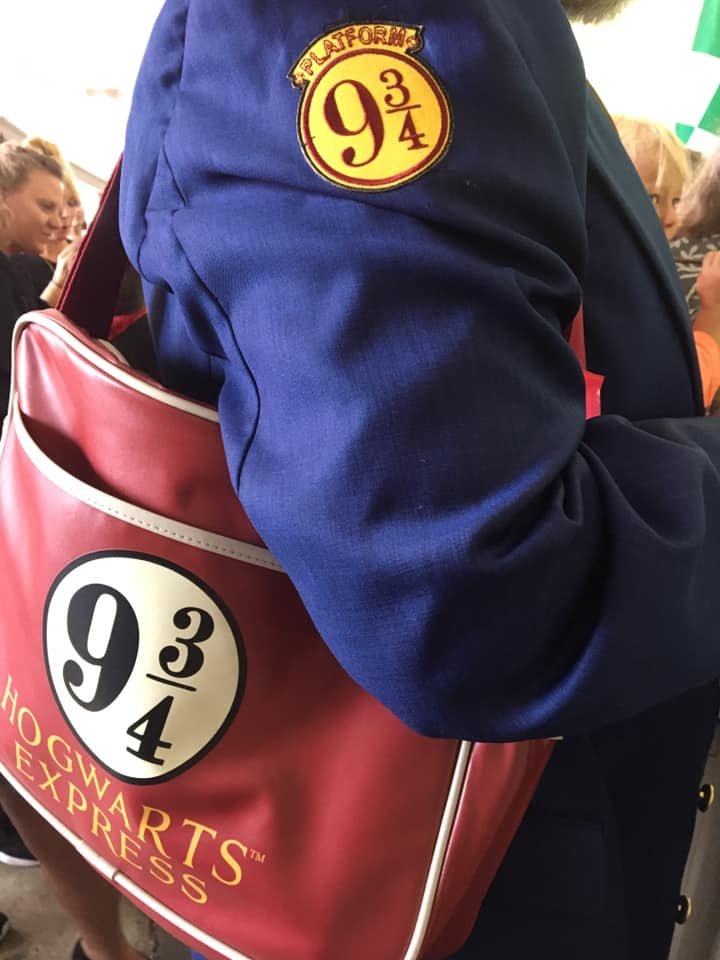
This past weekend, our family traveled to Staunton, Virginia, for their annual Queen City Mischief and Magic weekend – a weekend to celebrate all things Harry Potter.  We had a great time discovering what houses we were sorted into, observing how to duel with wands, and learning dances for the next Yule Ball.  The kids busied themselves collecting trading cards from costumed characters and from local establishments.  The whole downtown area shut down and found creative ways to channel the world of Harry Potter – from the local train station taking on the persona of Platform 9 ¾, to a photography business creating keepsake photos, to a toy store changing out their stock with Potter toys, games, and books, to the local university offering lectures related to themes from the series, to the local spirits store selling “butter beer.”  For those who love the Harry Potter books and movies, it is a great fun-filled weekend.

As we drove home, I realized what amazed me most about the weekend was not the characters, the paraphernalia, or the crowds.  What amazed me was how a few years ago this small town had a crazy idea to convert the town to this magical place – and everyone bought into the idea.  Staunton does not have some significant tie to JK Rowling or the filming of the movies.  They are just a small town in the middle of the state who decided to do something – and the whole town was all in.  I do not know the history of that idea, or how many people said, “but we’ve never done anything like this,” along the way, or how they figured out the logistics and convinced people to get on board.  But what I can tell you is after two years of attending the festival, the whole town is not just grudgingly on board, but wholeheartedly comes together to welcome people to their town that might not otherwise ever step onto their streets.

I know Staunton converts itself for just three days.  But the more I thought about the event, the more I wondered what kind of power our community might be able to harness for good.  I have certainly seen hints of that kind of energy with the WMBGkind movement in Williamsburg – a community of people committed to being a community of kindness as their dominant identity.  I think that is why I have always thought WMBGkind and the faith community can be such great partners.  Though we use religious language, the end result is the same.  We want our community to be a community that lives Christ-like lives of loving-kindness.  In that way, no matter what our denominational or faith differences are, we can step out of our day-to-day operations and be a part of something much bigger – of a people all united around mission of loving neighbor as ourselves.

This week, Hickory Neck kicked off its stewardship campaign, “Shining our Light.”  What I love about the campaign is the campaign reminds us to look at how much light we are gifted with (in worship, in learning, and in play), and then to gift that light the community around us – to shine our lights, rallying the entire community to live life differently.  That is a cause I am happy to pledge our financial giving to; that is a cause I am excited to pledge our time and talent to as well.  This month, as we pray about our own stewardship, I encourage you to think about how your giving not only supports the ministry of Hickory Neck, but might just have the power to transform our community into something much bigger than ourselves.  I am all in.  Won’t you join me?

71757278_2601111433278434_853371931125088256_o

Photo credit:  https://www.facebook.com/Hickory.Neck/photos/p.2601111426611768/2601111426611768/?type=1&theater

← Older posts
Newer posts →

Recent Posts

  • On the Myth and Magic of Advent…
  • On Risking Failure and Facing Fear…
  • Sermon – Luke 23.33-43, P29, YC, November 23, 2025
  • On Inhabiting Gratitude…
  • Sermon – Luke 20.27-38, P27, YC, November 9, 2025

Archives

  • December 2025
  • November 2025
  • October 2025
  • September 2025
  • August 2025
  • July 2025
  • June 2025
  • March 2025
  • February 2025
  • December 2024
  • November 2024
  • October 2024
  • September 2024
  • August 2024
  • July 2024
  • June 2024
  • May 2024
  • March 2024
  • February 2024
  • January 2024
  • December 2023
  • November 2023
  • October 2023
  • September 2023
  • August 2023
  • July 2023
  • June 2023
  • May 2023
  • March 2023
  • February 2023
  • January 2023
  • December 2022
  • November 2022
  • October 2022
  • June 2022
  • May 2022
  • January 2022
  • December 2021
  • November 2021
  • October 2021
  • September 2021
  • August 2021
  • June 2021
  • May 2021
  • April 2021
  • March 2021
  • February 2021
  • January 2021
  • December 2020
  • November 2020
  • October 2020
  • September 2020
  • August 2020
  • July 2020
  • June 2020
  • May 2020
  • April 2020
  • March 2020
  • February 2020
  • January 2020
  • December 2019
  • November 2019
  • October 2019
  • September 2019
  • August 2019
  • July 2019
  • June 2019
  • May 2019
  • April 2019
  • March 2019
  • February 2019
  • January 2019
  • December 2018
  • November 2018
  • October 2018
  • September 2018
  • August 2018
  • July 2018
  • June 2018
  • May 2018
  • April 2018
  • March 2018
  • February 2018
  • January 2018
  • December 2017
  • November 2017
  • October 2017
  • September 2017
  • August 2017
  • July 2017
  • June 2017
  • May 2017
  • April 2017
  • March 2017
  • February 2017
  • January 2017
  • December 2016
  • November 2016
  • October 2016
  • September 2016
  • August 2016
  • July 2016
  • June 2016
  • May 2016
  • April 2016
  • March 2016
  • February 2016
  • January 2016
  • December 2015
  • November 2015
  • October 2015
  • September 2015
  • August 2015
  • July 2015
  • June 2015
  • May 2015
  • April 2015
  • March 2015
  • February 2015
  • January 2015
  • December 2014
  • November 2014
  • October 2014
  • September 2014
  • August 2014
  • July 2014
  • June 2014
  • April 2014
  • March 2014
  • February 2014
  • January 2014
  • December 2013
  • November 2013
  • October 2013
  • September 2013
  • August 2013
  • July 2013
  • June 2013
  • May 2013
  • April 2013
  • March 2013
  • February 2013
  • January 2013
  • December 2012
  • November 2012
  • October 2012
  • September 2012

Categories

  • reflection
  • Sermons
  • Uncategorized

Meta

  • Create account
  • Log in
  • Entries feed
  • Comments feed
  • WordPress.com

Blog at WordPress.com.

  • Subscribe Subscribed
    • Seeking and Serving
    • Join 394 other subscribers
    • Already have a WordPress.com account? Log in now.
    • Seeking and Serving
    • Subscribe Subscribed
    • Sign up
    • Log in
    • Report this content
    • View site in Reader
    • Manage subscriptions
    • Collapse this bar
 

Loading Comments...