• About

Seeking and Serving

~ seek and serve Christ in all persons

Seeking and Serving

Tag Archives: God

Sermon – Luke 5.1-11, EP5, YC (Annual Meeting), February 6, 2022

25 Wednesday May 2022

Posted by jandrewsweckerly in Sermons

≈ Leave a comment

Tags

abundance, Annual Meeting, boldness, divot, God, Jesus, pandemic, Peter, pivot, relationships, sacred ground, Sermon

As we reflect back on a year of ministry here at Hickory Neck, we see two realities.  On the one hand, we are tired.  After almost two years of a pandemic, I like to say we have been pivoting so much there is a significant divot in this sacred ground.  We have been in and out of in-person worship, in and out of tightened and lessened restrictions, we have had moments of renewal where it felt like things were getting close to normal, and then moments where the rug was snatched out from under us, and we felt like we were back to square one.  We miss our friends, we want to get back to the work of ministry that has fed us in the past or that drew us to Hickory Neck as a newcomer, we want to experience deepened relationships that come from coffee hours and parties and crowded worship spaces.  We are weary emotionally, physically, and spiritually.

I think that is why I love our gospel lesson so much today.  Jesus and the disciples have been out on the boat all day and night, and the disciples have been working through the night to catch fish to feed their merry band of followers.  When they catch nothing, Jesus says to Simon Peter, “Put out into the deep water and let down your nets for a catch.”  Now what Simon actually says is, “Master, we have worked all night long but have caught nothing.”  But what I like to imagine is Peter’s tone – or even what Peter was really saying in those eleven words.  In my mind, what Peter is really saying is, “Look, sir.  I get that you are trying to help, and I get that you are wise enough for us to be following you.  But I am the fisherman, and I think I know a little bit more than you on this one.  And quite frankly, I’ve been at this all night.  I am exhausted and weary, and not really interested in your next big idea.”  Of course, what he says instead (with I suspect not only skepticism but also a bit of insincere, sarcastic, feigned respect) is, “Yet if you say so, I will let down the nets.”

We have all slipped into Peter’s attitude at times in the last year.  Sure, we’ll keep meeting on Zoom.  Sure, we will put the masks back on.  Sure, we’ll wait to schedule the funeral, or the baptism, or the wedding.  Sure, we’ll keep watching online worship.  That sense of frustration is totally normal and we’re lucky if it doesn’t happen more often than not.  But what that frustration can do is blind us to abundance.  If Peter had held his ground and not put down the nets, he would have missed the brilliant thing that happens next in the story.  After trying all night long, using all their gifts and talents and finding nothing, they had no logical reason to say yes to Jesus – to follow Jesus’ invitation to try again.  But when Simon Peter and the other disciples do, they catch so many fish their nets almost break.  Saying yes to Jesus leads to shocking, life-giving abundance.

That is the second reality of this past year for Hickory Neck.  As wearying as this last year has been, there have been so many incredible moments of overflowing abundance.  Whether when we tasted communion for the first time after a long hiatus, whether we were able to sing together after months of silence or lonely singing with a computer screen, whether we were able to safely embrace for the first time in a long time, or whether we were able to see someone’s face on Zoom – hearing the sound of their beautiful laughter – those moments have been abundant.  That deep divot from pivoting on this sacred ground has meant that we have reached isolated aging church members online, by phone call, or by card.  That deep divot has meant that people we had never met before the pandemic have found us online and come to know us in person, bringing us the gift of joy and renewed community.  That deep divot means that we have reconnected with Jesus, being confirmed, received, and reaffirmed by our Bishop.  That deep divot means that even with restrictions we have celebrated lives lived, consecrated new marriages, and baptized babies and toddlers.  That deep divot means that families in our neighborhoods have come to learn that Hickory Neck loves them and understands how hard being a parent and a student is right now.  That deep divot means those who are hungry and homeless have come to know comfort.  That deep divot has been filled to the brim with the abundance that we can only know by answering the call of Jesus over and over again – even when we are weary and want to tell Jesus to back off.

That is our invitation for 2022.  When Simon Peter and the disciples get back to land, they don’t take all those fish and eat a big feast.  They do not sell the fish and take the saved treasure for whatever might come.  No, they leave the overflowing abundance behind, and they follow Jesus.  The abundance was not simply a reward for good, faithful service.  The abundance was a reminder of what life with Jesus is all about.  That is our invitation today too.  When we look at that deep divot of 2021, seeing the ways that deep well overflows with the goodness of this past year, we are invited not to linger by the well of comforting abundance, hoarding it for ourselves.  We are invited to see the abundance and walk confidently into another year, knowing that continuing to follow Jesus will lead to more divots and much, much more abundance.  I could not be more excited to see how Jesus will use Hickory Neck for goodness this year.  We are emboldened today by all that God has done thus far in these hard times.  And now, we are asked to trust that the Holy Spirit has many more good things in store as we seek to care for one another and as we seek to care for those outside our walls.  Our invitation is to trust God with boldness and follow Jesus into this next year with Hickory Neck.  Amen.

On Pandemics, Rollercoasters, and God…

23 Sunday Jan 2022

Posted by jandrewsweckerly in reflection

≈ Leave a comment

Tags

compassion, coping, emotions, God, pandemic, presence, productive, rollercoaster, tender, thrive

Photo credit: https://theinconstantmuse.com/2016/07/27/rollercoaster-ride/

One of the habits this pandemic has cultivated is thriving in survivalist mode:  dealing with the thing in front of you, then moving to the next, until all the “things” are done.  This requires shelving one’s emotions for another time because they get in the way of what needs to be done.  This kind of operating can be intoxicating because there is a rush that comes from accomplishing things when times are hard – acknowledging that despite how hard things are, you are still being productive and useful.  It can be a useful skill, but a habit that cannot be sustained long-term.

Nowhere have I felt that reality more than in this last week.  In the course of one single week I conducted a funeral for a one-month old infant, I joyfully celebrated the baptism of two life-giving children (one infant and one preschooler), I received the shocking news that my beloved barre and yoga studio would be closing in 24 hours (a place that has been a source of joy, friendship, and health for five years), our family entered into quarantine as we finally succumbed to COVID (we’re all fully vaccinated and boosted), which involved postponing countless major and minor events at church, and finally, learned that a dear friend who is younger than we are was gravely ill from long COVID.  It was not until the end of the week, when COVID finally slowed me down that I realized what a rollercoaster of a week it had been emotionally.

Truth be told, the life of a pastor is regularly a rollercoaster like this.  I frequently have back-to-back meetings:  one for a couple preparing for marriage and one for someone facing divorce.  I can have back-to-back visits:  one for a family with a newborn and one for someone on Hospice.  Even Holy Week has Good Friday and Easter Sunday within days of each other.  Emotional whiplash is a regular occurrence in this field.  But in some ways, the disadvantage of this pandemic is that we all seem to be living in a constant emotional rollercoaster.  You may have read my litany of the last week and thought, “Seems like a typical week in COVID!” 

My prayer for all of us during this rollercoaster of a time is that we be tender with one another.  When we hear good or hard news, remember there are a lot of other things going on in the background – family who cannot be there, conflict among neighbors, or even happy news that seems inappropriately timed.  But especially remember to be tender with yourself.  If you need to congratulate yourself for just surviving and being productive, do it.  If you need to wallow or cry, do it.  And in case you cannot feel it or have lost touch with your relationship with God, remember God is with you in the midst of it all, being more tender with us than we could ever be to ourselves or others.  My prayer is that you feel God’s presence this week.

Sermon – Isaiah 43.1-7, Luke 3.15-17, 21-22, EP1, YC, January 16, 2022

23 Sunday Jan 2022

Posted by jandrewsweckerly in Sermons

≈ Leave a comment

Tags

baptism, belonging, blessing, children, communal, exile, God, hope, individual, Jesus, love, pandemic, redemption, Sermon, you

A couple of weeks ago, despite months of planning, I was not sure today would happen.  Of course, we would celebrate the feast of Jesus’ baptism regardless of whether we were gathered in person or online, but I really wanted all the things that come with an in-person baptism – babies crying the middle of sermons, moms and dads rhythmically bouncing their children to soothe them during the service, crayons scattered wherever children find themselves in the worship space.  But most of all, I love having the congregation’s children gather around the font, eyes fixed on the pouring of water, clutching onto the sacred items we have asked them to hold, nervously giggling as they wait for the big moment of their friends’ baptism.  Their energy is reflected by the adults in the space but seeing that energy up close is invigorating.

But then, we suspended physically gathered worship, and everything shifted.  We had choices in front of us, and after much prayer and discernment, the baptismal family decided to gather their small family without the enthusiasm of the whole congregation physically present.  Not until I read today’s Old Testament lesson did I appreciate the parallels in our collective journey to this day.  You see, Isaiah has been prophesying to a people in exile.  The sinful generations of Israel have led to their own demise, and they now sit in Babylon in despair, recognizing their failings, feeling isolated from everything familiar, wondering if they will ever find God’s favor again.  Though we have not been exiled from our land, this pandemic has created our own exile of sorts.  Our weary hearts long for good news.

Into these twin exiles in Babylon and in pandemic, God speaks words of redemption, belonging, and hope.  “Do not fear, for I have redeemed you; I have called you by name, you are mine,” God says.  “When you pass through the waters, I will be with you; and through the rivers, they shall not overwhelm you; when you walk through fire you shall not be burned…For I am the Lord your God…you are precious in my sight, and honored, and I love you.”  These words from God are a balm to the people of God.  But each of those promises are not only for the nation of God.  Those “you”s are accompanied by the second-person-singular verb forms, as one scholar explains, “as if speaking to each member of the community.”[i]  I will be with you.  You are mine.  You are precious and honored.  I love you.

That is what we do in baptism.  Although baptism is a communal event – whether, like in Luke’s gospel, as Jesus stands in a line of people to be baptized along with them, or whether we gather in some hybrid form of in-person and online worship – even though baptism is necessarily communal, baptism is also about the promises to a unique child of God:  who belongs to God, with whom God is present, and who is loved.  We hear echoes of God’s blessing from Isaiah in Jesus’ baptism, when God says, “You are my Son, the Beloved; with you I am well pleased.”  The Church claims the same for Reed and Zenora today – “You are my child, whom I love; with you I am well pleased.”[ii]  Although Reed is old enough to hear and understand this blessing, we as a community, with Zenora’s parents and godparents, promise today to keep reminding Zenora of her identity as a child of God, whom God protects, to whom she belongs, and who is deeply loved and honored.  In truth, we all need that reminder, especially during these dark times.  That is why we will all reaffirm our baptismal covenant in just a few moments – so that we might reclaim our baptismal identity and receive again the charge of our call. 

This service today is not just a day of blessing for Reed, Zenora, and all of us gathered in hybrid worship.  Today’s baptisms are also a commission.  As one pastor writes, “Luke uses very few words to share with us the baptism of our Lord.  But those few words lead us to very deep wellsprings of joy in the faithful ministry.  To identify with all people, to depend upon God in prayer for the strength to live and to love, and to hear the affirmation of your God as the source of your calling and purpose in life are the most enduring joys of life.  Theses are the blessing of our life together in Christ as the church.”[iii]  Our invitation today is to take this pivotal moment for Zenora and Reed, to receive the reminder of your own beloved status, and then to go back out into the world with a reenergized sense of purpose and renewal.  God says powerful words to us today.  I love you.  Our work this week is to say the same to a hurting world.  I love you.  Amen.


[i] Kathleen M. O’Connor, “Exegetical Perspective,” Feasting on the Word, Year C, Vol. 1 (Louisville: Westminster John Knox Press, 2009), 219.

[ii] Robert M. Brearley, “Pastoral Perspective,” Feasting on the Word, Year C, Vol. 1 (Louisville: Westminster John Knox Press, 2009), 240.

[iii] Brearley, 240.

On Feeling the Love…

12 Wednesday Jan 2022

Posted by jandrewsweckerly in reflection

≈ Leave a comment

Tags

affirming, baptism, God, I love you, intentional, intimate, Jesus, love, relationship, vulnerable

Photo credit: https://www.irishtimes.com/life-and-style/people/valentine-s-day-the-politics-of-saying-i-love-you-1.3777525

I grew up in a loving household, so I am not really sure where I picked up this particular sentiment.  But for as long as I can remember, I have not really been comfortable saying the words “I love you,” to just anybody.  I would sign cards, “Love,” or “Much Love,” or maybe throw around the casual, “Love ya!”  But somehow those three words seemed big and perhaps reserved only very special people.  There is an intentionality in those three words that made me feel uncomfortable or even too vulnerable.  As someone who can be a little emotionally guarded because of my profession, those three words evoke an intimacy that sends off warning bells.  And I am not sure I am alone in this sentiment.  There was even a movie called, I Love You, Man!  As if adding the word “man” qualifies the three words enough to not make them too intimate. 

But in the last couple of years, and certainly during this pandemic, this sentiment has started to shift.  I found after a long, hard phone call, where a friend and I bore our souls about how hard this pandemic has been, the words just came out of my mouth.  My immediate instinct was a little panic about how vulnerable those words felt.  But when the friend said the words back, a shift began.  The lesson was reiterated in a pastoral visit with an aging parishioner who was approaching the end of life.  After a long talk, I allowed the three words to escape my mouth again.  The returning “I love you too,” made me realize skirting around the words, “I love you,” has been an unnecessary, and perhaps false, act of denying the truth of our relationships.  No matter how much I try to protect myself, the very act of being a pastor means entering into, and sometimes offering one-sided, relationships of love.  The acts of Jesus were often shocking because he vulnerably offered love to all.

This Sunday, we will celebrate two baptisms at church.  It will be a day full of love, even in these restricted times when most of our parishioners will have to join online.  But as I prepare for Sunday, I am especially struck by our lesson from Isaiah,[i] which offers words of consolation to a suffering people.  In verse four, God says to God’s people, “…you are precious in my sight, and honored, and I love you.” We have lots of images of God rolling around in our minds and hearts, but these are some of the most intimate, affirming ones I have read of late.  And I really needed to hear them.  Perhaps you need them today too.  If so, they are my gift to you.  And if you need to hear them aloud, join us on Sunday for online worship.  There will be plenty of love to go around!


[i] Isaiah 43.1-7

Sermon – Isaiah 60.1-6, Matthew 2.1-12, EP, YC, January 9, 2022

12 Wednesday Jan 2022

Posted by jandrewsweckerly in Sermons

≈ Leave a comment

Tags

Coronavirus, darkness, epiphanies, Epiphany, exile, gifts, glory, God, Jesus, light, magi, pageant, pandemic, participate, radiant, Sermon, shine, shutdown

About a month ago, we were gathered for Youth Group, and the activity was assigning parts for the Epiphany pageant.  When we started, no one was particularly excited about the exercise, many committing to reading the parts for the night but not necessarily to performing the parts at church.  By the time we were done, youth were repeatedly asking when they should plan to be in church for the pageant, where they would get costumes, and when to schedule the dress rehearsal so they could coordinate the rehearsal with their other sports practices and commitments.  Their sparks of enthusiasm release a glint of hope in me:  maybe, after almost two years, with vaccinations for kids 5 and up, and with masking, maybe we would be able to finally have our beloved Epiphany Pageant.  And over the Christmas season, hope bloomed in my heart.

And then, five days ago, everything came apart at the seams.  We moved not along a spectrum of restrictive options, but completely shut down gathered worship altogether.  And although we have survived shutdowns before – even thrived in them – this one, on the Feast of Epiphany, is hard.  A day that is designated for the last of our Christmas celebrations instead feels like a day to recognize we are not yet done with this pandemic.  Instead of marveling at gifts and epiphanies, we feel like we are sitting in ashes.

I think that is why, even though we are celebrating the epiphany that occurs when the magi arrive in Matthew’s gospel, I am instead drawn to our lesson from Isaiah.  To understand why, we need to remember the context of this Isaiah lesson.  The lesson is a lesson proclaiming the favor of Jerusalem.  The lesson claims that although darkness covers the earth, nations shall come to Jerusalem, bearing gifts, and wealth, and abundance.  Maybe none of that sounds too remarkable – Jerusalem has always been the favored city of God.  But here’s what we might not realize about this passage of favor and blessing.  This passage is written to the exiles from Judah as they wait in Babylon.  As one scholar explains, “In the middle of the sixth century before Christ, things seem as dark as they have ever been, with little left to sustain the hopes of the Judeans.  They are exiled from their land; the temple has been destroyed; and the dynasty of David has come to disastrous end.” But, Isaiah says, “…the poverty and shame of exile will be overcome when all the wealth of the world pours into Zion and the city of exiles becomes a light to the nations.  Isaiah bids the people, ‘Arise, shine; for your light has come.’” [i]

We know all too well the darkness of exile.  If anything, this pandemic has been an exile of sorts – an exile from the physical plant of our church, an exile from family and friends, an exile from a way of life we probably never fully appreciated.  Into this darkness, Isaiah dares speak to the people a word of light:  not just the promise of the presence of light, but an instruction to be light.  “Arise, shine,” Isaiah says.  “Nations shall come to your light, and kings to the brightness of your dawn.  Lift up your eyes and look around; they all gather together, they come to you…you shall see and be radiant.”[ii] 

On this feast of the Epiphany, the first revelation of God to the Gentiles (the Gentiles being those magi that come from another land to see the Christ Child), we do not get to watch our children reenact the epiphanous moments of Christ’s birth narratives.  But maybe this year that is okay.  Because the story of the magi is not a story about sitting back and watching.  The story of the magi, as Isaiah reminds us, is not about observation but about participation.  This year, the question to us is not just how the magi or the exiles of Judah are epiphanies, but as Karoline Lewis asks, “how are we epiphanies of God’s glory?”[iii] 

When Isaiah says, “Arise, shine…be radiant,” our question and invitation is to consider how we can be radiant epiphanies of God’s glory in a time of darkness for our communities.  We mourn the lack of our youth and our children not being here to lead us in a pageant not because they are endearing, but because they model for us what embodying God’s light means.  The pageant is a physical reminder of the embodiment of faith we are invited into every day.  And without the pageant today, we lean into Isaiah who does not give us a free pass.  Even as we gather across the internet, we are invited to be light, to shine, to be radiant in the communities around us: to our families who maybe we’re a little tired of spending time with, to our neighbors who despite proximity may feel deeply alone, and to the weary world around us who needs Christ’s light more than ever.  And Isaiah reminds us we do not have to make light – the glory of the Lord has risen upon us already.  Our invitation is to not cover the light, but to let God’s light shine through us – to be radiant for others.  Maybe as nations come to our light, we might be able to lift up our eyes and look around and see the radiance they see in us.  Arise, my loves.  Shine.  For your light has come.  Amen.


[i] Kendra G. Hotz, “Theological Perspective,” Feasting on the Word, Year C, Vol. 1 (Louisville: Westminster John Knox Press, 2009), 196.

[ii] Isaiah 60.1, 3-5.

[iii] Karoline Lewis, “Sermon Brainwave #822:  Epiphany of Our Lord – January 6, 2022,” January 3, 2022, as found at https://www.workingpreacher.org/podcasts/822-day-of-epiphany-jan-6-2022 on January 8, 2022.

Sermon – Luke 1:39-55, A4, YC, December 19, 2021

22 Wednesday Dec 2021

Posted by jandrewsweckerly in Sermons

≈ Leave a comment

Tags

blessing, community, connection, Elizabeth, God, Holy Spirit, isolation, Mary, mirror, pregnant, prophecy, Sermon, The Visitation

A couple of years ago, I had the occasion to take a long walk with a mentor and friend.  I do not really remember what we talked about, except that our conversation was mostly about life, family, and vocation.  I remember she said something to me that was so profound, her words took my breath away and I stuttered in my steps.  But the funny thing was, she did not say anything new.  In fact, her words started with that classic line, “So what I hear you saying is…”  She simply reflected my own words back to me in a way I couldn’t hear them myself.  She held up a mirror to me and in that mirror I saw my truth in a way I could not have seen alone.

Although much of this day liturgically is about Mary, I find myself strangely drawn to Elizabeth this year.  We know a few things about Elizabeth.  She was a descendent of Aaron, which means her lineage is part of the priestly line in Judaism.  Her husband, Zechariah, is also a priest, but more of an ordinary village priest, not one of the priests based in Jerusalem.[i]  Elizabeth is a part of Aaron’s priestly line in her own right.  We also know when Elizabeth’s husband is told she will bear a child, he does not initially believe – and because of that is struck mute for the duration of Elizabeth’s pregnancy.  On the other hand, Elizabeth responds to her pregnancy with a profession of God’s favor for her.  And because Zechariah is mute, Elizabeth does the blessing and prophesying when Mary shows up.  As scholars Levine and Witherington tell us, “Elizabeth’s cry is both exultation and prophecy: ‘Blessed are you among women.’”[ii]

Sometimes I think we get lost in the reality of these two pregnancies and do not hear all of what is being said.  There have been countless artistic renderings of these two pregnant women.  And of course, the identity of who is in these wombs is important to the message of the Luke’s gospel.  But sometimes I think the presence of pregnant bellies is distraction to the other thing Elizabeth is preaching.  Pregnant bellies are at times a source of grief for those who long to carry a child but cannot; are at times a source of lost identity – because all people and artists see are the growing bellies and not the person carrying the child; and are at times a source of oppression and loss of power – especially for those, like Elizabeth who have been barren, and those like Mary who are pregnant way before societal expectations dictate. 

But here’s what we miss when our minds only see pregnant bellies.  As scholars point out, “Mary is blessed not simply because she is pregnant with an extraordinary child; Mary herself is blessed, and so she is more than simply a womb…Mary is blessed not simply because she conceived, but because she ‘believed’ – she trusted – that the ancient prophesies would be fulfilled.”[iii]  Elizabeth does what my mentor did so many years ago, and holds up a mirror to Mary.  Sure, Elizabeth confirms the words of the Angel Gabriel[iv], and prophesies Mary’s child will be, but she also looks deeply at Mary and says, “Look.  Look what you did.  You said yes.  You believed this tremendously impossible thing God told you and you said yes.  Blessed are you for your willingness to believe and say yes.”

What I love about The Visitation is the way we have access to Elizabeth’s here at Hickory Neck every Sunday.  I think one of the things we missed when we shut down churches during the pandemic was that reality – having access to an Elizabeth each week who somehow could see you, could reflect back what you shared in time after church over coffee or breakfast, or who had the ability to name faith in you – those times when you believed and trusted in God, even if in the moment, you had very little trust.  That is the gift of church every week – gathering with a group of people who you may not otherwise encounter in the world out there, getting to know their stories, and sharing the truth of God’s sacred activity in each other’s lives.  That is what Mary and Elizabeth give to each other: “…community and connection.”  As one scholar explains, “God removes their isolation and helps them to understand themselves more fully as part of something larger than their individual destinies.  Together they are known more fully, and begin to see more clearly, than they do as individuals.”[v]  Certainly we can experience faith alone – yes, even on the golf course occasionally.  And we can definitely experience church online, sharing our comments, prayers, and praises in the comments (something we do not even always even do in church).  But we also distinctly experience the incarnate God through other incarnate people – those people made in the image of God, whom the Holy Spirit uses to speak truth, and through whose bodies we witness truth, grace, and love.  May we all know Elizabeth’s this week as we walk toward the manger in awe and wonder and trust.  Amen.


[i] Amy-Jill Levine and Ben Witherington, III, The Gospel of Luke: New Cambridge Bible Commentary (Cambridge:  Cambridge University Press, 2018), 26.

[ii] Levine and Witherington, 38.

[iii] Levine and Witherington, 38-39.

[iv] Stephen A. Cooper, “Exegetical Perspective,” Feasting on the Word, Year C, Vol. 1  (Louisville: Westminster John Knox Press, 2009), 93.

[v] Michael S. Bennett, “Pastoral Perspective,” Feasting on the Word, Year C, Vol. 1  (Louisville: Westminster John Knox Press, 2009), 94.

Sermon – Luke 21.25-36, A1, YC, November 28, 2021

01 Wednesday Dec 2021

Posted by jandrewsweckerly in Sermons

≈ Leave a comment

Tags

Advent, anticipation, apocalyptic, busy, Christ Child, dread, God, happy, help, Jesus, righteousness, Sermon, works

As the passing of Thanksgiving brought on the presence of Christmas music radio stations, my husband and were talking about our favorite classics.  His grandfather and I both loved Nat King Cole’s “Christmas Song” with its images of, “chestnuts roasting on an open fire.”  Our conversation swept me up in wave of nostalgia as we talked about other favorites like Judy Garland’s “Have Yourself a Merry Little Christmas” or Mariah Carey’s admittedly cheesy “All I Want for Christmas is You.”  The tricky part about these songs though is that they do not connect me to the reality of my lifetime of Christmases.  Instead, they simply remind me of my idealized dream of Christmas – the glossy picture I have devised about the utter perfection of Christmas.

Our entrance into Advent is a lot like that contrast.  You might have come into church today totally excited about the hope and love of Advent as we await the perfect baby Jesus.  We imagine Advent as a sort of pregnancy, where we wait for four weeks to birth the Christ Child.  We cannot wait to hear those stories that are coming – of Mary and Joseph, of shepherds and angels, of wise men.  Advent in our minds is this great time of anticipation.

But the actual gospel text for today does little to fuel this happy anticipation.  Instead, our gospel lesson from Luke is an apocalyptic text about signs and fainting and fear.  “Stand up and raise your heads…Be on guard…Be alert at all times,” says Jesus.  The words from Jesus are not soothing or encouraging at all.  The kind of waiting Jesus describes does not sound like a joyful waiting for a birth but sounds more like the dreaded waiting for judgment. 

As modern Christians, we do not tend to enjoy apocalyptic scripture lessons for several reasons.  First, apocalyptic readings are usually weird.  We much more often associate these texts with crazy fanatics who make predictions about the end of the world that rarely come true.  We even make jokes with silly bumper stickers that say, “Jesus is coming.  Look busy.”  Second, we often do not understand what apocalyptic readings mean or how to interpret them.  That style of literature is totally foreign to us.  Even John Calvin, theologian and father of the Presbyterian Church, who wrote a commentary on every other book of the Bible, did not attempt to write about Revelation.[i]  If John Calvin cannot interpret apocalyptic literature, we do not have much hope for our own understanding.  And, finally, we do not tend to enjoy apocalyptic readings because we find them exhausting.  Even Will Willimon argues that, “It’s hard to stand on tiptoe for two thousand years.”[ii]  Our life is already full of anxiety these days.  Between the state of the economy, a devastating pandemic, deeply divisive political tensions, and our own financial, personal, and emotional anxieties, we have enough to worry about without having to also be anxious about Jesus’ return. 

Despite our hesitancy, there is good reason for us to turn to this kind of text.  The season of Advent reminds us that we cannot anticipate the first coming of Christ without also anticipating the second coming of Christ.  The two activities are intimately linked.  We celebrate the birth of this child because we know what this child will be.  We do not simply anticipate the Christ Child because he will be a cute baby.  We anticipate him because we know that he will be the Savior and Redeemer of the world and he promises to come again.  We anticipate this birth because of the joy of this specific person and Godhead, in whom we have redemption. 

In this time between the two advents, the Church invites us through Luke to live a little differently than normal.  This Advent, we are invited to step back and look at the whole of our Christian faith.  Sure, we may not want to be on guard at all times but being on guard from time to time is a good thing.  As Lewis Smedes argues the hardest part of anticipating the second coming of Jesus Christ is in “living the sort of life that makes people say, ‘Ah, so that’s how people are going to live when righteousness takes over our world.’”[iii]  This is our work this Advent.  Not just to look busy because Jesus is coming, but to be busy with works of righteousness.

There is a well-known story that happened in the colonial period of American history.  The Connecticut House of Representatives were going about their work on a sunny May day, when all of a sudden, an eclipse caught the entire legislature off guard.  Right in the middle of debate, everything went to darkness.  In the midst of panic over whether this might be the second coming, a motion was made to adjourn the legislature so that people could pray and prepare for the coming of the Lord.  In response, one legislator stood up and said, “Mr. Speaker, if it is not the end of the world and we adjourn, we shall appear to be fools.  If it is the end of the world, I choose to be found doing my duty.  I move you, sir, let candles be brought.”[iv]  Those men who expected Jesus went back to their desks and by candlelight resumed their debate. 

We too light candles in Advent.  We too move into a time of actively living in the time between two advents.  We too take on the intentional work of living as though righteousness has taken over the world.  Of course, we do not do this work alone.  We do this work “prayerfully, depending upon God to give strength to persevere despite temptation or persecution.”[v]  Jesus is coming.  With God’s help, instead of “looking busy” this Advent, we can be busy this Advent with works of righteousness.  Amen.       


[i] Cornelius Plantinga, Jr., “In the Interim,” Christian Century, vol. 117, no. 34, Dec. 6, 2000, 1271.

[ii] Will Willimon, as quoted by Plantinga, 1270.

[iii] Lewis Smedes, Standing on the Promises, as quoted by Plantinga, 1272.

[iv] Joanna M. Adams, “Light the Candles,” Christian Century, vol. 123, no. 24, Nov. 28, 2006, 18.

[v] Mariam J. Kamell, “Exegetical Perspective,” Feasting on the Word, Yr. C, Vol. 1 (Louisville: Westminster John Knox Press, 2009),25.

On Shielding and Sharing Joy…

17 Wednesday Nov 2021

Posted by jandrewsweckerly in reflection

≈ Leave a comment

Tags

complain, compline, God, goodness, grateful, gratitude, imperfection, joy, joyous, perfection, prayer, shield, Thanksgiving

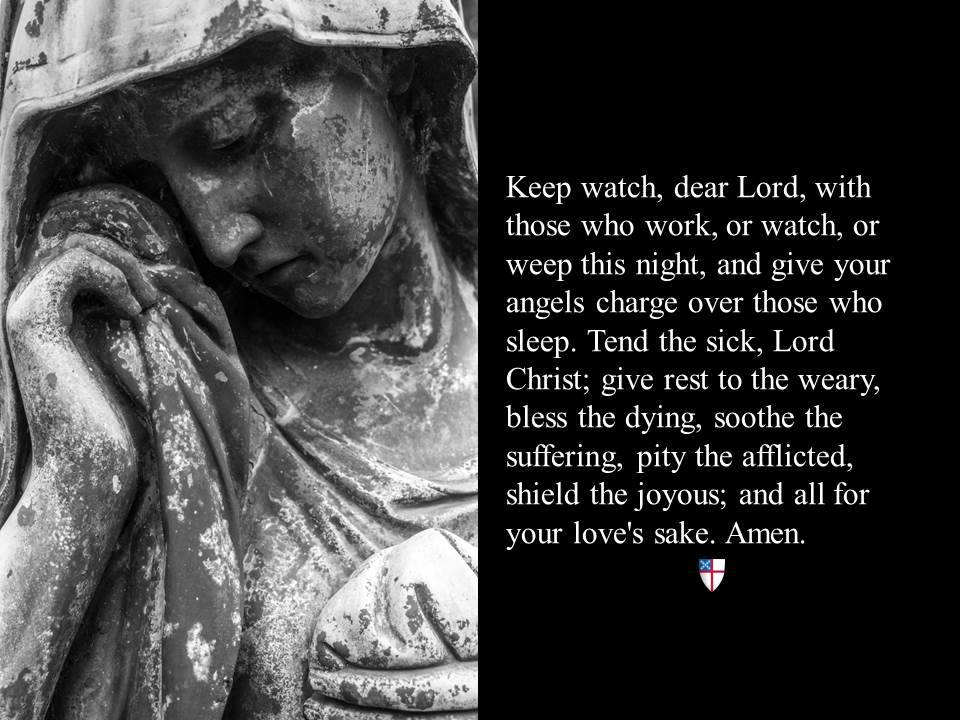
Photo credit: https://www.facebook.com/episcopalian/photos/keep-watch-dear-lord-with-those-who-work-or-watch-or-weep-this-night-and-give-yo/10155444636122925/

This month at Youth Group, before we began our closing prayer, the leader asked us each to name one good thing that had happened in the last week.  Immediately, the brows of each person in the room (adults included) furrowed as we tried to think back about something good in a sea of busyness.  Some of us struggled to remember anything good.  Others immediately burst forth with a fun thing they had gotten to do.  Some shyly shared an accomplishment for which they were proud.  And some were more abstract, like the beauty of the fall foliage.

I was struck by how each one of us in the room had to think quite hard about something good happening in our lives. I do not think we struggled because there is nothing good.  I think we struggled because our brains, or maybe our culture, has wired us to do the opposite – to complain about all the things going wrong, to see only the imperfections in life or in ourselves, to be discouraged by all that could be better in our circles.  A heart of gratitude or joy takes work.  Some of us come by gratitude and joy naturally, but most of us have been enculturated to see where there is want.  That’s why one of our favorite prayers from Compline has a line in its petitions to God for God to “shield the joyous.”[i] 

As we approach Thanksgiving Day next week, I wonder if this year you are still struggling to find the joy.  Maybe you still cannot gather safely with family, maybe you are worried about the safety of the children or the vulnerable in your family, or maybe you are just weary from this time of pandemic.  I suspect many of us are feeling critical of the imperfect and are having a hard time holding on to the perfect(ly good enough). 

My prayer for you this week is that God shields your joy.  But I invite you to consider partnering with God in this endeavor.  Each day until Thanksgiving Day, before you drift off to sleep, think back to one thing for which you grateful, that gave you joy, or was just a good moment.  The goodness does not have to be big or creative.  Start with something basic.  While you engage in this prayerful practice, I will be praying that God shields your joy, and I hope you will share your joy with someone else – so they can be shielded by God too. 


[i] Book of Common Prayer, 134.

Sermon – John 11.32-44, Isaiah 25.6-9, AS, YB, November 7, 2021

17 Wednesday Nov 2021

Posted by jandrewsweckerly in Sermons

≈ Leave a comment

Tags

All Saints Sunday, All Souls Day, death, God, hope, humanity, Jesus, Lazarus, loss, necrology, new life, promise, saint, Sermon, soul, strength, tears, weep

Most Sundays we talk about Jesus’ life and witness and how we can emulate the Son of God.  Many years ago, there was even a campaign with the letters WWJD:  What Would Jesus Do.  But what we rarely talk about is how incredibly hard that ideal is – how hard as everyday humans emulating the Savior, who was both fully human and fully divine, really is.  So, in theory, a day like today should be a relief.  All Saints Sunday is a day we shift gears and talk about emulating people who were fully human.  Of course, that notion is tricky too.  By “saints” the church means those “persons of heroic sanctity, whose deeds were recalled with gratitude by

later generations.”[i]  These are people like St. Francis who shed his every earthly possession and obtained the stigmata, Mother Teresa who nursed this sickest of the sick and poorest of the poor, or even St. Margaret, who slayed her way out of a dragon after being tortured for her faith. 

I think that is why we often conflate All Saints and All Souls Day – the latter being a day when we remember all of those who have died in the hope of the resurrection.  These are the saints or souls who may not have been marked by heroic sanctity, but certainly had an impact on our lives.  These are the moms and dads, the spouses and friends, the children and lovers who may not have always been holy, but certainly taught us about the Christian faith and who we entrusted to the hope of the resurrection as we sat by their deathbeds or mourned their sudden deaths from afar.

We conflate the notion of All Souls Day into All Saints Day because there is something more human about All Souls Day – not only because we can relate to ordinary human life and death, but because the celebration today makes us feel like our humanity can be enough too.  That’s why I love the gospel lesson we get today.  In all the texts about Jesus’ healings, outwitting the challengers, and his ultimate sacrifice for us on the cross, today we get a text about Jesus being very human.  Before the amazing miracle of raising Lazarus from the dead, we are told, very simply, Jesus wept.  Caught up in the grief of his friends Martha and Mary and lost in his own overwhelming sense of loss, Jesus cries; not just a single, artistic tear, but a full-on bout of weeping.  In that solitary moment of grief, Jesus feels deeply, tangibly human.

I do not know about you, but that is what I need from Jesus today.  Later in our service we will list the names of the beautiful souls from Hickory Neck who died in the last year – those who made us laugh, sometimes made us angry, who put a smile on our face, and sometimes made us weep.  In the Prayers of the People, we will pray for the over 750,000 people who have died of COVID in the United States, mourning not just their loss, but the loss of our old “normal” and all that this pandemic has taken from us.  We mourn the ways in which many of the funerals we celebrated in the last year cheated us from each other’s presence – a reality that has still not be fully remedied.  In the midst of what has been a time of significant trauma, we need a Savior who weeps with us – and not just for the dear friend who has died, but also for the fact that his raising Lazarus will soon mean his own death.[ii]

That very gift of Jesus’ humanity today is what empowers us to boldly proclaim hope[iii] in the midst of sorrow, in the midst of trauma, in midst of this strange in-between time.  The words of Isaiah remind us of the promise, the promise that, “the Lord of hosts will make for all peoples a feast of rich food, a feast of well-aged wines, of rich food filled with marrow, of well-aged wines strained clear.  And he will destroy on this mountain the shroud that is cast over all peoples, the sheet that is spread over all nations; he will swallow up death forever.  Then the Lord God will wipe away the tears from all faces, and the disgrace of his people he will take away from all the earth, for the Lord has spoken.  It will be said on that day, Lo, this is our God; we have waited for him, so that he might save us.  This is the Lord for whom we have waited; let us be glad and rejoice in his salvation.”  On this All Saints Sunday, that is our hope for the week – the promise that the Lord God will wipe away tears – because God’s Son has known our tears – and that we will enjoy that rich feast with our loved ones again.  This in-between time is just that – a time in-between where the promise of new life is a rich promise indeed; one that gives us strength for the not-yet time.  Thanks be to God!


[i] Holy Women, Holy Men:  Celebrating the Saints, (New York:  The Church Pension Fund, 2010),664.

[ii] Debie Thomas, “When Jesus Weeps,” October 28, 2018, as found at https://www.journeywithjesus.net/essays/1999-when-jesus-weeps on November 5, 2021.

[iii] Kathryn M. Schifferdecker, “Mourn Loss, Proclaim Faith,” November 1, 2021, as found at https://www.workingpreacher.org/dear-working-preacher/mourn-loss-proclaim-faith on November 5, 2021.

Sermon – Mark 12.28-34, Deuteronomy 6.1-9, P26, YB, October 31, 2021

17 Wednesday Nov 2021

Posted by jandrewsweckerly in Sermons

≈ Leave a comment

Tags

commandments, discomfort, gift, God, grace, Jesus, love, neighbor, perfect, radical, responsive, self, Sermon, shema, silence

In preparation for a mission trip to Honduras, we did a lot of study on the history, politics, and economic development of the country.  Part of that preparation included reading Don’t Be Afraid, Gringo, the story of Honduran woman Eliva Alvarado.  Her story is the story of all campesinos – the poor and oppressed in her country.  Her story is the kind of story that stirs up righteous indignation and makes you want to hop on a plane to go fight for justice.  But in the conclusion of her story, she says to the reader that her ultimate desire is for us to stay where we are.  She does not want her story to inspire us to come there and “fix” things.  Instead, she implores us to fix ourselves – explore our own country’s policies and practices that abet the oppression by the privileged in her country. 

I remember when we got to her conclusion, the team sat in silence for a long time.  You could see the wheels churning in each of our minds – surely, we know what is best, surely we can fix things if we can just get there, surely there is a way around the way this woman has made us feel impotent.  And yet, there was profound truth in her words, and an understanding that to not listen to her final request would be worse than to have not read her words at all.  And so, we sat in pained silence, letting her charge sit uncomfortably with us.

Jesus creates a similar silence at the end of our gospel lesson today.  Jesus has been poked and prodded by one group after another at this point in Mark’s gospel.  In chapter 11, the chief priests, scribes, and elders question Jesus’ authority.  Early in chapter 12, the Pharisees and some Herodians try to trap Jesus with a question.  Finally, some Sadducees question Jesus about a theological issue.  Then today, a scribe asks a “palpably disarming” question – not one to test Jesus, but as one scholar says, an “invitation to the table of theological discourse.”[i]  The conversation today is about the greatest of the commandments. 

Jesus’ response is not new.  In fact, Jesus quotes the shema, the classic text we heard just this morning from Deuteronomy, “Hear, O Israel: The Lord is our God, the Lord alone. You shall love the Lord your God with all your heart, and with all your soul, and with all your might.”  This is a text the Israelites have emblazoned in the minds of their children, and repeated for generations, “Shema Yisrael, Adonai eloheinu, Adonai echad.”  “Hear, O Israel, The Lord is our God, the Lord alone (or the Lord is one).”  Jesus tweaks the answer only slightly from the original shema, adding that we should love the Lord our God with all our mind in addition to all our heart, soul, and strength.  And he adds that we should love our neighbor as ourselves.  But that notion is true to the original commandments as well.  When the scribe agrees with Jesus, saying loving God and neighbor as self is more important than any other ritual of the faith, the crowd falls silent, and we are told “no one dared to ask him any question.”  In other words, “Jesus’ critics were silenced and the effect was momentarily deafening.”[ii] 

So why is the crowd suddenly and dramatically silenced?  What’s the big deal about loving God and neighbor as self?  We talk about these commands all the time.  I mean, Bishop Curry has preached these words more times than I can count.  So why do Jesus’ words shock the room into silence?  One scholar suggests that the silence is so deafening because those gathered understood something about the reality of love that we modern Americans sometimes neglect.  As one scholar explains, “…sometimes — especially in western Christianity — we focus so hard on the emotive and affective aspects of love that we forget its rigor, its robustness, its discomfort.  We assume that loving God and our neighbors means expressing friendly sentiments to God in Sunday worship, and exchanging warm pleasantries with the people who live near us during the week.  We forget that in the scriptures, the call to love is a call to vulnerability, sacrifice, and suffering.  It’s a call to bear a cross and lay down our lives.  Biblical love is not an emotion we feel, it’s a path we travel.  As the children of God, we are called to walk in love. Think aerobic activity, not Hallmark sentiment.”[iii]  An invitation into that kind of radical love – the love of neighbors we would rather not love, the love that is as powerful as the natural, preserving love of self[iv], the love that is a response to the overwhelming love of God for us – that kind of invitation is sobering. 

I remember having read Elvia’s disinvitation to come to Honduras and “fix” things felt like a disempowering, painful rebuffing of love.  But I think I felt that way because we do not get to dictate what love of neighbor looks like.  True love of neighbor is not self-designed but is responsive – responsive to our love of God, and respectfully responsive to the self-articulation of needs by others.  Elvia’s self-articulation was deafeningly silencing the way Jesus’ invitation is too.  As scholar Debie Thomas explains, “Silence is the appropriate first response to the radical love we’re called to.  We dare not speak of [love] glibly.  We dare not cheapen [love] with shallow sentiment or piety.  Rather, [we] ask for the grace to receive [love] as the wise scribe received [love].  In awed and grateful silence.”[v]  Only when we have sat in the uncomfortable silence that recognizes the true love of God and neighbor as self are we ready to take up every perfect gift God has given us and travel the path of love.  Amen.


[i] Cynthia A. Jarvis, “Pastoral Perspective,” Feasting on the Word, Year B, Vol. 4 (Louisville: Westminster John Knox Press, 2009), 262.

[ii] Jarvis, 364.

[iii] Debie Thomas, “Walk in Love,” October 24, 2021, as found at https://www.journeywithjesus.net/lectionary-essays/current-essay?id=2944 on October 29, 2021.

[iv] Victor McCracken, “Theological Perspective,” Feasting on the Word, Year B, Vol. 4 (Louisville: Westminster John Knox Press, 2009), 262.

[v] Thomas.

← Older posts
Newer posts →

Recent Posts

  • On Politics, Football, and Love…
  • On Sharing the Love…
  • Sermon – Micah 6.1-8, Matthew 5.1-12, EP4, YA, January 30, 2026
  • On Justice, Kindness, Humility, and the Messy Middle…
  • Feast of the Rev. Dr. Martin Luther King, Jr., January 18, 2026

Archives

  • February 2026
  • January 2026
  • December 2025
  • November 2025
  • October 2025
  • September 2025
  • August 2025
  • July 2025
  • June 2025
  • March 2025
  • February 2025
  • December 2024
  • November 2024
  • October 2024
  • September 2024
  • August 2024
  • July 2024
  • June 2024
  • May 2024
  • March 2024
  • February 2024
  • January 2024
  • December 2023
  • November 2023
  • October 2023
  • September 2023
  • August 2023
  • July 2023
  • June 2023
  • May 2023
  • March 2023
  • February 2023
  • January 2023
  • December 2022
  • November 2022
  • October 2022
  • June 2022
  • May 2022
  • January 2022
  • December 2021
  • November 2021
  • October 2021
  • September 2021
  • August 2021
  • June 2021
  • May 2021
  • April 2021
  • March 2021
  • February 2021
  • January 2021
  • December 2020
  • November 2020
  • October 2020
  • September 2020
  • August 2020
  • July 2020
  • June 2020
  • May 2020
  • April 2020
  • March 2020
  • February 2020
  • January 2020
  • December 2019
  • November 2019
  • October 2019
  • September 2019
  • August 2019
  • July 2019
  • June 2019
  • May 2019
  • April 2019
  • March 2019
  • February 2019
  • January 2019
  • December 2018
  • November 2018
  • October 2018
  • September 2018
  • August 2018
  • July 2018
  • June 2018
  • May 2018
  • April 2018
  • March 2018
  • February 2018
  • January 2018
  • December 2017
  • November 2017
  • October 2017
  • September 2017
  • August 2017
  • July 2017
  • June 2017
  • May 2017
  • April 2017
  • March 2017
  • February 2017
  • January 2017
  • December 2016
  • November 2016
  • October 2016
  • September 2016
  • August 2016
  • July 2016
  • June 2016
  • May 2016
  • April 2016
  • March 2016
  • February 2016
  • January 2016
  • December 2015
  • November 2015
  • October 2015
  • September 2015
  • August 2015
  • July 2015
  • June 2015
  • May 2015
  • April 2015
  • March 2015
  • February 2015
  • January 2015
  • December 2014
  • November 2014
  • October 2014
  • September 2014
  • August 2014
  • July 2014
  • June 2014
  • April 2014
  • March 2014
  • February 2014
  • January 2014
  • December 2013
  • November 2013
  • October 2013
  • September 2013
  • August 2013
  • July 2013
  • June 2013
  • May 2013
  • April 2013
  • March 2013
  • February 2013
  • January 2013
  • December 2012
  • November 2012
  • October 2012
  • September 2012

Categories

  • reflection
  • Sermons
  • Uncategorized

Meta

  • Create account
  • Log in
  • Entries feed
  • Comments feed
  • WordPress.com

Blog at WordPress.com.

  • Subscribe Subscribed
    • Seeking and Serving
    • Join 395 other subscribers
    • Already have a WordPress.com account? Log in now.
    • Seeking and Serving
    • Subscribe Subscribed
    • Sign up
    • Log in
    • Report this content
    • View site in Reader
    • Manage subscriptions
    • Collapse this bar
 

Loading Comments...