• About

Seeking and Serving

~ seek and serve Christ in all persons

Seeking and Serving

Tag Archives: grateful

On Commitments and Gratitude…

15 Wednesday Oct 2025

Posted by jandrewsweckerly in reflection

≈ Leave a comment

Tags

blessing, commitment, God, grateful, gratitude, joy, list, positive, sight, stewardship, support

Photo credit: https://medium.com/@mnwieschalla/why-you-should-make-a-gratitude-list-every-night-before-bed-fc4a30196af9

One of the tools I use in my line of work is an executive coach.  The coach helps me examine my leadership and develop tools for higher levels of executive functioning.  Sometimes that means troubleshooting a specific challenge I am facing and sometimes that means skill development work.  Each month that we meet, we monitor progress and reflect on newly emerging needs or unresolved issues.  This month the content of our meeting was a little different.  We spent most of the meeting reflecting on things that were going well – successes to celebrate, progress being made, and joys to honor.  As I shared each positive reflection, I was reminded of other things to celebrate.  It was as if the positive news was multiplying, bubbling up as I recalled each source of thanksgiving.

In many ways, that is what we have been inviting our entire congregation to do in this season of stewardship.  Before asking parishioners to consider how they might support ministry with their time, talent, and treasure, first we have been sharing our joys – what good things are happening in our church, what positive impact we are making inside and outside of our church community, and what goodness is motivating our members.  Each bit of sharing has led to more positive, encouraging reflection:  from the mom who really appreciated the elder member sharing about how much he values the formation of children in our church, to the person who still isn’t sure they are an Episcopalian hearing about someone else’s journey to the Episcopal Church through Hickory Neck, to the parishioner who knows the speaker has different views from them but who finds a similar sense of belonging in this unique place.  We have found the sharing of our gratitude begets more gratitude – opens our eyes to the abundance that seems hard to see lately.

This week, as we begin to think about our commitment of support to our church, I invite all of you to start first with gratitude.  What is bringing you joy in your faith community?  What are you grateful for?  What keeps bringing you back?  Start today with a list of three different things for which you are grateful.  Write them down (or make a note in your phone).  Tomorrow, think about three other items, repeating the process each day.  See how the list grows, and watch how your sight begins to widen.  You’re welcome to have your commitment card and forms nearby (or the link from our website open in your tabs), but first, take some time filling your heart with gratitude before filling out the forms with commitments.  Let your commitments pour out of your grateful heart and your conversation with God before sharing those commitments with the community.  I can’t wait to hear how starting with gratitude changes your sight.

Sermon – Luke 17.11-19, P23, YC, October 9, 2022

19 Wednesday Oct 2022

Posted by jandrewsweckerly in Sermons

≈ Leave a comment

Tags

blessing, bountiful, faith, goodness, grateful, gratitude, healing, health, Jesus, praise, Sermon, stewardship, talent, thanks, time, treasure, wholeness

Every once in a while, when we are having a particularly whiny, complaining, cranky evening at the Andrews-Weckerly household, I will break out the old, “So, what are you grateful for today?” question.  I cannot claim that our family has mastered some Zen-like practice of gratitude.  In fact, we still have to regularly remind each other simply to say, “Thank you!”  And if I am being honest, my question about what we are grateful for is a question based out frustration not out of a sense of habituated thankfulness.

I think that is why today’s Gospel lesson from Luke makes me so uncomfortable today.  Jesus graciously heals ten lepers at once with barely a word or flourish.  One of them, a Samaritan to be clear, returns, praising God in a loud voice, prostrating himself at Jesus’ feet, and thanking Jesus.  But Jesus’ response is where my guilt resides. “Were not ten made clean?  But the other nine, where are they?  Was none of them found to return and give praise to God except this foreigner?” Jesus asks.  How many times have I been one of the nine?  How many times have I experienced blessing, only to focus on another ill in my life?  How many times have I been surrounded by bountiful abundance only to be able to talk about scarcity?

For Jesus, this is unfathomable.  For Jesus, faith and gratitude go hand in hand.  Scholar Kimberly Long describes the issue thus, “…to ‘have faith’ is to live it, and to live [faith] is to give thanks.  It is living a life of gratitude that constitutes living a life of faith…One might almost say, in fact, that ‘faith’ and ‘gratitude’ are two words for the same thing:  to practice gratitude is to practice faith.”[i]  Some of you may be thinking, “Oh, to be faithful I just have to be thankful?  That’s not so hard!”  But how many of us have started a gratitude journal only to get out of the habit?  How many of us have engaged in the Ignatian practice of closing the day with enumerating the blessings of the day, giving thanks to God, only to slip into watching one more episode of your favorite show or reading one more chapter of a book, only to slip off to sleep before remembering to give thanks?  How many of us have had New Year’s resolutions or Lenten disciplines about gratitude only to drop them after a few weeks?

But here is why gratitude and faith are so intimately connected.  Jesus says at the end of this passage today, “…your faith has made you well.”  Now if we understand faith and gratitude as being synonymous, then Jesus does not mean because the Samaritan believes something he is healed.  He means because the Samaritan has embodied gratitude he has been made well.  But Jesus is not simply referring to being healed of leprosy.  The Samaritan’s life of gratitude has made him whole – has made him “truly and deeply well.”[ii]  C.S. Lewis perhaps captured the relationship of gratitude and wholeness most clearly.  He said, “I noticed how the humblest and at the same time most balanced minds praised most:  while the cranks, misfits, and malcontents praised least.  Praise almost seems to be inner health made audible.”[iii] 

Of course, this should not be news to us.  Luke’s gospel is always featuring praising.  As one professor explains, “Praising/thanking/blessing/glorifying God is a recurring theme in [Luke’s] writings – from the shepherds in the fields (2.20), to Simeon and Anna at the presentation in the temple (2.28, 38), to witnesses of Jesus’ miracles (5.25, 7.16, 18.43, etc.), to the centurion at the foot of the cross (23.47), and to both Jews and Gentiles who witness the growth of the church in Acts (4.21, 11.18, 13.48, etc.).  It seems, therefore, that Luke recounts this story not to distinguish one leper from the others but to emphasize the proper response to any act of grace:  thanks and praise to God.”[iv]

Luckily for you, Hickory Neck actually grounds you in praise every Sunday.  When we celebrate the Eucharistic feast, the celebrant says, “Let us give thanks to the Lord our God,” and you respond, “It is right to give him thanks and praise.” [or in the case of Rite I, we say, It is meet and right so to do.]  And then the celebrant affirms your words, saying, “It is right, and a good and joyful thing, always and everywhere to give thanks to you, Father Almighty, Creator of heaven and earth.”[v]  [“It is very meet, right, and our bounden duty, that we should at all times, and in all places, give thanks unto thee, O Lord, holy Father, almighty, everlasting God.]   In fact, the entire Eucharist Prayer is also referred to as the “Great Thanksgiving.” Our whole purpose of gathering on Sundays is to enter into praise of God – and as Luke tells us, we do that to make our beings whole – to make our beings truly and deeply well. 

And because we know doing something out of habit can make us forget why we are doing what we are doing, this month we enter into what we call stewardship season – or perhaps what should be called gratitude season.  This month we will be talking about the bountiful goodness we all experience in this community – the ways in which Hickory Neck is a blessing to us, the ways in which Hickory Neck feeds and shapes our faith lives, and the ways in which Hickory Neck helps us be a blessing to others.  In this month of praise and thanksgiving, we will be talking about how to make our praise tangible:  how the gift of our time, the offering of our talents, and the presentation of our financial giving might be acts of praise and gratitude.  This community has been a place where most of us have experienced transformative healing and wholeness.  Our invitation is to follow the example of the Samaritan and let our acts of gratitude become reflections of how Hickory Neck is helping us be truly and deeply well.  Amen.    


[i] Kimberly Bracken Long, “Pastoral Perspective,” Feasting on the Word, Yr. C, Vol. 4 (Louisville:  Westminster John Knox Press, 2010), 166.

[ii] Long, 166.

[iii] As quoted by John M. Buchanan, “Homiletical Perspective,” Feasting on the Word, Yr. C, Vol. 4 (Louisville:  Westminster John Knox Press, 2010), 165.

[iv] Oliver Larry Yarbrough, “Exegetical Perspective,” Feasting on the Word, Yr. C, Vol. 4 (Louisville:  Westminster John Knox Press, 2010), 169.

[v] BCP, 361.

On Shielding and Sharing Joy…

17 Wednesday Nov 2021

Posted by jandrewsweckerly in reflection

≈ Leave a comment

Tags

complain, compline, God, goodness, grateful, gratitude, imperfection, joy, joyous, perfection, prayer, shield, Thanksgiving

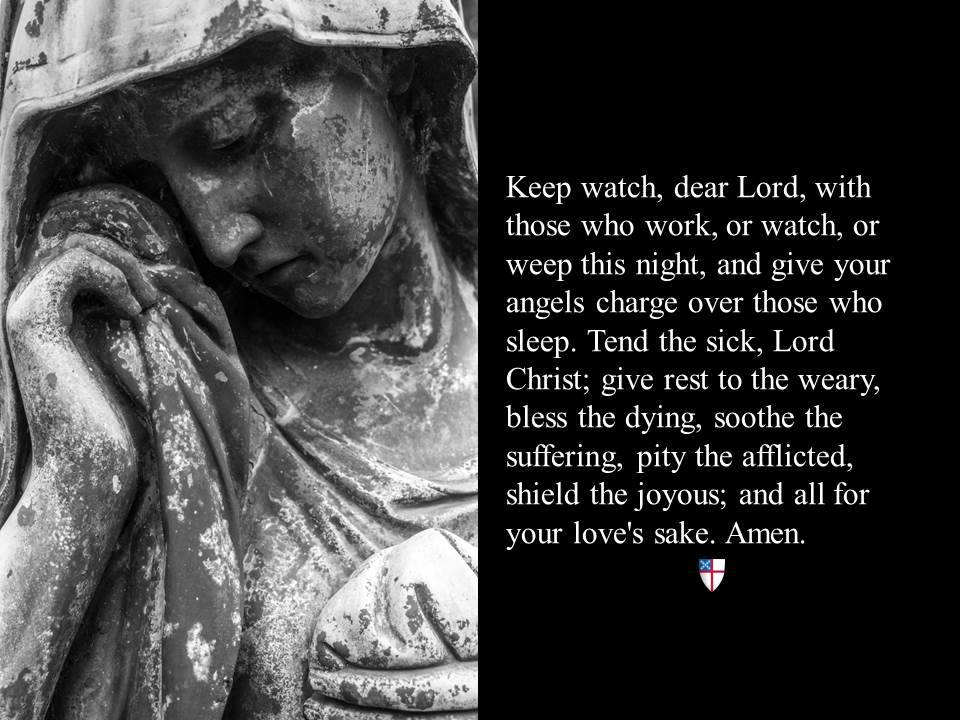
Photo credit: https://www.facebook.com/episcopalian/photos/keep-watch-dear-lord-with-those-who-work-or-watch-or-weep-this-night-and-give-yo/10155444636122925/

This month at Youth Group, before we began our closing prayer, the leader asked us each to name one good thing that had happened in the last week.  Immediately, the brows of each person in the room (adults included) furrowed as we tried to think back about something good in a sea of busyness.  Some of us struggled to remember anything good.  Others immediately burst forth with a fun thing they had gotten to do.  Some shyly shared an accomplishment for which they were proud.  And some were more abstract, like the beauty of the fall foliage.

I was struck by how each one of us in the room had to think quite hard about something good happening in our lives. I do not think we struggled because there is nothing good.  I think we struggled because our brains, or maybe our culture, has wired us to do the opposite – to complain about all the things going wrong, to see only the imperfections in life or in ourselves, to be discouraged by all that could be better in our circles.  A heart of gratitude or joy takes work.  Some of us come by gratitude and joy naturally, but most of us have been enculturated to see where there is want.  That’s why one of our favorite prayers from Compline has a line in its petitions to God for God to “shield the joyous.”[i] 

As we approach Thanksgiving Day next week, I wonder if this year you are still struggling to find the joy.  Maybe you still cannot gather safely with family, maybe you are worried about the safety of the children or the vulnerable in your family, or maybe you are just weary from this time of pandemic.  I suspect many of us are feeling critical of the imperfect and are having a hard time holding on to the perfect(ly good enough). 

My prayer for you this week is that God shields your joy.  But I invite you to consider partnering with God in this endeavor.  Each day until Thanksgiving Day, before you drift off to sleep, think back to one thing for which you grateful, that gave you joy, or was just a good moment.  The goodness does not have to be big or creative.  Start with something basic.  While you engage in this prayerful practice, I will be praying that God shields your joy, and I hope you will share your joy with someone else – so they can be shielded by God too. 


[i] Book of Common Prayer, 134.

Sermon – Matthew 15:10-28, P15, YA, August 20, 2017

23 Wednesday Aug 2017

Posted by jandrewsweckerly in Sermons, Uncategorized

≈ Leave a comment

Tags

blessing, Canaaanite woman, chosen, discomfort, dog, Gentile, God, grateful, insight, Jesus, Jew, mean, mercy, redemption, rude, Sermon, ugly

I have never really liked the story we hear from our gospel lesson today.  Every time I have heard or read the story of Jesus’ interaction with the Canaanite woman, I cringe.  I do not like the way Jesus ignores the woman.  I do not like the way Jesus then tries to dismiss her – not only because his dismissal is rude, but also because he is being exclusive, saying that his ministry is only for chosen of God.  And I especially do not like the way Jesus not only calls her a dog, but also basically treats her like a dog.  This is not the Jesus I know.  And I am pretty sure that this is not what the slogan designers meant when they asked, “What would Jesus do?”

But the real problem with this story, the problem that I do not like to talk about, is Jesus’ ugly behavior reminds me of all the times I have acted in a similarly ugly way.  Most of the time, my ugly behavior is well-intentioned or even justifiable.  When I see a homeless person or someone begging for money, and I know that I have nothing to give them that day, I have honed the art of avoiding eye contact.  Or, when I am not protected by the rolled-up windows of my car, and a similar person asks me directly for help, I have figured out my patented response, “Sorry I do not have any cash;” which is sometimes true, but is often a lie.  I do have cash, but I feel awkward explaining that I give to agencies that make a difference for people like them to protect me from having to have this very same engagement.  Or I have had countless conversations with people I have helped through the church’s discretionary fund, only to have to say “no” when they show up two weeks later because, as I clearly communicated, we have a policy of helping people not more than once every six months.

Now I can completely explain all the reasons for the things I do:  I am a petite woman, so avoiding engagement with what could be a volatile, unstable person is generally a good practice; I have created a framework for giving which makes a difference, but also makes me feel more comfortable; I have a system for our emergency assistance program because I need to make sure the church’s discretionary fund supports as many people as possible, and as fairly as possible.  All of those explanations are good, and they exhibit healthy boundary-drawing.  In fact, I have had multiple conversations over the years when each of those decisions has been labeled as smart, intentional, and fair.  And yet, when I am in the midst of each of those types of scenarios, the execution of those smart decisions still feels ugly.  I feel like I am actually following that slogan, “What would Jesus do,” when I am in the midst of ignoring, explaining why I cannot help, or firmly drawing a boundary with someone who is being too pushy.  But instead of following the Jesus we find in our passage today and feeling good about myself, I am left with a sense of discomfort.

So, if I feel uncomfortable with my actions, and I especially feel uncomfortable with this version of Jesus that we find in Holy Scripture, why is this story in scripture at all?  And why, of all the texts they could have included, did the designers of our lectionary demand that we hear this particular passage?  Let’s start with the first question – why this story is in scripture at all.  The good news is that this scripture, despite all its ugliness and discomfort is important.  Jesus is sent to the people of God with a very specific mission:  to initiate God’s purposes for God’s people.  God had promised long ago to send a messiah to save God’s people.  Jesus is now enacting that mission.  Jesus has been clear all along that God’s mission starts with God’s people.  In Matthew’s gospel, when Jesus sends out the disciples the first time, Jesus tells the disciples to go only to the house of Israel, not to be distracted by the Gentiles, or non-Jewish peoples.  He is not necessarily being exclusive.  Jesus knows that the people of Israel are going to be a blessing to all people, including the Gentiles.  But the first job is to get the people of Israel on board – to help them understand that the messiah is here and the reign of God is beginning.[i]

The problem for Jesus, and perhaps the reason why we find Jesus the way we find him today, is that the people of God are not listening.  They are throwing Jesus out of towns, they are arguing with him about the following of laws instead of seeing the fulfillment of the law, and they are faltering in their faith.  Just last week we watched as Peter sunk into the sea.  Today, Jesus is moving on to Tyre and Sidon because his people have kicked him out of town.  And all of that stuff we heard today about what defiles a person being what comes out of the mouth, not what goes in, is an argument about getting so caught up in the letter of the law that one cannot see how one is violating the spirit of the law.  So here Jesus is, beating his head against a wall, with the people of God refusing to understand or listen to him, when a woman from a country his people oppose says very simply, “Lord, Son of David.”  The people of God, the leaders of the people of God, even the disciples of God do not get who Jesus is.  But this unclean, foreign, woman – so a triple outcast – gets who Jesus is.

So, we can imagine that Jesus is feeling a little raw – in a sea of rejection, the affirmation of this lowly outsider may not have been enough to draw him out of his funk.[ii]  Fair enough.  But the woman persists.  Jesus lets down his guard a little bit, and instead of ignoring her explains he is not trying to be rude, but he has been sent on a mission that entails him proceeding in a particular manner – Jews first, Gentiles later.  But the woman persists again.  And frazzled, rejected Jesus, who has tried to politely ignore, then perhaps politely explain, snaps and asserts his boundary.  “The good news is just not ready for Gentiles, okay?”  But the woman persists again.  She takes Jesus’ nasty words and she transforms them.  She takes that belittling label “dog,” and puts the label right in front of Jesus.  She does not want to wait for Easter.[iii]  She does not want to wait for the people of God to wake up.  She wants her blessing, the blessing that God eventually intends anyway, to start.  Right now.

And Jesus does that beautiful, awful thing we all hate to do.  Jesus admits he is wrong.  He heals her daughter, seeing in the persistence of this woman that he has gotten so caught up in the proper process and the appropriate boundaries that he has limited the power of the gospel and the reach of the good news.

The last two weeks I have been working on a request for financial assistance.  The person needed rental assistance, and the case had been fully vetted.  I knew Hickory Neck could not cover the full rental payment, so I offered to collaborate with some other churches.  Now any of you who have ever tried to collaborate know that although collaboration is good, collaboration is never simple nor fast.  So this week, the case came back around because the deadline is rapidly approaching.  I explained where we were and how I needed to get back to the churches I had invited to help.  The person I had been working with finally snapped and said, “You guys are all wrapped up in all these protests over something that happened hundreds of years ago.  But when the effects of racism are staring you in the face, and you can actually do something about it, you can’t seem to move!”  I felt like I had been slapped in the face.  Here I was following my process, staying with in the reasoned boundaries I have created, working creatively to solve the problem, while also being quite passionate about and wanting to work on correcting the sin of racism that our whole country is addressing since Charlottesville last weekend.  And here was a Canaanite woman, a Gentile calling me out – pushing me out of the theoretical, or the master plan, and asking me to look her in the face and explain why the fulfillment of God’s promise cannot happen today.

We do not like this story today because Jesus is dismissive, rude, and mean.  But mostly we do not like this story because Jesus’ story reminds us of the times we have been dismissive, rude, or mean.  We can claim that we do not like how Jesus behaves in this story, but really we do not like how Jesus is a mirror of our own behavior in this story.  And for that reason, I am grateful for the discomfort today.  I am grateful for the ways in which I am squirming today because something tremendous happens when Jesus gets uncomfortable today.  When Jesus gets slapped in the face by the Canaanite woman, he wakes up.  He stops, sees, and hears her.  And he changes course.  This lowly triple-outcast changes the ministry of Christ forever.  No longer is Jesus doggedly sticking to the plan of the redemption of Jews followed by the redemption of Gentiles.  Jesus mercy and mission get wider, right in this very moment.[iv]  Jesus’ wide arms of mercy, love, and grace spread just a bit wider, eventually being spread so wide that they fit onto the cross.

Our invitation today is to let our arms start moving to the same position.  I do not know who the Canaanite women are in your lives.  I do not know if your heart needs softening on racism, on sexism, or on some other -ism.  I do not know if you heart needs softening on some other person or group you have deemed beyond redemption.  I do not know if your heart needs softening by the person whose eyes you are avoiding.  But our invitation today is to recognize that our dismissiveness, our exclusion, our boundary-drawing is already in line with what Jesus would do.  Now Jesus is inviting us to keep doing what Jesus would do and to change our minds – to do better, to behave better, to be better.  Stretching our arms that far wide will be hard.  But the promise of transformation is much more powerful than anything we have imagined.

[i] N. T. Wright, Matthew for Everyone, Part 1 (Louisville:  Westminster John Knox Press, 2004), 199-200.

[ii] Barbara Brown Taylor, The Seeds of Heaven:  Sermons on the Gospel of Matthew (Louisville:  Westminster John Knox Press, 2004), 62.

[iii] Wright, 201.

[iv] Brown Taylor, 64-65.

Participating in Gratitude…

02 Wednesday Nov 2016

Posted by jandrewsweckerly in Uncategorized

≈ Leave a comment

Tags

blessed, cycle, generosity, gift, God, grateful, gratitude, note, sacred, thanks, Thanksgiving

thank-you-note

Photo credit:  https://fastcompany.com/3057431/hit-the-ground-running/heres-what-to-write-in-your-thank-you-after-a-job-interview

In honor of Thanksgiving Day at the end of the month, a trend has developed that uses the entire month of November as a month of gratitude.  The practice has several forms:  journaling about at least five things for which you are grateful every day; posting daily on Facebook a note of gratitude; or using Instagram or other outlets to post a daily photo of something for which you are grateful.  The practice is quite spiritually based.  I have had countless spiritual directors who have encouraged me to use gratitude as a discipline for my prayer life – using the end of the day to give thanks for things in life as opposed to our natural tendency to look back at the day and make mental note of all the things that went unaccomplished or were hurtful to ourselves or others.

This past Sunday we gathered our pledges for the upcoming calendar year.  Each year in the Episcopal Church, parishioners are asked to fill out a pledge card, letting the Vestry, or governing board, know how much income can be expected so they can formulate a budget.  The pledge cards certainly serve a practical purpose.  But their use can also serve a deep spiritual purpose.  As I blessed three different baskets of pledge cards on Sunday, I had the thought that each of those baskets were like piles of thank you notes to God – a way of articulating how blessed we are and how grateful we are for the resources we have and our ability to share and support ministry with those resources.  Each card held a story – a story of someone who feels connected to and passionate about Hickory Neck, who has been nurtured and challenged in this place, who has a unique life story, and who has encountered Christ here.  As I thought of the conversations, prayers, and reflections those cards represented, I could not help but smile.  There is something quite beautiful in witnessing the intimate, vulnerable exchange between God and parishioner.  I felt privileged to bless that sacred act.

In the coming weeks, I have the privilege of entering into that sacred space of thanksgiving and gratitude.  I have the task of thanking each pledging member.  When the Stewardship Committee and I first talked about the campaign, we joked about whether my hand would be able to survive writing so many notes.  There may be times my hand actually does get sore, but so far, I am nothing but grateful to be writing those notes.  I have found that writing them has been a tremendous time of blessing – an opportunity for me to pray for each parishioner, to thank God for the gift of them to our community, and to send my blessings upon them.  The “duty” has become an incredible gift that keeps the cycle of gratitude going.

How are you participating in the cycle of gratitude?  In what ways do you cultivate a spirit of generosity, passing your sense of gratitude and blessing on to others?  I look forward to hearing how you are participating in the cycle, and how God is using you to bless others.

Sermon – Luke 17.11-19, P23, YC, October 9, 2016

12 Wednesday Oct 2016

Posted by jandrewsweckerly in Sermons, Uncategorized

≈ 1 Comment

Tags

church, compliment, duty, generously, giving, grateful, gratitude, guilt, Jesus, joy, leper, living, obligation, pledge, practice, praise, Sermon, stewardship, Thanksgiving, transformation, turning

I once knew a man who was impossible to compliment.  Whether you wanted to compliment a job well done or good deed, his response was always the same, “It’s not me.  All the glory goes to God.”  His response always left me feeling like I just offered a present that was rejected.  Of course, I totally agreed with what he was saying – none of us is able to do good without the God who empowers us to do so.  And truly, Jesus was not that great at accepting compliments either, especially if you recall all the times he asked people to keep a healing secret or to just go back to work.  But upon receiving a compliment, a simple, “Thank you,” would not have hurt this man.  After a while, I just stopped trying to praise his work or good deeds.

I think that is why I relate to the nine lepers who do not return to Jesus to give him thanks and praise.  There were ten lepers originally – nine who were Jewish and one who was a Samaritan.  We are not sure why the ten are together – the Jews and the Samaritans were enemies and rarely spent time together.[i]  We are told at the beginning of the text that Jesus was passing through a borderland between Samaria and Galilee, so there is a possibility that then ten men banded together through their disease instead of culture.  You see, both Samaritans and those of Galilee would have been seen as impure due to their leprosy.  Being exiled to the borders of their land, they may have found more in common than divided them.  And so, as a group, they shout out to Jesus for healing – careful not to approach him, of course, which would have been improper in their condition.  Respecting their distance, Jesus does not insist they come forward, but instead tells them to go to the priest to show themselves to be healed.  Along the way, they are healed, but they still would have needed to show a priest in order to be restored to their families and friends.[ii]

The Samaritan among them returns and gives praise to God, but the others do not.  We do not know how their journey unfolds.  Presumably they are faithfully doing what Jesus told them to do – going to the priest for restoration.  Perhaps they give praise to God once the priest restores them.  Perhaps they give praise when they are reunited with their families.  Maybe they even show their praise through helping lepers later.  But that is all supposition.  All we get today is Jesus’ criticism of the nine because they neglect to turn and give God praise and thanksgiving.

I have been reflecting on Jesus’ words this week, and what rubs me the wrong way may be the same thing that rubbed me the wrong way when that man I knew always refused praise.  In both cases, whether Jesus, or the man I knew, there is both implicit and explicit criticism of my own practice of gratitude and thanksgiving.  What irritated me about the man’s responses to me was that they made me feel guilty – that perhaps I was not grateful enough to God for the goodness in my life.  The same thing irritates me about Jesus this week – his judgment of the nine makes me feel guilty about the ways I have walked away healed and not given praise to God.

This week we are kicking off our stewardship season in a campaign called, “Living Generously.”  After the service, you will be receiving a packet of information about how you can support the ministry of Hickory Neck, and a pledge card that we will collect in a celebratory ingathering in just four weeks.  Most preachers would have read the text today and thought, “Yes!  The perfect Stewardship text!”  But the more I sat with Jesus’ words, the more I realized that his words actually bring up feelings of dread rather than joy.  Most people associate stewardship with the same sense of guilt that this reading brings up.  We feel guilted into showing gratitude, and so we guiltily look at our budgets and see if we can increase our pledge this year.

The first time I experienced the concept of pledging was when I started regularly attending an Episcopal Church.  In the churches where I grew up, you never had to tell anyone what you were going to give.  The preacher might have talked about a tithe – ten percent of your income.  But the preacher never wanted you to say exactly what you were going to give.  So when the warden of this church started explaining how he wanted us to pledge, I was aghast.  I remember thinking, “That’s private!  I don’t have to tell you how much I am going to give!”  Now, I knew we would probably tithe that year, but the idea of telling someone else about my giving seemed to go against every cultural norm I knew.  Fortunately, I stayed to hear the rest of the warden’s talk.  He explained that the way the church formed the church’s budget was through the knowledge of what income they could expect.  The Vestry would adjust expenses accordingly and try to get the budget balanced.  My outrage faded as I realized how responsible that model seemed.  Thus began my adult journey into pledging.

But that journey into pledging experienced a transformation about eight years later.  We were at a new church, and the priest asked to hold our pledge cards until a particular Sunday.  We did and the funniest thing happened.  In the middle of the service, a banner appeared.  The banner was processed down the aisle, joyful music started playing, and people started following the banner forward.  We placed our pledge in a basket, and I felt something stirring in me.  The priest blessed the pile of pledge cards, and something about stewardship turned in my heart – the pledging, the monthly giving was no longer an obligation or burden – something to be guilted into.  My pledge was a joyful sign of gratitude – a sign blessed by God and affirmed by the community.  And I have to say – it felt good!

In the gospel lesson today, the text says that the Samaritan turns back to Jesus.  That word for turns back is more than just a physical description – the action of turning back is a sign of deep transformation – a reorienting of the Samaritan’s life from duty to gratitude.[iii]  I do not think Jesus was looking for a guilty admission of thanks from the other nine lepers.  What Jesus is looking for is a transformation of the heart – a turning of one’s life away from obligation and duty to joyful gratitude and thanksgiving.

I was reading this week about a woman with an interesting habit.  Whenever someone asked her how she is – that basic question we always ask and anticipate the answer being, “Fine,” – instead she would say, “I’m grateful.”  No matter what is on her plate – stress at work or school, an illness that kept plaguing her, strife at home – her response is always the same, “I’m grateful.”[iv]  As I thought about her response this week, I realized that her response is probably one that took willful practice.  I am sure there were weeks when she really felt grateful.  But there were also probably weeks when she had to say she felt grateful even if she was not sure what there was to be grateful about.  But slowly, slowly, I imagine the practice cultivated a spirit of gratitude.  A practice like that can do exactly what Jesus wants for us all – a turning of the heart to praise and thanksgiving.  I know I will never be able to shift toward the kind of response that the man I knew always gave, rejecting praise altogether.  But learning to say, “I’m grateful,” might be a way for me to get a little closer to the same sentiment.

What that woman is doing, what Jesus is encouraging, and even what our Stewardship campaign is inviting is not a sense of guilt or burden, but a genuine invitation into a life that turns our heart to gratitude and transforms the way we see the world.  Now that does not mean that every time you write the check to fulfill your pledge you will part from that treasure with a joyful heart.  But that practice is a small invitation, every time, for us to turn our hearts and to see not only the God from whom all blessings flow, but to even see the blessings in the first place.  Jesus is not mad at those lepers because they are ungrateful – he is sad for them because they have denied themselves the gift of transformation.  That is the gift that he and the Church offer us every week – the gift of a transformed heart that can change everything.  For that, I’m grateful.  Amen.

[i] Audrey West, “Commentary on Luke 17.11-19,” October 9, 2016, as found at https://www.workingpreacher.org/preaching.aspx?commentary_id=3029 on October 5, 2016.

[ii] Oliver Larry Yarbrough, “Exegetical Perspective,” Feasting on the Word, Yr. C, Vol. 4 (Louisville: Westminster John Knox Press, 2010), 169.

[iii] Margit Ernst-Habib, “Theological Perspective,” Feasting on the Word, Yr. C, Vol. 4 (Louisville: Westminster John Knox Press, 2010), 166.

[iv] David Lose, “Pentecost 21C:  Gratitude and Grace,” October 3, 2016, as found at http://www.davidlose.net/2016/10/pentecost-21-c-gratitude-and-grace/ on October 5, 2016.

On Father’s Day…

17 Wednesday Jun 2015

Posted by jandrewsweckerly in Uncategorized

≈ Leave a comment

Tags

complicated, conflicted, father, Father's Day, God, grateful, honor, obligation, painful, parent, redeem

In general, I am opposed to “Hallmark Holidays.”  I learned a long time ago on Valentine’s Day how consumerism fueled by one stationery company (and let’s be honest, the restaurant industry, floral industry, chocolate industry, jewelry industry…) could make a person feel invalidated, lonely, or dissatisfied.  As with any consumerism, there really is no one thing that we purchase that can fill a void in our egos and hearts.  And so I stopped wanting an amazing Valentine’s Day and started trying to affirm my loved ones as often as possible on the other days.

The same is true for Mother’s and Father’s Day.  An industry has told us how and when we should specifically honor our mothers and fathers and any resistance makes one seem ungrateful and disrespectful.  Like with Valentine’s Day, I would much rather work intentionally on showing gratitude towards my parents as often as possible – and as a parent myself, I find that my gratitude is much easier to give now that I understand the fullness of their sacrifices, challenges, and struggles to love me in the best ways they knew and know how.

That being said, what really burdens me about Mother’s and Father’s Day is the ways in which they are fraught with emotion.  Not everyone has positive relationships with their parents.  Not everyone has two active parents in their lives.  Not everyone has living parents.  And some of us experience extremes in those areas – parents who were hurtful, abusive, or absent.  But what I had forgotten about until this week is that there are also men who want to be fathers and cannot.  Women are not the only victims of infertility, miscarriage, and infant loss.  So are men.  For those men who have longed to cradle a baby in their arms, to throw a baseball in the front yard with their child, or have a meaningful relationship with their child, Father’s Day is an equally painful day.  And because of the way that we socialize most men, there is rarely a forum for such a vulnerable conversation.  I was humbled by that realization when I read this poem this week:  http://projectpomegranate.org/2015/faith-hope-and-love/.  It gives more voice to that pain than I ever could.

Photo credit:  http://www.thegospelcoalition.org/article/when-fathers-day-hurts

Photo credit: http://www.thegospelcoalition.org/article/when-fathers-day-hurts

Once again, I am conflicted about Father’s Day.  For the wonderful father and step-father I have been blessed with and the amazing husband and father who is helping me raise our girls, I am eternally grateful.  For all the men who have been mentors and companions on my journey, and for those who are amazing dads to their children, I am equally grateful.  I am also mournful for all those who suffer because of the fraught relationships they have had with their fathers.  I grieve with all those men who want to be fathers and have not been able to conceive.  And I stand with all those fathers who recognize their faults and failures and long to be better versions of themselves.  Father’s Day is a complicated mess.  And so this year, I hold all of us in prayer, as we sort through the complicatedness of life, honor the good, recognize the bad, and celebrate our God who can redeem us all.

For the beauty of the earth…

23 Thursday Apr 2015

Posted by jandrewsweckerly in Uncategorized

≈ Leave a comment

Tags

blessed, blooms, creation, earth, God, grateful, spring, stewards, winter

This winter on Long Island was particularly rough.  We went months without seeing the grass – months!  I have friends on Facebook who live all over the country and I remember seeing their pictures of kids playing in the grass in March, and I was so jealous.  That experience of hunkering down through all the snow and ice accumulation left most of us here on Long Island feeling weary and listless.

But this past week, I feel like I have been brought back to life.  Daffodils are in full bloom, the forsythia finally emerged, tulip trees are opening, and not only is there grass, there is also that bright green grass that only comes out in spring.  I feel like I can finally breathe.  There is a lightness that comes with spring, and that lightness is even more potent after a long, arduous winter.

Photo credit: http://ideastations.org/watch/virginia-home-grown/tips-richard-prune-spring-blooming-plants

Photo credit: http://ideastations.org/watch/virginia-home-grown/tips-richard-prune-spring-blooming-plants

This morning at Eucharist we prayed, “For seasonable weather, and for an abundance of the fruits of the earth…For the good earth which God has given us, and for the wisdom and will to conserve it, let us pray to the Lord.”  Having just had Earth Day yesterday, watching our church’s community garden slowly sprout its early crop, and seeing spring unfold has given me a new appreciation of the gift of God’s creation.  Snow can be beautiful in its own right, but after a long winter, I am especially amazed at the bountiful and beautiful gift of God’s earth that one sees in spring.  And I am honored that God has invited us to be stewards of that earth.  As God’s earth is bursting forth with life, I find myself bubbling with new life and joy.  But mostly I feel grateful: grateful for this beautiful earth, our island home; grateful for a God who entrusts that earth to us; and grateful for how each new color and bloom reminds me of the beauty and grace surrounding me every day.  Thank you Mother Earth.  Thank you spring blooms.  Thank you God, for forming this beautiful earth out of a formless void.  We are blessed beyond measure and we promise to be the good stewards You would have us be!

Recent Posts

  • On the Myth and Magic of Advent…
  • On Risking Failure and Facing Fear…
  • Sermon – Luke 23.33-43, P29, YC, November 23, 2025
  • On Inhabiting Gratitude…
  • Sermon – Luke 20.27-38, P27, YC, November 9, 2025

Archives

  • December 2025
  • November 2025
  • October 2025
  • September 2025
  • August 2025
  • July 2025
  • June 2025
  • March 2025
  • February 2025
  • December 2024
  • November 2024
  • October 2024
  • September 2024
  • August 2024
  • July 2024
  • June 2024
  • May 2024
  • March 2024
  • February 2024
  • January 2024
  • December 2023
  • November 2023
  • October 2023
  • September 2023
  • August 2023
  • July 2023
  • June 2023
  • May 2023
  • March 2023
  • February 2023
  • January 2023
  • December 2022
  • November 2022
  • October 2022
  • June 2022
  • May 2022
  • January 2022
  • December 2021
  • November 2021
  • October 2021
  • September 2021
  • August 2021
  • June 2021
  • May 2021
  • April 2021
  • March 2021
  • February 2021
  • January 2021
  • December 2020
  • November 2020
  • October 2020
  • September 2020
  • August 2020
  • July 2020
  • June 2020
  • May 2020
  • April 2020
  • March 2020
  • February 2020
  • January 2020
  • December 2019
  • November 2019
  • October 2019
  • September 2019
  • August 2019
  • July 2019
  • June 2019
  • May 2019
  • April 2019
  • March 2019
  • February 2019
  • January 2019
  • December 2018
  • November 2018
  • October 2018
  • September 2018
  • August 2018
  • July 2018
  • June 2018
  • May 2018
  • April 2018
  • March 2018
  • February 2018
  • January 2018
  • December 2017
  • November 2017
  • October 2017
  • September 2017
  • August 2017
  • July 2017
  • June 2017
  • May 2017
  • April 2017
  • March 2017
  • February 2017
  • January 2017
  • December 2016
  • November 2016
  • October 2016
  • September 2016
  • August 2016
  • July 2016
  • June 2016
  • May 2016
  • April 2016
  • March 2016
  • February 2016
  • January 2016
  • December 2015
  • November 2015
  • October 2015
  • September 2015
  • August 2015
  • July 2015
  • June 2015
  • May 2015
  • April 2015
  • March 2015
  • February 2015
  • January 2015
  • December 2014
  • November 2014
  • October 2014
  • September 2014
  • August 2014
  • July 2014
  • June 2014
  • April 2014
  • March 2014
  • February 2014
  • January 2014
  • December 2013
  • November 2013
  • October 2013
  • September 2013
  • August 2013
  • July 2013
  • June 2013
  • May 2013
  • April 2013
  • March 2013
  • February 2013
  • January 2013
  • December 2012
  • November 2012
  • October 2012
  • September 2012

Categories

  • reflection
  • Sermons
  • Uncategorized

Meta

  • Create account
  • Log in
  • Entries feed
  • Comments feed
  • WordPress.com

Blog at WordPress.com.

  • Subscribe Subscribed
    • Seeking and Serving
    • Join 394 other subscribers
    • Already have a WordPress.com account? Log in now.
    • Seeking and Serving
    • Subscribe Subscribed
    • Sign up
    • Log in
    • Report this content
    • View site in Reader
    • Manage subscriptions
    • Collapse this bar
 

Loading Comments...