
• About

Seeking and Serving

~ seek and serve Christ in all persons

Seeking and Serving

Tag Archives: Jeremiah

Sermon – Jeremiah 31.31-34, Psalm 51.1-13, L5, YB, March 17, 2024

27 Wednesday Mar 2024

Posted by jandrewsweckerly in Sermons

≈ Leave a comment

Tags

blessing, covenant, Easter Vigil, failing, God, heart, Jeremiah, Lent, lovingkindness, salvation narrative, Sermon, share

In just a couple of weeks, Hickory Neck will gather for what is my favorite service of the entire year:  the Easter Vigil.  Now I know, you may be thinking, “But what about Easter Sunday?” or even “But Christmas Eve is the best!”  For me, the very best of the Episcopal Church happens at the Easter Vigil.  The lights are turned down low, a fire erupts as we sing the haunting Exultet, we read stories from scripture that feel like the ones you would tell around a campfire, we baptize new Christians, and then, with bells and singing, the lights come up as we ring in Easter.  The rest of the service feels like celebrating Eucharist for the first time – with the news of the empty tomb and feasting at the family table.

Part of why I love the service so much is those stories we hear by the fire:  what we often refer to as the salvation narrative.  In these stories we hear how we were created in God’s image and made for goodness, and then we hear how time and again we fail to live up to that goodness, but time and again, God meets us where we are, renewing God’s covenantal relationship with us, forgiving us, and getting us back on our feet to serve the world in God’s name.  The repetition of God extending that grace again and again and again, no matter how grave our failings, can make any participant begin to think that maybe, just maybe, we stand invited to receive that hesed or as we translate the Hebrew, that lovingkindness, of God.

Although we do not hear the text from Jeremiah on Easter Vigil night, today, on this fifth Sunday in Lent, just a week before we start the descent into the cross and the grave of Holy Week, we get one last reminder of the kind of redemption that waits on the other side of Easter.  I do not how recently you’ve been reading Jeremiah in your spare time, but just as a refresher, Jeremiah is one of those books that is generally filled with bad news.  Israel disobeyed the law of God, and, as a consequence, they are overthrown by outside forces, the walls of Jerusalem fall, the temple is destroyed, and the Israelites themselves are banished to Babylon.  The situation is bleak, and the prophet Jeremiah has a lot to say in judgment of the people.[i] 

But today, all the way in chapter 31, we get what is called “The Book of Comfort,”[ii] in Jeremiah where, after much shame and judgment, the people are promised a new day where there will be a new covenant between God and the people.  This time, they won’t have to wait for teaching, and they won’t have to store the commandments in a holy place.  The holy word of God will be written on their hearts – able to go with them anywhere, to be not just in their minds or in their temple, but on their very souls – they will be God’s and God’s will be theirs.  For a people utterly destroyed, who have lost their spiritual home in addition to their literal home, this is good news indeed.

When I was in seminary, we went to Chapel everyday – sometimes multiple times a day.  The rhythm of regular worship meant that not only did the liturgy get written into your body, so did the space.  You began to know the particulars of certain seats – which ones experienced more of a draft and which pew had someone’s initials carved in and aged over.  You knew how certain steps would creak when someone would ascend the lectern and you have seen the pulpit sway with a particularly vigorous preacher.  But mostly, you had stared, for years at a time, at the window behind the altar, around which were painted the words, “Go ye into all the world and preach the gospel.”  Consciously and maybe more subconsciously, those words became ingrained in our minds seeing them every day. 

A year and a half after I graduated, that chapel burned down, along with that wall that had been seared into my mind.  I remember feeling bereft – like a part of me had died with the loss of that building.  Even today, when I visit the campus, worshiping in the beautiful new chapel, I still grieve when I see the preserved ruins where an outdoor altar remains.  It took me a long time to realize that although my heart ached for the physical space, those words – those words that Jesus spoke, “Go ye into all the world and preach the gospel,” were gone from the world – but not from my heart.  Though I might miss the building – in the same way so many of us missed the buildings of this campus in those early years of the pandemic, the experience of God is written in my heart.

As we walk this last week of Lent, and as we begin next week to walk steadily through Holy Week, perhaps with sins weighing on our hearts, or feelings of being a failure at faith or at life in general, or even just the restlessness that can come when we find ourselves disconnected from any kind of relationship with God, our worship today is all about renewing that covenantal relationship with God.  Even in our psalm today, we prayed, “Create in me a clean heart, O God, and renew a right spirit within me.” – those same words a priest prays before she consecrates the sacred meal.  The psalm tells us the very nature of our God is “steadfast love and abundant mercy, a God who is eternally ‘for us’ with the endless love of a mother for her child.  The God who is everlasting love will never abandon us, no matter what our guilt says.  Steadfast love and abundant mercy heal us not only of the stain of sin, but also of the lie of our worthlessness.”[iii]  So likewise, Jeremiah confirms that encouragement.  As one scholar explains, “God will write the capacity for keeping the covenant on the inward hearts of the people.  Hope for such transformed wills will lie with God’s grace, not in any hope for human perfection.”[iv]

Your promise today is blessing upon blessing – blessing of belonging, of permanence, of mercy and lovingkindness.  The invitation today is then up to you.  What will you do with that renewed covenantal relationship?  How will walk differently this week with the covenant of God written on your heart?  How will you treat your neighbors differently, yourself differently, and your God differently?  The blessing is yours to keep deep in your soul.  And the blessing is also yours to share with a world that needs that blessing so very deeply.  Your work this week is to find your unique place to share that blessing.  Amen.


[i] Woody Bartlett, “Homiletical Perspective,” Feasting on the Word, Year B, Vol. 2 (Louisville: Westminster John Knox Press, 2008), 123.

[ii] Jon L. Berquist, “Exegetical Perspective,” Feasting on the Word, Year B, Vol. 2 (Louisville: Westminster John Knox Press, 2008), 123.

[iii] Elizabeth Webb, “Commentary on Psalm 51:1-12,” March 17, 2024, as found at https://www.workingpreacher.org/commentaries/revised-common-lectionary/fifth-sunday-in-lent-2/commentary-on-psalm-511-12-6 on March 14, 2024.

[iv] Samuel K. Roberts, “Theological Perspective,” Feasting on the Word, Year B, Vol. 2 (Louisville: Westminster John Knox Press, 2008), 126.
Sermon – Jeremiah 36.27-37.2, VTS Convocation Evensong, October 11, 2022

19 Wednesday Oct 2022

Posted by jandrewsweckerly in Sermons

≈ Leave a comment

Tags

church, God, how, Jeremiah, kingdom of God, love, normalcy, pandemic, poll, prophet, repeat, repent, rest, salvation narrative, Sermon, values, why

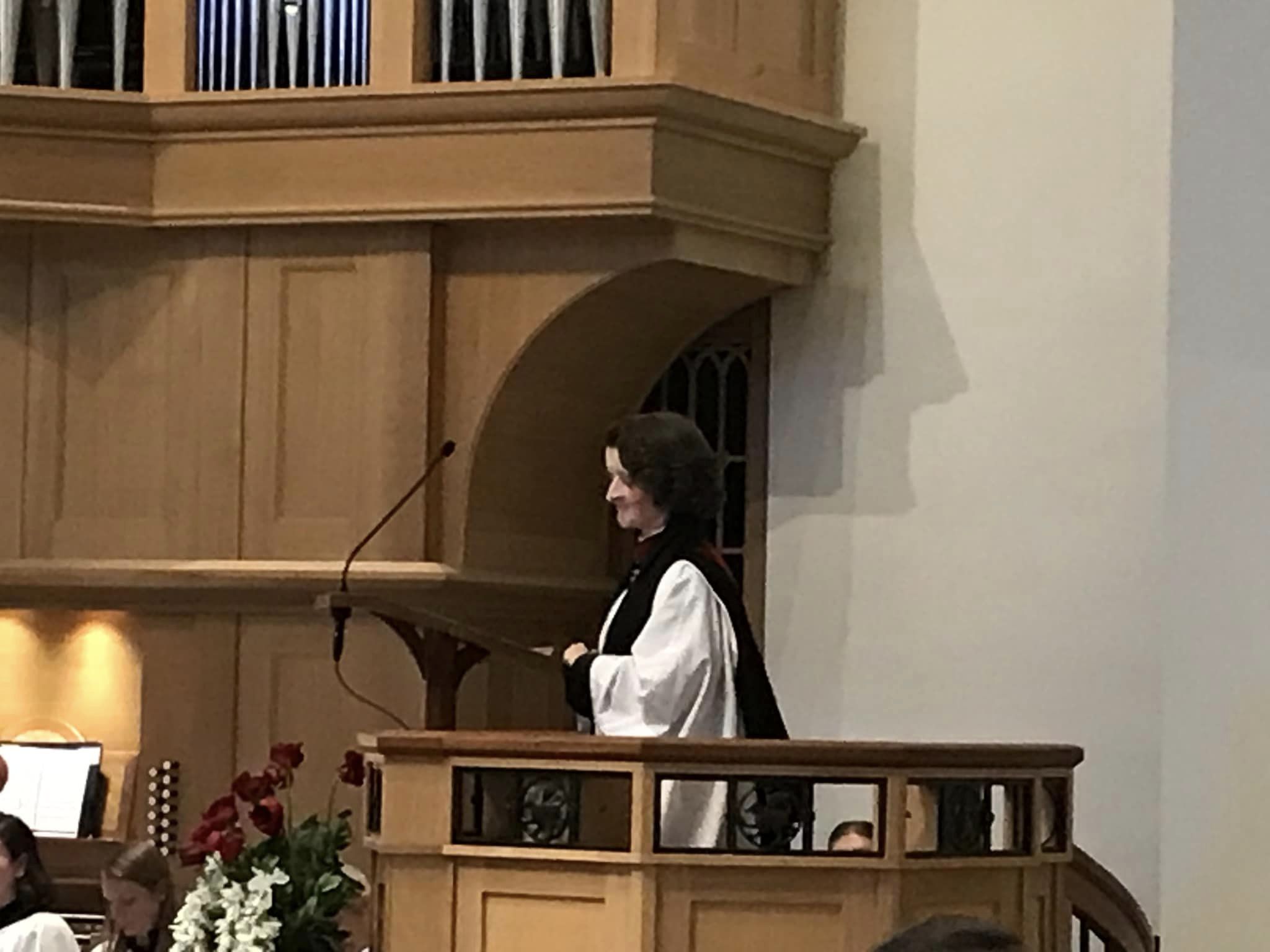
This sermon was delivered to Virginia Theological Seminary on the occasion of our annual Convocation for alumni, faculty and staff, and seminarians.

Photo credit: The Rev. Matthew Tucker

I live in a pretty “purple” district in Southern Virginia.  My Congressman represents a different party than my own, but I make a point to stay on his mailing list as a way to remind him that he represents a politically diverse district.  Every month he sends out polls, and I dutifully respond to them.  But with every survey I find myself frustrated.  My Congressman either has never taken a class in crafting an unbiased survey or he is simply not interested in different opinions.  The questions are always phrased something like, “In your opinion, how bad of a job is our president doing:  terrible, really bad, pretty bad, or I’m not sure.”  Or without any nuance or explanation about the background of the issue, the poll will ask something like, “The Congress wants to pay illegal immigrants who knowingly broke the law hundreds of thousands of dollars.  Should we pay these illegal immigrant criminals, yes or no?”  Or, one of my favorites, “Which of these issues should be the priority of Congress?” (PS, none of the options listed talk about caring for the poor or our neighbor, and there definitely isn’t an “other” category).  But I dutifully take the surveys, hoping my voice is part of my representative’s decision making.

I have been pondering the ministry of Jeremiah and thinking his prophetic ministry is a bit like trying to engage my Congressman.  For those of us not taking Old Testament this semester, Jeremiah is prophesying in a time of political decline.  The northern kingdom, Israel fell to Assyria nearly a hundred years before, and Judah remains in a tenuous situation.  The Assyrians are still in control, but in the course of the book of Jeremiah, Babylon defeats Assyria and takes control of Judah.  There are rebellions against Babylon, in particular by King Jehoiakim who we hear about today, but they are eventually unsuccessful.[i]  Like any good prophet, Jeremiah is attempting to get the people and king to repent and return to the Lord.  And like all people of all time, the people refuse to listen to God.  King Jehoiakim is particularly egregious in this refusal.  In fact, just verses before our reading, the King has his attendant read Jeremiah’s prophetic scroll three or four columns at a time, then cuts those columns off the scroll and throws them in a fire.  King Jehoiakim is not alarmed by the prophecy, and certainly not repentant. 

But here’s the funny part.  In the verses we read today, the Lord tells Jeremiah to rewrite the entire scroll and add in a little final judgment.  Like me, sitting down with yet another poll from my Congressman, he sits down and does the same thing over again.  I have been of two minds about this passage.  On the one hand, and no offense toward the Lord’s prophetic practices and policies, but how many times are we to keep doing the same thing and expecting different results.  As if King Jehoiakim is going to receive the second scroll and say, “Oh, a second scroll?  Okay, I guess I won’t burn this one and will change my ways!”  If this pandemic has taught us anything this pandemic has taught us we cannot keep doing Church the way we always have and expect the Church to thrive (or in biblical terms, to repent and return to the Lord).  This pandemic has made us nimble, agile, creative, and versatile.  This pandemic made us stop thinking about hybrid ministries and digital relevance and demanded we start doing and being those things.  And God help us if our churches just want to “return to normal” after the pandemic – if we just want to write another scroll. 

But as I mentioned, I am of two minds on this passage.  On the other hand, despite what seems like poor strategy on the Lord’s part, God’s covenantal relationship with us has never really made sense.  The entire salvation narrative is about failure after failure on our part as the people of God to listen and respond to the Lord.  Promise after promise, covenant after covenant, even the sending of God’s Son has meant the Lord’s corporate strategy is a case study in what not to do to thrive in business.  But that’s what we love about the Lord, right?  God keeps writing another scroll, God keeps giving another chance, God keeps holding out hope and promise because God’s love is not meted out in a logical, economical way.  Despite all of the innovation which has been entirely life giving during this pandemic, in some ways, what we have offered to a hurting world is the same as what we have always offered:  a community of faith, redeemed by God’s grace, commissioned to love God, self, and neighbor.  Perhaps that is why I am of two minds about this text.  Although this pandemic has not changed who we are and what we offer a broken world, this pandemic has changed how we are.  Our core values as the Episcopal Church have not changed.  But throughout this pandemic we have learned that how we go about living into those core values certainly can, should, and hopefully has changed.  And, as the Genesis writer would say, “…it was very good.”

In this particular season of the Church, many of us are feeling a longing for rest, for relief from constant pivoting, for a sense of normalcy.  Many of us would like to sit down and just write the same scroll over again.  In Jeremiah’s day that second scroll meant suffering and exile, and there would be more than twenty years before the people of God would see God’s promise of restoration realized.[ii]  But I do not think that is the invitation from scripture today.  I do not think the Lord is inviting the Church to write another scroll or fill out another poll.  We have a whole Bible full of examples of how doing the same thing over and over does not lead to the fulfillment of the kingdom of God.  Instead, the invitation from scripture today is to see the patterns of the resistance to love, and find a new way to love.  God is not inviting us to change our “who” or our “what,” but to change our “how.”  Your “how” might be different from mine.  But Jeremiah shows us time and again that the same repeated “how” does not turn hearts.  Our work in this season is to listen to what new “hows” the Holy Spirit is showing us, and then be willing to be vulnerable enough to try them.  Because, Lord knows, we do not need another scroll.  Amen. 


[i] Josey Bridges Synder, “Jeremiah,” The CEB Women’s Bible, (Nashville:  Common English Bible, 2016), 953.

[ii] 953.

Sermon – Jeremiah 31.31-34, L5, YB, March 21, 2021

24 Wednesday Mar 2021

Posted by jandrewsweckerly in Sermons

≈ Leave a comment

Tags

abundant, comfort, covenant, exile, faith, God, hope, Jeremiah, Jesus, Lent, love, lovingkindness, pandemic, ruin, Sermon

I do not know about you, but I entered Lent this year already done.  We talked about this reality five weeks ago, back on Ash Wednesday, when I told you that it was okay if you did not give up something this Lent – because we have already given up so much in the last year.  We have already fasted what feels like twenty Lents during this pandemic.  And then this week happened.  We started out with the words of the Vatican, declaring that although our LGBTQ brothers and sisters were still to be loved and welcomed in Church, their “sinfulness” would not be blessed within the covenant of marriage by the Roman Catholic Church.  I cannot tell you the pain and suffering those words created this week for so many who live in faithful, loving relationships and marriages.  Then, just a few days ago, a man in Atlanta murdered people of Asian descent, sparking off conversations about the rise of hate crimes against Asian Americans since this pandemic began.  Our own Sacred Ground circle, the group studying the institution of racism in our country – not just towards blacks, but towards indigenous Americans, Latinos, and Asians – just finished its ten weeks of work; and yet within the same week we are talking about racism yet again.  And then this week, as administered vaccines slowly rise in James City County, I see people becoming lax about masking and social distancing, some folks in public spaces barely covering their faces.  Even the test positivity rate – the one whose decrease has allowed us to enact regathering plans – is creeping slowly toward the numbers that will shut us back down again. 

That is why I found myself gravitating to Jeremiah this week.  Part of the attraction is the good news of the text, but a larger part of my attraction is empathizing with the Israelites.  Jeremiah writes in a time of desperation for the people of God. The Babylonians have razed the temple and carried King Zedekiah off in chains.  Effectively, the Babylonians have “destroyed the twin symbols of God’s covenantal fidelity.”[i]  Sometimes we talk about the exile so much that I think we forget the heart-wrenching experience of exile.  Being taken from homes and forced to live in a foreign land is certainly awful enough.  But the things that were taken – the land of promise, the temple for God’s dwelling, the king offered for comfort to God’s people – are all taken, leaving not just lives in ruin, but faith in question. 

But today, in the midst of the physical, emotional, and spiritual devastation, Jeremiah says God will make a new covenant.  God knows the people cannot stop breaking the old covenant, and so God promises to “forgive their iniquity and remember their sin no more.”  Instead of making the people responsible for the maintenance of the covenant, God goes a step further and writes the law in their hearts, embodies God’s way within the people.  The words of Jeremiah in the section called “the Book of Comfort,”[ii] and this new covenant by God, show a God whose abundance knows no limits.  God offers this new covenant to a people who surely do not deserve another covenant.  God has offered prophets and sages, has called the people to repentance, has threatened and cajoled, and yet still the people cannot keep the basic tenants of the covenant established in those ten commandments.  But instead of abandoning the people to exile, God offers reconciliation and restoration yet again.  And because God knows we have no power in ourselves to help ourselves, God basically says, “Here.  Let me help you.  Let me write these laws in your hearts so that you do not have to achieve your way into favor with me, but you will simply live faithfully, living the covenant with your bodies and minds.”  And when even that does not seem to work, God sends God’s only son.  God never gives up on us or our relationship with God.  Even all these years after Christ’s resurrection, God is still finding new ways to make our covenant work.  

That is where I find hope this week.  Despite how broken we may feel because of this pandemic, despite how our nation seems incapable of not harming one another due to the color of our skin, despite the ways we seek to limit God’s love and abundance, God is relentless with God’s lovingkindness.  In Jeremiah’s text, when the Israelites have hit rock bottom, God turns not to vengeance or even a notion of just desserts.  God picks up the covenant of love, not relying on our hard work to be faithful, but declaring how God will simply put God’s law within us, will write God’s law of love on our hearts, will be our God and we will be God’s people.  In essence, nothing we can do will drive God from us.  And that, my friends, is good news indeed.  God sees us in all our fullness – light and shadow alike – and loves us anyway.  In this continued time of strain and strife, in this long night of COVID, God gives us good news.  As one scholar affirms, “God will bring newness out of destruction.  God will bring hope where there is no hope.  God will bring life out of death.  God will make a way where there is no way.”[iii]  Thanks be to God!


[i] Richard Floyd, “Pastoral Perspective,” Feasting on the Word, Year B, Vol. 2 (Louisville:  Westminster John Knox Press, 2008), 122.

[ii] Jon L. Berquist, “Exegetical Perspective,” Feasting on the Word, Year B, Vol. 2 (Louisville:  Westminster John Knox Press, 2008), 123.

[iii] Floyd, 124.

Sermon – Jeremiah 1.4-10, P16, YC, August 21, 2016

07 Wednesday Sep 2016

Posted by jandrewsweckerly in Uncategorized

≈ Leave a comment

Tags

called, calling, church, God, Jeremiah, ministry, priest, prophet, Sermon, vocation

“What do you want to be when you grow up?”  I have lost count of how many times we have asked that question to our oldest daughter.  The answer varies widely depending on what phase she is in or what they have been talking about in school.  I confess that there have been times when I was disappointed when she changed her mind – “author and illustrator” was my favorite, though “engineer” was a pretty good one recently.  But my all-time favorite conversation about what she wanted to be when she grew up was actually a conversation about priesthood.  I asked her my typical question, “So have you decided what you want to be when you grow up?”  She replied thoughtfully, “I can’t decide.  There are too many options.”  Sympathetically I said, “I totally understand.  It took me years to decide what I wanted to be.”  And without a beat, she replied, with disgust, “And you decided to become a priest?!?”

The thing is, I do not think my daughter’s reaction is all that different than most people.  Very few people ever imagine themselves being ordained.  The vocation seems too foreign, to require some mysterious amount of holiness, or to just be too weird.  All of that makes sense to me – not everyone feels called to the priesthood.  But too often acknowledging we do not want to be a priest means that we stop using “call” language altogether.  Instead of being able to talk about what we feel called to do in life, we instead talk about what we want to be when we grow up.  A calling, a ministry, or even a vocation is something that clergy people do, not what we all do.

At least, that is what the secular world would have us believe.  The church says something a bit different.  Throughout our liturgies and Prayer Book, we talk about the ministry of all people.  Our Catechism defines the ministers of the Church as lay persons, bishops, priests, and deacons.  The Catechism further states that the ministry of lay persons is to represent Christ and his Church; to bear witness to him wherever they may be; and, according to the gifts given them, to carry on Christ’s work of reconciliation in the world; and to take their place in the life, worship, and governance of the Church.”[i]  In the baptismal covenant, we all promise to proclaim, by word and example, the Good News of God in Christ, to seek and serve Christ in all persons, and to strive for justice and peace.  Now some of you may argue that you do those things – just not as your daily work.  You are happy to be involved in church, but you do not see your life as a student, a secular worker, or a retiree as a vocation.

And stories like the one we hear in Jeremiah do not help us in this distinction.  You see, we hear Jeremiah’s call today like we hear the call of most prophets – and rightly so, since Jeremiah is so similar to other prophets.  Like Moses, Isaiah, and Ezekiel, Jeremiah balks at the idea that God may be calling him to do something.  Jeremiah protests that he is too young.  Similarly, Moses tried to argue he was unskilled, Isaiah that he was unworthy, and Ezekiel that he did not know what to say.[ii]  When God calls people to do big things, they often push back and seek an out.  In most cases, their fear is legitimate.  Being a prophet is often a thankless job – which can certainly lead to suffering, if not death.  But invariably, God reassures the person being called.  In Jeremiah’s case, God tells Jeremiah that he was born for this job.  “Before I formed you in the womb I knew you; and before you were born I consecrated you; I appointed you a prophet to the nations.”

All of that sounds nice. In fact, many of us love this verse from scripture because the verse gives us a sense of comfort, belonging, and affirmation – a sense that we are all known by God.[iii]  But what we forget is that in knowing Jeremiah so deeply, God also knows that Jeremiah will have to do a really hard job.  The touchy-feely part of the text starts to wane when we hear the part about being a prophet – especially a prophet who will need to fear others.  But here’s the real problem with Jeremiah’s call:  we do not think God similarly calls us.  Not even all priests see themselves as prophets.  Prophets, priests, deacons – those are jobs that other people do.  Those are not jobs we do.  We go to school everyday.  We are teachers, financial consultants, government workers, stay-at-home parents, or journalists.  We are retired and are done with the “job” part of our lives.  We hear stories like the call narratives of Jeremiah, Moses, Ezekiel, and Isaiah, and we can keep ourselves at a safe distance because those are the jobs that those people do.

But remember that catechism and baptismal covenant?  The truth is we are all called to something.  We all have a vocation.  That calling or vocation may be our jobs or what we do every day.  We may live out our vocation as a student when we stand up to a bully, play with the new kid who seems lonely, or help tutor the troublemaker clearly needs help.  We live out our vocations at work when we advocate for justice for our coworkers, when we offer an ear to a coworker who is struggling, or when we organize a volunteer day for our company.  We live out our vocations as retirees when we volunteer at the local homeless shelter, when we treat with dignity the workers we encounter who provide us services, and when we use our time to advocate for the poor.

But vocation is sometimes found outside of those typical confines.  Sometimes living into our vocation means calling that person who has been on our minds – only to discover how much they needed a word of encouragement.  Sometimes living into our vocation means helping the mom in front of us in the grocery store line who is clearly juggling children, groceries, and dealing with a cashier who has never handled food stamps or WIC benefits.  Sometimes living into our vocation means praising and giving thanks to a preschool teacher who just got chewed out by a parent who thinks their child is just fine (when you suspect the child is actually really hard for the teacher to manage).

This fall, we will be starting up an adult education series called Discovery Class.  The class is for newcomers and members alike, who want to learn more about our Episcopal Identity, the work of Hickory Neck, and how we can connect to a ministry.  In the final session, participants will take a survey to help us discern how our gifts might best tie in with a ministry at Hickory Neck.  The survey is a great resource because sometimes teachers are the best matches for Sunday School and Youth Group leadership.  But sometimes, best matches for Sunday School and Youth Group are retirees who have been around the block and get how hard the teenage years are.  Likewise, someone may have been may have been in construction or administration during their career, but really want to learn how to arrange flowers with the Flower Guild, or play with babies in the nursery.  Though many of us have vocations and callings out in the world, sometimes the church is another place where our vocations and callings feed us and others.

So if we are willing to agree that we all have a calling or vocation, recognizing that some vocations can change and evolve over time, how do we know if we are living into our calling?  The true test of a vocation might be something like this:  whatever in your life is the most intimidating, daunting, or even terrifying task (be it teaching teenagers, asking for money for church, or praying in front of a group), and yet, when you try doing that task gives you an odd sense of deep satisfaction and meaning, is probably your vocation.  Prophets would not go kicking and screaming if being a prophet was easy.  And yet, prophets would not say yes without the assurance that God is with them, empowering them to be God’s agents.[iv]

This fall, I hope we will all prayerfully consider what ministry God is calling us to do.  Paul says in his letter to the Ephesians, “I therefore, the prisoner in the Lord, beg you to lead a life worthy of the calling to which you have been called, …The gifts he gave were that some would be apostles, some prophets, some evangelists, some pastors and teachers, to equip the saints for the work of ministry, for building up the body of Christ, until all of us come to the unity of the faith and of the knowledge of the Son of God, to maturity, to the measure of the full stature of Christ.”[v]  Though Church is certainly meant to give us comfort and encouragement each week, Church is also the place that strengthens us and sends us out into the world to do the work Christ has given us to do.  One of my favorite church signs looked simple enough from the road – with the name of the church emblazed on front, as you drove into the parking lot.  But on the backside, as you were leaving church each week, the sign had a separate message.  The sign read, “Go in Peace to Love and Serve the Lord.”  That is our dismissal this and every week – to not just consume Church, but to use Church as our foundation to go out into the world to love and serve.  And our response is, as always, “Thanks be to God!”  Amen.

[i][i] BCP, 855.

[ii] Bruce C. Birch, “Exegetical Perspective,” Feasting on the Word, Yr. C, Vol. 3 (Louisville: Westminster John Knox Press, 2010), 367.

[iii] John t. DeBevoise, “Pastoral Perspective,” Feasting on the Word, Yr. C, Vol. 3 (Louisville: Westminster John Knox Press, 2010), 364.

[iv] Thomas R. Steagald, “Theological Perspective,” Feasting on the Word, Yr. C, Vol. 3 (Louisville: Westminster John Knox Press, 2010), 366, 368.

[v] Ephesians 4.1, 11-13.

Homily – Jeremiah 1.4-10, William White, July 17, 2014

23 Wednesday Jul 2014

Posted by jandrewsweckerly in Uncategorized

≈ Leave a comment

Tags

affirmation, bishop, bold, call, challenge, church, Episcopal, God, Jeremiah, William White

Today we honor William White, first bishop of Pennsylvania.  Born in 1747 in Philadelphia, White went to England to be ordained as a deacon and then priest.  He served at churches in Pennsylvania and was also the chaplain of the Continental Congress and U.S. Senate.  When elected bishop, he had to travel back to England; he and Samuel Provost were consecrated in 1787.  Bishop White was the chief architect of the Constitution of the Episcopal Church and served as Presiding Bishop at the first General Convention.  In addition to mentoring many church greats, Bishop White steered the American Church through its first decades of independent life – a hearty task given the Episcopal Church’s ties to England after the Revolution.

I have often wondered how those early church formers experienced their call.  The transition from the Church of England to the Episcopal Church must have been scary.  We often talk about the church reinventing itself today, but the church in the U.S. in the late 1700s really had to reinvent its whole identity.  I imagine many thought the church would die or at least flee from the United States.  To have been so bold as to totally reinvent the structure of the church took vision, courage and faith.

Bishop White could have easily told God what Jeremiah did in our Old Testament lesson today.  Jeremiah says, “Ah, Lord God!  Truly I do not know how to speak, for I am only a boy.”  Bishop White was only forty years old when he became Bishop – one could argue he was only a boy, too.  But when God calls people to ministries, God does so with gusto.  God tells Jeremiah, “… you shall go tell to whom I send you, and you shall speak whatever I command you.”  God’s instructions are firm and a bit scary.  But God also affirms Jeremiah: “I am with you to deliver you,” says the LORD.

Bishop White must have heard God’s affirmation in order to do all that he did.  But God’s challenge and comfort is not just for prophets and leaders.  God’s challenge and comfort is for each of us, too.  Though we may not have such grandiose calls, God still has a call on each person here.  Our reminder today is that God does challenge us to go where God sends, but God also comforts us with the assurance that God is with us and delivers us.  Amen.

Sermon – Jeremiah 18.1-11, P18, YC, September 8, 2013

12 Thursday Sep 2013

Posted by jandrewsweckerly in Uncategorized

≈ Leave a comment

Tags

change, covenant, God, Jeremiah, potter, pottery, Sermon, transform, vessel

I am a huge fan of pottery.  I have been given many gifts of pottery, my favorite being a chalice and paten upon my graduation from seminary.  When most of us think of pottery, we immediately think of a beautiful finished product:  the smooth texture, the radiant glaze, or the hands that carefully formed the bowl or other item.  We imagine the potter at his wheel, gracefully shaping clay into a work of art.  We might even recall the intimate scene from the movie “Ghost” where Demi Moore and Patrick Swayze romantically shape a piece of pottery together.

But the more I have read about potters and pottery this week, the more I realize how flawed this romantic image is of a potter.  First of all, potters begin their work with about a two pound chunk of clay that they then have to knead and work into a more elastic form.  They eventually have to throw the clay onto a wheel and get the clay centered.  This work is so difficult that new potters can take hours just to get the clay centered before they even begin the messy work of forming the clay.  Once they figure out the centering, then there is the work of using water, the spraying of wet clay everywhere, and of course the endless mistakes.  Exerting too much or too little pressure, making a wall too thin, or creating an unintended shape can mean starting all over.  One woman watched a man form a beautiful bowl, only to have the whole thing collapse when he tried to take the bowl off the wheel.  The man destroyed five bowls before he finally removed a perfect bowl properly – each time having to start from the messy beginning.[i]

This much more realistic version of a potter making pottery is what the Lord uses as a metaphor today for how God will treat the Israelites.  The Lord sends the prophet Jeremiah down to the potter’s house to hear God’s words.  Jeremiah says, “So I went down to the potter’s house, and there he was working at his wheel.  The vessel he was making of clay was spoiled in the potter’s hand, and he reworked it into another vessel, as seemed good to him.”  Jeremiah immediately recognizes the metaphor God is trying to communicate.  God is the potter and Israel is the vessel.  Clearly Israel has veered off course – in fact, Israel has already fallen at this point in history, and Judah is the only group of God’s people left who are still in active covenantal relationship with God.  So this people, who have journeyed from Sinai to the present, who have lived a covenantal life of reciprocal obligation and blessing, have hit yet another point in life where they have fallen away from their covenantal promises and face the option of being destroyed and discarded or being taken back to that compressed version of clay and being shaped into something more pleasing to God.[ii]

Knowing what we know about the potter’s work, we immediately see that this will not be easy work for God’s people.  Life as they know life will be collapsed, and new life with God will take a very different shape.  That transformation will be messy and uncomfortable, and in fact may take multiple attempts at reshaping.  Though the Israelites are offered a way out of destruction, the way out will be painful, disheartening, and disorienting.  All that is familiar will be changed, and though God is holding the Israelites in God’s hands, those hands do not promise to be gentle or permissive.

I have been thinking a lot this week about St. Margaret’s journey with the potter these last fifty years.  We were first centered as a rag tag team of Episcopalians at a local American Legion Hall.  Then the potter reshaped us time and again with various vicars.  When we called our first rector, we started all over again, finding new life and new ministries, God’s hands exerting pressure on us in various ways.  Even as we faced difficult times with our second rector, God’s hand was ever with us.  I am sure many of us felt like we were being compressed down into a clay heap, only to start being shaped again by God in these last couple of years.

Of course, all of that sounds a bit too much like the glossed over version of some of our favorite hymns.  In “Spirit of the Living God,” we hear, “Spirit of the living God, fall afresh on me.  Melt me, mold me, fill me, use me…”  Similarly, in “Have Thine Own Way Lord,” we hear, “Have thine own way, Lord!  Have thine own way!  Thou art the potter, I am the clay.  Mold me and make me after thy will; While I am waiting, yielded and still.”  Those are the old timey hymns I grew up singing, and I always remember singing them with heartfelt desire.  Of course, now that I know a little bit more about the pottery-making process, I am not sure how wholeheartedly I could sing those hymns.  Those hymns are calling on God to do exactly what God suggests in Jeremiah – that God will reshape us, remold us, and require us to be pliable, cooperative subjects in the process.

Since I entered the search process here about two years ago, we have been talking about change.  Change is a word we throw around a lot, that most of say we are ready for, but the majority of us secretly and not-so-secretly hate.  We know that change is necessary and inevitable, but we will fight change with every ounce of our being – even sometime unconsciously or at least without malicious intentions.  And yet change is what we have all been undergoing for the past two years, and the change does not seem to be stopping.  If we were to imagine St. Margaret’s on God’s Pottery Wheel, we might be able to think about the ways God keeps adding water to us, keeps exerting pressure, and keeps pushing us this way and that way.  It is entirely possible that God has even crumpled us down into a heap again and started afresh with us within the last two years.  I know we have all felt that potter’s work.  Every single person here, including me, at some point in the last two years has groaned under God’s constant shaping and molding.  This kind of shaping is not pretty, is messy and painful, and quite frankly is hard.  Most of us do not prefer to stand, “waiting, yielded and still.”  We prefer that God back off and just go ahead and declare us a beautiful bowl, and be done with us.

Now you have probably learned by now that I always like to give us a bit of good news on Sundays to take home.  I am going to try to give you a little taste of good news, but I have to warn you that today’s good news is a little bitter sweet.  The good news is that the metaphor the Lord gives to Jeremiah is one of promise.  God does not say that the potter takes the spoiled vessel and throws the vessel into the trash.  The promise to Israel is that God, despite all their sinfulness and evil ways, still gives the Israelites another chance to return to God and to the covenantal promises they have made to be in relationship with God.  But God does not promise that their misshapen selves get to stay misshapen.  They will still need to bend to the potter, and be willing to be shaped into something new and beautiful.

This is the colored promise for us as well.  God does not abandon us when we resist God and the changes God wants to make in this community.  God does not lose hope on our complaining selves that would much rather do things the way we have always done them.  God promises to keep God’s powerful hands around us, holding us with the seasoned hands of a potter.  God will be with us.  But God is also going to keep pushing us, and keep painfully shaping us, and artfully bending us into beautiful vessels that can glorify God and show Christ’s light to our community.  So maybe this week, we need to pick up our Lift Every Voice and Sing hymnals and start singing “Have thine own way, Lord!  Have thine own way!  Thou art the potter, I am the clay.  Mold me and make me after thy will; While I am waiting, yielded and still.”  Perhaps if we sing that old hymn enough, we might actually start yielding to the potter who loves us, is always with us, and who desires for us to be a beautiful vessel of God.  Amen.


[i] Christy Jo Waltersdorff, “Centering the Clay,” Brethren Life and Thought, vol. 50, no. 1-2, Wint. – Spr. 2005, 53.

[ii] Bruce C. Birch, “Exegetical Perspective,” Feasting on the Word, Yr. C, vol. 4 (Louisville: Westminster John Knox Press, 2010), 29.

Recent Posts

  • On the Myth and Magic of Advent…
  • On Risking Failure and Facing Fear…
  • Sermon – Luke 23.33-43, P29, YC, November 23, 2025
  • On Inhabiting Gratitude…
  • Sermon – Luke 20.27-38, P27, YC, November 9, 2025

Archives

  • December 2025
  • November 2025
  • October 2025
  • September 2025
  • August 2025
  • July 2025
  • June 2025
  • March 2025
  • February 2025
  • December 2024
  • November 2024
  • October 2024
  • September 2024
  • August 2024
  • July 2024
  • June 2024
  • May 2024
  • March 2024
  • February 2024
  • January 2024
  • December 2023
  • November 2023
  • October 2023
  • September 2023
  • August 2023
  • July 2023
  • June 2023
  • May 2023
  • March 2023
  • February 2023
  • January 2023
  • December 2022
  • November 2022
  • October 2022
  • June 2022
  • May 2022
  • January 2022
  • December 2021
  • November 2021
  • October 2021
  • September 2021
  • August 2021
  • June 2021
  • May 2021
  • April 2021
  • March 2021
  • February 2021
  • January 2021
  • December 2020
  • November 2020
  • October 2020
  • September 2020
  • August 2020
  • July 2020
  • June 2020
  • May 2020
  • April 2020
  • March 2020
  • February 2020
  • January 2020
  • December 2019
  • November 2019
  • October 2019
  • September 2019
  • August 2019
  • July 2019
  • June 2019
  • May 2019
  • April 2019
  • March 2019
  • February 2019
  • January 2019
  • December 2018
  • November 2018
  • October 2018
  • September 2018
  • August 2018
  • July 2018
  • June 2018
  • May 2018
  • April 2018
  • March 2018
  • February 2018
  • January 2018
  • December 2017
  • November 2017
  • October 2017
  • September 2017
  • August 2017
  • July 2017
  • June 2017
  • May 2017
  • April 2017
  • March 2017
  • February 2017
  • January 2017
  • December 2016
  • November 2016
  • October 2016
  • September 2016
  • August 2016
  • July 2016
  • June 2016
  • May 2016
  • April 2016
  • March 2016
  • February 2016
  • January 2016
  • December 2015
  • November 2015
  • October 2015
  • September 2015
  • August 2015
  • July 2015
  • June 2015
  • May 2015
  • April 2015
  • March 2015
  • February 2015
  • January 2015
  • December 2014
  • November 2014
  • October 2014
  • September 2014
  • August 2014
  • July 2014
  • June 2014
  • April 2014
  • March 2014
  • February 2014
  • January 2014
  • December 2013
  • November 2013
  • October 2013
  • September 2013
  • August 2013
  • July 2013
  • June 2013
  • May 2013
  • April 2013
  • March 2013
  • February 2013
  • January 2013
  • December 2012
  • November 2012
  • October 2012
  • September 2012

Categories

  • reflection
  • Sermons
  • Uncategorized

Meta

  • Create account
  • Log in
  • Entries feed
  • Comments feed
  • WordPress.com

Blog at WordPress.com.

  • Subscribe Subscribed
    • Seeking and Serving
    • Join 394 other subscribers
    • Already have a WordPress.com account? Log in now.
    • Seeking and Serving
    • Subscribe Subscribed
    • Sign up
    • Log in
    • Report this content
    • View site in Reader
    • Manage subscriptions
    • Collapse this bar
 

Loading Comments...