• About

Seeking and Serving

~ seek and serve Christ in all persons

Seeking and Serving

Tag Archives: Jesus

On hope…

15 Thursday Jan 2015

Posted by jandrewsweckerly in Uncategorized

≈ Leave a comment

Tags

baby, emotion, Epiphany, God, hope, incarnation, infant, Jesus

One of the things I had forgotten about having babies is how incredibly transformative they can be.  People totally change around babies.  They ooh and ahh around babies.  Their faces light up and they seem uncontrollably drawn toward infants.  Their whole demeanor shifts at the sight of a baby.  I have even brought my infant to meetings before, and I am amazed about how the whole mood of the room changes.  Work still gets done, but not without laughter, smiles, and joy.  Even a crying child makes people sympathetic and tender.

Courtesy of http://danielleshroyer.com/2014/12/01/moltmann-monday-hope-poor-advent-hope/

Courtesy of http://danielleshroyer.com/2014/12/01/moltmann-monday-hope-poor-advent-hope/

For a long time, I wondered what it was about babies that could turn even the sternest person to mush.  Then I realized what it was:  hope.  Because babies have little control or ability to assert their own (often contradictory) will, there is hope for all that the baby can be.  Their innocence and simplicity are a refreshing break from the complicated nature of life.  They truly are a gift to families, communities, and even strangers who sometimes have truly lost what it means to be a people of hope.

When our little one played baby Jesus in the Epiphany Pageant this year, I was not surprised at all then that the adult playing Mary teared up during the pageant.  I have not spoken to her about what was going on that made her teary, but watching the emotion bubble up in her was something that I knew only an infant could do.  Her emotional response made me see and hear the entire pageant differently – seeing the children in a different way, hearing the words of scripture in a different way, and singing the familiar Christmas songs in a different way.

In that moment of emotion, something else also became clear to me in a totally different way.  The human reality of Jesus as a baby became much more tangible in that moment.  It suddenly made sense to me how angels, shepherd, and wise men could reverence a child.  It made sense to me how Mary and Joseph were completely perplexed, but also completely hopeful about this new thing that was happening through their child.  It made sense to me the tremendous gift and miracle of God taking on flesh for us truly was.

Those moments of utter clarity are a bit rare in my life.  I know the biblical stories and our liturgies so well that sometimes they become rote.  I believe them all; I just do not always feel them.  That morning, I felt it.  I felt the wonder.  I felt the overwhelming gratitude.  I felt the hope.  My guess is that opportunities for those feelings are more present than we ever recognize.  Our challenge is honing the skill of perceiving when God is breaking into our routines and giving us hope.

Sermon – Mark 1.4-11, E1, YB, January 11, 2015

15 Thursday Jan 2015

Posted by jandrewsweckerly in Uncategorized

≈ Leave a comment

Tags

baptism, beloved, God, Jesus, sacred, Sermon, water

I have always had an affinity for water.  I am not sure why, but something about water connects to something deep in my soul.  Whether listening to water bubble over rocks in a river, hearing the roar of a waterfall, listening to a lake lap on the shore, or hearing the crashing of waves on the beach, something about the sound of water quiets my mind and connects with some deeper part of me.  Some of my most intimate conversations with God have taken place near water – times when I was facing a big transition, times when I was worried about a major life event, or times when I had run out of things to say and just needed a place to just listen.  Whether a quiet drip or trickle or a roaring rush, somehow the noise of water connects me to the mysterious and transcendent voice of God.

To be honest, I have always thought my connection to the water was a little strange.  But this week, as I studied our lessons, my connection suddenly made sense.  Water has always been a part of our faith narrative.  When we celebrate a baptism, we always retell the biblical story of water.  One denomination retells the biblical story this way, “Eternal Father, when nothing existed but chaos, you swept across the dark waters and brought forth light.  In the days of Noah you saved those on the ark through water.  After the flood, you set in the clouds a rainbow.  When you saw your people as slaves in Egypt you led them to freedom through the sea.  Their children you brought through the Jordan to the land which you promised.  In the fullness of time you sent Jesus, nurtured in the water of a womb.”[i]  Of course we know there are countless other water stories in scripture: Jonah who is thrown into the sea and swallowed by a great fish, Jesus who calms the seas and walks on water, women encountering God as they draw water in wells, and eunuchs running to rivers to be baptized.  Water is everywhere in our biblical narrative, and is where many people see, hear, taste, and feel God in their lives.

Today, we hear one of those ultimate stories of water – in fact, today is a feast day in the Episcopal Church:  Jesus’ baptism in the waters of the river Jordan.  When Jesus comes to be baptized, baptism in the river Jordan has already been transformative for many.  People from all over the Judean countryside have been coming to John to confess their sins, repent, and be baptized into forgiveness.  As if those experiences of conversion were not enough, something even more extraordinary happens in that water.  Jesus comes from Nazareth to be baptized by John, and when he comes up out of the water, the heavens are torn apart and the Spirit descends upon him like a dove.  Then a voice comes from heaven, saying, “You are my Son, the Beloved; with you I am well pleased.”  Just like all those other stories of water in the biblical story, something sacred and transformative happens in water – something so powerful that the heavens are torn apart, the Spirit descends, and the Lord proclaims favor, love, and affection.

Many of us do not remember our own baptism in water.  Though adults and young people are certainly welcome to be baptized later in life, most of us are baptized as infants.  Unless our parents or godparents told us the story of our baptism, we have no idea if we cried or cooed that day.  We have no idea what emotions or thoughts the priest or our sponsors had that day.  We have no idea whether we were inherently changed by the water that was poured over our heads.  For most of us, the holy experience of water at our own baptism is a lost memory.  But the Church does not let us forget the power of baptismal waters.  Every year we celebrate the feast of Jesus’ baptism.  Every year, we reaffirm our baptismal covenant – often multiple times per year.  And depending on the membership of the church, every year we baptize new members into the life of the church.  So even if we do not remember our own baptism, the repetition of the story of baptism, and the experience of reaffirming our vows, creates new memories for us.  That formation is so powerful that many of us will dip our fingers in Holy Water, looking for a blessing and a reminder of another water that was once poured over our heads.

But today is not a day just to celebrate sacred experiences with water.  Today is not just a day when we think back to our own encounters at the font and how holy they were.  Today is not just a day we think back to those biblical stories of water in our faith and marvel at the miracles that have happened through water.  Today is not just a day that we remember those moments by a river, lake, or beach where God seemed to be whispering comfort, truth, or blessing to us.  The danger with the text we hear from Mark today is that we could be tempted to do just that.  Our lesson ends with those words from the voice of heaven that says, “You are my Son, the Beloved; with you I am well pleased.”  We could sit here today and savor those words for Jesus.  In fact, I could tell you today that those words are words for you – that you are God’s beloved and with you God is well pleased.  I could do those things because they are true.  You are God’s beloved and God is well pleased with you.  The baptismal waters should always remind you of that – and others waters, like rivers, waterfalls, and oceans, may do the same.

But today we do not simply celebrate the gift of blessing, beloved-ness, and bounty.  Today is the day when we celebrate the “so what?” of Jesus’ baptism.  As one scholar explains, “Jesus did not receive the Spirit in order to enjoy privately its spiritual benefits, but rather in order to pass it on.”[ii]  In Mark’s gospel, in the immediate next verse, Jesus is driven out into the wilderness to be tempted.  His baptism opens a road that will lead to the cross.  For Jesus, his entire ministry is informed by this moment – this tremendous in-breaking of the Spirit and a declaration of Jesus as being the beloved of God.  But Jesus does not tarry in this moment.  Jesus keeps on moving, holding fast to the moment, but using the moment to change his future.

That is our invitation today too:  to think about the “so what?” of our own baptisms.  When I think about all of those sacred moments I have had near water, a distinct part of that memory is what walking away from those moments felt like.  Sometimes I walked away from that bubbling brook with a sense of peace that God would be with me in the trials that were ahead.  Sometimes I turned from that lapping lake with a sense of empowerment and energy about what new thing God was calling me to do.  And sometimes I walked away from that roaring ocean having no idea what was to come, but knowing that God would help me face whatever came.

Our invitation today is to consider the “so what?” of our own sacred watery moments.  You can come to Jesus’ story today like you would come to a body of water for renewal and refreshment.  You can soak in the blessing and affirmation that come to Jesus and to you.  But you will also need to walk out of those doors today.  In fact, our liturgy does not let you leave this place without a dismissal that sends you out in the world to do the work that God has given you to do.  The question this week is what that work is.  What is God renewing you for?  What is God empowering you to do?  The answers will be different for each of us.  But the answer is there, if you are willing to listen to the sacred sound of water.  Amen.

[i] Barbara Sholis, “A watery solution,” Christian Century, vol. 119, no. 26, December 18-31, 2002, 19.

[ii] Lee Barrett, “Theological Perspective,” Feasting on the Word, Yr. B, Vol. 1 (Louisville: Westminster John Knox Press, 2008), 240.

Sermon – Luke 1.26-38, A4, YB, December 21, 2014

15 Thursday Jan 2015

Posted by jandrewsweckerly in Uncategorized

≈ Leave a comment

Tags

action, Advent, Angel Gabriel, Black Lives Matter, burden, favored, God, Jesus, light, Magnificat, Mary, submission

This week, the song The Angel Gabriel has been running through my mind over and over.  Our choir sang the song at Advent Lessons and Carols a few weeks ago.  The lyrics go, “The angel Gabriel from heaven came, With wings as drifted snow, with eyes as flame:  ‘All hail to thee, O lowly maiden Mary, Most highly favored lady.’  Gloria!”  When sung the song has a soft, gentle feel to it.  You can almost sense the intimacy of the encounter between the Angel Gabriel and Mary.  The lyrics go on to say, “Then gentle Mary meekly bowed her head; ‘To me be as it pleaseth God,’ she said.  ‘My soul shall laud and magnify God’s holy name.’  Most highly favored lady.  Gloria!”  The description of Mary as a “most highly favored lady,” and her humble, bowed acceptance of God’s call all depict a meek and mild version of Mary, someone who obediently follows God’s will at the sacrifice of her own will.

Of course, that path is one that her son will take later in his life.  We remember the scene of Jesus praying in the Garden of Gethsemane.  As Jesus wrestles with God in prayer, he prays, “My Father, if it is possible, let this cup pass from me; yet not what I want but what you want.”  Like his mother who faced the impossibility of a virgin birth at a young age, Jesus faced a violent death.  And both responded with humble submission.  They gave over their lives to God, not knowing what was ahead, but trusting fully in the Lord.

My problem with our scripture this week is that the scripture just does not jive with what is happening in our world.  These last couple of weeks I have been overwhelmed with the sheer volume of stories about violence and degradation:  from the excessive use of force toward persons of color by the police force, to stories of sexual assault on college campuses, to the execution of children by terrorists in Pakistan.  As wave after wave of bad news comes, I keep hearing echoes of Eric Garner’s last words, “I can’t breathe.”  That is how these stories have made me feel – like I cannot breathe.  I ponder how our country has gotten to the point where black people feel like their lives do not matter.  I wrestle with how some of our young men have come to believe that they can exercise power over and violate women.  I am perplexed at how a group of faithful people can use that faith to justify killing others.  With these visceral stories bombarding me from every direction, the last kind of lesson I want to hear about is a lesson about how one should mildly and meekly submit to God.  I do not want to submit to God – I want to act!

What I really wanted to hear from scripture today was not the Angel Gabriel calling Mary a lowly maiden, but instead the Magnificat, Mary’s song that we sang today, which is found just a few verses after the gospel lesson today in Luke.  Right after Gabriel leaves, Mary reunites with Elizabeth.  When they connect over their miracle pregnancies, Mary sings a song of praise called the Magnificat.  In that song she proclaims, “…the Mighty One has done great things for me, and holy is his name.  His mercy is for those who fear him from generation to generation.  He has shown strength with his arm; he has scattered the proud in the thoughts of their hearts.  He has brought down the powerful from their thrones, and lifted up the lowly; he has filled the hungry with good things, and sent the rich away empty.”[i]  This is the kind of song I wanted to hear this week when current events are so dire.  I want the promise of a God who favors the oppressed, the hungry, and the violated.  I want a God who lifts up the poor and scatters the proud.  The Magnificat has all sorts of musical settings because Mary’s song is sung at the service of Evensong throughout the year.  Some of the settings are meek and mild, like our gospel reading today.  But some are actually quite powerful, connoting the strong victory you hear in Mary’s song.  I realized that is what I want to hear from scripture today – not a story of mild submission, but of victorious uprising and justice.

But the more I struggled this week with Luke’s words, the more I realized a deeper truth.  I have been looking to God for answers – some sort of response about how God could let these things happen, and why I feel like our world is falling apart.  But what I realized the more I heard these two competing songs in my mind is that victory for God does not always feel like victory for God’s agent.  So, yes, Jesus is ultimately victorious when he rises from the dead.  But at that moment of Gethsemane, he humbly submits to God, not knowing what evil awaits.  Likewise with Mary:  she will become the venerated mother, the one whom people will pray through for centuries.  God is victorious through her.  And yet, she is still a mother whose son is murdered by the officials.  In fact, being highly favored, as Gabriel claims Mary is, may not feel like being highly favored.  Months later, when Jesus is presented as a baby at the Temple, Simeon confirms this hard truth.  Simeon says to Mary, “This child is destined for the falling and the rising of many in Israel, and to be a sign that will be opposed so that the inner thoughts of many will be revealed – and a sword will pierce your own soul too.”[ii]

Of course, that is the way that being called to serve God usually is.  Though Moses was called by God in a dazzling display of a burning bush, he was also almost murdered by pharaoh and the very people he had saved.  Though David was the blessed and anointed king of Israel, David also had to flee for his life when Saul became jealous of God’s favor for David.  Though Thomas Cranmer was the Archbishop who basically founded and shaped the liturgy of the Church of England, and by association the Episcopal Church, he was also martyred for his commitment to the reformation of the Church.  Though eventually Nelson Mandela became the leader of South Africa and the facilitator for ending apartheid, he was first imprisoned for twenty-seven years.  That is the sad truth of Mary this week.  Favor in God’s eyes does not mean a smooth, satisfied, simple life.  When we accept God’s call, when we humbly submit to God’s invitation to serve in our own lives, we can only expect to journey through trials on the way to glory.  That is the sobering truth Mary offers us today.

But that is not the end of the story.  I think that the reason the songs about Mary have been battling in my head this week is because there will never be one victor.  Being highly favored in God’s sight is neither an invitation to a life of mild obedience and suffering, nor a life of victorious dominance.  Being favored in God’s sight is a bit of both.  So though Mandela suffered, he also came to know and love his prison guards.  He found hope and grace in the midst of darkness and oppression.  I think the same is happening in our current events today.  Despite the destruction caused by riots in Ferguson and the arrests from protests in Staten Island, people across racial lines are encountering one another.  A white police chief in Richmond, CA was photographed standing with other protestors holding a sign that read, “#Black Lives Matter.”  And when two officers were murdered in retaliation for Eric Garner yesterday, the black community immediately spoke out against such violent retaliation.  Despite the flurry of stories about sexual assault on college campuses, college campuses are now taking seriously their handling of the violence.  Despite the horror of students being murdered in Pakistan, advocates for change are beginning to see how desperate the need for change and collaboration is.  In the darkness of our world, God is using God’s favored ones to be light.

That is our invitation today.  Through Mary, we are reminded that answering God’s call on our lives will not be easy or even pleasant at times.  There will be times when serving the Lord will feel like more of a burden than a joy.  But when we submit to our God, God can use us in powerful ways.  God can make us agents of light, in a world that is striving to find a way out of the darkness.  Mary responds to that invitation with the words, “Here am I, the servant of the Lord; let it be with me according to your word.”  You can say those words today too, accepting God’s desire to use you as an agent of light.[iii]  The promise of being highly favored holds many blessings waiting to unfold.  Amen.

[i] Luke 1.49-53

[ii] Luke 2.34-35

[iii] David Lose, “Favored Ones,” December 11, 2011 found at https://www.workingpreacher.org/craft.aspx?post=1611 on December 16, 2014.

Sermon – Luke 2.1-20, YB, CE, December 24, 2014

14 Wednesday Jan 2015

Posted by jandrewsweckerly in Uncategorized

≈ Leave a comment

Tags

change, Christmas Eve, church, comfort, familiarity, God, Grinch, holy, Jesus, peace, Sermon, strength

Most of us have a favorite Christmas movie.  Whether we like “It’s a Wonderful Life,” “A Charlie Brown Christmas,” or “A Christmas Story,” many of us find that until we have watched that special movie, we do not feel like Christmas has really arrived.  My personal favorite is “How the Grinch Stole Christmas” – the animated one, not the newer one with Jim Carrey.  I love the cute little dog that the Grinch dresses up like a reindeer, I love the little girl who sweetly encounters the Grinch dressed as Santa, and I love the songs throughout the movie.  But my favorite part is when the Grinch hears the Whos singing on Christmas morning despite their supposedly ruined Christmases and how the Grinch’s heart is warmed and grows in size.  Part of what I love about the movie is the movie’s wonderful lesson about the true meaning of Christmas – that material goods and abundance do not make Christmas:  only love and community make Christmas.  But I think the real reason I love this movie is its familiarity.  I like that I can watch the movie every Christmas and the movie never changes.  I like that no matter what house I lived in growing up, or where I found myself as an adult, or even how happy or sad I was on a given Christmas, the familiarity of the movie made me feel like I had something to ground me.  When all else in my world was changing, the movie never changes.

I think that is why we find ourselves at Church on a Christmas Eve too.  Every year we find ourselves sitting in a pew hearing the same story of Mary, Joseph, shepherds, angels, and the baby Jesus.  The story is so familiar that we could probably recite the story if pressed.  Whether we are a child or an adult, at home or far away, with loved ones or alone, the story never changes.  That changelessness, that familiarity is something we eagerly anticipate every Christmas and in large part is why we come to Church this night.

Familiarity is something we all long for at Christmas.  When we have lived long enough, we come to know that despite the fact that we celebrate Christmas every year and we try to keep familiar traditions, our celebration is never the same.  Invariably someone has passed away and their absence changes our experience; a family member is not present because of a falling out in the past year; the grandchildren become too old to play silly games or make crafts and the mood is different; or any other number of things have changed – divorce, births, illness, job loss, or moves.  Even if you still gather with your family or a set of friends, change is inevitable at Christmas.  And because we all know how unsettling change can be, we long for something that is unchanging that we can cling to and with which we can ground ourselves.

This Advent we have talked a lot about how much turbulence and change has been happening in our world.  We have watched as the world has erupted in violence.  The atrocities, suffering, and fighting have been so vivid that many of us have stepped away from watching the news.  We have seen unrest in our own country, as issues of race, class, and gender have collided.  And in case any of us were tempted to believe that those issues of race, class, and gender are someone else’s issues, we have only to look at as far as Staten Island to know that we are not yet in a place of peace and justice.  The noise of unrest is so loud that there are times when instead of listening to the news we turn to music, sports, or any other escape we can think of to run from the reality of our world.

The funny thing is that though we turn to our gospel lesson for comfort and familiarity, the same noise that we find in our lives and in our world is present in our reading tonight too.  The very reason that Mary, Joseph, and Jesus end up in a stable is that the Roman Empire has been greedily looking for more ways to bring in money into the empire.  And so peoples are being displaced, making their way back to their hometowns so that the empire can determine whether they have collected enough money from the people.  The Pax Romana is bearing down upon the people, and this nobody couple from Bethlehem is just one more victim of the injustice of the system.[i]

Perhaps that background noise is part of why we love this story so much.  Despite the chaos of that night and of that time, good news comes – to shepherds, to angels, to Mary and Joseph.  We savor the familiar words of goodness that override the story:  “do not be afraid”; “good news of great joy”; “peace among those whom he favors.”  To displaced Mary and Joseph, to disenfranchised shepherds, and to distant little Bethlehem peace, joy, comfort, and hope explode on this very night.  We have learned from hearing Scripture Sunday after Sunday that Scripture can often be hard, challenging, and downright condemning.  We spend much time throughout the Church year struggling with where God is challenging us to live differently and beckoning us to live more Christ-like lives.  But not on this night.  On this night, we get assurance, comfort, and joy.  We get an innocent baby – in fact a baby that will change the world for good.  Like young parents ourselves, we can worry about money, health, and safety later – because on this night of Jesus’ birth, we just want to cling to the Christ Child and all that the child represents.

Now there are times in our lives when clinging to the familiar just for the sake of comfort is a bad thing.  Maybe you yourself have been criticized for living in the past, romanticizing what once was, especially at this time of year.  But this is one of those rare instances when the Church says that we have permission to live in the past and cling to the familiar.  That is because this familiar – this story of Jesus’ birth – is worthy of that kind of devotion.  We are not staking our claim on something superficially good when we come to Church this night – we are not clinging to a romanticized past that can never fulfill us.  We are clinging to an event that happened a long time ago, but whose significance changed things forever.  In this incarnate experience of God, the game changed for all time.  God became flesh and dwelled among us, and we are changed for the better.

So tonight, I invite you accept the gift of familiarity and comfort.  Let this night warm your heart and soul and cling to the familiar story and all that the story means for us.  Hold fast to that comfort, and return to these words whenever you need them.  We have 364 other days to worry about what is going on in the world.  In fact what happens here in Scripture tonight deeply impacts how we will respond to that world the rest of the year.  But that is for another day.  Tonight, take the gift of comfort, joy, and hope and let that gift fill you up and strengthen you for the work God has given you.  Use that gift as fuel, and then let God’s holy meal fill your belly so that you are strengthened for the work ahead.  May God’s peace and joy fill you up and overflow out of you to others.  And then be agents of peace through the Prince of Peace who comforts you tonight.  Amen.

[i] David Lose, “Something More,” December 18, 2011 as found at http://www.workingpreacher.org/craft.aspx?post=1612 on December 20, 2014.

Keeping Christ in Christmas…

19 Friday Dec 2014

Posted by jandrewsweckerly in Uncategorized

≈ Leave a comment

Tags

Christ, Christmas, church, encourage, guilt, Jesus, uplifting, witness

I live in an area of our country that has a lot of “Keep Christ in Christmas,” signs.  I think people post these signs for all sorts of reasons:  for fear that Christmas has become too secular and lost its focus on the birth of the Christ Child; out of resistance to Christmas becoming a consumerist holiday; as a defensive response to what feels like a mandate to be “politically correct,” (i.e. saying “Happy Holidays!” instead of “Merry Christmas!”).  Many of these arguments make sense to me.  I myself have a hard time explaining to my five-year old why Christmas is both the celebration of Jesus’ birth and the day Santa Claus comes.  I too feel lured in by the advertisements that want me to spend more money than I have in order to show my love and affection.  I too want to be fully Christian, not wanting to minimize my faith in order to honor others’ faith.  In fact, it was not until I moved to a community with a large Jewish population that I really had to think about whether my “Merry Christmas!” greeting was even appropriate.

But here is my issue:  when I see those (sometimes very large) signs posted all around town, they do not sound like a gentle reminder or encouragement to return to our Lord.  When I see them, I feel like someone is shouting at me, “Keep Christ in Christmas!!”  Those signs do not feel well-intended, encouraging, or uplifting.  They seem angry, defensive, and off-putting.  They make me feel like I am guilty and should be ashamed of something.  And if I, as a priest in the Church, feel criticized, judged, and reprimanded by the signs, imagine how someone feels who knows very little about the Church.

Courtesy of https://www.facebook.com/uCatholic/photos/pb.123119221038808.-2207520000.1418930355./1004120959605292/?type=3&theater

Courtesy of https://www.facebook.com/uCatholic/photos/pb.123119221038808.-2207520000.1418930355./1004120959605292/?type=3&theater

A meme has recently been floating around that helped me identify what it is that is so off-putting about the normal “Keep Christ in Christmas” sign.  The sign says, “Want to keep Christ in Christmas?  Feed the hungry, clothe the naked, forgive the guilty, welcome the unwanted, care for the ill, love your enemies.”  The quote comes from Steve Maraboli, and I think his words get at my struggle.  What I like about this quote is that it does not just describe how to reclaim a holiday.  This quote describes how to live as an authentic Christian, to live like Christ, in the midst of this holiday.  That is a much more powerful witness to me than simply insisting people keep Christ in Christmas.  Perhaps instead of saying “Keep Christ in Christmas,” our message could be, “Be Christ this Christmas.”  When we busy ourselves with being Christ to others it is a lot easier to remember the reason for the season – no fussing and finger-wagging necessary.

Sermon – Matthew 25.31-46, P29, YA, November 23, 2014

26 Wednesday Nov 2014

Posted by jandrewsweckerly in Uncategorized

≈ Leave a comment

Tags

face, goats, God, Jesus, poor, privilege, Sermon, sheep, suffering

Once upon a time, “there was a cobbler who lived alone in his shop with one window that looked out on the street.  His wife and children had all died and he asked God, “Holy One why have you so long delayed your coming?  I have almost given up hope in seeing you.  Please come to my humble shop this day and show me your face.”

Outside on the street the cold winter brought snow.  Through his window he saw a beggar who shivered in the cold.  The cobbler invited the beggar into the shop to warm him and offer a meager meal from his shrinking larder.  The beggar thanked him and left.

As the day passed, a few customers came with repairs they needed for their shoes and harnesses.  A young boy sought shelter from the cold and snow.  The child’s feet were wrapped in old dirty rags and stuffed with paper.  Into the shop he invited the boy.  After making him some warm milk and a sandwich from the little food he had he went to his closet and found a pair of shoes that [had] belonged to his son.  He fit the shoes to the boy.  Grateful, the boy left with a promise to return to visit him.

It was approaching dusk and the cobbler despaired of a visit from the Lord.  A woman with her young babe appeared in front of the window.  She was dressed in a thin piece of cloth and she looked as if she might freeze to death.  The cobbler invited her into his shop.  Wary of the old man, she hesitated at the door, but feeling the warmth within she stepped across the threshold.  The cobbler made her some tea and went to his closet to find a heavy woolen cloak that [had] belonged to his wife.  Giving her the cloak the woman thanked him and after he shared the rest of his larder with her, she left with the child.

The sun descended and left the cobbler bereft.  “Why didn’t you come and visit me today,” the cobbler asked?  There was a voice that spoke to him in his humble shop:  “But I did come to you.  When you invited in the beggar, the boy, and the mother and her child, I was there with you.  In each of their faces you looked into my eyes.”  [The cobbler] then remembered the scripture: “When did you see me hungry and feed me, alone and naked and clothe me and thirsty and you gave me a drink.”  The visitors who had come to his shop that day had been his master.  In their faces he had looked into the eyes of God.

That night the cobbler slept happy and at peace for the first time in many months.”[i]

Today’s gospel lesson is one of those lessons that we might hear and immediately panic, for fear that we are those goats at God’s left hand.  We can picture all of those homeless persons we passed without a nod or a coin; that nursing home that we go by everyday but fail to stop in for a visit; or that prison that we avoid because passing the prison makes us nervous enough – we cannot imagine actually going inside.  In fact, we are pretty sure that we are the goats of Jesus’ story, and we know that when those goats do not feed the hungry, clothe the naked, welcome the stranger, tend the sick, and visit the prison, they are sent away to eternal punishment.  Talk about a sobering text.

Truthfully, we probably all could use a little sobering from time to time.  But today, I am more intrigued by the ways in which we are sheep.  In fact, St. Margaret’s gives us all kinds of opportunities to be sheep:  when we plant, tend, and pick produce that feeds the hungry in Huntington Station and Hicksville; when we donate money to the Outreach Fund, which provides clothing, gas, food, and toiletries to needy students at JFK High School here in Plainview; when we take communion to the shut-ins, or simply stop by for a visit or drop off a container of soup; or when we clear out our closets for veterans we may never meet.  All of these ways are ways in which St. Margaret’s is seeking and serving Christ in our neighborhood, and inviting us to fully become sheep at God’s right hand.

But as proud as I am of each of us, and as much as I want to assure us that we fall into the sheep category as often as we fall into the goat category[ii], the more important point is that Jesus’ words today are not meant to make us worry about completing a check list that will get us into heaven someday.  Instead, Jesus’ words today are meant to be a different kind of wake up call.  Jesus is saying today [clap], “Hey!  I am right here.  Wake up!”  Jesus does not want you to do all those wonderful things because that is what will get you into heaven.  Jesus wants you to do those wonderful things because that is where we will see his face and he will see ours.  Only when we are in those places of vulnerability, messiness, and desperation will we find each other.

I do not mean to romanticize poverty or helping the less fortunate.  But here is what I do know:  for the person who is in need, asking for help is one of the most humiliating experiences a person can know.  Asking for help means swallowing one’s pride, admitting defeat, and opening up oneself to rejection.  And for the person who is giving aid, giving that help means talking to someone we usually try to ignore, acknowledging our own privilege, and seeing afresh how thin the line is between “us” and “them.”  In that narrow space is where we can hear God say, “But I did come to you.  When you invited in the beggar, the boy, and the mother and her child, I was there with you.  In each of their faces you looked into my eyes.”  That is the invitation of today’s gospel lesson: not to panic in fear, but to step into those narrow spaces where Christ resides, and to see Christ face to face.  Amen.

[i] Leo Tolstoy, “Martin the Cobbler,” as retold by Bob Stuhlmann in “Goat Cheese And Starfish: For November 23, 2014,” posted on November 18, 2014, as found at http://storiesfromapriestlylife.wordpress.com/2014/11/18/goat-cheese-and-starfish-for-november-232014/.

[ii] Mark Douglas, “Theological Perspective,” Feasting on the Word, Year A, Vol. 4 (Louisville: Westminster John Knox Press, 2011), 336.

Sermon – Matthew 5.1-12, All Saints Sunday, YA, November 2, 2014

05 Wednesday Nov 2014

Posted by jandrewsweckerly in Uncategorized

≈ Leave a comment

Tags

Beatitudes, blessed, discipleship, God, Jesus, journey, money, path, road, Sermon, stewardship, walking the way

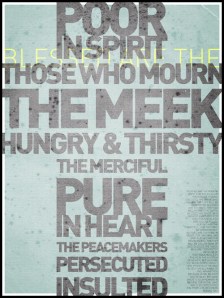
Courtesy of http://firecatching.blogspot.com/2011_04_01_archive.html

Courtesy of http://firecatching.blogspot.com/2011_04_01_archive.html

Today we hear one of the most beloved pieces of scripture.  The Beatitudes from Matthew’s gospel have been the source of inspiration for Christians for centuries, for artists and musicians, for entire ministries, and even for comedians like Monty Python.  As soon as we hear that phrase, “Blessed are…” our eyes close and we let the words flow over us.  We nod in assent, and maybe even whisper, “Yes!”  And as the preacher for In-Gathering Sunday, getting the Beatitudes in the lectionary is like being handed a silver platter.  What other inspiration can we need on a Sunday like this than to think about blessings?  That is what our Stewardship Committee has been encouraging us to do for weeks: to think about the ways that we are blessed and to return that blessing to this community through the gift of our financial resources.  That message could not be better captured than in the Beatitudes from our gospel lesson today.

Or at least that is what I thought before I started really working with the Beatitudes this week.  The more I poured over the text, the more I became confused.  Then the questions came pouring in:  What does it mean to be poor in spirit?  How do we know if we are pure in heart?  I might prefer peace, but could any of us in our everyday lives be considered peacemakers?  And those are just the surface level questions.  When we read at a deeper level, ethical questions begin to emerge.  Our news outlets have been flooded lately with people who are reviled, persecuted, and having evil uttered against them.  All we have to remember are Christians in Iraq, Palestine, or Burma whose very faith means a life of oppression and sometimes death.  Is the word for them today, “You are blessed”?  Many a liberation theologian has balked at the idea of Holy Scripture being used to keep down oppressed peoples.

Luckily, I stumbled on two things this week that opened up the Beatitudes for me in a fresh way.  First I began to look at what the word translated as “blessed” really means.  There are a couple of words in scripture that are translated in English as “blessed,” but they do not necessarily have the same meaning.  In our Beatitudes today, one scholar argues that the phrase translated as “blessed are you when…” is more rightly translated as “You are on the right road when…”  For example, “You are on the right road when you are poor in spirit.”[i]  So blessed does not really mean, “Happy are you when people persecute you,” but instead, “You are on the right road when people persecute you.”  Somehow this translation makes for a much more sober, honest rendering of Jesus’ words.  Jesus is not saying that these things are cause for happiness in a superficial way.  Jesus is saying that we are fortunate in those experiences because they point us to a deeper truth:  that we are heading in the right direction, making the right decisions, and living a meaningful life.

The other source of insight I found this week was from The Message’s translation of this text.  If you are not familiar with The Message, The Message is a paraphrase of the Bible:  not a literal translation of the Biblical language, but a modern rephrasing of the text to make the text more accessible.  Of course, biblical scholars often cringe when they hear certain paraphrases of key texts, but in the case of the Beatitudes, I found this paraphrase quite useful.

I have taken the two ideas – The Message’s paraphrase and the new introduction of “You are on the right road when…” and want to read for you my hybrid rephrasing of the Beatitudes.  Our text now goes like this:

You are on the right path when you’re at the end of your rope.  With less of you there is more of God and God’s rule.  You are on the right path when you feel you’ve lost what is most dear to you.  Only then can you be embraced by the One most dear to you.  You’re on the right path when you’re content with just who you are—no more, no less.  That’s the moment you find yourselves proud owners of everything that can’t be bought.  You’re on the right path when you’ve worked up a good appetite for God.  God’s food and drink in the best meal you’ll ever eat.  You’re on the right path when you care.  At the moment of being ‘care-full,’ you find yourselves cared for.  You’re on the right path when you get your inside world—your mind and heart—put right.  Then you can see God in the outside world.  You’re on the right path when you can show people how to cooperate instead of compete or fight.  That’s when you discover who you really are, and your place in God’s family.  You’re on the right path when your commitment to God provokes persecution.  The persecution drives you even deeper into God’s kingdom.  Not only that— You’re on the right path every time people put you down or throw you out or speak lies about you to discredit God.  What it means is that the truth is too close for comfort and they are uncomfortable.  You can be glad when that happens—give a cheer, even!—for though they don’t like it, God does!  And all heaven applauds.  And know that you are in good company.  God’s prophets and witnesses have always gotten into this kind of trouble.

This Stewardship Season, we have been talking about “Walking the Way.”  Certainly Walking the Way is a metaphor for our journey into a time of reflection about the value our money holds for us and how our relationship with that money is connected to our relationship with God.  But the Walking the Way metaphor is one that goes beyond just our money too.  Walking the Way is a metaphor for our entire journey with God – a path that is ever winding, has steep slopes at times, is sometimes full of potholes and rocks, and at other times is as smooth as a freshly paved road.  Our entire life is a journey – one in which we mature in faith from the time of our birth and baptism to the time of our old age and death.  We are constantly Walking the Way with Christ, growing, learning, messing up, and returning to a loving God.

What I like about this reworded rendition of the Beatitudes is the affirmation in them.  When we are on a journey, Walking the Way, we sometimes struggle to know whether we are on the right path.  We wonder if we are where we should be and whether God is really with us.  This rendition of the Beatitudes gives us a tiny glimpse into that affirmation:  You are on the right path when…  Of course, the description is not all roses.  Mourning, persecution, and making peace are not easy roads.  But a sign of true discipleship, of Walking the Way, are those times when the path is in fact quite rocky.  Then we know that we are on the right path, and Jesus is walking right beside us.  Amen.

[i] Earl F. Palmer, “Pastoral Perspective,” Feasting on the Word, Year A, Vol. 4 (Louisville: Westminster John Knox Press, 2011), 238.

Sermon – Matthew 22.34-46, P25, YA, October 25, 2014

30 Thursday Oct 2014

Posted by jandrewsweckerly in Uncategorized

≈ 2 Comments

Tags

active, commandment, God, heart, Jesus, love, mind, neighbor, passive, Sermon, soul, stewardship

I hear it all the time.  Whether talking to engaged friends or working with a couple in premarital counseling, inevitably the question will come up, “So why do you want to get married?”  And then I get the response, “Well, we’re just so in love.”  Though their googly eyes are endearing and make me somewhat nostalgic for a time long ago, my thought is almost always, “Cute.  I wonder how long that will last.”  Though I try not to squash their mushy moment, eventually we get around to talking about life outside of their love bubble – talking about what happens when they argue, how they will negotiate the in-laws, and who will balance the checkbook.  Those are the times when the warm emotions of love are sometimes difficult, if not impossible, to maintain.  I do not meant to suggest that those warm, fuzzies of love are temporary necessarily; I simply mean that the emotional experience of love is not enough to sustain any relationship – neither those between couples, family, nor friends.  We are right to assume that love is necessary for relationships, but our definition of love has to be much bigger if we are to maintain any kind of meaningful relationships with others.

Sometimes we forget the multilayered meaning of love when we hear passages like the one from our gospel lesson today.  When asked about the greatest commandment, Jesus says, “You shall love the Lord your God with all your heart, and with all your soul, and with all your mind… and… love your neighbor as yourself.”  These commandments are so familiar to us that we sometimes forget how hard they really sound.  If our definition of love only includes the emotional kind of love that we might call “being in love,” does that mean we need to have googly eyes toward God?  I know very few people who profess to be “in love” with God.  In fact, I am not sure we would even say that we love God.  We might be grateful to God, we may revere God, or we might even be in awe of God.  But I know very few people who would say, “I love God.”  That emotion just feels strange to us.  And yet, Jesus says today, love the Lord your God with all your heart, and with all your soul, and with all your mind.

Now the second commandment is a little easier.  We are used to loving our neighbors – loving people is what we are used to doing.  We love our friends and our family.  But Jesus says to love our neighbor, not just our friends.  Our neighbor includes those grouchy neighbors next door, that kid from school or that guy from work who always pushes your buttons, and most certainly that woman who cut you off while driving.  Our neighbor also includes those neighbors that often go unseen by us: the teen at JFK High School whose family cannot afford clothes and school supplies this year, that family who picked up our produce in Huntington Station through Food Not Bombs, that homeless man who received basic toiletries from St. Ignatius this week, or that Veteran’s family who is struggling to put life back together after returning to Plainview from war.  About these grouchy, mean, and unseen neighbors Jesus says, “Love your neighbor as yourself.”

When I work with those couples planning weddings, I am grateful when they choose the First Corinthians passage for their wedding, “Love is patient, love is kind…”[i]    I am grateful because then we can talk about what love really is.  We can talk about how love is more than simply a warm feeling or even a passionate desire.  In fact, when scripture talks about love, more often than not the kind of love scripture is talking about is not a passive emotion, but an active mercy.  In scripture, love is not something we feel, but something that we do.  To help us understand the difference, scripture will often translate the word for love as “loving-kindness.”  Love is not a feeling, but a choice:  a choice that we have to make over and over again.  As one person explains, “To love neighbor as oneself is to act toward the other as one would act toward those close to you.  We treat the stranger as well as we treat those that we love emotionally.”[ii]

So what does this active love look like?  For our neighbor, this kind of love is a bit more obvious.  The next time someone is rude to you or unkind to you, instead of reacting to them defensively, perhaps you take a moment to wonder what happened to them in life that made them act this way toward you.  Once you start to wonder about what things make them human and what has hurt them in life, your ability to be angry with them for hurting you lessens a bit.  In my early working days, I worked with a woman who most of the time was pretty pleasant to be around.  But there were times that she lashed out – and when she did I used to be both perplexed and angry.  I eventually started avoiding her altogether when, in a totally different context, someone who knew her shared with me that her father and an ex-husband had been alcoholics and were both abusive.  Suddenly the pieces fell together for me.  She had not known the kind of love that God commands – and I had not loved her as my neighbor.  The next time she snapped at me, her snapping felt less personal and awful – and instead I could see a vulnerable, hurting person who did not know how to love.  When Jesus tells us to love our neighbor as ourselves, this is the kind of shift in thinking Jesus invites.

In some ways, loving our neighbor is a tangible task we can imagine assuming.  But loving God still feels a little foreign, let alone loving God with all our heart, mind, and soul.  Luckily, God leads by example.  Our stories of God tell us of how, time and again, God chooses God’s people, makes covenants with them, forgives them, and invites them into relationship again. God’s love for God’s people is not an emotion, but an action.  Just recently we reheard the Exodus stories of how as soon as the people get out of bondage, they complain about not having food, not having water, and feeling separated from their creature comforts.  We heard again about how when God takes too long with Moses up on the mountain, they quickly revert to worshiping a golden calf.  And yet God keeps providing for, caring for, and loving them.  This is our model for how we are to love God too.  “We can love with our heart: through generosity to God’s people.  We can love with our soul: by worshiping God and praying for our neighbors and ourselves.  And we can love with our minds: studying God’s Word and letting it correct us, enlighten us, and send us out in loving action to the world.”[iii]

As we continue to prayerfully walk the way through this stewardship season, I first wondered whether this lesson really had anything to say about stewardship.  But as I thought about loving God and neighbor, I realized that is what stewardship is really all about.  Like love, stewardship is not something we feel or think about – stewardship is something we do.  When we make a financial pledge or contribution, we are expressing to God our gratitude for our blessings.  We take money from our pockets – money that certainly could be used for a hundred other things we want or need – and we instead give that money to God.  This is our full-bodied way of loving God with our heart, soul, and mind.  And, when the church uses that money for educating our children, serving our neighbors in need, and sharing the Gospel in our community, the church helps us to love our neighbor through our money too.  Jesus is certainly inviting us to change our feelings about God and our neighbor – but Jesus is also inviting us to change our actions toward God and neighbor.  That is what love is.

Next week, you will have the chance to act on that love.  We will process our pledge cards forward, as a symbolic gesture of our financial commitment to the work and ministry of St. Margaret’s.  We commit to funding the worship, which helps us love God with our soul.  We commit to funding the outreach and evangelism, which helps us love God with heart.  We commit to funding education and formation, which helps us love God with our minds.  And we commit to funding a ministry that enables us to not only love God, but to love our neighbor as ourselves.  I cannot think of a better way to invest our money than to invest our money in love.  Amen.

[i] 1 Corinthians 13.1-13.

[ii] Clayton Schmit, “Matthew 22:34-46 Commentary,” 2011, as found at http://www.workingpreacher.org/preaching.aspx?commentary_id=1063 on October 21, 2014.

[iii] Schmit.

Sermon – Matthew 22.15-22, P24, YA, October 19, 2014

23 Thursday Oct 2014

Posted by jandrewsweckerly in Uncategorized

≈ Leave a comment

Tags

belong, church, emperor, giving, God, Jesus, perspective, Sermon, state, stewardship, taxes

Today’s gospel lesson is one of those funny lessons in the Bible that is often quoted, but frequently misconstrued.  Jesus’ says, “Give therefore to the emperor the things that are the emperor’s, and to God the things that are God’s.”  As one scholar points out, “Some people point to this passage as proof that God and politics should be kept separate — that things like taxes have absolutely nothing to do with one’s theological commitments.  Others say that this story proves that religion is a matter of the heart, and that Jesus doesn’t really care about mundane things like what you do with your money.  And some have cited this passage as proof that Jesus taught that the law is the law, and our duty as Christians is to support the government no matter what.”[i]

All of these conclusions are based in modern assumptions, and ignore the context within which Jesus says these words.  Jesus is not laying out a treatise of how his followers are to navigate the tensions between church and state.  What Jesus is doing is navigating the various factions that would much rather have him eliminated than hear the real meaning of his words.  The Pharisees and the Herodians have little in common.  In fact, they are pretty much enemies, with the Herodians being dedicated to King Herod and the Pharisees being dedicated to Jewish Law – including being opposed to paying the tax to Caesar for religious reasons.  But despite these divided loyalties, the Pharisees and Herodians are united in their desire to remove Jesus from the scene.[ii]  And so they play this game, trying to trick Jesus into either angering the state or angering the faithful – either way cursing Jesus.  What they had forgotten is how clever and insightful Jesus can be.  And with this one response, “Give therefore to the emperor the things that are the emperor’s, and to God the things that are God’s,” Jesus answers a trick question much more broadly than the answer that either the Pharisees or the Herodians were hoping for.

Jesus is not really talking about the separation of church and state today.  He is not even really talking about taxes.  Jesus is talking about a new perspective on the whole of our lives – a way to think about money certainly, but also a way to put all things in perspective.  Now I do not know about you, but I am kind of a visual learner.  I need to see something in writing or have something in a chart or spreadsheet to really grasp a new idea.  So let’s take Jesus’ statement, “Give therefore to the emperor the things that are the emperor’s, and to God the things that are God’s,” and make a mental pie chart.  Are you ready?  First, let’s put our taxes pie piece in the chart.  What is that, like twenty percent, right?  So now we have a pie chart that leaves about eighty percent.  From that, let’s take our pledge out.  For ease of argument, let’s say you subscribe to giving a tithe, so we will take ten percent out.  That leaves us with seventy percent with which to play.  But Jesus says that the things that belong to God should be given to God.  If we have jobs or we go to school, our ability to do those things belongs to God.  So, we have to give that back to God.  That probably leaves us with about fifty percent in our pie chart.  Our good health is all owed to God as well, so now we are down to about forty percent.  Those friends and family that we hold so dear – those are also gifts from God.  Now we are down to about thirty percent.  And let’s not forget about food, shelter, and clothing.  We just dropped down to about fifteen percent.  Then there is the air we breathe, and God’s own creation upon which we rely.  Now we are down to about five percent.

Whew!  We have five percent of our “stuff” that belongs to us.  But wait – Jesus did not say, “Give therefore to the emperor the things that are the emperor’s, and to God the things that are God’s…and then keep the final five percent for yourselves.”  Surely Jesus knew we would need a night on the town, or a moment to just be self-absorbed, and not think about those suffering around the world.  But here is where the rub is in our lesson today.  The reason why the Pharisees and the Herodians leave Jesus amazed and go away is because they are shocked into silence.  If Jesus answers that the people should not pay the tax, the Herodians will be able to call him a seditionist.  If Jesus tells the people they should pay the tax, the Pharisees will be able to accuse him of not following the law of God because the use of the coin alone, which claimed Caesar’s divinity, was blasphemous.  Not to mention the fact that Caesar was oppressing the people.  If Jesus says they should pay the tax, surely the people of faith will turn on him.[iii]  But Jesus answers with “Give therefore to the emperor the things that are the emperor’s, and to God the things that are God’s.”

The reason Jesus is able to send the people away amazed is because Jesus point out one even trickier, harder truth – everything we have – our tax money, our tithe, our jobs, our health, our family and friends, our food, shelter and clothing, the very air we breathe – everything belongs to God.  What Jesus is really saying today is that our question – and yes, this is our question too, not just the question of the Pharisees and Herodians – our question today is laughable.  We can make all the pie charts and balance sheets we want.  The pie chart really only has one big piece – and that piece says, “God’s.”

This past week, my daughter and I were talking about the prayer rocks that we got from the Stewardship Committee last week.  If you have not received yours yet, there are some in the back.  The idea is that when you received your pledge card and stewardship packet, you would have a tool to help you prayerfully consider your pledge for the coming year.  The rock is meant to be your tactile way of praying about your pledge this year.  The other nice thing about the rock is that the rock is also a conversation piece.  That is how my daughter and I had a prayerful conversation this week.  We were comparing our rocks – both of ours says “love” on the rock, but hers is more oblong and black, while mine is rounder and grayer.  When my daughter asked me what we were supposed to do with our rocks, I told her that the rock was supposed to help us think about what we wanted to give to God this year.  I suggested she decide on a coin that she could take to church every Sunday.  Instead, my daughter told me she wanted to give a can of food every Sunday.  See, I wanted her to understand the connection of our money with God.  But perhaps my daughter understood the bigger statement of Jesus today – that everything, including the food on our shelves, belongs to God.  So we compromised, agreeing that she could do both.  Because she was right – our money, our food, our livelihood all belongs to God.  Our poor pledge coordinator is going to have to figure out how to calculate that pledge when we turn in our card on November 2nd.

I joke, but I think our pledge card this year might be some hybrid of our ideas.  The adults of our family will certainly be putting on a tithe.  The children in our family will have to calculate a dime or nickel times 52 weeks in the year.  And our cupboard will have to sacrifice 52 items as well.  Normally once a month or so, our family goes to Costco and gets a packet of something to put in our food drive.  But I like my daughter’s idea better – because my daughter’s idea reminds us that the food on our shelves – our food, not food bought for others – belongs to God.  And as Jesus reminds us today, we are to give to God the things that are God’s.  Amen.

[i] Lance Pape, “Commentary on Matthew 22:15-22, found at http://www.workingpreacher.org/preaching.aspx?commentary_id=2201 on October 15, 2014.

[ii] Marvin A. McMickle, “Homiletical Perspective,” Feasting on the Word, Year A, Vol. 4 (Louisville: Westminster John Knox Press, 2011), 191.

[iii] Susan Grove Eastman, “Exegetical Perspective, Feasting on the Word, Year A, Vol. 4 (Louisville: Westminster John Knox Press, 2011), 191, 193.  Other resources explain this duality as well.

Sermon – Matthew 11.25-30, St. Francis’ Feast Day, YA, October 5, 2014

08 Wednesday Oct 2014

Posted by jandrewsweckerly in Uncategorized

≈ Leave a comment

Tags

animals, blessing, burden, disciple, Jesus, light, reconciliation, rest, Sermon, St. Francis, wolf

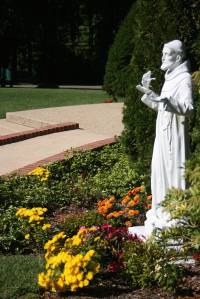
Today we honor the life of St. Francis of Assisi.  Francis is one of the most popular and admired saints of all time.  Most of us know the highlights of his story: born the son of a wealthy man in 1182; had a conversion experience and devoted his life to Lady Poverty; shaped monastic and lay devotion; was a friend to all God’s creatures – being know to have preached to the birds.

But the story I like most is the story about St. Francis and the Wolf.  According to legend, there was a wolf that was terrorizing the town of Gubbio, killing and eating animals and people.  The villagers tried to fight back, but they too died at the jaws of the wolf.  Francis had pity on the townspeople and went out to meet the wolf.  When Francis found the wolf, he made the sign of the cross, and said, “Come to me, Brother Wolf.  In the name of Christ, I order you not to hurt anyone.”  In response, the wolf calmly laid down at Francis’ feet.  Francis then went on to explain to the wolf how he was terrorizing the people and other animals – all who were made in the image of God.  The wolf and Francis then made a pact that he would no longer harm the townspeople and the townspeople would no longer try to hurt the wolf.  The two traveled into town to explain the pact they had formed.  The people were amazed as Francis and the wolf walked side-by-side into town.  Francis made the people pledge to feed the wolf and the wolf pledge not to harm anyone else.  From that day on, the wolf went door to door for food.  The wolf hurt no one and no one hurt the wolf; even the dogs did not bark at the wolf.[i]

What I love about this story of St. Francis is that the story is about reconciliation and relationship.  At the beginning of the story the town and the wolf are at an impasse – the wolf is hungry and getting attacked; the people are afraid and are lashing out.  What Francis does for both parties is shock them out of the comfortable.  For the wolf, no one has addressed the wolf kindly – they have either shut the wolf out or actively tried to kill him.  For the people, the wolf has not asked for help – he has simply and violently taken what he needed and wanted.  Francis manages to shock the wolf first – not through violence or force, but with the power of love and blessing.  By giving a blessing in the name of God, Francis is then able to implore the wolf to reciprocate with love.  Francis also manages to shock the village – not with a violent victory, but with a humble display of forgiveness and trust.  By walking into town with a tamed wolf at his side, Francis is able to encourage the town embrace, forgive, and care for the wolf.  Francis’ actions remind both parties that unless their relationships are reconciled, unrest and division will be the norm.

The funny thing about this story is that the story is pretty ridiculous.  I mean, how many of us go around talking to wild animals, blessing them with the sign of the cross, expecting anything other than being attacked?  We will never really know whether the story is true.  But like any good Biblical story, whether the story is true is hardly the point: the point is that the stories point toward “Truth” with a capital “T.”  What this story teaches is that peace and reconciliation only happen through meeting others where they are.  We cannot expect great change unless we are willing to get down in the trenches – to go out and meet that destructive wolf face-to-face.  The other thing this story teaches is relationships are at the heart of peace work.  Only when the wolf and the town began to get to know each other and began to form a relationship with one another could they move forward.

This is the way life is under Jesus Christ.  In our gospel lesson today, Jesus says, “Come to me, all you that are weary and are carrying heavy burdens, and I will give you rest.  Take my yoke upon you, and learn from me; for I am gentle and humble in heart, and you will find rest for your souls.  For my yoke is easy, and my burden is light.”  Jesus’ words have layered meaning.  The first meaning we all catch is that Jesus offers us rest and refreshment.  Jesus encourages us to come to him, to cast our burdens and cares upon him, and to take rest, to take Sabbath in Christ.  Our souls will find peace in Christ Jesus.  The second meaning is that peace in Christ Jesus is not without work.  Jesus does not say come unto me and relax forever in happy retirement.  Jesus says we will still have to take on a yoke – the burden of disciple living.  But luckily, that burden of being Christ’s disciple will not be burdensome – it will be light.  Finally, not only will Jesus make the workload “light,” as in not heavy.  Jesus will also make us “light” – as in lights that shine into the darkness and refuse to allow the shadow to overwhelm.[ii]  We become the light when we work for reconciliation in our relationships with others.

That is why we do so many special things today.  Today, we ask for healing prayers – that God might help us reconcile the relationships in our life that need healing.  Today, we ask for blessing on our animals – that God might help our relationship with our pet be one of blessing and light.  Today, we come to Jesus for Sabbath rest – that God might renew us on this Sabbath day, use the rest to fill us with light, and renew our commitment to be agents of reconciliation, gladly putting on Christ’s yoke.  Amen.

[i] John Feister, “Stories about St. Francis and the Animals,” as found at http://www.americancatholic.org/features/francis/stories.asp on September 30, 2014.

[ii] Mel Williams, “Let it go…and rest” Faith and Leadership, July 6, 2014 as found at http://www.faithandleadership.com/sermons/mel-williams-let-it-go%E2%80%A6and-rest  on September 30, 2014.

← Older posts
Newer posts →

Recent Posts

  • On Politics, Football, and Love…
  • On Sharing the Love…
  • Sermon – Micah 6.1-8, Matthew 5.1-12, EP4, YA, January 30, 2026
  • On Justice, Kindness, Humility, and the Messy Middle…
  • Feast of the Rev. Dr. Martin Luther King, Jr., January 18, 2026

Archives

  • February 2026
  • January 2026
  • December 2025
  • November 2025
  • October 2025
  • September 2025
  • August 2025
  • July 2025
  • June 2025
  • March 2025
  • February 2025
  • December 2024
  • November 2024
  • October 2024
  • September 2024
  • August 2024
  • July 2024
  • June 2024
  • May 2024
  • March 2024
  • February 2024
  • January 2024
  • December 2023
  • November 2023
  • October 2023
  • September 2023
  • August 2023
  • July 2023
  • June 2023
  • May 2023
  • March 2023
  • February 2023
  • January 2023
  • December 2022
  • November 2022
  • October 2022
  • June 2022
  • May 2022
  • January 2022
  • December 2021
  • November 2021
  • October 2021
  • September 2021
  • August 2021
  • June 2021
  • May 2021
  • April 2021
  • March 2021
  • February 2021
  • January 2021
  • December 2020
  • November 2020
  • October 2020
  • September 2020
  • August 2020
  • July 2020
  • June 2020
  • May 2020
  • April 2020
  • March 2020
  • February 2020
  • January 2020
  • December 2019
  • November 2019
  • October 2019
  • September 2019
  • August 2019
  • July 2019
  • June 2019
  • May 2019
  • April 2019
  • March 2019
  • February 2019
  • January 2019
  • December 2018
  • November 2018
  • October 2018
  • September 2018
  • August 2018
  • July 2018
  • June 2018
  • May 2018
  • April 2018
  • March 2018
  • February 2018
  • January 2018
  • December 2017
  • November 2017
  • October 2017
  • September 2017
  • August 2017
  • July 2017
  • June 2017
  • May 2017
  • April 2017
  • March 2017
  • February 2017
  • January 2017
  • December 2016
  • November 2016
  • October 2016
  • September 2016
  • August 2016
  • July 2016
  • June 2016
  • May 2016
  • April 2016
  • March 2016
  • February 2016
  • January 2016
  • December 2015
  • November 2015
  • October 2015
  • September 2015
  • August 2015
  • July 2015
  • June 2015
  • May 2015
  • April 2015
  • March 2015
  • February 2015
  • January 2015
  • December 2014
  • November 2014
  • October 2014
  • September 2014
  • August 2014
  • July 2014
  • June 2014
  • April 2014
  • March 2014
  • February 2014
  • January 2014
  • December 2013
  • November 2013
  • October 2013
  • September 2013
  • August 2013
  • July 2013
  • June 2013
  • May 2013
  • April 2013
  • March 2013
  • February 2013
  • January 2013
  • December 2012
  • November 2012
  • October 2012
  • September 2012

Categories

  • reflection
  • Sermons
  • Uncategorized

Meta

  • Create account
  • Log in
  • Entries feed
  • Comments feed
  • WordPress.com

Blog at WordPress.com.

  • Subscribe Subscribed
    • Seeking and Serving
    • Join 395 other subscribers
    • Already have a WordPress.com account? Log in now.
    • Seeking and Serving
    • Subscribe Subscribed
    • Sign up
    • Log in
    • Report this content
    • View site in Reader
    • Manage subscriptions
    • Collapse this bar
 

Loading Comments...