• About

Seeking and Serving

~ seek and serve Christ in all persons

Seeking and Serving

Tag Archives: light

Sermon – Isaiah 9.2-7, Blue Christmas, December 21, 2020

06 Wednesday Jan 2021

Posted by jandrewsweckerly in Sermons

≈ Leave a comment

Tags

Blue Christmas, Christ Child, Christmas, church, darkness, God, joy, light, mourn, night, painful, pandemic, Sermon, strength, suffering

Blue Christmas is a service we offer every year.  This service is not always mainstream.  For many, Christmas is a season of uncomplicated joy.  But for others, Christmas can be a painful experience:  we mourn the memories of those who are no longer with us, the darkness of shorter days weighs on our mental health, or the unbounded exuberance of others creates a chasm between their happiness and our loneliness, sorrow, or pain.  And that does not account for the grief we may be experiencing otherwise – broken relationships, dissatisfaction with or lost employment, an unexpected medical diagnosis, or a dream unfulfilled.  And because Christmas cheer is all around us, we feel even more isolated in our sadness – as if we are alone in our feelings.  Only in services like these do we feel seen.

That is the experience of a “normal” Christmas.  This year, we have added nine months of a pandemic, a tumultuous political year, and civil unrest.  Suddenly, those of us who struggle with finding joy this Christmas find ourselves in a rising majority, not the minority.  I watched this year as hundreds of people decorated for Christmas in mid-November, in an effort to demand the experience of joy from a year that has been short on joy.  I can see the desperate need of a suffering people to find light somewhere, anywhere, during this holiday season.

Fortunately for us, the church is not silent on this experience.  The text we heard from Isaiah earlier says, “The people who walked in darkness have seen a great light; those who lived in a land of deep darkness–on them light has shined. You have multiplied the nation, you have increased its joy; they rejoice before you as with joy at the harvest, as people exult when dividing plunder. For the yoke of their burden, and the bar across their shoulders, the rod of their oppressor, you have broken as on the day of Midian.”  The prophet says all of this light and joy is possible for one reason:  “For a child has been born for us, a son given to us.”  Scripture tonight honors that there are seasons of darkness.  There are times when we live in deep darkness, devoid of joy.  There are times when burdens feel like weights on our shoulders, where oppressors keep us in positions of suffering.  Sometimes those times of darkness happen around holidays, and sometimes the memory of those dark moments invade our holidays.  To that experience, the prophet says, God brings us light.  God lifts burdens, God helps us recall joy, God strengthens us.  And perhaps, most importantly, God gives us the Christ Child – the only true source of light that can lighten the darkness.

I have always loved that the Christ Child was born in literal darkness.  The delivery of the Christ Child at night reminds us that even in the rustic setting of being outcast, joy comes to Mary and Joseph.  The delivery of the Christ Child at night reminds us that even in the mundane, lonely, and exhausting work of tending sheep through the night, unbounded joy can break forth in the form of angels with heavenly news.  The delivery of the Christ Child at night reminds us that even in the darkness of night, whispered conversations between strangers can bring joy to kindle and ponder in our hearts.

Tonight, by the manager, God sees your darkness, your suffering, your hurt.  The removal of that darkness, suffering, and hurt may not be possible in these next few days.  But in that darkness, God promises you the tiniest sliver of light.  Whether you find that light by seeing you are not alone in the darkness tonight, whether you find that light through the stories of others, or whether you find that light gazing on the miracle of the Christ Child, the light, however faint, is there, waiting for you, warming you ever so slightly, and starting the long, hard work of lifting your heavy burden.  And until you are ready to receive that light, the Church sits with you in the darkness tonight.  Amen.

On Things Ludicrous and Holy…

17 Thursday Dec 2020

Posted by jandrewsweckerly in Uncategorized

≈ Leave a comment

Tags

best, Christmas, church, division, humble, indignation, joy, light, love, pandemic, praise, resurrection, separation

Photo credit: https://loe.org/shows/segments.html?programID=18-P13-00051&segmentID=1

My children are preparing for their winter socially distanced holiday recital, and we have been flooded with a flurry of details, items to purchase, things to organize.  One of the flyers that came this week was for a t-shirt they could buy promoting the recital and the cause that will benefit from the proceeds.  The shirt says, “Best Christmas Ever.”

I was glad my children were not around when I saw the flyer because my immediate response was to scoff – out loud, in my house, looking at a piece of paper with indignation.  Best Christmas Ever?!?  Had the dance studio lost their minds?  What about this Christmas could possibly be the “best”?  Families are separated, some of whom have not seen each other in over a year.  The Coronavirus is rapidly spreading, with the death toll in the United States now over 300,000.  And despite a transition in political power, we remain as divided as ever, struggling to find peace among our brothers and sisters. 

After recovering from self-righteous indignation, I began to think about the approaching Christmas season, and what the Church, and I as her priest, have invited people to do.  We are still inviting our parishioners, friends, and neighbors to join the Holy Family on Christmas Eve and sing songs of praise and thanksgiving.  Although we honor grief and suffering at our Blue Christmas service on December 21, we are still making a claim for hope, for light, and for love.  Even with our church buildings closed again, we are still encouraging the church to gather in their cars for a drive-thru, or by their hearths with their devices to join with the shepherds as we go to see this thing that has come to pass.  Perhaps to an outsider, the work of the Church this next week seems as ludicrous as claiming this Christmas is the Best Christmas Ever.

This week, I find myself humbled.  I know the Church is going to ask a lot of you over this next week.  You may not feel like singing carols, or hearing the familiar story, or watching candles flicker as we pray.  And that’s okay.  But, if it is alright with you, we are going to keep doing it anyway.  The Church has always been full of resurrection people.  We cannot help ourselves once we know the Risen Lord.  And so, when the Christ Child comes next week, we will keep holding on to light, to joy, and to love.  We will keep holding on to the promise that Christ is with us always, even to the end of the age.  We will keep shining the light of the Christ Child, reflecting his light to all.  And we will keep believing and trusting for you until you can come to the place where you can believe and trust yourself.  You do not need to rush.  We will keep holding the light until you are ready to take it up yourself.

Sermon – John 1.6-8, 19-28, A3, YB, December 13, 2020

17 Thursday Dec 2020

Posted by jandrewsweckerly in Uncategorized

≈ Leave a comment

Tags

Advent, baptism, community, Gaudete Sunday, Jesus, John, John the Baptist, joy, light, Sermon, witness

Yesterday the Edwards family gathered outside the Chapel to baptize eight-month-old Bryson.  When Bryson’s family asked me if Bryson could be baptized this weekend in a small family gathering, I had to think for a moment.  Advent is not one of the normal seasons for baptisms.  But then I remembered two things.  One, this Sunday is Gaudete Sunday – the Sunday in Advent marked for joy, and often marked by shades of pink and rose.  What could be more joyful than a baptism?  Two, I glanced at our lessons and saw John the Baptist was in our Gospel lessons.  Who better to feature in our lessons on a baptism weekend than John the Baptist?!?

Of course, I only needed a few minutes of sermon preparation this past week to realize I had missed something critical about our lessons this Sunday.  Last week, we had John the Baptizer featured in Mark’s gospel.  But this Sunday, when John appears in John’s Gospel, he is not labeled as John the Baptizer, but John the Witness.[i]  John’s role in the Gospel of John does not rest as centrally in his role of baptizer, but more centrally in testifying to the identity of Jesus Christ.  As Lamar Williamson says, “John’s role is to recognize the true light when [the light] appears, and to call attention to [the light] so that others may recognize [the light] and believe – that is, recognize, trust in, and commit themselves to the light.”[ii]  There went my perfectly arranged baptism weekend!  “John the Witness” does not really have quite the same je ne sais quoi as “John the Baptist.” 

So, I started thinking about what we are doing when we baptize people into the community of faith.  Baptism certainly is a rite of initiation into the body of Christ.  Upon baptism, one may receive communion and participate fully in the body.  We make promises on behalf of the baptized, we renew our most fundamental promises on our own lives through the Baptismal Covenant, and we open up a life’s journey of faith, hope, and joy in Jesus. 

But at the end of the day, the thing we are really doing in baptism is witnessing.  We are witnessing to the baptized, and their family, what are the things of ultimate importance to us as Christians.  We are witnessing a commitment to our community – the full responsibility we are willing to take on in the faith journey of the baptized, from infancy to adulthood.  And we are witnessing to the broader community:  that even in the midst of a pandemic (in which Bryson has spent his entire life), even in the midst of divisiveness and unrest, even in the midst of economic uncertainty, we are witnesses to new life, new hope, new joy.

Like John the Witness today, in baptism, we point the way to Jesus.  When Bryson, or our friends, ask the big questions, we will point them toward Jesus.  When Bryson, or our families, question faith and express doubt, we will witness to them about our own faith and doubt stories.  When Bryson, or our community, cannot claim joy or are simply numb to the overwhelming suffering of these days, we will share with them as Steve Garnaas-Holmes says, that “Christ does not come to make us happy, but to stand with us in the pain of life until joy like a seed rises.  All is swallowed up in joy.”[iii]  That is what Gaudete Sunday, a baptism weekend, and John the Witness invite us to do this week:  to be witnesses of joy, not looking at ourselves to be the light, but looking toward the one who is light – the only one who can solidify joy in the darkness of Advent.  Amen.


[i] Karoline M. Lewis, John (Minneapolis:  Fortress Press, 2014), 27

[ii] Lamar Williamson Jr., Preaching the Gospel of John (Louisville:  Westminster John Knox Press, 2004), 4, as cited by Gary W. Charles, “Exegetical Perspective,” Feasting on the Word, Year B, Volume 1 (Louisville:  Westminster John Knox Press, 2008), 71.

[iii] Steve Garnaas-Holmes, “Rejoice Always,” December 10, 2020, as found at https://www.unfoldinglight.net/reflections/b4fws8bsnsjklfkw3ws8823kke9a7t on December 10, 202.

On Grief, Fairies, and Grace…

17 Thursday Sep 2020

Posted by jandrewsweckerly in Uncategorized

≈ Leave a comment

Tags

abnormal, coping, fairy, feelings, gentle, God, grace, grief, light, lost, normal, pandemic, virus

Photo credit: https://childrengrieve.org/resources/about-childhood-grief

A dear friend of mine once talked about the experience of a “grief fairy.”  This fairy was the metaphorical way she explained how grief was not a simple, linear process from tragic event through grief to wholeness.  Instead, she imagined grief as a fairy who would, out of nowhere, lighten upon your shoulder and all of a sudden you went from fine, or at least managing, to not fine at all.

In some ways, I feel like this pandemic has become the same way.  We have begun to convince ourselves that we had our chance to be sad in the first few months of the virus, or even in these last six months.  But by now we should be adjusted, used to the “new normal,” and ready to get moving.  All the markers are there:  Summer has pretty much ended; the children are back to school – if not in person, certainly online; some employers are expecting workers to return to the workplace; churches kicked off their program years – even if they were missing the normal parish parties and picnics; and things like elections are rapidly approaching.  For all intents and purposes, we should be putting on our game faces and getting back to “normal.”

The problem is nothing is truly normal.  And every time we run into anything abnormal, we are reminded of our grief over what has been lost during this time.  We have become quite good at coping, to be sure, but somehow, that fairy keeps landing on our shoulder, reminding us of our grief in big and small ways:  when the kid’s back to school photos are missing pictures of the school bus; when a visit to someone sick is either not allowed, or has enough restrictions that we do not even bother; when the church year begins, but we’re still watching online; when we go to run a quick errand and realize we left our mask at home.   

My prayer for all of us is that we be a bit gentler – with each other, but especially with ourselves.  If you are feeling frustrated about your inability to keep your game face on, take the game face off and let yourself acknowledge the grief still lingering among us.  If you are surprised by a sudden surge of feelings about something seemingly small, remember that grief during this time is not linear, and that the fairy will keep on visiting.  If you are feeling alone in your ability to keep it all together, lean into your faith community to remember God’s grace for all of us.  We are all in this together.  We will have days of strength and days of weakness.  But God is present in all of it, always holding out the light to get us through the darkness. 

On New Songs…

29 Wednesday Jul 2020

Posted by jandrewsweckerly in Sermons, Uncategorized

≈ Leave a comment

Tags

God, grace, gracious, Holy Spirit, Jesus, light, Lord, love, moving, new song, praise, Psalm, reflection, Sermon, sing, suffering

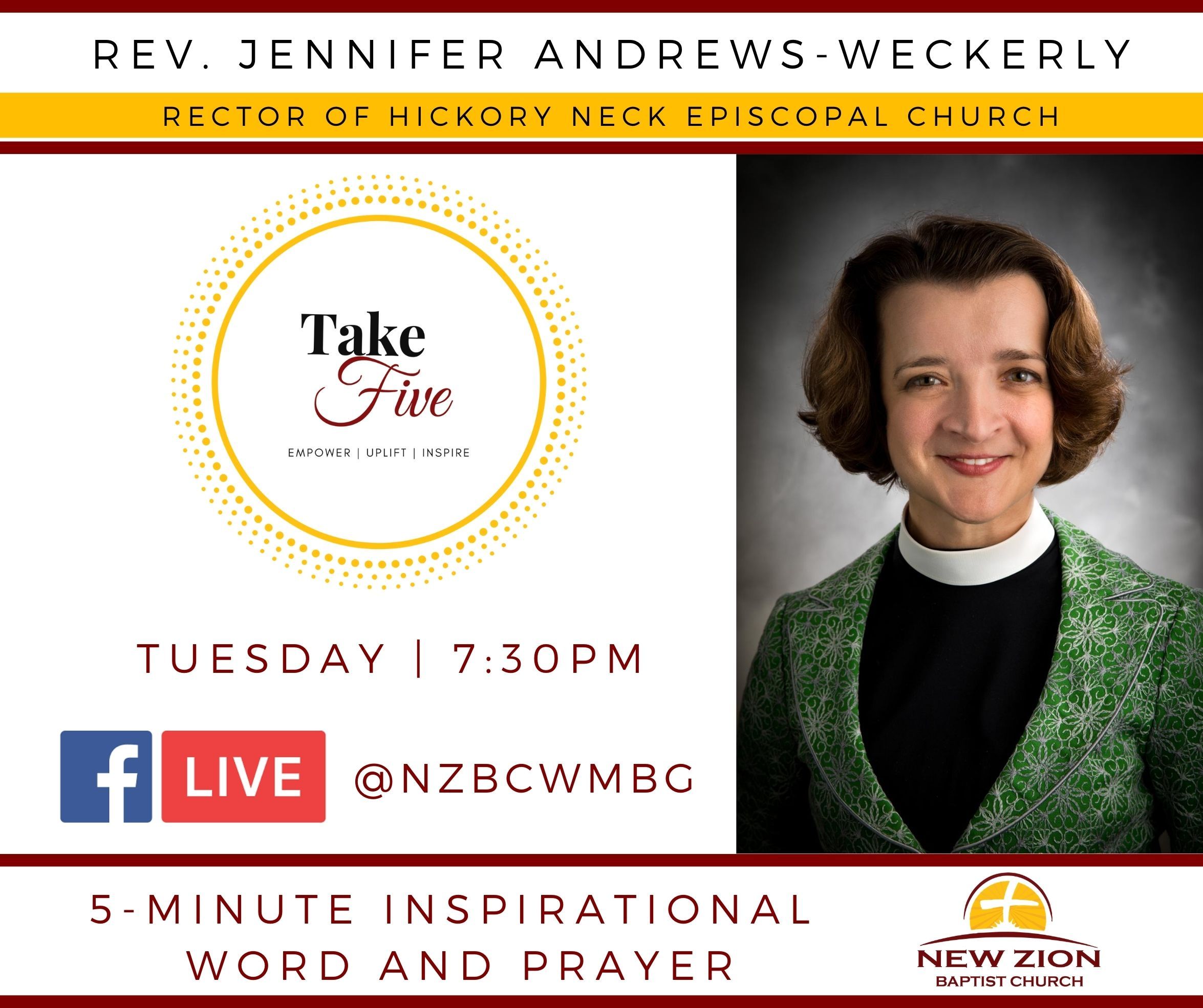
Take Five Speakers-Rev. Jennifer Andrews-WeckerlyThis reflection was offered through the livestream program called “Take Five” at New Zion Baptist Church on July 28, 2020.  This is the text from that talk.

Tonight we turn to Psalm 149, which says, “Praise the Lord.  Sing to the Lord a new song, his praise in the assembly of the saints.  Let Israel rejoice in their Maker; let the people of Zion be glad in their King.  Let them praise his name with dancing and make music to him with tambourine and harp.  For the Lord takes delight in his people; he crowns the humble with victory.  Let the saints rejoice in this honor and sing for joy on their beds.”

Now I know what you may be thinking.  Really?  You want us to talk about praising God?  We’ve got a worldwide pandemic, which our country is becoming one of the worst handlers of in the world, which disproportionately is affecting people of color, and has become so politicized that we are no longer worried about the sanctity of human life, but are instead arguing about rights and the ethics of sacrificing life for some contrived greater good.  Not only that, we are in a crucible around racism, that alternatively gives us great hope for change and makes us despondent about how far we really have to go.  Add to that the emotional, spiritual, financial, and physical toll of this time, a time when we seem incapable of respecting the dignity of every human being, and you want to talk about singing to the Lord a new song?

I don’t know about you, but when I am feeling the weight of the world, and when I am longing for a word from God, an old song is usually where I return.  Every once in a while, when I slow down enough not to just to pray to God, but to actually listen to God, those old timey hymns from my childhood come back.  Their words speak to my ache, or let me wallow in my despair.  They talk about sweet, sweet Spirits, and walks through garden alone with Jesus, and balms in Gilead.  When I talk to Jesus, I want an old song.

But that is not what the psalmist says.  We are not asked to recall the old songs; we are invited to sing a new song.  In fact, seven times in the psalms, we are invited to sing a new song to the Lord.  As a fellow pastor says, “New songs of praise are appropriate for new rescues and fresh manifestations of grace.  As long as God is gracious toward us, as long as he keeps showing us his power, and wowing us with his works, it is fitting that we not just sing old songs inspired by his past grace, but also that we sing new songs about his ever-streaming, never-ceasing grace.”[i]

In this time of utter upheaval, unrest, and unevenness, two things are happening.  One, God is still moving.  The Spirit’s movement may be hard to see or hear in the cacophony of noise.  But I know in talking to New Zion’s leadership, talking to the folks at Hickory Neck Church, and talking to our neighbors here in James City County, Jesus is still moving.  I know that you are finding moments of grace, even in the darkness of this time.  I know that you are seeing shreds of hope, even in what feels like the disappointing failures of our nation.  Two, despite how comforting those old songs are, I am guessing the Holy Spirit has whispering some new songs in your ear.  You may not be sure of the words, and you may be straining to hear the tune.  But in the depths of your heart, where we fear change and we harbor anxiety, we know that only a new song can help get us out of this mess.

So, here’s the good news.  We are not on our own to birth these new songs.  Psalm 40 says, “I waited patiently for the Lord; he turned to me and heard my cry.  He lifted me out of the slimy pit, out of the mud and mire; he set my feet on a rock and gave me a firm place to stand.  He put a new song in my mouth, a hymn of praise to our God.  Many will see and fear the Lord and put their trust in him.”  God put a new song in my mouth, says the psalmist.  Not I, out of my genius, wrote a new song.  Not, I worked hard and put in the time, and out of my labor created a new song.  Not, I listened to what others were singing and sang their songs.  No, the psalmist says, God put a new song in my mouth.  Our invitation tonight is to open ourselves to that new song.  Our invitation is to concede that during this time – a time unlike anything any of us has experienced – God is providing something new – new grace and new songs (which might be even better than that old favorite).  Our invitation tonight is to sing the new song God gives us out in the world – to trust in the wisdom of the words and notes Jesus is giving us and shout them out to a world that desperately needs to hear that new song.

Let us pray.  Holy and creative God, we know that you see our suffering and our cries.  We know that you see us patiently waiting on you to lift us up out of the mud and mire, to put us on a firm place to stand.  Help us to trust that you will put a new song in our mouths – a song to give voice to your ever-streaming, never-ceasing grace.  When we finally hear your new song, help us to sing that song – help us to praise your name with dancing, and make music with tambourine and harp.  Help us to remember that when we sing your new song, we shine your light into the world, helping your transformative, life-giving love take root, and disrupt the injustice of our day.  We praise you, Lord, and we bless you, and we sing a new song with you.  Amen.

[i] David Mathis, “Sing a New Song,” May 4, 2014, as found at https://www.desiringgod.org/articles/sing-a-new-song on July 27, 2020.

On Haircuts, Darkness, and Light…

15 Wednesday Jul 2020

Posted by jandrewsweckerly in Uncategorized

≈ 1 Comment

Tags

anxiety, Bible, darkness, excitement, God, haircut, light, pandemic, prayer, vanity, weight

bob-haircut-lede

Photo credit:  https://www.allure.com/story/getting-haircut-after-hair-loss-confidence

One of the inconveniences of this pandemic was that I was due for a haircut right as salons were closed.  I decided quickly this was a superficial, somewhat vain, concern, and I could simply wait until things reopened.  As the months passed, my growing hair became a symbol of this time – our need to stay-in-place, to stay socially distanced, and to make sacrifices for the sake of the community.  Eventually, as I did daily online prayers, it became a running joke that people were measuring the length of quarantine by the length of my hair.

So, when my hairdresser finally came back to work last week, I was equal parts thrilled and nervous.  My hair had not grown that long since college, and I longed for the ability to look properly groomed.  But I also was anxious – there is no way to stay six feet away from someone cutting your hair, and even with us both wearing masks, getting my hair cut was taking on a risk.  I tentatively booked the appointment, feeling both relief and guilt.

That tension did not dissipate during the experience.  My nervousness made my entire body tense.  I realized half-way through the cut I was subconsciously praying for both of us – that neither of us would get sick (then, guiltily realizing I probably ought to be praying for my hairdresser daily!).  As three-inches curls of hair fell to the ground, I had flashes of the Sampson story we had just read in our 90-day Bible Reading Challenge.  Had this been a mistake?  Was shedding all this hair a symbol of my failed ability to lead others with the example of compassion and care?

As I got back into my car though, the lightness of the weight of my hair created a lightness on my spirit too.  I suddenly realized that in addition to all of the suffering and death this pandemic has brought, it has also given us an invisible weight on our shoulders – the angst of making decisions about communal versus personal behavior, the load of constant cycles of grief, and the burden of a system crumbling around us.  Losing my hair was akin to losing a bit of the weight on my shoulders – remembering that despite all of the bad that has come out of this pandemic, so has a lot of good.  For me, cutting my hair (done with all the safety precautions possible) was a reminder of the light in the darkness of this time.  I say that not as an endorsement of getting one’s hair cut in general.  I say that because we all need reminders of the light trying to shine through during this time of darkness.  If you are finding you need help finding that light, I am here.  If you need help finding that light, Hickory Neck Church is here.  If you need help finding that light, God is surrounding you with light on every side, even if you cannot see it yet.  My prayer for you is you find hints of light today to sustain you in this darkness!

Sermon – Matthew 11.16-19, 25-30, P9, YA, July 5, 2020

15 Wednesday Jul 2020

Posted by jandrewsweckerly in Sermons, Uncategorized

≈ Leave a comment

Tags

abdication, comfort, delightful, God, Jesus, light, meaning, pandemic, purpose, reckless, refreshment, rest, satisfying, Sermon, weary, yoke

In Compline, one of the prayers is for “we who are wearied by the changes and chances of this life.”[i]  I have been feeling that prayer these last several weeks – or even months.  The longer we stay in our homes, the longer this pandemic wages illness and death upon us, the longer the spread of virus takes away the everyday privileges we never fully appreciated, and the longer civil unrest forces us to look at our demons and sinfulness, we become more and more weary.  We do not have to ponder too long why cases of the pandemic are soaring this summer.  People who are wearied by the changes and chances of this life are so grief-stricken they are becoming reckless, self-centered, and indignant.

So, you can imagine my full-bodied relief when I heard the last verses of our Gospel lesson today.  “Come to me, all you that are weary and are carrying heavy burdens, and I will give you rest.”  Those words from Jesus are sweet comfort to us, who just want a break, who just want some semblance of normalcy, who just want peace.  Jesus’ words are a warm embrace in a time of touchlessness.  Jesus’ words are a balm to our country who this very weekend honors a liberty that many of our neighbors are reminding us is not felt by all our citizens.

But as scholar Thomas Long says, “What Jesus offers, however, is not a hammock, but a yoke.”[ii]  I know we want to linger on verse 28, but immediately after that comforting embrace, Jesus says, “Take my yoke upon you, and learn from me; for I am gentle and humble in heart, and you will find rest for your souls.  For my yoke is easy, and my burden is light.”  In the shift between these last verses, Jesus does a bit of a bait and switch.  He beckons us into his comforting arms, but also places a burden on our shoulders.

I confess, I have been a bit cranky about that switch.  Can’t we just have one week, one Sunday, one moment, where we abdicate responsibility, where we take a sabbath from all this work, where we binge watch television and eat crappy food?  Isn’t that what Jesus means when he says he will give us rest?!?

Fortunately for all of us, I had my tempter tantrum early in the week, and have had some time to sit with this yoke of Jesus’.  You see, when I am being honest, I know binge watching television or eating junk food is not actually restorative.  I feel stiff and tired after sitting for hours.  And when I eat unhealthily, the lingering stomachache or sluggishness is not actually as comforting as the comfort food implies.

What Jesus is suggesting today is not a restful, self-centered, time of abdication.  What Jesus is suggesting is we find rest in the things of life that matter.  As one scholar suggests, “we will find rest for carrying the burden of the gospel by living out the unique mission to which Jesus calls each of us.”[iii]  That yoke we may be skeptical of this week, is not actually a ploy or a trick by Jesus.  The reason Jesus says his yoke is easy and his burden is light is “because [his yoke] is the way of God, and [his yoke] is profoundly satisfying to the human soul.”[iv]

Jesus uses some strong imperatives today:  come to me, take my yoke, learn from me.  But Jesus is not being bossy.  Jesus is reminding us, in his ever so firm, but pastoral way, that the ways we are seeking rest and relief from weariness are not the ways to life.  The way to life, of true refreshment, of renewed spirits is through the yoke of Christ.  How is that possible?  As one scholar reminds us, “The easy yoke means having something to do:  a purpose that demands your all and summons forth your best.  [The easy yoke] means work that is motivated by a passionate desire to see God’s kingdom realized.  [The easy yoke] means work toward a certain future in which all of God’s dreams will finally come true.  To accept the yoke of the gentle and humble Lord is to embrace the worthy task that puts the soul at ease.”[v]  Jesus reminds us today that the rest we seek is not mind-numbing, emotion-numbing, spirit-numbing relief, but purposeful, meaning-filled, reward-making clarity.  When we harness ourselves to Christ, the burdens no longer feel like burdens, the work no longer feels like work, and the desire to be done turns to a desire for God’s delightful sense of purpose and meaning.  That is the kind of profound satisfaction Jesus offers today.  Thanks be to God!

[i] Book of Common Prayer, 133.

[ii] Thomas G. Long, Matthew (Louisville:  Westminster John Knox Press, 1997), 132.

[iii] Emilie M. Townes, “Theological Perspective,”  Feasting on the Word, Year A, Volume 3 (Louisville:  Westminster John Knox Press, 2011), 214.

[iv] Long, 132.

[v] Lance Pape, “Homiletical Perspective,” Feasting on the Word, Year A, Volume 3 (Louisville:  Westminster John Knox Press, 2011), 217.

On Teachers, Nurses, and Grandmas…

07 Thursday May 2020

Posted by jandrewsweckerly in Uncategorized

≈ Leave a comment

Tags

appreciation, blessing, care, Christ, God, grandmother, gratitude, Jesus, light, love, ministry, notes, nurses, pandemic, sacred, teachers, thank you, thankful, vocation, work

thank-you-notes

Photo credit:  https://www.considerable.com/life/etiquette/bring-back-thank-you-notes/

One of the things my grandmother instilled in me from an early age was the importance of thank you notes.  She taught me how to write them, how quickly to send them, and the significance of being a person who reliably sends them.  These days I fear she would be sorely disappointed with how those carefully honed skills have deteriorated over time – not that I do not know how to write them or understand their importance, but how my overflowing plate often means the list of thank you notes to be written makes it to the bottom of my “to do” pile.

That is why I am thankful for the ways in which our country has designated this week as appreciation weeks for two powerful vocations:  teachers and nurses.  Left to my own devices, I regularly forget to show my appreciation for the teachers in our lives.  But this annual week always reminds me that for thirty-five-plus hours a week, teachers are the people who are with my children – teaching them, shaping them into thoughtful citizens, helping them grow into their unique identity, and generally helping them feel loved and valued.  I have always thought of teachers as part of our “village,” who are helping my husband and me raise our children.  And this year, more than ever, I am amazed at the ways teachers are pivoting, learning new technologies, figuring out different ways to engage children in a pandemic, and showing love to our kids while socially distanced.

Likewise, I am grateful for a week to show our gratitude toward our nurses.  My most powerful experience with a nurse was in childbirth.  I had been laboring for the better part of twelve hours when I finally elected to have an epidural.  Everyone left the room, and as I leaned forward for the anesthesiologist, I could not stop shaking – whether from exhaustion or fear, I am not sure.  But the nurse took my arms firmly, looked me right in the eyes, and instilled in me a trust so deep I can still feel it palpably ten years later.  Nurses do this every day – take our lives into their hands, guide us through healing and wellness, and comfort us in ways that build confidence, trust, and care.  And in the midst of this pandemic, they are literally putting their lives on the line to do this often-overlooked work.

I’m not sure this is enough of a thank you note to meet my grandmother’s standard.  But what I can tell you is our teachers and our nurses are doing sacred work every day of the year.  They love us, care for us, and show us the light of Christ every day.  If you have a teacher or nurse in your life, neighborhood, or circle of friends, please be sure to thank them personally for the ways in which they are changing our lives today.  I invite you to return God’s blessing they have been to you back to them.

Sermon – John 9.1-41, L4, YA, March 22, 2020

27 Friday Mar 2020

Posted by jandrewsweckerly in Sermons, Uncategorized

≈ Leave a comment

Tags

blind man, cause and effect, comfort, Coronavirus, faith, God, good, grace, hope, Jesus, journey, light, questions, see, Sermon, sight, sin, suffering, theology

I must confess to you:  I have been dreading talking to you about this text all week.  The presence of cause and effect in this text is overwhelming.  The text says multiple times that the reason the blind man is blind from birth is because he sinned (and since it was from birth, there is the implication his parents sinned, and the blind man is being doubly punished and exists in double sin).  Those gathered insist that Jesus must be sinful too because he does not follow the law – he heals on the Sabbath, and he cannot possibly speak for or act for God as a sinner.  Jesus also says those gathered are sinners for they cannot see God.  Even at the beginning of John’s story, even Jesus says, “Neither this man nor his parents sinned; he was born blind so that God’s works might be revealed in him.”

I have not wanted to preach this text today because I do not at feel comfortable with the cause and effect nature of this text, especially what that cause and effect nature seems to imply about suffering.  Can Jesus really be saying this man was made blind so that God could be revealed?  Is this text saying God causes suffering – pain, disability, ostracizing from community, poverty so deep that only begging will ensure survival?  That concept is a huge hurdle for me because that is not at all my theology of suffering.  And I especially do not like hearing that theology of suffering this week – a week when we are watching the cases of Coronavirus creep up in our country and double in our county and have begun asking the same sorts of questions the people in this passage are asking:  Where is God in this?  Why is God allowing not only this terrible virus to happen, but the accompanying societal upheaval?  Is God causing this suffering for some greater good?  This kind of health crisis pulls at all of us and in our innermost, private places, and makes us wonder, even if we cannot say the words aloud, “Did God have something to do with this virus?”  Or sometimes we find ourselves not embarrassingly asking the question, but boldly shouting at God, “What in the world are you doing?  Why aren’t you here fixing this?  How could you do this?!?”  The absolute LAST passage I want to hear when we are asking these bone-deep theological, desperate questions is a text that seems to imply God causes suffering for God’s own glory.

That is why I am especially grateful for biblical scholars who can journey with us in interpreting scripture.  Biblical Scholar Rolf Jacobson took a look at that same verse that has been nagging me all week, “Neither this man nor his parents sinned; he was born blind so that God’s works might be revealed in him.”  Luckily Jacobson is better at Greek than me.  He explains that the writers of the New Revised Standard Version inserted text into the English translation that simply is just not there.  In the original Greek, the words “he was born blind,” are not there.  Instead of the text saying, “Neither this man nor his parents sinned; he was born blind so that God’s works might be revealed in him,” the text actually says, “Neither this man nor his parents sinned [period].  In order that God’s works might be revealed in him, we must work the works of him who sent me…”  According to Jacobson, Jesus is not saying the man was blind so God could be revealed.  Jesus is saying no one sinned.  But given the situation, God has given his disciples the opportunity to do something good to reveal God’s goodness.[i]  In other words, God does not cause suffering.  But God can use us in the midst of suffering for good.

I don’t know about you, but that has shifted my understanding of this text completely.  All of the arguing about who sinned, what laws you must follow to be holy, and who should be in or out are a distraction.  The same can be true of us.  When we start trying to logic our way through fault, or sin, or blame – even blame on God, we lose our way; we become blind like those gathered and arguing in our text today.  Instead, this text is inviting us to ask different questions.  Instead of whose sin caused this virus, we can ask, “How can I be a force for good in the midst of this virus?”  Instead of why God is doing this or allowing this to happen, we can ask, “Where are the opportunities to see God acting for good in the midst of suffering?”  Instead of where is God in this, we can ask, “Where am I finding moments of God’s grace in this?”  I am not arguing our questions and demands of God are not valid at this time.  In fact, I think our quiet doubt of and our raging anger at God are perfectly normal – and maybe even necessary for honest relationship with God.  What I am arguing is this text is not a reinforcement of our sense of darkness, but instead an invitation into light – an invitation to seeing when we may feel blinded.  My prayer this week is that we stumble into those moments of light this week – that we find those moments of grace upon grace that give us renewed comfort, hope, and faith.  May God bless you in the journey toward the light.  Amen.

[i] Rolf Jacobson, “Sermon Brainwave #713 – Fourth Sunday in Lent,” March 14, 2020, as found at http://www.workingpreacher.org/brainwave.aspx?podcast_id=1240, on March 19, 2020.

On Serving, Humanity, and Jesus…

29 Wednesday Jan 2020

Posted by jandrewsweckerly in Uncategorized

≈ Leave a comment

Tags

abundance, comfort, community, homeless, humanity, Jesus, light, love, poor, poverty, relationship

Christ of the Breadlines

Photo credit:  https://www.flickr.com/photos/jimforest/8367811926

This week our church is hosting our community’s winter shelter.  Every week, a different church hosts homeless community members from approximately 6:30 pm – 8:00 am, providing dinner, a place to sleep, breakfast, and a bag lunch to go.  The organization that runs the program also coordinates services like off-site showers, bus passes, referrals for services, and other necessities.  For our church, this is an all hands on deck kind of week – from checking in guests, setting up and cleaning spaces, making and serving meals, handling checkout, and doing security.  The week brings us together as a community, helps create a sense of giving back to the community, and gives us an outlet to shine Christ’s light.

But one of the things the shelter also does is forces us to look into the face of poverty.  As I talk with our parishioners, I find them surprised to know (or remember) that the homeless often have jobs, sometimes are going to school, and may have things like cars, cell phones, and laptops.  I find our parishioners reminded of our common humanity – that comfortable or poor, we all have likes, dislikes, joys, and sorrows.  I find our parishioners able to see how important community can be for support, care, and love – whether a church community, a nonprofit community, or a community of people struggling to get by who look out for each other.  I find our parishioners taking fresh new looks at their surroundings, perhaps seeing abundance for the first time in a long time.

Jesus spent a lot of time with the poor, oppressed, and marginalized.  Part of that time was certainly about relieving suffering and healing brokenness.  But I imagine part of that time was about looking into the face of poverty and seeing something one cannot see elsewhere – humanity, commonality, community, and abundance.  I think Jesus also knew how hard it is to see the realness of life when surrounded by wealth – that’s why he was always telling people to give it away!  Ultimately, Jesus cared about loving relationships, and sometimes money just gets in the way of those kind of authentic interactions.

Whether you are volunteering this week or not, I encourage you to find a way this week to step out of your comfort zone – have a conversation with someone who is suffering, look into the eyes of someone asking for help, or take a look at your own lifestyle and assess what you need less of in your life.  It is in those moments we see glimpses of where Jesus is, and it is in those moments that we shine Christ’s light for others.  I can’t wait to hear your stories!

← Older posts
Newer posts →

Recent Posts

  • On the Myth and Magic of Advent…
  • On Risking Failure and Facing Fear…
  • Sermon – Luke 23.33-43, P29, YC, November 23, 2025
  • On Inhabiting Gratitude…
  • Sermon – Luke 20.27-38, P27, YC, November 9, 2025

Archives

  • December 2025
  • November 2025
  • October 2025
  • September 2025
  • August 2025
  • July 2025
  • June 2025
  • March 2025
  • February 2025
  • December 2024
  • November 2024
  • October 2024
  • September 2024
  • August 2024
  • July 2024
  • June 2024
  • May 2024
  • March 2024
  • February 2024
  • January 2024
  • December 2023
  • November 2023
  • October 2023
  • September 2023
  • August 2023
  • July 2023
  • June 2023
  • May 2023
  • March 2023
  • February 2023
  • January 2023
  • December 2022
  • November 2022
  • October 2022
  • June 2022
  • May 2022
  • January 2022
  • December 2021
  • November 2021
  • October 2021
  • September 2021
  • August 2021
  • June 2021
  • May 2021
  • April 2021
  • March 2021
  • February 2021
  • January 2021
  • December 2020
  • November 2020
  • October 2020
  • September 2020
  • August 2020
  • July 2020
  • June 2020
  • May 2020
  • April 2020
  • March 2020
  • February 2020
  • January 2020
  • December 2019
  • November 2019
  • October 2019
  • September 2019
  • August 2019
  • July 2019
  • June 2019
  • May 2019
  • April 2019
  • March 2019
  • February 2019
  • January 2019
  • December 2018
  • November 2018
  • October 2018
  • September 2018
  • August 2018
  • July 2018
  • June 2018
  • May 2018
  • April 2018
  • March 2018
  • February 2018
  • January 2018
  • December 2017
  • November 2017
  • October 2017
  • September 2017
  • August 2017
  • July 2017
  • June 2017
  • May 2017
  • April 2017
  • March 2017
  • February 2017
  • January 2017
  • December 2016
  • November 2016
  • October 2016
  • September 2016
  • August 2016
  • July 2016
  • June 2016
  • May 2016
  • April 2016
  • March 2016
  • February 2016
  • January 2016
  • December 2015
  • November 2015
  • October 2015
  • September 2015
  • August 2015
  • July 2015
  • June 2015
  • May 2015
  • April 2015
  • March 2015
  • February 2015
  • January 2015
  • December 2014
  • November 2014
  • October 2014
  • September 2014
  • August 2014
  • July 2014
  • June 2014
  • April 2014
  • March 2014
  • February 2014
  • January 2014
  • December 2013
  • November 2013
  • October 2013
  • September 2013
  • August 2013
  • July 2013
  • June 2013
  • May 2013
  • April 2013
  • March 2013
  • February 2013
  • January 2013
  • December 2012
  • November 2012
  • October 2012
  • September 2012

Categories

  • reflection
  • Sermons
  • Uncategorized

Meta

  • Create account
  • Log in
  • Entries feed
  • Comments feed
  • WordPress.com

Blog at WordPress.com.

  • Subscribe Subscribed
    • Seeking and Serving
    • Join 394 other subscribers
    • Already have a WordPress.com account? Log in now.
    • Seeking and Serving
    • Subscribe Subscribed
    • Sign up
    • Log in
    • Report this content
    • View site in Reader
    • Manage subscriptions
    • Collapse this bar
 

Loading Comments...