• About

Seeking and Serving

~ seek and serve Christ in all persons

Seeking and Serving

Tag Archives: liturgy

On Sacred Snippets…

08 Wednesday Mar 2017

Posted by jandrewsweckerly in Uncategorized

≈ 1 Comment

Tags

balance, chaos, God, goodness, holy, Lent, lenten discipline, liturgy, prayer, sacred, sinfulness

lent_image

Photo credit:  https://prayerbookguide.wordpress.com/living-the-season/lent/

I know many Christians who loathe the season of Lent.  They find the season to be heavy-handed, to be too somber and full of self-loathing, and to be a bit of a downer.  I am not one of those Christians.  Lent is probably my favorite season of the Church Year.  There is an honesty about Lent that feels more authentic to me.  I feel like we do not have to pretend in Lent – pretend to be happy, pretend to have our lives together, pretend to be perfect.  Instead, Lent feels like a great equalizer – a time when we all confess our utter inability to live the lives we intend, and our utter dependence upon God.  Add on top of that intentional disciplines, liturgies that articulate the tension of our sinfulness and goodness, and additional church programming, and I come alive during Lent.

But this year, I have been struggling a bit with Lent.  I have gone through all the motions of Lent:  I am reading a book with a study group, I am playing Lent Madness with my oldest child, and I am attending a weekly ecumenical worship service and fellowship gathering.  I have also worked with our liturgical team to change up the liturgies to make them just different enough to shake up the senses.  I am helping teach a bible study in preparation for Holy Week.  I participated in the winter emergency shelter our church hosted last week.  The Lenten “wheels” are all in motion.  But I find this year that I am having a difficult time getting my Lenten grounding.

Now, it could be that my family has been in and out illness over the past month.  It could be that the church schedule has been particularly full, leaving me working most Saturdays this past month.  It could be that I’m still adjusting to my first full year at Hickory Neck, not having shaped a Lenten season here yet.  Whatever is going on, I was gently reminded by my Spiritual Director once that there is no wrong or right prayer life.  Our prayer life is a reflection of the rest of our life.  The Director told me that it was no wonder that my prayers were happening on the go much of the time – because juggling a family of four and a parish means that prayers happen with the rest of life.  In fact, it is unlikely that I will have an hour of prayer time every morning – because balance means finding varied ways to pray in various stages of life.

Remembering that instruction, I have been shifting my expectation of Lent this year.  Since there is little likelihood that Lent will slow down, I am trying to catch meaningful moments as they fly by.  Like how my seven-year old demands that she be allowed to go to Ash Wednesday services to get her ashes or how she begsto go to the winter shelter one more time.  Like how a parishioner calls between drop-offs to talk about navigating the faithful raising of children.  Like how the Great Litany shakes me to my core.  Like how a sermon I prepared speaks to me on a totally different level as I am preaching it.  Like how a conversation with a parishioner reminds me of the powerful ways we are living into God’s call to respect the dignity of every human being.  I may not be finding long periods of silence, setting apart times of dutiful Lenten practices, or mastering a Zen-like experience at church.  But holiness is happening all around me.  My hope now is to savor each moment for just a bit longer, honoring the holy moments God throws my way in the midst of a chaotic season of life.

On Traditions and Routine…

08 Thursday Dec 2016

Posted by jandrewsweckerly in Uncategorized

≈ Leave a comment

Tags

Advent, church, comfort, identity, liturgy, power, routine, tradition

1st-candle

Photo credit:  https://scpeanutgallery.com/2013/12/01/1st-sunday-in-advent-isaiah-21-5-psalm-122-romans-1311-14-matthew-2436-44-suddenly-out-of-zion/

As I began personal preparations for Advent this year, I began to wonder if a change was in order.  The last few years, our family has used the same Advent calendar.  It has wonderful daily devotions, and fun, pop-out depictions to coordinate with each day.  It has suggested ways to pray as a family and how to make Advent through Epiphany Day meaningful.  But I wondered if my family was boring of the same old tradition, so I started to think about alternatives.  Right as I prepared to place my order, I mentioned something about the order to my husband.  My seven-year old immediately chimed in, “We’re getting the same calendar, right?!?  I want to do the devotions.”  Shocked by her commitment, I went back to the old order, and ordered a new calendar right away.

Just this past weekend we purchased our annual live tree.  Though I knew I had a day or two to let the tree settle, my husband was anxious for me to get the lights and ornaments on and to unpack our Christmas decorations.  I, on the other hand, was not as enthusiastic about the work it would entail.  As soon as my daughter heard that I would be unpacking ornaments, she begged to help, even though it was a school night.  So, we turned on the Christmas music and got to work.  Her enthusiasm was contagious.  As she unpacked various ornaments, she would declare, with glee, “I remember this one!!!”  She eagerly reminded me of how we strategically place delicate ornaments up high, out of reach of her younger sister.  She also worked to place all the ornaments that make noise down low so her sister could enjoy them too.  As I watched her revel in reliving Christmases of years past, I was flooded with memories of a similar routine with my own mother.

My interactions with my daughter this year have reminded me of why being a part of a liturgical church is so special.  Though “routine,” or tradition, may sound boring to some, the routine of liturgy is a tremendous source of comfort and belonging to those who participate.  Every Advent we hear of Isaiah, John the Baptist, and Mary the Mother of God.  Every Christmas we retell the Lukan nativity narrative.  Year after year, the pattern of the liturgical calendar, the repeating of holy scripture, and the weekly practice of Eucharist are our routine – our tradition.  Though we always want to keep church fresh and relevant, the routine is what grounds us.  The routine brings us comfort.  The routine gives us a sense of identity.

I am especially grateful for that grounding in identity this year.  In a year of political upheaval, of community and country divisions, and of raised awareness to the phobias and “isms” of our time, I am grateful for a liturgical pattern that reminds me of who I am, what is important, and what brings us peace.  Though I am always excited to try new experiments, I am reminded this Advent of the power of tradition – and it is anything but routine!

On Saints, Elections, and God…

09 Wednesday Nov 2016

Posted by jandrewsweckerly in Uncategorized

≈ 1 Comment

Tags

altar, church, election, God, liturgy, messiness, saints, worship

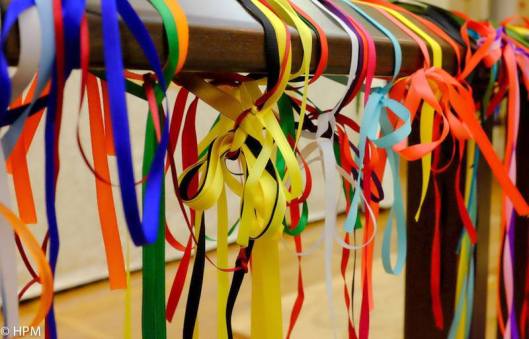
14917060_1270799702976287_658328143983009977_oThis past Sunday, I got to try on one of Hickory Neck’s traditions.  For the past several years, every All Saints Sunday, the congregation has been invited to tie a ribbon on the altar rail in honor of saints who have gone before.  To be honest, before our liturgies started, I was not sure how the liturgical action would go.  I had imagined all sorts of reasons it might be awkward:  I didn’t think our early, reserved worshipers would be that interested; I worried that the ribbons would be messy, making communion at the rail difficult; I wondered if the symbolism would work in our space.  Happily, I was wrong on all accounts.
Instead, the liturgical symbolism was potent.  As I watched countless people kneel at the rail, tying on the ribbons, many with tears streaming down their faces, I realized how easy it is for me to forget the pain of grief that people struggle with every day.  When we see a well-dressed person at church on Sunday, we forget that there is a unique, sometimes painful story underneath appearances.  As I looked at ribbons draped on the altar rail, I imagined the bodies of the saints, draped on the entrance of the heavenly banquet, having given their lives to love and witness.  As my mind struggled with the messiness of the rail, my heart could see the messiness of life, clinging to the very altar where we kneel not just for solace and pardon, but for strength and renewal.  The liturgical action created a beautiful moment that was overwhelmingly powerful.

Today, I woke up to the news of election returns. Being a pastor of a diverse congregation, I know there are hearts that are relieved, hearts that are satisfied, and hearts that are saddened, fearful, and disappointed.  As I process that reality today, I am reminded of those ribbons, dripping from the altar of church.  I am reminded of the saints that have gone before, who have waded through their own times of conflict.  I am reminded of the fact that on Sunday, each worshiper will be bringing a story to the altar that I will never know fully.  I am reminded of the fact that our church offers a rail where we all kneel or stand, in all of life’s messiness, longing for something bigger and with greater meaning than we can give each other in our limited humanity.

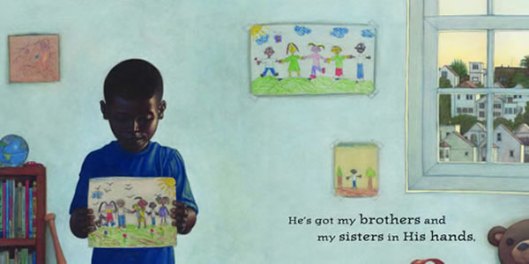
As I got ready for the day this morning, my two-year old sat in the floor of our bedroom with some books.  I was still processing that image of All Saints Day when I heard her singing from one of her books.  “He’s got my brothers and my sisters in his hands…he’s got the whole world in his hands.”  Her sweet voice brought me to tears as I realized the deep wisdom in her, perhaps unintended, words.  In this messiness of life, there will be days that are really complicated, confusing, and hard.  But as a person of faith, I also trust that the Lord our God is holding us in God’s hands, tending not just to me, but to my brothers and my sisters.  For today, that is all I can ask for.

world6

Photo credit:  He’s Got the Whole World in His Hands, Kadir Nelson.  Photo found at http://www.walkingbytheway.com/blog/picture-books-for-transracial-adoptive-families/

Sermon – Luke 22.14-23.56, PS, YC, March 20, 2016

29 Tuesday Mar 2016

Posted by jandrewsweckerly in Sermons, Uncategorized

≈ Leave a comment

Tags

burden, church, depravity, Easter, failure, gift, gratitude, Holy Week, Jesus, liturgy, Palm Sunday, profound, release, Sermon, sin

What strikes me this year about the passion narrative is the profound depth of failure.  We start off today with the glorious action of waving palms and declaring Christ to be the King, only to betray him and to deny that truth over and over again.  Judas, one of Jesus’ faithful disciples, fails Jesus by betraying him to the authorities.  The disciples fail Jesus by getting caught up in an argument about whom among them is the greatest – a self-centered argument on the best of days, but an utter failure of focus on Jesus’ last day.  Later the disciples fail Jesus by falling asleep while he prays in Gethsemane – when he had specifically pleaded with them to pray with him.  One of the disciples fails as he resorts to violence, striking one of the slaves of the high priest.  Peter, one of Jesus’ most loyal and insightful disciples, three times denies having known Jesus before others.  The leadership of the faithful fail over and over as they insist on Jesus’ death out of fear.  Pilate tries three times to release Jesus but succumbs to peer pressure and has Jesus killed despite the fact that he knows Jesus is innocent.  All the people gathered are willing to release a known murderer and insurrectionist in order to kill innocent Jesus.  Hanging in death, one of the two criminals by Jesus’ side derides Jesus to the end.  Even the soldiers mock Jesus as he hangs helplessly approaching death.

Jesus’ death on the cross is a grave enough sin to mourn today.  But when that sin is preceded by failure after failure after failure of the people to right their relationship with God, we see more clearly the deep recesses of human depravity.  The staggeringly long list of sins would be easy enough for us to dismiss as “those peoples’ sin.”  But that is part of the reason that we participate so tangibly in the liturgy today: waving palms, reading parts of the passion narrative, shouting “crucify him!”  We play an active role in the liturgy today so that we can understand how active our role is in the same sin of “those people.”  Listening to the story is heartbreaking – not just because watching others sin is hard to do, but also because we see ourselves in their sinfulness.  We know their failures because we fail too. We fail to honor Christ in our own day, we deny our Lord, we betray our God, we fail to be faithful disciples.[i]  Though there is a part of us that wants to claim we would never have been bystanders or participants in Jesus’ death, the scary reality is that we know we would have.[ii]  Their failure is our failure.

Acknowledging our utter depravity is important today.  We have spent the last six weeks pondering our sinfulness and working on amendment of life.  But perhaps we can never truly amend our lives without recognizing how deeply our sinfulness goes.  Our Lenten disciplines are meant to help us focus on one specific area of life that needs amendment, and in that way, our disciplines are effective means of bringing us closer to God.  But today, the Church reminds us that we have so much further to go.  Even if we managed to see amendment of life this Lent, today we are reminded of how our very nature is one of repetitious sinfulness that knows no bounds.

So why does the Church have us wallow so deeply in our sin today?  The primary reason we journey through the dark tunnel of our sinfulness and failures is so that we can more fully appreciate the enormity of next week.  Next week, our tone and content is almost the opposite – total joy and jubilation that our Lord is risen from the dead.  But in case we were tempted to become jaded by Easter – to be distracted by our new suits and dresses, the festive songs and flowers, or the bountiful meals – the Church wants us to remember how profoundly full of blessing Easter is.  The profound depth of our sinfulness is matched by the profound depth of love and forgiveness offered in Christ’s resurrection next week.  So although the depravity of this day may feel like overkill, that overkill is necessary for us to understand the shocking gift of Christ’s resurrection.  Although today’s sense of failure may feel overwhelming, I invite you to absorb the sobering reality of this day.  Carry that weight with you this week as we journey through the Holy Days.  If you are able to do that, the release of that burden on Easter Day may be more profound than any of the surface trappings of Easter.  And your cries of rejoicing will be born out of a place of deep gratitude and appreciation for the Lord our God, who loves us despite our failings.  As a people who know how little we deserve our Lord, we will rejoice with newfound appreciation of the God of love – the God who gave his only begotten Son, so that all that believe in him might have eternal life:  a tremendous gift indeed!  Amen.

[i] William G. Carter, “Pastoral Perspective,” Feasting on the Word, Year C, Vol. 2 (Louisville:  Westminster John Knox Press, 2009), 182.

[ii] H. Stephen Shoemaker, “Homiletical Perspective,” Feasting on the Word, Year C, Vol. 2 (Louisville:  Westminster John Knox Press, 2009), 181.

Sermon – Matthew 6.1-6, 16-21, AW, YC, February 10, 2016

12 Friday Feb 2016

Posted by jandrewsweckerly in Sermons, Uncategorized

≈ Leave a comment

Tags

Ash Wednesday, authenticity, comfort, disciplines, discomfort, Episcopal, Episcopalian, God, holy, hypocrisy, intention, Lent, liturgy, senses, Sermon

One of the dangers of being a faithful Episcopalian is getting lured in by the liturgy.  The liturgy is certainly what reeled me into the Episcopal Church.  Having been raised as a United Methodist, I had seen a variety of styles and orders of worship.  On any given Sunday, you never knew what text the preacher would use.  And since Eucharist only happened 2-4 times a year, liturgy was not synonymous with rhythm.  But not so in the Episcopal Church.  Once you figure out the kneeling, sitting, and standing patterns, the liturgy becomes gloriously expected.  You get so used to the patterns that your body almost does the movements without thinking.  You love being able to be anywhere in the country and know that the liturgy will be familiar and the lessons predetermined.  When seasonal changes, like Advent or Epiphany, happen, you expect and appreciate the subtle differences more.  Since most people I know do not really like change, the Episcopal Church is like a little slice of predictable heaven.

The trouble with that sense of comfort is we can miss when something really powerful happens.  Ash Wednesday is one of those kinds of days.  Growing up in the south, I never really had an experience of Ash Wednesday.  College was my first exposure to seeing others with ashes while being invited to don them myself.  I remember thinking how exposed having ashes on one’s forehead must be.  Ash Wednesday seemed like a big deal.  But, I am an Episcopalian now, and like many other things in liturgy, the shock of Ash Wednesday has softened.

That is why I love having a young child around.  The first time my oldest really understood what the ashes were all about she exclaimed, “Ew, what is that on your head?!?”  Try explaining to a three year old what being dust means and why I needed to remember I would return to dust.  Watch the child’s face as they process what mortality means.  Wait for the heavy feeling in your chest when they ask if they can have ashes too – knowing that you will have to say, “remember you are dust, and to dust you shall return” to her precious, innocent face.

Today the Church invites us into a holy Lent.  The Prayer Book says this is a time of prayer, fasting, and self-denial.  Matthew’s Gospel talks about the disciplines of giving alms, prayer, and fasting.  Some of us will take up these specific disciplines.  Others of us will commit to reading scripture or a devotional book, giving up chocolate, or playing Lent Madness.  The Church tells us these practices or disciplines are to help us walk with Jesus in repentance.  The challenge with taking on a spiritual discipline in Lent is making sure the practice is not rote – much like our participation in liturgies can be rote.  The Church is not inviting us into the practice of disciplines out of habit.  The Church is trying to help breathe life into our faith – and one of the ways that we do that is to do something out of the ordinary to shake up our comfortable, unchanging practices.

Matthew’s gospel is pretty strict about the way those disciplines happen.  Jesus says that we are to be private about our alms giving, prayer, and fasting so as not to seem like hypocrites, boasting about our giving, piety, or suffering.  But who among us has not slipped on the slippery slope of hypocrisy?  Those of us who give charitably often find ourselves claiming that giving on our taxes.  Those of us who have ever attended a prayer breakfast or have told a friend that we will pray for them surely were being a little showy about our prayers.  And let’s face it, I cannot imagine fasting without complaining at least a little bit.  The question then becomes, “How can a text that implores private acts of righteousness be read on the day one receives the imposition of ashes, a very visible and public act of piety?”[i]

But Jesus is not looking to trick us.  He is checking our intentions – our authenticity.  The trouble with anything rote, whether liturgies or disciplines, is that we risk losing why we are doing them in the first place.  When I am busy complaining about fasting, I do not have space in my thoughts to remember those who go without food daily.  When I am busy talking about my prayer life, I am filling up the silence through which God most likes to speak to me.  When I am weeding through giving materials trying to decide who to support financially, I lose sight of the gratitude from which my giving originates.  The issue is not really whether or not public and private acts are authentic or inauthentic.  The issue is being intentional about not only choosing our disciplines, but living into them.

I invite you today to use the tool of liturgy to awaken your intentionality this Lent.  Listen to the prayers and psalms today.  Notice the discomfort of kneeling – whether you kneel physically or kneel in your heart.  Listen to and feel the gritty ashes being spread on your forehead, allowing the solemnity of the words wash over you.  Taste the bread and the sting of wine on your tongue.  As you allow the liturgy to be fresh today, take time in prayer to consider in what ways God is inviting you into deeper relationship, and what discipline you can realistically take on to get you closer to God.  The liturgy today is not about sending us out with pious reminders to others about our faith.  The liturgy today is about jolting our senses into understanding our humanity, sinfulness, and mortality.  Today, the Church uses the Church’s most familiar tool to create just enough discomfort to help us turn our hearts and minds to God – the God whose arms are wide enough to spread on a cross and wide enough to embrace us all.  Amen.

[i] Lori Brandt Hale, “Theological Perspective,” Feasting on the Word, Yr. C, vol. 2 (Louisville:  Westminster John Knox Press, 2009), 22.

Sermon – Mark 6.1-13, P9, YB, July 5, 2015

08 Wednesday Jul 2015

Posted by jandrewsweckerly in Uncategorized

≈ Leave a comment

Tags

baptism, Christian, covenant, disciples, faith, identity, Jesus, liturgy, protection, purpose, seek, Sermon, serve, share, vulnerability

A few weeks ago, as we were planning liturgies, we were discussing the fact that we had two baptisms in a row – last Sunday and today.  A few people in the group kind of groaned, “Two in a row?!?”  I laughed at the time.  But the more I thought about their exasperation, the more I wondered why they were exasperated.  Certainly baptisms can take longer.  Between the blessing of the water, the renewal of vows, and the baptism itself, the service is a bit longer.  And perhaps to groan came out of a place of wanting to spread out the requency of special services – much like one rations out Halloween candy instead of eating it all at once.  But the more I thought about having two baptisms in a row, the more I liked the idea; in fact, the more I thought about the baptismal liturgy, I began to wish we had one every Sunday.

Now before you all issue a collective groan of exasperation, let me explain.  You see, the baptismal liturgy is one of those foundational liturgies.  In baptism, we ritually welcome someone into the family of faith.  But the baptismal liturgy is about more than the cute baby (though Rose is very cute, I admit!).  The baptismal liturgy is the time when we declare who we are, how we are to live, and how we will accomplish that ideal.  In this liturgy, we retell the story of our history – how God moved over the waters in creation, how God split the waters to free the enslaved people of Israel, and how God used the waters of baptism to mark a new way through Jesus’ own baptism.  In this liturgy, we also talk about our nature – how we are prone to sin, how we (despite the fact that we are saved by the waters of baptism) are on a continual journey of repenting and returning to the Lord, and how we need each other if we are ever to keep turning toward God.  In this liturgy, we also declare the radical way that we will live our lives in Christ – what being a Christian actually means.  Being a Christian means regularly gathering to learn together, to pray together, to eat at the Holy Table together, and to join in fellowship together.  Being a Christian means sharing the good news with others – not just by example, but by our words too.  Being  a Christian means seeking and serving Christ in others, loving our neighbor, striving for justice and peace, and respecting the dignity of others.  I don’t know about you, but regular worship, regular evangelism, and regular mission sounds like a lot of work!  And yet, here we are (for the second week in a row!) proclaiming that we will do these things.

So if today is all about defining who we are and who we are going to shape little Rose into being, what might be the best way for us to prepare her for her new life in Christ?  Some of us might imagine the story we heard a few weeks ago about David and Goliath.  If you remember, David was just a boy who agreed to take on the enormous Goliath, that everyone feared.  When King Saul agrees to let David fight Goliath, he first wants to suit up David.  Saul clothes David with Saul’s armor; he puts a bronze helmet on David’s head and clothes him with a coat of mail.  By the time Saul puts his sword over the armor, David cannot even walk!  David realizes the protection weighs him down.  So he removes the armor and weapon and instead takes only a staff, five smooth stones in his shepherd’s bag, and his sling.  Goliath (and if we are honest, probably everyone else gathered, including the people of God) laughs at David’s puny preparation.  The funny thing is that in our gospel lesson today, Jesus does the same thing for the disciples when he commissions them to go out in the world.  Jesus tells them to take nothing for their journey except a staff; no bread, no bag, no money in their belts; they get a staff, one pair of sandals, and one tunic.

When we think about preparing ourselves for the life of faith – of going out into the world to seek Christ, serve Christ, and share Christ – most of us think about preparing the way that Saul prepares David.  We want some armor for all those times that we are rejected when we share our faith; we want a sword in case we run into trouble while seeking Christ; we want some heavy mail so that when we serve others, nothing or no one gets too close[i]  But instead, Jesus sends out the disciples with a staff to steady their walking as they share the good news, a pair of sandals and one tunic so that they can humbly encounter others as they serve Christ, and empty hands and bellies so that they can seek Christ in others.  On this day when we proclaim who we are and how we will live, one might imagine that we are readying ourselves and gathering our supplies, and especially that we are arming this small, vulnerable child for walking the way of Christ.  But instead, Jesus basically tells us that there is no way to protect ourselves; there is no way to prepare.[ii]  We go with our trust in the Lord, with vulnerability, and with a sense of identity and purpose.

That is why I think we could stand to have baptism Sunday every Sunday.  Our tendency would be to find the biggest backpack we can and load that bag with all the things we think we need for our journey.  But Jesus tells us to put that bag down and start walking:  walking the way, the truth, and the light; walking by seeking, serving, and sharing Christ.  In many ways Rose has more to teach us today than we have to teach her.  She came into this world with very little.  In fact, she even came here with very little – sure her parents might have a monster diaper bag with all the “just in case” stuff babies often need.  But Rose herself cannot carry a bag; she is not self-sufficient; she is vulnerable with us all.  Instead of giving Rose an armor for Christ today, she encourages us to take off our armor and swords, and get back to the basics: our staff, sandals, and tunic.  That is the beauty of baptism.  Baptism helps us remember that we need each other.  Rose needs us to teach her the way.  We need her to teach us how to gat back to basics.  Together we find our way to living the faithful life in Christ.  Thanks be to God!  Amen.

[i] Michael L. Lindvall talks about the anxiety that evangelism produces in all of us in his article, “Pastoral Perspective,” Feasting on the Word, Yr. B, Vol. 2 (Louisville:  Westminster John Knox Press, 2009), 216.

[ii] C. Clifton Black, “Commentary on Mark 6:1-13,” July 5, 2015, as found at http://www.workingpreacher.org/preaching.aspx?commentary_id=2502 on July 2, 2015.

Holy chaos…

08 Wednesday Jan 2014

Posted by jandrewsweckerly in Uncategorized

≈ Leave a comment

Tags

chaos, children, Christ Child, Christmas, church, Epiphany, holy, incarnation, Jesus, life, liturgy, messy, pageant

Courtesy of http://saintansgar.blogspot.com/2010/11/joint-childrens-christmas-pageant-and.html

Courtesy of http://saintansgar.blogspot.com/2010/11/joint-childrens-christmas-pageant-and.html

This past Sunday, our church held its annual Epiphany Pageant.  Since the pageant involves using Scripture and hymns to retell the entirety of Jesus’ birth narratives, the pageant replaces most of the Liturgy of the Word (the part of the service when we traditionally read/chant the four lessons and then hear a sermon).  Though part of what we love about the pageant is the kids’ presence, we also love being invited into the familiar – rehearing the story of the Christ’s birth and incarnation and singing the hymns that we look forward to all year.

Inevitably, the pageant is a bit messy and chaotic – children forget where to go, costumes do not quite fit, or attention spans are just not long enough.  Situating the pageant within the context of worship also means that the entire worship experience that morning is loud and a bit difficult to stay fully engaged in – especially if you are looking for a quiet, contemplative reflection on the incarnation.

But to be honest, that is what I love about the pageant – the holy chaos of it all.  We often think about the birth of the Christ Child as a clean story, much like many of the two-dimensional artistic renderings we see of what looks like quiet adoration at a manger.  But the whole concept of the incarnation is messy:  from Jesus’ scandalous conception, to what had to have been an unsanitary birth among hay and animals, to stinky visitors like the shepherds, to the visit of three foreign men who act strangely and probably raise more suspicion than excitement.  The birth of Jesus is a bit of a holy mess, not to mention the rest of Jesus’ incarnate life, which involves hanging with those of ill-repute, with smelly fishermen, and with the seriously infected and ill.  Nothing about Jesus’ birth or life is sanitary, controlled, or predictable.

Later on Sunday morning in worship, as I distributed communion, I gave the body of Christ to the young girl who had just played Mary in the pageant.  In that moment, the chaos of the day disappeared, and the miracle of the incarnation became much more real to me.  Mary, the mother of Jesus, was just a woman, trying to live faithfully, caught in the holy chaos of life.  I found myself wondering what receiving the body of Christ, the body of her son, would have been like, especially once he was gone.  And just like Mary was just a woman, each one of us in church – the young girl, the middle-aged man, the aging woman – are all just people, caught in the holy chaos of life, trying to make sense of it all, but also eternally grateful for a God who takes on human flesh for us.  That is why Church is so incredible to me.  In the midst of contemplative prayer, and even in the midst of what feels like a loud, crazy liturgy, God can break through and speak truth to us.  I am grateful to our children for reminding me that God is incarnate in the midst of all of life – in the beautiful and quiet, but especially in the messy, loud, chaos of life.

A few of my favorite things…

10 Wednesday Apr 2013

Posted by jandrewsweckerly in Uncategorized

≈ Leave a comment

Tags

God, Holy Week, liturgy, pilgrimage, spiritual

AlleluiaBWWhen I went on a choral pilgrimage in England a couple of years ago, I remember finding that each day I had a new favorite sacred space.  Not once did we visit a place and I say, “Oh, well that one wasn’t as good as yesterday.”  They all blew me away, and I had such a hard time naming a favorite when I returned home.
In some ways, Holy Week this year was like that for me.  Every liturgy of Holy Week brought its own unique gifts and made me feel like the next liturgy could not possibly top the one I had just experienced.  At St. Margaret’s, we began Holy Week a day early with our Cemetery Memorial Service on the Saturday before Palm Sunday.  I am always amazed at how our Cemetery manages to create a community of faith, despite the wide variety of Christian backgrounds present, and I am grateful for the honor of helping that community remember their loved ones every year.

The next day, on Palm Sunday, we began our second service at the Cemetery cross and processed our way into the church.  The sun was shining down on us, and our procession captured some of the joy of that day in Jerusalem for us.  It was the perfect setup for our Passion Narrative.

We came back together Monday night for compline.  I was amazed at how such a brief service could be so profoundly spiritual.  As we chanted “Jesus remember me,” I could hear the echoes of our Passion Narrative from the day before.  The next morning, I renewed my ordination vows with the clergy of our Diocese, and then came home for evensong led by our guitar group.  We hosted the local Lutheran church, and I loved the musical selections of our music leaders.  Their music brought a new flavor to Holy Week.

Wednesday, we headed over to the Lutheran church for a healing service.  There is something quite sacred about laying hands on both parishioners and complete strangers that is entirely humbling as a priest.  I really am so blessed to be entrusted with this ministry.  That same humility overwhelmed me during our footwashing service on Thursday.  The experience of both washing and having your feet washed is a profoundly intimate and sacred practice.  Leaving the church with the bare, stripped altar that night brought a deep quiet over me that lasted until Saturday.

Our Good Friday liturgy electrified the experience of silence.  Without music and adornments, the silence left us with nothing but ourselves to face.  Though we did not sing at that service, I could hear the words from that favorite hymn, “sometimes it causes me to tremble, tremble, tremble…”  That night, our confirmands led our Stations of the Cross service.  We used a devotional stations of the cross, and I was so proud of our confirmands.  Despite their initial nerves, they led as confident young adults, and invited us into deeper reflection on Jesus’ journey to death.

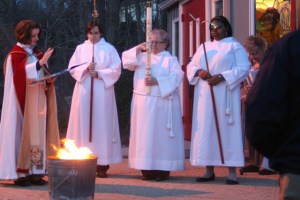
Saturday morning, we took a brief break from the solemnity of Holy Week, and welcomed tons of children to our campus for our Easter Egg hunt.  The laughter and enthusiasm of the children – whether with crafts, egg hunting, sack hopping, or simply running around – brought me back to why this life that Christ gives us is so precious.  Their energy brought me back to my favorite liturgy of all time – the Easter Vigil.  I cannot say enough about this service.  From hearing the haunting music and words of the Exultet, to listening to our salvation stories in darkness, to ringing in the alleluias, to feasting once again on the Eucharistic feast, that service is one of the most powerful service the Episcopal Church offers.

And after all of that, you might think Easter would be a let-down.  But looking at those much fuller pews just reminded me that no one can contain Easter joy.  Our alleluias are louder, and our hearts explode with love for Christ and one another.  There is no greater joy for us that day.

So you see, picking a favorite from Holy Week is actually quite difficult.  I think the difficulty in choosing a favorite is that each service captures an experience with God – and no one can rank or rate experiences with God.  They are all special in their unique ways, and would each suffice for spiritual strength for weeks.  So imagine my joy in experiencing them all in one week.  If going away for a pilgrimage is not an option for you, I invite you to consider using Holy Week as your spiritual pilgrimage next year.  I guarantee you, you won’t be able to pick a favorite!

Sermon – Luke 24.1-12, EV, YC, March 30, 2013

10 Wednesday Apr 2013

Posted by jandrewsweckerly in Uncategorized

≈ Leave a comment

Tags

Easter Vigil, God, light, liturgy, Messiah, movie, salvation, Sermon, tomb

IMG_3202Our liturgy tonight operates a bit like a movie whose mode of telling stories is in flashbacks.  We start the movie with the scene we just heard.  Several women are gathered around the empty tomb, their mouths agape, and their minds racing.  And then, the flashbacks begin.
Mary the mother of James recalls that ancient story of creation.  That empty tomb reminds her of those words – tohu wabohu – the formless void.  She vaguely remembers what God said about creating humankind in God’s image.  And she hears those words repeated over and over again, “It was good; ki-tov”

Meanwhile, another woman flashes back to when humankind’s sinfulness so angered God that God flooded the earth.  For forty days, Noah knew the nothingness of that empty tomb in front her.  But she also remembers that covenant God made with Noah – that never again will there be a flood to destroy the earth.  Perhaps there is a rainbow in this tomb, and not only the watery floods that she sees.

Joanna looks into that empty tomb and remembers another time her people faced desperation.  She flashes back to the rushing Egyptians who have pinned her people to the Red Sea.  She remembers the panicked screams of her people toward Moses.  She remembers how God saved them then – how God created a way out of no way.  She wonders whether the empty tomb is not unlike that empty seabed – the one that the Israelites used to get to freedom.

Another woman stares into that vacant tomb and she remembers a different tomb.  She remembers the death and hopelessness of those bones in that valley – the thousands of devastated lives.  But then she remembers what God told Ezekiel.  She remembers the rattling of those bones coming together, and the way the breath of God, the ruah of God breathed life into those bones.  She wonders if she hears the faint ruah of God now coming out of that empty tomb.

But Mary Magdalene remembers a different story from Zephaniah.  She hears the words of that song in a fresh way today.  “Sing aloud, O daughter of Zion.”  Is this the day that God will save us?  Can her beloved Jesus be not missing, but raised?  Might Jesus be the one who will restore her fortunes?  She longs for God to be saying to her, “Rejoice and exult with all your heart, O daughter Jerusalem.”  “Please let this empty tomb be an occasion for rejoicing and not for more pain and suffering for my Lord,” Mary Magdalene prayers in her heart.

And then the movie brings us abruptly back to the empty tomb, the sound of silence like so many times before in their history.  The appearance of emptiness threatens their fragile, exhausted psyches.  Their unspoken memories fail to comfort them because they are unable to utter a word of remembrance and assurance to one another.

As outsiders watching this movie, as we watch those looking into the tomb, we begin to connect the various flashbacks.  The answers are there before the angels need to say a word.  God loves us and creates us in God’s image.  And we are not only good – but we are very good – wehineh-tov.  God promises to never destroy us again as God once did.  God promises liberation from oppression.  God promises restoration to our bodies and spirits.  God promises to bring us home.  God promises and God saves us time and again.  And now, with this Messiah who has finally arrived, God saves us once and for all.  What has felt like a defeat is now the reason to rejoice.  The smiles that spread across our faces are exact mirrors of the smiles that spread across the faces of those women at the tomb.  The smiles are smiles that happen as we connect the varied flashbacks, remembering our salvation history, and this final act of salvation through the death and resurrection of our Lord and Savior Jesus Christ.  That tomb is not a formless void, but the holy site where all our salvation narrative culminates.  That empty tomb is in fact not empty at all.  That tomb is full of life.  Tonight is a night for alleluias, for songs of joy, and for dancing.  The light shatters the darkness this night, and we celebrate the greatest victory of all time.  Alleluia! Christ is risen.  The Lord is risen indeed!!

Advent transition…

19 Wednesday Dec 2012

Posted by jandrewsweckerly in Uncategorized

≈ Leave a comment

Tags

Advent, Christmas, grief, incarnation, liturgy, Newtown

dark churchThis Advent has been a bit of an emotional rollercoaster.  Here in Plainview, at the beginning of Advent we were just getting back into a “normal” rhythm post-Hurricane Sandy.  One of my parishioners even noted that he realized I was “back in the game” when he got a flurry of church emails from me.  On Second Advent, we had our Annual Meeting, and we were all pleasantly surprised that an Annual Meeting could actually be quite fun and reinvigorating.  We were all heading toward the Christmas apex when the shooting in Newtown last Friday threw us for a loop.  Advent Three was one of the most mournful Sundays we have had in a while.  Many parishioners shared with me that they wanted to be in Church because they needed it.  We shared sadness, fears, and tears.  We lingered a little longer at Coffee Hour, needing the community of faith to help us process the event.  We all seem to be struggling to hold on to the “Christmas spirit.”

In the midst of this emotional rollercoaster, St. Margaret’s heads into a four-day series of liturgies that leads us to the manger.  I would be a little more anxious about how I was going to revive my own “Christmas spirit,” if the liturgies were not laid out as they are.  I am relieved to start our four days with our Cemetery Memorial services.  Every year we invite parishioners and family members who have loved ones buried in our cemetery to come for one of two memorial services.  We pray the burial office, listen to a necrology, and sing Christmas hymns.  The service is not simply for those whose names will be read.  This service really is becoming a “Blue Christmas” service – a service to recognize that Christmas is not always the happy version of perfection that commercials would have us believe.  Christmas is rife with baggage from our past, strife within families, feelings of loneliness or grief, and a general desire to pull inward during a season that tries to shove us outward.  In the wake of the shooting in Newtown, I am especially grateful for these liturgies.

After we get through these services, we move into Advent Lessons and Carols the next day.  On this last Sunday in Advent, we get the chance to really ease our way out of Advent and into Christmas by lingering in Advent through scripture and songs.  I am grateful for the gentle transition and pray that it will allow me the space to turn my thoughts and emotions to the blessing of Christ’s incarnation.

Perhaps after these liturgies I will be ready for our family service on Christmas Eve.  I am looking forward to the revamped service, in which our children and families will play an active leadership role in worship.  In a time when we have been mourning the loss of God’s beloved children, I cannot think of a better way to embrace Jesus’ command to, “Let the little children come to me.”  Perhaps by then I will be relieved to join the choir in singing those long-awaited Christmas hymns and to enter into the Holy Night of Christmas Midnight Mass.

Of course, if all of that does not do the trick, certainly the spoken service on Christmas Day might.  The quiet of that service is a nice place to recenter in the midst of a crazy time.  Sure, opening presents will be fun, especially with my more aware three-year old, but the quiet of church may be the safe haven we all need to ground the day in Christ Jesus.  It is at times like this that I am grateful for the ways in which the Episcopal Church is a church rooted in rich liturgies.  Come join us!

Newer posts →

Recent Posts

  • On Sharing the Love…
  • Sermon – Micah 6.1-8, Matthew 5.1-12, EP4, YA, January 30, 2026
  • On Justice, Kindness, Humility, and the Messy Middle…
  • Feast of the Rev. Dr. Martin Luther King, Jr., January 18, 2026
  • On Peace, Love, and Conduits…

Archives

  • February 2026
  • January 2026
  • December 2025
  • November 2025
  • October 2025
  • September 2025
  • August 2025
  • July 2025
  • June 2025
  • March 2025
  • February 2025
  • December 2024
  • November 2024
  • October 2024
  • September 2024
  • August 2024
  • July 2024
  • June 2024
  • May 2024
  • March 2024
  • February 2024
  • January 2024
  • December 2023
  • November 2023
  • October 2023
  • September 2023
  • August 2023
  • July 2023
  • June 2023
  • May 2023
  • March 2023
  • February 2023
  • January 2023
  • December 2022
  • November 2022
  • October 2022
  • June 2022
  • May 2022
  • January 2022
  • December 2021
  • November 2021
  • October 2021
  • September 2021
  • August 2021
  • June 2021
  • May 2021
  • April 2021
  • March 2021
  • February 2021
  • January 2021
  • December 2020
  • November 2020
  • October 2020
  • September 2020
  • August 2020
  • July 2020
  • June 2020
  • May 2020
  • April 2020
  • March 2020
  • February 2020
  • January 2020
  • December 2019
  • November 2019
  • October 2019
  • September 2019
  • August 2019
  • July 2019
  • June 2019
  • May 2019
  • April 2019
  • March 2019
  • February 2019
  • January 2019
  • December 2018
  • November 2018
  • October 2018
  • September 2018
  • August 2018
  • July 2018
  • June 2018
  • May 2018
  • April 2018
  • March 2018
  • February 2018
  • January 2018
  • December 2017
  • November 2017
  • October 2017
  • September 2017
  • August 2017
  • July 2017
  • June 2017
  • May 2017
  • April 2017
  • March 2017
  • February 2017
  • January 2017
  • December 2016
  • November 2016
  • October 2016
  • September 2016
  • August 2016
  • July 2016
  • June 2016
  • May 2016
  • April 2016
  • March 2016
  • February 2016
  • January 2016
  • December 2015
  • November 2015
  • October 2015
  • September 2015
  • August 2015
  • July 2015
  • June 2015
  • May 2015
  • April 2015
  • March 2015
  • February 2015
  • January 2015
  • December 2014
  • November 2014
  • October 2014
  • September 2014
  • August 2014
  • July 2014
  • June 2014
  • April 2014
  • March 2014
  • February 2014
  • January 2014
  • December 2013
  • November 2013
  • October 2013
  • September 2013
  • August 2013
  • July 2013
  • June 2013
  • May 2013
  • April 2013
  • March 2013
  • February 2013
  • January 2013
  • December 2012
  • November 2012
  • October 2012
  • September 2012

Categories

  • reflection
  • Sermons
  • Uncategorized

Meta

  • Create account
  • Log in
  • Entries feed
  • Comments feed
  • WordPress.com

Blog at WordPress.com.

  • Subscribe Subscribed
    • Seeking and Serving
    • Join 395 other subscribers
    • Already have a WordPress.com account? Log in now.
    • Seeking and Serving
    • Subscribe Subscribed
    • Sign up
    • Log in
    • Report this content
    • View site in Reader
    • Manage subscriptions
    • Collapse this bar
 

Loading Comments...