• About

Seeking and Serving

~ seek and serve Christ in all persons

Seeking and Serving

Tag Archives: loving kindness

On Light, Community, and Being All In…

02 Wednesday Oct 2019

Posted by jandrewsweckerly in Uncategorized

≈ Leave a comment

Tags

community, gift, give, harness, idea, Jesus, light, loving, loving kindness, ministry, neighbor, pledge, power, shining, stewardship, together, transform

70161290_10158145043567565_8013087704956796928_n

Photo credit:  Jennifer Andrews-Weckerly; resuse with permission

This past weekend, our family traveled to Staunton, Virginia, for their annual Queen City Mischief and Magic weekend – a weekend to celebrate all things Harry Potter.  We had a great time discovering what houses we were sorted into, observing how to duel with wands, and learning dances for the next Yule Ball.  The kids busied themselves collecting trading cards from costumed characters and from local establishments.  The whole downtown area shut down and found creative ways to channel the world of Harry Potter – from the local train station taking on the persona of Platform 9 ¾, to a photography business creating keepsake photos, to a toy store changing out their stock with Potter toys, games, and books, to the local university offering lectures related to themes from the series, to the local spirits store selling “butter beer.”  For those who love the Harry Potter books and movies, it is a great fun-filled weekend.

As we drove home, I realized what amazed me most about the weekend was not the characters, the paraphernalia, or the crowds.  What amazed me was how a few years ago this small town had a crazy idea to convert the town to this magical place – and everyone bought into the idea.  Staunton does not have some significant tie to JK Rowling or the filming of the movies.  They are just a small town in the middle of the state who decided to do something – and the whole town was all in.  I do not know the history of that idea, or how many people said, “but we’ve never done anything like this,” along the way, or how they figured out the logistics and convinced people to get on board.  But what I can tell you is after two years of attending the festival, the whole town is not just grudgingly on board, but wholeheartedly comes together to welcome people to their town that might not otherwise ever step onto their streets.

I know Staunton converts itself for just three days.  But the more I thought about the event, the more I wondered what kind of power our community might be able to harness for good.  I have certainly seen hints of that kind of energy with the WMBGkind movement in Williamsburg – a community of people committed to being a community of kindness as their dominant identity.  I think that is why I have always thought WMBGkind and the faith community can be such great partners.  Though we use religious language, the end result is the same.  We want our community to be a community that lives Christ-like lives of loving-kindness.  In that way, no matter what our denominational or faith differences are, we can step out of our day-to-day operations and be a part of something much bigger – of a people all united around mission of loving neighbor as ourselves.

This week, Hickory Neck kicked off its stewardship campaign, “Shining our Light.”  What I love about the campaign is the campaign reminds us to look at how much light we are gifted with (in worship, in learning, and in play), and then to gift that light the community around us – to shine our lights, rallying the entire community to live life differently.  That is a cause I am happy to pledge our financial giving to; that is a cause I am excited to pledge our time and talent to as well.  This month, as we pray about our own stewardship, I encourage you to think about how your giving not only supports the ministry of Hickory Neck, but might just have the power to transform our community into something much bigger than ourselves.  I am all in.  Won’t you join me?

71757278_2601111433278434_853371931125088256_o

Photo credit:  https://www.facebook.com/Hickory.Neck/photos/p.2601111426611768/2601111426611768/?type=1&theater

Sermon – Luke 6.27-38, EP7, YC, February 24, 2019

27 Wednesday Feb 2019

Posted by jandrewsweckerly in Sermons, Uncategorized

≈ Leave a comment

Tags

change, commands, discipleship, God, hard, intentional, Jesus, kindness, love, loving kindness, mercy, Sermon, shelter, sickness, symptoms, system

Last week, we joined the entire community of Williamsburg in performing acts of kindness.  When we issued the charge two weeks ago to go out and perform three acts of kindness, the reactions were pretty wide-ranging at Hickory Neck.  Several parishioners addressed me with concern, “I have to do three?  Can’t I just do one act before next Sunday?”  Other parishioners took on the challenge with gusto – with several parishioners plotting out what they were going to do before they even got back to the parking lot.  While other parishioners noted during the week and the days afterwards how shockingly easy the challenge was.  “I felt silly writing down my acts of kindness.  I mean, I do acts of kindness every week,” shared one parishioner.

I am not sure which perspective was predominant, but I can tell you that Hickory Neck performed over 100 acts of kindness that week.  There were some simple acts:  holding doors for strangers, paying people compliments, and writing thank you notes.  Some were a little more labor intensive:  volunteering at a food pantry, helping out at your child’s school, going through your closet to donate clothes.  Others showed some real effort:  listening to a stranger who seemed to need a friend, making Valentines for the whole class – even the kids you do not like, visiting someone in the hospital – even though you hate hospitals.

Now I know several parishioners who thought our challenge was a bit silly or who felt uncomfortable with the idea of drawing attention to our own good works.  Surely we should just be doing acts of kindness every week.  But for those of you who jumped in with both feet, my hope is that you got a tiny glimpse into what can happen when you start living out kindness more intentionally:  your whole way of being starts to shift.  When you do acts of kindness, the more opportunities for additional kindness seem to appear.  The more you think about kindness, the more you start to notice kindness all around you.  And the more you engage in kindness, the more your whole demeanor shifts – from one of staying in your lane, attending to your daily routine, to lifting up you head and noticing how you can shift the community around you.

That seismic shift is what Jesus is talking about in Luke’s gospel today.  Many of us hear the instructions from Jesus as a list of commands or a checklist of duties:  love your enemies, do good to those who hate you, bless those who curse you, pray for those who abuse you; do not judge, do not condemn, forgive, and give.  If we look at today as a list of commands from Jesus, then we might as well consider this week as Week Two of an acts of kindness challenge – except this time, Jesus asks us to do acts of kindness for those to whom showing kindness is the hardest.  When we read Jesus’ words like a weighty list of to-do items, this gospel feels just that – full of weight and guilt with no promise of hope or encouragement.  And part of what Jesus is saying is just that:  showing kindness is actually pretty hard when we show kindness to those who are hardest to love.  We do not mind showing kindness to friends, and we do not even really mind showing kindness to strangers.  But asking us to show kindness to those who we actively dislike or to those who have hurt us?  Now Jesus is pushing us way out of our comfort zones!

At the beginning of February, the Greater Williamsburg area kicked off a commitment to becoming a community of kindness with a rallying event.  The former Mayor of Anaheim, California, Tom Tait, who had run on a campaign of kindness, was the keynote speaker.  Mayor Tait talked about his time on City Council in Anaheim, how part of his work felt like a game of whack-a-mole.  Each month, some crisis or community problem would arise – violence in the community, the prevalence of drugs, problems in the public schools.  And the City Council’s response felt like trying to whack at the problem to temporarily knock the problem out.  But those solutions never really made a deep impact.  What Mayor Tait saw was all those problems were like symptoms – symptoms of a city that was facing an internal sickness.  The only way to heal the internal sickness was to commit as a city to transform its entire way of operating.  Mayor Tait believed transformation would occur by committing to kindness.  To many, the idea sounded a little too pie-in-the-sky.  But once elected, Mayor Tait was forced to try to live out the reality of kindness.  With every decision, every major action, the community wondered together what would reflect kindness.  And slowly, the illness in the system began to heal.  Kindness was not a Band-Aid, but a system-altering antidote to a host of problems.

In a lot of ways, that is what Jesus is talking about today.  Yes, the things Jesus is talking about are commands – a list of ways to be kind, even to the persons to whom being kind is most difficult.  But Jesus is not just talking about commands.  As one scholar describes, “Jesus isn’t offering a set of simple rules by which to get by or get ahead in this world but is inviting us into a whole other world.  A world that is not about measuring and counting and weighing and competing and judging and paying back and hating and all the rest.  But instead is about love. Love for those who have loved you.  Love for those who haven’t.  Love even for those who have hated you.  That love gets expressed in all kinds of creative ways, but often come through by caring – extending care and compassion and help and comfort to those in need – and forgiveness – not paying back but instead releasing one’s claim on another and opening up a future where a relationship of …love is still possible.”[i]

What Jesus is doing is trying to, “inculcate, and illustrate, an attitude of heart, a lightness of spirit in the face of all that the world can throw at you.”  We are to assume this new way of being because “that’s what God is like.  God is generous to all people, generous…to a fault:  [God] provides good things for all to enjoy, the undeserving as well as the deserving.  [God] is astonishingly merciful…”  As N. T. Wright adds, “…this list of instructions is all about which God you believe in – and about the way of life that follows as a result.”[ii]  When we take Jesus seriously, and embrace this new way of being, the way of kindness that leads to love, life can be “exuberant, different, astonishing.  People [will] stare.”[iii]

In a lot of ways, what Jesus does to today is saying, “I see your week of kindness, and I raise you to life of loving-kindness.”  In other words, keep going.  Now, fortunately for us, Hickory Neck has set up the perfect set of circumstances for you to try on this new life of loving-kindness.  Tonight, we open our doors to strangers.  Tonight, we open our doors to some people we will find easy to love, and some people that will make us uncomfortable.  Tonight, we open our doors to some late nights, really early mornings, and hard labor.  But tonight, we also open our doors to a new way of being – a way of opening ourselves to live exuberantly, differently, astonishingly – to live like God.

Now I know one week (or even the one shift or duty you signed up for at the Winter Shelter, or even the financial contribution you made) may not change the world necessarily.  Jesus is talking about a seismic change in the way we live our lives every day.  But the Winter Shelter is a pretty good start.  And the good news for you, is Lent is coming, and we’ve set up all kinds of tools for you to embrace this way of loving-kindness.  Instead of a week of kindness, we have a whole 40-day kindness challenge.  We have a devotional set of readings that reflect on kindness, story, and scripture for forty days.  We will be studying kindness in scripture.  Hickory Neck has assembled the tools to help you not just try simple deeds for a week, or not just try the hard stuff of relationship with the homeless for a week – but instead to try on a new way of being – to take on the way of God.  Part of what Hickory Neck is all about is empowering discipleship – empowering you to go out into the world and live as faithful witnesses of Christ.  This is what discipleship is all about.  And Hickory Neck is here to help – to walk with you, to lift you up when you fall, to hold your hand in the hard parts, and to revel in the joy of watching love win.  We cannot wait to enter in to this most sacred time of loving-kindness with you!  Amen.

[i] David Lose, “Epiphany 7 C:  Command or Promise?” February 22, 2019, as found at http://www.davidlose.net/2019/02/epiphany-7-c-command-or-promise/ on February 22, 2019.

[ii] N.T. Wright, Luke for Everyone (Louisville:  Westminster John Knox Press, 2004), 73-74.

[iii] Wright, 74.

Sermon – Luke 4.7-18, A3, YC, December 16, 2018

19 Wednesday Dec 2018

Posted by jandrewsweckerly in Sermons, Uncategorized

≈ Leave a comment

Tags

asking, bully, call, calling, church, clergy, fair, God, John the Baptist, light, love, loving kindness, share, simple, spiritual gifts, unique, vocation

Today we are honoring the beginning of Bob Gay’s diaconal ministry with Hickory Neck.  We do not arrive at this day lightly.  Bob and his family had to discern if coming out of retirement was what God was calling him to do.  Bob had to confirm that call with church leaders, church members, and Diocesan staff.  Bob had to prayerfully consider what a diaconal ministry at Hickory Neck would look like and how that ministry might be different than at other churches.  And today, Bob and our community make commitments to not only support his call, but also recommit to our own senses of call.  Though our celebration of Bob’s ministry may feel brief in relation to all we do today, the gravity of what we do in and through Bob is serious.

Although I am thrilled to honor Bob’s new ministry among us, sometimes these types of days can leave us with the impression that “calling,” is something that happens to those with collars – people are called to be priests, deacons, and bishops.  Sometimes we are willing to expand the notion of calling to certain helping professionals – people are called to be nurses, social workers, fire fighters, and teachers.  But we get a little tripped up imagining being called to be other things – a lawyer, an engineer, a stay-at-home parent, an investment banker, or a business owner.  And when we are younger, we almost never hear people saying we are called to be a student, a babysitter, a friend, or a sibling.  We might think we are good at some of those things, or we enjoy those jobs or roles, but we do not always say we are “called” to do them.

I met a retired priest once, and he said his greatest joy in retirement was in helping parishioners experience God on Mondays.  In partnership with the clergy of his church, his “calling” in retirement was to set up what he called “Sunday-Monday Appointments” with church members.  He would go visit members of Church on Mondays in their places of employment and talk about where they see God in their everyday life – how they make the connection between what they do on Sundays and what they do on Mondays.  Those conversations are meant to help the parishioners name how they experience “calling” in their work place.  For some parishioners, that conversation is quite easy.  But for others, that conversation is much more difficult.  Many of them have never had a priest visit them at work, and they have certainly never prayed aloud at the end of a meeting at work.  When the retired priest asks them about their Sunday-Monday connection, sometimes he finds parishioners do not really have a connection.  Those two days feel very separate in their minds.

Part of what is challenging in claiming that we are “called” to a role outside of church is we feel intimidated declaring what God would want us to do outside of church.  We imagine something a bit like what happened to those around John the Baptist in our gospel lesson today.  We do not like the idea of being called a “brood of vipers.”  We do not like the idea of being told our ancestry does not matter – that being a descendant of Abraham does not hold sway with God.  We do not like hearing about repentance, or axes lying at the root of trees who do not bear fruit.  Perhaps if we had been one of those gathered around John the Baptist, we might have simply concluded that the whole baptism thing was not for us.  Baptized living sounds hard as John describes baptism.

But before we get too far down the path of defeatism, something interesting happens in our gospel story.  Instead of walking away with their heads hung low when John starts calling them broods of vipers, the crowd asks a question, “What then should we do?”  After being called broods of vipers, you might expect the eccentric John to tell them to sell all their possessions, eat insects, and live in rags.  Instead, John says something quite simple, “Whoever has two coats must share with anyone who has none; and whoever has food must do likewise.”  Basically, John says, share your stuff when you have more than you need.  That is all:  share your stuff.  We can tell John’s answer is pretty benign because the tax collectors jump in, “Teacher, what should we do?”  They ask because although the others get off pretty easy, the tax collectors know they are in a bit of hot water, resembling broods of vipers more than they might like to admit.  But John is mild again, “Collect no more than the amount prescribed for you.”  In other words, John says, “Just do your job fairly.”  The soldiers are emboldened now too, asking, “And we, what should we do?”  John gives them an easy out too, “Do not extort money from anyone by threats or false accusation, and be satisfied with your wages.”  That one is pretty basic too:  appreciate what you have, and don’t be a bully.

What scholar David Lose appreciates “is how mundane, if not downright obvious, John’s admonition proves.  I mean, this is not rocket-science; indeed, [John’s admonition] is the logic of the classroom and playground most of us first heard in kindergarten: share, be fair, don’t bully.  But if somewhat obvious, [John’s admonition] is at least also within their reach.  John does not tell the crowds to join him out in the wilderness, he does not ask the tax-collectors to abandon or betray Rome, and he does not urge soldiers to a life of pacifism.  Instead, he points them to the very places in which they already live and work, love and laugh, struggle and strive, and suggests that these places are precisely where God calls them to be, where God is at work in them and through them for the sake of the world.”[i]

This month in our Sunday Forum series we are talking about our spiritual gifts.  We are hearing diverse voices talk about what gifts each of us have and how we can use those gifts in our various callings.  The idea is not simply to discover what gifts we have so that we can use them in the world; the idea is also to name how we are already using our gifts in the world, and to understand the use of those gifts out in the world and within this community as our calling.  You know as well as I do that some of us are called to teach children, some to read scripture in worship, some to advise the church about financial decisions, some to plan parties, and others to find and stop leaks in water pipes.  And some of us are not called to do any of those things.  But each of us has spiritual gifts unique to ourselves, and each of us are invited to use those gifts in the church and the world.  Those spiritual gifts can be as simple as the fidelity of a parent or spouse, the attentiveness of a friend, the hard work of an employee, the honesty of an employer, the steadfastness of a volunteer, the generosity of participating in an outreach ministry, or the compassion of visiting the sick or homebound.[ii]

What Bob’s new ministry and John’s invitation in our gospel lesson today do is not send us home thinking we must be ordained or be some crazy wilderness prophet to be faithful to God and live out our calling.  What we do liturgically and hear scripturally today is remember that the connection from Sunday to Monday matters.  The things we do in our everyday lives are opportunities to stop seeing work, home, school, and community as simply work, home, school, and community, but instead as our mission field – as the places where we live out the calling we discern here on Sundays.  And if we are not certain what that calling is, the crowd surrounding John encourage us to ask the same question they ask, “And me, what should I do?”  I promise the answer will not be overwhelming.  The answer will be simple:  show God’s loving-kindness in the workplace, at home, at school, and in the community; be Christ’s light in the grocery store, on the playground, with your loved one, and with the stranger; share the Holy Spirit’s love while driving, while emailing, while eating, and while playing on a team.  Our job each Sunday is to keep asking, “And me, what should I do?” and then trust on Monday the answer will be unique to our gifts, within our reach, and fulfilling beyond measure.  Amen.

[i] David Lose, “Advent 3C:  Beyond Scolding,” December 11, 2018, as found at http://www.davidlose.net/2018/12/advent-3-c-beyond-scolding/ on December 14, 2018.

[ii] Lose.

On Leading with Kindness…

28 Wednesday Nov 2018

Posted by jandrewsweckerly in Uncategorized

≈ Leave a comment

Tags

act, Community of Kindness, conflict, God, hesed, inspire, kindness, lead, loving kindness, transform, Williamsburg

hug-1080x675

Photo credit:  https://www.mediumsizedfamily.com/acts-of-kindness-in-words/

Recently I have been feeling pretty defeated about the ways we have been treating one another in our country.  It happens in all sorts of ways.  It happens in the tribalism in politics that makes us unable to even listen to alternate perspectives or work toward respectful compromise.  It happens in the ways in which we give ourselves permission to believe stereotypes instead of getting to know individuals.  It happens in the ways in which truth is distorted and disregarded.  It even happens in our wonderful hometown, when people submit hateful, anonymous comments in what our local paper calls “The Last Word.”

I think that is why I have been finding such joy in a new endeavor here in this same hometown.  I am a part of the LEAD Greater Williamsburg program, a community immersion program that provides opportunities for recognized and emergent leaders to collaborate on issues of importance to the region, run through the Greater Williamsburg Chamber and Tourism Alliance.  The issue that our class is working on is kindness.  I know that may sound simple or even too ephemeral, but the more we work on helping the Greater Williamsburg Area become the next Community of Kindness, the more excited I become.

The program will launch on February 1, 2019, but already I am seeing the power of kindness.  First, the LEAD with Kindness program is already uncovering all kinds of efforts by schools, businesses, and non-profit organizations to promote kindness.  Just learning about these efforts has lifted some of that defeatedness I had been feeling.  But it has not stopped there.  The more we talk about promoting, developing, and honoring kindness, the more I have started seeing kindness.  I see it in my parishioners at Hickory Neck, I see it in my family members, and I even see it in that “Last Word” column in the paper.  And the more I see kindness, the more inspired I become to live into kindness – in fact, the more I see the loving-kindness, or hesed, of our God in others.

You will be hearing a lot more from me about this kindness project, my dreams for seeing the Greater Williamsburg area become the next Community of Kindness, and our church’s role in the movement.  But for now, I invite you to try a few things.  First, put on your “kindness glasses,” and just start looking around you for acts of kindness you see every day.  Two, acknowledge the kindness you see around you – whether it’s a high five, a pat on the back, or even a note about how someone’s kindness inspired you.  And three, perform one act of kindness today.  It does not have to be anything grandiose.  Just one small act of kindness.  And then let me know about it.  Let’s let God’s loving-kindness take root in us, transforming our community, our region, and maybe even the world!

Looking for Love…

22 Wednesday Jun 2016

Posted by jandrewsweckerly in Uncategorized

≈ 4 Comments

Tags

death, God, growth, hesed, love, loving kindness, marriage, plant

IMG_1797One of the things you may not know about me is that I am terrible with plants.  Though many people have a green thumb, I am a textbook example of a brown thumb.  My instincts and habits are terrible.  Either I water the plant too much or not enough.  I never know how much sun is enough.  I am lucky if a plant lasts more than a month in my house.  If I am really honest, most of my plants suffer from neglect.  I just get too busy and by the time I remember the plant, the plant is past the point of redemption.  One of my former parishioners was convinced she could convert me to a green thumb.  She even regularly put plants on our front porch – right near the water spigot.  I am sure she mourned many a plant on my behalf.
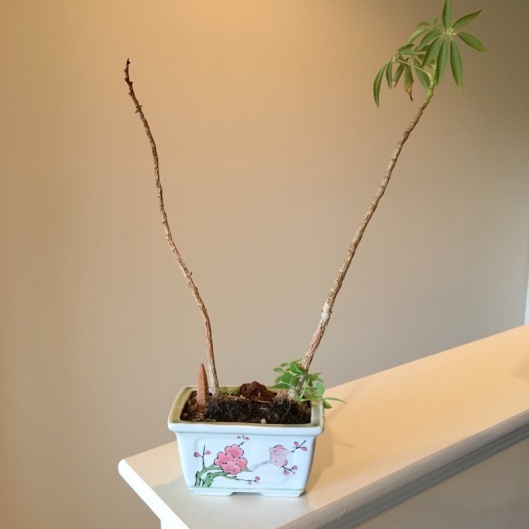
IMG_1794There is, however, one exception to this rule.  It was a plant given to us as a wedding present almost fifteen years ago.  Of course, when we received it, my immediate thought was, “Great!  There goes another plant in the trash!”  But much to my surprise, the plant was hearty.  No matter how long I forgot to water it, it managed to forgive me and perk back up when watered.  No matter how many new places I took it, it kept on going.  I jokingly started referring to the plant as our “love plant.”  It was a reminder of our special day, and like a loving marriage, it held together through thick and thin.

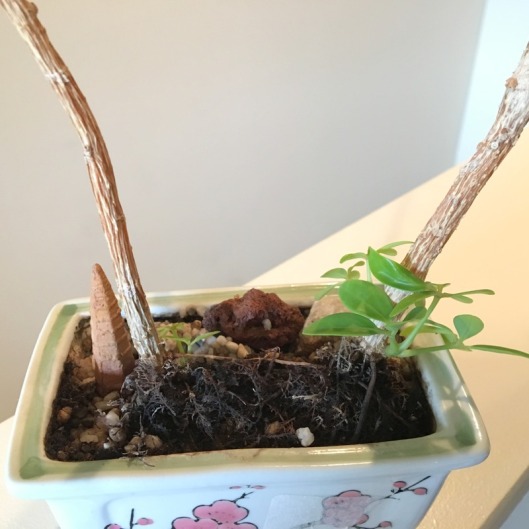
But during our most recent move, I pretty much killed our love plant.  I left the plant in the car.  It was not that warm in April, so I figured it would be okay there.  But I think our love plant just got scorched over the several-day move.  I had never seen the plant look like it did.  Normally the leaves naturally fell off when it was getting thirsty (my number one sign to water it!!).  But these leaves just shriveled and refused to fall or separate from the stem.  One stem seemed salvageable, but the other was totally gone – shriveled and dry.  I was devastated – not only for the plant that lasted almost 15 years with me, but also because of the significance the love plant had assumed.  What did its death mean?  Was it a sign about my marriage?!?IMG_1795

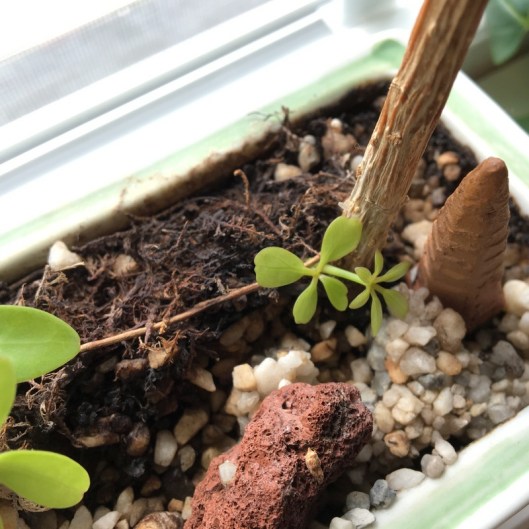
I refused to throw the plant away.  It just broke my heart too much.  So it sat on a window sill and I just let it be a sad reminder of my failure.  But then last week, something incredible happened.  At the bottom of the “barely alive” stem of the plant appeared new foliage.  I almost cried.  The plant has never gotten new foliage at the bottom – only at the top.  I don’t know what it means or if they will just fade too, but the joy I felt for those new little guys was overwhelming.  And then, today, I noticed some new foliage on the “dead” stem too. IMG_1796

I do not know if there is any real symbolism in the new growth, but I have to imagine there is.  My husband and I have started new jobs, our kids have begun new schools, and we have begun a new phase of our life.  Almost fifteen years later, love continues to find new ways to grow in our marriage, even on days when it feels like the love is dried up.  That kind of faithfulness is the same faithfulness we see in God’s hesed, or loving-kindness, for all of us.  Even when we feel like God’s love has abandoned us, we find new springs of life bubbling up where we least expect it.  Today, I encourage you to look for the new growth in your life.  Where is love sneaking in and gifting you with joy?

Recent Posts

  • On the Myth and Magic of Advent…
  • On Risking Failure and Facing Fear…
  • Sermon – Luke 23.33-43, P29, YC, November 23, 2025
  • On Inhabiting Gratitude…
  • Sermon – Luke 20.27-38, P27, YC, November 9, 2025

Archives

  • December 2025
  • November 2025
  • October 2025
  • September 2025
  • August 2025
  • July 2025
  • June 2025
  • March 2025
  • February 2025
  • December 2024
  • November 2024
  • October 2024
  • September 2024
  • August 2024
  • July 2024
  • June 2024
  • May 2024
  • March 2024
  • February 2024
  • January 2024
  • December 2023
  • November 2023
  • October 2023
  • September 2023
  • August 2023
  • July 2023
  • June 2023
  • May 2023
  • March 2023
  • February 2023
  • January 2023
  • December 2022
  • November 2022
  • October 2022
  • June 2022
  • May 2022
  • January 2022
  • December 2021
  • November 2021
  • October 2021
  • September 2021
  • August 2021
  • June 2021
  • May 2021
  • April 2021
  • March 2021
  • February 2021
  • January 2021
  • December 2020
  • November 2020
  • October 2020
  • September 2020
  • August 2020
  • July 2020
  • June 2020
  • May 2020
  • April 2020
  • March 2020
  • February 2020
  • January 2020
  • December 2019
  • November 2019
  • October 2019
  • September 2019
  • August 2019
  • July 2019
  • June 2019
  • May 2019
  • April 2019
  • March 2019
  • February 2019
  • January 2019
  • December 2018
  • November 2018
  • October 2018
  • September 2018
  • August 2018
  • July 2018
  • June 2018
  • May 2018
  • April 2018
  • March 2018
  • February 2018
  • January 2018
  • December 2017
  • November 2017
  • October 2017
  • September 2017
  • August 2017
  • July 2017
  • June 2017
  • May 2017
  • April 2017
  • March 2017
  • February 2017
  • January 2017
  • December 2016
  • November 2016
  • October 2016
  • September 2016
  • August 2016
  • July 2016
  • June 2016
  • May 2016
  • April 2016
  • March 2016
  • February 2016
  • January 2016
  • December 2015
  • November 2015
  • October 2015
  • September 2015
  • August 2015
  • July 2015
  • June 2015
  • May 2015
  • April 2015
  • March 2015
  • February 2015
  • January 2015
  • December 2014
  • November 2014
  • October 2014
  • September 2014
  • August 2014
  • July 2014
  • June 2014
  • April 2014
  • March 2014
  • February 2014
  • January 2014
  • December 2013
  • November 2013
  • October 2013
  • September 2013
  • August 2013
  • July 2013
  • June 2013
  • May 2013
  • April 2013
  • March 2013
  • February 2013
  • January 2013
  • December 2012
  • November 2012
  • October 2012
  • September 2012

Categories

  • reflection
  • Sermons
  • Uncategorized

Meta

  • Create account
  • Log in
  • Entries feed
  • Comments feed
  • WordPress.com

Blog at WordPress.com.

  • Subscribe Subscribed
    • Seeking and Serving
    • Join 394 other subscribers
    • Already have a WordPress.com account? Log in now.
    • Seeking and Serving
    • Subscribe Subscribed
    • Sign up
    • Log in
    • Report this content
    • View site in Reader
    • Manage subscriptions
    • Collapse this bar
 

Loading Comments...