
• About

Seeking and Serving

~ seek and serve Christ in all persons

Seeking and Serving

Tag Archives: messiness

Sermon – Mark 11.1-11, Mark 14.1-15.47, PS, YB, March 24, 2024

27 Wednesday Mar 2024

Posted by jandrewsweckerly in Sermons

≈ Leave a comment

Tags

God, Great Litany, Hosanna, Jesus, messiness, Palm Sunday, palms, passion, right, save, Sermon, sins

I don’t know if you remember, but back on the first Sunday of Lent about six weeks ago, we said a very long series of prayers at the beginning of the service called the Great Litany – or as my younger daughter calls them, “That time where you talked [sang] a really long time.”  Though I heard a few groans that morning when folks realized we would be praying for a long time, what I love about that Great Litany is that the litany somehow manages to encapsulate every single flaw in the human condition and the way those flaws pull us out of right relationship with God:  pride, hypocrisy, hatred, and envy; hardness of heart and sinful affections; oppression, violence, and war; and maybe the worst – dying suddenly and unprepared.

The list goes on and on, but what really gets me is how everything we started praying about in the beginning of Lent comes to the fore today in our liturgies.  I have always thought what the people do in the palm procession is where the people get things right and everything after in the Passion Narrative is where the people mess up.  But even in the Palm Narrative we mess up:  from pride in what feels like the Messiah coming to take down the powers that be, to a murderous desire to put down the oppressors that they assume Jesus will do when they shout, “Hosanna,” or “Save us,” as “Hosanna” is translated.[i]  And then we hear how the rest goes:  betrayal by loyal followers, to disciples too sleepy to keep vigil and pray, to abandoning Jesus, to mockery and violence, to conflict avoidance, hatred, and definitely a lot of hardness of heart. 

At the end of the Palm Narrative today, we are told that after the procession, Jesus goes into the temple in Jerusalem, and Jesus looks around at everything.  This may seem like a throwaway comment or a passing glance, but scholar Matt Skinner argues this is not a casual looking around at Jerusalem.  He says, “There is power in that glare.”  Jesus is setting his eyes and his heart to the work of provoking that he is about to do and he knows will lead to his death.[ii]  He is preparing for the holy, sacred work of resistance that will lead to both his demise, and ultimately to our redemption – our actual saving.  Maybe not the kind of saving we want, but the saving we need.

And that’s what brings me back to that long Great Litany from six weeks ago.  We did indeed confess a whole bunch of sins.  But you know what we also did?  We asked God to right things.  We prayed for grace to hear and receive God’s word, that God might empower us to go out in the world and share the Good News, that we might – in our several callings – serve the common good, that God might heal the brokenness in all of us and in the world.  This journey of Holy Week is not just about the despair and awfulness of our condition and the condition of the world.  This week, shockingly enough, is also about hope.  Frederick Buechner said of this day, “Despair and hope.  They travel the road to Jerusalem together, as together they travel every road we take — despair at what in our madness we are bringing down on our own heads and hope in him who travels the road with us and for us and who is the only one of us all who is not mad.”[iii] 

That is the messiness of us and of this most sacred week we now enter.  As scholar Debie Thomas writes, “I am known and held by a God who is too big for thin, one-dimensional truths — even my own, most cherished, one-dimensional truths.  I am held by a God who sticks with me even when I won’t stick with God.  A God who accepts my worship even when it is mingy, half-baked, and selfish.  A God who knows all the reasons my heart cries, ‘Save now!’ and carries those broken, strangled cries to the cross on my behalf. 

“Welcome to Holy Week.  Here we are, and here is our God.  Here are our hosannas, broken and earnest, hopeful and hungry.  Here is all that is unbearable, and all that promises to end in light brighter than we can imagine.  Blessed is the One who comes to die so that we will live.”[iv]  That journey starts today.  Your invitation is to join us everyday until we can shout our Easter praises.  Amen.       


[i]  John R. Donahue and Daniel J. Harrington, The Gospel of Mark:  Sacra Pagina (Collegeville, MN:  Liturgical Press, 2002), 322.

[ii]  Matt Skinner, as discussed in the podcast, “Sermon Brainwave:  #954: Palm/Passion Sunday – Mar. 24, 2024,” March 17, 2024, as found at https://www.workingpreacher.org/podcasts/954-palm-passion-sunday-mar-24-2024 on March 20, 2024.

[iii] As quoted by Debie Thomas, “Save Us, We Pray,” March 21, 2021, as found at https://www.journeywithjesus.net/essays/2958-save-us-we-pray on March 22, 2024.

[iv] Thomas.

Sermon – Luke 2.1-20, CE, YC, December 24, 2022

05 Thursday Jan 2023

Posted by jandrewsweckerly in Sermons

≈ Leave a comment

Tags

baby, Christ Child, Christmas, Christmas Eve, community, discomforting, disruption, familiar, Jesus, joy, love, Mary, messiness, peaceful, Sermon

When our girls were very small, our favorite book was Goodnight Moon.  We read that book so many times, I could have recited the book to you from memory.  “In the great green room there was a telephone, and a red balloon, and a picture of – the cow jumping over the moon…”  I read to our girls to calm them for bedtime, but truth be told, the cadence of a familiar book calmed me too.  Reading Goodnight Moon for the hundredth time became like taking a deep, steadying breath.

The same thing happened to me this year as I heard tonight’s gospel.  “In those days a decree went out from Emperor Augustus that all the world should be registered…”  As I kept listening, I could feel my body physically relaxing, my breath slowing, and a sense of peace and comfort settling in me. 

In all honesty, the reaction is a bit strange.  Nothing about Luke’s birth narrative is all that soothing.  Governments are forcibly moving people, accommodations are extremely cramped, childbirth in such conditions is anything but luxurious, we are transported to far off fields with the smells and discomforts of tending animals, and angels are sharing wonderful, terrible news, and mysteries are being introduced that delight and terrify.

So why in the world did my body have such a viscerally peaceful reaction to these familiar words despite the discomforting story?  Because Christ’s birth happens in the middle of disruption, chaos, shame, and messiness is perhaps the reason why the story is so comforting.  Our lives have been full of disruption, chaos, shame, and messiness these last few years.  Whether it was the global upending of a pandemic, economic and political upheaval, the denigrating, objectifying, or persecuting of other humans, or something closer to home – like death, divorce, job loss, or even lost sense of purpose, there is something tremendously familiar and contemporary about this story.  Of course, the government is causing disruption and chaos.  Of course, Mary is laying her baby in a manger.  Of course, strange, dirty men are interrupting an exhausted family in the middle of the night.  “Of course!” is the exclamation we have all assumed of late.

The “Of course!” though is not why we are here and is certainly not why my body heaved a sigh of relief.  What causes that relief is the “And…” of our scripture.  And, God came among us in the form of a child.  And, angels came and sang stunning songs of reassurance, promise, and deliverance.  And, strangers became friends and praised and pondered this magnificent God.  We came here burdened with our “Of course!”s.  Maybe the cookies burned before you got here.  Maybe there were some tempter tantrums in the car – or before you even got in the car.  Maybe the storms are cancelling the plans of you or your loved ones. 

And, you are here, hearing a familiar, reassuring story.  And you are among others just like you – who long for peace, comfort, and joy.  And you will be fed at the Eucharistic table, a food more glorious than the best roast beast!  We are here for our “and…” tonight.  But not just for our own sense of peace – we are here for the “and…” that God gives us to take out into the world.  And, hearing the story of the Christ Child reminds us of our bountiful blessings.  And, singing familiar songs reminds us of what really matters in life.  And, having reconnected with a community of believers, we are given a chance to go back out into the world and be harbingers of peace, shepherds of joy, caregivers of love.  That is the gift of this familiar story tonight.  You will likely experience some “Of course!”s on the way home tonight or in the coming days.  But now you have your, “And…”.  Amen.

On Saints, Elections, and God…

09 Wednesday Nov 2016

Posted by jandrewsweckerly in Uncategorized

≈ 1 Comment

Tags

altar, church, election, God, liturgy, messiness, saints, worship

14917060_1270799702976287_658328143983009977_oThis past Sunday, I got to try on one of Hickory Neck’s traditions.  For the past several years, every All Saints Sunday, the congregation has been invited to tie a ribbon on the altar rail in honor of saints who have gone before.  To be honest, before our liturgies started, I was not sure how the liturgical action would go.  I had imagined all sorts of reasons it might be awkward:  I didn’t think our early, reserved worshipers would be that interested; I worried that the ribbons would be messy, making communion at the rail difficult; I wondered if the symbolism would work in our space.  Happily, I was wrong on all accounts.
Instead, the liturgical symbolism was potent.  As I watched countless people kneel at the rail, tying on the ribbons, many with tears streaming down their faces, I realized how easy it is for me to forget the pain of grief that people struggle with every day.  When we see a well-dressed person at church on Sunday, we forget that there is a unique, sometimes painful story underneath appearances.  As I looked at ribbons draped on the altar rail, I imagined the bodies of the saints, draped on the entrance of the heavenly banquet, having given their lives to love and witness.  As my mind struggled with the messiness of the rail, my heart could see the messiness of life, clinging to the very altar where we kneel not just for solace and pardon, but for strength and renewal.  The liturgical action created a beautiful moment that was overwhelmingly powerful.

Today, I woke up to the news of election returns. Being a pastor of a diverse congregation, I know there are hearts that are relieved, hearts that are satisfied, and hearts that are saddened, fearful, and disappointed.  As I process that reality today, I am reminded of those ribbons, dripping from the altar of church.  I am reminded of the saints that have gone before, who have waded through their own times of conflict.  I am reminded of the fact that on Sunday, each worshiper will be bringing a story to the altar that I will never know fully.  I am reminded of the fact that our church offers a rail where we all kneel or stand, in all of life’s messiness, longing for something bigger and with greater meaning than we can give each other in our limited humanity.

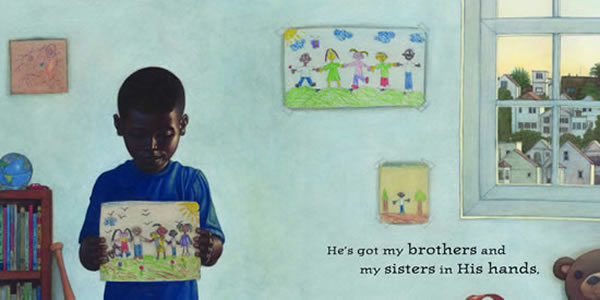
As I got ready for the day this morning, my two-year old sat in the floor of our bedroom with some books.  I was still processing that image of All Saints Day when I heard her singing from one of her books.  “He’s got my brothers and my sisters in his hands…he’s got the whole world in his hands.”  Her sweet voice brought me to tears as I realized the deep wisdom in her, perhaps unintended, words.  In this messiness of life, there will be days that are really complicated, confusing, and hard.  But as a person of faith, I also trust that the Lord our God is holding us in God’s hands, tending not just to me, but to my brothers and my sisters.  For today, that is all I can ask for.

world6

Photo credit:  He’s Got the Whole World in His Hands, Kadir Nelson.  Photo found at http://www.walkingbytheway.com/blog/picture-books-for-transracial-adoptive-families/

Sermon – Matthew 1.18-25, A4, YA, December 22, 2013

08 Wednesday Jan 2014

Posted by jandrewsweckerly in Uncategorized

≈ Leave a comment

Tags

Advent, Christmas, God, goodness, Joseph, Mary, messiness, righteous

So there he is, betrothed to Mary.  The way betrothal works in those days was that the husband and wife, or often the husband and the wife’s parents, enter into a marriage contract.  From that point on, the couple is considered married for all intents and purposes.  Any breaking of the contract would require a divorce.  During the betrothal period, the man prepares financially for his marriage, and the woman grows a bit more into womanhood, since she usually enters into the contract right after beginning puberty.  Some time later, the couple completes the marriage process with some sort of celebration or feast; then, the groom takes his wife into his home and the couple is considered fully married.[i]

Joseph had done everything by the books.  He is a righteous man, which means he follows the law to the letter.  Everything is heading in the proper direction, going as planned, according to schedule.  And then he gets the worst possible news.  Mary is pregnant.  Since Mary and Joseph are betrothed, but not yet in the stage of marriage where they have consummated the union, there is no way Joseph is the father of the child.  He can only assume Mary has been unfaithful.  Joseph has two options: he can have Mary stoned or he can divorce her.[ii]  He is well within his rights to utilize either path, and would not receive criticism by other faithful Jews.  But Joseph is one of those rare treasures who not only knows the letter of the law, but also understands the spirit of the law.  Instead of a brutal, public punishment for Mary, he decides he will divorce her quietly, hoping to help her avoid the full force of cultural judgment.

Joseph makes a well-informed, respectable, and compassionate decision.  He makes his decision and then rests his weary mind and body.  That is when life changes yet again.  God appears to Joseph in a dream, and explains that Joseph’s decision cannot stand.  This child in Mary’s womb is special, and not only is Joseph not to divorce her, he is to legally claim the child as his own by naming the child.  So what does Joseph do?  He bends even further than he already has, and takes Mary as his wife.

When most of us think of the Holy Family or even that holy night, we have a pretty romanticized picture of their life.  Our joy about the Christ Child seems to erase the reality of that poor family.  In fact, the Holy Family was a bit of a holy mess.  Mary is in the extremely vulnerable position of having her body taken over by the Holy Spirit and this child, all without the promise of a willing partner.  And Joseph is in a legal and cultural predicament.  I am sure that anyone in their community could do the math about Mary’s due date and wonder why Joseph stays with her, let alone assume ownership of the child.  Despite being obedient to God, I cannot imagine that Joseph’s dream wiped away all the tension between Joseph and Mary.

Of course, we are no stranger to this kind of messiness in families.  We all have experienced tensions in our relationships with parents, partners, siblings, and extended family.  Sometimes the tensions are from minor issues that eventually get resolved.  But sometimes the tensions break down communication, create broken relationships, and have ripple effects in our families.  Just this week, I have had conversations with people about an aging mother who is creating tensions among her children; a couple struggling with infertility; parents navigating the sexual orientation of their child; and a single person who feels lonely and hopeless.  We all know the messiness of life – in fact, we may have begun to wonder whether our dreams of peace and concord among our families is just a pipe dream.  Or maybe we would rather just divorce ourselves entirely from what our lives have become.

In the midst of messiness, another way emerges.  Joseph, a man who we know to be righteous and faithful makes a choice.  He had nothing to do with the messiness in his life, and he has every reason and right to just walk away and find a much neater, tidier life and a more conventional wife.  But Joseph makes a choice to believe God.  Joseph chooses differently.  “He claims the scandal, he owns the mess – he legitimizes it – and the mess becomes the place where the Messiah is born.”[iii]  Joseph’s choice is unconventional, a bit radical, and perhaps even a bit illogical.  But Joseph, having no idea where the choice will lead him, or how he will navigate his relationships once his decision is made, chooses to believe and to follow God right into the heart of the messiness, trusting that God will sustain him in the messiness and make something beautiful out of the mess.

Of course, Joseph had reason to believe that God could make a way through the messiness.  Just a few verses before the text we hear today in Matthew, Matthew lists the genealogy of Jesus.  In that genealogy, Jesus’ heritage begins with Abraham, goes through David, and ends with Joseph.  But in that list of forty-two fathers, four women from the Old Testament are also listed – all of whom had a history either before marriage or childbirth that made their story either strange or scandalous.  Take Tamar for example.  She was found to be pregnant long after her husband’s death.  Her father-in-law denounced her until he realized that he was the father.  Or look at Bathsheba, the wife of Uriah.  She became pregnant not by her husband Uriah, but by David.[iv]  Joseph comes from a long line of messiness and scandal, and yet, God moves through the messiness to create something new and powerful every time.  Perhaps a family history of messiness and divine action leads Joseph to take that leap of faith with Mary.

I wonder how all of this messiness resonates with your life.  We are still wrapping up Advent, and not quite yet to Christmas.  Like Joseph, we are not quite at the manger, finally arriving at our destination.  Now I recognize that some of you will be blessed by a blissful, picturesque Christmas with nothing but familial harmony.  That kind of reality may be entirely due to some good luck, and if that is what your Christmas looks like, then praise be to God.  But most of us probably are approaching Christmas with our fair share of messiness.  There are relationships to navigate or perhaps relationships that have entirely crumbled over the years.  You may have lingering questions about how God will act and what kind of goodness can come out of your mess.

Our invitation today is to remember that God still speaks to us in the messiness, and that God can still work not in spite of our mess, but through our mess for goodness.  And if you not convinced, perhaps then Joseph might be your best companion in the coming days.  Perhaps Joseph can journey with you as you wade into the messiness of your life, praying to hear God’s words for you.  Perhaps Joseph can fill you with hope and promise that your messiness, which may or may not be as severe as some of the Biblical messiness we have heard about today, has surely been seen by and blessed by God.  Perhaps Joseph can hold your hand at the stable, like he did with Mary, inviting you into a sure, steady trust that your God can do infinitely more than you can ask for or imagine this Christmas.  Amen.


[i] Arland J. Hultgren, “Commentary on Matthew 1.18-25,” as found on http://www.workingpreacher.org/ preaching.aspx? commentary_id=1936 on December 18, 2013.

[ii] David Lose, “Matthew’s Version of the Incarnation,” as found on http://www.workingpreacher.org/craft. aspx?post=2961 on December 18, 2013.

[iii] Martin B. Copenhaver, “Jesus’ Other Parent,” Journal for Preachers, vol. 31, no. 1, Advent 2007, 35.

[iv] Raymond E. Brown, “The Annunciation to Joseph,” Worship, vol. 61, no. 6, November 1987, 483.

Recent Posts

  • On the Myth and Magic of Advent…
  • On Risking Failure and Facing Fear…
  • Sermon – Luke 23.33-43, P29, YC, November 23, 2025
  • On Inhabiting Gratitude…
  • Sermon – Luke 20.27-38, P27, YC, November 9, 2025

Archives

  • December 2025
  • November 2025
  • October 2025
  • September 2025
  • August 2025
  • July 2025
  • June 2025
  • March 2025
  • February 2025
  • December 2024
  • November 2024
  • October 2024
  • September 2024
  • August 2024
  • July 2024
  • June 2024
  • May 2024
  • March 2024
  • February 2024
  • January 2024
  • December 2023
  • November 2023
  • October 2023
  • September 2023
  • August 2023
  • July 2023
  • June 2023
  • May 2023
  • March 2023
  • February 2023
  • January 2023
  • December 2022
  • November 2022
  • October 2022
  • June 2022
  • May 2022
  • January 2022
  • December 2021
  • November 2021
  • October 2021
  • September 2021
  • August 2021
  • June 2021
  • May 2021
  • April 2021
  • March 2021
  • February 2021
  • January 2021
  • December 2020
  • November 2020
  • October 2020
  • September 2020
  • August 2020
  • July 2020
  • June 2020
  • May 2020
  • April 2020
  • March 2020
  • February 2020
  • January 2020
  • December 2019
  • November 2019
  • October 2019
  • September 2019
  • August 2019
  • July 2019
  • June 2019
  • May 2019
  • April 2019
  • March 2019
  • February 2019
  • January 2019
  • December 2018
  • November 2018
  • October 2018
  • September 2018
  • August 2018
  • July 2018
  • June 2018
  • May 2018
  • April 2018
  • March 2018
  • February 2018
  • January 2018
  • December 2017
  • November 2017
  • October 2017
  • September 2017
  • August 2017
  • July 2017
  • June 2017
  • May 2017
  • April 2017
  • March 2017
  • February 2017
  • January 2017
  • December 2016
  • November 2016
  • October 2016
  • September 2016
  • August 2016
  • July 2016
  • June 2016
  • May 2016
  • April 2016
  • March 2016
  • February 2016
  • January 2016
  • December 2015
  • November 2015
  • October 2015
  • September 2015
  • August 2015
  • July 2015
  • June 2015
  • May 2015
  • April 2015
  • March 2015
  • February 2015
  • January 2015
  • December 2014
  • November 2014
  • October 2014
  • September 2014
  • August 2014
  • July 2014
  • June 2014
  • April 2014
  • March 2014
  • February 2014
  • January 2014
  • December 2013
  • November 2013
  • October 2013
  • September 2013
  • August 2013
  • July 2013
  • June 2013
  • May 2013
  • April 2013
  • March 2013
  • February 2013
  • January 2013
  • December 2012
  • November 2012
  • October 2012
  • September 2012

Categories

  • reflection
  • Sermons
  • Uncategorized

Meta

  • Create account
  • Log in
  • Entries feed
  • Comments feed
  • WordPress.com

Blog at WordPress.com.

  • Subscribe Subscribed
    • Seeking and Serving
    • Join 394 other subscribers
    • Already have a WordPress.com account? Log in now.
    • Seeking and Serving
    • Subscribe Subscribed
    • Sign up
    • Log in
    • Report this content
    • View site in Reader
    • Manage subscriptions
    • Collapse this bar
 

Loading Comments...