• About

Seeking and Serving

~ seek and serve Christ in all persons

Seeking and Serving

Tag Archives: mind

Sermon – 1 Corinthians 1.10-18, EP3, YA, January 22, 2023

15 Wednesday Feb 2023

Posted by jandrewsweckerly in Sermons

≈ Leave a comment

Tags

invigorated, Jesus, mind, pressure, purpose, Sermon, tension, transformational, united

The following sermon was delivered as the Annual Address at Hickory Neck Episcopal Church.

A few months ago, we had a fellowship event on campus that had a large group of parishioners who did not necessarily know each other.  As we made introductions around the room, I noticed a trend.  People began their Hickory Neck story with a reference to our history:  I came in the Kellett days; I came to Hickory Neck through Father Michael; I started at Hickory Neck about the same time Mother Jennifer did.  As I surveyed the room, I knew there would be parishioners who needed to introduce themselves who had never heard of the previous clergy, let alone how their personalities and ministries were different.  Suddenly, I realized there were going to be people who are a part of the Hickory Neck family whose stories start with, “I joined in the pandemic days.”  I have always bragged about how we are a diverse community politically.  But our diversity is so much bigger than our political differences:  we came here at various historical points, from very different denominational backgrounds, at different stages of life (whether as a young singleton, a new parent, or a new retiree).  Even out of your four affiliated clergy, not one of us is a cradle Episcopalian.

I love then, on this day of our Annual Meeting, that we get this reading from Paul’s first letter to the Corinthians.  When Paul gathered the church in Corinth, he “attempted what scarcely anyone has tried before.  A church composed of rich and poor, Jew and Greek, and slave and free,” with none of the “normal bonds of ethnicity and family that holds a community together.”  As one scholar explains, with such diversity, the factions in Corinth were likely inevitable.[i]  To this unusual combination of people, Paul asks them to be united in the same mind and the same purpose, that everyone be in agreement and there be no division among them.  Anyone who has ever tried to accomplish anything with a group of two or more people knows this request from Paul is endearing, if not laughable.  Bless Paul’s heart!

But having gotten to know the stories of the people in this room, Paul’s encouragement for us to be united in the same mind and purpose is exactly what we are going to be doing in 2023 at Hickory Neck.  We have had an incredible year leading up to this new start.  We have worshiped and learned apart during yet another shutdown, we have gained new members who found us online, we have welcomed longtimers back after a multi-year hiatus, and we have brought along neighbors and friends who just wanted to find a community where they could belong.  We have baptized, married, and buried.  We have celebrated, grieved, and grown.  We have said goodbye and lots more hellos.  And now we find ourselves at the start line of 2023 in a season of vibrancy, of hope, of promise. 

I confess, I am feeling more invigorated and excited about Hickory Neck than I have at any other time in our almost seven years together.  We have an almost entirely new staff:  a staff who is extraordinarily talented, creative, passionate, and fun-loving.  We have a Vestry who is not only a brilliant combination of longtimers and newer members, but also a group who is dedicated to strategic thinking and leadership – not to mention laughter and love.  We have a Sabbatical Team who has thoughtfully and lovingly prepared a twelve-week plan of renewal and community-building activities that will bring health, refreshment, and renewed discipleship to our parish.  And we have some percolating ministries that are going to help us grow our stewardship, evangelism, formation, community engagement, and worship.

One of the things we teach our Vestry about every year is about church-size dynamics.  There is a whole science about behaviors and leadership patterns that are indicative of a church’s size.  A church who is family-sized, with just a few family units is run collectively and where everyone knows everyone else, whereas a corporate-sized parish has a highly structured leadership system and people find a sense of community through smaller groups within the larger system.  In that scientific analysis, Hickory Neck is situated in the most challenging size:  the transitional-sized parish.  We are not so small that everyone knows everyone or that one pastor can be hands on with every member; but we are also not so big that we are in a more complex and large-staffed system.  The reason our size is challenging is because there is always a tension:  a pull to be smaller, and more intimate, and a pull to grow and focus on programming and creating intimacy in multiple small group settings.  That tension has been here throughout my tenure at Hickory Neck, and I feel that tension acutely as we emerge from this pandemic:  where we have the choice to shrink into a more comfortable, manageable size, or to grow into a dynamic, changing size requiring creativity around funding, programming, and invitation.

Living in tension year after year can feel exhausting.  But living in tension can also be transformational.  When carbon is put into tremendous pressure, a diamond emerges.  I think Paul wanted the Corinthians to know that they were under that same kind of diamond-making pressure.  His advice for those hoping to become diamonds?  Be united in the same mind and the same purpose.  And how, might you wonder will the Corinthians (or Hickory Neckers) accomplish such a feat?  According to Paul, by the name of our Lord Jesus Christ.  Whether you found Hickory Neck when children were sitting in the window wells of the Historic Chapel because there was no room elsewhere, whether you were crowded into this newly constructed space with hopes and dreams about where we would go, whether a preschool on our campus meant an encounter with our community, or whether a livestream gave you a peak that made you want more – we are a community united in purpose and mind:  to seek and serve Christ, to make Christ known, to love neighbor as self, to experience belonging and meaning.  In the name of our Lord Jesus Christ, you will be invited into a year of pressure and transformation.  The promise is a diverse community who is ready to emerge with you.  Amen.


[i] James W. Thompson, “Exegetical Perspective,” Feasting on the Word, Yr. A, Vol. 1 (Louisville:  Westminster John Knox Press, 2010), 279.

On Blessings and Curses, and Surviving Thanksgiving Meals

23 Wednesday Nov 2016

Posted by jandrewsweckerly in Uncategorized

≈ Leave a comment

Tags

conflict, creation, fall, family, God, gratitude, heart, leaves, mind, prayer, space, Thanksgiving, Thanksgiving Day

Colorful autumn

Photo credit:  www.fluentu.com/french/blog/french-fall-autumn-vocabulary-word-list

For those of you who know me well (or read this blog each fall), you know that I love the changing of the leaves during Fall.  Fall is my favorite season of the year – the cooler weather, the crunch of leaves, and the brilliant reds, yellows, and oranges that take your breath away.  The leaves turned later than usual this year in Virginia, so I have had time to enjoy their beautiful journey until now.  Just this week, a light wind was blowing, and a tree was raining down yellow leaves like a flower girl before the bride.  Some people like to stop and smell the roses.  I like to stop and revel in the beauty of God’s changing leaves.

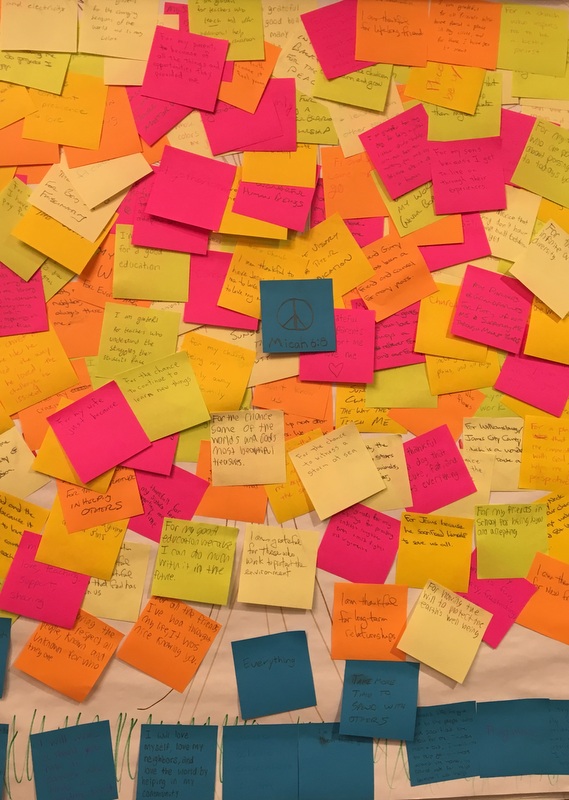
Watching and being fed spiritually by that beauty this year led us to creating a Thanksgiving Tree at Youth Group this past Sunday.  We took a poster with a bare tree, and then used our post-it notes to cover the tree with things for which we are grateful.  We had five categories, including family, relationships, creation, God, and school/work.  I challenged the group to write down three things in each category – not just a one-word response, but an explanation of their gratitude.  Perhaps 15 notes seemed like overkill to the young adults, but what I was hoping was that the more they thought about the blessings in their lives, the less space the negative would have in their hearts and minds.

That is my prayer for each of you this week as we head into Thanksgiving celebrations.  Though we may have Normal Rockwell images of Thanksgiving Day meals in our minds, and although some of you may actually get that experience, the reality of most meals, especially if spent with family, is that they will include a fair share of conflict.  If you are lucky to avoid talking about politics, some other family drama will surely emerge.  Expecting that conflict, I invite you to start praying your thanksgivings.  If your crazy family promises to bring angst, start praying now about the things that bring you joy about each member of your family.  You may have to dig deep (Lord knows your uncle’s jokes can drive you insane – but maybe you can thank God for predictability with your uncle or for the knowing glances of your cousins).  But my guess is that the more you start looking at your family or friends with the eyes of gratitude, there will be a lot more space in your heart and mind for blessings than curses.

If you can master that practice of thanksgiving prayers throughout one of the more stressful days of the year, perhaps you can carry that prayer practice through the next month.  As you hone that spiritual discipline for the next month, you may find it becomes easier to carry it into the next year.  Given our current climate, we are going to need all the space we can get for blessings. img_3401

Sermon – Matthew 22.34-46, P25, YA, October 25, 2014

30 Thursday Oct 2014

Posted by jandrewsweckerly in Uncategorized

≈ 2 Comments

Tags

active, commandment, God, heart, Jesus, love, mind, neighbor, passive, Sermon, soul, stewardship

I hear it all the time.  Whether talking to engaged friends or working with a couple in premarital counseling, inevitably the question will come up, “So why do you want to get married?”  And then I get the response, “Well, we’re just so in love.”  Though their googly eyes are endearing and make me somewhat nostalgic for a time long ago, my thought is almost always, “Cute.  I wonder how long that will last.”  Though I try not to squash their mushy moment, eventually we get around to talking about life outside of their love bubble – talking about what happens when they argue, how they will negotiate the in-laws, and who will balance the checkbook.  Those are the times when the warm emotions of love are sometimes difficult, if not impossible, to maintain.  I do not meant to suggest that those warm, fuzzies of love are temporary necessarily; I simply mean that the emotional experience of love is not enough to sustain any relationship – neither those between couples, family, nor friends.  We are right to assume that love is necessary for relationships, but our definition of love has to be much bigger if we are to maintain any kind of meaningful relationships with others.

Sometimes we forget the multilayered meaning of love when we hear passages like the one from our gospel lesson today.  When asked about the greatest commandment, Jesus says, “You shall love the Lord your God with all your heart, and with all your soul, and with all your mind… and… love your neighbor as yourself.”  These commandments are so familiar to us that we sometimes forget how hard they really sound.  If our definition of love only includes the emotional kind of love that we might call “being in love,” does that mean we need to have googly eyes toward God?  I know very few people who profess to be “in love” with God.  In fact, I am not sure we would even say that we love God.  We might be grateful to God, we may revere God, or we might even be in awe of God.  But I know very few people who would say, “I love God.”  That emotion just feels strange to us.  And yet, Jesus says today, love the Lord your God with all your heart, and with all your soul, and with all your mind.

Now the second commandment is a little easier.  We are used to loving our neighbors – loving people is what we are used to doing.  We love our friends and our family.  But Jesus says to love our neighbor, not just our friends.  Our neighbor includes those grouchy neighbors next door, that kid from school or that guy from work who always pushes your buttons, and most certainly that woman who cut you off while driving.  Our neighbor also includes those neighbors that often go unseen by us: the teen at JFK High School whose family cannot afford clothes and school supplies this year, that family who picked up our produce in Huntington Station through Food Not Bombs, that homeless man who received basic toiletries from St. Ignatius this week, or that Veteran’s family who is struggling to put life back together after returning to Plainview from war.  About these grouchy, mean, and unseen neighbors Jesus says, “Love your neighbor as yourself.”

When I work with those couples planning weddings, I am grateful when they choose the First Corinthians passage for their wedding, “Love is patient, love is kind…”[i]    I am grateful because then we can talk about what love really is.  We can talk about how love is more than simply a warm feeling or even a passionate desire.  In fact, when scripture talks about love, more often than not the kind of love scripture is talking about is not a passive emotion, but an active mercy.  In scripture, love is not something we feel, but something that we do.  To help us understand the difference, scripture will often translate the word for love as “loving-kindness.”  Love is not a feeling, but a choice:  a choice that we have to make over and over again.  As one person explains, “To love neighbor as oneself is to act toward the other as one would act toward those close to you.  We treat the stranger as well as we treat those that we love emotionally.”[ii]

So what does this active love look like?  For our neighbor, this kind of love is a bit more obvious.  The next time someone is rude to you or unkind to you, instead of reacting to them defensively, perhaps you take a moment to wonder what happened to them in life that made them act this way toward you.  Once you start to wonder about what things make them human and what has hurt them in life, your ability to be angry with them for hurting you lessens a bit.  In my early working days, I worked with a woman who most of the time was pretty pleasant to be around.  But there were times that she lashed out – and when she did I used to be both perplexed and angry.  I eventually started avoiding her altogether when, in a totally different context, someone who knew her shared with me that her father and an ex-husband had been alcoholics and were both abusive.  Suddenly the pieces fell together for me.  She had not known the kind of love that God commands – and I had not loved her as my neighbor.  The next time she snapped at me, her snapping felt less personal and awful – and instead I could see a vulnerable, hurting person who did not know how to love.  When Jesus tells us to love our neighbor as ourselves, this is the kind of shift in thinking Jesus invites.

In some ways, loving our neighbor is a tangible task we can imagine assuming.  But loving God still feels a little foreign, let alone loving God with all our heart, mind, and soul.  Luckily, God leads by example.  Our stories of God tell us of how, time and again, God chooses God’s people, makes covenants with them, forgives them, and invites them into relationship again. God’s love for God’s people is not an emotion, but an action.  Just recently we reheard the Exodus stories of how as soon as the people get out of bondage, they complain about not having food, not having water, and feeling separated from their creature comforts.  We heard again about how when God takes too long with Moses up on the mountain, they quickly revert to worshiping a golden calf.  And yet God keeps providing for, caring for, and loving them.  This is our model for how we are to love God too.  “We can love with our heart: through generosity to God’s people.  We can love with our soul: by worshiping God and praying for our neighbors and ourselves.  And we can love with our minds: studying God’s Word and letting it correct us, enlighten us, and send us out in loving action to the world.”[iii]

As we continue to prayerfully walk the way through this stewardship season, I first wondered whether this lesson really had anything to say about stewardship.  But as I thought about loving God and neighbor, I realized that is what stewardship is really all about.  Like love, stewardship is not something we feel or think about – stewardship is something we do.  When we make a financial pledge or contribution, we are expressing to God our gratitude for our blessings.  We take money from our pockets – money that certainly could be used for a hundred other things we want or need – and we instead give that money to God.  This is our full-bodied way of loving God with our heart, soul, and mind.  And, when the church uses that money for educating our children, serving our neighbors in need, and sharing the Gospel in our community, the church helps us to love our neighbor through our money too.  Jesus is certainly inviting us to change our feelings about God and our neighbor – but Jesus is also inviting us to change our actions toward God and neighbor.  That is what love is.

Next week, you will have the chance to act on that love.  We will process our pledge cards forward, as a symbolic gesture of our financial commitment to the work and ministry of St. Margaret’s.  We commit to funding the worship, which helps us love God with our soul.  We commit to funding the outreach and evangelism, which helps us love God with heart.  We commit to funding education and formation, which helps us love God with our minds.  And we commit to funding a ministry that enables us to not only love God, but to love our neighbor as ourselves.  I cannot think of a better way to invest our money than to invest our money in love.  Amen.

[i] 1 Corinthians 13.1-13.

[ii] Clayton Schmit, “Matthew 22:34-46 Commentary,” 2011, as found at http://www.workingpreacher.org/preaching.aspx?commentary_id=1063 on October 21, 2014.

[iii] Schmit.

Homily – Genesis 1.14-19, Nicolaus Copernicus and Johannes Kepler, May 23, 2013

29 Wednesday May 2013

Posted by jandrewsweckerly in Uncategorized

≈ Leave a comment

Tags

Copernicus, faith, God, homily, Kepler, mind, science

Today we celebrate Nicolaus Copernicus and Johannes Kepler.  Both lived in the 1500s, although they were born about a century apart.  If you remember, Copernicus was the first to put out the theory that the sun, rather than the earth, was the center of the universe, around which the planets rotated.  Kepler helped solidify this theory.  Both men saw no conflict between their theory and their faith.  Copernicus dedicated his work to the Pope, and Kepler saw in the relationship between the sun and the rotating planets the image of God.  But as you may also remember, religious thought was uncomfortable with this idea.  A great debate ensued, as though science and religion could not operate together.

Truthfully, I am not sure we have ever recovered from this debate.  There are still Christians who believe faith and science are not compatible.  Many centuries after Copernicus and Kepler, we are still pushing scientific minds away from the church.  I think part of the challenge is that our favorite stories from Scripture, especially like the part of the creation story we heard today, do not always make logical sense.  As we become older, we fear that if we start questioning those stories, our whole faith might unravel.

But the saints of God have been telling us differently for centuries, if we are willing to hear.  Copernicus saw no conflict between his theory and the authority of Scripture.  Kepler was able see the image of God in his work.  “Both men, through their life’s work, testified to the extraordinary presence of God in creation and maintained, in the face of both religious and scientific controversy, that science can lead us more deeply into an understanding of the workings of the Creator.”

Just over our vacation, we had coffee with an old friend.  She had been struggling with her faith because she saw so many discrepancies between what she knew as a scientist and teacher and as a woman of faith.  In our conversation, I was reminded of a campaign the Episcopal Church ran many years ago.  It said, “Jesus died to take away your sins, not your mind.”  Like the beauty and wonder of this place we live in that God created, God also created us in God’s image.  God invites us every day to live fully into the gifts, talents, and mind that God has given us.  Amen.


Recent Posts

  • On the Myth and Magic of Advent…
  • On Risking Failure and Facing Fear…
  • Sermon – Luke 23.33-43, P29, YC, November 23, 2025
  • On Inhabiting Gratitude…
  • Sermon – Luke 20.27-38, P27, YC, November 9, 2025

Archives

  • December 2025
  • November 2025
  • October 2025
  • September 2025
  • August 2025
  • July 2025
  • June 2025
  • March 2025
  • February 2025
  • December 2024
  • November 2024
  • October 2024
  • September 2024
  • August 2024
  • July 2024
  • June 2024
  • May 2024
  • March 2024
  • February 2024
  • January 2024
  • December 2023
  • November 2023
  • October 2023
  • September 2023
  • August 2023
  • July 2023
  • June 2023
  • May 2023
  • March 2023
  • February 2023
  • January 2023
  • December 2022
  • November 2022
  • October 2022
  • June 2022
  • May 2022
  • January 2022
  • December 2021
  • November 2021
  • October 2021
  • September 2021
  • August 2021
  • June 2021
  • May 2021
  • April 2021
  • March 2021
  • February 2021
  • January 2021
  • December 2020
  • November 2020
  • October 2020
  • September 2020
  • August 2020
  • July 2020
  • June 2020
  • May 2020
  • April 2020
  • March 2020
  • February 2020
  • January 2020
  • December 2019
  • November 2019
  • October 2019
  • September 2019
  • August 2019
  • July 2019
  • June 2019
  • May 2019
  • April 2019
  • March 2019
  • February 2019
  • January 2019
  • December 2018
  • November 2018
  • October 2018
  • September 2018
  • August 2018
  • July 2018
  • June 2018
  • May 2018
  • April 2018
  • March 2018
  • February 2018
  • January 2018
  • December 2017
  • November 2017
  • October 2017
  • September 2017
  • August 2017
  • July 2017
  • June 2017
  • May 2017
  • April 2017
  • March 2017
  • February 2017
  • January 2017
  • December 2016
  • November 2016
  • October 2016
  • September 2016
  • August 2016
  • July 2016
  • June 2016
  • May 2016
  • April 2016
  • March 2016
  • February 2016
  • January 2016
  • December 2015
  • November 2015
  • October 2015
  • September 2015
  • August 2015
  • July 2015
  • June 2015
  • May 2015
  • April 2015
  • March 2015
  • February 2015
  • January 2015
  • December 2014
  • November 2014
  • October 2014
  • September 2014
  • August 2014
  • July 2014
  • June 2014
  • April 2014
  • March 2014
  • February 2014
  • January 2014
  • December 2013
  • November 2013
  • October 2013
  • September 2013
  • August 2013
  • July 2013
  • June 2013
  • May 2013
  • April 2013
  • March 2013
  • February 2013
  • January 2013
  • December 2012
  • November 2012
  • October 2012
  • September 2012

Categories

  • reflection
  • Sermons
  • Uncategorized

Meta

  • Create account
  • Log in
  • Entries feed
  • Comments feed
  • WordPress.com

Blog at WordPress.com.

  • Subscribe Subscribed
    • Seeking and Serving
    • Join 394 other subscribers
    • Already have a WordPress.com account? Log in now.
    • Seeking and Serving
    • Subscribe Subscribed
    • Sign up
    • Log in
    • Report this content
    • View site in Reader
    • Manage subscriptions
    • Collapse this bar
 

Loading Comments...