
• About

Seeking and Serving

~ seek and serve Christ in all persons

Seeking and Serving

Tag Archives: miracle

Sermon – Luke 2.1-20, CE, YC, December 24, 2021

12 Wednesday Jan 2022

Posted by jandrewsweckerly in Sermons

≈ Leave a comment

Tags

appearance, Christmas, Christmas Eve, church, connection, earth, Good News, heaven, Jesus, Joseph, light, love, Mary, miracle, neighbors, ordinary, Sermon

Church on Christmas Eve is always a funny thing.  For years, I scoured the stores for matching dresses for our girls.  I served in churches where people would sport tuxedos and fur coats for the night’s services.  Family pictures were regularly taken by the Christmas tree – either at home or at church.  Quite frankly, I was a little relieved when I became a priest and never had to worry about a new outfit because no one would see the outfit under my vestments anyway.  And then the pandemic hit.  Last year, we had to watch Christmas from home – maybe in matching pajamas, but more likely just in a pair of jeans or sweats.  A year later, we are all out of the habit of dressing for public, and, if you are here at Hickory Neck, you know jeans are just as acceptable as that fancy dress or jacket in the back of your closet or that some of you are fabulously sporting tonight. 

I am not really sure where the notion of dressing up for Christmas came from, except maybe an older tradition of always dressing up for church.  But nothing about our Christmas story screams high fashion.  Mary and Joseph are traveling to Bethlehem under order of the oppressive government and are likely in traveling clothes, dirty and weary from the road.  Mary also gives birth this night, so her body is likely sweaty and soiled.  Meanwhile, her child is not in a matching layette, but in bands of cloth.  Both are likely an exhausted mess.  And the shepherds who later come visit are likely not to fresh-smelling themselves, probably in their most utilitarian clothing for tending to sheep in the dark cold of night.

And yet, in these most basic settings, the privilege of the miraculous happens.  Mary births not just an ordinary baby, but the Christ Child – the Messiah – as Isaiah says, the “Wonderful Counselor, Mighty God, Everlasting Father, Prince of Peace.”  Meanwhile, not only does an angel appear in the blinding glory of God, but also a whole multitude of the heavenly host shows up.  All to ordinary people, dressed in ordinary garb, going about doing ordinary things.  But as scholar Sarah Henrich says, “Heaven and earth meet in obscure places, not in the halls of power.”[i] 

This week I read about such a meeting of the heavenly and earthly in the Washington Post.  In November 2020, Kim Morton was sitting at home with her daughter watching a movie in Baltimore County, Maryland, when her neighbor sent her text telling her to look outside.  Her neighbor, Matt Riggs, had hung a string of Christmas lights all the way across the street from his house to hers, as he explained, to brighten Kim’s world and to show her that they were always connected, despite the isolation the pandemic had created.  Kim had been struggling with anxiety and depression, had lost a loved one, had a lot of work stress, and had started experiencing panic attacks.  Matt knew her pain himself, and so decided they both needed a reminder that they are not alone in their pain. 

But here’s the funny thing about Matt and Kim’s story.  The neighbors saw what Matt did, and they wanted in too.  Neighbors across the street from one another started talking and said, “Let’s do it too!”  Slowly, but surely, neighbors started reaching out to one another with expressions of connection, love, and quite literally, light.  By the time Christmas arrived, 75% of the neighbors had joined in with strings of light crossing the entire drive.  And this year, in November 2021, the whole neighborhood held a house-to-house light hanging party.  Kim, the initial recipient of the lights said, “It made me look up, literally and figuratively, above all the things that were dragging me down.  It was light, pushing back the darkness.”[ii]

Matt and Kim’s story did not happen in Jerusalem, Bethlehem, or even New York City.  Their story happened in a little neighborhood, outside of Baltimore, that no one had heard of until the Washington Post came along.  And although Matt and Kim never mention Jesus, the truth is that heaven and earth met in an obscure place, shining connection, love, and light.  This Christmas, the ordinary, earthy setting of Bethlehem and the shepherd fields are reminders – reminders that we can have all the fancy bow ties and heels we want, but more often, we will see and experience the sacred in the ordinary moments where Jesus shows up and offers us love.  The birth of the Christ Child tonight is a reminder that we, like ordinary shepherds can be used to be sharers of the Good News in tiny, ordinary ways – ways that show Christ’s love and light, and in ways that help us experience sacred connection with our neighbors.  Amen.


[i] Sarah Henrich, “Commentary on Luke 2:1-14 [15-20],” December 24, 2021, as found at https://www.workingpreacher.org/commentaries/revised-common-lectionary/christmas-eve-nativity-of-our-lord/commentary-on-luke-21-14-15-20-20 on December 22, 2021. 

[ii] Sydney Page, “A man strung Christmas lights from his home to his neighbor’s to support her. The whole community followed,” Washington Post, December 21, 2021.

On Looking for Miracles…

24 Wednesday Jul 2019

Posted by jandrewsweckerly in Uncategorized

≈ Leave a comment

Tags

behavior, change, community, feeding, generosity, God, hoarding, miracle, prayer, security, selfishness, sharing, St. Peter, substance

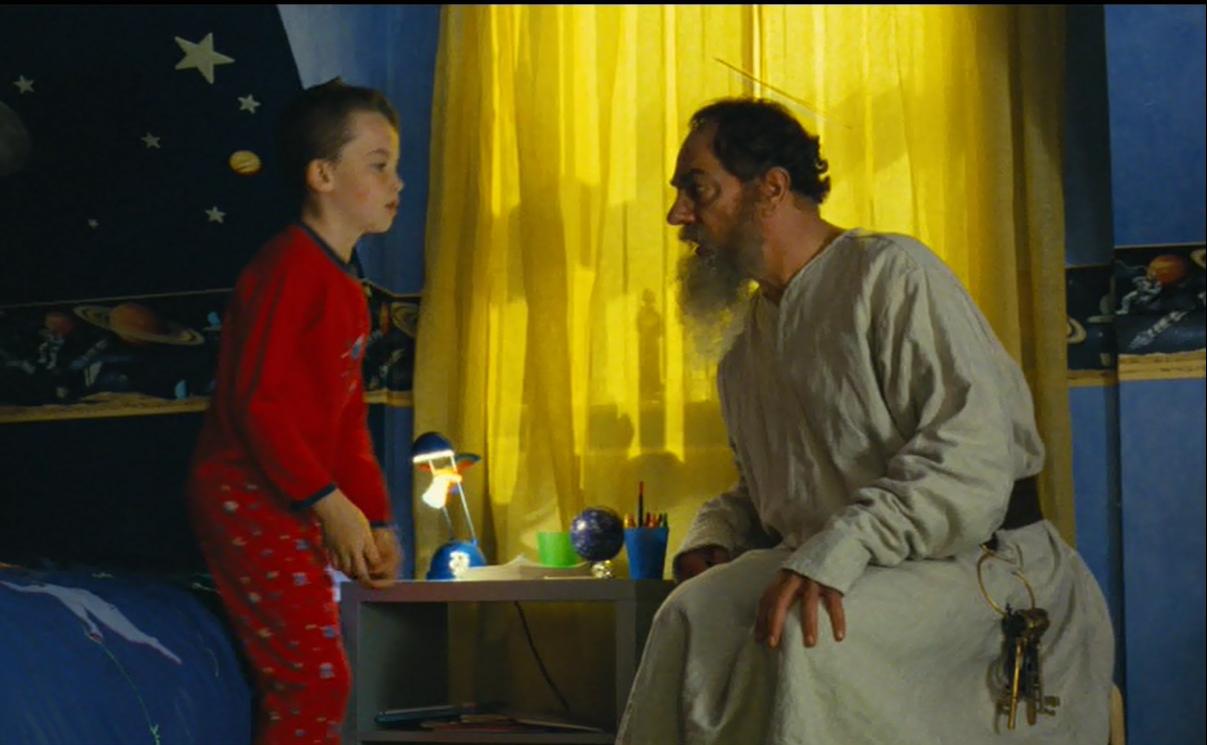
St. Peter

Photo Credit:  https://www.imdb.com/title/tt0366777/mediaviewer/rm1454393856

This past Sunday, our parish gathered to watch the film Millions (2004).  The film tells the story of two brothers who accidentally come into the possession of a bag with cash, and what they each want to do with the money.  The younger brother, still reeling from their mother’s death, regularly has visions of and conversations with saints, where he discusses the moral issues of how to handle the money.  My favorite scene is between the younger brother and St. Peter.  As St. Peter is talking to him about miracles, he tells him about the Feeding of the Five Thousand story.  But this Peter’s version is a little different than the one we all know.

In the film, Peter says what actually happened that day was not really a miracle.  A boy showed up with some sardines to share with the hungry crowd, and Jesus had the disciples pass them around.  But when each person received the plate, they did not take any, because they had been hiding a stash for themselves.  So, each person took their own stash out, and ate that food instead.  Some people even had a little extra, and so they added a small amount to the plate.  Peter argues there was no magic because the food did not actually multiply.  But as he talks the story through, he confesses perhaps a miracle did happen – the miracle of people sharing their food; the miracle of a once stingy people, hoarding their own food, to a tentatively generous people, willing to share.

What St. Peter was cheekily alluding to was a miracle not of substance, but of changed behavior.  Though the scene is meant to be playful, I have been thinking about that distinction ever since.  We are in a time of stingy hoarding; perhaps humans always are.  But in the face of our selfishness, I often find myself praying for a miracle – for God to act dramatically to change these awful patterns in our society.  But perhaps the miracle we need today is not a miracle of substance, but a miracle of changed behavior.  Perhaps we need little boys with plates of shared sardines to inspire us to let go of our own death grips on security, and open up our hands and hearts to generosity.   Perhaps when we open up, others will see works of miracle in our simple changes of behavior.

What are you hoarding this week on which you can loosen your grip?  Who are the children you have been ignoring who have something inspirational to share with you?  How might you slowly begin to let go of your posture of inward protection and look around your community to see who might need you and your open arms?  I invite you to be open to a miracle of changed behavior this week, and to let me know what ripple effects you see.  Maybe St. Peter is right about us, even today!

Sermon – Luke 2.8-20, CD, YB, December 25, 2017

10 Wednesday Jan 2018

Posted by jandrewsweckerly in Sermons, Uncategorized

≈ Leave a comment

Tags

birth, Christ, Christmas, contemplate, God, incarnate, Mary, miracle, ponder, quiet, sacred, Sermon, silence, wonder

Eight years ago, while serving as a curate in my first position out of seminary, I experienced Christmas Day worship for the first time.  Though I had often gone to Christmas Eve services before ordination, I suppose it never occurred to me to go to church on Christmas Day.  I was probably still in my pajamas or on the road to see family.  So imagine my surprise when the Rector told me there would be no music at the Christmas Day service.  I was shocked!  After all this time, patiently waiting through Advent music, on the actual day of Christmas, we were not going to hear any music?!?  I threw what some might consider a bit of a temper tantrum, and was told I should talk to the people who normally go to Christmas Day services.

Of course, my Rector knew what she was talking about.  As I talked to Christmas Day attendees, I discovered one universal truth:  they loved the spoken Christmas Day service.  First, they all went to a Christmas Eve service, so they got their carols fix the night before.  Second, they loved the quiet respite in an otherwise chaotic day.  A quiet service on Christmas Day was a godsend.  And third, they loved the Christmas Day service because it was a small, intimate service of what they called the “faithful;” much like what happens when you throw a party at your home and everyone but your close friends go home at the end of the night.  You kick off your shoes, find a warm beverage, and enter into quiet, meaningful conversation with your friends.  Music, in those parishioners’ minds, would have hindered the intimate, contemplative, peaceful vibe they loved.

In a lot of ways, having a quiet Christmas Day service is like taking a cue from Mary in our gospel lesson today.  After the chaos of travel and birthing a child in less than ideal accommodations, after shepherds have seen blinding lights and hear the triumphant chorus of the multitude of heavenly host, when everything quietens down, all that is left is a mother, father, and child, and some shepherds who seem like old friends.  I have always imagined the shepherds bursting through the doors, talking on top of each other to tell the story of the angels.  But I wonder if perhaps the scene was a little different.  Knowing full well the baby has arrived in less than ideal circumstances, and that babies are notorious for crying when disturbed, maybe the shepherds were whispering their intimate tale to the holy family.  Maybe they were those gathered at the end of the party, sharing in quiet, meaningful conversation.

I wonder if this might be true because we get one short line about Mary at the end of our text today, “But Mary treasured all these words and pondered them in her heart.”  Exhausted, fatigued, weary Mary takes the enormity of what has happened:  to her, when Gabriel came to her; with Elizabeth, who further revealed the angel’s proclamation; with Joseph, as he shared his own angelic story; and now with the shepherds who tell of yet another angelic encounter.  Mary takes all the bits of information – all the encounters she is privy to – and ponders them.  She takes a personal moment to sit quietly in the enormity of it all to ponder.  In some ways, she is a mother like anyone else – one who has carried a child in her womb with all the normal doubts and concerns that come from every ache, pain, and discomfort.  But in other ways, she is nothing like other mothers.  She is an instrument – pregnant without her own doing, carrying a child who will be bigger than anything before, and mothering someone who will never fully belong to her, but to the greater world he will soon save.

The funny thing is, pondering is an activity that would hardly ever make an appearance on our Christmas to-do lists.  We have been scurrying about this past month:  decorating homes, sending cards, attending parties, planning liturgies, hosting guests or finding hostess gifts.  We have either been caught up in the joy of the season, reveling in the 24-7 Christmas radio stations, or maybe we have been lost in our grief of all that is not this Christmas season.  Regardless of whether you are off to a Christmas celebration with twenty or more people, or having a quiet day alone or with one other, there is likely to be little true quiet:  our minds are way too noisy for quiet today.

And yet, quiet pondering is exactly what Mary does today.  She takes all the noise and chaos – both outward and inward – and she pauses for pondering.  She hits the pause button on the movie called life, takes a deep breath, and drinks in the miracle of Christ’s birth.  She stops talking, turns off her internal conversation, and listens.  She makes room for God in that rustic, foreign room, with people who are not her own, letting her body and soul contemplate the enormity of the nativity:  God incarnate; Messiah arrived; Eternal life made possible.  The wonder of that moment is enough to silence Mary, giving her much to ponder.

That is our invitation today too.  I know today is the least likely day for a moment of wonder, pondering, and contemplation.  But you are here.  You took a moment away from whatever today will be to sit at the manger with Mary and ponder.  Drink in the miracle of Christ’s birth, the gift of God incarnate.  Stand before our God in holy quiet and reverence as we pray and eat a different meal.  Remember “how God became one of us, remember how Christ still joins us at the Table, remember how we are fed by him in order that we might live as his body in the world.”[i]  These kinds of sacred moments are so rare in life.  Receive the gift of pondering at the manger with Mary today, and take that quiet out into the world with you, giving your heart the gift of true celebration and joy.  Amen.

[i] Kimberly Bracken Long, “Homiletical Perspective,” Feasting on the Word, Yr. B, Vol. 1 (Louisville:  Westminster John Knox Press, 2008), 121.

Sermon – Acts 9.36-43, E4, YC, April 17, 2016

20 Wednesday Apr 2016

Posted by jandrewsweckerly in Sermons, Uncategorized

≈ 1 Comment

Tags

charity, Dorcas, first Sunday, gestating, God, good works, health, hibernation, Hickory Neck, Holy Spirit, ministry, miracle, new life, Peter, Sermon, servant, Tabitha, work

This morning I want start with some thanksgiving.  I would like to thank the members of the Search Committee and the Vestry for being so faithful in prayerful discernment with me and the other candidates for Rector of Hickory Neck Episcopal Church.  My interactions with them gave me a sense of hope and joy about what lies ahead for us as a community of faith.  Though I know he has moved on to his next cure, I would also like to thank Henry for being such a faithful shepherd among us, especially during a time of transition and upheaval while still being new to the priesthood.  He paved the way for us to be ready for this next phase of ministry.  And finally, I would like to thank each one of you.  You have put a tremendous amount of prayer and trust into this process, and I am grateful for your support of this parish.  I am looking forward to learning about your ministries in this place and helping bolster your good work in the world.

The people of Hickory Neck are in good company today.  In our reading from Acts this morning, we hear about another faithful servant of God.  Tabitha, also known in her community by the name Dorcas, is a disciple renowned for her good works and acts of charity.  We know that she is an adept seamstress, who uses her sewing prowess to clothe the needy in her community.  We know that her witness and work are so powerful that the widows who benefit from her charity are found weeping by her deathbed.  We know that her discipleship is so profound that two men journey to a nearby town to find Peter in the hopes that he might be able to do something miraculous for the woman who was a miracle for so many others.[i]

As I prayed with Tabitha this week, I realized how many similarities her witness shares with Hickory Neck’s witness and ministry.  One of the reasons I was attracted to Hickory Neck during the discernment process was the vibrancy of ministry and the health of the congregation.  I was impressed to learn that thousands of dollars raised by your annual Fall Festival go directly to supporting local outreach ministries.  I have enjoyed hearing stories about making meals, visiting prisoners, and collecting goods for our neighbors in need.  But even more impressive to me is the desire among parishioners to do more:  to dream bigger dreams about how not only we can use our hands to more directly serve the poor, but also how we might use the gift of this property more creatively to be a living witness of the love of Jesus in our community.  What I saw in the discernment process was a church who is healthy and vibrant and who is poised for new and exciting work.

Now what is funny about all those good vibrations is that juxtaposed with that percolating vision is a community who has been treading water.  After the decline of your last rector, a shortened interim period, and making due with only an assistant, many of you have also shared with me your sense that these last few years have also been a time of getting by, but maybe not necessarily thriving.  I would never suggest that these last years have been like a death – but maybe like a time of hibernation.  Like an animal who lives off their stored up energy and fat over the winter, Hickory Neck has been getting by with the things that she learned long ago:  good worship and music, solid pastoral care and welcome, and powerful outreach ministries and educational opportunities.

Now Tabitha is not hibernating.  According to Luke’s writing in Acts, Tabitha is not just sleeping.  She becomes quite ill and dies.  Truthfully, if Tabitha had been in a deep sleep, her story might be a little easier to believe.  I do not know about you, but miracle stories like Tabitha’s are always a little strange to me.  Whether the story is the one from First Kings, where Elijah brings the son of the widow back to life after a strange ritual of laying himself over the dead boy’s body three times[ii]; or whether the story is of Jesus raising his friend Lazarus from the dead after four days in the tomb[iii]; or whether the story is this strange one where Peter prays over a dead disciple and simply says, “Tabitha, get up,” and she does, these stories always seem strange to me.  One, I do not really understand the mechanics of raising someone from the dead.  Having never seen such a miracle myself, I cannot imagine how or why such a thing happens.  Perhaps I am too jaded by modern science, but part of me just does not understand raising people from the dead.  Two, I do not understand why people are raised from the dead.  The idea sounds great in principle.  I am sure the mourning families and friends are incredibly relieved.  But, with the exception of Jesus, all of the people who are raised from the dead must have to die again eventually.  I’m not sure why people even bother.  Finally, what I really do not understand about these stories is what they mean for us today.  Though we love these biblical stories, I know plenty of people who would like to see their loved ones raised from the dead.  Many of them might even have a case based on the good works they have done, like Tabitha.  Surely people like Tabitha deserve another chance to keep making a difference in the world!

Regardless of the fact that the text does not tell us how, or why, or even why not someone else, what the text does tell us is that Tabitha is in fact dead, Peter in fact raises her from the dead, and then the alive Tabitha is presented to her people, presumably to get back to doing all the good works and charity she had been doing before – or perhaps even better works of charity.  Implicit in Peter’s words, “Tabitha, get up,” is the notion that Tabitha’s work is not done yet.  In fact, Tabitha must have even greater works to do.  God is not done with Tabitha yet.

That is what I love about this story for Hickory Neck.  God is not done with us yet either.  As I was reading up about hibernation, one of the things I learned is that some species, like polar bears, hibernate while gestating their young.  I was blown away by that realization.  Pregnancy is that time when the host is usually taking on more calories, building up muscles to prepare for the birth, and dealing with the activity of a developing fetus – especially once the kicking begins.  I cannot imagine sleeping through that whole process or storing up enough sustenance to help both bodies grow and thrive during hibernation.

But the more I thought about the hibernating polar bear, the more I realized that is exactly what has been happening with Hickory Neck.  Perhaps these last couple of years have felt like a hibernation period – a time of lower energy and output.  But I wonder if Hickory Neck is not unlike a hibernating mama polar bear.  Though we have been keeping things steady, we have also been working hard on nurturing and producing new life.  We have not been sleeping to survive a cold spell.  We have been resting to cultivate and grow new life – a new life which is about to be born.

Today, Peter’s words and actions are for us too.  The text tells us that when Peter arrives he sends everyone outside, kneels down, and prays.  We have been praying too.  We have been praying that God guide us through a time of turbulence and transition, we have been praying that Jesus nurture us during our time of hibernating, and we have been praying that the Holy Spirit help us explode with renewed energy and life.  After Peter prays, his words to Tabitha are simple, “Tabitha, get up.”  Hickory Neck has received a similar charge.  When the Holy Spirit led us to one another, we heard the same words.  “Hickory Neck, get up.”  God is not done with us yet either.  That new life we have been gestating is eager to be born in and through us.  Finally, one more thing happens in our text.  The text says, “Peter gave Tabitha his hand and helped her up.”  Though Peter’s words are unambiguous to Tabitha, Peter does not expect Tabitha to get up and get to work alone.  He offers her a hand.  The same is true for us.  Though we are charged to get up and start caring for this new life we have been nurturing, we do not do the work alone.  The Holy Spirit is reaching out to us to help guide us to our feet.  I will be reaching out my hand to each of you, but I will also need you to reach your hand out to me.  And, more importantly, we will also need to reach out our hands to those not yet in our midst, who will be a part of the new life we have been gestating.  I do not know about you, but I cannot wait to see what our new growing family looks like.  So, Hickory Neck, get up!  Amen.

[i] Stephen D. Jones, “Homiletical Perspective,” Feasting on the Word, Year C, Vol. 2 (Louisville:  Westminster John Knox Press, 2009), 429.

[ii] 1 Kings 17.17-24

[iii] John 11.1-44

The Truth about Weddings…

20 Wednesday Jan 2016

Posted by jandrewsweckerly in Uncategorized

≈ Leave a comment

Tags

abundance, Anglican Communion, Cana, conflict, Episcopal Church, feast, God, Jesus, joy, marriage, miracle, pain, tension, water, wedding, wine

wedding-cana

Photo credit:  http://www.freebibleimages.org/photos/wedding-cana/

Almost two years ago, we welcomed our second daughter, Cana into the world.  We have gotten countless questions about the choice of her name and we find ourselves telling the story about the wedding in Cana over and over again.  Sometimes the repetition is annoying.  But mostly, retelling the story is a gift in itself.  You see, the story of Jesus’ first miracle is a story of great joy.  There is the setting of a wedding – one already filled with merriment and delight.  There is the wonder of a miracle – the amazing ability of Jesus to convert water into wine.  And there is the shock of abundance – not just the enormous amount of wine that Jesus produces, but also the best wine of the evening.  There are certainly questions in the story:  What is happening between Jesus and Mary?  Is this kind of miracle an exercise in indulgence?  Why does Jesus choose this as his first miracle?  But the questions usually fade in comparison to the joy.  Jesus chooses an occasion of joy to bring forth a miracle of abundance and pleasure.  I cannot help but smile every time I read the story.

Attending a wedding this weekend, hearing the story of Cana in Sunday’s lectionary, and thinking about our own daughter Cana, I cannot help but be left with a sense of gratitude for the gift of abundant joy given to us by Jesus in his first miracle.  There are parts of Jesus’ story that are neither joyful nor abundant.  But this first miracle gives us a taste – a literal and delightful taste – of the abundance of God’s love and kingdom.  I really cannot seem to wipe the smile off my face when I think of any of the three of those reminders of Jesus’ abundance and grace.

Perhaps that is why I am so saddened by the continued discord in the Anglican Communion about gay marriage.  In my country, the occasion of the legalization and blessing of gay marriage in the Episcopal Church has been a source of great joy for my gay and lesbian brothers and sisters, as well as their allies.  That, coupled with the ordination of gay and lesbian clergy, has left many in our church feeling a deep connection to the joy and abundance that Christ brings.  And yet, that joy is bringing great sadness to a large portion of the Anglican Communion.  Here we are at the earthly banquet, and instead of a joyful occasion of abundance, we are at a different feast – one where family drama and strife is overshadowing the joy of some of our members.

The irony of the wedding of Cana being appointed for the same Sunday that the Episcopal Church is grappling with the Anglican Communion Primates’ decision to suspend the full participation of the Episcopal Church in the life and work of the Anglican Communion is not lost on me.  But maybe that is the truth of every wedding – the constant tension between heavenly grace and abundance and human sinfulness and frailty.  Behind every dreamy wedding is some glossed over (or sometimes very obvious) family drama.  But even in the midst of family tension, there are usually moments of grace – glimpses of the abundance Jesus wants to shower upon us.  That is what I am grasping onto this week:  in the midst of pain, and facing the ambiguity of these next years in the Anglican Communion, God will keep breaking through with abundance, joy, and miracle.  Though I do not know all the answers to the biblical or the ecclesiastical story, I am grateful for the gift of Cana.

Sermon – Mark 4.35-41, P7, YB, June 21, 2015

22 Monday Jun 2015

Posted by jandrewsweckerly in Uncategorized

≈ 2 Comments

Tags

afraid, asleep, boat, care, Charleston, comfort, covenant, disciples, gun control, Jesus, Kingdom, Mark, miracle, oppression, other, racism, relationship, scared, Sermon, storm, suffering, violence

A long time ago, we got on a boat.  We were not really sure what was going to happen while we were out to sea, but we got on the boat because we were curious.  We had an experience, or maybe multiple experiences with a man named Jesus, and something about those experiences compelled us to get on the boat.  Maybe the experience happened as early as Sunday School, maybe the experience happened when we were confirmed, or maybe the experience happened as an adult.  We may not even be able to articulate the reason why we got on the boat.  But all of us, at some point, step onto the boat, however tentatively or boldly, and we sail with Jesus to the other side.

The disciples have that same experience in today’s gospel lesson from Mark.  After a long day of preaching and teaching, during which Jesus pulls them aside and explains parables to them, Jesus says, “Let us go across to the other side.”  Now if the disciples had been smart, they would have asked some questions: “What is on the other side?  What if a storm comes?  Can’t we just stay here and get a good night’s rest?  This place is familiar and comfortable.”  And they should have asked questions.  The “other side” of that body of water is exactly that – other.  The other side is Gentile territory, the land of the Gerasenes.  Jesus is taking his first journey into what might be considered dangerous, and even inappropriate.  Jesus is beginning a ministry beyond just the Jews.[i]  “Let us go across to the other side,” is no “Hey, let’s mix things up this year and go to Cabo.”  Yes, the disciples should have asked a lot more questions.[ii]

But they do not.  Something about this Jesus compels them forward, stepping on and manning that boat without question.  That’s the funny thing about Jesus.  We too got on a boat because of him, probably having no idea what we were getting into.  Suddenly we find ourselves cooking casseroles, watering gardens, and bringing in men’s undergarments for our needy neighbors.  Suddenly we find ourselves getting asked by the Rector to serve on some committee.  Suddenly we find the news of the day is not so simple when we remember all those words we said in our baptismal covenant about seeking and serving Christ, loving our neighbor as ourselves, and sharing the Good News.  We really should have asked more questions before we got on that boat to follow Jesus.

I have been thinking about that boat a lot this week.  You see, some of our fellow disciples were murdered this week – nine to be exact, in Charleston, South Carolina.  They were praying and reading Holy Scripture – just like we do every Thursday.  They even welcomed in a stranger that night – like Jesus always tells us to do.  That very stranger turned out to be crazy, filled with racist rage, and willing to kill nine people before fleeing.  At least that was how I saw the episode at first.  At first, this was another instance of a crazy person, senselessly killing other people.  But then the prophets of our time began to speak.  The prophets reminded me that violence proliferates in our society.  The prophets reminded me that because we cannot agree on a reasonable gun policy, more and more people die in our backyards.  The prophets reminded me that our African-American brothers and sisters in this country experience very fragile and virtually non-existent safety – they cannot even be safe in church.  There was a part of me that wanted to stay on the shore this week and say, “Oh, Jesus, that was just an isolated event by a crazy kid with extremist views.”  But I had already gotten on the boat.  It was too late.  And a storm began to rage.

That storm for me was the storm of our time:  a storm of violence, racism, and suffering.  No longer could I contain each story:  Trayvon Martin, Ferguson, Sandy Hook, Baltimore, Columbine, Selma, Charleston.  One story bled into another, and as I was reminded of each one, I felt the buckets of water dousing my face.  As I thought about every conversation I have had about how racism is not dead, I felt the water creeping up to my waist.  As I thought about the historical shadow of the oppression of others in our country, I wanted to cry out to God.  And all I could think about was Jesus on that stupid boat, asleep on a cushion in the stern.  Who can sleep at a time like this?  Doesn’t Jesus care about us at all?  Why couldn’t we have just stayed on the shore in that comfortable, familiar place instead of getting on the God-forsaken boat with a man who does not seem in the least bit bothered by our suffering?

The disciples know that feeling.  They are experienced at life on a boat.  At least when they get on the boat, they knew how to manage a boat.  They know the dangers and the perils, and have learned to navigate them for the necessity of survival.  But even these experienced fishermen are scared.  They have tried to control the boat, they have scooped out as much water as they can, and they know they have met their match.  And so they go to their last resort.  They wake up Jesus and shout, “Teacher, do you not care that we are perishing?!?”  When they got on that boat, this is not what they were expecting.  They were expecting the fulfillment of a promise – the fulfillment of a different life and a different world:  the kingdom of God here on earth.  Instead they were going down fast with a man who could not even stay awake and fight the good fight with them.

I shouted those words this week too.  Teacher, do you not care that we are perishing?  Maybe we brought all this violence on ourselves, but surely you care?  Surely you did not lure me onto this boat – into this relationship with you – only to watch us perish?  Though I wanted more than anything to think this was an isolated event of a crazy person doing something ungodly, I could not ignore the storm swirling around.

I struggled to find hope today in our gospel lesson.  All I saw was Jesus scolding the disciples for their fear and their lack of faith.  And then I saw disciples even more afraid than before – which is saying something given the awfulness of that storm.  Straining for some strand of hope – some glimmer of redemption – I came back to that invitation from Jesus, “Let us go across to the other side.”  Jesus does not tell the disciples to go to the other side alone.  Jesus does not say, “Go to the other side without me.”  Jesus says, “Let us go to the other side.”[iii]  Whether the disciples felt like Jesus was with them during that storm or not, Jesus was with them.  That may not seem like much, but that may be the biggest miracle of all in this story.  As one scholar writes, “God’s power isn’t in the control of creation or of people, but in being in covenant and relationship with them.  [God’s power] isn’t in imposing the divine will or insisting on its own way but in sojourning with us as we fumble around and make our way in the world.  God’s power is not in miraculous interventions, pre-emptive strikes in the cosmic war against suffering and evil, but in inviting us to build a kingdom out of love, peace, and justice with God.  God’s power is not in the obliterating of what is bad in the world, but in empowering us to build something good in this world.”[iv]

A long time ago, we got on a boat.  We did not know where we were going, what we would see, or who we would encounter.  All we knew was that Jesus was inviting us into a different life, and we felt compelled by this passionate, nonsensical man.  Oh, we had clues.  We knew that the “other side,” was not a place we wanted to go.  We knew that going there might change us, and change our entire worldview.  We knew that getting on that boat would mean stepping away from the familiar, comfortable coastline, and sailing into something different and scary.[v]  But Jesus said he would go with us.  Jesus invited us on a journey with him and something deep inside us, despite the little devil on our shoulder telling us to stay put, told us to step onto that boat.

I am still scared of the storm.  In fact, I am a little afraid of Jesus too.  But what brings me comfort this week is that Jesus is with us.  Jesus does not invite us onto a boat and let us sail alone.  And though Jesus may have an ability to sleep through a storm, with complete confidence in the direction of God, I also know that Jesus will wake up and respond to me when I call out his name.  He may not say what I want to hear.  He may leave me feeling more uncomfortable than getting soaked in a storm.  But he is here.  Jesus is here on our boat, and can make things right.  We just have to be prepared to go to the other side.  Amen.

[i] Beverly Zink-Sawyer, “Homiletical Perspective,” Feasting on the Word, Yr. B, Vol. 2 (Louisville:  Westminster John Knox Press, 2009), 165.

[ii] This train of thought comes from Karoline Lewis’ writing “The Other Side,” June 14, 2015 as found at https://www.workingpreacher.org/craft.aspx?post=3645 on June 18, 2015.

[iii] Lewis.

[iv] David R. Henson, “When God Sleeps through Storms (Lectionary Reflection for Mark 4:35-41),” June 15, 2015 as found at http://www.patheos.com/blogs/davidhenson/2015/06/1804/ on June 18, 2015.

[v] Lewis.

Sermon – John 1.1-18, C1, YA, December 29, 2013

08 Wednesday Jan 2014

Posted by jandrewsweckerly in Uncategorized

≈ Leave a comment

Tags

Christmas, God, Holy Family, Jesus, John, Mary, miracle, prologue, Rembrandt, scripture

A couple of days after Christmas, the all-Christmas-music radio stations have switched back to their normal formats.  At local stores, the Christmas rack of cards had been transformed to a rack of Valentine’s Day cards.  In our neighborhoods and among our friends and family, we have switched our greeting from, “Merry Christmas!” to, “Happy New Year!”  The world has moved on from Christmas, and yet, the Church is still dwelling in Christmastide – in fact we celebrate not just one day, but the famous twelve days of Christmas.  Our celebrations continue until those wise men arrive on the 6th, when we transition to Epiphanytide.  Today, after stories of shepherd, angels, and the holy family, we find ourselves not wondering what is next, but instead still pondering what has just happened.

For a reflection on what happens in Jesus’ birth, what better text than John’s prologue?  John takes us out of the stable, and invites us not to just consider the miracle of that holy night, but to consider the miracle of a God who takes on human flesh for us.  And so, instead of telling us about the earthly beginning of Jesus’ life, John takes us all the way back to the beginning of all things – that creative moment when the Word and God are together, making all life come into being.  “In the beginning was the Word, and the Word was with God, and the Word was God.”  The words sound beautiful, and John’s text is rich with meaning and interpretation.  But John’s words are also a little circuitous, repetitive, and a bit difficult to understand without reading them multiple times over.  The familiarity and beauty of the words may be soothing, but the meaning of those words sometimes eludes us.

As I sat pondering these words this week, I found myself drawn again to Rembrandt’s painting, “Holy Family,”[i]  In the foreground of the painting, Mary, who is bathed in light, has a well-worn book, perhaps scriptures, lying on her lap, held in place by one hand, as though she has been reading the book intently.  Her face, however is turned away from the weathered book, as her other hand lifts a blanket that is covering a cradle, revealing a sleeping, contented Jesus.  Behind Mary and Jesus, in much fainter light, Joseph is standing over a piece of wood that he is intently planing.  Meanwhile, in the top left corner of the painting, young cherubim are hovering around the scene with outstretched arms.

What I like so much about the painting is that Mary gives us a clue about how we are to understand John’s beautiful, but convoluted words today.  First, I am intrigued by the way Mary clutches her well-worn book.  In looking at her book’s worn edges, I am reminded of the Bible I used for my Education for Ministry class several years ago.  In EFM, you spend two years reading through the Old and New Testaments.  I remember how my homework for the class instructed me to highlight certain passages in different colors so I could track the different contributors to a text.  I remember writing notes in the margins of passages that stood out, held particular meaning, or raised questions.  I remember certain pages being soiled by the meal I tried to cram in while finishing my assigned reading for a particular session.  That Bible looked like a Bible someone actually lived with as opposed to the clean, commemorative ones I have on many of my shelves.

That is the way I imagine Mary treating her worn book.  As the one who ponders things in her heart, I imagine Mary also ponders scripture in her heart.  I imagine she pours over the texts as she looks for words to explain her experiences with Jesus or as she simply longs for words to describe her feelings toward the God who had done something so tremendous in her life.  As Mary seeks to understand the Word made flesh, perhaps she returns again and again to the words of scripture, trying to discern their meaning.  And given that she is a faithful Jew, she probably also does that pouring over scripture with her faith community, as they seek to always hear God’s word for the people.  Her community probably turns back to that creation narrative over and over again.  Her community probably turns back to the Law of Moses over and over again.  Her community probably turns back to the prophets over and over again.

Given her longing for scriptural insight, Mary likely would have appreciated John’s text today, even though John’s gospel was not written until about 60 years after Jesus’ death.  She would have already known the stories of Luke and Matthew because they are her story.  But our text by John today is an attempt to help all of us understand the magnificence of what happens when God takes on human flesh.  In fact, if Mary had been reading John, I imagine that the last line we hear is what draws her attention away from her well-worn book to look at the Christ Child himself in Rembrandt’s painting.  John writes, “No one has ever seen God.  It is God the only Son, who is close to the Father’s heart, who has made him known.”

Perhaps this text is why Rembrandt depicts Mary’s eyes wandering back to that cradle, her hand pulling back the blanket, and her mind not just worrying like any mother does over an infant, but her mind also worrying about what God is doing in this child of hers.  She wants to do more than read the words on the paper – she wants to read the Word, with a capital “W,” in her life.  She wants to gaze at the Word made flesh, who shines light into that dimly lit room and into the world.  She wants to not only know the Law of Moses, but to know the grace and truth that comes directly from the Word incarnate.

What Rembrandt depicts in his painting is perhaps where we find our invitation from John’s gospel lesson today.  In order to understand John’s language, we too are invited to create our own dialogue between the Word of Scriptures and the Word made flesh.  Studying both Holy Scripture and the Holy Child is how we come to understand challenging texts like John’s gospel.  For some of us, that invitation may seem as muddy as John’s gospel.  But what Mary does in Rembrandt’s painting is available for us today too.  We can “develop a richer, fuller faith by tending both to the Word through words and to the Word made flesh, the Christ who is with us in the sacraments, with us in prayer, with us in our church, with us in our friends, with us in the stranger, and with us in creation, since ‘all things came into being through him, and without him not one thing came into being.’”[ii]

For those of you still wondering what this life pattern still looks like, consider the ways in which we already live into this balance.  When we reach into our pockets a little deeper for those families in our neighborhood who are just struggling to put gas in the car and food on the table, honoring the holy in one another, we then turn back to Holy Scripture that tell us to care for the poor.  When we care for one another in this community, sharing our deepest pains and struggles, we then turn to back to Holy Scripture as we struggle to find words to verbalize our understanding of God in that pain and struggle.  When we come to this table, and consume the body of Christ in the bread, we then turn to Holy Scripture to understand what the Word became flesh means.  We gather today as a community of faith, both clutching the Word in Holy Scripture, and clutching Word in the Christ Child, knowing that we can never fully understand one without the other.  Amen.


[i] C. 1645.

[ii] Thomas H. Troeger, “Homliletical Perspective,” Feasting on the Word, Yr. A., Vol. 1 (Louisville: Westminster John Knox Press, 2010), 193.

Recent Posts

  • On the Myth and Magic of Advent…
  • On Risking Failure and Facing Fear…
  • Sermon – Luke 23.33-43, P29, YC, November 23, 2025
  • On Inhabiting Gratitude…
  • Sermon – Luke 20.27-38, P27, YC, November 9, 2025

Archives

  • December 2025
  • November 2025
  • October 2025
  • September 2025
  • August 2025
  • July 2025
  • June 2025
  • March 2025
  • February 2025
  • December 2024
  • November 2024
  • October 2024
  • September 2024
  • August 2024
  • July 2024
  • June 2024
  • May 2024
  • March 2024
  • February 2024
  • January 2024
  • December 2023
  • November 2023
  • October 2023
  • September 2023
  • August 2023
  • July 2023
  • June 2023
  • May 2023
  • March 2023
  • February 2023
  • January 2023
  • December 2022
  • November 2022
  • October 2022
  • June 2022
  • May 2022
  • January 2022
  • December 2021
  • November 2021
  • October 2021
  • September 2021
  • August 2021
  • June 2021
  • May 2021
  • April 2021
  • March 2021
  • February 2021
  • January 2021
  • December 2020
  • November 2020
  • October 2020
  • September 2020
  • August 2020
  • July 2020
  • June 2020
  • May 2020
  • April 2020
  • March 2020
  • February 2020
  • January 2020
  • December 2019
  • November 2019
  • October 2019
  • September 2019
  • August 2019
  • July 2019
  • June 2019
  • May 2019
  • April 2019
  • March 2019
  • February 2019
  • January 2019
  • December 2018
  • November 2018
  • October 2018
  • September 2018
  • August 2018
  • July 2018
  • June 2018
  • May 2018
  • April 2018
  • March 2018
  • February 2018
  • January 2018
  • December 2017
  • November 2017
  • October 2017
  • September 2017
  • August 2017
  • July 2017
  • June 2017
  • May 2017
  • April 2017
  • March 2017
  • February 2017
  • January 2017
  • December 2016
  • November 2016
  • October 2016
  • September 2016
  • August 2016
  • July 2016
  • June 2016
  • May 2016
  • April 2016
  • March 2016
  • February 2016
  • January 2016
  • December 2015
  • November 2015
  • October 2015
  • September 2015
  • August 2015
  • July 2015
  • June 2015
  • May 2015
  • April 2015
  • March 2015
  • February 2015
  • January 2015
  • December 2014
  • November 2014
  • October 2014
  • September 2014
  • August 2014
  • July 2014
  • June 2014
  • April 2014
  • March 2014
  • February 2014
  • January 2014
  • December 2013
  • November 2013
  • October 2013
  • September 2013
  • August 2013
  • July 2013
  • June 2013
  • May 2013
  • April 2013
  • March 2013
  • February 2013
  • January 2013
  • December 2012
  • November 2012
  • October 2012
  • September 2012

Categories

  • reflection
  • Sermons
  • Uncategorized

Meta

  • Create account
  • Log in
  • Entries feed
  • Comments feed
  • WordPress.com

Blog at WordPress.com.

  • Subscribe Subscribed
    • Seeking and Serving
    • Join 394 other subscribers
    • Already have a WordPress.com account? Log in now.
    • Seeking and Serving
    • Subscribe Subscribed
    • Sign up
    • Log in
    • Report this content
    • View site in Reader
    • Manage subscriptions
    • Collapse this bar
 

Loading Comments...