• About

Seeking and Serving

~ seek and serve Christ in all persons

Seeking and Serving

Tag Archives: noise

Sermon – John 21.1-19, E3, YC, May 4, 2025

18 Wednesday Jun 2025

Posted by jandrewsweckerly in Sermons

≈ Leave a comment

Tags

action, disciples, discipleship, follow, follow me, Jesus, lead, listen, noise, quiet, Sermon, storytelling

Our gospel lesson today utilizes two overlapping modes of storytelling.  The primary mode has a lot of movement and action.  We have disciples fishing, a man shouting about where to put nets, Peter leaping out of a boat to swim ashore, breakfast sizzling in a pan over a crackling fire, and Peter and Jesus having this strangely repetitive conversation.  This mode of the text is a little discombobulating.  There is so much happening that by the time we get to Jesus telling Peter to feed his lambs, we forget the part of the story about Peter getting dressed to jump into water.  The frenetic nature of the text leaves us with more questions than answers:  Why is Peter fishing at a time like this?  Why is he naked?  Why do the disciples not recognize Jesus at first?  Why is Jesus cooking breakfast?  Why does Jesus repeat his question to Peter three times?

In some ways, the frenetic nature of storytelling reflects the frenetic nature of the disciples.  Before they met Jesus, they had all settled into certain identities in their lives – many of them were fishermen, many of them had families with whom they worked, and all of them had homes where they resided.  Their lives were simple and predictable.  Then this guy comes into their lives and their identity and purpose get totally out of balance.  They have no consistent daily routine, they leave behind everything they know, this man they are following is compelling but also completely confusing, and they are being asked to totally change their lives.  And just when they find a rhythm of managing their unpredictable lives with Jesus, everything turns over on its head again, and they lose everything – their leader, their purpose, and their identity.  So, in an effort to find something to hang on to, the disciples become punchy with action.

We all do this.  My family has learned that something is going on with mom when they find me intently scrubbing something in the house.  I may not be able to solve some problem at work, or I might not be able to fix some relationship that needs mending, but I can have a clean floor.  I might not have responded to the forty-eight emails in my inbox and the twenty-nine items on my to-do list, but my desk will be cleared of all clutter and looking freshly dusted.  My frenetic coping mechanism is cleaning, but we all have some frenetic coping behavior.  Some of us need to find a shopping center or online store to clear our minds of all the stuff going on inside of us.  Somehow finding the perfect dress or newest gadget takes away our other anxieties.  Others get out in the garden and dig our way to peace of mind.  Something about a freshly weeded garden makes us feel like something was accomplished, even if the rest of us is in shambles.  Still others hit the gym.  There is nothing like sweating away anxieties or feeling the burn to take away the other feelings going on inside of us.[i]

What is interesting about all the activity and noise found in our gospel lesson is that there is also a mode of storytelling present that is completely quiet.  We start with the disciples silently staring at that Sea of Tiberias.  There is nothing left to say among them, because they have talked this whole resurrection thing to exhaustion.  Then we find the disciples on the boat fishing in the middle of the night, silently absorbed in the mechanics of navigating waters and fishing nets.  Despite the splashing of Peter to swim to Jesus, once they all gather on the beach, no one says a word.  The air is only filled with the quiet lapping of water and the sizzling of a pan over a fire.  The disciples have questions, but no one asks them.  Even the conversation between Jesus and Peter has a quiet, sober tone.

I think this quiet space is where the text is really pointing.  The disciples, who have irritated Jesus to no end, finally fall silent.  No more asking about who shall be first, and nor more asking what Jesus means or who he is.  No more crazy proposals like building booths for Moses, Elijah, and Jesus, and no more insisting that Jesus wash all of their bodies, not just their feet.  No more insisting that they would never betray Jesus.  There is nothing left to say.  And so, they stare quietly, they fish in silence, and they answer in hushed, humble voices.

This mode is the most important because this mode marks a shift.  The disciples stop trying to muscle their way into discipleship, and they finally learn to let Jesus take the lead.  They have become so physically, mentally, and spiritually exhausted that they stop trying to control everything, and they simply wait for Jesus to tell them what to do.  This is a critical moment in the disciples’ journey with Christ.

If you didn’t know before this past winter, you certainly know by now that one of my loves is dance.  I grew up doing all sorts of dancing:  ballet, jazz, tap, hip hop.  But the most difficult form of dancing I stumbled into was formal partnered dancing – the fox trot, waltz, cha-cha.  In the other forms of dancing, I am responsible for myself, learning the steps, and making sure I know the rhythm so that the dance looks beautiful.  But in partnered dance, especially as the woman, you have to learn how to follow.  As someone with pretty good rhythm and memory for steps, you have no idea how incredibly frustrating following a man who does not know what he is doing can be.  The tendency is to want to use your arms or legs to start guiding the man, or even to whisper the directions.  But the role of the woman in partnered dancing is to follow where the man leads – quite a challenge for many of us who consider ourselves liberated women!  But what I also find in partnered dancing is that when you have a really good partner, he can make you feel like the most graceful, beautiful woman on the dance floor.  In fact, you stop worrying about the steps and the count, and you start moving with fluidity and ease.  The price for such a feeling is total surrender and trust.  But the payoff is that you find a joy so strong that you will hunt down that partner and beg them to save you a dance.

This is the kind of submission the disciples finally master on that beach.  No more trying to muscle Jesus into the way they want him to behave.  No more trying to talk their way through their relationship with him.  They surrender all they have to him, longing for the clarity that only he can give them.  And when they finally do that, in the quiet of that morning, they finally hear the words of purpose for their lives.  “Follow me,” Jesus says.  They are the same words Jesus said to them at the beginning of their relationship with him; he has already called them into discipleship.[ii]  But now they finally hear.  And now they can finally respond with their whole being.  Jesus’ words are as clear as they can be.  Jesus’ words give their life meaning.  And their spirit is finally in the place where they can hear and respond.  They are truly and thoroughly ready to follow him – they are ready and able to be disciples.

This is what Jesus invites us to do as well.  This morning, in this sacred place, Jesus invites us to shove those piles off the desks of our minds, to rip out the weeds blocking our hearts, and to drop our armfuls of distractions and to listen to his simple words for us.  The words are there waiting.  The direction is clear.  The peace and comfort of clarity and purpose are ours for the taking and the world needs our discipleship now more than ever.  So, when you come to this table for the Eucharistic feast, quietly listening for Jesus’ words for you, you will be able to hear those words, “Follow me,” and do just that when you walk out those church doors.  Amen.


[i] Gary D. Jones, “Pastoral Perspective,” Feasting on the Word, Yr. C, Vol. 2 (Louisville: Westminster John Knox Press, 2009), 420.

[ii] Karoline Lewis, Sermon Brainwave:  #1021: Third Sunday of Easter – May 4, 2025, April 24, 2025 as found at https://www.workingpreacher.org/podcasts/1021-third-sunday-of-easter-may-4-2025 on May 1, 2025.

Sermon – Mark 13.24-37, A1, YB, December 3, 2023

06 Wednesday Dec 2023

Posted by jandrewsweckerly in Sermons

≈ Leave a comment

Tags

Advent, anxious, beauty, children, Christmas, church, discipline, gift, important, Jesus, loud, noise, quiet, sacred, secular, Sermon

I live a very loud life these days.  Whether it’s the morning hustle to get everyone to school, or the evening jockeying for showers, rushed dinners, or one last FaceTime with friends, my house can be a constant source of shh-ing, pleading for less noise, or reminders to close doors to contain volume.  That is not to say that all the noise in our home is unpleasant – there is also the noise of laughter, dance parties, and storytelling.  But if you are looking to set up a yoga mat or trying to meditate, my house is not the place I would necessarily recommend. 

I sometimes blame all the noise in my life on my beloved children.  But the truth is I am as much a cause of the noise as they are.  I am admittedly loud myself – whether barking instructions around the house, singing aloud, or simply talking my husband’s ear off.  But I am not just loud in the house – I am also loud inside my head.  My mind is in constant conversation:  my to-do list, searching for ideas for a blog post, worrying about a sick friend or parishioner, trying to make plans for the weekend, processing a troublesome conversation, or wallowing in guilt for missed exercise or time in prayer.  As loud as my outside world is, my inside world is probably much worse.  Add Christmastime to the mix, and the loudness of my life reaches levels that can be incapacitating.

That is why I love Advent so much.  In the lead-up to Christmas, the outside world bombards us with noise:   Christmas songs on the radio, shopping to complete, parties to attend, gifts to wrap, houses to decorate, gatherings to host, cards to send, and loud relatives or friends to entertain.  In contrast, the Church at this time asks us to do the exact opposite:  slow down, take a breath, light some candles, breathe in the fresh greenery, sing quiet, meditative songs, and worship in the soothing blue of anticipation.  When the outside world is telling us, “Do more, buy more, run more, fuss more, stress more,” the Church says, “Do less, worry less, run less, talk less, be busy less.”  The contrast between the two worlds is like night and day, and at a time of high stress, Advent becomes the Church’s greatest gift to us. 

Into this contrast, we hear words from Mark’s gospel today.  The text says, “Beware, keep alert; for you do not know when the time will come.  It is like a man going on a journey, when he leaves home and puts his slaves in charge, each with his work, and commands the doorkeeper to be on the watch.  Therefore, keep awake– for you do not know when the master of the house will come, in the evening, or at midnight, or at cockcrow, or at dawn, or else he may find you asleep when he comes suddenly.  And what I say to you I say to all: Keep awake.”  Many of us hear this text today with a sense of anxiety – of needing to keep anxious watch for the Lord.  We might imagine the many apocalyptic movies, predictions, and preachers we have witnessed over the years and wonder whether Jesus really does want us to be more alarmed.  Certainly the outside world would have us also be alert and anxious for the coming Christmas. 

But I think the Church is saying something else today.  Instead of an anxious alarm, our gospel lesson sounds like a gentle reminder to me.  Keep awake, for you do not want to miss the quiet beauty of Advent.  Keep awake, for you do not want to miss the gift of time set apart in these four weeks.  Keep awake, for you do not want to miss the lead in to the manger, the dramatic retelling of why the manger is so important, and the grounding for this entire season.[i]  Jesus’ words for us to “keep awake,” are not meant to be one more anxiety to pile on top of a mound of concerns.  Jesus’ words for us to “keep awake,” are meant to help us focus on what is really important. 

So, make a commitment to come to church each Sunday in Advent and spend those Sundays in quiet worship with your church community.  Grab an Advent calendar or devotional to help you more intentionally mark the days leading up to the manger.  Or set up that Advent wreath at home, so that you might bring the quiet candlelight of prayer and meditation to your home.  Whatever the discipline, choose something this Advent that will help you maintain the quiet peace you find here at Church and carry that quiet peace throughout your weeks leading up to Christmas.  My guess is that noise of life will slowly fade into a quiet hum in the background – which is right where it should be.  Amen. 


[i] Lillian Daniel, “Pastoral Perspective,” Feasting on the Word, Yr. B, Vol. 1 (Louisville: Westminster John Knox Press, 2008), 22.

Sermon – Acts 2.1-21, PT, YC, June 5, 2022

05 Wednesday Oct 2022

Posted by jandrewsweckerly in Sermons

≈ Leave a comment

Tags

hearing, Holy Spirit, languages, light, listen, love, noise, Pentecost, people, Sermon, speak

At Hickory Neck, one of our core values is creativity.  We have an openness to experimentation that has served us well throughout this pandemic.  You might have noticed our Acts reading today was a little different – allowing us to sample the idea of what it might have been like to hear the chorus of languages on that famous Pentecost Day.  In the past, we experimented a little differently – with all the languages at one time, so that a cacophony of noise filled this space.  I LOVED the experience every year.  However, some found the cacophony to be more an experience of noise as opposed to joyful noise.  So, we experimented again this year with another way to stimulate our imagination about this significant day in the life of the Church.

As I have been thinking about our experimentation with hearing today, I stumbled on the work of theologian Willie James Jennings.  Jennings argues about Pentecost, “…we must see more than a miracle of hearing.  …The miracles are not merely in ears.  They are also in mouths and in bodies.”[i]  Jennings argues that just as important as everyone hearing in their own tongues at Pentecost was the miracle of speaking in tongues.  Now I do not know how to recreate our Acts readings by randomly choosing five of you to spontaneously speak another language.  We’ll have to experiment with that next year.  But I am intrigued by why Jennings thinks the speaking is just as important as the hearing.  Jennings argues that when you can speak in the language of another group of people, you can “speak a people.”  He says, “God speaks people, fluently.  And God, with all the urgency that is with the Holy Spirit, wants the disciples of his only begotten Son to speak people fluently too.  This is the beginning of a revolution that the Spirit performs.”[ii]

During a year of volunteer AmeriCorps service, you learn to live a little differently.  I stayed in a campus ministry building on campus for free in exchange for cleaning and locking up the building every night.  I lived on a shoestring budget and managed to get by with support.  One day, I was sitting on the loading dock of the Food Bank where I was working next to older teenager, Jayden.  We had just done a lot of work with fresh produce.  He lived in a group home that was a frequent shopper at the Food Bank.  Together, we sat on the dock, sweaty and exhausted.  As our conversation meandered, we began to talk about our homes – him in the group home and me in the home that was also a job.  When I explained my arrangement to him (which I had admittedly resented sometimes – I mean who likes cleaning toilets and pest control?), he looked dreamily out into the sky in front of us and sighed, “I hope I can find a place like that someday.”  Now, Jayden did not speak a foreign language.  The Holy Spirit did not make another language burst out of my mouth.  But Jayden and I were from very different worlds – me a recent college graduate and him unsure of his fate after he aged out of the group home.  But sitting on that loading dock, the Holy Spirit allowed me to “speak a people” – to break down the walls of language so that we could sit as equals and ponder the wonder of God and express our deepest desires with vulnerability. 

Pentecost is an invitation for the Church to learn to speak a people.  Now that does not mean you need to go sign up for foreign language class – though that certainly would not hurt.  And that does not mean you need to go volunteer for a year – though that would not hurt either.  But what speaking a people means is finding ways to meet people where they are, hear their stories in their own “language,” and share the love of God that you have received so abundantly.  Speaking a people may also mean that you do not use your mouth as much as your body to show forth love and light. 

And just in case you are hearing this invitation today and thinking, “That sounds like the work preachers should be doing, or evangelicals are better at doing,” remember what happened at that festival of Pentecost.  The text tells us, “All of them were filled with the Holy Spirit and began to speak in other languages, as the Spirit gave them ability.”  As scholar Karoline Lewis reminds us, the text says “all” of them.  Not some of them.  All of them were filled with the Holy Spirit.  Just like John the Baptist was filled with the Holy Spirit, and Mary was filled with the Spirit, and Elizabeth, and Zechariah, and Simeon.  All of them were filled.[iii]  And just in case you find yourself saying, “But those were famous people, a long, long time ago.  How can I do that?”  The answer is right there in verse four.  “All of them were filled with the Holy Spirit and began to speak in other languages, as the Spirit gave them ability.”  The Spirit will give you the ability to speak a people.  The Spirit will give you the ability to listen deeply and speak meaningfully.  The Spirit will make a way for those powerful, vulnerable moments of truth and love.  So, when you hear that dismissal today, “Let us go forth into the world, rejoicing in the power of the Spirit, alleluia, alleluia,” your answer can be an emphatic, “Thanks be to God, alleluia, alleluia!”  Amen.


[i] Willie James Jennings, Acts, Belief:  A Theological Commentary on the Bible (Louisville:  Westminster John Knox Press, 2017), 29.

[ii] Jennings, 30.

[iii] Karoline Lewis, Sermon Brainwave:  #847: Day of Pentecost (C) – June 5, 2022, May 29, 2022, as found at https://www.workingpreacher.org/podcasts/847-day-of-pentecost-c-june-5-2022 on June 2, 2022.

Sermon – Luke 2.1-20, CD, YA, December 25, 2019

08 Wednesday Jan 2020

Posted by jandrewsweckerly in Sermons, Uncategorized

≈ Leave a comment

Tags

amazing, Christ Child, Christmas, Christmas Eve, church, glorify, God, love, new, noise, praise, quiet, Sermon, silence, Silent Night, story

This past year I have been learning a lot about Godly Play, the program we use with our smallest children in Sunday School, and more recently, the program we use with the Kensington School too.  At first blush, the program is pretty simple:  we tell Bible stories, using simple props to engage the children visually, we let the children play with the story, and then we wonder about the story along the way.  But when we are telling the story with the Kensington School, we have about fifteen kids, ages two-and-a-half to five years old.  I do not know how much time you have spent with that age group recently, but what that means is working super hard to hold their attention.  Being the loud extrovert that I am, I assumed holding their attention would mean using a loud, commanding voice.  But I have discovered from our seasoned teachers that the opposite is true.  They lower their voices to a slow-paced, almost whisper, and they manage to keep the children on the edges of their seats – as if something amazing is going to happen if they listen really hard.

Oftentimes, when we think of Christmas, we imagine a similar pattern.  When we gather on Christmas Eve, we look forward to savoring the familiar story, imagining being able to hear a pin drop as the beloved story is told again.  Our favorite song on Christmas Eve is usually Silent Night.  The song lulls us to imagining Mary and Joseph blissfully enjoying a silent night of wonder.  But that holy night, and most Christmas Eve services, are anything but quiet.  Bethlehem is inundated with people coming in for the registration.  The fact that there is no room for Joseph and Mary tells us how crowded Bethlehem is.  But Mary and Joseph not only have to tend with homecoming revelers, they also have to contend with the animals over whose abode they have taken.  Add into the mix a screaming newborn, and the idea of a silent night is almost comical.

But Mary and Joseph get even more noise than that.  You see, nearby shepherds hear a cacophony of praise from the heavenly hosts in the middle of the night.  Their night has been anything but quiet too.  Instead of trying to get the animals and themselves back to sleep, they decide to go into town and see this thing which has come to pass.  And so, they spend the night, talking to Mary and Joseph, maybe taking turns trying to soothe the baby Jesus.  When they leave those rudimentary quarters, they leave town praising and glorifying God.  This is no silent night for the shepherds either.

I think that is why I enjoy our celebration on Christmas Day so much.  Silence is in short supply on Christmas Eve.  We sing carols, we hear the giddy laughter of children awaiting gifts, stockings, and cookies, and we chant the mass, singing our traditionally spoken words.  For those of us with small children, even the wee hours of the morning on Christmas Day are loud – filled with cries of elation, joy, and battery-operated toys.  But on Christmas Day, after a noisy night and morning, we make our way to church and find, perhaps for the first time, the silence for which we have been looking.  We do not sing carols.  We do not have to speak over the hubbub of full pews.  Instead we gather in relative quiet, and tell the old story again – but this time with a softness that cannot be found on Christmas Eve.

What I love about finding true silence on Christmas Day is that our morning is structured a lot like I imagine that first holy morning being structured.  Christmas Eve is full of noise – of animals, shepherds, angels, and crying babies.  But that next morning, the dust has settled.  Gone are the shepherds and angels.  The animals have calmed down after too many midnight guests.  I even imagine baby Jesus has given in to sleep, since most newborns get their nights and days reversed for the first few weeks.  Into this relative quiet is when I imagine Mary treasuring all those words and pondering them in her heart.  The night before is just too loud.  The exhausted, travel-weary, physically and emotionally spent Mary gets a moment in the morning to begin to process what God has done in and through her.  After the break of dawn, as the sun rises and the loud revelers and news deliverers have gone, she can have a quiet moment as she rocks or feeds baby Jesus and ponder in her heart this child at her breast.

I do not think that night is silent.  But I understand why our hymnodists would want to talk about silence.  I think that is why I prefer the hymn, “Let all mortal flesh keep silence.”  Instead of depicting a silent night, that hymn invites us to keep silence as a form of reverence.  The first verse says, “Let all mortal flesh keep silence, and with fear and trembling stand; ponder nothing earthly minded, for with blessing in his hand, Christ our God to earth descendeth, our full homage to demand.”  I like the hymn because that is the kind of pondering I imagine Mary does in her heart this morning.  Unlike most new mothers, I do not think she is worried about the impact of birth on her body or even about her humble surroundings.  I imagine her thoughts that morning are consumed with nothing earthly minded.  Instead, I imagine her heart is pondering the blessing of Christ our God descending on earth through her – and the enormity of the event drives her to pay silent homage as she gazes on Jesus’ precious face.

That is what the church invites us to do today as well.  We structure a morning for worship.  The dust of gift wrap, eggnog, and stocking stuffers is settling.  The noise of carols, singing choirs and priests, and antsy children in pews is fading.  The anxiety of preparing for the big event of this day is easing.  And all that is left is a moment to let our mortal flesh keep silent before the Christ Child.  This morning we take a moment to ponder nothing earthly minded, and instead join Mary as she ponders all that has happened in her heart.  We come to church on this holy morning to ponder the miracle of the Christ Child.  We honor the way in which God is ever trying to honor the covenant God has made with us – willing to go to the extreme of taking on human form to care for and preserve us.  Our God’s love knows no bounds.  Humbled by that knowledge, we come to pay God homage.

The question for us in our pondering is what we will do with that love.  Though we make space this morning for silence, we do not remain here all day.  Like any other Sunday, the clergy will dismiss us to go in peace, and serve the Lord.  Anytime we feast at Christ’s table, that is our charge:  to take whatever sustenance we have gained and to go out into the world to do the work that Christ has given us to do.  Certainly that may involve cooking, travel, or more gift giving.  But the news we ponder in our hearts today is much bigger than today.  Today we are commissioned to consider the impact of the birth of the Christ Child on our lives, what our response will be to the God who is so faithful to God’s covenant with us that God would take on human flesh to redeem us.  As our talented Godly Play teachers might pose, I wonder what new work God is crafting in our hearts.  Perhaps this morning, or for at least the next few minutes, you can let your mortal flesh keep silence and ponder with Mary.  And then go out with the shepherds, glorifying and praising God in your work.  Amen.


On Turning Down the Noise…

30 Wednesday Nov 2016

Posted by jandrewsweckerly in Uncategorized

≈ 1 Comment

Tags

Advent, breath, breathe, Christ Child, church, God, loud, noise, quiet

o-shh-facebook

Photo Credit:  www.huffingtonpost.co.uk/lucy-gaskin/playing-the-game-of-shh_b_7894332.html

I live in a noisy house.  We have tried teaching our children about volume control (we use a scale to help our oldest; e.g. “You’re at a 10.  I need you at a 6.”).  We have worked on the concept of taking turns while speaking.  We have tried yoga breathing (which more often sounds like hyperventilating that calming breaths).  And we use a lot of “time out.”  As a parent, most of the time I am used to the volume of our house.  But occasionally I spend time with families who have much more quiet homes, and the experience reminds me of how loud my house really is.

We are currently living in a culture of loud.  Every day I receive emails from some online store who promises that today’s sale is even better than yesterday’s.  When I try to work in public places on my laptop, either music or TVs are blaring loudly.  Our current political discourse feels more like a shouting match than a quiet discussion of issues.  And that does not even include the noise of Christmas preparation.  Our lives are very loud when we stop to listen.

I think that is why I love Advent so much.  It is the one church season that is almost always the total opposite of our secular season.  In a time when the secular world is getting louder and louder, the church invites us to be more and more quiet.  Our liturgies get simplified.  Our educational offerings focus more on quiet reflection than dynamic presentations or lively conversations.  Our calendar invites us to slow down.  We do all this not to be contrary, but because our church wants to give us space to ponder and savor the coming miracle of the Christ Child.

This morning I used on online version of Morning Prayer that I don’t usually use.  The nice thing about the website (or app if you use it on your phone), is the lessons are incorporated into the page so you do not have to find them separately.  Also incorporated are some hymns and canticles.  Today, the hymn was “Breathe on me Breath of God.”  I remember that old hymn from my childhood and it was just what I needed to help me stay engaged in the quiet of Advent.  My prayer for each of you today is not only that you feel God’s breath on you, filling you with life anew, but also that you breathe in God, allowing God to work through you so that God’s light might shine through you with renewed vigor.  Perhaps simply by breathing in God and allowing God to breathe on you, you might find some small way to combat the loudness of life today.

The Sound of Silence…

07 Thursday Jul 2016

Posted by jandrewsweckerly in Uncategorized

≈ 1 Comment

Tags

brokenness, church, contemplations, Episcopal, God, listen, noise, prayer, Rite I, silence, sinfulness, worship

The-Sound-of-Silence

Photo credit:  advisoranalyst.com/glablog/s015/05/27/jeff-miller-the-sound-of-silence.html

In almost every parish I have served, there has been an 8:00 am, Rite I, spoken service.  The crowd usually is not that large.  Because the service is spoken, it tends to be very quiet and to be the shortest service of the day.  Those who are attracted to the service usually like the language (We use “thee” and “thou” language and the service has a more penitential tone.)  Others like the brevity of the service – appreciating both going to church and having the rest of the day free.  While others like the service because it feels more contemplative and centering.

Though the service is always pretty quiet in whatever Episcopal Church you choose, what I have noticed about the 8:00 am crowd at Hickory Neck is that they tend to be not just prompt, but early.  Every Sunday, at least five minutes before the service begins, everyone is seated and is silent.  Up until this past Sunday, I found the practice unsettling.  On Sundays, I am usually amped up, and ready to jump into liturgical leadership.  As an extrovert, I am chatty, and am used to some lighthearted conversation before the service starts.  So the silence immediately before the service feels discordant with my pent-up energy.

But this past Sunday, I remembered a complaint long ago from a fellow parishioner at the Cathedral where I became an Episcopalian.  She used to complain that the beginning of the service was not meant to be happy hour – she was irritated by the chatter all around her when all she wanted to do was kneel on the prayer cushion in front of her and enjoy a moment of silence before the service began.  Even the bulletin had a comment at the beginning that reminded people that we should respect others’ desire to begin our worship in quiet contemplation and centering prayer.  Though I appreciated the guidance, I never really “got” it – until this past Sunday.

The beauty of five minutes of silence before worship is that you can let go of all the stuff on your to-do list.  The beauty of the five minutes of silence before worship is that you can let go of the pain, worry, anger, or stress that is ever present and present yourself humbly before worship.  The beauty of the five minutes of silence before worship is that you can listen to God instead of talk to God.  As a celebrant, I do not know that I will ever be able to use those last five minutes to center myself (I tend to arrive much earlier at church to find that centering time).  But as one who facilitates worship, I have found myself greatly appreciating the gift of those five minutes for our parishioners.  I could use a good five minutes today to just listen.  In the noise of mass gun violence, terrorism, racism, poverty, and suffering, I am a bit out of things to say to God.  Instead I would rather kneel in silence today and give humanity’s and my own brokenness and sinfulness to God.  What might you offer to God today in that silence?  What do you imagine you might hear in that silence?

Sermon – Luke 2.1-20, CD, YC, December 25, 2015

06 Wednesday Jan 2016

Posted by jandrewsweckerly in Uncategorized

≈ Leave a comment

Tags

Christmas, Jesus, love, noise, ponder, quiet, reverence, Sermon, silence, story

One of the things I have always found funny about Christmas is the number of hymns that talk about silence.  Our favorite is usually Silent Night.  When we sing the song on Christmas Eve, we dim the lights and enjoy a quiet moment of reflection.  But that holy night was anything but quiet.  Bethlehem is inundated with people coming in for the registration.  The fact that there is no room for Joseph and Mary tells us how crowded Bethlehem is.  But Mary and Joseph not only have to tend with homecoming revelers, they also have to contend with the animals over whose abode they have taken.  Add into the mix a screaming newborn, and the idea of a silent night is almost comical.

But Mary and Joseph get even more noise than that.  You see, nearby shepherds hear a cacophony of praise from the heavenly hosts in the middle of the night.  Their night has been anything but quiet too.  Instead of trying to get the animals and themselves back to sleep, they decide to go into town and see this thing which has come to pass.  And so, they spend the night, talking to Mary and Joseph, maybe taking turns trying to soothe baby Jesus.  When they leave those rudimentary quarters, they leave town praising and glorifying God.  Yes, this is no silent night for the shepherds either.

I think that is why I enjoy our Christmas Day celebration.  Silence is in short supply on Christmas Eve.  We sing carols, we hear the giddy laughter of children awaiting gifts, stockings, and cookies, and we chant the mass, singing our traditionally spoken words.  For those of us with small children, even the wee hours of the morning of Christmas Day are loud – filled with cries of elation, joy, and battery-operated toys.  But on Christmas Day, after a noisy night and morning, we make our way to church and find, perhaps for the first time, the silence for which we have been looking.  We do not sing carols.  We do not have to speak over the hubbub of full pews.  Instead we gather in relative quiet, and tell the old story again – but this time with a softness that cannot be found on Christmas Eve.

What I love about finding true silence on Christmas Day is that our morning is structured a lot like I imagine that first holy morning being structured.  Christmas Eve was full of noise – of animals, shepherds, angels, and crying babies.  But that next morning, the dust has settled.  Gone are the shepherds and angels.  The animals have calmed down after too many midnight guests.  I even imagine baby Jesus has given in to sleep, since most newborns get their nights and days reversed for the first few weeks.  Into this relative quiet is when I imagine Mary treasuring all those words and pondering them in her heart.  The night before was just too loud.  The exhausted, travel-weary, physically and emotionally spent Mary gets a moment in the morning to begin to process what God has done in and through her.  After the break of dawn, as the sun rises and the loud revelers and news deliverers have gone, she can have a quiet moment as she rocks or feeds baby Jesus and ponder in her heart this child at her breast.

I do not think that night was silent.  But I understand why our hymnodists would want to talk about silence.  I think that is why I prefer the hymn, “Let all mortal flesh keep silence.”  Instead of depicting a silent night, that hymn invites us to keep silence as a form of reverence.  The first verse says, “Let all mortal flesh keep silence, and with fear and trembling stand; ponder nothing earthly minded, for with blessing in his hand, Christ our God to earth descendeth, our full homage to demand.”  I like the hymn because that is the kind of pondering I imagine Mary does in her heart this morning.  Unlike most new mothers, I do not think she is worried about the impact of birth on her body or even about her humble surroundings.  I imagine her thoughts that morning are consumed with nothing earthly minded.  Instead, I imagine her heart is pondering the blessing of Christ our God descending on earth through her – and the enormity of the event drives her to pay silent homage as she gazes on Jesus’ precious face.

That is what the church invites us to do today as well.  We structure a morning for worship.  The dust of gift wrap, egg nog, and stocking stuffers has settled.  The noise of carols, singing choirs and priests, and antsy children in pews has faded.  The anxiety of preparing for the big event of this day has eased.  And all that is left is a moment to let our mortal flesh keep silent before the Christ Child.  This morning we take a moment to ponder nothing earthly minded, and instead join Mary as she ponders all that has happened in her heart.  We come to church on this holy morning to ponder the miracle of the Christ Child.  We honor the way in which God is ever trying to honor the covenant God has made with us – willing to go to the extreme of taking on human form to care for and preserve us.  Our God’s love knows no bounds.  Humbled by that knowledge, we come to pay God homage.

The question for us in our pondering is what we will do with that love.  Though we make space this morning for silence, we do not remain here all day.  Like any other Sunday, the priest will dismiss us to go in peace, and serve the Lord.  Anytime we feast at Christ’s table, that is our charge:  to take whatever sustenance we have gained and to go out into the world to do the work that Christ has given us to do.  Certainly that may involve cooking, travel, or more gift giving.  But the news we ponder in our hearts today is much bigger than today.  Today we are commissioned to consider the impact of the birth of the Christ Child on our lives.  What will our response be to the God who is so faithful to God’s covenant with us that God would take on human flesh to redeem us?  We may need still need to ponder in our hearts what that response will be.  I cannot imagine a better day than today to keep pondering what new work God is crafting in our hearts.  Amen.

Sermon – Mark 13.24-37, A1, YB, November 30, 2014

03 Wednesday Dec 2014

Posted by jandrewsweckerly in Uncategorized

≈ Leave a comment

Tags

Advent, anxiety, awake, Christmas, contrast, discipline, God, loud, noise, quiet, Sermon

I live a very loud life these days.  If any of you have ever visited the Rectory between the hours of five and seven in the evening, you have witnessed the sheer volume of my life.  Between the baby who can only communicate frustration through crying and the kindergartner who is quite verbose nowadays, mixed in with the fatigue they both feel after a long day of school and nursery care, let’s just say these hours are full of a lot of noise.  That is not to say that all of the noise is unpleasant – there is also the noise of laughter, storytelling, and shaking rattles.  But our house in those hours is not the place where you would want set up a yoga mat and try to meditate.

I sometimes blame all the noise in my life on my beloved children.  But the truth is I am as much a cause of the noise as they are.  I am admittedly loud myself – whether barking instructions around the house, singing aloud, or simply talking my husband’s ear off.  But I am not just loud in the house – I am also loud inside my head.  My mind is in constant conversation:  my to-do list, searching for ideas for a blog post, worrying about a sick friend or parishioner, trying to make plans for the weekend, processing a troublesome conversation, or wallowing in guilt for missed exercise or time in prayer.  As loud as my outside world is, my inside world is probably much worse.  Add Christmastime to the mix, and the loudness of my life reaches levels that can be incapacitating.

That is why I love Advent so much.  In the lead-up to Christmas, the outside world bombards us with noise:   Christmas songs on the radio, shopping to complete, parties to attend, gifts to wrap, houses to decorate, gatherings to host, cards to send, and loud relatives or friends to entertain.  In contrast, the Church at this time asks us to do the exact opposite:  slow down, take a breath, light some candles, breath in the fresh greenery, sing quiet, meditative songs, and worship in the soothing purple of anticipation.  When the outside world is telling us, “Do more, buy more, run more, fuss more, stress more,” the Church says, “Do less, worry less, run less, talk less, be busy less.”  The contrast between the two worlds is like night and day, and at a time of high stress, Advent becomes the Church’s greatest gift to us.

Into this contrast, we hear words from Mark’s gospel today.  The text says, “Beware, keep alert; for you do not know when the time will come.  It is like a man going on a journey, when he leaves home and puts his slaves in charge, each with his work, and commands the doorkeeper to be on the watch.  Therefore, keep awake– for you do not know when the master of the house will come, in the evening, or at midnight, or at cockcrow, or at dawn, or else he may find you asleep when he comes suddenly.  And what I say to you I say to all: Keep awake.”  Many of us hear this text today with a sense of anxiety – of needing to keep anxious watch for the Lord.  We might imagine the many apocalyptic movies, predictions, and preachers we have witnessed over the years and wonder whether Jesus really does want us to be more alarmed.  Certainly the outside world would have us also be alert and anxious for the coming Christmas.

But I think the Church is saying something else today.  Instead of an anxious alarm, our gospel lesson sounds like a gentle reminder to me.  Keep awake, for you do not want to miss the quiet beauty of Advent.  Keep awake, for you do not want to miss the gift of time set apart in these four weeks.  Keep awake, for you do not want to miss the lead in to the manger, the dramatic retelling of why the manger is so important, and the grounding for this entire season.[i]  Jesus’ words for us to “keep awake,” are not meant to be one more anxiety to pile on top of a mound of concerns.  Jesus’ words for us to “keep awake,” are meant to help us focus on what is really important.

So make a commitment to come to church each Sunday in Advent and spend those Sundays in quiet worship with your church family.  Grab an Advent calendar or devotional to help you more intentionally mark the days leading up to the manger.  Or set up that Advent wreath at home, so that you might bring the quiet candlelight of prayer and meditation to your home.  Whatever the discipline, choose something this Advent that will help you maintain the quiet peace you find here at Church and carry that quiet peace throughout your weeks leading up to Christmas.  My guess is that noise of life will slowly fade into a quiet hum in the background – which is right where it should be.  Amen.

[i] Lillian Daniel, “Pastoral Perspective,” Feasting on the Word, Yr. B, Vol. 1 (Louisville: Westminster John Knox Press, 2008), 22.

Sacred noise…

20 Wednesday Feb 2013

Posted by jandrewsweckerly in Uncategorized

≈ 1 Comment

Tags

children, church, life, noise, thanks

kids-in-church

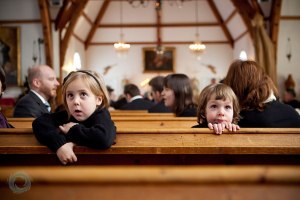
One of my challenges as a priest has been how to encourage parents who are worshiping with their children in church.  I want them to stay in church, but I also want to honor the occasional discomfort of their experience.  Of course, my opinion on this matter has changed dramatically since I became a parent, but what was once distracting noise by children in church has now become the sound of life to me.  A fellow blogger expressed this reality for me quite beautifully here.

But me telling a parent that they are welcome to stay in church does not solve much.  I cannot control the glares or the shh-es from other parishioners.  I cannot control the wave of panic that crashes over a parent when it feels like your child’s noises are as loud as a parade in a library.  I cannot even set an example because I am rarely actually in the pews with my fellow parents.  But I have experienced some of the grace that can happen when people are open to a child in church.  Back in December, I took my three-year old daughter to an ordination at the Cathedral.  She lasted relatively well for the first hour, but then became antsy.  I asked her if we should go after the peace, but she insisted she wanted to stay.  We made it back to the pew, and midway through the bishop’s praying of the Eucharistic prayer, my daughter impatiently asked, quite loudly, “Can I have the body of Christ now?!?”  Everyone around me giggled and I did too.  She broke the tension I had been feeling about her noise.  She probably voiced the fatigue that fellow worshipers around me felt too.  And she showed me that she fully understood what was happening, and was eager to receive the sacrament.  It doesn’t get more awesome than that.

I can’t force parents to stay in church with their kids.  I can’t force parishioners to always be sympathetic or even helpful.  What I can do is continue to hold all parents and children in prayer, thanking God for their presence, and the ways in which they keep me humble.  Thank you, parents, for all that you do to raise our children in the church.  We are blessed by you more than you know and always happy to have you in church.

Recent Posts

  • On the Myth and Magic of Advent…
  • On Risking Failure and Facing Fear…
  • Sermon – Luke 23.33-43, P29, YC, November 23, 2025
  • On Inhabiting Gratitude…
  • Sermon – Luke 20.27-38, P27, YC, November 9, 2025

Archives

  • December 2025
  • November 2025
  • October 2025
  • September 2025
  • August 2025
  • July 2025
  • June 2025
  • March 2025
  • February 2025
  • December 2024
  • November 2024
  • October 2024
  • September 2024
  • August 2024
  • July 2024
  • June 2024
  • May 2024
  • March 2024
  • February 2024
  • January 2024
  • December 2023
  • November 2023
  • October 2023
  • September 2023
  • August 2023
  • July 2023
  • June 2023
  • May 2023
  • March 2023
  • February 2023
  • January 2023
  • December 2022
  • November 2022
  • October 2022
  • June 2022
  • May 2022
  • January 2022
  • December 2021
  • November 2021
  • October 2021
  • September 2021
  • August 2021
  • June 2021
  • May 2021
  • April 2021
  • March 2021
  • February 2021
  • January 2021
  • December 2020
  • November 2020
  • October 2020
  • September 2020
  • August 2020
  • July 2020
  • June 2020
  • May 2020
  • April 2020
  • March 2020
  • February 2020
  • January 2020
  • December 2019
  • November 2019
  • October 2019
  • September 2019
  • August 2019
  • July 2019
  • June 2019
  • May 2019
  • April 2019
  • March 2019
  • February 2019
  • January 2019
  • December 2018
  • November 2018
  • October 2018
  • September 2018
  • August 2018
  • July 2018
  • June 2018
  • May 2018
  • April 2018
  • March 2018
  • February 2018
  • January 2018
  • December 2017
  • November 2017
  • October 2017
  • September 2017
  • August 2017
  • July 2017
  • June 2017
  • May 2017
  • April 2017
  • March 2017
  • February 2017
  • January 2017
  • December 2016
  • November 2016
  • October 2016
  • September 2016
  • August 2016
  • July 2016
  • June 2016
  • May 2016
  • April 2016
  • March 2016
  • February 2016
  • January 2016
  • December 2015
  • November 2015
  • October 2015
  • September 2015
  • August 2015
  • July 2015
  • June 2015
  • May 2015
  • April 2015
  • March 2015
  • February 2015
  • January 2015
  • December 2014
  • November 2014
  • October 2014
  • September 2014
  • August 2014
  • July 2014
  • June 2014
  • April 2014
  • March 2014
  • February 2014
  • January 2014
  • December 2013
  • November 2013
  • October 2013
  • September 2013
  • August 2013
  • July 2013
  • June 2013
  • May 2013
  • April 2013
  • March 2013
  • February 2013
  • January 2013
  • December 2012
  • November 2012
  • October 2012
  • September 2012

Categories

  • reflection
  • Sermons
  • Uncategorized

Meta

  • Create account
  • Log in
  • Entries feed
  • Comments feed
  • WordPress.com

Blog at WordPress.com.

  • Subscribe Subscribed
    • Seeking and Serving
    • Join 394 other subscribers
    • Already have a WordPress.com account? Log in now.
    • Seeking and Serving
    • Subscribe Subscribed
    • Sign up
    • Log in
    • Report this content
    • View site in Reader
    • Manage subscriptions
    • Collapse this bar
 

Loading Comments...